
- Home
- »
- Next Generation Technologies
- »
-
Philippines Contact Center Software Market Size Report, 2033GVR Report cover

Philippines Contact Center Software Market (2025 - 2033) Size, Share & Trends Analysis Report By Solution (ACD, CTI), By Services (Integration & Deployment, Support & Maintenance), By Deployment, By Enterprise Size, By End Use, And Segment Forecasts
Philippines Contact Center Software Market Summary
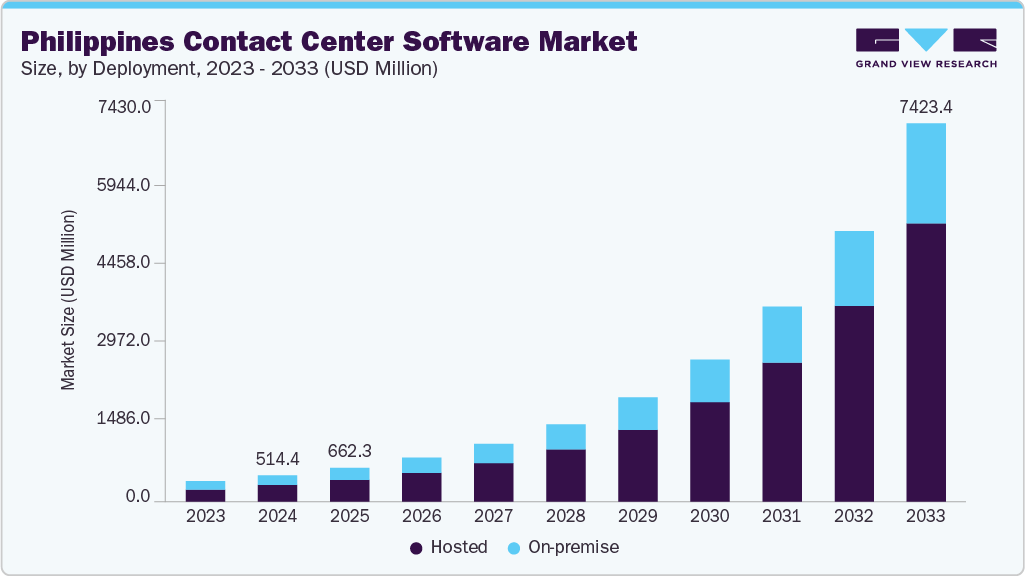
The Philippines contact center software market size was valued at USD 514.4 million in 2024 and is expected to reach USD 7,423.4 million by 2033, registering a CAGR of 35.3% from 2025 to 2033. The Philippine government's growing emphasis on improving digital customer experience (CX) in public services is becoming a key driver for the adoption of contact center software. This shift aims to enhance transparency, responsiveness, and accessibility in citizen-facing services. Multiple government-led digitalization programs have introduced the need for cloud-based communication platforms, automated workflows, and omnichannel engagement tools to manage large-scale interactions efficiently. One of the most prominent initiatives is the 8888 Citizens’ Complaint Center, launched through Executive Order No. 6 in August 2016.
 Source: Grand View Research, IR Documents, Primary Interviews, Paid DatabasesTo learn more about this report,
 Download Free Sample Report
 The Philippines' BPO sector is undergoing a strategic transformation toward omnichannel customer engagement, driven by the need to enhance customer satisfaction, streamline service delivery, and meet global client expectations across digital platforms. With a strong base of over 851 registered BPOs and 1.57 million full-time employees as of 2022 (Philippine Statistics Authority and TESDA), BPO firms are increasingly shifting from voice-centric operations to multichannel and AI-enabled service models.
Various factors, including technology advancements, regulatory frameworks, supplier strategies, and buyer preferences, are actively shaping the Philippines Contact Center Software (CCS) market. Among these, technology trends have emerged as a key catalyst for growth. Contact centers across the country are increasingly embracing AI-powered automation, where virtual assistants and chatbots are used for common inquiries, freeing up agents for high-value tasks. Cloud-native omnichannel platforms are also transforming service delivery by integrating voice, chat, email, and social media into a single interface, which is essential for managing remote and hybrid workforces. Additionally, the growing deployment of advanced analytics and real-time dashboards is enabling supervisors to monitor agent performance, customer sentiment, and service-level adherence in real time. Another notable trend is the use of speech recognition and sentiment analysis tools that enhance interaction quality and allow dynamic coaching, especially for industries like banking and healthcare, where service consistency is critical.
Growing regulatory complexity and data sovereignty requirements are posing notable challenges to the expansion of the contact center software market in the Philippines. As organizations increasingly handle sensitive personal information, the need to comply with evolving data protection laws is constraining flexibility in software deployment and cross-border data processing. At the core of this issue is the Data Privacy Act of 2012, overseen by the National Privacy Commission (NPC). This legislation mandates that entities adopt adequate data protection measures, perform privacy impact assessments, and ensure lawful processing of personal and sensitive data. More recently, the NPC issued Circular 2023-06, which outlines minimum information security standards, and Circular 2023-04, which details requirements around obtaining consent and protecting data subjects’ rights. For contact center software providers, these rules add pressure to support advanced security features such as encryption, role-based access controls, and full audit trails. However, not all legacy or foreign-hosted platforms are equipped to meet these obligations out of the box.
Solution Insights
The interactive voice response segment held a revenue share of 19.0% in 2024. IVR adoption is being reinforced by rising customer expectations for 24/7 service availability, the expanding digital transformation of enterprise operations, and efforts to minimize call handling times. Institutions are implementing speech-enabled IVRs that support both English and Filipino, allowing for better engagement with the country’s diverse customer base. Also, the use of IVR systems for multilingual self-service has proven effective in increasing accessibility and reducing inbound pressure on agents. All such factors, along with the growing need to manage growing call volumes while maintaining service quality, are further supporting the segment growth.
The workforce optimization segment is expected to witness the highest growth rate of 40.6% over the forecast period. Workforce optimization has become a strategic imperative for contact centers in the Philippines as providers aim to boost productivity, reduce operational costs, and deliver consistent service quality across multiple shifts and geographies. The growing adoption of hybrid work models, increased client expectations for measurable performance, and the complexity of managing large, distributed teams are key drivers behind this trend. Philippine contact centers are now deploying advanced workforce management platforms, AI-powered scheduling tools, and real-time agent analytics to improve staffing efficiency and performance outcomes.
Service Insights
The integration & deployment segment dominated the market in 2024 with a share of 42.3%. Integration and deployment capabilities have become central to the modernization of Philippine contact centers, especially as operators transition to modular, cloud-based ecosystems. With the increasing adoption of CRM, WFM, IVR, and AI-driven platforms, contact centers require seamless interoperability across tools to ensure consistent service delivery, data flow, and business continuity. The segment is driven by growing demand for faster go-live timelines, reduced vendor lock-in, and centralized visibility across hybrid environments.
The managed services segment is expected to witness the fastest growth over the forecast period. As the complexity of contact center environments increases, managed service providers are playing a critical role in ensuring business continuity, reducing incident resolution times, and enabling agile responses to shifting operational demands. The adoption of managed services is being driven by increasing platform complexity due to the integration of omnichannel communication tools, rising demand for 24/7 system availability from offshore clients, accelerating migration to cloud-based environments, and limited in-house IT capacity among mid-sized BPOs.
Deployment Insights
The hosted segment dominated the market in 2024 with a share of 63.3%. By leveraging hosted contact center models, Filipino service providers are increasing operational agility, reducing IT overhead, and ensuring business continuity in both domestic and offshore service delivery. Hosted contact center deployments are managed by external data center providers and enable contact centers to operate with reduced hardware dependency, lower upfront costs, and easier access to system upgrades and security enhancements.
The on-premise segment is expected to witness significant growth over the forecast period. On-premise deployment continues to be a strategic choice for contact centers in the Philippines that manage sensitive transactions, operate under strict compliance frameworks, or require operational continuity in regions with unstable internet infrastructure. This deployment model allows organizations to retain full control over their data, ensure internal security protocols, and meet the audit requirements set by domestic regulatory bodies.
Enterprise Size
The large enterprise segment dominated the market in 2024 with a share of 56.9%. Companies in the market are increasingly focusing on enhancing operational resilience, expanding multilingual capabilities, and meeting sector-specific regulatory demands through modernized service delivery models. This trend is being driven by the rising complexity of global customer engagement, growing compliance requirements from industries such as banking, telecommunications, and healthcare, and the need to consolidate disparate customer service platforms into unified, agile ecosystems.
The small & medium enterprise (SME) segment is expected to witness the fastest growth of 37.1% over the forecast period. The SMEs segment in the Philippines has been witnessing steady expansion, supported by the growing need for structured customer communication, enhanced digital responsiveness, and scalable service models. Solutions provided by firms such as Aria Telecom and Ameyo have been tailored to meet the evolving requirements of Philippine SMEs. Aria Telecom offers dialer and ACD solutions with flexible licensing models, while Ameyo enables omnichannel customer support that includes voice, web chat, and social messaging, along with built-in reporting tools. These systems are increasingly being deployed by SMEs requiring multilingual capabilities, low-latency communication infrastructure, and seamless CRM integrations.
End Use Insights
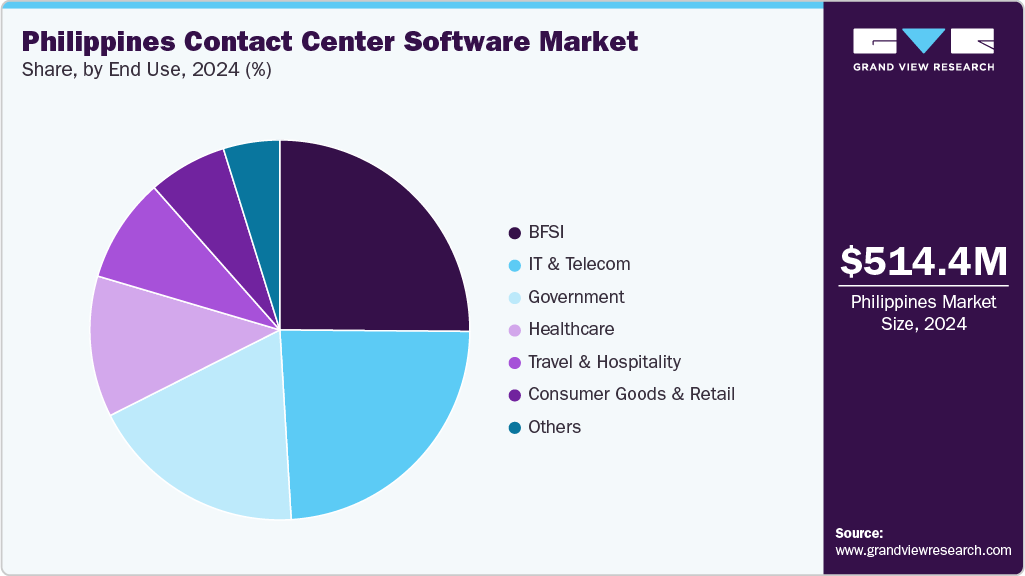
The BFSI segment led the market and accounted for more than 25% of the revenue in 2024. BFSI service providers are under increasing pressure to modernize customer engagement while ensuring adherence to anti-fraud and data protection standards. As a result, cloud-based solutions with embedded risk controls, remote agent functionality, and multilingual support are becoming standard in the market. To address these evolving demands, local and international vendors are forming sector-specific partnerships and scaling operations. For instance, in February 2024, Call Center Studio partnered with RGS Global Solutions, a leading banking collections firm in the Philippines. The collaboration is focused on delivering scalable, remote-ready contact center software designed to support outbound collections, customer authentication, and compliance-driven workflows across banking and financial accounts. This reflects growing demand for flexible and efficient customer service infrastructure within the collections and receivables space.
 To learn more about this report, Download Free Sample Report
 The consumer goods & retail segment is expected to witness the fastest growth over the forecast period in the Philippines contact center software market. The adoption of modern contact center software in the Philippines' consumer goods and retail sector is being driven by the increasing complexity of customer engagement channels, rising expectations for seamless service delivery, and heightened demand for real-time issue resolution during peak shopping periods. Additionally, the need for multilingual and culturally contextual support has become critical as both domestic and regional customer bases expand.
Key Philippines Contact Center Software Company Insights
Key players operating in the Philippines contact center software market are undertaking various initiatives to strengthen their presence and increase the reach of their products and services. Strategies such as expansion activities and partnerships are key in propelling the market growth.
Key Philippines Contact Center Software Companies:
- Genesys
- Avaya LLC
- Cisco Systems, Inc.
- Five9, Inc.
- NiCE
- Talkdesk
- Ameyo
- AVOXI
- 8x8, Inc.
- Zendesk
Three ways to get this report
Buy it, customize it, or ask a question.Ask an Analyst
Analyst response in 1 business day
- AccessReport author, directly
- Reply timeWithin 1 working day
- No sales callDirect answer only
- FormatEmail reply
- CostFree, no cost
Get the Full Report
What the study covers
- FormatsPDF · Excel · Dashboard
- Timeline2025–2033 annual, 2024 base
- Coverage20+ countries, 5 regions
- Companies10+ key players profiled
Customize the Report
20% free customization
- IncludeCountries, segments, points
- TailorTo your product definition
- ExtendDeeper competitor detail
- OrA fully bespoke study
- Turnaround5–10 working days
Recent Developments
-
In February 2025, Talkdesk expanded its Asia-Pacific cloud infrastructure by launching a new regional cloud (hosted in Australia) for APAC customers. Talkdesk has dedicated local teams, including one in the Philippines, and a broad partner ecosystem to support regional clients. This ensures Philippine companies can host Talkdesk’s AI-powered contact-center platform onshore (for data compliance and performance) with local support available.
-
In December 2024, Cisco’s Webex Contact Center became available for the Philippines via its Singapore-hosted APAC cloud region. This deployment offers local hosting options for Philippine enterprises, improving service reliability, data governance, and latency. It supports organizations in transitioning to cloud-based contact center operations while maintaining regional compliance.
-
In November 2023, Tonik Digital Bank, Inc., the Philippines’ first licensed neobank, officially went live on Genesys Cloud. This strategic partnership enables Tonik to leverage the AI-powered capabilities of Genesys’ leading contact center platform to deliver a seamless, personalized, and omnichannel digital banking experience. By integrating advanced automation, intelligent routing, and real-time analytics, Tonik can enhance customer engagement, streamline support operations, and provide faster, more efficient service across voice, chat, and digital channels.
Philippines Contact Center Software Market Report Scope
Report Attribute
Details
Market size value in 2025
USD 662.3 million
Revenue forecast in 2033
USD 7,423.4 million
Growth rate
CAGR of 35.3% from 2025 to 2033
Base year for estimation
2024
Historical data
2021 - 2024
Forecast period
2025 - 2033
Quantitative units
Revenue in USD million/billion and CAGR from 2025 to 2033
Report coverage
Revenue forecast, company ranking, competitive landscape, growth factors, and trends
Segments covered
Solution, service, deployment, enterprise size, end use
Key companies profiled
Genesys; Avaya LLC; Cisco Systems, Inc.; Five9, Inc.; NiCE; Talkdesk; Ameyo; AVOXI; 8x8, Inc.; Zendesk
Customization scope
Free report customization (equivalent up to 8 analysts working days) with purchase. Addition or alteration to country, regional & segment scope.
Pricing and purchase options
Avail customized purchase options to meet your exact research needs. Explore purchase options
Philippines Contact Center Software Market Report Segmentation
This report forecasts revenue growth at the country level and provides an analysis of the industry trends in each of the sub-segments from 2021 to 2033. For this study, Grand View Research has segmented the Philippines contact center software market report based on solution, service, deployment, enterprise size, and end use.
-
Solution Outlook (Revenue, USD Million, 2021 - 2033)
-
Automatic Call Distribution (ACD)
-
Call Recording
-
Computer Telephony Integration (CTI)
-
Customer Collaboration
-
Dialer
-
Interactive Voice Responses (IVR)
-
Reporting & Analytics
-
Workforce Optimization
-
Others
-
-
Services Outlook (Revenue, USD Million, 2021 - 2033)
-
Integration & Deployment
-
Support & Maintenance
-
Training & Consulting
-
Managed Services
-
-
Deployment Outlook (Revenue, USD Million, 2021 - 2033)
-
Hosted
-
On-premise
-
-
Enterprise-size Outlook (Revenue, USD Million, 2021 - 2033)
-
Large Enterprise
-
Small & Medium Enterprise
-
-
End Use Outlook (Revenue, USD Million, 2021 - 2033)
-
BFSI
-
Consumer Goods & Retail
-
Government
-
Healthcare
-
IT & Telecom
-
Travelling & Hospitality
-
Others
-
Frequently Asked Questions About This Report
The Philippines contact center software market size was estimated at USD 514.4 million in 2024 and is expected to reach USD 662.3 million by 2025.
The Philippines contact center software market is expected to grow at a compound annual growth rate of 35.3% from 2025 to 2033 and is expected to reach USD 7,423.4 million by 2033.
In the Philippines contact center software market, the solution segment dominated the market with a 67.1% share in 2024, primarily driven by the growing demand for omnichannel communication platforms, advanced analytics, workforce optimization, and AI-driven automation that enhance customer engagement and operational efficiency.
Some of the key players are Genesys; Avaya LLC; Cisco Systems, Inc.; Five9, Inc.; NiCE; Talkdesk; Ameyo; AVOXI; 8x8, Inc.; and Zendesk
The Philippines contact center software market is driven by the country’s strong BPO industry, rapid adoption of cloud-based and AI-driven solutions, rising demand for omnichannel customer engagement, and the shift to remote work models.
About the Author(s)
Next Generation Technologies Research Team
Technology · Next Generation TechnologiesThis report was authored by the next generation technologies research team at Grand View Research - comprising two research analysts, one senior research analyst, and one industry expert - with specialized expertise in the next generation technologies segment of the technology industry. All findings are based on proprietary technology databases, executive interviews, and regulatory analysis, subject to internal peer review prior to publication.
Last Updated:
Speak to Analyst

Customize this report to your needs - add regions, segments, or data points, with 20% free customization.
Or view our licence options:


ISO 9001:2015 & 27001:2022 Certified
We are GDPR and CCPA compliant! Your transaction & personal information is safe and secure. For more details, please read our privacy policy.


