
- Home
- »
- Medical Devices
- »
-
Philippines Death Care Market Size, Industry Report, 2033GVR Report cover
![Philippines Death Care Market Size, Share & Trends Report]()
Philippines Death Care Market (2026 - 2033) Size, Share & Trends Analysis Report By Service (Funeral Homes / Directors / Crematorium, Funeral Planning Services), By Payment Model, By Distribution Channel, By Operator Type, By Pricing Tier, By Region, And Segment Forecasts
- Report ID: GVR-4-68040-863-7
- Number of Report Pages: 100
- Format: PDF
- Historical Range: 2021 - 2025
- Forecast Period: 2026 - 2033
- Industry: Healthcare
- Report Summary
- Table of Contents
- Segmentation
- Methodology
- Download FREE Sample
-
 Download Sample Report
Philippines Death Care Market Summary
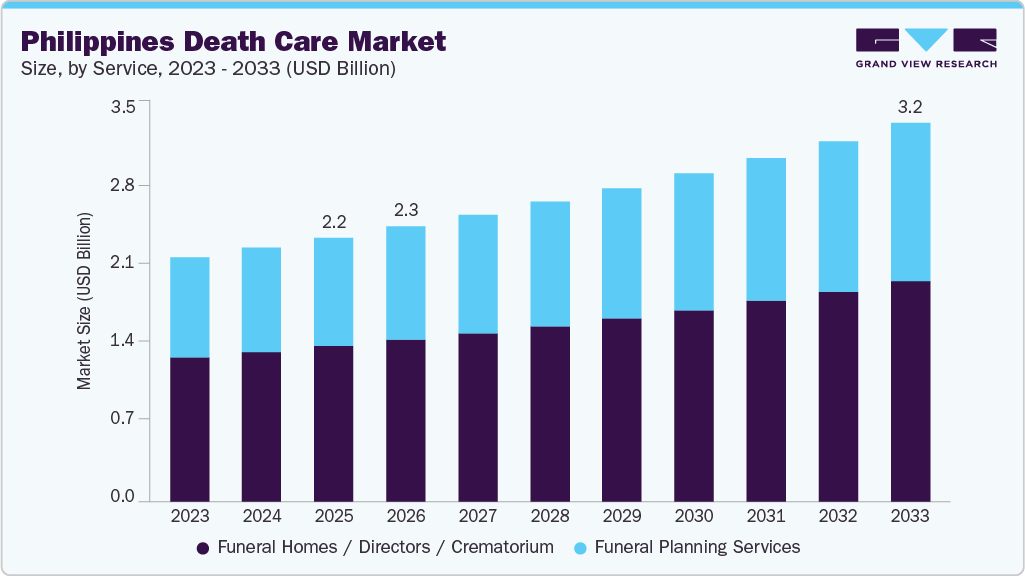
The Philippines death care market size was valued at USD 2.24 billion in 2025 and is expected to reach USD 3.21 billion by 2033, growing at a CAGR of 4.66% from 2026 to 2033. The growth of the market is driven by the growing demand for professional funeral and end-of-life services and increasing demand for pre-need funeral plans, insurance products, and burial financing solutions. This awareness encourages individuals to plan, reduce the financial burden on their loved ones, and ensurelessen the financial load on their loved ones, and make surereduce the financial burden on their loved ones, and ensure their final wishes are honored. In addition, demographic shifts, including an aging population and increasing urbanization, are further supporting the market expansion.
Rising demand for professional funeral and end-of-life services:
Rising demand for professional funeral and end-of-life services is primarily driving the market as urbanization, changing lifestyles, and economic considerations push families toward formal service providers for funerals, cremation, and planning. According to the Philippine Statistics Authority article published in January 2026, total registered deaths rose by 1% year-on-year to 701,884 in 2024, resulting to 1,918 deaths per day, or nearly one death per minute. While the crude death rate remained stable at 6.2 per 1,000 population, the long-term trend is more significant. Over the past decade, registered deaths increased by 25.2%, reflecting population growth, demographic aging, and improved death registration systems. This sustained rise in mortality volumes directly increases demand for professional funeral, burial, cremation, and memorial services, as families require timely, organized, and compliant end-of-life arrangements.
With increasing deaths per day across the country, families often seek the logistical and administrative help of professional providers to manage documentation, embalming, transport, and ceremonial arrangements tasks that can be complex and stressful without expert support. The growing popularity of cremation over traditional burials, partly due to scarcity in cities and changing preferences, has also led more families to rely on specialized services that handle the unique requirements of cremation and inurnment. Pre-need funeral plans and comprehensive packages offered by companies such as St. Peter Life Plan and others are gaining traction as Philippines increasingly recognize the value of planning ahead to reduce financial and emotional burdens on relatives when a death occurs. These instances illustrate both the increase in demand for structured end-of-life services and how the market is adapting to meet evolving needs of consumers in the Philippines.
Increasing demand for pre-need funeral plans, insurance products and burial financing solutions:
The increasing demand for pre‑need funeral plans, insurance products, and burial financing solutions is a key growth driver for the market as more Philippines families are recognizing the financial and emotional benefits of planning ahead for end‑of‑life expenses. Pre-need plans and related insurance products enable individuals to arrange and finance funeral and burial services in advance, relieving family members of unexpected financial burdens and guaranteeing that final wishes are fulfilled without added stress. This shift toward proactive planning provides stable, predictable revenue for death care providers and expands the overall market for funeral services, cremation options, and related products.
Firms such as NewLife Memorial Plan and St. Peter Life Plan Inc. are offering structured, installment‑based pre‑need funeral packages that include services such as embalming, caskets, chapel use, cremation, and insurance coverages, making it easier for families to budget for these costs over time. In addition, the Department of Social Welfare and Development (DSWD) in the Philippines is rolling out a free funeral aid program to help low-income and crisis-affected families afford dignified end-of-life services for their loved ones. This initiative stems from the passage of the Free Funeral Services Act (Republic Act No. 12309), which lapsed into law in September 2025 and mandates that the government provide funeral support to indigent families and those affected by disasters or emergencies who cannot afford burial or cremation costs. By removing financial barriers to basic funeral services, the program aims to ensure that even the most economically disadvantaged Filipino families can give their loved ones a proper and respectful farewell without undue burden. These developments illustrate how both traditional pre‑need plans and newer insurance‑based options are gaining traction as Philippines consumers increasingly seek to manage funeral expenses proactively and protect their families financially.
Growing cultural & religious shifts:
A growing shift in cultural and religious practices in the Philippines is becoming an important driver of the market, as traditional funeral and burial practices evolve, leading to increased demand for new services and products. Previously, burial in a family plot with extended wakes was the dominant custom, deeply rooted in Catholic and indigenous traditions. However, rising urbanization, space constraints in cities, and greater economic pressures are encouraging many families, especially in urban centers, to consider cremation as a more practical and affordable alternative to traditional burials. For instance, cremation acceptance in the Philippines is increasing, driven by cost‑effectiveness (cremation is often significantly cheaper than burial) and reduced land requirements compared to traditional cemetery interment.
Religious perspectives have shifted, as the Catholic Church once opposed to cremation, now permits it under faith-respecting conditions, increasing its social acceptance among Philippine Catholics. At the same time, environmental awareness is pushing interest toward eco‑friendly and alternative memorialization practices, such as green burials or biodegradable urns, reflecting how cultural values (such as environmental stewardship) are reshaping preferences in end‑of‑life care.
Together, these cultural and religious shifts expand market opportunities by creating demand for diversified offerings such as cremation services, columbarium niches, eco‑friendly burial options, and personalized memorial experiences that traditional death care providers can develop to meet evolving consumer expectations.
Case Study published by MDPI AG (Basel, Switzerland) in April 2025: Influence of New Religious Movements on the Philippines Death Care Market
Background:
The Philippines, with a population of over 116 million, is traditionally a deeply Catholic country, with approximately 80% of the population adhering to Catholicism. However, in recent decades, New Religious Movements (NRMs) such as Iglesia ni Cristo (INC), Jesus Is Lord Church (JIL), El Shaddai, and the Kingdom of Jesus Christ (KOJC) have emerged, gaining significant followings (comprising around 11% of the population). These movements have introduced modernized religious practices, flexible rituals, and active grassroots engagement, in contrast to the hierarchical, traditional structure of Catholicism.
Drivers for Market:
-
Changing Funeral Preferences: NRMs emphasize practical, temporal, and community-oriented rituals. Followers often prefer personalized funeral services, including flexible memorials, modernized rituals, and alternative burial or cremation practices that align with their faith.
-
Urbanization and Space Considerations: Many NRM followers reside in urban areas where traditional cemetery space is limited. NRMs’ emphasis on practicality supports cremation services, columbarium niches, and memorial halls, increasing demand in urban death care markets.
- Cultural Acceptance of Alternative Services: Unlike traditional Catholicism, which historically emphasized elaborate wakes and burials, NRMs are more open to modern death care options, including eco-friendly or simplified services, making innovative death care offerings more acceptable.
Instances Supporting Market Impact:
-
Iglesia ni Cristo (INC): With its highly organized structure and strong community networks, INC followers increasingly utilize dedicated community memorial services and columbarium niches, reflecting a shift from traditional cemetery burials.
-
Jesus Is Lord Church (JIL): The church’s outreach to overseas Filipino workers (OFWs) has fostered demand for personalized funeral arrangements abroad and memorial services for families with transnational ties.
-
El Shaddai Movement: By integrating Prosperity Theology, El Shaddai encourages followers to invest in high-quality funeral services as part of legacy planning, contributing to demand for premium memorial products and pre-need plans.
Market Implications:
The rise of NRMs has diversified religious practices and reformed consumer preferences in the death care market, encouraging providers to offer flexible, culturally sensitive, and modernized funeral services. Businesses that adapt to these evolving demands, such as columbaria, cremation services, and eco-friendly memorial options, capitalize on this growing segment, particularly in urban and OFW-influenced markets.
Conclusion:
New Religious Movements in the Philippines act as cultural and religious drivers in the market, fostering acceptance of modernized, personalized, and alternative funeral services. By understanding the beliefs, rituals, and community networks of NRMs, death care providers can strategically tailor offerings to meet the evolving needs of a diversifying religious population.
Market Concentration & Characteristics
The market is fragmented, with many small players entering the market and launching new innovative services. There is a high degree of innovation, moderate level of merger & acquisition activities, high impact of regulations, and moderate expansion of industry.
The market is changing. This shift is due to changing consumer preferences and the use of advanced technologies. Providers are now offering more than traditional funeral services such as online memorial platforms, virtual funeral arrangements, and digital planning tools. These tools help organize end-of-life services and make it easier for customers. Digital obituaries and remote consultations meet modern consumer needs. Moreover, eco-friendly, and personalized options, such as biodegradable caskets, green burial choices, and customized memorial packages, are becoming popular. This trend reflects a move away from traditional practices toward more meaningful service experiences.
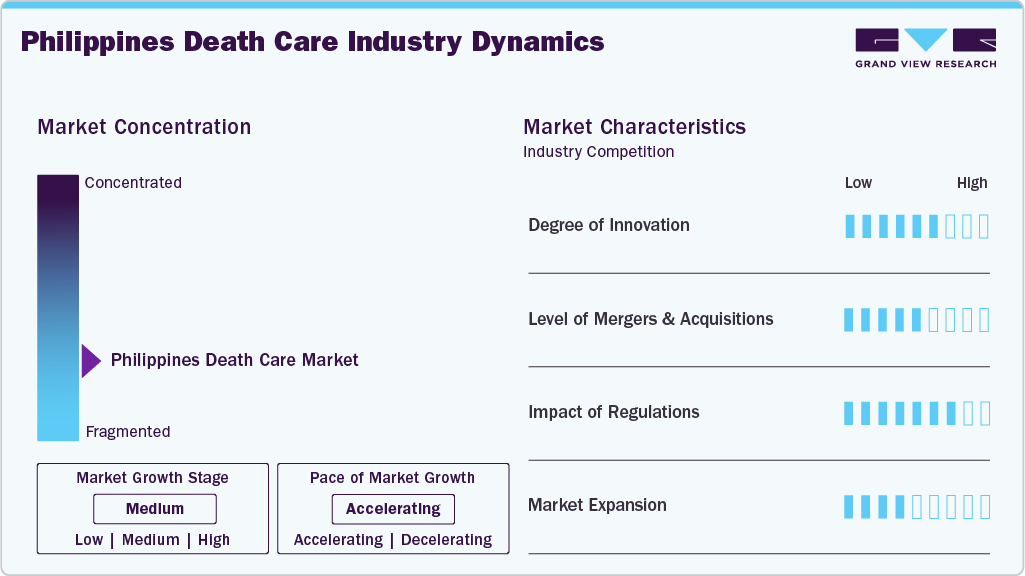
Although the industry remains fragmented and focused on local needs compared to some West markets, partnerships and collaborations are becoming important for growth. For instance, death care companies have formed partnerships to combine services, such as pre-need funeral plans, memorial plots, and improved service packages to expand their presence in the region. The trend highlights a shift toward cooperation that strengthens competitive positions and service coverage. In addition, larger memorial park operators and death care service providers are expanding their reach through property acquisitions or new site developments. This indicates a move toward early consolidation and efforts to scale regionally.
Regulatory frameworks in the Philippines influence how death care services operate, especially in terms of health, sanitation, and local standards. The Department of Health (DOH) has sanitation rules that govern the handling of deceased individuals and the operation of funeral establishments. These rules include licensing for embalmers, health and sanitation guidelines, and protocols for handling to ensure public safety. At the national level, legislation such as Republic Act provisions includes measures to monitor funeral service pricing and ensure fair fees for death care services, including oversight of casket and urn prices.
Market players are actively broadening their service offerings and geographic reach to meet the increasing demand for funeral, cremation, and memorial services. Established funeral homes, such as Cosmopolitan Funeral Homes, Inc., recently opened new branches and launched affordable life plan options. These plans bundle core services, such as retrieval, embalming, viewing, and hearse transport, with insurance components to attract a wider range of customers. Collaborative efforts among death care providers, such as integrating pre-need and memorial packages, aim to simplify planning for families and improve access to quality death care solutions in local communities.
Service Insights
The funeral homes / directors / crematorium segment dominated the market with the largest revenue share in 2025. The growth of the segment in the industry is primarily driven by population growth, urbanization, and changing cultural and religious practices. Rapid urban development and limited burial space in highly populated areas such as Metro Manila and Cebu have increased demand for cremation services and columbarium’s as space-efficient alternatives to traditional burials. Rising awareness of professional death care services, along with increasing disposable incomes among middle-class families, is encouraging the shift from informal, home-based wakes to organized funeral homes that offer complete end-of-life solutions.
The funeral planning services segment is anticipated to grow at a lucrative CAGR during the forecast period. This is driven by deep-rooted cultural and religious practices, particularly the predominantly Catholic faith, which emphasizes wakes, novenas, and formal burial rites as essential expressions of respect for the deceased. Family-centric values and close community ties further reinforce the preference for traditional services, as extended wakes and memorial gatherings provide space for collective mourning and social support. The country’s growing and aging population, along with steady urbanization, has increased demand for organized funeral homes that can manage complex rituals, logistics, and documentation.
Payment Model Insights
The at-need funeral services segment held the largest market share in 2025. The demand for at-need funeral services is primarily driven by the sudden and unpredictable nature of death, which leaves many families unprepared to make advance funeral arrangements. Strong cultural and religious traditions emphasize immediate and proper burial rites often within a short timeframe prompting families to seek comprehensive, ready-to-deploy funeral services at the time of need. In addition, limited awareness and adoption of pre-need plans, especially among lower and middle-income households, push consumers toward at-need services when a death occurs.
The pre-paid funeral plans segment is projected to grow at highest CAGR during the forecast period. The growth of the segment in the Philippines death care market is primarily driven by strong cultural emphasis on family responsibility, financial preparedness, and dignity in death. Many Philippine families prefer pre-need funeral plans to avoid the sudden financial burden and emotional stress associated with arranging funerals, which is costly and immediate. Rising funeral expenses, coupled with limited savings among middle and lower-income households, make installment-based pre-paid plans an attractive and manageable option.
Distribution Channel Insights
The online segment held the largest market share in 2025 and is expected to grow at a highest CAGR during the forecast period. The growth of online distribution channels for death care services in the Philippines is primarily driven by increasing digital adoption, convenience, and changing consumer behavior. With high internet and smartphone penetration, Philippine families are increasingly turning to online platforms to research funeral packages, compare prices, and arrange services remotely, especially during emotionally stressful periods. The rise of e-wallets, online banking, and installment-based digital payments has further enabled seamless transactions for funeral plans and memorial services. Moreover, urbanization and overseas Philippine workers play a key role, as families often need to coordinate death care arrangements from different locations or abroad, making online platforms a practical solution.
The offline segment is expected to witness a substantial growth during the forecast period. The growth of offline distribution channels is primarily driven by the deeply personal, emotional, and time-sensitive nature of funeral arrangements. Families generally prefer face-to-face interactions when making end-of-life decisions, as these allow for empathy, guidance, and immediate reassurance during periods of grief. Cultural and religious traditions strongly influenced by Catholic practices also necessitate physical locations such as funeral homes, chapels, memorial parks, and churches, reinforcing the importance of offline service delivery.
Operator Type Insights
The independent / local players segment held the largest share of 59.6% in 2025. The growth is primarily driven by strong community ties, cultural familiarity, and affordability. These operators often have deep-rooted relationships within local communities, enabling them to offer personalized services that align closely with Philippines traditions, religious practices, and family-centered mourning customs. Their flexible business models allow them to adapt rapidly to local preferences, provide customized funeral packages, and maintain competitive pricing, an important factor in a price-sensitive market.
The standalone funeral homes and crematoriums segment is expected to witness the fastest growth during the forecast period. The growth of the segment is driven by a combination of urbanization, space constraints, and evolving consumer preferences. Rapid urban growth, particularly in Metro Manila and other highly populated cities, has led to limited land availability and rising costs for traditional burial plots, making standalone crematoriums a more practical and space-efficient alternative.
Pricing Tier Insights
The standard/core services segment held the largest market share of 45.3% in 2025 and is expected to witness the fastest growth during the forecast period. This growth is primarily driven by the country’s strong price sensitivity, middle-income population base, and cultural emphasis on dignified yet affordable funeral rites. The presence of life plan providers and installment-based pre-need funeral plans further reinforces demand for standardized service packages, as these plans are designed to be financially accessible and widely applicable. For instance, pre-need funeral plans by major providers such as St. Peter Life Plan, Forest Lake Life Plans, and Cosmopolitan CLIMBS focus heavily on standardized funeral packages.
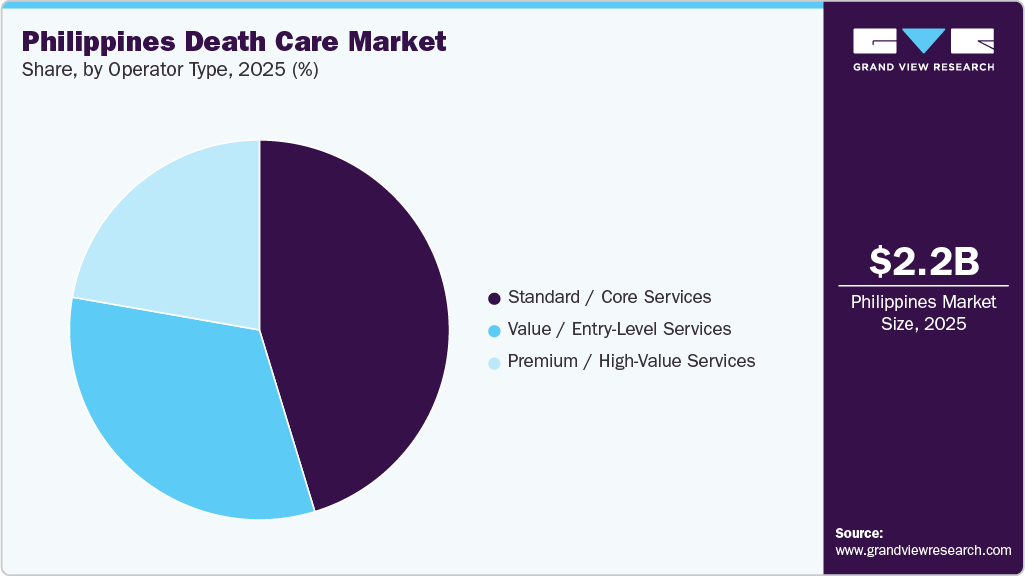
The value/entry-level services segment is expected to witness lucrative growth during the forecast period. This is driven by price sensitivity among a large portion of the population, where funeral expenses are often paid out-of-pocket and household incomes remain moderate. Many families seek dignified yet affordable funeral solutions that meet cultural and religious expectations without excessive financial burden. This demand has encouraged providers to offer basic service packages, flexible payment plans, and memorial life plans that spread costs over time.
Regional Insights
The Luzon region held the largest market share of 60.4% in 2025 and is expected to grow at a highest CAGR during the forecast period. The demand for death care services in Luzon is primarily driven by its large and aging population, rapid urbanization, and increasing pressure on land availability, particularly in Metro Manila and nearby provinces. For instance, as per City Population, Central Luzon’s population of 12,989,074 as of 2024 underscores its importance as one of the most densely populated and rapidly developing regions in the Philippines.
The Visayas region is expected to witness substantial growth over the forecast period. The rise in suicide-related deaths in Eastern Visayas highlights a growing public health and social concern that has broader implications for death care services in the region. The Department of Health report published in September 2024, more than 95 suicide deaths in 2023, nearly double the figure recorded in 2022, along with police data showing over 204 cases across six provinces, underscores increasing mental health challenges linked to economic stress, social isolation, and limited access to mental health support. From a death care perspective, this trend contributes to higher demand for immediate funeral, embalming, and memorial services, often under emotionally complex and sudden circumstances.
Key Philippines Death Care Company Insights
Key companies in the Philippines death care market include St. Peter Group, Manila Memorial Park, Inc., Loyola Memorial Chapels & Crematorium, Inc., and Arlington Memorial Chapels & Crematory are among the leading players, supported by strong brand recognition, nationwide or multi-regional presence, and comprehensive offerings that include funeral services, cremation, memorial parks, and pre-need plans. Companies such as St. Peter Group, Golden Future, PHILPLANS FIRST, INC., and Cosmopolitan Funeral Chapel are actively expanding their footprints through new branch openings, partnerships with memorial parks, and investments in cremation and columbarium facilities to cater to rising urban demand.
Key Philippines Death Care Companies:
- St. Peter Group
- Golden Future
- PHILPLANS FIRST, INC.
- Loyola Memorial Chapels & Crematorium, Inc.
- Ever Memorial Garden
- ARLINGTON MEMORIAL CHAPELS & CREMATORY
- The Evergreen Chapels & Crematory
- Everest Memorial Services
- Cosmopolitan Funeral Chapel
- Manila Memorial Park, Inc.
Recent Developments
-
In May 2025, PhilPlans announced its plans to introduce more affordable memorial plans specifically tailored for younger generations such as Generation Z and millennials in the workforce as part of its broader strategy to grow sales.
-
In July 2024, the Dychangco Group, through its subsidiaries Cosmopolitan Funeral Homes, Inc. (CFHI) and Cosmopolitan CLIMBS Life Plans, Inc. (CCLPI), opened a new funeral care facility in Cordova to strengthen and modernize death care services in Lapu-Lapu City and the wider Cordova area.
Philippines Death Care MarketReport Scope
Report Attribute
Details
Revenue forecast in 2033
USD 3.21 billion
Growth rate
CAGR of 4.66% from 2026 to 2033
Actual data
2021 - 2025
Forecast data
2026 - 2033
Quantitative units
Revenue in USD million/billion, volume in units, and CAGR from 2026 to 2033
Report coverage
Revenue forecast, company ranking, competitive landscape, growth factors, and trends
Segments covered
Service, payment model, distribution channel, operating type, pricing tier, region
Country scope
Philippines
Key companies profiled
St. Peter Group; Golden Future; PHILPLANS FIRST, INC.; Loyola Memorial Chapels & Crematorium, Inc.; Ever Memorial Garden; ARLINGTON MEMORIAL CHAPELS & CREMATORY; The Evergreen Chapels & Crematory; Everest Memorial Services; Cosmopolitan Funeral Chapel; Manila Memorial Park, Inc.
Customization scope
Free report customization (equivalent up to 8 analysts working days) with purchase. Addition or alteration to country, regional & segment scope.
Pricing and purchase options
Avail customized purchase options to meet your exact research needs. Explore purchase options
Philippines Death Care Report Market Report Segmentation
This report forecasts revenue growth, country level and provides an analysis of the latest industry trends in each of the sub-segments from 2021 to 2033 For this study, Grand View Research has segmented the Philippines death care market report based on service, payment model, distribution channel, operator type, pricing tier, and region.
-
Service Outlook (Revenue, USD Billion; Volume, Units; 2021 - 2033)
-
Funeral Homes / Directors / Crematorium
-
Traditional Funeral Services
-
Cremation Services
-
Green/Environmental Funerals
-
Pre-planned/Pre-paid Funeral Services
-
-
Funeral Planning Services
-
Memorial Services
-
Green / Sustainable Burial Products and Services
-
Direct Cremation
-
Other Services
-
-
-
Payment Model Outlook (Revenue, USD Billion; Volume, Units; 2021 - 2033)
-
Pre-paid Funeral Plans
-
At-need Funeral Services
-
-
Distribution Channel Outlook (Revenue, USD Billion; Volume, Units; 2021 - 2033)
-
Online
-
Offline
-
-
Operator Type Outlook (Revenue, USD Billion; Volume, Units; 2021 - 2033)
-
Independent / Local Players
-
Standalone Funeral Homes / Crematoriums
-
Regional Chains
-
Integrated Operators
-
-
Pricing Tier Outlook (Revenue, USD Billion; Volume, Units; 2021 - 2033)
-
Value / Entry-level Services
-
Standard / Core Services
-
Premium / High-value Services
-
-
Region Outlook (Revenue, USD Billion; Volume, Units; 2021 - 2033)
-
Luzon
-
National Capital Region
-
Manila
-
Quezon
-
Makati
-
Pasay
-
Rest of NCR
-
-
Rest of Luzon
-
-
Visayas
-
Mindanao
-
Frequently Asked Questions About This Report
b. The Philippines death care market size was estimated at USD 2.24 billion in 2025 and is expected to reach USD 2.34 billion in 2026.
b. The Philippines death care market is expected to grow at a compound annual growth rate of 4.66% from 2026 to 2033 to reach USD 3.21 billion by 2033.
b. Luzon dominated the Philippines death care market with a share of 60.4% in 2025. The demand for death care services in Luzon is primarily driven by its large and aging population, rapid urbanization, and increasing pressure on land availability.
b. Some key players operating in the Philippines death care market include St. Peter Group, Golden Future, PHILPLANS FIRST, INC., Loyola Memorial Chapels & Crematorium, Inc., Ever Memorial Garden, ARLINGTON MEMORIAL CHAPELS & CREMATORY, The Evergreen Chapels & Crematory, Everest Memorial Services, Cosmopolitan Funeral Chapel, Manila Memorial Park, Inc.
b. The growth of the market is driven by the growing demand for professional funeral and end-of-life services and increasing demand for pre-need funeral plans, insurance products, and burial financing solutions.


Share this report with your colleague or friend.
Need a Tailored Report?
Customize this report to your needs — add regions, segments, or data points, with 20% free customization.


ISO 9001:2015 & 27001:2022 Certified
We are GDPR and CCPA compliant! Your transaction & personal information is safe and secure. For more details, please read our privacy policy.
Trusted market insights - try a free sample
See how our reports are structured and why industry leaders rely on Grand View Research. Get a free sample or ask us to tailor this report to your needs.













