
- Home
- »
- Petrochemicals
- »
-
Phosphoric Acid Market Size, Share & Trends Report, 2033GVR Report cover

Phosphoric Acid Market (2026 - 2033)
Size, Share & Trends Analysis Report By Application (Diamonium Hydrogenphosphate (DAP), Monoammonium Dihydrogenphosphate (MAP), Triple Superphosphate (TSP), Other Fertilizers), By Region, And Segment Forecasts
Market Size, 2025
$45.8BMarket Estimate, 2026
$47.6BMarket Forecast, 2033
$63.6BCAGR, 2026–2033
4.2%Phosphoric Acid Market Summary
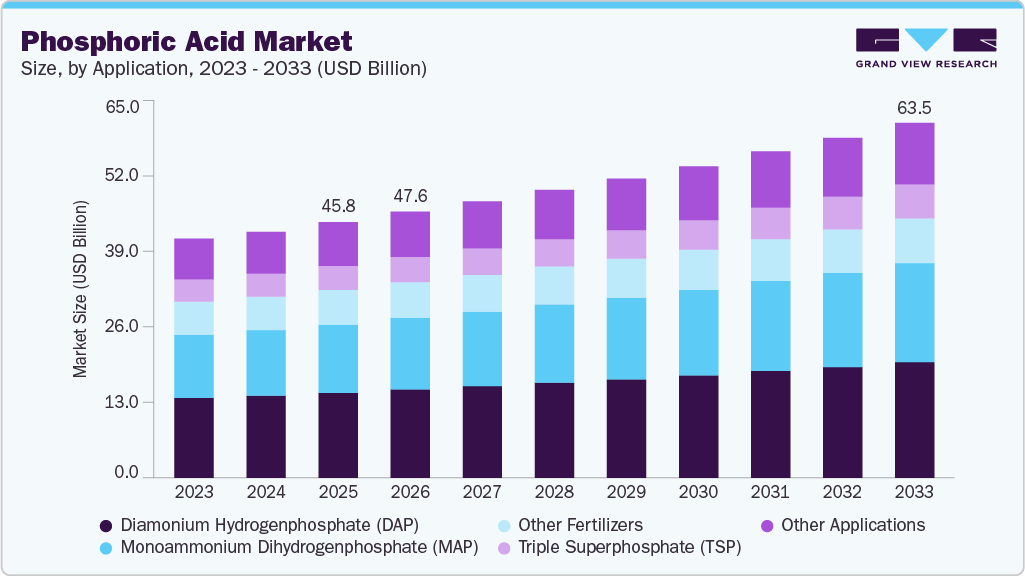
The global phosphoric acid market size was valued at USD 45.8 billion in 2025 and is projected to grow from USD 47.6 billion in 2026 to USD 63.6 billion by 2033, at a CAGR of 4.2% from 2026 to 2033.Asia Pacific dominated the market, accounting for a revenue share of 50.0% in 2025. As the world population grows and dietary patterns evolve, agricultural producers are under pressure to increase crop yields.
 Source: Grand View Research, IR Documents, Primary Interviews, Paid DatabasesTo learn more about this report,
 Download Free Sample Report
 Key Market Trends & Insights
- By application: Diammonium hydrogenphosphate (DAP) held a dominant position, contributing 33.3% of total revenue in 2025.
Regional Highlights
- Largest regional market: Asia Pacific (50.0% revenue share, 2025)
- By country: China held the largest market share in 2025.
Market Size & Forecast
- Market size in 2025: USD 45.8 Billion
- Estimated market size in 2026: USD 47.6 Billion
- Projected market size by 2033: USD 63.6 Billion
- CAGR (2026-2033): 4.2%
Three ways to get this report
Buy it, customize it, or ask a question.Ask an Analyst
Analyst response in 1 business day
- AccessReport author, directly
- Reply timeWithin 1 working day
- No sales callDirect answer only
- FormatEmail reply
- CostFree, no cost
Get the Full Report
What the study covers
- FormatsPDF · Excel · Dashboard
- Timeline2026–2033 annual, 2025 base
- Coverage20+ countries, 5 regions
- Companies10+ key players profiled
Customize the Report
20% free customization
- IncludeCountries, segments, points
- TailorTo your product definition
- ExtendDeeper competitor detail
- OrA fully bespoke study
- Turnaround5–10 working days
This trend is encouraging fertilizer manufacturers to increase their procurement of phosphoric acid, a key raw material, prompting global producers to expand production capacities and strengthen supply chains. Phosphoric acid is increasingly used across industries beyond agriculture, including food and beverage processing, water treatment, metal surface treatment, and electronics manufacturing. The rising demand for high-purity and specialty-grade phosphoric acid is driving innovation and diversification in production, opening new revenue opportunities and supporting growth across various industrial sectors.
 To learn more about this report, Download Free Sample Report
 Emerging economies in Asia, Africa, and Latin America present significant market potential. Rapid urbanization, expanding agricultural activities, and increasing industrialization are boosting demand for both fertilizer-grade and industrial phosphoric acid. By expanding production capacities and strengthening regional distribution, market players can capitalize on these high-growth areas and enhance their global competitiveness.
 To learn more about this report, Download Free Sample Report
 Market Dynamics
The global phosphoric acid market is driven by sustained demand from the fertilizer industry, where it serves as a critical raw material for producing phosphate-based fertilizers such as diammonium phosphate (DAP), monoammonium phosphate (MAP), and triple superphosphate (TSP). Rising agricultural productivity requirements, coupled with the need to improve crop yields amid shrinking arable land, continue to support market expansion. Increasing investments in phosphate mining, processing technologies, and integrated fertilizer production further enhance supply efficiency and production capacity. However, the market is influenced by fluctuations in phosphate rock availability, energy costs, and stringent environmental regulations governing mining operations and emissions. Geopolitical developments affecting the global phosphate supply chain also contribute to price volatility. At the same time, growing adoption of precision agriculture, sustainable nutrient management practices, and advancements in phosphoric acid purification technologies are creating new opportunities beyond traditional fertilizer applications.
The increasing need to enhance agricultural productivity is a primary driver of the global phosphoric acid market. As the global population continues to grow and dietary patterns evolve, agricultural producers are under pressure to achieve higher crop yields from limited cultivable land. Phosphoric acid is an essential raw material for manufacturing phosphate-based fertilizers such as diammonium phosphate (DAP), monoammonium phosphate (MAP), and triple superphosphate (TSP), which play a vital role in improving soil fertility and supporting healthy plant development. This sustained demand from the fertilizer sector continues to underpin long-term market growth.
Government initiatives aimed at strengthening food security, along with rising investments in modern farming practices and nutrient management programs, are further accelerating fertilizer consumption across both developed and emerging economies. The expansion of commercial agriculture, increasing adoption of balanced fertilization practices, and continuous capacity additions by fertilizer manufacturers are reinforcing demand for phosphoric acid. As agricultural productivity remains a strategic priority worldwide, phosphoric acid consumption is expected to maintain a stable growth trajectory.
The global phosphoric acid market faces a significant restraint in the form of fluctuating phosphate rock availability and volatile raw material costs. Phosphate rock, the primary feedstock for phosphoric acid production, is geographically concentrated in a limited number of countries, making the supply chain vulnerable to geopolitical tensions, export restrictions, mining regulations, and logistical disruptions. In addition, variations in energy prices, transportation expenses, and environmental compliance costs further increase production expenditures for manufacturers. These factors create uncertainty in pricing, compress profit margins, and complicate long-term procurement and investment planning. Smaller producers are particularly affected, as they often lack access to integrated phosphate mining operations or long-term supply agreements.
The growing use of high-purity phosphoric acid in industrial and specialty applications presents a significant opportunity for market participants. Beyond fertilizers, phosphoric acid is increasingly utilized in food and beverage processing, pharmaceuticals, electronics, water treatment, and specialty chemicals, where stringent quality and purity standards are required. Rising industrialization, increasing healthcare investments, and expanding processed food production are driving demand for purified phosphoric acid grades, enabling manufacturers to diversify their product portfolios and access higher-value markets. Technological advancements in purification processes and production efficiency are further supporting this transition toward specialty-grade phosphoric acid. Manufacturers are investing in advanced refining technologies to meet evolving regulatory requirements and customer specifications while improving operational efficiency.
Market Concentration & Characteristics
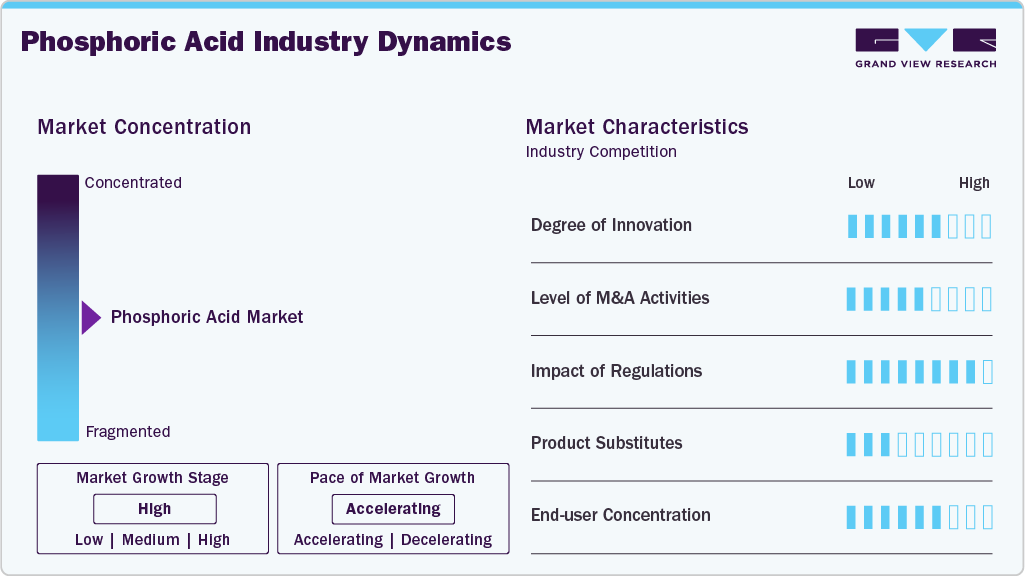
The global phosphoric acid market exhibits a moderately concentrated structure, with a few large producers holding a significant share of production capacity. These key players leverage integrated operations, including phosphate mining and acid processing, to maintain cost efficiencies and secure supply chains. While top manufacturers dominate in North America, Europe, and the Middle East, a large number of regional and local players, particularly in Asia and Latin America, contribute to market diversity, creating a mix of global and regional competition.
 To learn more about this report, Download Free Sample Report
 In terms of market characteristics, the demand for phosphoric acid is highly segmented by application, with fertilizer production accounting for most of the consumption, followed by industrial uses such as food processing, water treatment, and specialty chemicals. The market is capital-intensive due to the cost of raw materials, environmental compliance, and production technology. Price volatility is influenced by phosphate rock availability, regulatory policies, and energy costs, making supply chain management and operational efficiency critical for sustaining profitability and competitive positioning in the global market.
Analyst Perspective
The phosphoric acid market is expected to grow, supported by sustained demand from phosphate fertilizer production and increasing emphasis on global food security. While fertilizers will remain the primary revenue contributor, expanding applications in food processing, pharmaceuticals, and water treatment are creating opportunities for product diversification. Integrated producers with secure phosphate rock resources and efficient manufacturing capabilities are likely to maintain a competitive advantage. Technological advancements in production processes and investments in high-purity phosphoric acid are further strengthening market potential. Companies that enhance supply chain resilience, operational efficiency, and value-added product offerings are expected to be well positioned for long-term growth.
Application Insights
By application, diammonium hydrogenphosphate (DAP) held a dominant position, contributing 33.3% of total revenue in 2025, due to its high nutrient content and widespread adoption in large-scale agriculture. Its efficiency in improving crop yields and supporting staple crop production makes it the preferred choice for farmers in mature agricultural regions. The consistent demand for DAP, driven by global food security needs and government initiatives promoting fertilizer use, ensures stable consumption and positions this segment as a market cornerstone.
The Monoammonium Dihydrogenphosphate (MAP) segment is witnessing strong growth with the revenue CAGR of 4.8% during the forecast period, as precision agriculture and high-value crop cultivation gain momentum. With higher phosphorus efficiency and better solubility than other fertilizers, MAP is increasingly preferred for specialized crops and intensive farming practices. Rising awareness of crop nutrition optimization and sustainable farming methods is accelerating the adoption of MAP, making it the fastest-growing application segment within the phosphoric acid market.
Regional Insights
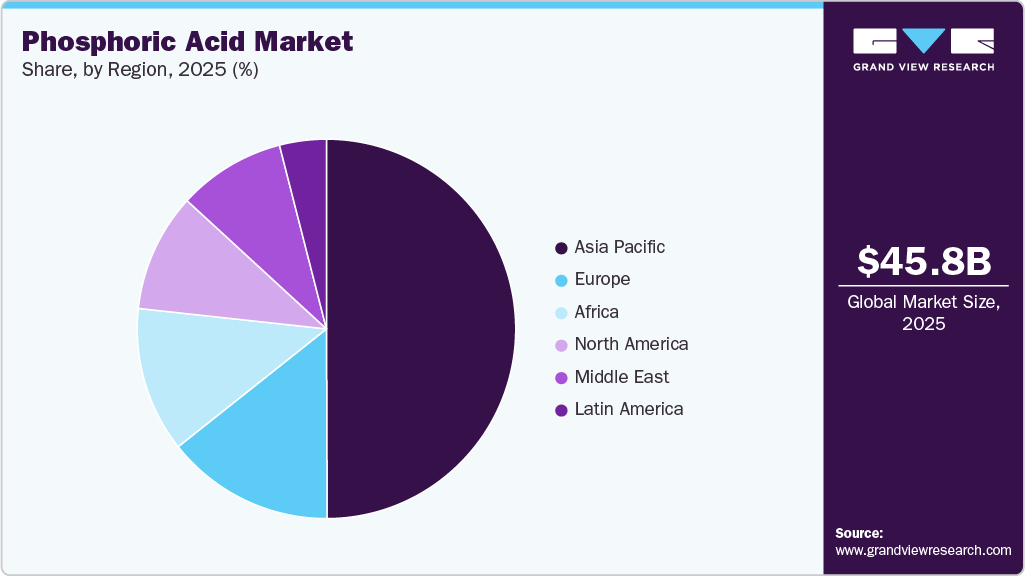
Asia Pacific dominated the phosphoric acid market with the highest revenue share of 50.0% in 2025, driven by expanding agricultural activities and industrialization. Rising demand for high-yield crops, coupled with government initiatives to promote fertilizer use, is fueling the need for both fertilizer-grade and industrial phosphoric acid. Rapid urbanization and infrastructure development further support growth in industrial applications, making the region a strategic focus for market expansion.
China accounted for the Asia Pacific phosphoric acid market in 2025. The phosphoric acid industry in China is supported by its extensive agricultural base and growing industrial sector. Rising consumption of fertilizers, increasing food production needs, and the expansion of industrial applications support both domestic production and imports.
 To learn more about this report, Download Free Sample Report
 North America Phosphoric Acid Market Trends
The phosphoric acid industry in North America maintains a strong position in the market due to advanced agricultural practices and high adoption of phosphate-based fertilizers. The region benefits from established supply chains, modern production facilities, and steady industrial demand across food processing, water treatment, and specialty chemical applications, sustaining stable market growth.
U.S. Phosphoric Acid Market Trends
The U.S. phosphoric acid industry benefits from advanced fertilizer adoption, technological integration in agriculture, and stable industrial demand. Government policies promoting efficient crop production and sustainability further reinforce the market’s growth trajectory.
Europe Phosphoric Acid Market Trends
The phosphoric acid industry in Europe is the fastest-growing region with an expected CAGR of 4.6%, in terms of revenue, during the forecast period. The regional market is driven by stringent regulatory standards and increasing demand for high-purity and specialty-grade products. Growth is supported by precision agriculture, sustainable farming practices, and industrial applications in chemicals and water treatment, encouraging innovation and efficiency among manufacturers.
The Germany phosphoric acid industry growth is driven by industrial applications and a focus on sustainable agricultural practices. High demand for specialty-grade acid in food processing, water treatment, and chemicals, along with strong regulatory compliance, positions Germany as a strategic market in Europe.
Middle East Phosphoric Acid Market Trends
The phosphoric acid industry in the Middle East is experiencing growth, driven by expanding fertilizer production and industrial applications. Abundant phosphate rock reserves in countries like Saudi Arabia and Morocco support strong local production, while investments in agriculture and infrastructure development continue to fuel market demand.
Africa Phosphoric Acid Market Trends
The phosphoric acid industry in Africa is benefiting from rising agricultural investments and initiatives to improve crop yields. Increasing industrialization and the development of local production capacities in key phosphate-rich countries are supporting steady growth and creating new opportunities for market players in the region.
Latin America Phosphoric Acid Market Trends
The phosphoric acid industry in Latin America presents significant growth opportunities as large agricultural regions expand fertilizer usage to improve crop yields. Increasing investments in commercial farming, coupled with rising industrial applications, are driving demand for phosphoric acid and attracting both domestic and global producers.
Key Phosphoric Acid Company Insights
The major companies in the phosphoric acid market have marked their strong production capacities, integrated phosphate rock operations, and extensive global distribution networks, enabling them to maintain a competitive edge across fertilizer and industrial applications. Continuous investments in capacity expansion, process optimization, and strategic partnerships further reinforce their positioning in both established and emerging markets.
Key Phosphoric Acid Companies
The following key companies have been profiled for this study on the phosphoric acid market.
-
OCP Group
-
The Mosaic Company
-
PhosAgro
-
Nutrien Ltd.
-
ICL Group Ltd.
-
Yara International ASA
-
IFFCO Group
-
Prayon Group
-
PJSC PhosAgro
-
Aditya Birla Group
Competitive Benchmarking
Category
Operating Strategies
Competitive Edge
Weakness
Established Players (OCP Group, The Mosaic Company, Nutrien Ltd., ICL Group Ltd., Yara International ASA, PhosAgro (PJSC PhosAgro), Prayon Group)
- Operate integrated phosphate value chains spanning mining, phosphoric acid production, and fertilizer manufacturing.
- Invest in capacity expansion and advanced processing technologies to improve production efficiency.
- Secure long-term raw material supplies through captive phosphate mines and strategic sourcing agreements.
- Expand global distribution networks while increasing focus on high-purity phosphoric acid for industrial applications.
- Strong ownership of phosphate rock reserves ensures reliable feedstock availability.
- Extensive international presence with well-established customer and distribution networks.
- Large-scale production facilities enable cost-efficient manufacturing and consistent product quality.
- Strong financial capabilities support innovation, sustainability initiatives, and strategic acquisitions.
- High capital investment requirements increase operational and maintenance costs.
- Significant exposure to environmental regulations governing mining and chemical processing.
- Revenue is highly influenced by fluctuations in global fertilizer demand and commodity prices.
- Large organizational structures can reduce operational agility in rapidly changing markets.
Emerging Players (IFFCO Group, Aditya Birla Group)
- Focus on strengthening regional production capacity to meet domestic fertilizer demand.
- Establish strategic partnerships to enhance technology access and market penetration.
- Expand downstream fertilizer operations to increase value addition and profitability.
- Modernize manufacturing facilities to improve operational efficiency and product quality.
- Strong understanding of regional agricultural requirements and customer needs.
- Greater flexibility in responding to local market trends and demand fluctuations.
- Competitive pricing is supported by proximity to domestic customers and streamlined distribution.
- Benefit from government initiatives and cooperative networks in agricultural markets.
- Limited global footprint compared to established multinational producers.
- Dependence on external sources for phosphate rock and other critical raw materials.
- Smaller production capacities restrict economies of scale and export opportunities.
- Lower financial resources constrain investments in advanced technologies and specialty products.
OCP Group is a vertically integrated leader in the global phosphoric acid and phosphate fertilizer market. Leveraging extensive phosphate rock reserves, the company operates large-scale production facilities that ensure cost efficiency and reliable supply. Its strong focus on research, innovation, and sustainable practices enables OCP to meet the growing global demand for both fertilizer-grade and industrial phosphoric acid, solidifying its position as a market frontrunner.
The Mosaic Company is a major North American producer of phosphoric acid and phosphate-based fertilizers, serving both agricultural and industrial sectors. With advanced production technologies and a robust distribution network, the company ensures consistent quality and supply to meet regional and global demand. Mosaic’s strategic investments in capacity expansion and operational efficiency strengthen its competitive position and support long-term growth in the phosphoric acid market.
Recent Developments
-
In April 2025, The Jordan Phosphate Mines Company (JPMC) and the Indonesian government agreed to establish a new phosphoric acid plant in Surabaya with an annual capacity of 200,000 tons, effectively doubling production at the site to 400,000 tons. The joint effort aims to meet rising fertilizer demand and strengthen bilateral industrial cooperation.
-
In February 2025, Prayon announced an investment in a new production unit at its site in Bex to double its electronic-grade phosphoric acid capacity by 2028. The expansion is aimed at meeting rising demand from the semiconductor and advanced electronics industries, where ultra-high-purity phosphoric acid is essential. This move strengthens Prayon’s position in the specialty and high-value segment of the phosphoric acid industry and supports supply security for critical technology applications.
Phosphoric Acid Market Report Scope
Report Attribute
Details
Market size in 2025
USD 45.8 billion
Estimated market size in 2026
USD 47.6 billion
Projected market size by 2033
USD 63.6 billion
Growth rate
CAGR of 4.2% from 2026 to 2033
Base year for estimation
2025
Historical data
2021 - 2024
Forecast period
2026 - 2033
Quantitative units
Revenue in USD billion/billion, Volume in Kilotons and CAGR from 2026 to 2033
Report coverage
Revenue forecast, company ranking, competitive landscape, growth factors, and trends
Segments covered
Application, region
Regional scope
North America; Europe; Asia Pacific; Latin America; Middle East & Africa
Country scope
U.S.; Canada; Germany; Belgium.; France; Russia; Spain; China; India; Japan; Indonesia; Thailand; Vietnam; Brazil; Mexico; Peru; Argentina; Chile; Saudi Arabia; Israel; Jordan; Turkey; Egypt; Morocco; South Africa; Tunisia; Senegal
Key companies profiled
OCP Group; The Mosaic Company; PhosAgro; Nutrien Ltd.; ICL Group Ltd.; Yara International ASA; IFFCO Group; Prayon Group; PJSC PhosAgro; Aditya Birla Group
Customization scope
Free report customization (equivalent up to 8 analysts' working days) with purchase. Addition or alteration to country, regional & segment scope.
Pricing and purchase options
Avail customized purchase options to meet your exact research needs. Explore purchase options
Global Phosphoric Acid Market Report Segmentation
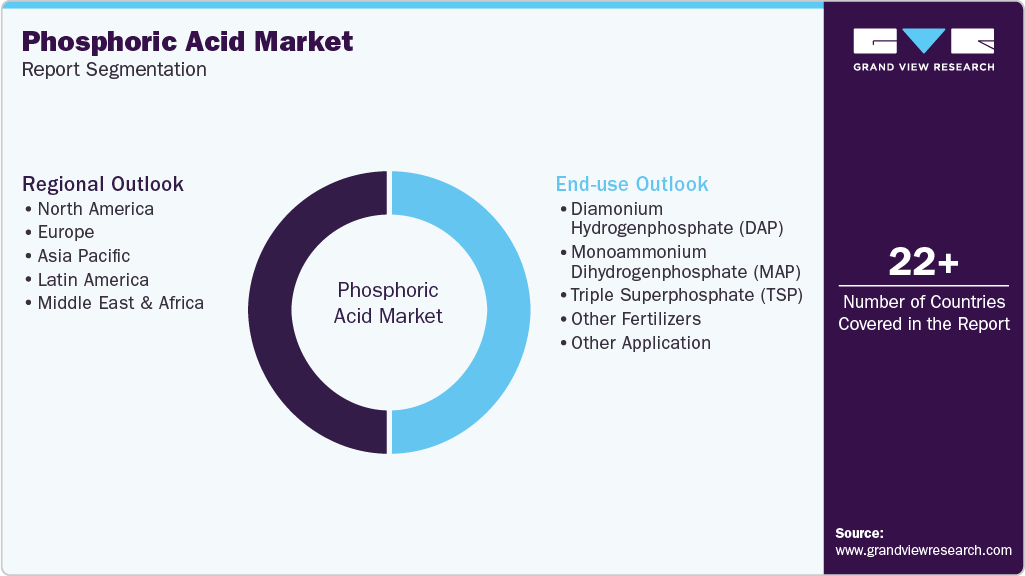
This report forecasts volume & revenue growth at global, regional, and country levels and provides an analysis of the latest industry trends in each of the sub-segments from 2021 to 2033. For this study, Grand View Research has segmented the global phosphoric acid market report based on application and region:
 To learn more about this report, Download Free Sample Report
 -
Application Outlook (Volume, Kilotons; Revenue, USD Million, 2021 - 2033)
-
Diamonium Hydrogenphosphate (DAP)
-
Monoammonium Dihydrogenphosphate (MAP)
-
Triple Superphosphate (TSP)
-
Other Fertilizers
-
Other Application
-
-
Regional Outlook (Volume, Kilotons; Revenue, USD Million, 2021 - 2033)
-
North America
-
U.S.
-
Canada
-
-
Europe
-
Germany
-
Belgium
-
France
-
Russia
-
Spain
-
-
Asia Pacific
-
China
-
Indonesia
-
Japan
-
India
-
Thailand
-
Vietnam
-
-
Latin America
-
Mexico
-
Brazil
-
Peru
-
Argentina
-
Chile
-
-
Middle East
-
Saudi Arabia
-
Israel
-
Jordan
-
Turkey
-
-
Africa
-
Egypt
-
Morocco
-
South Africa
-
Tunisia
-
Senegal
-
-
Research Methodology
The phosphoric acid market figures in this report are based on a proven research process that combines executive interviews with secondary research from proprietary databases, company filings, and recognized regulatory and institutional sources. Market size is built through value-chain sizing - reconciling supply-side and demand-side estimates - and triangulated with bottom-up and top-down approaches. Every estimate passes multiple levels of expert validation before publication, with each phosphoric acid segment quantified using the revenue-capture definitions in the table below.
Segment Definition
Segment - Application
Revenue capture definition
Diammonium Hydrogenphosphate (DAP)
Revenue is generated through the large-scale use of phosphoric acid in manufacturing DAP fertilizers, which are widely applied to improve crop productivity. Strong demand from commercial agriculture and bulk fertilizer production makes this the leading value-generating segment.
Monoammonium Dihydrogenphosphate (MAP)
Commercial returns stem from phosphoric acid consumption in MAP production, driven by its balanced nutrient composition and suitability for a broad range of crops. Increasing adoption of precision farming and efficient nutrient application supports steady business expansion.
Triple Superphosphate (TSP)
Value creation is supported by the conversion of phosphoric acid into TSP fertilizers that deliver concentrated phosphorus for soils with nutrient deficiencies. Continued investments in agricultural modernization and soil enrichment programs sustain market demand.
Other Fertilizers
Income is derived from the production of specialty phosphate fertilizers and customized nutrient formulations tailored to diverse crop and soil requirements. Product innovation and expanding cultivation of high-value crops contribute to revenue growth in this segment.
Other Applications
Business opportunities arise from phosphoric acid utilization in food processing, pharmaceuticals, water treatment, metal finishing, and industrial chemicals. Expanding industrial applications and growing preference for high-purity phosphoric acid create additional avenues for long-term market development.
Estimation Model
Layer Name
Key Question
Description
Raw Material & Production Layer
What forms the supply base?
Analyze the phosphoric acid production ecosystem, focusing on the sourcing of phosphate rock, sulfur, and water as key feedstocks. Evaluate wet-process and thermal-process manufacturing technologies, beneficiation of phosphate ore, sulfuric acid integration, production capacities, raw material availability, integrated mining-to-processing operations, international trade flows, and major manufacturing hubs that ensure consistent global supply.
Application Adoption Layer
Where is phosphoric acid consumed?
Assess phosphoric acid utilization across phosphate fertilizer production, including diammonium phosphate (DAP), monoammonium phosphate (MAP), triple superphosphate (TSP), and specialty fertilizers, as well as industrial applications such as food processing, pharmaceuticals, water treatment, and metal surface treatment. Adoption trends are influenced by agricultural productivity goals, industrial expansion, regulatory standards, and growing demand for high-purity phosphoric acid.
Consumption Intensity Layer
How much phosphoric acid is utilized?
Measure phosphoric acid consumption by evaluating fertilizer manufacturing volumes, crop nutrient requirements, seasonal agricultural demand, industrial processing needs, and production capacities across downstream industries. The assessment considers application-specific usage patterns, regional fertilizer demand, and industrial consumption to estimate annual market volumes across key geographies.
Revenue Layer
How is market revenue generated?
Market value is generated through the production and supply of merchant-grade and high-purity phosphoric acid for fertilizer and industrial applications. Commercial performance is shaped by raw material pricing, production efficiency, long-term supply agreements, downstream demand from agriculture and manufacturing sectors, technological improvements, international trade dynamics, and investments in integrated phosphate value chains.
Delivered Customizations
This report has been delivered with the following In-depth customizations
Client Request
Customization Delivered
Value Adds
Regional Segmentation
The study delivers a detailed country-level assessment across major phosphoric acid production and consumption markets. It evaluates phosphate rock reserves, fertilizer manufacturing capacity, agricultural demand, industrial consumption, trade flows, pricing trends, regulatory frameworks, and investments in integrated phosphate production facilities across key regions.
Supports market expansion by identifying high-growth countries, evaluating regional demand trends, assessing investment opportunities, and recognizing supply chain advantages across fertilizer and industrial application markets.
Competitive Benchmarking
The study provides an in-depth comparison of leading phosphoric acid manufacturers based on product portfolio, production capacity, vertical integration, manufacturing footprint, distribution network, technological capabilities, regional presence, strategic initiatives, and recent business developments. It also evaluates each company's position across fertilizer-grade and high-purity phosphoric acid markets.
Enables stakeholders to benchmark competitors, identify strategic strengths, evaluate market positioning, recognize partnership and acquisition opportunities, and develop effective competitive growth strategies.
Opportunity Assessment
The study identifies emerging opportunities driven by increasing fertilizer demand, expansion of high-purity phosphoric acid applications, advancements in production technologies, investments in phosphate mining and processing, sustainable nutrient management practices, and growing industrial consumption across food, pharmaceutical, and water treatment sectors.
Assists organizations in prioritizing attractive investment areas, strengthening portfolio diversification, aligning with evolving customer requirements, and capitalizing on long-term growth opportunities across the global phosphoric acid value chain.
Frequently Asked Questions About This Report
The global phosphoric acid market size is estimated to grow at a compound annual growth rate (CAGR) of 4.2% from 2026 to 2033 and expected to reach USD 63.6 billion by 2033.
Diammonium hydrogenphosphate (DAP) held a dominant position, contributing 33.3% of total revenue in 2025.
The market is driven by increasing demand for phosphate-based fertilizers like MAP and DAP. With the world population growing and dietary patterns evolving, agricultural producers are under pressure to improve crop yields. This trend is encouraging fertilizer manufacturers to increase procurement of phosphoric acid as a key raw material, prompting global producers to expand production capacities and strengthen supply chains.
Asia Pacific dominated the phosphoric acid market with the largest revenue share of 50.0% in 2025. China and India remained the primary growth engines, supported by their large fertilizer industries, expanding agricultural production, and integrated phosphate processing capacities.
The global phosphoric acid market size was valued at USD 45.8 billion in 2025 and is expected to reach USD 47.6 billion in 2026.
Some of the key players operating in the phosphoric acid market include OCP Group, The Mosaic Company, PhosAgro, Nutrien Ltd., ICL Group Ltd., Yara International ASA, IFFCO Group, Prayon Group, PJSC PhosAgro, Aditya Birla Group.
About the Author(s)
Petrochemicals Research Team
Bulk Chemicals · PetrochemicalsThis report was authored by the petrochemicals research team at Grand View Research - comprising two research analysts, one senior research analyst, and one industry expert - with specialized expertise in the petrochemicals segment of the bulk chemicals industry. All findings are based on proprietary bulk chemicals databases, executive interviews, and regulatory analysis, subject to internal peer review prior to publication.
Last Updated:
Speak to Analyst

Customize this report to your needs - add regions, segments, or data points, with 20% free customization.
Or view our licence options:


ISO 9001:2015 & 27001:2022 Certified
We are GDPR and CCPA compliant! Your transaction & personal information is safe and secure. For more details, please read our privacy policy.


