
- Home
- »
- Renewable Energy
- »
-
Plasma Pyrolysis Hydrogen Market Size Report, 2026-2033GVR Report cover

Plasma Pyrolysis Hydrogen Market (2026 - 2033)
Size, Share & Trends Analysis Report By Technology (Thermal Plasma, Non-thermal Plasma), By Application (Industrial Hydrogen, Waste-to-Hydrogen, Chemical Feedstock, Energy Generation ), By Region, And Segment Forecasts
Market Size, 2025
$9.2MMarket Estimate, 2026
$13.0MMarket Forecast, 2033
$104.0MCAGR, 2026–2033
34.6%Plasma Pyrolysis Hydrogen Market Summary
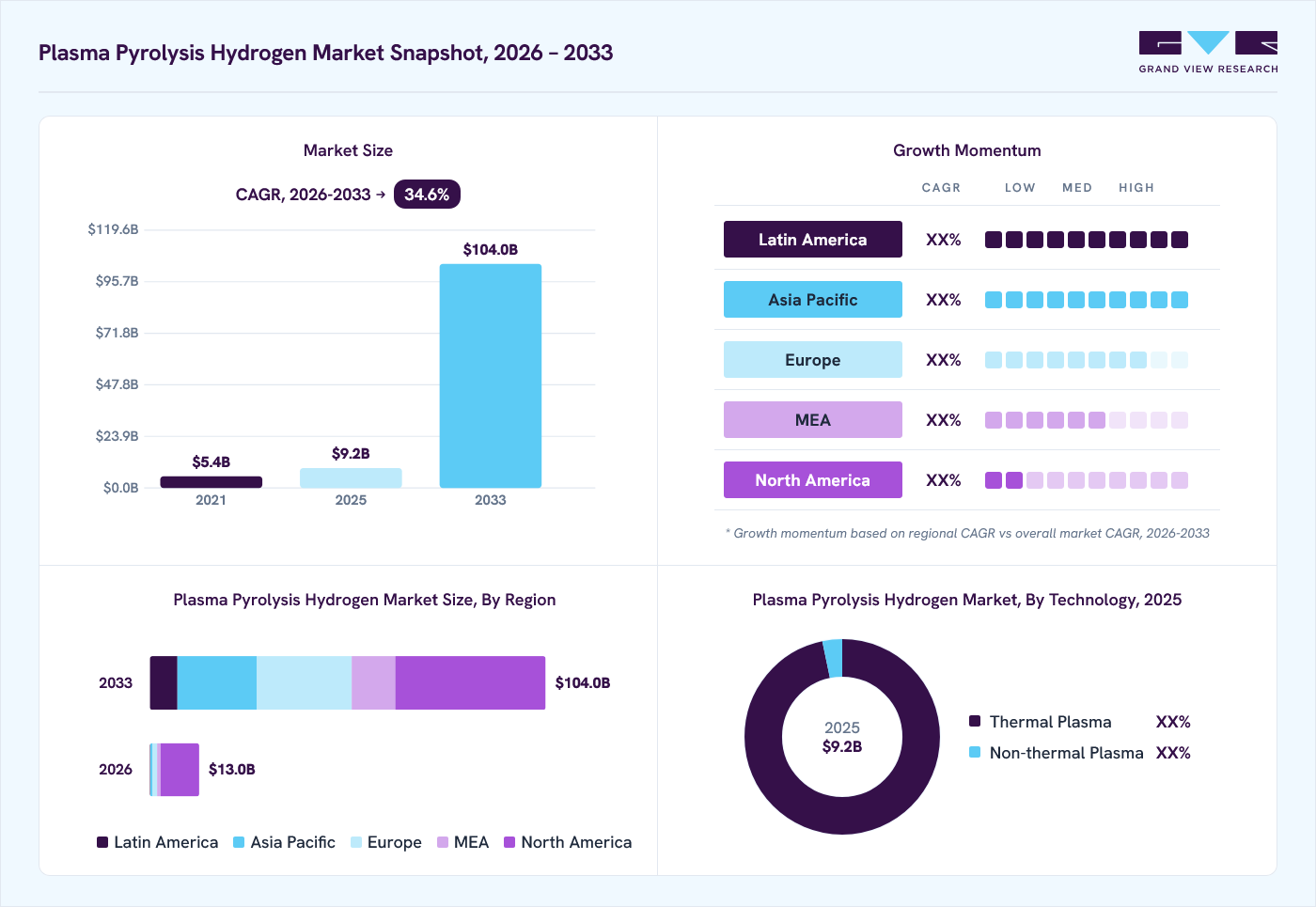
The global plasma pyrolysis hydrogen market size was valued at USD 9.2 million in 2025 and is projected to grow from USD 13.0 million in 2026 to USD 104.0 million by 2033, at a CAGR of 34.6% from 2026 to 2033. North America dominated the market, accounting for a revenue share of 84.0% in 2025. The market is driven by the need to decarbonize hydrogen-intensive industries and develop alternative pathways to conventional steam methane reforming and coal-based production.
 Source: Grand View Research, IR Documents, Primary Interviews, Paid DatabasesTo learn more about this report,
 Download Free Sample Report
Key Market Trends & Insights
- By technology: The thermal plasma segment held the largest revenue share of 96.6% in 2025.
- By application: The industrial hydrogen segment dominated the market with the largest revenue share of 45.8% in 2025.
Regional Highlights
- Largest regional market: North America (84.0% revenue share, 2025)
- Fastest-growing regional market: Latin America (highest CAGR, 2026-2033)
- By country: The U.S. held the largest market share in 2025.
Market Size & Forecast
- Market size in 2025: USD 9.2 Million
- Estimated market size in 2026: USD 13.0 Million
- Projected market size by 2033: USD 104.0 Million
- CAGR (2026-2033): 34.6%
GVR research-powered AIAsk Prism AI about the plasma pyrolysis hydrogen marketGet cited answers from GVR research on market growth, segments, regulations and forecasts.Start with✓ Source-linked answers ✓ Market-specific context ✓ Traceable figuresExplore Prism AI ↗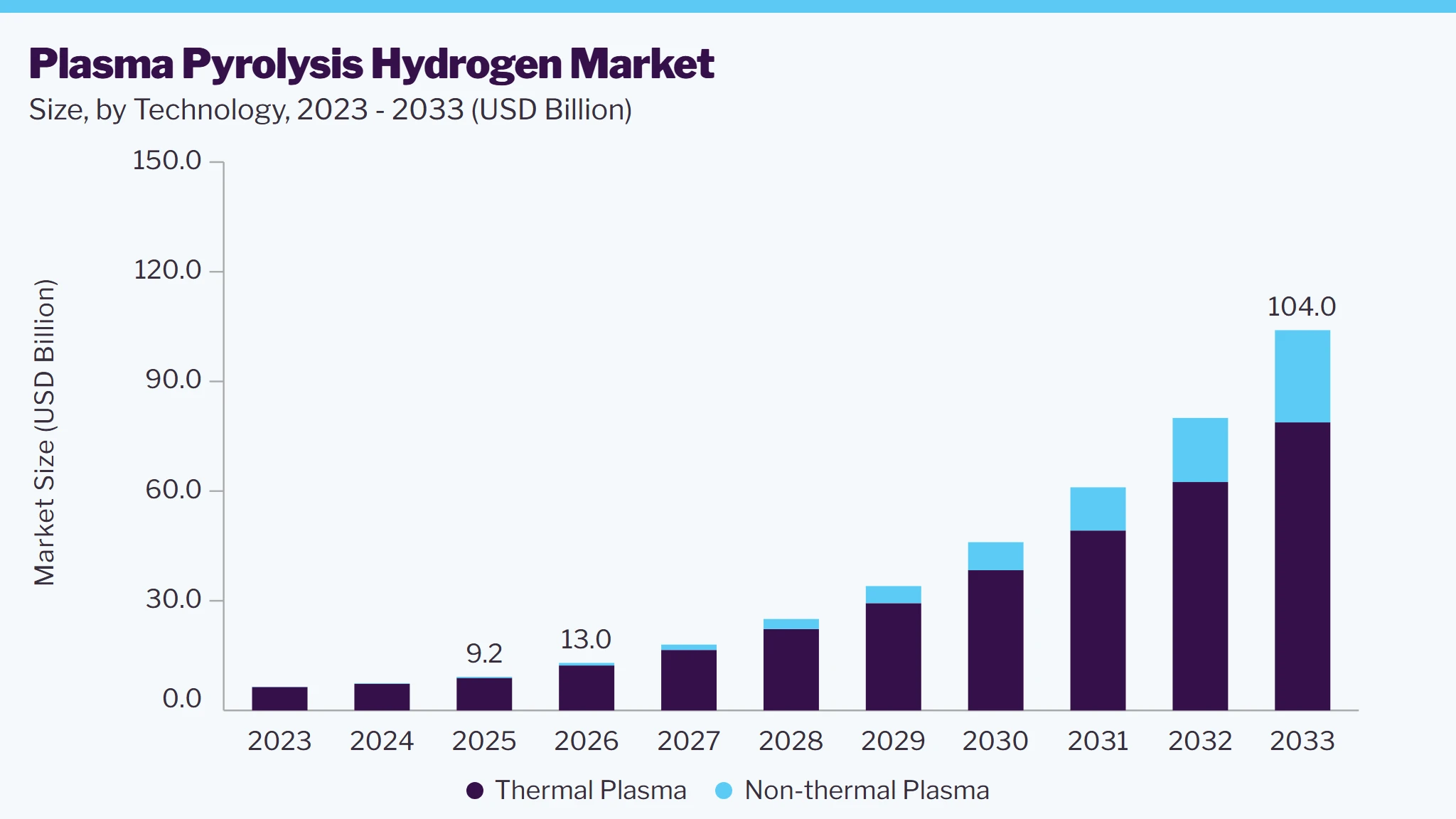 To learn more about this report, Download Free Sample Report
Plasma pyrolysis can convert hydrocarbon feedstocks into hydrogen while limiting direct CO₂ formation, strengthening its relevance as industries face tighter emissions targets.
Market Dynamics
The plasma pyrolysis hydrogen industry is gaining traction as industries seek lower-emission alternatives to conventional hydrogen production, particularly in energy-intensive applications such as refining, chemicals, and steel. The technology converts hydrocarbon-based feedstocks into hydrogen and solid carbon, creating opportunities to reduce direct CO₂ emissions while generating a potentially marketable carbon by-product. Market expansion is supported by advances in plasma reactor efficiency, feedstock flexibility, and hydrogen recovery, which can improve project economics. However, high capital requirements, electricity consumption, and the need to establish reliable markets for solid carbon remain key factors influencing commercial deployment.
The plasma pyrolysis hydrogen market is driven by growing demand for lower-emission hydrogen in existing industrial applications, where hydrogen consumption remains substantial. Plasma pyrolysis offers an alternative production pathway that converts methane and other hydrocarbon feedstocks into hydrogen while producing solid carbon rather than directly forming CO₂, thereby enhancing its relevance for industrial decarbonization. The IEA reported that global hydrogen demand reached almost 100 Mt in 2024 and was expected to exceed this level in 2025, while low-emissions hydrogen remained below 1% of total demand, indicating significant scope for alternative production technologies. In February 2026, Graforce secured a double-digit-million-euro financing round from Calderion, Terravent, and WenCo to scale its plasma pyrolysis technology and expand deployment of industrial plants globally. The company also strengthened its collaboration with RAG Austria AG to optimize and industrialize methane plasma pyrolysis plants. The investment highlights growing commercial and infrastructure support for plasma-based hydrogen production to support industrial decarbonization.
The market is constrained by the high electricity requirements and capital intensity of plasma-based systems, particularly for large-scale hydrogen production. Plasma generation requires substantial electrical input, while reactors, power systems, gas handling, hydrogen purification, and carbon recovery equipment add to upfront investment. The economics, therefore, depend heavily on electricity prices, plant utilization, feedstock costs, and the value generated from hydrogen and solid carbon, which can limit deployment in regions with expensive power or underdeveloped supporting infrastructure.
A key emerging opportunity in the plasma pyrolysis hydrogen industry is the commercial utilization of solid carbon produced alongside hydrogen, which can create an additional revenue stream and improve overall project economics. Plasma pyrolysis can generate relatively high-purity carbon materials that may be used in applications such as carbon black, conductive materials, construction materials, and other industrial products. Developing consistent carbon quality, downstream processing capabilities, and offtake partnerships can therefore support the commercialization of plasma pyrolysis plants while reducing reliance on hydrogen revenue alone.
Analyst Perspective
The plasma pyrolysis hydrogen market is moving from technology development toward early commercial deployment, supported by growing demand for low-carbon hydrogen and industrial decarbonization. A key trend is the development of modular and scalable plasma systems that can operate closer to hydrogen demand centers and use diverse feedstocks, including methane, biogas, and waste gases. Companies are also focusing on improving energy efficiency, hydrogen yield, and the quality of solid carbon to strengthen project economics. In parallel, partnerships, project financing, and the commercial use of solid carbon are emerging as important factors supporting technology scale-up.
Technology Insights
The thermal plasma segment dominated the market with the largest revenue share of 96.6% in 2025. Its leading position reflects its ability to generate extremely high temperatures, enabling efficient conversion of methane and other hydrocarbon feedstocks into hydrogen and solid carbon. The technology offers high reaction rates and efficient feedstock conversion, supporting its use in large-scale industrial applications. Increasing interest in low-emission hydrogen production is further supporting the adoption of thermal plasma systems.
The non-thermal plasma segment is anticipated to grow at the fastest CAGR of 66.5% during the forecast period. Growth is supported by its ability to facilitate hydrogen production at relatively lower operating temperatures and energy requirements. Advances in plasma reactor designs are improving process efficiency and scalability, supporting wider adoption. Growing interest in decentralized hydrogen production and low-emission technologies is further creating opportunities for non-thermal plasma systems.
Application Insights
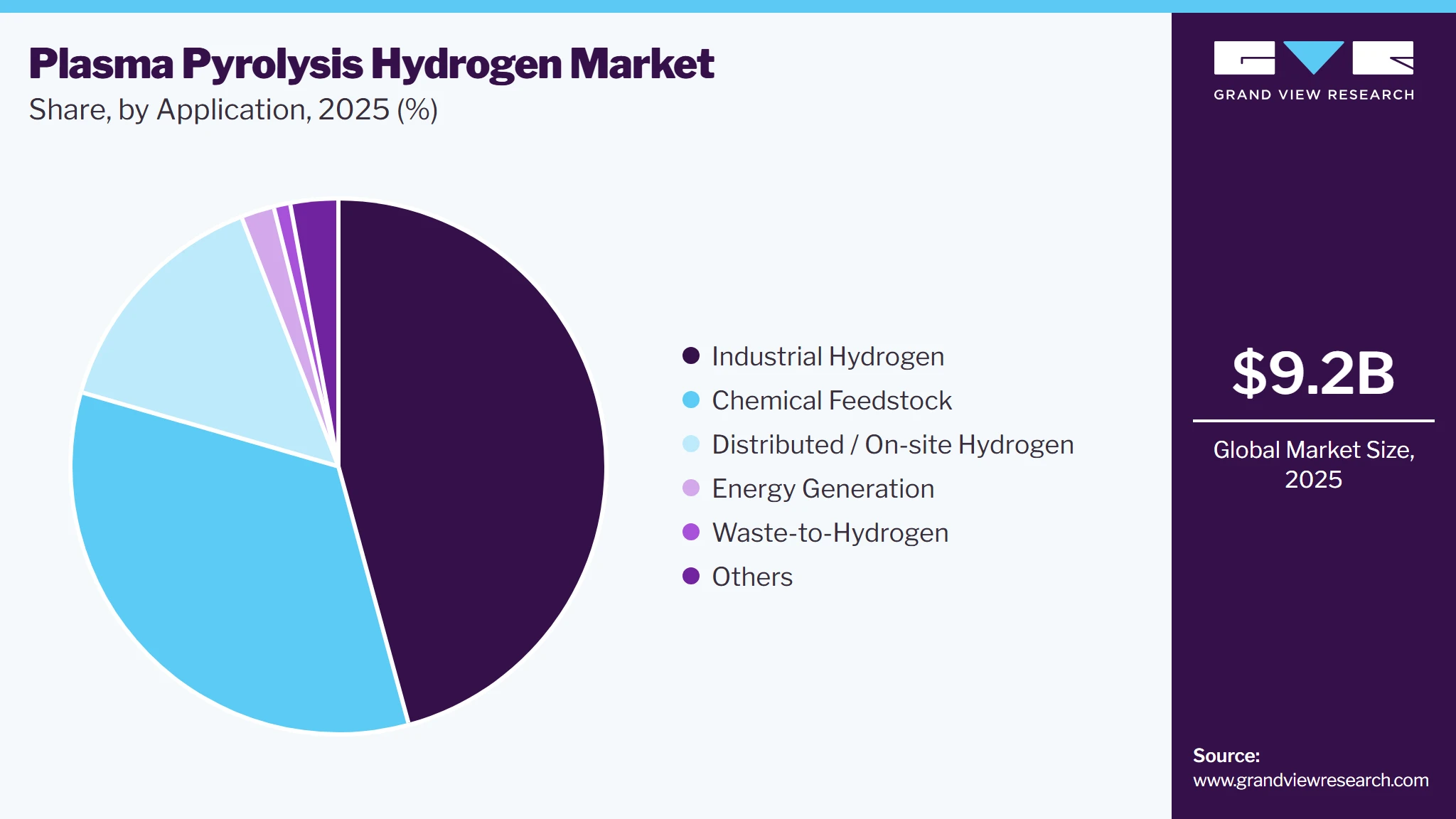
The industrial hydrogen segment led the market with the largest revenue share of 45.8% in 2025, driven by strong demand for hydrogen across chemical processing, steel, and other energy-intensive industries. The need for reliable and scalable hydrogen supplies is encouraging the adoption of advanced production technologies. Growing investments in low-emission hydrogen production are further supporting the use of plasma-based systems. Increasing industrial decarbonization initiatives are expected to sustain demand for hydrogen produced by plasma pyrolysis.
 To learn more about this report, Download Free Sample Report
The waste-to-hydrogen segment is expected to grow at the fastest CAGR of 57.5% from 2026 to 2033. This growth is attributed to the increasing focus on converting waste streams into valuable hydrogen while reducing landfill disposal and emissions. Growing interest in circular economy approaches is encouraging investments in waste-to-hydrogen technologies. Advances in plasma pyrolysis are also improving the potential to efficiently convert waste and hydrocarbon-rich feedstocks into hydrogen and solid carbon.
Regional Insights
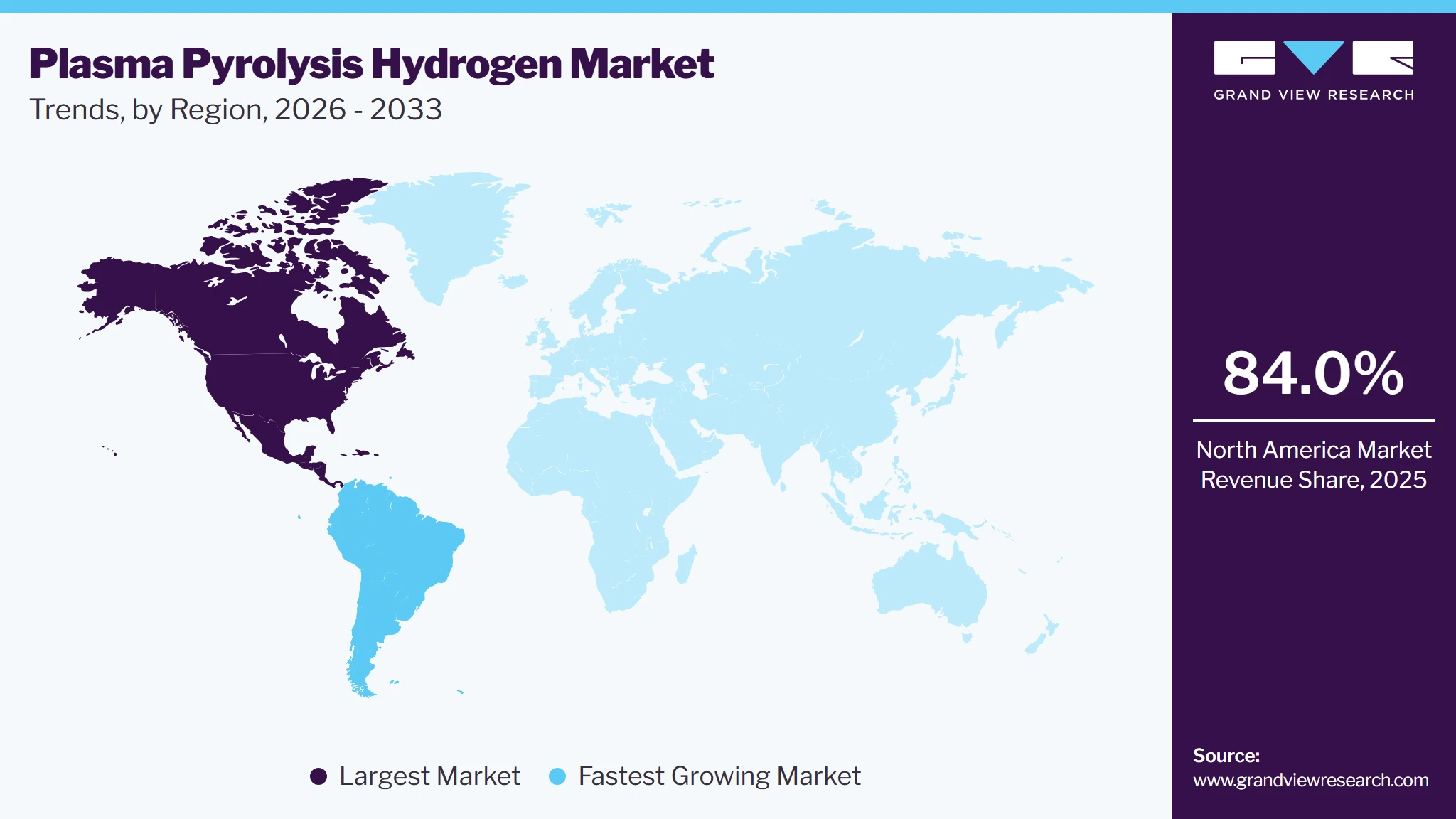
The North America plasma pyrolysis hydrogen market held the largest revenue share of 84.0% in 2025. This region benefits from abundant natural gas resources, established hydrogen-consuming industries, and comparatively mature industrial infrastructure, creating favorable conditions for methane-based plasma pyrolysis. The U.S. is also home to technology developers pursuing commercial-scale deployment, while Canada is developing microwave-based methane pyrolysis capabilities. In 2025, Aurora Hydrogen completed construction of a microwave methane pyrolysis demonstration plant in Canada, indicating increasing regional activity beyond conventional hydrogen production routes.
 To learn more about this report, Download Free Sample Report
U.S. Plasma Pyrolysis Hydrogen Market Trends
The plasma pyrolysis hydrogen market in the U.S. accounted for the largest market revenue share in North America in 2025, supported by the combination of large-scale refining and chemical hydrogen demand, natural gas availability, and growing interest in technologies that can produce hydrogen alongside commercially useful solid carbon. Monolith has established an important domestic reference for thermal plasma methane pyrolysis, while broader investment in clean hydrogen infrastructure provides potential channels for technology deployment. The market is increasingly moving toward applications in which plasma pyrolysis can be integrated directly into existing industrial operations, reducing the need for extensive new hydrogen transportation infrastructure.
Europe Plasma Pyrolysis Hydrogen Market Trends
The plasma pyrolysis hydrogen market in Europe is developing a strong ecosystem for plasma-based hydrogen through industrial decarbonization, methane utilization, and demand for low-carbon production routes. The region has an advantage in technology development because of its established hydrogen infrastructure, industrial gas networks, and concentration of chemical and energy companies. The UK is particularly active, with HiiROC developing thermal plasma electrolysis and securing industrial partnerships for applications such as cement production. In 2025, HiiROC's technology also received attention as an alternative hydrogen pathway for the chemicals sector, highlighting growing interest in using methane-derived feedstocks while generating solid carbon as a co-product.
Asia Pacific Plasma Pyrolysis Hydrogen Market Trends
The plasma pyrolysis hydrogen market in the Asia-Pacific region is supported by growing interest in low-carbon hydrogen production technologies across China, Japan, India, Australia, and South Korea. Growing hydrogen demand from refining, chemicals, steel, and other energy-intensive industries is encouraging investment in alternative production pathways, including methane pyrolysis and plasma-based technologies. The region’s large industrial base, availability of hydrogen feedstocks, and decarbonization initiatives provide opportunities for plasma pyrolysis systems, particularly where hydrogen production can be integrated with existing gas and industrial infrastructure.
The China plasma pyrolysis hydrogen market is supported by strong hydrogen demand across the chemical, steel, refining, and manufacturing sectors, creating opportunities for lower-emission hydrogen production technologies. The country's significant industrial waste and methane resources also create opportunities for plasma-based conversion, particularly where hydrogen production can be integrated with existing industrial facilities. However, commercial deployment remains dependent on reducing system costs, improving energy efficiency, and demonstrating reliable large-scale operation, making technology localization and scale-up important themes for the Chinese market.
Latin America Plasma Pyrolysis Hydrogen Market Trends
The plasma pyrolysis hydrogen market in Latin America is anticipated to grow at the fastest CAGR of 67.7% from 2026 to 2033. It remains an emerging market, with opportunities driven by natural gas resources, industrial hydrogen demand, waste availability, and the development of clean-hydrogen strategies. Brazil and other major economies can use plasma pyrolysis for applications that combine hydrogen production with the management of waste or hydrocarbon feedstocks. The technology's relatively early stage of commercialization means deployment is likely to be concentrated initially in demonstration and industrial projects rather than in broad adoption.
Middle East & Africa Plasma Pyrolysis Hydrogen Market Trends
The plasma pyrolysis hydrogen market in the Middle East presents a distinctive opportunity due to its large natural gas and hydrocarbon base, established energy infrastructure, and growing focus on lower-carbon hydrogen and carbon management. Plasma pyrolysis can complement existing gas infrastructure by converting methane and other hydrocarbon streams into hydrogen while producing solid carbon. In 2025, ADNOC and Baker Hughes commissioned a microwave-plasma pilot producing hydrogen and graphene, while Levidian also agreed to deploy a 1.5-tpa plant in the UAE using flared gas, demonstrating the region's interest in converting gas resources and emissions streams into higher-value products.
Key Plasma Pyrolysis Hydrogen Company Insights
Some of the key players operating in the global market include Graforce GmbH and HiiROC, among others.
-
Graforce GmbH is a Germany-based hydrogen technology company developing Plasmalyzer systems for producing hydrogen from methane, natural gas, biomethane, and other hydrocarbon feedstocks. Its methane plasmolysis process uses high-voltage plasma to dissociate methane into hydrogen and solid carbon, with modular systems designed for applications such as industrial hydrogen production, energy generation, and on-site production. Graforce has also built and commissioned a methane pyrolysis plant at RAG Austria, designed to produce approximately 50 kg of hydrogen and 150 kg of solid carbon per hour, highlighting the company’s focus on scaling plasma-based hydrogen production and integrating carbon recovery into the process.
-
HiiROC is a UK-based hydrogen technology company that has developed Thermal Plasma Electrolysis (TPE), a proprietary plasma process that converts natural gas, biomethane, and other hydrocarbons into hydrogen and solid carbon black. The technology uses electrical plasma torches to dissociate hydrocarbons and is designed for continuous-flow operation, modular scaling, and point-of-use hydrogen production across industrial and energy applications. HiiROC’s TPE process has been included within the scope of the UK Government’s Low Carbon Hydrogen Standard, while partnerships with companies such as Siemens support automation and scaling of its hydrogen production systems.
Key Plasma Pyrolysis Hydrogen Companies
The following key companies have been profiled for this study on the global plasma pyrolysis hydrogen market
-
Graforce GmbH
-
H Quest
-
HiiROC
-
Hyurja Fuel Systems Pvt Ltd
-
Levidian Nanosystems Limited
-
Monolith Materials, Inc.
-
Plenesys
-
PyroGenesis Inc.
-
SEID
-
Spark Cleantech
Competitive Benchmarking
Category
Operating Strategies
Competitive Edge
Weakness
Established Players (PyroGenesis Inc., Graforce GmbH, HiiROC, Levidian Nanosystems Limited, Monolith Materials, Inc. )
- Focus on commercializing proprietary plasma pyrolysis and methane-to-hydrogen technologies.
- Expand through pilot, demonstration, and commercial-scale projects.
- Form partnerships with energy, industrial gas, manufacturing, and technology companies.
- Develop modular systems for industrial and distributed hydrogen production.
- Higher technology maturity and greater industrial validation.
- Established plasma engineering and process-development capabilities.
- Stronger intellectual property and proprietary technology portfolios.
- Greater access to strategic partners, customers, and project financing.
- High capital requirements for commercial-scale deployment.
- Significant electricity consumption can affect production economics.
- Dependence on commercial markets for solid-carbon co-products.
- Longer project development and scale-up cycles.
Emerging Players (Plenesys, Spark Cleantech, Hyurja Fuel Systems Pvt Ltd, SEID, H Quest)
- Focus on developing differentiated plasma and reactor technologies.
- Prioritize modular and smaller-scale systems for decentralized deployment.
- Conduct pilot and demonstration projects to establish technology performance.
- Build strategic partnerships to accelerate commercialization.
- Greater flexibility in technology and reactor design.
- Modular systems can support deployment closer to hydrogen demand centers.
- Ability to target specialized applications and feedstocks.
- Leaner structures can enable faster technology development.
- Limited commercial-scale deployment and operating track record.
- Smaller financial resources compared with established players.
- Limited customer references and project history.
- Scale-up and long-duration operating performance remain key challenges.
Recent Developments
- In November 2025, BASF and ExxonMobil signed a joint development agreement to advance methane pyrolysis technology for low-emission hydrogen production, with plans to construct a demonstration plant at ExxonMobil’s Baytown Complex in Texas. The facility is planned to produce up to 2,000 tons of low-emission hydrogen and 6,000 tons of solid carbon annually, providing a platform to validate the technology on a larger scale. The collaboration combines BASF’s methane-pyrolysis reactor technology with ExxonMobil’s process development and scale-up capabilities, supporting the transition of methane pyrolysis toward commercial industrial deployment and strengthening the role of plasma-based and electrically driven pyrolysis technologies in low-emission hydrogen production.
Plasma Pyrolysis Hydrogen Market Report Scope
Report Attribute
Details
Market definition
The plasma pyrolysis hydrogen market refers to hydrogen production using thermal and non-thermal plasma technologies across various applications, with market revenue representing sales of the associated plasma pyrolysis hydrogen production systems and technology solutions.
Market size in 2025
USD 9.2 million
Estimated market size in 2026
USD 13.0 million
Projected market size by 2033
USD 104.0 million
Growth rate
CAGR of 34.6% from 2026 to 2033
Base year for estimation
2025
Historical data
2021 - 2024
Forecast period
2026 - 2033
Quantitative units
Revenue in USD million and CAGR from 2026 to 2033
Report coverage
Revenue forecast, competitive landscape, growth factors, and trends
Segments covered
Technology, application, region
Regional scope
North America; Europe; Asia Pacific; Latin America; Middle East & Africa
Country scope
U.S.; Canada; Mexico; Germany; UK; France; Italy; Spain; China; India; Japan; South Korea; Australia; Brazil; Argentina; UAE; Saudi Arabia; South Africa
Key companies profiled
Graforce GmbH; H Quest; HiiROC; Hyurja Fuel Systems Pvt Ltd; Levidian Nanosystems Limited; Monolith Materials, Inc.; Plenesys; PyroGenesis Inc.; SEID; Spark Cleantech
Customization scope
Free report customization (equivalent up to 8 analysts working days) with purchase. Addition or alteration to country, regional & segment scope.
Pricing and purchase options
Avail customized purchase options to meet your exact research needs. Explore purchase options
Global Plasma Pyrolysis Hydrogen Market Report Segmentation
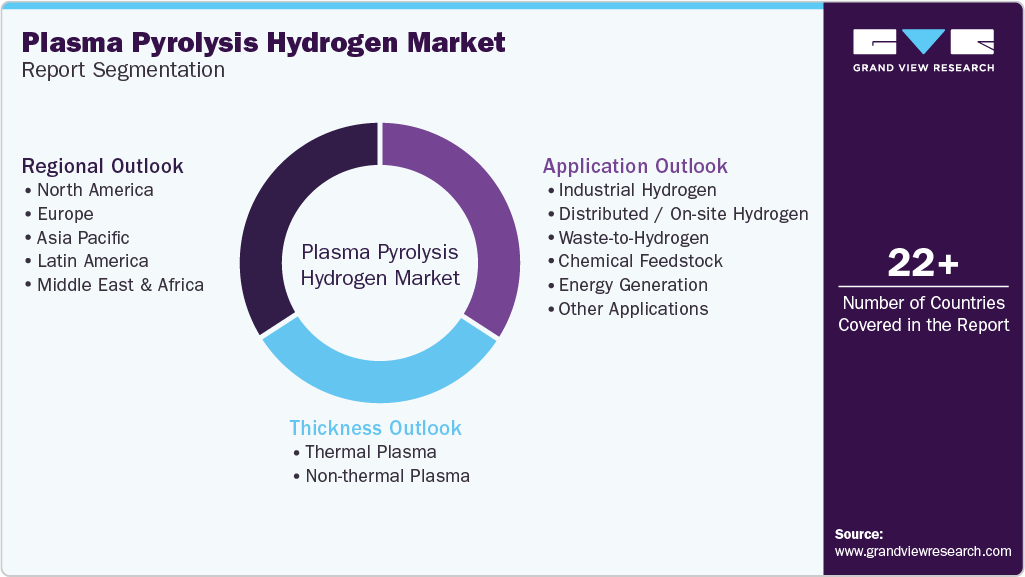
This report forecasts revenue growth at global, regional, and country levels and provides an analysis of the latest industry trends in each of the sub-segments from 2021 to 2033. For this study, Grand View Research has segmented the global plasma pyrolysis hydrogen market report based on the technology, application, and region.
 To learn more about this report, Download Free Sample Report
-
Technology Outlook (Revenue, USD Million, 2021 - 2033)
-
Thermal Plasma
-
Non-thermal Plasma
-
-
Application Outlook (Revenue, USD Million, 2021 - 2033)
-
Industrial Hydrogen
-
Distributed / On-site Hydrogen
-
Waste-to-Hydrogen
-
Chemical Feedstock
-
Energy Generation
-
Other Applications
-
-
Regional Outlook (Revenue, USD Million, 2021 - 2033)
-
-
North America
-
U.S.
-
Canada
-
Mexico
-
-
Europe
-
Germany
-
UK
-
France
-
Italy
-
Spain
-
-
-
Asia Pacific
-
China
-
India
-
Japan
-
South Korea
-
Australia
-
-
Latin America
-
Brazil
-
Argentina
-
-
Middle East & Africa
-
Saudi Arabia
-
UAE
-
South Africa
-
-
Research Methodology
The plasma pyrolysis hydrogen marketfigures in this report are based on a proven research process that combines executive interviews with secondary research from proprietary databases, company filings, and recognized regulatory and institutional sources. Market size is built through value-chain sizing-reconciling supply-side and demand-side estimates-and triangulated with bottom-up and top-down approaches. Every estimate passes multiple levels of expert validation before publication, with each plasma pyrolysis hydrogen segment quantified using the revenue-capture definitions in the table below.
Segment Definition
Technology
Revenue capture definition
Thermal Plasma
Revenue generated from the sale of plasma pyrolysis systems that use high-temperature thermal plasma to convert hydrocarbon or waste feedstocks into hydrogen and solid carbon.
Non-thermal Plasma
Revenue generated from the sale of plasma pyrolysis systems that use non-thermal plasma to facilitate hydrocarbon or waste conversion into hydrogen and solid carbon at comparatively lower bulk gas temperatures.
Application
Revenue capture definition
Industrial Hydrogen
Revenue generated from plasma pyrolysis hydrogen systems deployed for large-scale hydrogen supply to industrial operations, including refining, metals, manufacturing, and other energy-intensive processes.
Distributed / On-site Hydrogen
Revenue generated from plasma pyrolysis hydrogen systems installed at or near the point of consumption to provide localized hydrogen production for industrial facilities, commercial operations, or other users.
Waste-to-Hydrogen
Revenue generated from plasma pyrolysis systems that process waste feedstocks into hydrogen, including municipal, industrial, plastic, biomass, or other suitable waste streams.
Chemical Feedstock
Revenue generated from plasma pyrolysis hydrogen systems used to produce hydrogen for chemical manufacturing processes, including applications where hydrogen serves as a feedstock for ammonia, methanol, and other chemical products.
Energy Generation
Revenue generated from plasma pyrolysis hydrogen systems used to produce hydrogen for electricity or energy generation, including hydrogen-fired power generation and fuel-cell-based applications.
Other Applications
Revenue generated from plasma pyrolysis hydrogen systems deployed in applications not covered under industrial hydrogen, distributed/on-site hydrogen, waste-to-hydrogen, chemical feedstock, or energy generation.
Estimation Model
Layer Name
Key Question
Description
Demand Layer
Which factors generate demand for plasma pyrolysis hydrogen?
Assess demand arising from industrial decarbonization, rising low-carbon hydrogen requirements, demand for cleaner hydrogen production, availability of methane and other hydrocarbon feedstocks, waste-to-hydrogen initiatives, and increasing investment in hydrogen infrastructure.
Technology Layer
Which plasma pyrolysis technologies generate market revenue?
Evaluate revenue across thermal plasma and non-thermal plasma technologies based on plasma generation method, reactor configuration, hydrogen yield, energy consumption, feedstock compatibility, system capacity, and technology maturity.
Application Layer
Which applications generate market revenue?
Assess revenue across industrial hydrogen, distributed / on-site hydrogen, waste-to-hydrogen, chemical feedstock, energy generation, and other applications based on hydrogen demand, feedstock requirements, decarbonization needs, deployment scale, and application-specific technology suitability.
Revenue Layer
How is market revenue generated?
Market revenue is quantified through the sale of plasma pyrolysis hydrogen systems and associated technology solutions. Revenue varies by technology type, system capacity, application, project scale, feedstock configuration, and geographic market.
Delivered Customizations
This report has been delivered with the following In-depth customizations
Client Request
Customization Delivered
Value Adds
Technology Opportunity Assessment
Market analysis was performed across thermal and non-thermal plasma pyrolysis technologies by evaluating plasma generation methods, reactor configurations, feedstock compatibility, hydrogen yield, energy requirements, and technology maturity.
Enabled identification of high-potential technology approaches based on efficiency, scalability, feedstock flexibility, commercialization progress, and future deployment opportunities.
Application Opportunity Assessment
Market analysis was conducted across industrial hydrogen, distributed / on-site hydrogen, waste-to-hydrogen, chemical feedstock, energy generation, and other applications by assessing hydrogen demand, feedstock availability, decarbonization requirements, infrastructure readiness, and technology suitability.
Identified high-potential application segments based on hydrogen consumption, decarbonization potential, deployment requirements, technology suitability, and future revenue opportunities.
Regional Opportunity Assessment
Country-level analysis was conducted to assess plasma pyrolysis hydrogen adoption based on hydrogen demand, hydrocarbon and waste feedstock availability, electricity costs, decarbonization targets, carbon management infrastructure, and clean-hydrogen policies across key regions.
Identified high-growth countries and regions with favorable feedstock availability, strong hydrogen demand, supportive policies, and commercialization potential.
Frequently Asked Questions About This Report
The plasma pyrolysis hydrogen market is driven by growing demand for low-carbon hydrogen, increasing industrial decarbonization efforts, and the technology’s ability to convert hydrocarbon feedstocks into hydrogen with limited direct CO₂ emissions.
The North America region dominated the plasma pyrolysis hydrogen market with a revenue share of 84.0% in 2025.
Latin America is the fastest-growing region over the forecast period.
The plasma pyrolysis hydrogen market size was valued at USD 9.2 million in 2025 and is estimated at USD 13.0 million in 2026.
The plasma pyrolysis hydrogen market is expected to grow at a CAGR of 34.6% from 2026 to 2033, reaching USD 104.0 million by 2033.
The thermal plasma segment accounted for largest revenue share of 96.6% in 2025 while non-thermal plasma segment is expected to be the fastest-growing market.
The industrial hydrogen segment led the market with the largest revenue share of 45.8% in 2025, driven by strong demand for hydrogen across chemical processing, steel, and other energy-intensive industries.
The key players operating in the plasma pyrolysis hydrogen market are Graforce GmbH, H Quest, HiiROC, Hyurja Fuel Systems Pvt Ltd, Levidian Nanosystems Limited, Monolith Materials, Inc., Plenesys, PyroGenesis Inc., SEID, Spark Cleantech, and others.
About the Author(s)
Renewable Energy Research Team
Energy & Power · Renewable EnergyThis report was authored by the renewable energy research team at Grand View Research - comprising two research analysts, one senior research analyst, and one industry expert - with specialized expertise in the renewable energy segment of the energy & power industry. All findings are based on proprietary energy & power databases, executive interviews, and regulatory analysis, subject to internal peer review prior to publication.
Last Updated:
Speak to Analyst

Customize this report to your needs - add regions, segments, or data points, with 20% free customization.
Or view our licence options:


ISO 9001:2015 & 27001:2022 Certified
We are GDPR and CCPA compliant! Your transaction & personal information is safe and secure. For more details, please read our privacy policy.


