
- Home
- »
- Specialty & Chemicals
- »
-
Polycaprolactone Polyol Market Size, Growth Report, 2026-2035GVR Report cover

Polycaprolactone Polyol Market (2026 – 2035)
Size, Share & Trends Analysis Report By Product (Diols, Triols, Tetrols), By Application (Adhesives, Coatings, Sealants), By End Use (Automotive, Healthcare), By Region, And Segment Forecasts
Market Size, 2025
$265.0MMarket Estimate, 2026
$281.4MMarket Forecast, 2035
$483.6MCAGR, 2026–2035
6.2%Polycaprolactone Polyol Market Summary
The global polycaprolactone polyol market size was valued at USD 265.0 million in 2025 and is projected to grow from USD 281.4 million in 2026 to USD 483.6 million in 2035, at a CAGR of 6.2% from 2026 to 2035. Asia Pacific dominated market, accounting for the largest revenue share of 35.0% in 2025. The industry is experiencing steady growth, driven by rising demand for high-performance polyurethane materials in coatings, adhesives, sealants, and elastomers. The growing adoption of biodegradable and biocompatible polymers in biomedical and specialty industrial applications also contributes to the market growth.
Key Market Trends & Insights
- By product: The diols segment held the largest market share of approximately 57.0% in 2025.
- By application: The coatings segment held the largest market share of approximately 35.0% in 2025.
- By end use: The automotive segment held the largest market share of approximately 32.0% in 2025.
Regional Insights
- Largest regional market: Asia Pacific (35.0% revenue share, 2025).
- Fastest-growing regional market: Asia Pacific (highest CAGR, 2026-2035).
Market Size & Forecast
- Market size in 2025: USD 265.0 Million
- Estimated market size in 2026: USD 281.4 Million
- Projected market size by 2035: USD 483.6 Million
- CAGR (2026-2035): 6.2%
Prism AI by Grand View Research Free to tryAsk a question about the polycaprolactone polyol marketTry asking✓Every figure cited from GVR research Prefer the report? Download free sample →
The industry is experiencing steady growth, driven by increasing demand for high-performance polyurethane materials across the coatings, adhesives, sealants, and elastomers industries. Polycaprolactone polyols offer excellent flexibility, hydrolytic stability, abrasion resistance, and low-temperature performance, making them suitable for automotive, construction, packaging, and industrial applications. The growing emphasis on lightweight materials, durable coatings, and sustainable product formulations is further accelerating market adoption. In addition, rising investments in biomedical applications, including drug delivery systems, tissue engineering, and biodegradable medical devices, are creating new growth opportunities for polycaprolactone polyols due to their biocompatibility and biodegradability.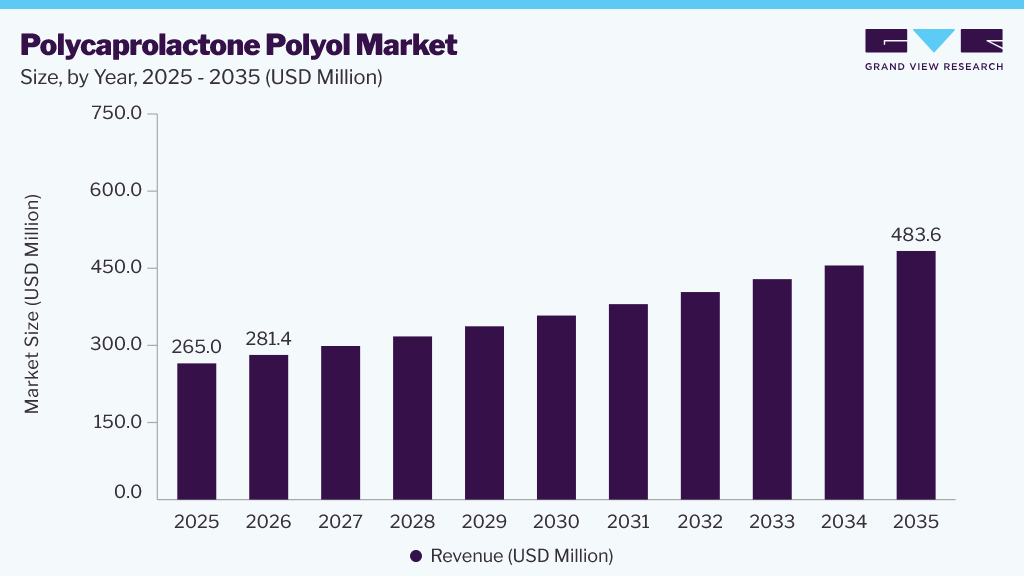 Source: Grand View Research, IR Documents, Primary Interviews, Paid DatabasesTo learn more about this report,
 Download Free Sample Report
However, the market faces challenges, including the relatively high production costs of polycaprolactone polyols compared to conventional polyether and polyester polyols, which may limit their adoption in cost-sensitive applications. Fluctuations in raw material prices and the availability of alternative polyurethane feedstocks also restrain market expansion. Despite these challenges, ongoing advancements in bio-based polyol technologies, increasing research and development activities, and the growing demand for environmentally friendly and high-performance specialty materials are expected to create significant opportunities for manufacturers. Expanding industrialization in emerging economies and the increasing use of advanced polyurethane systems in electric vehicles, renewable energy, and healthcare applications are also anticipated to support long-term market growth.
Analyst Perspective
The industry is supported by increasing demand for high-performance polyurethane materials across industrial and specialty applications. The market is benefiting from the growing preference for durable, flexible, and hydrolysis-resistant polyols in coatings, adhesives, sealants, and elastomers. The rising adoption of biodegradable and biocompatible materials in healthcare is further expanding the scope of applications for polycaprolactone polyols. Manufacturers are focusing on product innovation, sustainable formulations, and capacity expansion to address evolving customer requirements and regulatory expectations. In addition, increased investment in electric vehicles, advanced manufacturing, and biomedical technologies is expected to create new opportunities for market participants.
Product Insights
The diols segment dominated the market and accounted for the largest revenue share of approximately 57.0% in 2025. The dominance of the segment is attributed to the extensive use of polycaprolactone diols as key building blocks in polyurethane coatings, adhesives, sealants, and elastomers due to their excellent flexibility, hydrolytic stability, low-temperature performance, and chemical resistance. Their compatibility with isocyanates and ability to improve durability and mechanical properties make them the preferred choice in automotive, construction, industrial, and specialty applications, further increasing demand for polycaprolactone diols-based products.
The triols segment is expected to register the fastest CAGR during the forecast period. The growth is driven by rising demand for higher-functionality polyols that enable improved crosslink density, mechanical strength, and chemical resistance in advanced polyurethane formulations. Triols are increasingly adopted in specialty coatings, adhesives, and elastomers that require enhanced durability, flexibility, and long-term performance. In addition, the expanding development of sustainable polyurethane systems and increasing demand from biomedical, automotive, and specialty industrial applications are contributing to the market growth. Furthermore, continuous product innovation is further strengthening the adoption of caprolactone-based triols in high-performance polyurethane systems. For instance, in March 2025, Ingevity showcased its Capa caprolactone polyol portfolio at the European Coatings Show 2025 and introduced Capa PROTX 3112, a low-viscosity, trifunctional caprolactone polyol. This polyol is designed for safer coating formulations, supporting the development of high-performance, low viscosity polyurethane coatings.
Application Insights
The coatings segment dominated the market and accounted for the largest revenue share of approximately 35.0% in 2025. The segment growth is attributed to the widespread use of polycaprolactone polyols in high-performance polyurethane coatings that offer excellent durability, flexibility, abrasion resistance, hydrolytic stability, and chemical resistance. These properties make them suitable for automotive, industrial, marine, and protective coating applications where long service life and superior performance are essential. Growing demand for environmentally friendly, low-VOC, and high-performance coating systems, coupled with continuous advancements in polyurethane technology, is further supporting the expansion of the coatings segment.
The biomedical segment is expected to register the fastest CAGR during the forecast period. The growth of the segment is driven by the increasing use of polycaprolactone polyols in biodegradable and biocompatible medical materials, including tissue engineering scaffolds, drug delivery systems, wound care products, and implantable devices. Rising investments in regenerative medicine, advanced biomaterials, and medical research are expanding the application scope of polycaprolactone-based materials. Furthermore, increasing demand for sustainable and bioresorbable healthcare products is expected to create significant growth opportunities for the biomedical segment throughout the forecast period.
End Use Insights
The automotive segment dominated the market and accounted for the largest revenue share of 32.0% in 2025. Segment growth is driven by the extensive use of polycaprolactone polyols in polyurethane coatings, adhesives, sealants, and elastomers for automotive interiors, exterior components, and structural assemblies. These materials offer excellent flexibility, abrasion resistance, hydrolytic stability, and durability while supporting vehicle lightweighting and long-term performance. The increasing production of passenger and electric vehicles, coupled with rising demand for high-performance polyurethane materials, is expected to continue driving the adoption of polycaprolactone polyols in the automotive industry.
The healthcare segment is expected to register the fastest CAGR during the forecast period. The growth is driven by increasing demand for biocompatible and biodegradable materials used in medical devices, tissue engineering, drug delivery systems, wound care products, and implantable applications. Polycaprolactone polyols are gaining wider acceptance due to their controlled degradation characteristics, excellent biocompatibility, and ability to support advanced biomedical formulations. Furthermore, ongoing advancements in regenerative medicine, increasing healthcare investments, and growing research into sustainable biomaterials are expected to create significant growth opportunities for the healthcare segment over the forecast period.
Regional Insights
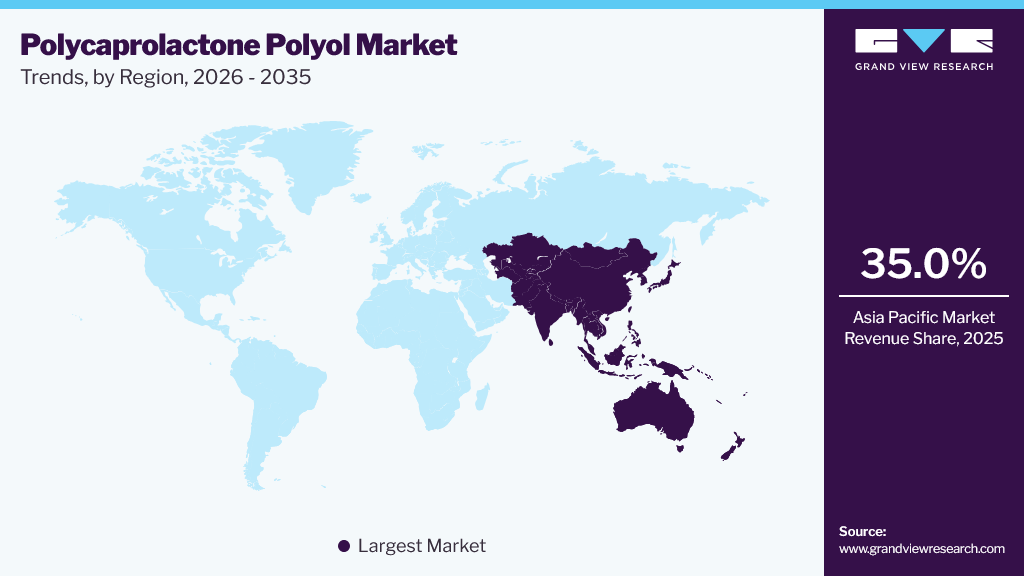
The Asia Pacific polycaprolactone polyol market dominated and accounted for the largest revenue share of 35.0% in 2025. The region is also expected to register the fastest CAGR during the forecast period. This growth is driven by the rapid expansion of the polyurethane industry, increasing production of automotive components, and rising demand for high-performance coatings, adhesives, sealants, and elastomers across China, India, Japan, and South Korea. Strong industrialization, expanding construction activities, and growing investments in advanced materials and specialty chemicals are further supporting market growth. In addition, the increasing adoption of sustainable polyurethane technologies and the presence of major manufacturing hubs are expected to reinforce Asia Pacific's leading position throughout the forecast period.
 To learn more about this report, Download Free Sample Report
North America Polycaprolactone Polyol Market Trends
The polycaprolactone polyol market in North America is anticipated to witness significant growth during the forecast period. The regional market is supported by increasing demand for high-performance polyurethane materials across the automotive, construction, healthcare, and industrial sectors. Growing investments in advanced polymer research, sustainable material development, and biomedical applications are contributing to market expansion. Furthermore, the presence of established polyurethane manufacturers, continuous product innovation, and increasing emphasis on environmentally friendly and high-value specialty materials are expected to support steady growth in the North American market. The region also benefits from a well-established specialty chemicals industry and strong research and development capabilities, supporting the commercialization of innovative polyurethane materials. For instance, in June 2025, Ingevity expanded its Capa caprolactone business in North America by strengthening its distribution network across the U.S. and Canada through a partnership with Jamplast. The expansion is aimed at increasing the market reach and availability of Ingevity’s polycaprolactone product portfolio in the region.
Key Polycaprolactone Polyol Market Companies Insights
The polycaprolactone polyol market is moderately consolidated, with leading companies focusing on product innovation, portfolio expansion, strategic partnerships, and strengthening their distribution network to enhance their competitive position. Market participants are investing in the development of high-performance and sustainable polycaprolactone polyols to meet the evolving requirements of polyurethane coatings, adhesives, sealants, elastomers, and biomedical applications. Companies are emphasizing research and development, advanced manufacturing capabilities, and global market expansion to address the growing demand for specialty polyurethane materials. In addition, collaborations with distributors and end-use industries, along with continuous innovation in bio-based and low-VOC formulations, are expected to strengthen their market presence over the forecast period.
Key Polycaprolactone Polyol Companies
The following key companies have been profiled for this study on the polycaprolactone polyol market:
-
Ingevity
-
Daicel Corporation
-
BASF
-
Covestro AG
-
LANXESS AG
-
Mitsubishi Chemical Group Corporation
-
Evonik Industries AG
-
Huntsman Corporation
-
UBE Corporation
Recent Developments
-
In November 2024, Ingevity and Nordmann expanded their long-standing distribution partnership to supply Capa polyols across additional European markets, including the Baltic states, Croatia, the Czech Republic, Poland, and Southeastern Europe. The expanded collaboration aims to strengthen customer access to high-performance caprolactone polyols for polyurethane applications and broaden Ingevity's market reach across Central and Eastern Europe.
-
In September 2024, Ingevity launched Capa HS, a next-generation polycaprolactone polyol with enhanced hydrolytic resistance, at the 2024 Polyurethanes Technical Conference. The product is designed to improve the durability of polyurethane elastomers in harsh, wet, and humid environments for applications across offshore, mining, petroleum, and wind energy industries.
-
In September 2024, Ingevity launched Capa L, a next-generation sustainable polycaprolactone polyol for polyurethane adhesives, at the FEICA European Adhesive & Sealant Conference and EXPO 2024. The product is designed for flexible food packaging, construction, and industrial applications, offering liquid-at-room-temperature processing, enhanced biodegradability, and compliance with EU food-contact regulations.
Polycaprolactone Polyol Market Report Scope
Report Attribute
Details
Market size in 2025
USD 265.0 million
Estimated market size in 2026
USD 281.4 million
Projected market size by 2035
USD 483.6 million
Growth rate
CAGR of 6.2% from 2026 to 2035
Base year for estimation
2025
Actual data
2021 – 2024
Forecast period
2026 – 2035
Quantitative units
Revenue in USD million, and CAGR from 2026 to 2035
Report coverage
Revenue forecast, company ranking, competitive landscape, growth factors, and trends
Segments covered
Product, application, end use, region
Regional scope
North America; Europe; Asia Pacific; Latin America; Middle East & Africa
Country scope
U.S.; Canada; Mexico; UK; Germany; France; Italy; Span; China; Japan; India; Australia; South Korea; Brazil; Argentina; South Africa; Saudi Arabia; UAE
Key companies profiled
Ingevity; Daicel Corporation; BASF; Covestro AG; LANXESS AG; Mitsubishi Chemical Group Corporation; Evonik Industries AG; Huntsman Corporation; UBE Corporation
Customization scope
Free report customization (equivalent to 8 analyst working days) with purchase. Addition or alteration to country, regional & segment scope.
Pricing and purchase options
Avail of customized purchase options to meet your exact research needs. Explore purchase options
Global Polycaprolactone Polyol Market Report Segmentation
This report forecasts revenue growth at the global, regional, and country levels and provides an analysis of the latest industry trends and opportunities across each sub-segment from 2021 to 2035. For this study, Grand View Research has segmented the global polycaprolactone polyol market report based on product, application, end use, and region:
-
Product Outlook (Revenue, USD Million, 2021 - 2035)
-
Diols
-
Triols
-
Tetrols
-
Others
-
-
Application Outlook (Revenue, USD Million, 2021 - 2035)
-
Adhesives
-
Coatings
-
Elastomers
-
Sealants
-
Biomedical
-
Others
-
-
End Use Outlook (Revenue, USD Million, 2021 - 2035)
-
Automotive
-
Construction
-
Healthcare
-
Packaging
-
Others
-
-
Regional Outlook (Revenue, USD Million, 2021 - 2035)
-
North America
-
U.S.
-
Canada
-
Mexico
-
-
Europe
-
UK
-
Germany
-
France
-
Italy
-
Spain
-
-
Asia Pacific
-
China
-
Japan
-
India
-
Australia
-
South Korea
-
-
Latin America
-
Brazil
-
Argentina
-
-
Middle East and Africa (MEA)
-
South Africa
-
Saudi Arabia
-
UAE
-
-
Frequently Asked Questions About This Report
The global polycaprolactone polyol market size was valued at USD 265.0 million in 2025 and is estimated at USD 281.4 million for 2026.
The global polycaprolactone polyol market is expected to grow at a CAGR of 6.2% from 2026 to 2035, reaching USD 483.6 million.
Asia Pacific dominated with approximately 35.0% revenue share in 2025.
The diols segment accounted for the largest revenue share of approximately 57.0% in 2025.
Key players in the market include Ingevity, Daicel Corporation, BASF, Covestro AG, LANXESS AG, Mitsubishi Chemical Group Corporation, Evonik Industries AG, Huntsman Corporation, UBE Corporation, and others.
About the Author(s)
Specialty & Chemicals Research Team
Research · Specialty & ChemicalsThis report was authored by the specialty & chemicals research team at Grand View Research - comprising two research analysts, one senior research analyst, and one industry expert - with specialized expertise in the specialty & chemicals segment of the research industry. All findings are based on proprietary research databases, executive interviews, and regulatory analysis, subject to internal peer review prior to publication.
Last Updated:
Speak to Analyst

Customize this report to your needs - add regions, segments, or data points, with 20% free customization.
Or view our licence options:


ISO 9001:2015 & 27001:2022 Certified
We are GDPR and CCPA compliant! Your transaction & personal information is safe and secure. For more details, please read our privacy policy.


