
- Home
- »
- Plastics, Polymers & Resins
- »
-
Polyvinyl Chloride Packaging Film Market Size Report, 2035GVR Report cover

Polyvinyl Chloride Packaging Film Market (2027 - 2035)
Size, Share & Trends Analysis Report By Film Type (PVC Stretch Film, PVC Shrink Film, PVC Cling Film, PVC Rigid Packaging Film), By Packaging Type, By Layer Type, By End-use, By Region, And Segment Forecasts
Market Size, 2026
$15.5BMarket Estimate, 2027
$16.1BMarket Forecast, 2035
$23.4BCAGR, 2027–2035
4.8%Polyvinyl Chloride Packaging Film Market Summary
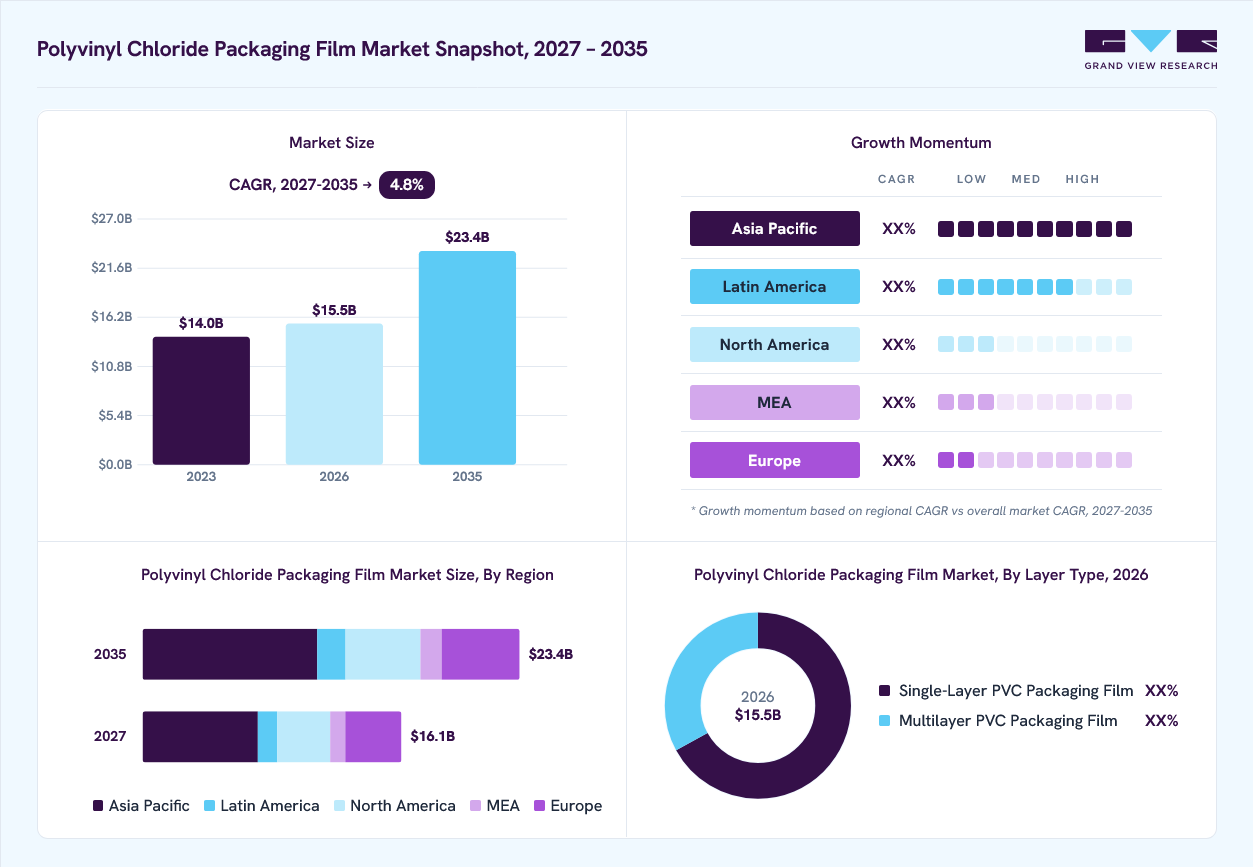
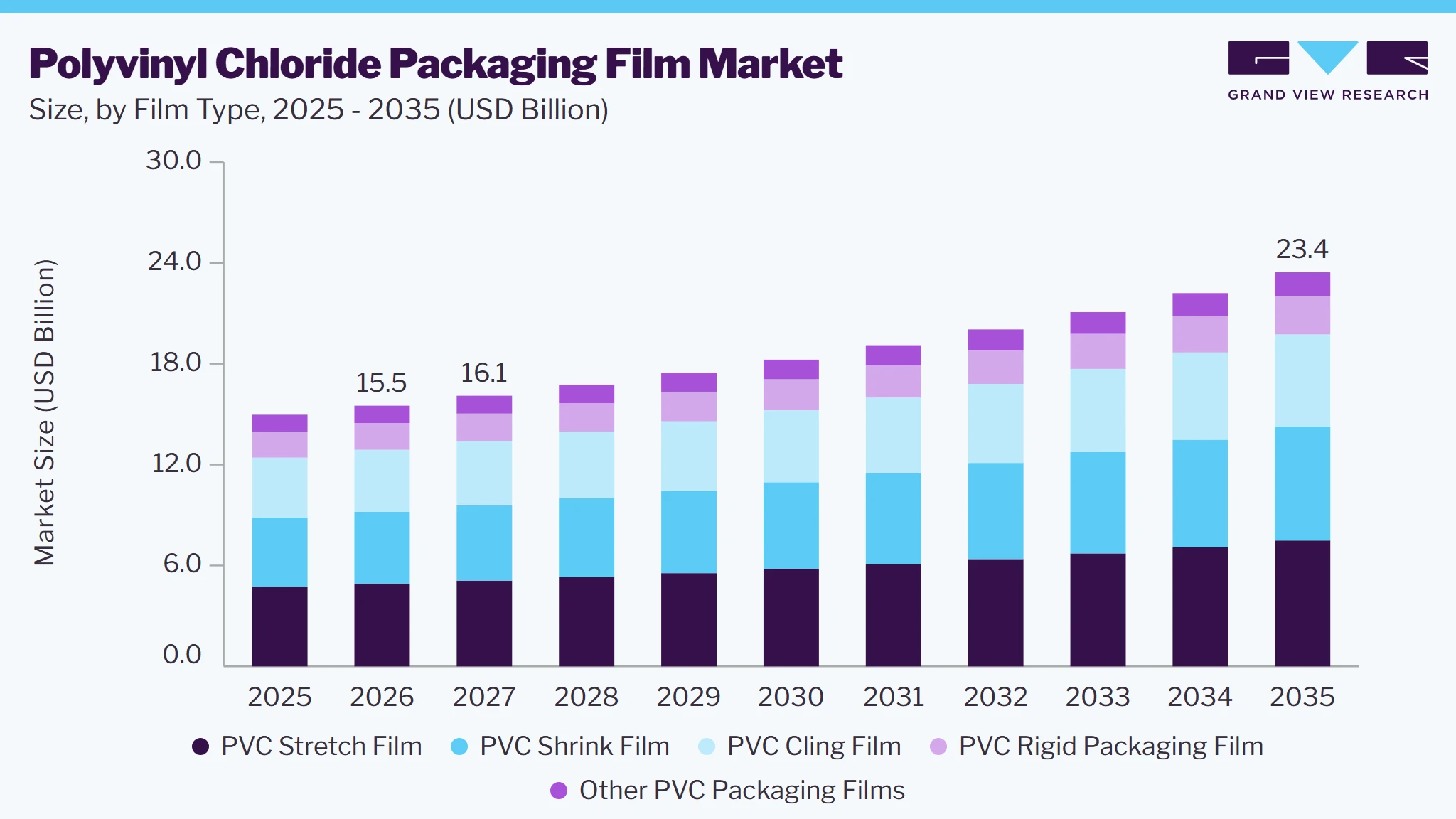
The global polyvinyl chloride packaging film market size was valued at USD 15.5 billion in 2026 and is projected to grow from USD 16.1 billion in 2027 to USD 23.4 billion by 2035, at a CAGR of 4.8% from 2027 to 2035. Asia Pacific dominated the market, accounting for a revenue share of 44.3% in 2026. The market is primarily driven by the increasing demand for cost-effective, durable, and versatile packaging materials across the food and beverage, pharmaceutical, personal care, and consumer goods industries.
 Source: Grand View Research, IR Documents, Primary Interviews, Paid DatabasesTo learn more about this report,
 Download Free Sample Report
Key Market Trends & Insights
- By film type: PVC stretch film held the largest revenue share of 31.7% in 2026.
- By packaging type: Flexible PVC packaging film accounted for the largest revenue share of 56.6% in 2026.
- By layer type: Single-layer PVC packaging film dominated the market with a 67.0% revenue share in 2026.
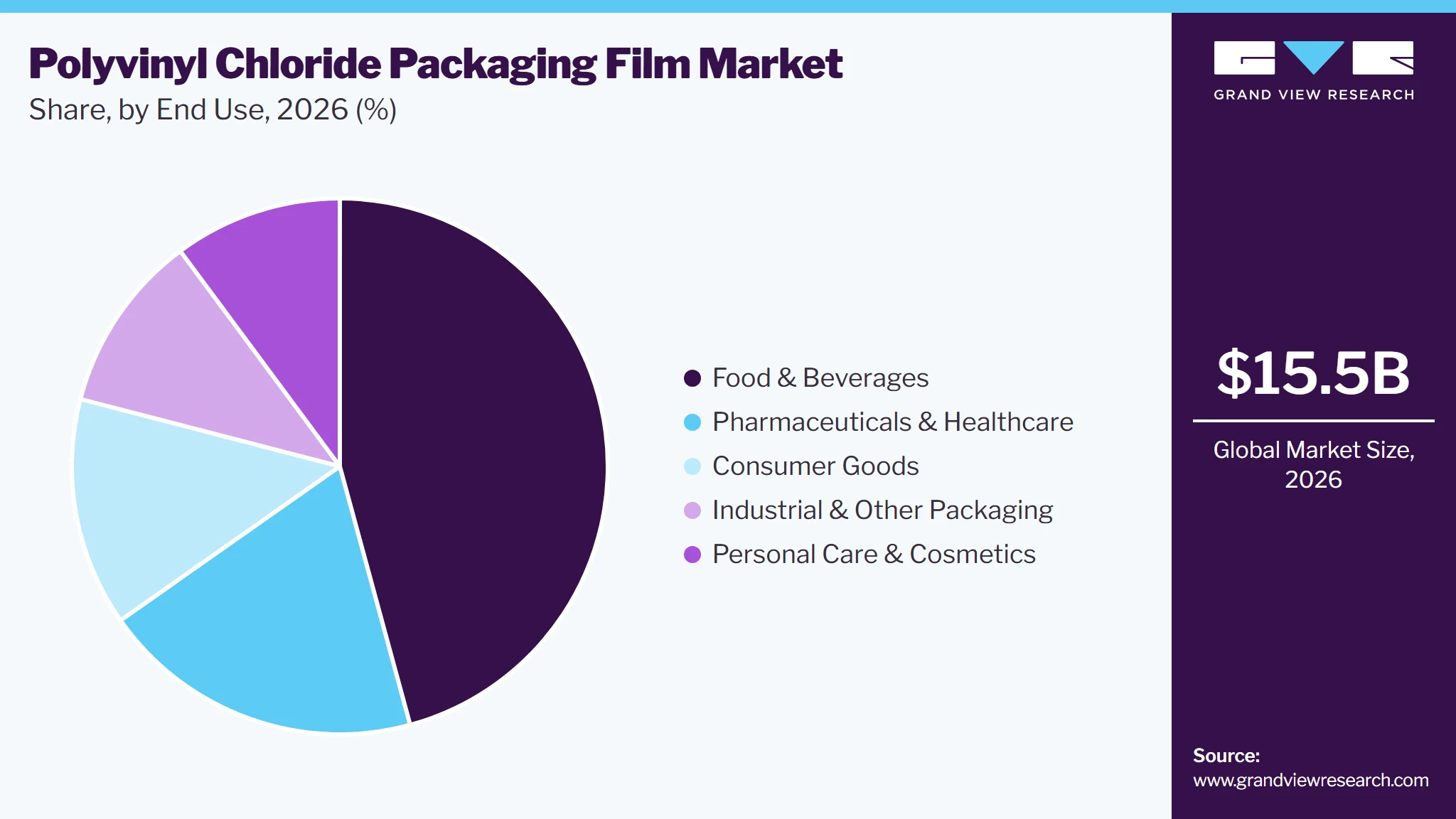
- By end-use: Food & beverages accounted for the largest revenue share of 45.8% in 2026.
Regional Highlights
- Largest regional market: Asia Pacific (44.3% revenue share, 2026)
- By country: China held the largest market share in 2026
Market Size & Forecast
- Market size in 2026: USD 15.5 Billion
- Estimated market size in 2027: USD 16.1 Billion
- Projected Market size by 2035: USD 23.4 Billion
- CAGR (2027-2035): 4.8%
Prism AI by Grand View Research Free to tryAsk a question about the polyvinyl chloride packaging film marketTry asking✓Every figure cited from GVR research Prefer the report? Download free sample →
PVC packaging films offer good transparency, flexibility, moisture resistance, and sealing properties, making them suitable for applications such as blister packaging, shrink wrapping, and product overwrapping.The global polyvinyl chloride (PVC) packaging film market is driven by demand for transparent, flexible, and cost-effective packaging. PVC films offer useful properties such as formability, sealing performance, and product visibility, supporting their use in food wrapping, shrink packaging, and pharmaceutical blister packs. Growing requirements for efficient packaging operations and consistent material performance continue to shape product demand.
 To learn more about this report, Download Free Sample Report
The market is also influenced by evolving packaging requirements in food safety and healthcare. Pharmaceutical applications require films with reliable forming characteristics and compatibility with high-speed packaging processes, while food packaging relies on suitable wrapping and protective properties. These diverse requirements are encouraging manufacturers to develop application-specific film grades that balance performance, processing efficiency, and cost.
Environmental concerns and recycling challenges remain important considerations for the industry. PVC film manufacturers face pressure to improve material efficiency and address end-of-life management while maintaining the functional properties required by customers. As a result, formulation improvements, optimized film structures, and responsible material use are becoming increasingly relevant to long-term market development.
Market Dynamics
The global polyvinyl chloride (PVC) packaging film market is driven by the demand for versatile, cost-effective, and protective packaging materials across food and beverage, pharmaceutical, personal care, and consumer goods applications. PVC films are valued for their transparency, flexibility, formability, and suitability for shrink wrapping, blister packaging, and product overwrapping. Market growth is supported by the need for product visibility, tamper-evident packaging, and efficient packaging formats. However, environmental concerns associated with PVC disposal, challenges related to recycling, and regulatory scrutiny of certain additives are encouraging manufacturers to improve material formulations and explore alternative packaging solutions.
The increasing use of transparent and formable packaging across pharmaceutical, food, and consumer goods applications is supporting demand for PVC packaging films. Their clarity enables product identification and visual inspection, while their flexibility and thermoformability make them suitable for producing packaging formats with customized shapes and dimensions. In retail applications, PVC shrink films and overwraps help secure products, maintain bundle integrity, and improve shelf presentation.
The expansion of organized retail, consumer goods distribution, and pharmaceutical packaging requirements is creating opportunities for manufacturers to supply films with application-specific thickness, stiffness, clarity, and processing characteristics. Improvements in film extrusion, thermoforming, and converting technologies are also helping packaging producers achieve consistent film quality and efficient production, supporting continued demand across established end use industries.
A major restraint for the PVC Packaging Film Market is the growing environmental scrutiny of PVC materials and the challenges associated with their collection, sorting, and recycling. Thin films, contaminated packaging, and multilayer structures can complicate material recovery, while PVC requires separation from other plastics to maintain recycling quality. Regulatory requirements concerning plastic waste management and certain additives, combined with brand owners' preference for packaging materials compatible with established recycling systems, may increase compliance costs and encourage substitution with alternative materials in selected applications.
A significant opportunity for the PVC Packaging Film Market lies in developing lightweight, high-performance films that maintain transparency, flexibility, and protective properties while reducing material consumption. Advances in film formulation, extrusion, and processing technologies can improve thickness consistency, formability, and packaging efficiency across pharmaceutical blister packs, shrink wraps, and protective overwraps. Additionally, improvements in PVC waste collection, sorting, and recycling infrastructure, alongside the development of application-specific formulations that comply with evolving regulations, can help manufacturers strengthen product differentiation and address changing sustainability requirements.
Market Concentration & Characteristics
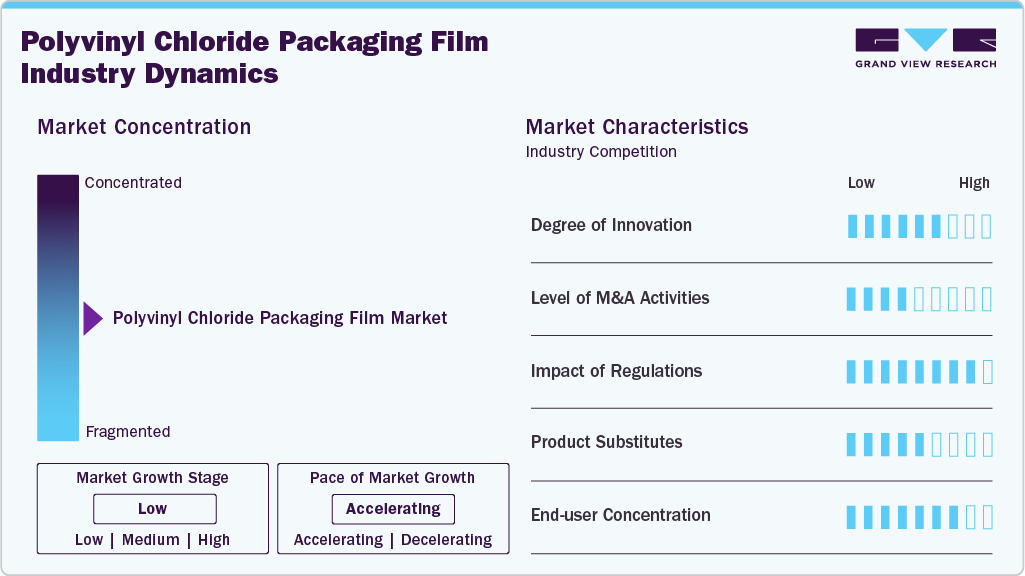
The polyvinyl chloride packaging film market is characterized by its application-driven demand, cost-sensitive production, and reliance on film properties tailored to specific packaging requirements. Manufacturers focus on achieving consistent film thickness, transparency, flexibility, thermoformability, and dimensional stability to meet the needs of pharmaceutical blister packaging, shrink wrapping, and protective overwrapping. Production efficiency, formulation control, and compatibility with downstream processes such as printing, sealing, and thermoforming are important competitive factors. Demand is influenced by the requirements of pharmaceutical companies, food processors, and consumer goods manufacturers, which prioritize packaging performance, product visibility, and reliable processing across high-volume operations.
 To learn more about this report, Download Free Sample Report
A defining feature of the industry is its dependence on PVC resin and specialized additives, including plasticizers, stabilizers, and processing aids, to achieve the required flexibility, clarity, and mechanical properties. Different formulations enable manufacturers to supply rigid, semi-rigid, and flexible films for diverse end use applications. However, environmental concerns surrounding PVC waste, recycling complexity, and regulatory scrutiny of certain additives are influencing material development and purchasing decisions. Manufacturers are increasingly focusing on optimized formulations, reduced material consumption, and improved production efficiency while assessing the suitability of alternative materials for selected applications. These factors are shaping product innovation, supplier differentiation, and long-term investment decisions across the global PVC packaging film industry.
Analyst Perspective
The global PVC packaging film market has evolved from conventional wrapping applications into a specialized packaging segment serving pharmaceutical blister packs, food wrapping, shrink packaging, and consumer goods protection. Historically, its growth has been supported by cost-effectiveness, transparency, flexibility, and ease of processing. Currently, demand is shaped by pharmaceutical manufacturing, retail packaging requirements, and the need for consistent performance in automated production. Looking ahead, the market is expected to benefit from expanding healthcare and consumer goods industries, alongside improvements in film formulation and processing technologies. However, recycling challenges, environmental concerns, and competition from alternative materials will influence future adoption. Manufacturers focusing on application-specific performance, material efficiency, and regulatory compliance are likely to remain competitive.
Film Type Insights
The PVC stretch film segment accounted for the largest revenue share of 31.7% in 2026. PVC stretch films are used for wrapping and securing products, bundling goods, and providing protective coverage during storage, handling, and transportation. Their flexibility, conformability, and ability to maintain close contact with packaged items make them suitable for selected industrial, commercial, and consumer packaging applications. Demand is supported by the need for cost-effective wrapping solutions that help protect products against dust, surface contamination, and handling-related damage. Their adaptability to different product shapes and packaging operations further supports their adoption across diverse end use industries.
The PVC shrink film segment is expected to grow at the fastest CAGR of 5.3% during the forecast period. PVC shrink films contract when exposed to heat, allowing them to conform closely to products and create a secure, visually appealing package. They are used in multipack bundling, retail product overwrapping, and packaging for consumer goods, cosmetics, and other merchandise. Their ability to provide product visibility, tamper-evident presentation, and compact packaging makes them attractive for retail-oriented applications. Growth is supported by demand for promotional multipacks, improved shelf presentation, and efficient secondary packaging formats. However, material selection is increasingly influenced by recyclability requirements and the availability of alternative shrink-film materials.
Packaging Type Insights
The flexible PVC packaging film segment accounted for the largest revenue share of 56.6% in 2026 and is expected to grow at the fastest CAGR of 5.0% during the forecast period. Flexible PVC films are used in cling wrapping, shrink wrapping, product overwrapping, and other applications requiring conformability and transparent packaging. Their flexibility, lightweight structure, and ability to adapt to different product shapes make them suitable for food packaging, consumer goods, and retail applications. Demand is supported by the need for efficient material utilization, product visibility, and packaging formats that facilitate handling and distribution.
The rigid and semi-rigid PVC packaging film segment serves applications that require greater structural stability, dimensional consistency, and formability. These films are particularly relevant to pharmaceutical blister packaging, where PVC film is thermoformed into cavities that hold tablets and capsules. Their suitability for high-speed forming and converting operations, combined with transparency and consistent processing performance, supports adoption in pharmaceutical and selected specialty packaging applications. However, material selection increasingly depends on product protection requirements, regulatory compliance, and compatibility with packaging waste-management systems.
Layer Type Insights
The single-layer PVC packaging film segment accounted for the largest revenue share of 67.0% in 2026. Single-layer PVC films are widely used in applications where a consistent material structure, transparency, flexibility, and cost-effective processing are sufficient to meet packaging requirements. These films are suitable for shrink-wrapping, cling-film applications, and product overwrapping, offering ease of conversion and compatibility with established packaging equipment. Their relatively straightforward manufacturing process and suitability for high-volume production support adoption among packaging converters and end use manufacturers seeking reliable performance without the added complexity of multilayer structures.
The multilayer PVC packaging film segment is expected to grow at the fastest CAGR of 5.4% during the forecast period. Multilayer film structures combine PVC with other polymers or functional layers to achieve specific packaging characteristics that may be difficult to obtain with a single material. Depending on the structure and application, these films can be engineered to improve barrier performance, mechanical strength, sealing characteristics, or resistance to handling-related damage. Demand is supported by specialized packaging requirements in pharmaceutical, healthcare, and consumer goods applications, where product protection and processing performance are important. However, multilayer construction can increase manufacturing complexity and make material separation and recycling more challenging.
End-use Insights
The food & beverages segment accounted for the largest revenue share of 45.8% in 2026. PVC packaging films are used in food wrapping, cling film applications, shrink wrapping, and overwrapping of selected food products. Their transparency allows consumers and retailers to inspect products, while their flexibility and conformability support wrapping irregular shapes and maintaining package presentation. Demand is supported by the requirements of food processors, supermarkets, and retail distributors for efficient packaging, product visibility, and convenient handling. PVC films are selected according to the specific food-contact regulations and performance requirements applicable to each application.
 To learn more about this report, Download Free Sample Report
The pharmaceuticals & healthcare segment is expected to grow at the fastest CAGR of 5.3% during the forecast period. PVC films are widely used as forming materials in pharmaceutical blister packaging, where they are thermoformed into individual cavities for tablets and capsules. Their formability, dimensional consistency, and compatibility with high-speed packaging operations make them suitable for large-scale pharmaceutical production. Growth is supported by rising demand for packaged medicines, expanding pharmaceutical manufacturing, and the need for unit-dose packaging that facilitates product identification, handling, and distribution. Material selection is also influenced by drug compatibility, moisture-barrier requirements, and regulatory standards, creating opportunities for application-specific PVC film formulations and specialized packaging structures.
Regional Insights
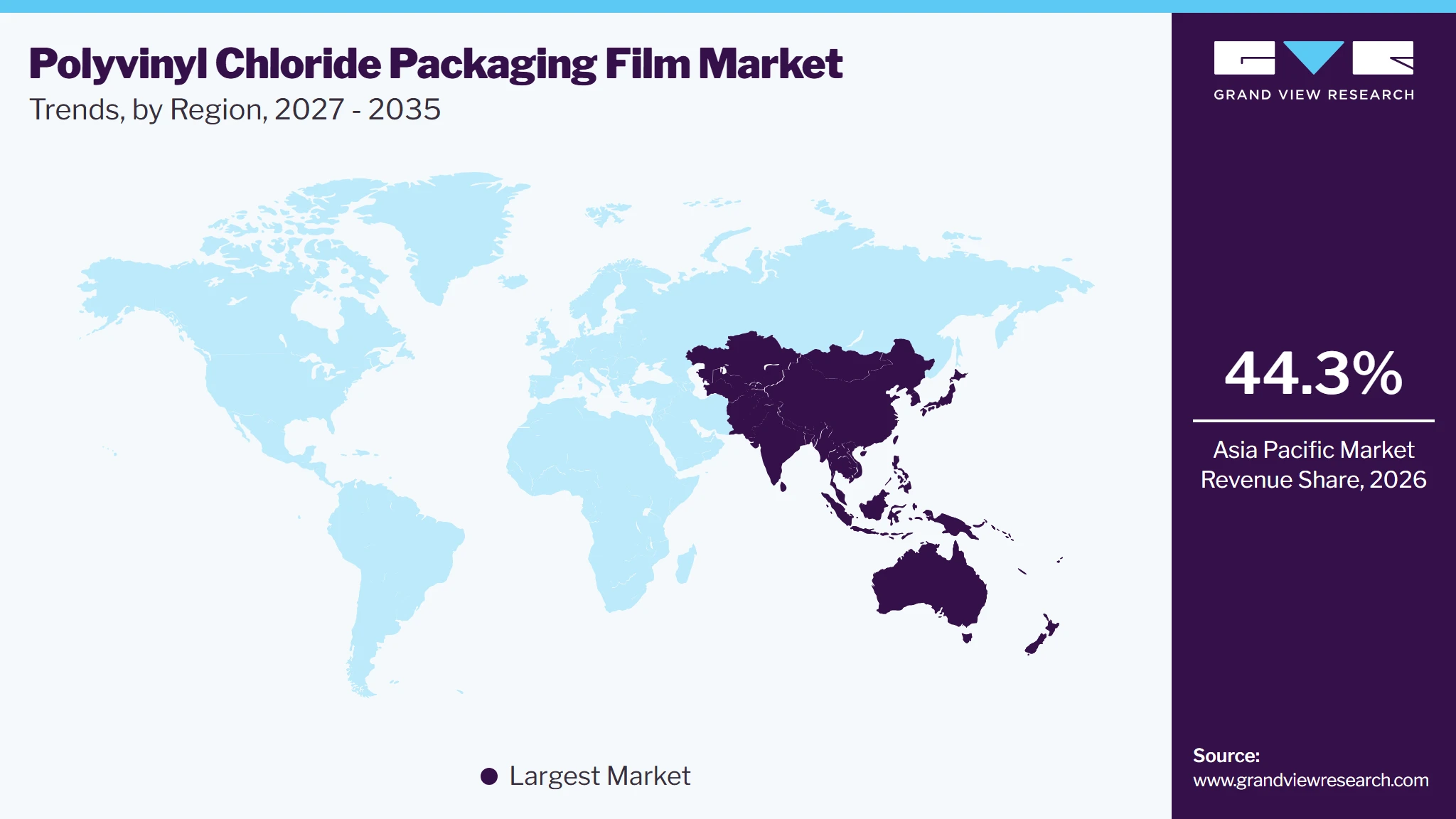
The Asia Pacific polyvinyl chloride packaging film market accounted for the largest revenue share of 44.3% in 2026 and is expected to register the fastest CAGR of 5.3% during the forecast period. Regional leadership is supported by the extensive manufacturing base for pharmaceuticals, food products, personal care items, and consumer goods across major economies. Expanding pharmaceutical production, growth in organized retail, and increasing demand for transparent packaging and shrink-wrapping solutions are sustaining film consumption. The presence of PVC resin producers, film converters, and packaging machinery suppliers also supports cost-efficient production and a well-developed supply chain. Rising investments in packaging automation and growing requirements for pharmaceutical blister films are expected to strengthen regional demand.
 To learn more about this report, Download Free Sample Report
China Polyvinyl Chloride Packaging Film Market Trends
China polyvinyl chloride packaging film market holds a prominent position in Asia Pacific, supported by its large-scale plastics processing industry and extensive manufacturing ecosystem. Demand is associated with pharmaceutical blister packaging, food wrapping, consumer goods overwrapping, and retail shrink films. The country's established PVC resin production and converting capabilities enable manufacturers to serve high-volume domestic requirements and export-oriented packaging markets. Continued development of pharmaceutical manufacturing, modern retail distribution, and packaging technology is expected to support market demand, while environmental compliance and plastic waste management remain important considerations for producers.
Polyvinyl chloride packaging film market in India is expected to experience strong growth, driven by expanding pharmaceutical manufacturing, increasing packaged food consumption, and the development of organized retail and consumer goods distribution. PVC films are used in pharmaceutical blister packs, shrink wrapping, and selected food and personal care packaging applications. Growth in domestic medicine production and the need for efficient unit-dose packaging are creating opportunities for film manufacturers and packaging converters. Investments in processing capacity, improvements in packaging infrastructure, and rising demand for cost-effective packaging formats are expected to support further market expansion.
North America Polyvinyl Chloride Packaging Film Market Trends
The polyvinyl chloride (PVC) packaging film market in North America is supported by established pharmaceutical, healthcare, food processing, and consumer goods industries that require consistent film quality and reliable packaging performance. Demand is influenced by the use of PVC in pharmaceutical blister packs, protective overwrapping, and selected shrink-film applications. Manufacturers emphasize process consistency, product protection, and compatibility with automated packaging lines. At the same time, increasing attention to packaging recyclability, material selection, and regulatory compliance is influencing purchasing decisions and encouraging converters to assess alternative materials for applications where PVC is less suitable.
Polyvinyl chloride packaging film market in the U.S. benefits from a substantial pharmaceutical manufacturing sector, advanced packaging conversion capabilities, and demand for reliable packaging formats across healthcare and consumer goods. Pharmaceutical blister packaging remains an important application because PVC films can be thermoformed into consistent cavities for tablets and capsules. Food retailing and consumer product distribution also support demand for selected shrink films and overwraps. Investments in automated packaging systems and high-quality film processing are expected to sustain demand, while customer expectations regarding material transparency, waste reduction, and compliance continue to shape product development.
Europe Polyvinyl Chloride Packaging Film Market Trends
The polyvinyl chloride packaging film market in Europeis shaped by demand from pharmaceutical manufacturing, specialty packaging, food processing, and consumer goods industries. PVC films continue to serve applications requiring transparency, formability, and reliable processing, particularly in pharmaceutical blister packaging and selected shrink-wrapping formats. However, the region's emphasis on packaging waste reduction, circularity, and chemical safety is influencing material specifications and supplier strategies. Manufacturers are increasingly required to consider applicable packaging regulations, additive restrictions, and end-of-life management when developing products for European customers. These factors are encouraging improvements in material efficiency and a more application-specific approach to PVC film use.
Germany represents an important polyvinyl chloride (PVC) packaging film market within Europe because of its established pharmaceutical, chemical, machinery, and packaging manufacturing industries. Demand for PVC packaging films is supported by pharmaceutical blister production, industrial packaging operations, and the country's advanced converting and processing infrastructure. The presence of technically sophisticated manufacturers creates demand for films with consistent thickness, thermoformability, dimensional stability, and dependable performance on automated packaging equipment. Ongoing emphasis on manufacturing efficiency, product quality, and packaging sustainability is expected to influence investment in film processing and material optimization.
UK polyvinyl chloride packaging film market is supported by pharmaceutical packaging requirements, food retail operations, and demand for protective packaging across consumer goods distribution. PVC films are used in selected blister packaging, shrink wrapping, and overwrapping applications where transparency and conformity to product shape are important. Demand is influenced by the requirements of pharmaceutical suppliers, packaging converters, and retailers seeking dependable packaging performance and efficient product presentation. Increasing focus on packaging waste reduction and recyclability is also encouraging businesses to review material specifications and evaluate alternative films for applications where they can meet the required functional and regulatory standards.
Latin America Polyvinyl Chloride Packaging Film Market Trends
The polyvinyl chloride packaging film market in Latin America is supported by the expansion of pharmaceutical production, packaged food distribution, personal care manufacturing, and modern retail channels. Demand is concentrated in applications where affordable packaging, transparency, and practical processing characteristics are important. PVC shrink films and overwraps support product bundling and retail presentation, while rigid and semi-rigid PVC films serve selected pharmaceutical packaging requirements. Market development is influenced by local film-converting capacity, raw material availability, currency fluctuations, and investment in packaging infrastructure. Growth in consumer goods manufacturing and distribution is expected to create additional opportunities for regional suppliers.
Brazil polyvinyl chloride packaging film market benefits from its sizeable consumer market and established food processing, pharmaceutical, cosmetics, and personal care industries. Demand for PVC films is supported by shrink wrapping, product overwrapping, and selected pharmaceutical packaging applications. The expansion of supermarkets, regional distribution networks, and packaged consumer products creates opportunities for converters supplying customized film formats. Domestic manufacturing capabilities and demand for cost-effective packaging solutions support market development, while growing attention to packaging waste management and material recovery is influencing decisions among manufacturers and brand owners.
The polyvinyl chloride packaging film market in Argentina is influenced by demand from pharmaceutical manufacturers, food processors, and consumer goods producers seeking functional and economical packaging materials. PVC films can support blister packaging, shrink wrapping, and protective overwrapping, depending on product requirements. Market performance is closely linked to industrial production, the availability and cost of imported or locally sourced inputs, and investment in packaging conversion equipment. Demand for reliable packaging formats in medicine distribution and retail product presentation is expected to support opportunities for suppliers that can maintain consistent quality and manage input-cost volatility.
Middle East & Africa Polyvinyl Chloride Packaging Film Market Trends
The polyvinyl chloride packaging film market in the Middle East & Africa is supported by growing pharmaceutical distribution, food processing, retail modernization, and the gradual development of local packaging manufacturing. Demand arises from selected shrink-film applications, product overwrapping, and pharmaceutical packaging requirements. Investments in healthcare infrastructure and consumer goods distribution are creating opportunities for packaging converters, particularly in markets seeking to strengthen domestic supply capabilities. However, dependence on imported packaging materials and processing equipment in some countries, together with differences in recycling infrastructure and regulatory implementation, can influence adoption and operating costs. Expansion of local manufacturing and improved packaging supply chains are expected to contribute to market development.
Key Polyvinyl Chloride Packaging Film Company Insights
Some of the key companies in the global polyvinyl chloride (PVC) packaging film market include Klöckner Pentaplast, AVI Global Plast Pvt. Ltd., NAN YA PLASTICS CORPORATION, Amcor plc, Tekni-Plex, Inc., RENOLIT SE, Riflex Film, Liveo Research, Caprihans India Limited, ALFATHERM SpA, and Röchling. The market is characterized by demand for transparent, formable, flexible, and durable films used in pharmaceutical blister packaging, shrink wrapping, overwrapping, and other protective packaging applications. Key participants focus on developing application-specific film grades, maintaining consistent processing and forming performance, and meeting customer requirements for product protection, visual presentation, and manufacturing efficiency. Environmental considerations, material optimization, and competition from alternative packaging materials also influence product development and purchasing decisions.
-
Klöckner Pentaplast (kp) develops rigid and barrier films for pharmaceutical packaging, including PVC-based films used in blister applications. Its portfolio addresses packaging requirements such as thermoformability, product protection, and compatibility with pharmaceutical packaging processes. The company also offers film structures designed to meet different barrier requirements, supporting the needs of medicine manufacturers.
-
AVI Global Plast Pvt. Ltd. manufactures PVC films and thermoformed packaging at its facility in India. Its portfolio includes application-specific PVC film grades for pharmaceutical blister packaging, printing, lamination, cards, and other packaging uses. By combining film production with thermoforming capabilities, the company supports customers seeking consistency between material specifications and finished-pack requirements.
Key Polyvinyl Chloride Packaging Film Companies:
The following key companies have been profiled for this study on the polyvinyl chloride packaging film market:
-
Klöckner Pentaplast
-
AVI Global Plast Pvt. Ltd.
-
NAN YA PLASTICS CORPORATION
-
Amcor plc.
-
Tekni-Plex, Inc.
-
RENOLIT SE
-
Riflex Film
-
Liveo Research
-
Caprihans India Limited.
-
ALFATHERM SpA
-
Röchling
Competitive Benchmarking
Category
Operating Strategies
Competitive Edge
Weakness
Established Players (Klöckner Pentaplast; Amcor plc; Tekni-Plex, Inc.; NAN YA PLASTICS CORPORATION; RENOLIT SE; Röchling)
- Focus on expanding PVC film portfolios for pharmaceutical blister packaging, shrink sleeves, and protective packaging. Invest in film formulation, thermoforming performance, barrier properties, manufacturing efficiency, and product quality to meet end use requirements.
- Established manufacturing capabilities, technical expertise, broad customer relationships, and diversified film portfolios support consistent supply and application-specific solutions across packaging markets.
- Environmental concerns surrounding PVC, recycling complexity, regulatory compliance costs, and competition from alternative packaging materials may affect investment decisions and market growth.
Specialized and Emerging Players (AVI Global Plast Pvt. Ltd.; Riflex Film; Liveo Research; Caprihans India Limited; ALFATHERM SpA)
- Emphasize specialized PVC film grades, pharmaceutical blister films, flexible packaging films, and shrink applications. Focus on product customization, film quality, printability, formability, and customer-specific specifications.
- Application-focused expertise, product customization, and the ability to address specific packaging requirements support differentiation in pharmaceutical, healthcare, and flexible packaging applications.
- Relatively narrower geographic reach or product specialization may limit access to broader markets. Raw-material cost fluctuations, sustainability expectations, and competition from non-PVC films can create additional challenges.
Recent Developments
-
In January 2026, Liveo Research AG introduced EZ Fill™, an improved coating surface for pharmaceutical blister films designed to reduce friction during tablet filling and lower blister rejection rates. Company testing indicated that the technology could increase blister-line productivity by more than 30%. The development supports demand for PVC and other blister films that improve processing efficiency and packaging-line performance.
-
In May 2026, Tekni-Plex Healthcare highlighted its recyclable pharmaceutical blister packaging solutions at Pharma Days 2026. Its portfolio included PFAS-free SBC PVDC-coated PVC structures designed to provide moisture and oxygen protection for medicines requiring demanding stability performance. The company also showcased alternative recyclable blister structures, reflecting the industry’s focus on balancing drug protection with end-of-life packaging considerations.
Polyvinyl Chloride Packaging Film Market Report Scope
Report Attribute
Details
Market size in 2026
USD 15.5 billion
Estimated market size in 2027
USD 16.1 billion
Projected market size by 2035
USD 23.4 billion
Growth rate
CAGR of 4.8% from 2027 to 2035
Base year for estimation
2026
Historical data
2023 - 2025
Forecast period
2027 - 2035
Quantitative units
Revenue in USD billion and CAGR from 2027 to 2035
Report coverage
Revenue forecast, company ranking, competitive landscape, growth factors, and trends
Segments covered
Film type, packaging type, layer type, end-use, region
Regional Scope
North America; Europe; Asia Pacific; Latin America; Middle East & Africa
Country Scope
U.S.; Canada; Mexico; Germany; France; UK; Italy; Spain; China; India; Japan; South Korea; Australia; Brazil; Argentina; Saudi Arabia; UAE; South Africa
Key companies profiled
Klöckner Pentaplast; AVI Global Plast Pvt. Ltd.; NAN YA PLASTICS CORPORATION; Amcor plc.; Tekni-Plex, Inc.; RENOLIT SE; Riflex Film; Liveo Research; Caprihans India Limited.; ALFATHERM SpA; Röchling
Customization scope
Free report customization (equivalent up to 8 analysts working days) with purchase. Addition or alteration to country, regional & segment scope.
Pricing and purchase options
Avail of customized purchase options to meet your exact research needs. Explore purchase options
Global Polyvinyl Chloride Packaging Film Market Report Segmentation
This report forecasts revenue growth at the global, regional, and country levels and provides an analysis on the latest industry trends and opportunities in each of the sub-segments from 2023 to 2035. For this study, Grand View Research has segmented the global polyvinyl chloride packaging film market report on the basis of film type, packaging type, layer type, end-use, and region:
-
Film Type Outlook (Revenue, USD Billion, 2023 - 2035)
-
PVC Stretch Film
-
PVC Shrink Film
-
PVC Cling Film
-
PVC Rigid Packaging Film
-
Other PVC Packaging Films
-
-
Packaging Type Outlook (Revenue, USD Billion, 2023 - 2035)
-
Flexible PVC Packaging Film
-
Rigid and Semi-Rigid PVC Packaging Film
-
-
Layer Type Outlook (Revenue, USD Billion, 2023 - 2035)
-
Single-Layer PVC Packaging Film
-
Multilayer PVC Packaging Film
-
-
End-use Outlook (Revenue, USD Billion, 2023 - 2035)
-
Food & Beverages
-
Pharmaceuticals & Healthcare
-
Personal Care & Cosmetics
-
Consumer Goods
-
Industrial & Other Packaging
-
-
Regional Outlook (Revenue, USD Billion, 2023 - 2035)
-
North America
-
U.S.
-
Canada
-
Mexico
-
-
Europe
-
Germany
-
France
-
UK
-
Italy
-
Spain
-
-
Asia Pacific
-
China
-
India
-
Japan
-
South Korea
-
Australia
-
-
Latin America
-
Brazil
-
Argentina
-
-
Middle East & Africa
-
Saudi Arabia
-
UAE
-
South Africa
-
-
Research Methodology
The polyvinyl chloride packaging film marketfigures in this report are based on a proven research process that combines executive interviews with secondary research from proprietary databases, company filings, and recognized regulatory and institutional sources. Market size is built through value-chain sizing-reconciling supply-side and demand-side estimates-and triangulated with bottom-up and top-down approaches. Every estimate passes multiple levels of expert validation before publication, with eachpolyvinyl chloride packaging film segment quantified using the revenue-capture definitions in the table below.
Segment Definition
Segment - Film Type
Revenue capture definition
PVC Stretch Film
Revenue generated from the sale of PVC stretch films used to wrap, secure, and bundle products for storage, handling, and transportation. Includes PVC films supplied for protective wrapping and packaging applications requiring flexibility, conformability, and resistance to surface contamination.
PVC Shrink Film
Revenue generated from the sale of PVC shrink films that contract under heat to conform closely to packaged products. Includes films used for retail overwrapping, multipack bundling, product presentation, tamper-evident packaging, and protective packaging of consumer goods and other merchandise.
PVC Cling Film
Revenue generated from the sale of PVC cling films used to wrap food products and other suitable items requiring a flexible film that adheres to itself or compatible surfaces. Includes films supplied for food wrapping, commercial food handling, retail packaging, and other applications requiring transparency, conformability, and surface adhesion.
PVC Rigid Packaging Film
Revenue generated from the sale of rigid and semi-rigid PVC packaging films used primarily in thermoformed packaging applications. Includes PVC films supplied for pharmaceutical blister packs, tablet and capsule packaging, and other packaging formats requiring dimensional stability, formability, transparency, and consistent processing performance.
Other PVC Packaging Films
Revenue generated from the sale of other PVC packaging films not classified under stretch, shrink, cling, or rigid packaging films. Includes specialty PVC films used for protective overwrapping, customized packaging formats, and other applications requiring specific combinations of flexibility, clarity, thickness, and mechanical properties.
Segment - Packaging Type
Revenue capture definition
Flexible PVC Packaging Film
Revenue generated from the sale of flexible PVC packaging films used for wrapping, covering, bundling, and protecting products across food and beverage, personal care, consumer goods, and other suitable applications. Includes PVC cling films, shrink films, stretch films, and flexible overwrapping films that provide conformability, transparency, and efficient packaging performance.
Rigid and Semi-Rigid PVC Packaging Film
Revenue generated from the sale of rigid and semi-rigid PVC packaging films used in applications requiring structural stability, formability, and dimensional consistency. Includes PVC films supplied for pharmaceutical blister packaging, thermoformed trays, cavities, and other specialized packaging formats where product visibility, mechanical strength, and compatibility with high-speed forming processes are important.
Segment - Layer Type
Revenue capture definition
Single-Layer PVC Packaging Film
Revenue generated from the sale of single-layer PVC packaging films manufactured with a single continuous polymer layer. Includes films used in shrink wrapping, cling wrapping, product overwrapping, and pharmaceutical packaging applications where transparency, flexibility, formability, and cost-efficient processing meet the required packaging specifications.
Multilayer PVC Packaging Film
Revenue generated from the sale of multilayer packaging films incorporating PVC as one of the constituent layers, combined with other polymers or functional materials to achieve application-specific performance. Includes films designed to enhance barrier properties, mechanical strength, sealing performance, or product protection for pharmaceutical, healthcare, consumer goods, and other specialized packaging applications.
Segment - End Use
Revenue capture definition
Food & Beverages
Revenue generated from the sale of PVC packaging films used for wrapping, overwrapping, bundling, and protecting food and beverage products. Includes PVC cling films for food wrapping, shrink films for multipack packaging, and other suitable films used in food retail, food service, and distribution applications, subject to applicable food-contact requirements.
Pharmaceuticals & Healthcare
Revenue generated from the sale of PVC packaging films used in pharmaceutical and healthcare packaging applications. Includes rigid and semi-rigid PVC films used as forming materials in blister packs for tablets and capsules, as well as films used for selected medical and healthcare product packaging requiring formability, dimensional stability, product visibility, and compatibility with packaging processes.
Personal Care & Cosmetics
Revenue generated from the sale of PVC packaging films used to package, wrap, bundle, and protect personal care and cosmetic products. Includes shrink films and overwrapping films for products such as toiletries, skincare items, cosmetic containers, and personal hygiene products, where transparency, product presentation, and packaging integrity are important.
Consumer Goods
Revenue generated from the sale of PVC packaging films used for packaging and protecting consumer products across retail and distribution channels. Includes shrink films, cling films, and overwrapping films used for toys, household products, stationery, electronics accessories, and other merchandise requiring product visibility, bundling, surface protection, and secure presentation.
Industrial & Other Packaging
Revenue generated from the sale of PVC packaging films used in industrial, commercial, and other specialized packaging applications not classified under the preceding end use segments. Includes films used for component wrapping, product bundling, protective overwrapping, and packaging of selected manufactured goods where flexibility, durability, conformability, and resistance to handling-related damage are required.
Estimation Model
Layer Name
Key Question
Description
End Use Industry Layer
What drives demand?
Estimate demand from key end use industries, including food and beverages, pharmaceuticals and healthcare, personal care and cosmetics, consumer goods, and industrial packaging, which utilize PVC packaging films for wrapping, product protection, blister packaging, and retail presentation.
Packaging Type Adoption Layer
Where are PVC packaging films used?
Assess the adoption of flexible and rigid or semi-rigid PVC packaging films across applications based on requirements such as transparency, flexibility, thermoformability, dimensional stability, product protection, and compatibility with packaging machinery.
Film Type and Layer Consumption Layer
Which products generate demand?
Evaluate consumption of PVC stretch films, PVC shrink films, PVC cling films, PVC rigid packaging films, and other PVC packaging films, while assessing single-layer and multilayer film structures according to their functional properties and end use requirements.
Revenue Layer
How is revenue generated?
Estimate revenue generated through the sale of PVC packaging films to packaging converters, pharmaceutical manufacturers, food processors, personal care companies, consumer goods producers, and industrial customers. Revenue assessment considers film type, packaging configuration, end use application, product specifications, and regional demand patterns.
Delivered Customizations
We have successfully delivered the following deep-dive customizations:
Client Request
Customization Delivered
Value Adds
Competitive
Benchmarking
Comparative assessment of key PVC packaging film manufacturers based on film portfolio, product specifications, manufacturing capabilities, end use industry focus, geographic presence, technological developments, and sustainability initiatives. The analysis evaluates their positioning across PVC stretch films, shrink films, cling films, and rigid packaging films.
Helps clients assess competitor strengths, identify product portfolio gaps, benchmark manufacturing capabilities, and develop effective strategies for market positioning, partnerships, and business expansion.
Regional Analysis
Detailed assessment of the PVC Packaging Film Market across North America, Europe, Asia Pacific, Latin America, and the Middle East & Africa, covering regional demand patterns, pharmaceutical and consumer goods manufacturing, packaging applications, local production capabilities, regulatory requirements, and material preferences.
Enables clients to identify promising geographic markets, understand regional differences in application demand, evaluate expansion opportunities, and align distribution and investment strategies with regional market conditions.
Opportunity Assessment
In-depth evaluation of emerging opportunities across film types, packaging configurations, and end use industries, including pharmaceutical blister packaging, food wrapping, shrink films, and consumer goods overwrapping. The assessment considers demand trends, product innovation, material efficiency, evolving packaging requirements, and opportunities for application-specific film development.
Supports strategic decision-making by identifying attractive market segments, emerging customer requirements, potential areas for product differentiation, and opportunities to strengthen market presence through targeted investments and portfolio development.
Frequently Asked Questions About This Report
The global polyvinyl chloride packaging film market size was valued at USD 15.5 billion in 2026 and is estimated at USD 16.1 billion for 2027.
The global polyvinyl chloride packaging film market is expected to grow at a CAGR of 4.8% from 2027 to 2035, reaching USD 23.4 billion by 2035.
Key factors include the market is primarily driven by increasing demand for flexible and protective packaging, growing applications in food and beverages and pharmaceutical packaging, the need for transparent and formable packaging materials, and the expanding use of stretch, shrink, and cling films across consumer and industrial applications.
Asia Pacific dominated the market, accounting for a revenue share of 44.3% in 2026.
The PVC stretch film segment accounted for the largest revenue share of 31.7% in 2026, while PVC shrink film segment is the fastest-growing film type.
The single-Layer PVC packaging film segment led the market with a 67.0% revenue share in 2026, while multilayer PVC packaging film segment is the fastest-growing layer type.
The flexible PVC packaging film segment accounted for the largest revenue share of 56.6% in 2026 and is the fastest-growing segment.
The food & beverages segment accounted for the largest revenue share of 45.8% in 2026, while pharmaceuticals & healthcare segment is the fastest-growing end-use.
About the Author(s)
Plastics, Polymers & Resins Research Team
Bulk Chemicals · Plastics, Polymers & ResinsThis report was authored by the plastics, polymers & resins research team at Grand View Research - comprising two research analysts, one senior research analyst, and one industry expert - with specialized expertise in the plastics, polymers & resins segment of the bulk chemicals industry. All findings are based on proprietary bulk chemicals databases, executive interviews, and regulatory analysis, subject to internal peer review prior to publication.
Last Updated:
Speak to Analyst

Customize this report to your needs - add regions, segments, or data points, with 20% free customization.
Or view our licence options:


ISO 9001:2015 & 27001:2022 Certified
We are GDPR and CCPA compliant! Your transaction & personal information is safe and secure. For more details, please read our privacy policy.


