
- Home
- »
- Plastics, Polymers & Resins
- »
-
Blister Packaging Market Size, Share, Industry Report, 2033GVR Report cover

Blister Packaging Market (2026 - 2033) Size, Share & Trends Analysis Report By Material (Paper & Paperboard, Plastic Films, Aluminum), By Type (Carded, Clamshell), By Technology (Thermoforming, Cold Forming), By End Use, By Region, And Segment Forecasts
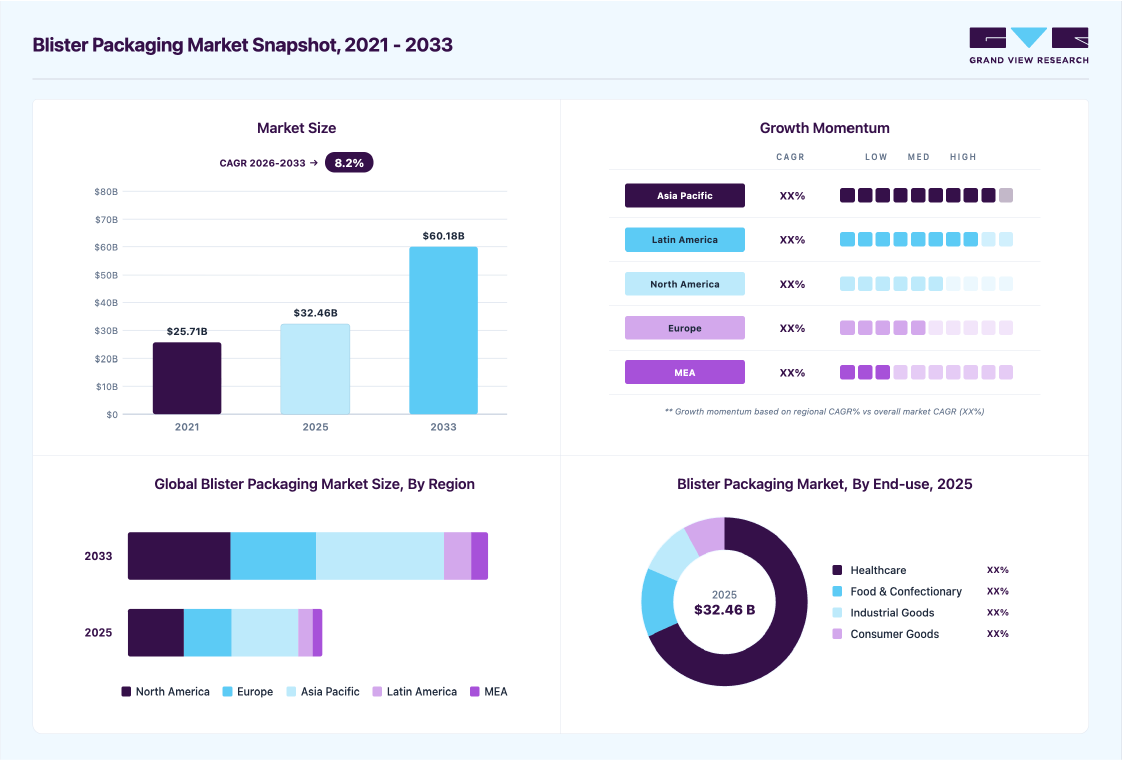
Market Size, 2025
$32.5BMarket Estimate, 2026
$34.7BMarket Forecast, 2033
$60.2BCAGR, 2026–2033
8.2%Blister Packaging Market Summary
The global blister packaging market size was valued at USD 32.5 billion in 2025 and is projected to grow from USD 34.7 billion in 2026 to USD 60.2 billion by 2033, at a CAGR of 8.2% from 2026 to 2033. Asia Pacific held the dominating position in the global nitrogen oxide control systems market with 34.1% share in 2025. The expanding pharmaceutical and healthcare industry is driving market growth.
 Source: Grand View Research, IR Documents, Primary Interviews, Paid DatabasesTo learn more about this report,
 Download Free Sample Report
 Key Market Trends & Insights
- By material: the plastic films segment is anticipated to expand at a CAGR of 8.4% in revenue from 2026 to 2033.
- By technology: the thermoforming segment is projected to grow at a CAGR of 8.3% in terms of revenue from 2026 to 2033.
- By type: the carded segment is expected to grow at a CAGR of 8.3% in revenue from 2026 to 2033.
- By end use: the healthcare segment is forecast to witness growth at a CAGR of 8.7% in revenue from 2026 to 2033.
Regional Highlights
- Largest regional market: Asia Pacific (34.1% revenue share, 2025)
- By country: The China nitrogen oxide control systems industry is a major contributor to the global market.
Market Size & Forecast
- Market size in 2025: USD 32.5 Billion
- Estimated market size in 2026: USD 34.7 Billion
- Projected market size by 2033: USD 60.2 Billion
- CAGR (2026-2033): 8.2%
Three ways to get this report
Buy it, customize it, or ask a question.Ask an Analyst
Analyst response in 1 business day
- AccessReport author, directly
- Reply timeWithin 1 working day
- No sales callDirect answer only
- FormatEmail reply
- CostFree, no cost
Get the Full Report
What the study covers
- FormatsPDF · Excel · Dashboard
- Timeline2026–2033 annual, 2025 base
- Coverage20+ countries, 5 regions
- Companies10+ key players profiled
Customize the Report
20% free customization
- IncludeCountries, segments, points
- TailorTo your product definition
- ExtendDeeper competitor detail
- OrA fully bespoke study
- Turnaround5–10 working days
Moreover, the development of eco-friendly and recyclable blister packaging has addressed sustainability concerns, thus contributing to market growth. The pharmaceutical and healthcare sectors are major consumers of blister packaging. This packaging solution offers several advantages, including product protection, tamper-evident features, and ease of distribution. Blister packs ensure the safety and integrity of medications, supplements, and medical devices during storage and transportation. Moreover, the ability to include desiccants or moisture-absorbing materials in blister packs helps extend the shelf life of sensitive products.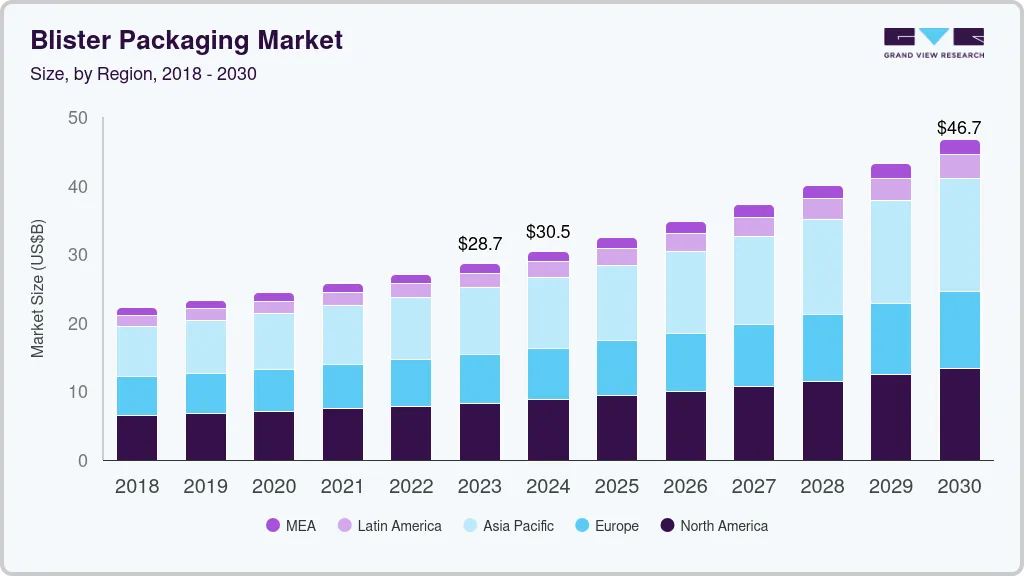 To learn more about this report, Download Free Sample Report
 Blister packs are highly convenient for consumers, especially for on-the-go products. Their compact size and easy-to-carry nature make them ideal for various consumer goods, such as pain relievers, cough drops, and small electronic components. The ability to detach individual doses or units from the blister pack offers portability and ease of use. This convenience factor has driven the adoption of blister packaging in consumer markets, ranging from personal care products to batteries and small hardware items.
Blister packaging offers valuable branding and marketing opportunities for the end use companies. The clear visibility of the product allows for effective product display and differentiation on retail shelves. In addition, blister packs can be printed with vibrant graphics, logos, and product information, enhancing brand recognition and consumer appeal. This versatility in branding and marketing has made blister packaging a popular choice for various consumer goods, electronics, and retail products.
Moreover, the market is constantly evolving, driven by technological advancements and innovative solutions to address sustainability concerns and align with eco-friendly packaging trends. For instance, in November 2024, Bayer launched PET-based blister packaging for its Aleve pain relief capsules, marking a sustainability milestone in pharmaceutical packaging. This mono-material innovation replaces traditional PVC, improving recyclability while cutting environmental impact.
Market Dynamics
One of the major factors driving the global blister packaging market is the rapid expansion of the pharmaceutical industry and the increasing need for safe, tamper-evident, and dosage-specific packaging solutions. Blister packaging offers superior product protection against moisture, oxygen, contamination, and physical damage, making it highly suitable for tablets, capsules, and medical devices. In addition, the growing prevalence of chronic diseases, aging populations, and rising healthcare expenditure across both developed and emerging economies are significantly increasing pharmaceutical consumption, thereby driving demand for blister packs. Pharmaceutical manufacturers also prefer blister packaging because it improves patient compliance through unit-dose packaging and clear labeling, helping reduce medication errors and enhancing convenience for consumers.
Beyond pharmaceuticals, the growing adoption of blister packaging in consumer goods, food, and personal care products is further supporting market growth. Manufacturers are increasingly using blister packs for their attractive product visibility, lightweight design, cost efficiency, and compatibility with automated packaging lines. The rising demand for retail-ready, sustainable packaging formats is also driving innovation in recyclable, paper-based blister packaging materials. Moreover, the expansion of the e-commerce and organized retail sectors has heightened the need for durable packaging that protects products during transportation while enhancing shelf appeal. These advantages continue to strengthen the adoption of blister packaging across multiple end-use industries globally.
Despite strong market growth, the blister packaging industry faces a significant restraint: environmental concerns about plastic waste and limited recyclability. Traditional blister packs are commonly manufactured using combinations of plastic materials such as PVC, PET, and aluminum foil, which are difficult to separate and recycle through conventional waste management systems. Increasing global regulations targeting single-use plastics, along with rising consumer preference for sustainable packaging alternatives, are putting pressure on manufacturers to develop eco-friendly solutions. However, transitioning to recyclable or biodegradable blister packaging often entails higher production costs, technological limitations, and supply chain adjustments, which can limit adoption, particularly among small and medium-sized manufacturers.
A major challenge in the global blister packaging market is balancing sustainability goals with the high-performance requirements of blister packaging applications, particularly in the pharmaceutical sector. Blister packs must provide strong barrier protection against moisture, light, oxygen, and contamination to maintain product safety and shelf life. However, many sustainable or recyclable material alternatives currently struggle to match the durability, sealing efficiency, and regulatory compliance of conventional plastic-aluminum structures. In addition, manufacturers face challenges including higher material costs, changes in production equipment, and stringent packaging validation requirements, making the transition to eco-friendly blister packaging both technically complex and financially demanding.
Market Characteristics
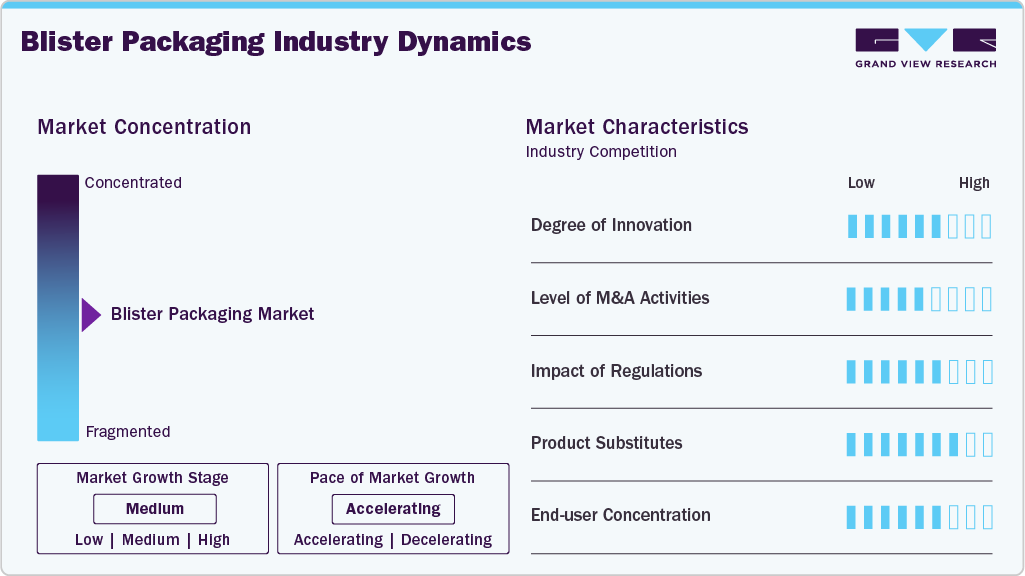
Prominent blister packaging companies operating in the industry include Amcor plc, Constantia Flexibles, UFlex Limited, Sonoco Products Company, WINPAK LTD., WestRock Company, SteriPackGroup, Honeywell International Inc., Klockner Pentaplast, ACG, SÜDPACK, TekniPlex, Blisterpack Inc., Abhinav Enterprises, and YuanPeng Plastic Products Co., Ltd.
 To learn more about this report, Download Free Sample Report
 Companies in the blister packaging industry are increasingly prioritizing the development of sustainable packaging solutions. For example, in February 2024, Sanofi joined the Blister Pack Collective, an industry collaboration focused on reducing single-use plastic packaging. The initiative aims to create eco-friendly blister packs using dry molded fiber technology, which helps lower CO₂ emissions and offers recyclability similar to paper.
Similarly, in January 2024, TekniPlex launched a pharmaceutical-grade PET blister film incorporating 30% post-consumer recycled (PCR) monomers. The product is fully recyclable and complies with stringent pharmaceutical quality standards set by both the European and U.S. Pharmacopoeia.
Material Insights
Aluminum dominated the overall market with a market share of 48.1% in 2025. Aluminum is lightweight in nature and highly durable, making it a suitable choice for healthcare blister packaging. Moreover, aluminum blister packs provide a strong defense against tampering, giving consumers confidence in the product's reliability.
The plastic films material segment growth is attributed to their lightweight properties, which make them ideal for transportation by reducing the shipping cost. Plastic films from polyvinyl chloride (PVC), polyethylene terephthalate (PET), and polyethylene (PE) provide sturdy packaging that is transparent and protects the product against external environmental factors.
Technology Insights
The thermoforming technology segment dominated the market and accounted for the largest revenue share of 85.2% in 2025. Thermoforming-based blister packaging is a cost-effective packaging solution. It allows for faster production speeds and lower manufacturing costs compared to other technologies, including cold forming, making it an attractive option for end use companies. Besides, thermoformed blister packs are designed for easy handling.
The cold-forming technology-based blister packaging exhibits the ability to resist oxygen and water completely and provides a longer shelf life to the products owing to the thickness of the aluminum foil in the laminate. Different types of cold form foils, including peelable, push-through, tear-open, child-resistant, and peel-push, are produced based on the specific requirements of end use companies.
Type Insights
The carded type segment dominated the market and accounted for the largest revenue share of 57.1% in 2025. The product is placed inside the blister with a card sealed to it using adhesive or heat, offering visibility, convenience, lower cost, and protection to the product. For example, AAA or AA batteries are sold in blister packaging with a clear plastic blister and a cardboard backing. This packaging protects against damage and moisture, while also allowing the product information and batteries to be visible to consumers.
The clamshell-type market growth is attributed to its benefits, such as versatility, higher protection, and attractive packaging design. Clamshell blister packaging is easily customizable and can be manufactured as per the required shape and size. Moreover, these packaging solutions can be designed uniquely by adding graphics and logos to the packaging, allowing consumers to differentiate the products from the competitors.
End Use Insights
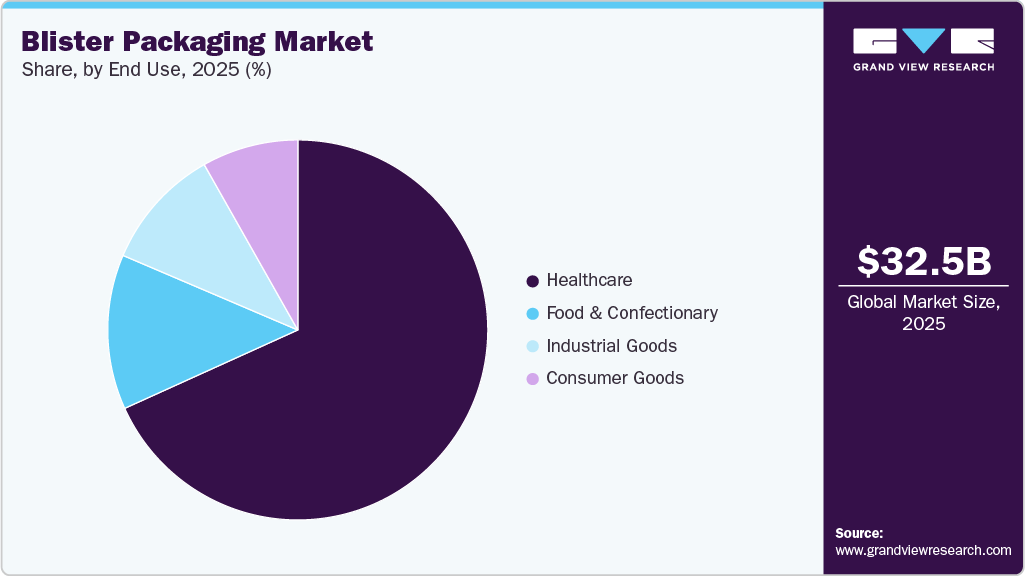
The healthcare end use segment dominated the market and accounted for the largest revenue share of 68.3% in 2025. This positive outlook is attributed to its increasing usage in the packaging of various healthcare products such as prescription drugs, OTC drugs, medical devices, and others. Moreover, the market growth of blister packaging in the healthcare sector is also being driven by the increasing trend of smart blister packaging. This involves tracking a patient's drug intake to improve their compliance by providing medication data based on their activity.
 To learn more about this report, Download Free Sample Report
 In consumer goods end use segment, blister packaging is used for packaging a range of products such as toys, cosmetics, toothbrushes, and personal care products. For instance, Arcade Beauty offers thermoform blister packaging for its wide range of make-up and skin-care products. Moreover, blister packaging is commonly used for packaging small food items such as candies, chocolates, chewing gum, and other confectionery products. It provides a clear view of the product, enhances shelf appeal, and protects the contents from external factors such as moisture and contamination.
Regional Insights
Asia Pacific dominated the blister packaging market with the largest revenue share of 34.1% in 2025. Countries such as China, India, and other Asian nations have large populations and a rapidly growing middle class. This translates to increased demand for consumer goods, pharmaceuticals, and other products that commonly use blister packaging. Moreover, the region has witnessed significant industrialization and growth in consumer goods production, particularly in sectors such as electronics, cosmetics, and food. These industries extensively use blister packaging for product protection and presentation, fueling the market's growth in the region.
 To learn more about this report, Download Free Sample Report
 China Blister Packaging Market Trends
The blister packaging market in China is primarily driven by increasing pharmaceutical sales in the country. This outlook is due to the rising pharmaceutical per capita expenditures, rising health awareness among the masses, and an aging population. Hence, the surging pharmaceutical sales imply the increased consumption of pharmaceuticals, resulting in growing demand for secure packaging solutions for oral pharmaceutical drugs, positively impacting the healthcare market in China.
North America Blister Packaging Market Trends
The blister packaging market in North American countries, such as the U.S. and Canada, has well-established and highly regulated pharmaceutical and healthcare industries, which are major consumers of blister packaging. Companies such as Pfizer Inc., Johnson & Johnson Services, Inc., and Merck & Co., Inc., headquartered in the U.S., extensively use blister packaging for the over-the-counter (OTC) and prescription drug products. Moreover, the well-developed consumer goods and retail sectors in North America are fueling the demand for blister packaging solutions in the region.
The U.S. blister packaging marketis being driven by the well-established pharmaceutical and healthcare industry and increasing healthcare expenditure across the country. According to the National Health Expenditure Account (NHEA), healthcare spending in the U.S. grew by 2.7% in 2021, reaching USD 4.3 trillion or USD 12,914 per person. In terms of the country's Gross Domestic Product (GDP), the healthcare spending represented 18.3% of the total. This increasing healthcare expenditure is projected to positively influence the production of pharmaceuticals and medical devices, presenting market growth potential in the country.
The blister packaging market in Canada is expected to witness growth, owing to the escalating demand for biodegradable and eco-friendly packaging solutions. Hence, Canadian companies in the blister packaging industry are actively engaged in research and development activities, exploring new materials, designs, and technologies to improve the functionality, sustainability, and cost-effectiveness of their products.
Europe Blister Packaging Market Trends
The blister packaging market in Europe is home to a significant number of major pharmaceutical companies and manufacturing facilities. The pharmaceutical industry is one of the primary consumers of blister packaging solutions for medication packaging. This strong industry presence drives the demand for blister packaging in Europe.
The UK blister packaging market has been at the forefront of sustainability initiatives, including in the packaging industry. The nation has implemented regulations and policies aimed at reducing packaging waste and promoting eco-friendly materials. Hence, UK-based blister packaging manufacturers have responded by developing sustainable solutions, such as using recycled or biodegradable materials, which has further strengthened their market position. For instance, in February 2024, the UK pharmacy industry launched a blister pack recycling plan to address the growing issue of plastic waste from medicine packaging. This initiative is part of the broader "Recycle at Boots" program, which currently spans over 100 Boots stores. The plan aims to provide sustainable disposal options for customers and reduce the amount of blister packs that end up in landfills.
Latin America Blister Packaging Market Trends
The blister packaging market in Latin America is projected to expand at a moderate CAGR from 2026 to 2033. The food and consumer goods industries in the Latin America region are growing due to increasing consumer demand for packaged products. Blister packaging is widely used for packaging various food items, confectionery, and consumer goods, creating opportunities for the regional market.
Middle East & Africa Blister Packaging Market Trends
The blister packaging market in the Middle East & Africa is influenced by the growing pharmaceutical industry and the rising demand for processed and packaged foods. The pharmaceutical industry in the Middle East and Africa region has experienced significant growth driven by factors such as population growth, increasing healthcare expenditure, and the prevalence of chronic diseases.
Saudi Arabia blister packaging market is expected to witness growth over the forecast period. According to the National Industrial Development Center (NIDC), in August 2023, Saudi Arabia's pharmaceutical sector was set for substantial growth following the signing of a trilateral memorandum of understanding by the Kingdom's National Industrial Development Center, Jubail Pharma, and RR Holding Co. This agreement aims to enhance the local production of chemical compounds essential for manufacturing pharmaceutical products. Furthermore, the partnership was expected to facilitate the domestic manufacturing of active pharmaceutical ingredients, intermediate materials, and chemicals crucial to the pharmaceutical industry. Hence, the focus on boosting local manufacturing of chemical compounds and pharmaceutical products implies an increase in the production of medications. This outlook is expected to contribute to a higher demand for blister packaging in the country during the forecast period.
Key Blister Packaging Company Insights
The market is moderately fragmented, with several major players operating globally. The market has been witnessing a significant number of new product launches and expansions over the past few years.
-
In November 2025, SÜDPACK started expanding PharmaGuard blister production capacity at its Erolzheim, Germany site. The project converts a hall into an ISO 7 cleanroom for PP mono-material recyclable blisters, targeting Q3 2027 operations amid high demand.
-
In April 2025, Amcor plc secured a commercial order for its sustainable AmSky Blister System, featuring high-density polyethylene (HDPE) for superior recyclability in PE streams. The system debuted with TheraBreath Invigorating Icy Mint chewing gum, now available in major U.S. retailers, offering vinyl- and aluminum-free packaging with child-resistant features. This milestone advances eco-friendly blister solutions for pharma and consumer health, earning APR recognition for recyclability.
Key Blister Packaging Companies:
The following key companies have been profiled for this study on the blister packaging market
- Amcor plc
- Constantia Flexibles
- UFlex Limited
- Sonoco Technology Company
- WINPAK LTD.
- WestRock Company
- SteriPackGroup
- Honeywell International Inc.
- Klockner Pentaplast
- ACG
- SÜDPACK
- TekniPlex
- Blisterpack Inc.
- Abhinav Enterprises
- YuanPeng Plastic Technologys Co., Ltd.
Competitive Benchmarking
Operating Strategies
Competitive Edge
Weakness
Mature Players: Amcor plc, Constantia Flexibles, WINPAK LTD., WestRock Company, Honeywell International Inc., Klockner Pentaplast, SÜDPACK, TekniPlex, Sonoco Technology Company
- Securing long-term supply agreements with leading pharmaceutical and healthcare companies.
- Expanding global production capacities through acquisitions and facility expansions.
- Enhancing high-barrier packaging technologies for moisture and oxygen protection.
- Strong global presence and established customer relationships across the pharmaceutical and healthcare sectors.
- Advanced R&D capabilities and regulatory compliance expertise.
- Ability to deliver high-volume, high-performance blister packaging solutions.
- High operational and compliance costs compared to regional manufacturers.
- Dependence on large pharmaceutical contracts and pricing negotiations.
- Slower adaptability to niche or highly customized regional demands.
Emerging Players: UFlex Limited, SteriPackGroup, ACG, Blisterpack Inc., Abhinav Enterprises, YuanPeng Plastic Technologys Co., Ltd.
- Expanding aggressively in emerging pharmaceutical manufacturing markets across Asia-Pacific and Latin America.
- Offering cost-effective and customized blister packaging solutions for regional clients.
- Strengthening medical-grade and contract packaging capabilities.
- Lower manufacturing and operational costs compared to multinational competitors.
- Strong flexibility in serving small and mid-sized pharmaceutical companies.
- Faster response to local customer requirements and market changes.
- Limited global reach and weaker brand recognition compared to established multinational players.
- Challenges in meeting stringent international regulatory and sustainability standards.
- Lower investment capacity for advanced material innovation and automation.
Blister Packaging Market Report Scope
Report Attribute
Details
Market size in 2025
USD 32.5 billion
Estimated Market size in 2026
USD 34.7 billion
Projected Market size by 2033
USD 60.2 billion
Growth rate
CAGR of 8.2% from 2026 to 2033
Historical data
2021 - 2025
Forecast period
2026 - 2033
Quantitative units
Revenue in USD million/billion, volume in kilotons, and CAGR from 2026 to 2033
Report coverage
Volume forecast, revenue forecast, competitive landscape, growth factors and trends
Segments covered
Material, technology, type, end use, region
Regional scope
North America; Europe; Asia Pacific; Latin America; MEA
Country Scope
U.S.; Canada; Mexico; Germany; France; UK; Italy; Spain; China; India; Japan; South Korea; Australia; Brazil; Chile; Saudi Arabia; South Africa; UAE
Key companies profiled
Amcor plc; Constantia Flexibles; UFlex Limited; Sonoco Products Company; WINPAK LTD.; WestRock Company; SteriPackGroup; Honeywell International Inc.; Klockner Pentaplast; ACG; SÜDPACK; TekniPlex; Blisterpack Inc.; Abhinav Enterprises; YuanPeng Plastic Products Co., Ltd.
Customization scope
Free report customization (equivalent up to 8 analyst’s working days) with purchase. Addition or alteration to country, regional & segment scope
Pricing and purchase options
Avail customized purchase options to meet your exact research needs. Explore purchase options
Global Blister Packaging Market Report Segmentation
This report forecasts revenue growth at global, regional, and country levels and provides an analysis of the latest industry trends in each of the sub-segments from 2021 to 2033. For this study, Grand View Research has segmented the global blister packaging market report based on material, technology, type, end use, and region:
-
Material Outlook (Revenue, USD Billion; Volume, Kilotons, 2021 - 2033)
-
Paper & Paperboard
-
Solid Bleached Sulfate (SBS)
-
White-lined chipboard
-
Others
-
-
Plastic Films
-
Polyvinyl Chloride (PVC)
-
Polyethylene Terephthalate (PET)
-
Polyethylene (PE)
-
Others
-
-
Aluminum
-
-
Technology Outlook (Revenue, USD Billion; Volume, Kilotons, 2021 - 2033)
-
Thermoforming
-
Cold Forming
-
-
Type Outlook (Revenue, USD Billion; Volume, Kilotons, 2021 - 2033)
-
Carded
-
Clamshell
-
-
End-use Outlook (Revenue, USD Billion; Volume, Kilotons, 2021 - 2033)
-
Healthcare
-
Consumer Goods
-
Industrial Goods
-
Food
-
-
Regional Outlook (Revenue, USD Billion; Volume, Kilotons, 2021 - 2033)
-
North America
-
U.S.
-
Canada
-
Mexico
-
-
Europe
-
Germany
-
UK
-
France
-
Italy
-
Spain
-
-
Asia Pacific
-
China
-
India
-
Japan
-
South Korea
-
Australia
-
-
Latin America
-
Brazil
-
Chile
-
-
Middle East & Africa
-
Saudi Arabia
-
UAE
-
South Africa
-
-
Delivered Customizations
This report has been delivered with the following In-depth customizations
Client Request
Customization Delivered
Value Adds
Regional Segmentation
Detailed analysis of the global blister packaging market across North America, Europe, Asia Pacific, Latin America, and the Middle East & Africa, including country-level pharmaceutical production trends, healthcare packaging demand, regulatory framework analysis, sustainability initiatives, medical device packaging adoption, and regional growth outlook.
Identify high-growth regional markets and emerging pharmaceutical manufacturing hubs. Support region-specific expansion strategies and production planning. Enable understanding of regional regulatory dynamics, sustainability adoption, and competitive intensity across healthcare and consumer packaging sectors.
Competitive Benchmarking
Comparative assessment of key blister packaging manufacturers based on product portfolio, material capabilities, thermoforming and cold-form technologies, sustainability initiatives, pharmaceutical compliance expertise, production capacity, regional presence, partnerships, innovation focus, and strategic developments.
Support competitor tracking and positioning analysis. Identify market leaders, regional challengers, and innovation-driven companies. Enable informed partnership evaluation, supplier selection, and competitive strategy development across pharmaceutical and healthcare packaging applications.
Pricing Analysis
Assessment of blister packaging pricing trends across raw materials, packaging formats, barrier technologies, thermoforming and cold-form solutions, pharmaceutical-grade packaging standards, and sustainable packaging alternatives, including regional pricing variations, production cost analysis, and supplier benchmarking.
Identify the major pricing drivers and the areas of margin pressure. Support procurement optimization and supplier negotiation strategies. Enable benchmarking of packaging costs across regions and material types while evaluating the commercial feasibility of sustainable blister packaging solutions.
Frequently Asked Questions About This Report
The aluminum segment led with a 48.1% revenue share in 2025.
Thermoforming segment held the largest share (over 85.0%) in 2025.
Healthcare segment dominated the market and accounted for a share of 68.3% in 2025.
Carded segment accounted for the largest revenue share of 57.1% in 2025.
Key players include Amcor plc; Constantia Flexibles; UFlex Limited; Sonoco Products Company; WINPAK LTD.; WestRock Company; SteriPackGroup; Honeywell International Inc.; Klockner Pentaplast; ACG; SÜDPACK; TekniPlex; Blisterpack Inc.; Abhinav Enterprises; YuanPeng Plastic Products Co., Ltd.
Blister packaging market is mainly driving by the rising consumer shift from traditional bottles to blister packs for packaging unit doses in healthcare.
Asia Pacific dominated with a 34.1% revenue share in 2025. This is attributed to the increased demand from the personal care, electronics, and healthcare industries for products such as mobile charging cords, testers, generic drugs, and liquid cosmetics.
The global blister packaging market is expected to grow at a CAGR of 8.2% from 2026 to 2033, reaching USD 60.2 billion.
The global blister packaging market size was valued at USD 32.5 billion in 2025 and is estimated at USD 34.7 billion for 2026.
About the Author(s)
Plastics, Polymers & Resins Research Team
Bulk Chemicals · Plastics, Polymers & ResinsThis report was authored by the plastics, polymers & resins research team at Grand View Research - comprising two research analysts, one senior research analyst, and one industry expert - with specialized expertise in the plastics, polymers & resins segment of the bulk chemicals industry. All findings are based on proprietary bulk chemicals databases, executive interviews, and regulatory analysis, subject to internal peer review prior to publication.
Last Updated:
Speak to Analyst

Customize this report to your needs - add regions, segments, or data points, with 20% free customization.
Or view our licence options:


ISO 9001:2015 & 27001:2022 Certified
We are GDPR and CCPA compliant! Your transaction & personal information is safe and secure. For more details, please read our privacy policy.


