
- Home
- »
- Drilling & Extraction Equipments
- »
-
Potassium Formate Market Size & Share Report, 2026-2033GVR Report cover

Potassium Formate Market (2026 - 2033)
Size, Share & Trends Analysis Report By Form (Solid, Liquid/Brine), By Purity (Below 90%, 90%-95%, Above 95%), By Application (Drilling Fluids, Completion Fluids, De-Icing Agents, Heat Transfer Fluids), By End Use, By Region, Forecasts
Market Size, 2025
$896.3MMarket Estimate, 2026
$936.2MMarket Forecast, 2033
$1,296.0MCAGR, 2026–2033
4.8%Potassium Formate Market Summary
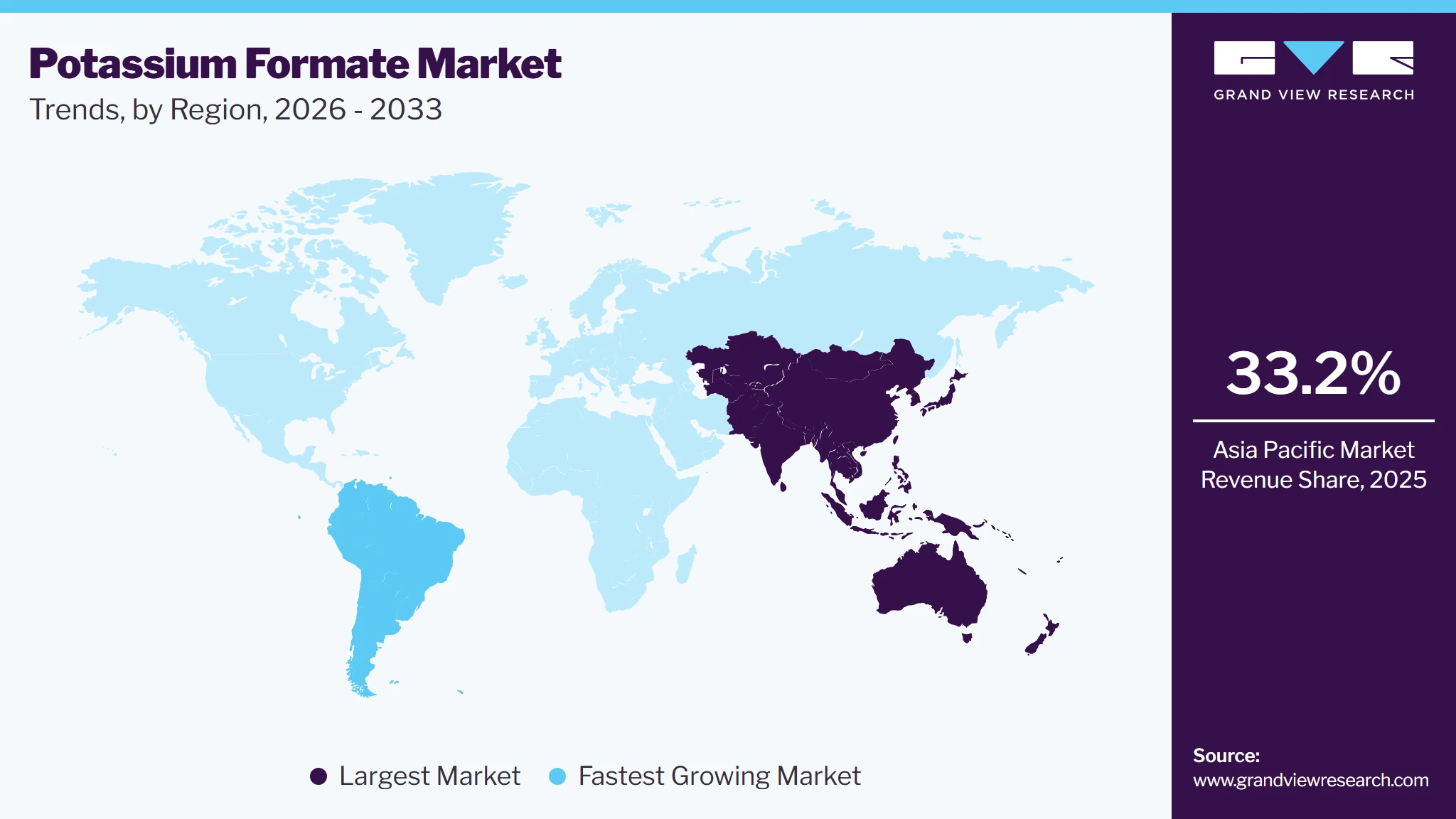
The global potassium formate market size was valued at USD 896.3 million in 2025 and is projected to grow from USD 936.2 million in 2026 to USD 1,296.0 million by 2033, at a CAGR of 4.8% from 2026 to 2033. North America dominated the market, accounting for the largest revenue share of 33.2% in 2025. Expansion is supported by broader utilization across oilfield operations, aviation infrastructure, industrial cooling, and specialized chemical applications, alongside rising preference for high-performance fluids with favorable thermal and operational characteristics.
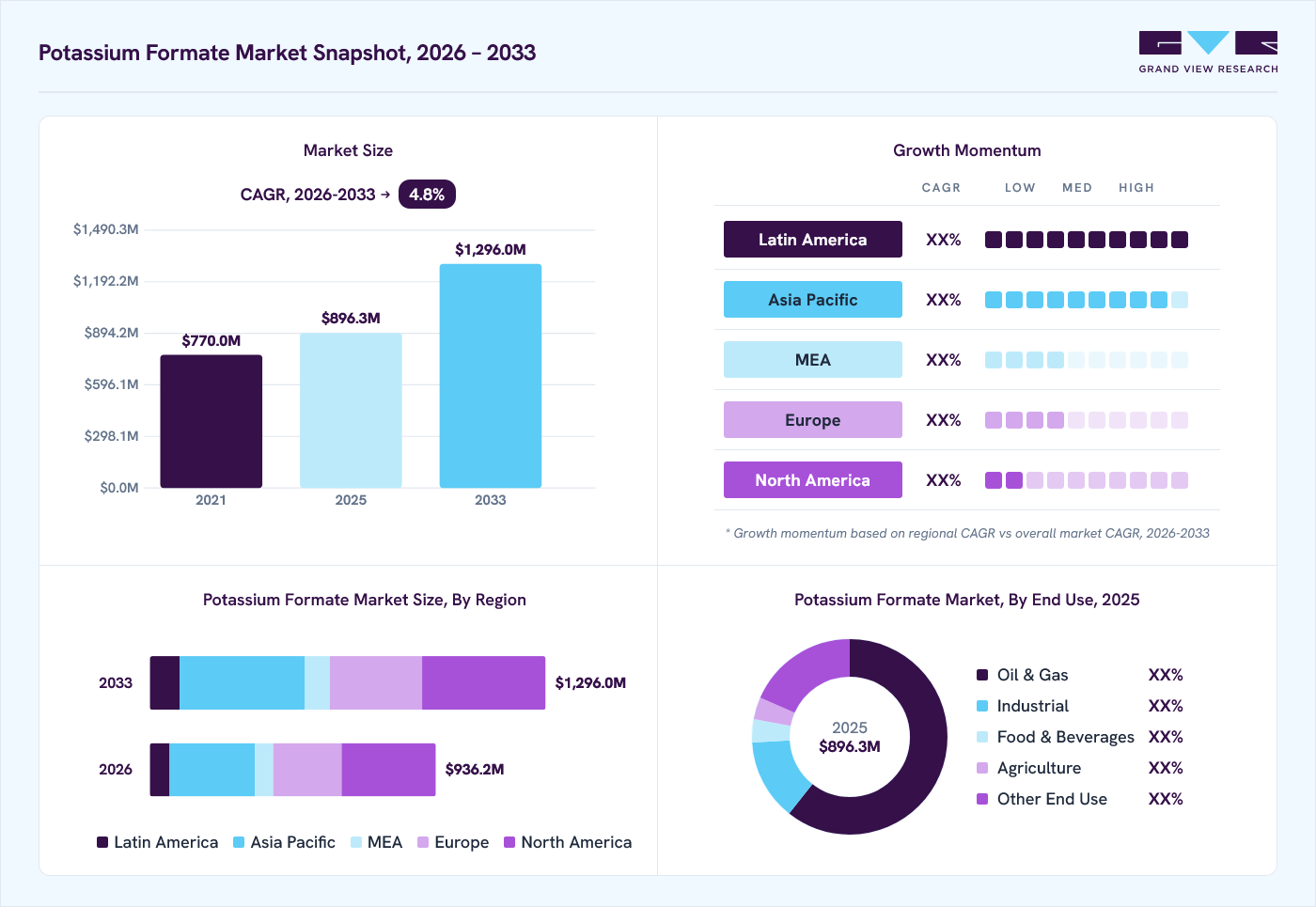 Source: Grand View Research, IR Documents, Primary Interviews, Paid DatabasesTo learn more about this report,
 Download Free Sample Report
Key Market Trends & Insights
- By form: The liquid/brine held the largest revenue share of 78.5% in 2025.
- By purity: The above 95% held the highest revenue share of 51.2% in 2025.
- By application: The drilling fluids segment dominated with a share of 37.3% in 2025.
- By end use: The oil & gas segment led with a share of 60.6% in 2025.
Regional Highlights
- Largest region: North America (33.2% revenue share, 2025)
- Fastest-growing region: Latin America (fastest CAGR, 2026-2033)
Market Size & Forecast
- Market size in 2025: USD 896.3 Million
- Estimated market size in 2026: USD 936.2 Million
- Projected market size by 2033: USD 1,296.0 Million
- CAGR (2026-2033): 4.8%
GVR research-powered AIAsk Prism AI about the potassium formate marketGet cited answers from GVR research on market growth, segments, regulations and forecasts.Start with✓ Source-linked answers ✓ Market-specific context ✓ Traceable figuresExplore Prism AI ↗
The industry is benefiting from rising demand across oil and gas drilling, completion fluids, de-icing, heat-transfer systems, and industrial applications. In upstream operations, brines are increasingly valued for their high density, low crystallization temperature, shale inhibition, and comparatively favorable environmental characteristics, supporting their use in high-pressure and high-temperature well environments. Expansion of drilling and well-intervention activities, particularly in regions with challenging subsurface conditions, is creating opportunities for suppliers of high-performance clear-brine systems. At the same time, the development of airports and transportation infrastructure in colder regions is supporting consumption of potassium-formate-based runway de-icers, while its favorable thermal properties are encouraging adoption in specialized cooling and heat-transfer applications.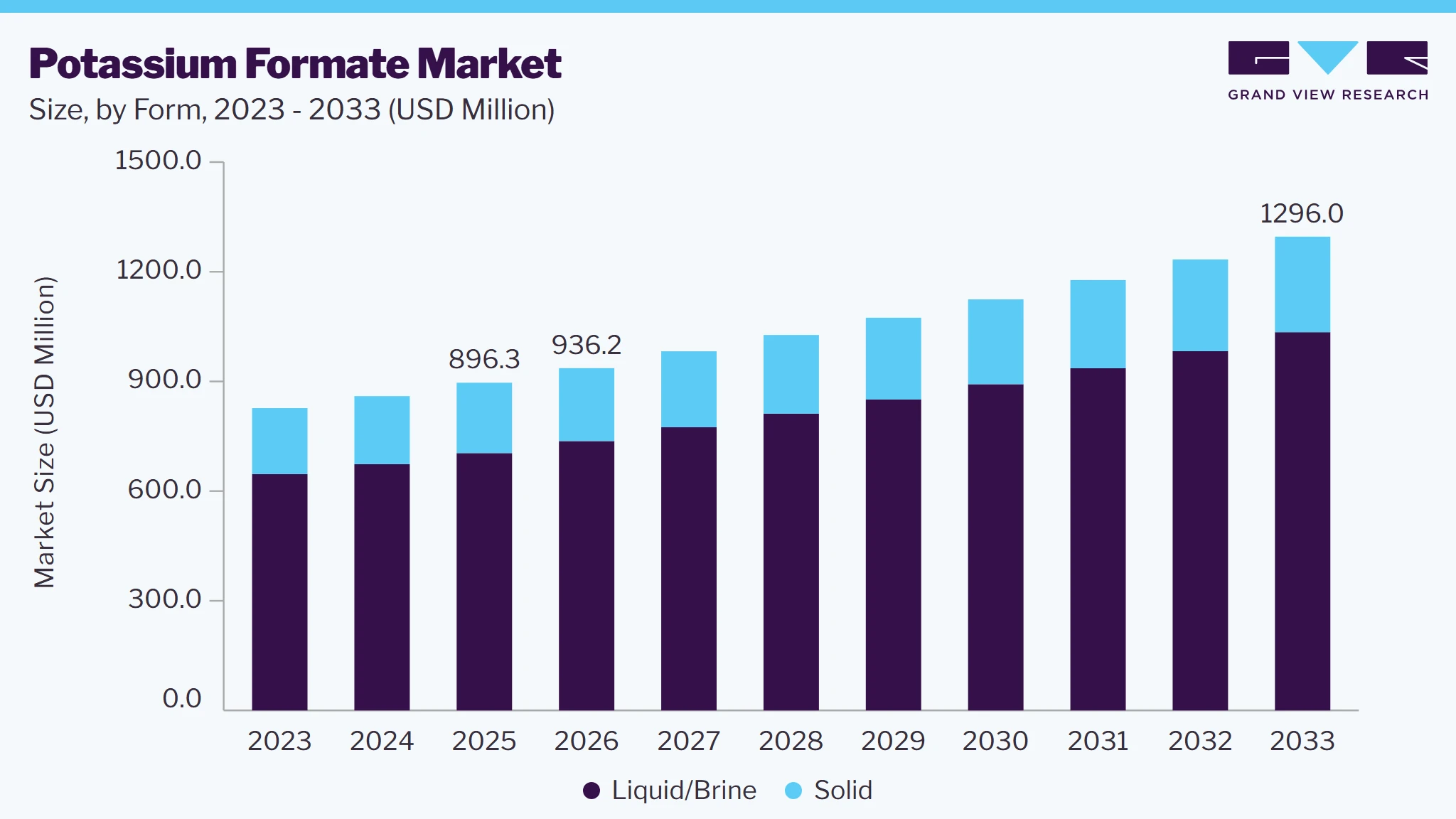 To learn more about this report, Download Free Sample Report
Opportunities are also emerging from the shift toward more sustainable and operationally efficient chemical solutions. The product is increasingly considered an alternative to conventional chloride-based de-icing agents because it can provide effective low-temperature performance with lower concerns related to corrosion and chloride accumulation. Further potential exists in emerging oil-producing regions, where investment in exploration, production, and well-completion infrastructure can stimulate demand for high-density brines. Manufacturers that strengthen regional production, develop customized formulations, improve fluid recovery and recycling, and expand distribution networks are well positioned to capture these emerging application opportunities.
Market Dynamics
The industry is shaped by a combination of oil and gas exploration, specialty fluid requirements, winter maintenance, and industrial cooling applications. Growing drilling activity in technically demanding formations is supporting the use of high-density clear brines, particularly where operators require effective shale inhibition, thermal stability, and reliable wellbore control. Demand from airports and transport infrastructure also contributes to consumption, as de-icing formulations provide effective low-temperature performance with reduced chloride-related concerns. Specialized heat-transfer systems are creating additional avenues across process industries, refrigeration, data centers, and renewable-energy installations. However, elevated production costs, feedstock availability, transportation expenses, and competition from alternative brine chemistries can constrain adoption in price-sensitive applications.
Operators working in high-pressure, high-temperature formations require dense brines that can provide reliable well control while limiting formation damage and maintaining fluid stability. It offers a combination of high density, low crystallization temperature, shale inhibition, and compatibility with sensitive formations, making it suitable for demanding downhole environments. The increasing complexity of offshore developments, deep wells, and mature-field intervention programs is consequently creating a favorable environment for specialized clear-brine solutions.
This trend also presents opportunities for suppliers to move beyond standardized chemical sales toward application-specific fluid engineering. Producers can strengthen their commercial position by developing customized density grades, recovery and recycling systems, and fluid-management services tailored to reservoir conditions. Such capabilities can improve operating efficiency, reduce disposal requirements, and lower the total cost associated with well-completion activities.
The higher overall cost associated with producing, transporting, maintaining, recovering, and disposing of concentrated solutions compared with some conventional brine alternatives. Although the material provides attractive technical properties, its economic advantage is not uniform across applications. High-purity grades and concentrated formulations require controlled manufacturing processes, specialized storage, and appropriate handling infrastructure. Transportation can also become costly because customers frequently purchase substantial quantities of liquid solutions, increasing freight and storage requirements. In drilling operations, additional expenditure may arise from fluid monitoring, density adjustment, filtration, recovery, and recycling systems needed to preserve formulation quality.
The expansion of high-density computing infrastructure is opening an emerging avenue for heat-transfer fluids. Data centers, particularly those supporting artificial intelligence and accelerated computing, require increasingly sophisticated thermal-management systems as server power densities rise. Solutions can provide favorable low-temperature heat-transfer characteristics and can be formulated for closed-loop cooling applications. The growth of liquid-cooling architectures therefore creates scope for specialized fluids designed to maintain thermal performance, equipment protection, and system reliability. This opportunity extends beyond conventional computing facilities into industrial process cooling, energy-storage infrastructure, and renewable-energy installations where dependable thermal management is becoming strategically important. Chemical producers with expertise in formulation, corrosion control, fluid monitoring, and lifecycle management can establish differentiated positions by supplying complete thermal-fluid solutions.
Market Concentration & Characteristics
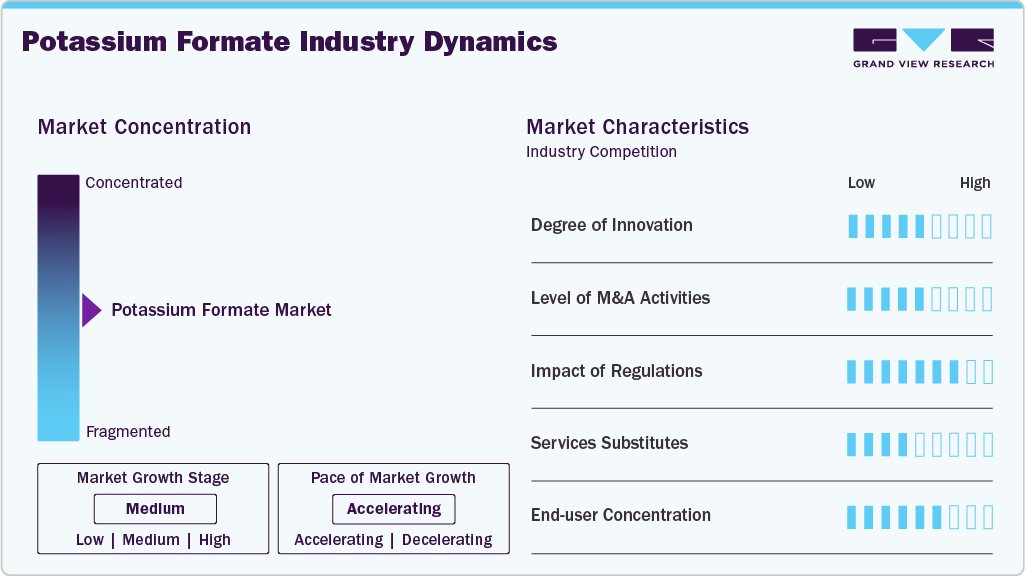
The competitive environment comprises specialty chemical producers, oilfield service companies, industrial-fluid manufacturers, and formulated-solutions providers. Leading participants compete through product consistency, concentration grades, technical performance, application expertise, geographic reach, and supply reliability. Companies such as Perstorp, ADDCON, Eastman, Clariant, and Proviron maintain differentiated positions through specialized formate products and downstream formulations serving drilling fluids, runway de-icing, and thermal-management applications. TETRA Technologies and SLB leverage their established oilfield-service platforms to integrate potassium-formate brines into broader completion-fluid and well-intervention offerings.
 To learn more about this report, Download Free Sample Report
Competition is also influenced by vertical integration and formulation capabilities. Producers with control over manufacturing, blending, logistics, and technical support can respond more effectively to customer-specific requirements and reduce supply-chain exposure. Private specialists such as Dynalene and Nachurs Alpine Solutions compete by focusing on targeted industrial and thermal-fluid applications, while larger publicly traded groups benefit from stronger capital resources, established distribution networks, and broader research capabilities. Product development is increasingly centered on improved thermal performance, corrosion management, environmental compatibility, fluid recovery, and application-specific formulations. Strategic partnerships, capacity investments, regional expansion, and portfolio diversification are consequently becoming important competitive tools.
Analyst Perspective
The industry is moving beyond a conventional focus on basic brine performance toward solutions that combine operational efficiency, environmental compatibility, fluid recovery, and application-specific functionality. Advanced well-completion requirements are increasing the importance of high-density formulations with reliable thermal and formation-control characteristics, while emerging demand from data-center cooling and specialized heat-transfer systems is broadening the application base. At the same time, customers are placing greater emphasis on lifecycle economics, recyclability, supply reliability, and reduced environmental burden.
Form Insights
The liquid/brine category accounted for 78.5% of revenue in 2025, reflecting its established use across major industrial applications. Its prominence is closely linked to the widespread adoption of aqueous formulations in drilling, completion, de-icing, and thermal-management operations. Liquid grades also offer practical advantages in handling, blending, pumping, and application. Established production infrastructure and strong commercial availability further reinforce its leading position.
The solid category is projected to expand at a CAGR of 3.9% during the forecast period. supported by its suitability for specialized chemical processing and industrial formulations. Its concentrated composition offers advantages in storage, transportation, and downstream blending, particularly for buyers preparing customized solutions. Demand is also sustained by applications requiring precise control over chemical inputs and product specifications.
Purity Insights
The above 95% concentration captured 51.2% of revenue in 2025, making this grade the predominant concentration category. Their strong position reflects demand for highly concentrated formulations that offer efficient transportation, storage, and downstream dilution. Such grades are particularly relevant where customers require flexibility in preparing application-specific solutions. Established industrial usage and favorable handling economics are supporting continued adoption.
The 90% - 95% concentration category is forecast to register a CAGR of 4.2%, supported by demand for formulations that balance active content with processing flexibility. These grades cater to industrial users seeking consistent chemical specifications for downstream blending and specialized applications. Their commercial appeal is influenced by purity requirements, handling convenience, and the economics of formulation preparation.
Application Insights
Drilling fluids represented 37.3% of revenue in 2025, giving this application the strongest contribution among major end uses. Potassium-formate brines are valued in challenging well environments because of their high density, thermal stability, and ability to limit formation-related complications. Continued exploration and well-development activity is sustaining requirements for specialized completion and drilling fluids. Increasing complexity in deep and high-pressure wells is further reinforcing demand.
Heat-transfer fluids are anticipated to record the fastest expansion, with a CAGR of 6.0% during the forecast period. Rising demand for efficient thermal-management solutions is creating new avenues across industrial processing, refrigeration, energy infrastructure, and advanced cooling systems. Potassium-formate formulations offer favorable low-temperature performance and can be tailored for closed-loop applications.
End Use Insights
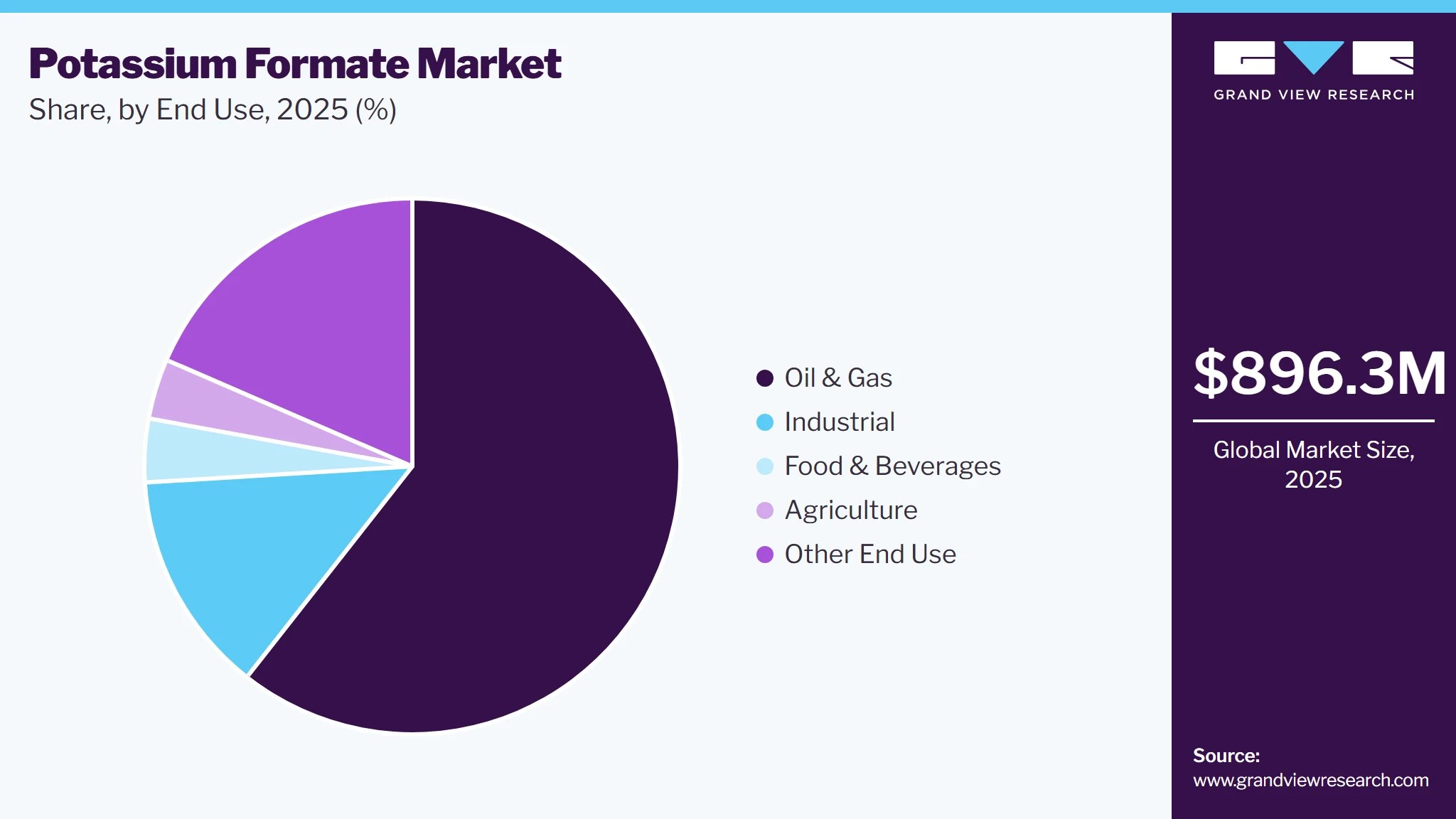
The oil and gas sector accounted for 60.6% of revenue in 2025, reflecting the extensive utilization of potassium-formate solutions in drilling, completion, and workover operations. High-density brines are particularly valuable in technically demanding wells where density control and formation compatibility are critical. Continued investment in exploration, offshore developments, and mature-field intervention is supporting consumption. The sector's established use of specialized clear-brine systems provides a strong foundation for continued demand.
 To learn more about this report, Download Free Sample Report
The industrial segment is projected to grow at a CAGR of 5.4% during the forecast period, supported by expanding applications beyond traditional energy-related uses. Increasing requirements for thermal management, specialized cooling, and chemical processing are broadening the customer base. Industrial facilities are also placing greater emphasis on efficient fluid performance and operational reliability. Emerging applications in data centers and advanced cooling infrastructure could further accelerate adoption.
Region Insights
North America maintains a strong position with a revenue share of 33.2% in 2025, due to its mature oil and gas industry, extensive drilling infrastructure, and established specialty-chemical supply chain. Potassium-formate solutions are used in technically demanding completion and workover operations where fluid density, thermal behavior, and formation compatibility are important. The region also benefits from established manufacturers and oilfield-service providers capable of supplying customized brines and technical support. Increasing investment in data centers and advanced cooling infrastructure could provide an additional avenue for demand diversification.
U.S. Potassium Formate Market Trends
The potassium formate market in the U.S. represents one of the most commercially developed markets, growing at a CAGR of 3.8%, supported by substantial shale production, offshore exploration, well-intervention programs, and a sophisticated industrial-fluid ecosystem. Potassium-formate brines are particularly relevant to drilling and completion activities requiring controlled fluid density and reduced formation damage. Northern states and aviation infrastructure also provide opportunities for de-icing applications. Rapid expansion of hyperscale and AI-focused data centers is creating a developing market for advanced heat-transfer fluids, potentially broadening consumption beyond traditional energy-related uses.
Asia Pacific Potassium Formate Market Trends
The potassium formate market in the Asia Pacific represents a significant opportunity, supported by expanding oil and gas exploration, increasing well-completion activity, airport infrastructure development, and industrial cooling requirements. Countries with substantial upstream operations are generating demand for high-density clear-brine systems, while colder areas provide opportunities for runway de-icing formulations. China, Australia, India, and Southeast Asian economies are also strengthening industrial and energy infrastructure, creating additional avenues for specialized thermal-management fluids. Regional chemical manufacturing capabilities and improving logistics networks further support local availability.
 To learn more about this report, Download Free Sample Report
China potassium formate market is an important consumption and manufacturing base, underpinned by extensive chemical production capabilities, domestic energy development, and large-scale infrastructure investment. Offshore and unconventional hydrocarbon activities create potential demand for potassium-formate completion fluids, particularly for technically demanding wells. The country's expanding aviation infrastructure also provides scope for de-icing applications in northern and high-altitude locations. In parallel, growth in industrial cooling and data-center capacity is creating emerging opportunities for specialized heat-transfer formulations.
Europe Potassium Formate Market Trends
The potassium formate market in Europe has strong prospects due to stringent environmental considerations, extensive airport infrastructure, specialized chemical manufacturing, and demand for efficient thermal-management systems. Runway de-icers are gaining relevance where operators seek alternatives to conventional chloride-based materials. Northern and Central European countries provide favorable conditions for winter-maintenance applications, while the region's advanced industrial base supports specialized heat-transfer uses. European producers also benefit from established R&D capabilities and well-developed distribution networks, enabling customized formulations for industrial and energy applications.
Germany potassium formate market serves as an important European manufacturing and technology center, supported by its sophisticated chemical industry, extensive industrial infrastructure, and established automotive and engineering sectors. Demand potential extends across specialty heat-transfer fluids, industrial processing, and winter maintenance. The country's focus on energy efficiency and advanced industrial systems creates opportunities for thermally stable fluid formulations. Strong chemical research capabilities and proximity to major European markets also provide domestic producers with advantages in product development, technical support, and regional distribution.
Middle East & Africa Potassium Formate Market Trends
The potassium formate market in MEA presents substantial potential, primarily because of its large oil and gas production base and continued investment in exploration, production, and well-development programs. High-temperature reservoirs and technically complex drilling environments can support demand for specialized clear-brine systems. Gulf countries are also investing heavily in airports, logistics infrastructure, industrial facilities, and energy diversification projects, creating supplementary application potential. In Africa, expanding upstream activity and infrastructure development could gradually increase consumption, although logistics, local manufacturing capacity, and project-specific procurement economics remain important considerations.
Latin America Potassium Formate Market Trends
The potassium formate market in Latin America offers attractive prospects with a CAGR of 6.0% from 2026 to 2033, owing to extensive hydrocarbon resources, offshore development, and increasing investment in deepwater exploration. Brazil is particularly important because of its large offshore petroleum operations, where technically advanced completion fluids can support challenging well conditions. Mexico and other producing economies also provide opportunities as drilling and field-development programs progress. Beyond energy applications, expanding airport infrastructure and industrial modernization can support demand for de-icing and thermal-management products in selected countries. Regional growth, however, will depend on upstream capital expenditure, infrastructure availability, and reliable chemical supply networks.
Key Potassium Formate Company Insights
Companies are strengthening their competitive positions by expanding application-specific formulations, enhancing production capabilities, and broadening regional distribution networks to improve supply reliability and customer responsiveness. Greater emphasis is also being placed on technical collaboration, customized fluid solutions, and entry into emerging applications such as advanced thermal management, while portfolio diversification helps reduce dependence on traditional oilfield and de-icing demand.
-
TETRA Technologies is a specialized energy services provider offering engineered completion-fluid solutions for demanding drilling, completion, and workover environments. Its portfolio includes potassium-formate brines that can achieve densities of up to 13.1 ppg and provide shale inhibition, lubricity, hydrate control, and formation-damage mitigation. The company differentiates its offering through customized fluid formulation, vertical integration, manufacturing capabilities, and technical expertise, enabling it to address well-specific operating conditions and support productivity across complex reservoirs.
-
Nachurs Alpine Solutions, through its NASi industrial division, is a North American specialty-chemical manufacturer supplying potassium formate in 50%-75% concentrations for industrial, energy, transportation, and mining applications. Its manufacturing platform encompasses seven plants, extensive terminal infrastructure, bulk-storage capacity, and access to rail and major ports, supporting dependable regional distribution. The company also offers potassium-formate-based runway de-icing solutions, while its broader portfolio includes potassium blends, specialty chemicals, and industrial formulations, allowing it to leverage shared manufacturing capabilities across multiple end-use sectors.
Key Potassium Formate Companies
The following key companies have been profiled for the study on the potassium formate market.
-
Perstorp Holding AB
-
ADDCON GmbH
-
Eastman Chemical Company
-
TETRA Technologies, Inc.
-
Clariant AG
-
SLB
-
Proviron Industries NV
-
Dynalene, Inc.
-
Hawkins, Inc.
-
Nachurs Alpine Solutions (NASi)
Competitive Benchmarking
Operating Strategies
Competitive Edge
Weaknesses
Mature Players: Perstorp Holding AB / PETRONAS Chemicals Group, ADDCON GmbH / ESSECO Industrial, Eastman Chemical Company, TETRA Technologies, Inc., Clariant AG, SLB.
- Maintain broad chemical and industrial-fluid portfolios spanning potassium formate, clear-brine systems, heat-transfer fluids, de-icing formulations, and other complementary products to serve diverse end-use requirements.
- Strengthen international reach through established manufacturing facilities, distributor networks, technical-service teams, and direct commercial channels across key geographic markets.
- Preserve product reliability and customer confidence by emphasizing consistent specifications, technical expertise, established manufacturing processes, and application-specific performance.
- Expand customer engagement through technical support, application guidance, formulation expertise, product documentation, and engineering services that facilitate informed solution selection.
- Leverage extensive industry experience, established customer relationships, recognized brands, and broad technical capabilities to serve demanding industrial applications.
- Utilize diversified manufacturing and distribution infrastructure to support dependable product availability, regional responsiveness, and supply-chain continuity.
- Apply advanced formulation expertise, research capabilities, and application knowledge to address specialized requirements across drilling, de-icing, heat transfer, and industrial processing.
- Benefit from strong financial resources, established operating platforms, and global commercial networks that support continued investment, innovation, and market expansion.
- Operate with comparatively complex organizational structures, extensive infrastructure, and higher administrative requirements that can increase overall operating costs.
- Manage broad product portfolios and multiple business divisions, which may reduce flexibility when responding to highly specialized or rapidly changing customer requirements.
- Remain exposed to fluctuations in raw-material prices, energy costs, freight rates, and cyclical conditions across oil and gas and industrial end-use sectors.
- Maintain diversified business models that may limit dedicated focus on potassium-formate-specific applications compared with specialized niche manufacturers.
Emerging Players: Proviron Industries NV, Dynalene, Inc., Hawkins, Inc., Nachurs Alpine Solutions (NASi)
- Focus on specialized applications such as industrial cooling, de-icing, specialty chemicals, fertilizers, and thermal-management systems to establish targeted market positions.
- Expand customer coverage through regional distributors, selected export markets, strategic partnerships, and focused additions to manufacturing and blending capabilities.
- Develop customized formulations and concentration grades to address specific performance requirements across industrial and commercial applications.
- Diversify application coverage by extending potassium-formate solutions into emerging areas such as advanced cooling systems and specialized industrial fluids.
- Leverage leaner organizational structures and focused operating models to respond quickly to customer requirements and changing application conditions.
- Utilize specialized technical knowledge and concentrated product portfolios to provide deeper expertise within selected end-use segments.
- Strengthen customer relationships through direct communication, responsive technical assistance, customized formulations, and application-specific support.
- Concentrate product-development resources on targeted applications, enabling faster refinement of formulations designed for operating environments.
- Operate with comparatively limited financial resources, which can constrain large-scale capacity expansion, extensive R&D programs, acquisitions, and international infrastructure investments.
- Maintain narrower geographic coverage, with manufacturing, sales, and distribution activities concentrated in selected countries or regions.
- Remain more vulnerable to supply-chain disruptions because of greater dependence on specific raw-material suppliers, logistics providers, manufacturing sites, or regional distributors.
- Face lower international brand recognition and fewer established relationships with major industrial customers, creating challenges when competing for large, technically demanding, or multinational contracts.
Recent Developments
-
In December 2025, Hawkins expanded its Texas operations through the acquisition of Redbird Chemical, Inc., broadening its chemical manufacturing and distribution footprint. The move strengthens its regional infrastructure as a producer and supplier of specialty and industrial chemicals, including liquid potassium formate.
-
In July 2025, SLB completed its acquisition of ChampionX, strengthening its production-chemicals, artificial-lift, digital, and emissions-technology portfolio. While broader than potassium formate specifically, the transaction enhances SLB's capabilities across the production lifecycle and reinforces its position in oilfield chemical solutions.
Potassium Formate Market Report Scope
Report Attribute
Details
Market size in 2025
USD 896.3 million
Estimated market size in 2026
USD 936.2 million
Projected market size by 2033
USD 1,296.0 million
Growth rate
CAGR of 4.8% from 2026 to 2033
Historical data
2021 - 2025
Forecast period
2026 - 2033
Quantitative units
Volume, kilotons, revenue in USD million, and CAGR from 2026 to 2033
Report coverage
Revenue forecast, volume forecast, company ranking, competitive landscape, growth factors, and trends
Segments covered
Purity, form, application, end use, region
Regional scope
North America; Europe; Asia Pacific; Latin America; Middle East & Africa
Country scope
U.S.; Canada; Mexico; Germany; UK; France; Italy; Spain; China; India; Japan; South Korea; Brazil; Argentina; Saudi Arabia; South Africa
Key companies profiled
Perstorp Holding AB; ADDCON GmbH; Eastman Chemical Company; TETRA Technologies, Inc.; Clariant AG; SLB; Proviron Industries NV; Dynalene, Inc.; Hawkins, Inc.; Nachurs Alpine Solutions (NASi)
Customization scope
Free report customization (equivalent up to 8 analysts’ working days) with purchase. Addition or alteration to country, regional & segment scope.
Pricing and purchase options
Avail customized purchase options to meet your exact research needs. Explore purchase options
Global Potassium Formate Market Report Segmentation
This report forecasts volume & revenue growth at regional and country levels and provides an analysis of the latest industry trends in each of the sub-segments from 2021 to 2033. For this study, Grand View Research has segmented the potassium formate market report based on form, purity, application, end use, and region:
-
Form Outlook (Revenue, USD Million, Volume, Kilotons, 2021 - 2033)
-
Solid
-
Liquid/Brine
-
-
Purity Outlook (Revenue, USD Million, Volume, Kilotons, 2021 - 2033)
-
Below 90%
-
90%-95%
-
Above 95%
-
-
Application Outlook (Revenue, USD Million, Volume, Kilotons, 2021 - 2033)
-
Drilling Fluids
-
Completion Fluids
-
De-Icing Agents
-
Heat Transfer Fluids
-
Fertilizer Additives
-
Other Applications
-
-
End Use Outlook (Revenue, USD Million, Volume, Kilotons, 2021 - 2033)
-
Oil & Gas
-
Agriculture
-
Industrial
-
Food & Beverages
-
Other End Uses
-
-
Regional Outlook (Revenue, USD Million, Volume, Kilotons, 2021 - 2033)
-
North America
-
U.S.
-
Canada
-
Mexico
-
-
Europe
-
UK
-
Germany
-
France
-
Italy
-
Spain
-
-
Asia Pacific
-
China
-
Japan
-
India
-
South Korea
-
-
Latin America
-
Brazil
-
Argentina
-
-
Middle East and Africa (MEA)
-
South Africa
-
Saudi Arabia
-
-
Research Methodology
The potassium formate market figures in this report are based on a proven research process that combines executive interviews with secondary research from proprietary databases, company filings, and recognized regulatory and institutional sources. Market size is built through value-chain sizing-reconciling supply-side and demand-side estimates-and triangulated with bottom-up and top-down approaches. Every estimate passes multiple levels of expert validation before publication, with each potassium formate segment quantified using the revenue-capture definitions in the table below.
Segment Definition
Segment - Form
Revenue capture definition
Solid
Sales originate from crystalline or powdered potassium formate supplied for specialty chemical production, agricultural formulations, and industrial processing. Its commercial appeal stems from concentrated composition, convenient storage, and flexibility in downstream preparation. Pricing is shaped by purity specifications, packaging formats, order quantities, handling expenses, and the intended industrial application.
Liquid/Brine
Income is generated through aqueous concentrates and formulated brines supplied to oilfield operators, aviation facilities, and industrial cooling-system providers. Ready-to-use solutions simplify blending and fluid deployment, while concentration levels, density requirements, transport distances, and customized specifications influence transaction values.
Segment - Purity
Revenue capture definition
Below 90%
Lower-concentration grades serve applications where moderate active content meets operational specifications without requiring highly concentrated inputs. Their commercial attractiveness depends on formulation economics, dilution practices, freight costs, and suitability for processing requirements.
90%-95%
Intermediate purity grades cater to buyers seeking a balance between concentration, handling convenience, and preparation costs. Their value proposition reflects consistency across batches, required fluid properties, downstream blending needs, and suitability for industrial formulations with defined technical parameters.
Above 95%
Highly concentrated grades command commercial value where elevated purity and efficient downstream formulation are priorities. Their uptake is associated with reduced dilution requirements, improved storage efficiency relative to more dilute alternatives, and precise control over finished-product composition. Production standards and customer-specific quality specifications influence achievable selling prices.
Segment - Application
Revenue capture definition
Drilling Fluids
Expenditure arises from the incorporation of potassium-formate brines into drilling-fluid systems designed for challenging subsurface conditions. Their high density, low crystallization temperature, and shale-inhibition properties make them suitable for selected technically demanding wells. Project complexity, reservoir characteristics, fluid-recovery requirements, and offshore activity determine purchasing volumes.
Completion Fluids
Commercial returns stem from clear-brine systems deployed during well completion, workover, and intervention procedures. Operators value controlled density, formation compatibility, and the potential to limit damage to productive zones. Contract duration, fluid customization, well conditions, recycling practices, and specialist service requirements shape supplier earnings.
De-Icing Agents
Sales are associated with potassium-formate formulations used to remove or prevent ice accumulation on airport runways and selected transportation surfaces. Adoption reflects freezing conditions, airfield maintenance schedules, corrosion considerations, environmental requirements, and infrastructure budgets. Demand can fluctuate with seasonal weather patterns and regional aviation activity.
Heat Transfer Fluids
Revenue originates from specialized thermal-management formulations used in suitable cooling and industrial temperature-control systems. Favorable low-temperature characteristics can support applications requiring dependable circulation and heat exchange. Commercial prospects depend on operating conditions, system design, corrosion protection, equipment compatibility, and fluid-service life.
Fertilizer Additives
This category encompasses agricultural formulations incorporating potassium formate for selected nutrient-delivery and fertigation applications. Commercial uptake is influenced by crop-nutrition practices, formulation compatibility, cultivated acreage, irrigation infrastructure, and demand for specialized nutrient solutions. Product positioning also depends on demonstrated agronomic suitability and application economics.
Other Applications
Additional revenue streams arise from chemical synthesis, catalyst-related uses, carbon-black production, laboratory reagents, and other specialized processes. These niches often require tailored specifications, reliable chemical composition, and consistent supply arrangements. Their contribution varies with industrial output, process requirements, and the availability of technically suitable alternatives.
Segment - End Use
Revenue capture definition
Oil & Gas
Petroleum exploration and production account for expenditure on high-density brines used in drilling, completion, workover, and well-intervention programs. Revenue opportunities are linked to offshore developments, complex reservoir conditions, intervention frequency, and operators' requirements for formation-compatible fluids.
Agriculture
Agricultural consumption is associated with selected crop-nutrition formulations and fertigation products containing potassium formate. Commercial prospects depend on farming practices, irrigation-system penetration, crop-specific nutrient requirements, regional growing conditions, and the economics of specialty inputs.
Industrial
Manufacturing facilities purchase the compound for thermal-management systems, chemical processing, carbon-black production, and other specialized operations. Spending patterns reflect factory output, process efficiency targets, equipment requirements, and demand for application-specific chemical formulations.
Food & Beverages
Potential consumption is linked to appropriate closed-loop cooling and temperature-control systems serving food-processing and beverage-production facilities. Purchasing considerations include thermal efficiency, equipment compatibility, fluid-handling requirements, and compliance with relevant operational and safety standards. Adoption depends on the suitability of the specific formulation for its intended system.
Other End Uses
Additional customers include aviation operators, transportation authorities, laboratories, and specialized chemical processors. Their expenditure is shaped by winter-maintenance requirements, analytical-grade specifications, infrastructure investment, and niche process needs. Contract volumes and purchasing cycles vary considerably according to the end user's operational priorities.
Estimation Model
Layer Name
Key Question
Description
Raw Material & Production Layer
What forms the supply base?
Assess the raw materials and manufacturing inputs required to produce potassium formate, primarily formic acid and potassium-containing feedstocks or reagents. Examine raw-material sourcing, chemical synthesis, reaction conditions, concentration, crystallization or solution preparation, purification, filtration, drying, blending, packaging, quality control, storage, and transportation. The assessment also considers feedstock availability, production capacity, manufacturing location, energy requirements, supplier relationships, batch consistency, handling infrastructure, and compliance with applicable chemical safety, environmental, and industrial regulations.
Application Adoption Layer
Where is potassium formate s utilized?
Evaluate utilization across oil and gas, de-icing and heat-transfer systems, and other industrial applications. Adoption varies according to technical performance requirements, operating temperature, required fluid density, environmental considerations, infrastructure availability, and total operating economics. Oilfield applications are influenced by drilling and completion activity, while de-icing demand depends on airport and transportation infrastructure. Thermal-management uptake is shaped by industrial cooling requirements, refrigeration systems, and emerging applications such as data-center cooling. Manufacturers influence adoption through application engineering, technical support, product development, distributor networks, and customer-specific formulations.
Consumption Intensity Layer
How extensively is potassium formate s consumed?
Analyze usage according to product form, concentration, application, operating conditions, and end-user requirements. Consumption patterns differ between solid material and aqueous solutions because handling methods, transportation requirements, formulation practices, and dosage vary. Demand intensity is also affected by drilling depth and well complexity, de-icing frequency and weather conditions, heat-transfer-system capacity, fluid replacement cycles, recovery and recycling practices, and project duration. Repeat requirements from oilfield operations, seasonal airport maintenance, and continuous industrial cooling systems can significantly influence overall volume utilization.
Revenue Layer
How is market revenue generated?
Revenue is generated through the sale of solid/powder potassium formate, concentrated aqueous solutions, formulated brines, heat-transfer fluids, de-icing products, and application-specific chemical solutions through manufacturers, distributors, oilfield-service providers, industrial suppliers, and direct commercial channels. Commercial value is influenced by concentration, purity, formulation complexity, production scale, packaging, transportation, technical support, geographic coverage, and application requirements. Premium opportunities arise from high-purity grades, customized brine systems, specialized thermal fluids, integrated fluid-management services, environmentally preferable formulations, and solutions designed for technically demanding drilling or industrial applications.
Delivered Customizations
This report has been delivered with the following In-depth customizations
Client Request
Customization Delivered
Value Adds
Regional segmentation
The assessment provides country-level market sizing and forecasts by examining oil and gas activity, drilling and completion expenditure, airport infrastructure, industrial production, thermal-management requirements, de-icing demand, chemical manufacturing capacity, import and export flows, and domestic production capabilities. It evaluates regional supply chains, manufacturing clusters, distribution channels, feedstock availability, purchasing patterns, regulatory conditions, and application-specific adoption across major countries.
Supports geographic prioritization, market-entry planning, distributor selection, production allocation, supply-chain optimization, and investment decisions by identifying territories with substantial upstream activity, developed aviation infrastructure, expanding industrial capacity, established chemical manufacturing bases, and emerging demand for advanced cooling solutions.
Opportunity Assessment
Comprehensive evaluation of emerging avenues across oilfield completion fluids, drilling brines, runway de-icing, heat-transfer fluids, industrial cooling, data-center thermal management, agriculture, and other specialized applications. The assessment examines prospects arising from technically demanding wells, infrastructure modernization, winter-maintenance requirements, energy-efficiency initiatives, advanced cooling technologies, environmental considerations, formulation improvements, and expansion into underpenetrated geographic markets.
Helps identify attractive applications, customer groups, distribution routes, and territories by assessing operating requirements, product specifications, technology developments, infrastructure investments, regulatory trends, and supplier strategies. Findings support formulation development, application diversification, technical-service enhancement, capacity planning, strategic partnerships, and market-entry initiatives.
Competitive Benchmarking
Comparative assessment of leading participants based on potassium-formate production capabilities, product forms and concentrations, application coverage, manufacturing infrastructure, technical expertise, geographic footprint, distribution networks, oilfield-service capabilities, formulation technologies, customer relationships, and portfolio breadth. The analysis also reviews recent product introductions, capacity additions, acquisitions, partnerships, facility investments, application development, regional expansion, and other strategic initiatives undertaken by prominent producers and solution providers.
Enables companies to evaluate competitive positioning, portfolio strengths, capability gaps, application exposure, differentiation potential, and strategic priorities. The resulting insights facilitate decisions concerning product development, formulation enhancement, capacity expansion, channel diversification, geographic penetration, technical collaboration, supply-chain resilience, and long-term positioning within specialized chemical applications.
About the Author(s)
Drilling & Extraction Equipments Research Team
Bulk Chemicals · Drilling & Extraction EquipmentsThis report was authored by the drilling & extraction equipments research team at Grand View Research - comprising two research analysts, one senior research analyst, and one industry expert - with specialized expertise in the drilling & extraction equipments segment of the bulk chemicals industry. All findings are based on proprietary bulk chemicals databases, executive interviews, and regulatory analysis, subject to internal peer review prior to publication.
Last Updated:
Speak to Analyst

Customize this report to your needs - add regions, segments, or data points, with 20% free customization.
Or view our licence options:


ISO 9001:2015 & 27001:2022 Certified
We are GDPR and CCPA compliant! Your transaction & personal information is safe and secure. For more details, please read our privacy policy.


