
- Home
- »
- Advanced Interior Materials
- »
-
Power Tools Market Size, Share & Growth Report, 2026-2033GVR Report cover

Power Tools Market (2026 - 2033)
Size, Share & Trends Analysis Report By Product (Drills, Saws, Wrenches, Grinders, Sanders), By Mode of Operation (Electric, Pneumatic), by Application (Industrial, Residential), By Region, And Segment Forecasts
Market Size, 2025
$34.7BMarket Estimate, 2026
$37.3BMarket Forecast, 2033
$72.3BCAGR, 2026–2033
9.9%Power Tools Market Summary
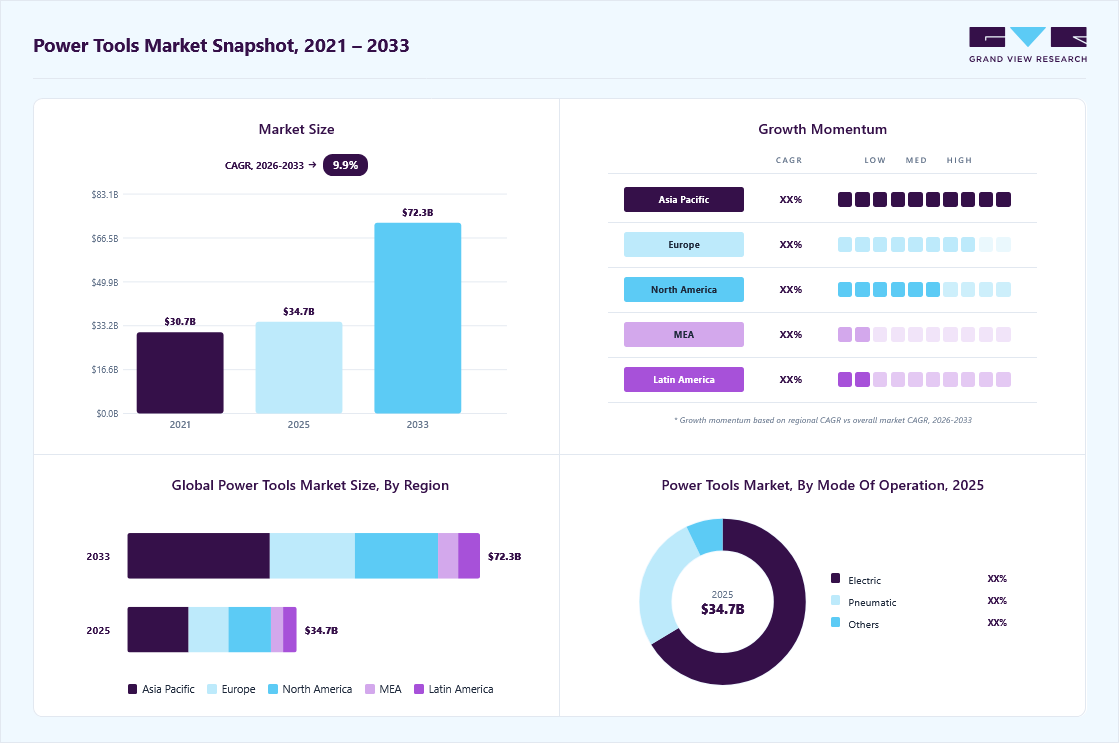
The global power tools market size was valued at USD 34.7 billion in 2025 and is projected to grow from USD 37.3 billion in 2026 to USD 72.3 billion by 2033, at a CAGR of 9.9% from 2026 to 2033. Asia Pacific dominated the global market, accounting for a revenue share of 36.2% in 2025. The growing adoption of cordless, lightweight, and technologically advanced tools is expected to support market expansion across both professional and industrial applications.
 Source: Grand View Research, IR Documents, Primary Interviews, Paid DatabasesTo learn more about this report,
 Download Free Sample Report
 Key Market Trends & Insights
- By product: Drills segment is expected to grow at the fastest CAGR of 11.9% from 2026 to 2033
- By mode of operation: Electric segment is expected to grow at the fastest CAGR of 10.5% from 2026 to 2033
- By application: Residential segment is expected to grow at the fastest CAGR of 11.0% from 2026 to 2033
Regional Highlights
- Largest regional market: Asia Pacific (36.2% revenue share, 2025)
- Fastest regional market: Asia Pacific (2026-2033)
Market Size & Forecast
- Market size in 2025: USD 34.7 Billion
- Estimated market size in 2026: USD 37.3 Billion
- Projected market size by 2033: USD 72.3 Billion
- CAGR (2026-2033): 9.9%
Three ways to get this report
Buy it, customize it, or ask a question.Ask an Analyst
Analyst response in 1 business day
- AccessReport author, directly
- Reply timeWithin 1 working day
- No sales callDirect answer only
- FormatEmail reply
- CostFree, no cost
Get the Full Report
What the study covers
- FormatsPDF · Excel · Dashboard
- Timeline2026–2033 annual, 2025 base
- Coverage20+ countries, 5 regions
- Companies10+ key players profiled
Customize the Report
20% free customization
- IncludeCountries, segments, points
- TailorTo your product definition
- ExtendDeeper competitor detail
- OrA fully bespoke study
- Turnaround5–10 working days
Key Takeaways from the Report
- Despite the growing popularity of cordless alternatives, AC power tools continue to maintain steady demand across professional environments where reliability and high power capacity are essential. Contractors and industrial users often rely on corded equipment for applications that require extended operating hours or high mechanical loads.
- Manufacturers are increasingly introducing advanced charging technologies such as fast chargers, smart chargers, and multi-bay charging systems to reduce downtime and improve productivity.
- Technological advancements such as integrated battery management systems and smart battery technologies are helping improve performance, enabling features like charge monitoring, improved safety, and better energy management in modern power tool batteries.
- The increasing adoption of lithium-ion battery technology, which offers longer runtime, lighter weight, and faster charging capabilities, has significantly improved the performance of cordless tools and accelerated their market penetration.
- A key trend in the North America region is the integration of advanced and ergonomic pneumatic tools designed to improve worker safety and productivity. Manufacturers are focusing on lightweight tools, vibration reduction, and noise-control technologies to comply with strict workplace safety regulations.
Moreover, rapid industrialization, urbanization, and expanding construction activities across key economies are expected to contribute to the market growth. The power tools market is experiencing sustained growth, supported by rising construction and infrastructure activity, expanding industrial and manufacturing operations, and increasing consumer inclination toward do-it-yourself (DIY), repair, and maintenance activities. Power tools are increasingly adopted across a broad range of applications, including construction, woodworking, metalworking, automotive repair, assembly, renovation, and general maintenance, creating demand across both professional and residential end users.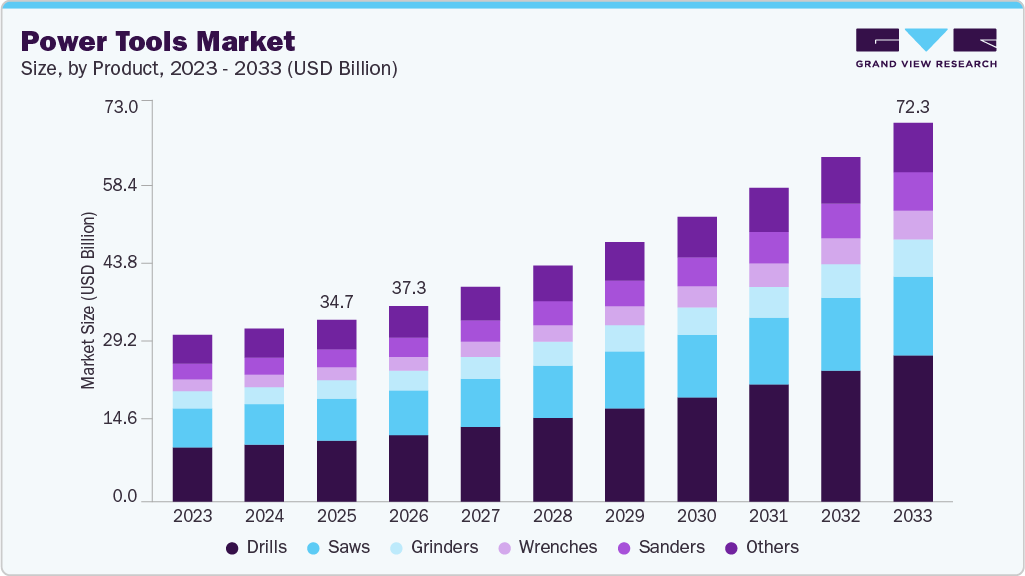 To learn more about this report, Download Free Sample Report
 A notable shift in the power tools industry is the growing preference for cordless power tools, driven by their portability, operational flexibility, ease of use, and ability to perform without access to a fixed power source. Battery-powered tools, including drills, impact drivers, impact wrenches, saws, grinders, and other equipment, are gaining wider acceptance across construction, industrial, commercial, and household applications. The increasing use of lithium-ion battery technology is further supporting this transition by enabling longer operating times, higher power output, faster charging, and reduced tool weight compared with conventional battery technologies.
Technological advancements are also shaping competitive dynamics in the power tools market, as manufacturers increasingly integrate intelligent features, improved motor technologies, advanced battery-management systems, and connected capabilities into their product portfolios. These innovations are aimed at improving productivity, precision, safety, runtime, and overall user experience while addressing the evolving requirements of professional users and consumers.
Furthermore, ongoing infrastructure development, industrial modernization, residential construction, and renovation activities are expected to sustain demand for power tools over the forecast period. Expanding end-use application scope, accelerating adoption of cordless tools, continued battery innovation, and product-level technological advancements are expected to create favorable growth opportunities for manufacturers across developed and emerging markets.
Market Dynamics
The global power tools market is shaped by a combination of strong construction and infrastructure activities, evolving consumer preferences, technological advancements in tools, and cost-related challenges. Rising investments in residential, commercial, and infrastructure development are driving demand for efficient and high-performance tools, while the shift toward cordless, battery-powered, and smart solutions is creating new avenues for market expansion. High product prices, fluctuations in raw material cost, and maintenance expenses may limit product adoption, particularly among price-sensitive users. Increasing demand for lightweight, ergonomic, connected, and energy-efficient tools, alongside growing DIY and renovation activities, is expected to create further opportunities for manufacturers to differentiate their offerings and strengthen their competitive position in the market.
The rapid expansion of the global construction industry is a key driver of the power tools market, supported by rising residential, commercial, and infrastructure development activities. Construction projects require extensive use of drilling, fastening, cutting, grinding, and demolition tools, creating sustained demand for professional-grade equipment among contractors and construction workers. Rapid urbanization and growing investments in housing, transportation networks, utilities, and industrial infrastructure are further increasing construction activities across developed and emerging economies.
Government-led infrastructure modernization and economic development programs are also accelerating construction spending worldwide. Large-scale investments in highways, railways, airports, energy systems, and urban infrastructure involve labor-intensive activities that increasingly rely on mechanized and high-performance power tools to improve productivity, precision, and operational efficiency. As construction projects become larger and more complex, continued infrastructure investment and urban development are expected to drive sustained adoption of electric and cordless power tools.
The increasing cost of power tools and associated components is a key restraint on market growth, particularly for price-sensitive residential and small-scale users. The adoption of advanced cordless tools with sophisticated batteries, motors, electronic controls, and smart features has increased product costs compared with conventional tools. In addition, fluctuations in the prices of steel, aluminum, semiconductors, and other raw materials can raise manufacturing costs and ultimately increase selling prices.
High maintenance and replacement costs further limit the adoption of power tools, particularly in demanding construction and industrial environments where frequent use and exposure to dust and harsh operating conditions can accelerate wear and tear. Rising costs of batteries, accessories, spare parts, and repairs can increase the total cost of ownership and discourage replacement or new purchases. Supply chain disruptions and trade-related tariffs may further increase the cost of imported components and aftermarket products, creating additional pressure on consumers and businesses and potentially restraining market growth.
The power tools market presents substantial growth opportunities through the continued transition toward cordless and battery-powered solutions across professional, industrial, and consumer applications. Advancements in lithium-ion battery technology are improving runtime, charging efficiency, power output, and overall tool performance, enabling cordless equipment to address increasingly demanding applications. This trend is particularly relevant across construction, maintenance, and industrial environments where mobility, flexibility, and ease of operation are critical. The expansion of high-capacity battery platforms and broader cordless product ecosystems is expected to accelerate the replacement of conventional corded tools and create opportunities for manufacturers to strengthen product portfolios and capture premium demand.
Growing residential construction, renovation, and DIY activities also offer significant opportunities, supported by urbanization, rising homeownership, and increasing consumer interest in home improvement. The proliferation of e-commerce platforms, online tutorials, and digital content is making power tools more accessible to household users and hobbyists, encouraging demand for compact, lightweight, and multifunctional products. In parallel, the integration of smart connectivity, tool tracking, performance monitoring, and digital management capabilities is creating opportunities for differentiated solutions targeting professional and industrial users. Increasing emphasis on ergonomics, workplace safety, energy efficiency, and productivity is further supporting demand for technologically advanced and premium power tools.
Analyst Perspective
The power tools market is expected to witness greater adoption of cordless devices, with manufacturers focusing on enhanced battery performance, connected tool ecosystems, and smarter product designs. Future competition is likely to be centered around battery runtime, charging speed, durability, ergonomics, and integration of digital features that improve productivity and user safety. Manufacturers with scalable battery platforms and broad tool compatibility are expected to gain an advantage by strengthening customer retention and reducing switching costs. Product innovation, particularly in brushless motors, advanced battery systems, and connected tools, will remain a key differentiator. In addition, competitors that combine premium performance with competitive pricing, strong distribution networks, localized product portfolios, and responsive after-sales service will be better positioned to expand market share across professional, industrial, and DIY segments.
Product Insights
The drills segment dominated the power tools industry in 2025, accounting for a revenue share of 33.4%, and is expected to maintain its leading position throughout the forecast period. Drills remain one of the most widely adopted power tools owing to their ease of operation, relatively affordable cost, and versatility across residential, commercial, construction, and industrial applications. Their use in drilling, fastening, installation, repair, and maintenance activities, combined with the growing availability of cordless and brushless models, continues to support segment growth. Product innovation is further strengthening demand; for instance, For instance, Bosch Power Tools expanded its 18V cordless portfolio in 2025, including the GSB18V-65 Professional hammer drill/driver, which features a brushless motor, KickBack Control, and three operating modes.
The segment is also benefiting from advancements in battery technology, ergonomics, and compact tool designs, which are improving portability and usability for both professional users and DIY consumers. In 2024, Bosch expanded its cordless portfolio with the 18V Drill/Driver with 5-in-1 Flexiclick system, highlighting the industry's shift toward multifunctional cordless platforms. In addition to drills, the product segment comprises saws, wrenches, grinders, sanders, and other power tools.
The wrenches segment is anticipated to grow at a CAGR of 11.2% during the forecast period, driven by growing demand for faster, more precise, and less labor-intensive fastening solutions. Compared with conventional hand wrenches, power wrenches significantly reduce manual effort and operating time, making them particularly suitable for high-volume fastening applications. Wrenches are widely used across production facilities, automotive assembly, construction, and industrial maintenance operations to improve productivity and consistency. The increasing automation of manufacturing facilities, coupled with the growing adoption of cordless and ergonomically designed power wrenches, is expected to further support segment growth over the coming years.
Mode of Operation Insights
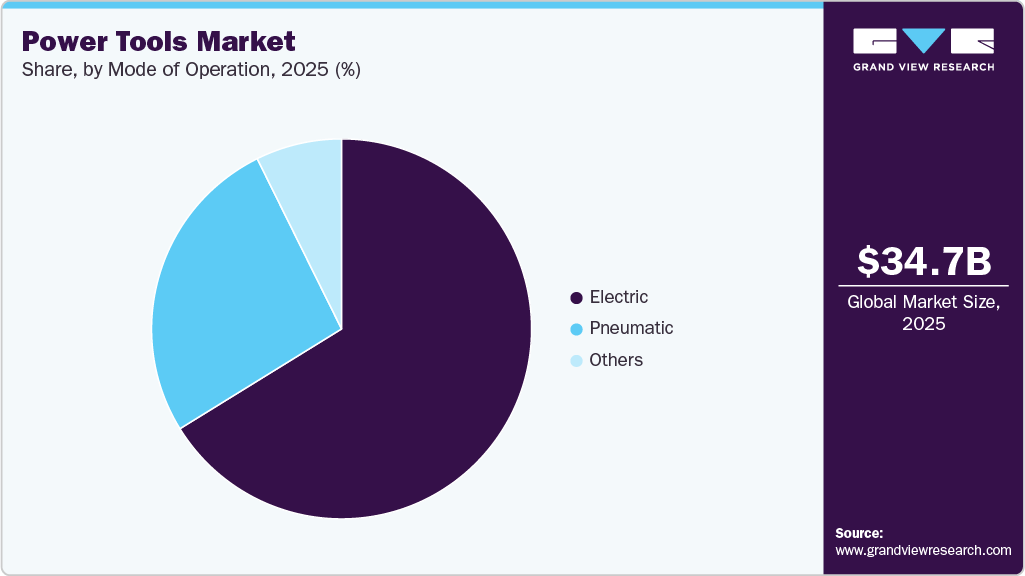
The electric mode of operation segment dominated the power tools market, accounting for the largest revenue share of 66.3% in 2025 and is expected to maintain its leading position over the forecast period. Demand for electric power tools is supported by their ease of operation, energy efficiency, durability, and growing technological sophistication across construction, manufacturing, maintenance, and DIY applications. The continued shift toward cordless solutions is further strengthening the segment, as advancements in lithium-ion batteries and brushless motor technology improve runtime, power output, and portability.
 To learn more about this report, Download Free Sample Report
 The pneumatic mode of operation segment is expected to grow at a CAGR of 9.2% during the forecast period, supported by the high power-to-weight ratio, durability, reliability, and suitability of pneumatic tools for demanding industrial applications. These tools are particularly prevalent across automotive manufacturing, assembly lines, construction, and heavy-duty maintenance, where consistent torque and high-frequency operation are critical. The continued automation of manufacturing and production facilities is expected to support adoption by enabling faster and more consistent fastening, grinding, drilling, and assembly processes. Atlas Copco, for example, continues to offer handheld pneumatic tools as part of its Power Technique portfolio, serving demanding construction and industrial applications and reinforcing the continued relevance of pneumatic technology alongside the growing adoption of electric tools.
Application Insights
The industrial application segment accounted for the largest revenue share of 61.8% in 2025, supported by extensive use of power tools across automotive, construction, aerospace, logistics, and other industrial sectors. Increasing automation, technological advancements, and the adoption of precision-driven manufacturing processes are strengthening demand for efficient and high-performance power tools. Automotive and construction industries remain among the largest users of power tools, particularly for drilling, fastening, cutting, grinding, and assembly operations. The growing emphasis on productivity, operational efficiency, and workplace safety is also encouraging industrial users to replace conventional tools with advanced cordless and ergonomic solutions.
The residential application segment is projected to grow at the fastest CAGR of 11.0% during the forecast period, driven primarily by the expanding DIY and home improvement culture. The availability of lightweight, user-friendly, and easy-to-operate power tools is making these products increasingly accessible to household users and DIY enthusiasts. Rising home renovation, remodeling, repair, and maintenance activities are further increasing the use of power tools in residential settings. In addition, the growing availability of consumer-grade cordless tools through e-commerce platforms and retail channels is improving product accessibility and supporting adoption among first-time and occasional users.
Regional Insights
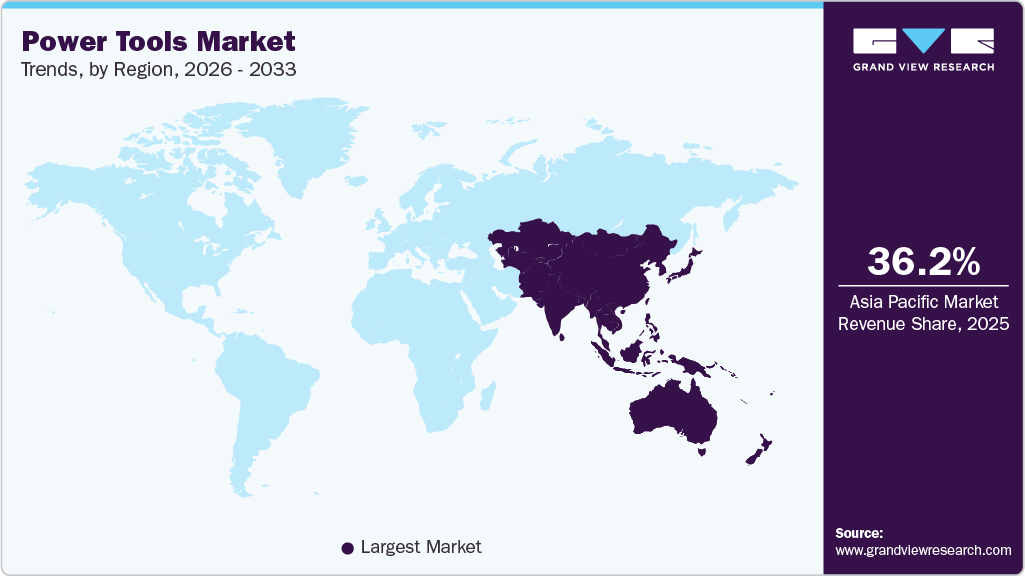
The Asia Pacific power tools market held the largest global share of 36.2% in 2025 and is projected to grow at the fastest CAGR over the forecast period, owing to the flourishing automotive industry in countries such as India and China. Growth of the regional market is primarily driven by rising disposable income and expanding construction and infrastructure development. The availability of affordable labor and reduced production expenses are prompting multinational companies to set up their manufacturing operations in countries including China and India. Furthermore, government initiatives aimed at increasing domestic manufacturing, aiding producers, and decreasing imports to achieve self-sufficiency are anticipated to favor industrial sectors and accelerate the expansion of power tools throughout the forecast period.
 To learn more about this report, Download Free Sample Report
 China Power Tools Market Trends
China’s power tools market is benefiting from continued infrastructure development and increasing public expenditure on large-scale projects, including railway networks, data centers, and steps associated with the Belt and Road Initiative. These investments are generating sustained demand for power tools across construction and infrastructure applications. Government efforts to strengthen domestic manufacturing capabilities and advance industrial self-reliance are supporting the expansion of local production activities. The emphasis on developing indigenous technologies and reducing reliance on foreign suppliers is expected to accelerate industrial and manufacturing growth, creating additional demand for power tools across a range of industrial applications.
Europe Power Tools Market Trends
The Europe power tools industry held a revenue share of 23.5% in 2025, primarily driven by the region’s strong industrial and manufacturing base, ongoing construction and infrastructure development, and the rising adoption of cordless, energy-efficient, and technologically advanced tools such as those featuring brushless motors and smart connectivity. Europe represents a significant market for power tools, primarily driven by construction activity, infrastructure modernization, and industrial manufacturing. According to Eurostat, the construction production in the EU increased by 1.4% month-on-month in April 2025, reflecting ongoing construction activity across member states. European governments are also prioritizing infrastructure modernization, energy-efficient buildings, and sustainable construction practices. These initiatives are expected to increase demand for advanced construction equipment and power tools across the region as governments implement policies focused on urban infrastructure upgrades and climate-friendly building standards.
The Germany power tools market is expected to grow during the forecast period. Germany also has one of the largest manufacturing sectors in Europe, including automotive and industrial machinery production. Industrial maintenance and assembly operations require a wide range of power tools, including drilling, grinding, and fastening tools, contributing to stable demand in the country. Germany’s government continues to promote energy-efficient building renovation programs and sustainable construction policies aimed at reducing emissions in the building sector. These initiatives are expected to increase demand for construction equipment and power tools used in retrofitting and building modernization projects.
North America Power Tools Market Trends
The North America power tools industry held a revenue share of 28.5% in 2025, driven by strong construction, manufacturing, and home improvement activities across the region. Infrastructure modernization programs across North America are further contributing to the product demand and favoring market growth. Governments across the region are investing in transportation infrastructure, public buildings, and housing developments to address urbanization and economic growth. In addition, North America has a strong culture of DIY home improvement and residential renovation, particularly in the U.S. and Canada, which further contributes to the market growth.
The U.S. power tools market is expected to grow during the forecast period. In the U.S., construction activity continues to expand steadily, which directly supports demand for professional power tools used in drilling, cutting, fastening, and demolition applications. According to the U.S. Census Bureau, total construction spending reached an annualized value of USD 2.19 trillion in January 2025, representing a 3.3% increase compared to the previous year in January 2024. The U.S. has a well-established aerospace manufacturing industry, supported by extensive production facilities operated by major players. The expansion and modernization of these manufacturing operations support demand for power tools used in aircraft assembly, drilling, fastening, fabrication, and maintenance activities.
Latin America Power Tools Market Trends
The Latin America power tools industry is benefiting from accelerating urbanization, population growth, and expanding residential and commercial construction across countries such as Brazil, Argentina, and Peru. Increasing infrastructure development and industrial activity are broadening demand beyond traditional construction applications, with automotive, manufacturing, metalworking, and agricultural activities creating additional opportunities for power tool manufacturers. Brazil is expected to remain a key growth market, supported by its large construction and industrial base.
Middle East & Africa Power Tools Market Trends
The Middle East & Africa (MEA) power tools industry held a revenue share of 7.2% in 2025, supported by expanding construction, infrastructure, and industrial development across the region. Large-scale investments in transportation networks, urban projects, commercial facilities, and energy infrastructure are driving demand for drilling, cutting, fastening, and demolition tools. The oil and gas sector remains a major end user, particularly for maintenance and field operations. Meanwhile, economic diversification initiatives in countries such as Saudi Arabia and the UAE are accelerating manufacturing, automotive, and industrial development. These trends, alongside increasing adoption of cordless, durable, and high-performance tools, are expected to create new growth opportunities for power tool manufacturers across the MEA region.
Competitive Landscape
The global power tools market is characterized by intense competition, with established manufacturers leveraging broad product portfolios, technological expertise, strong distribution networks, and brand recognition to maintain their market positions. Key players include Atlas Copco AB, a manufacturer of power equipment, compressors, and industrial machinery, and Koki Holdings Co., Ltd., which manufactures and sells power tools under brands including HIKOKI, Metabo HPT, and Metabo. Stanley Black & Decker offers hand and power tools, accessories, fastening systems, and related solutions across multiple industries, while Hilti focuses on technology-driven equipment, product development, manufacturing, logistics, sales, and servicing.
Across the competitive landscape, companies are increasingly prioritizing cordless technologies, advanced battery systems, ergonomic designs, smart connectivity, acquisitions, geographic expansion, and direct-to-consumer and e-commerce channels to differentiate offerings, strengthen customer relationships, and capture opportunities across professional, industrial, and DIY applications. Participants are strengthening their presence through product innovation, portfolio expansion, strategic investments, and enhanced distribution capabilities.
Key Power Tools Companies
The following are the leading companies in the power tools market. These companies collectively hold the largest market share and dictate the industry trends.
Competitive Benchmarking
Operating Strategies
Competitive Edge
Weakness
Mature Players: Robert Bosch GmbH; Stanley Black & Decker; Techtronic Industries Co., Ltd.; Makita Corporation; Hilti Corporation; Atlas Copco; Ingersoll Rand, Inc.
- Established players in the power tools market primarily emphasize continuous innovation, international expansion, and robust distribution networks to sustain their market leadership.
- These companies allocate significant resources to cordless technologies, connected tools, and next-generation battery systems.
- These companies benefit from strong brand equity, diversified product portfolios, and extensive global service and support networks.
- Their competitive position is reinforced by sustained R&D investments, high-quality product offerings, established dealer and distribution channels, and the ability to serve a broad range of professional and industrial end users.
- Established players may face challenges arising from high operating costs, pricing pressures, and comparatively slower adaptability.
- This can limit their ability to respond as quickly as emerging and fast-growing competitors.
Emerging Players: Apex Tool Group, LLC; Emerson Electric Co.; Koki Holdings Co., Ltd.
- Emerging players in the power tools market emphasize rapid portfolio expansion, competitive pricing, and the accelerated adoption of cordless and lightweight tool technologies.
- These companies are strengthening their market presence through strategic acquisitions, geographic expansion, digital sales channels, and targeted product offerings for professional contractors and DIY consumers.
- Emerging players benefit from shorter innovation cycles, expanding expertise in battery-powered tools, and increasing penetration across developing markets.
- Their ability to offer cost-effective products, contemporary designs, and user-friendly cordless solutions enables them to capture market share across residential and industrial applications.
- Emerging players may face challenges related to elevated operating expenses, intense cost competition, and limited agility in responding to market changes relative to rapidly expanding rivals.
- Lack of global brand recognition, narrower distribution networks, and relatively smaller manufacturing capacities are also often among the key challenges.
Recent Developments
-
In March 2026, Makita launched new XGT cordless tools and framing nailers under its 40V Max battery platform. These tools are designed for heavy-duty construction applications and offer higher power output and longer runtime. The expansion strengthens Makita’s professional cordless ecosystem and improves productivity for contractors.
-
In October 2024, Makita released a 40V Max XGT cordless breaker hammer, 9-inch power cutter, and new woodworking tools as part of its expanding XGT cordless platform. This offers an ideal tool for masons and general contractors, hardscape contractors, and fire and rescue personnel.
-
In September 2024, Stanley Black & Decker introduced a new range of DEWALT XR brushless cordless tools, designed to improve performance and durability for construction applications.
Value Chain Analysis
The key stages of the value chain of the power tools market are raw material suppliers, product manufacturers, distributors/installers, and end users. Raw material suppliers provide essential inputs such as steel, aluminum, plastics, rubber, granules, and other metals, as well as materials and components used in batteries, motors, and electronic control systems. Suppliers increasingly leverage advanced material technologies to improve strength, durability, and efficiency while maintaining stringent quality standards. Power tool manufacturers, in turn, prioritize reliable and cost-effective sourcing through short- and long-term supplier agreements, although procurement can be affected by raw material price volatility, tariffs, supply chain disruptions, and international trade policies.
Product manufacturers are the core stage of the value chain, leveraging R&D, engineering capabilities, and advanced technologies to develop innovative, application-specific power tools. Manufacturers distribute products through direct sales, distributors, authorized dealers, retailers, and e-commerce platforms, with aftermarket providers supporting replacement parts and accessories. The final stage comprises end users across construction, automotive, aerospace, energy, shipbuilding, industrial, and DIY applications, whose growing preference for cordless, lightweight, ergonomic, and smart tools continues to influence product development and intensify competition across the market.
Power Tools Market Report Scope
Report Attribute
Details
Market size in 2025
USD 34.7 billion
Estimated market size in 2026
USD 37.3 billion
Projected market size by 2033
USD 72.3 billion
Growth rate
CAGR of 9.9% from 2026 to 2033
Base year for estimation
2025
Historical data
2021 - 2024
Forecast period
2026 - 2033
Quantitative units
Revenue in USD million/billion and CAGR from 2026 to 2033
Report coverage
Revenue forecast, company ranking, competitive landscape, growth factors, and trends
Segments covered
Product, mode of operation, application, and region
Regional scope
North America; Europe; Asia Pacific; Latin America; Middle East & Africa
Country scope
U.S.; Canada; Mexico; UK; Germany; France; China; India; Japan; Brazil
Key companies profiled
Makita Corporation; Robert Bosch GmbH; Stanley Black & Decker; Techtronic Industries Co., Ltd.; Emerson Electric Co.; Atlas Copco; Hilti Corporation; Ingersoll Rand, Inc.; Koki Holdings Co., Ltd., Apex Tool Group, LLC
Customization scope
Free report customization (equivalent to up to 8 analysts working days) with purchase. Addition or alteration to country, regional & segment scope.
Pricing and purchase options
Avail of customized purchase options to meet your exact research needs. Explore purchase options
Global Power Tools Market Report Segmentation
This report forecasts revenue growth at the global, regional, and country levels and provides an analysis of the latest industry trends in each of the sub-segments from 2021 to 2033. For this study, Grand View Research has segmented the power tools market report based on product, mode of operation, application, and region.
Global Power Tools Market Report - Table of Contents
Chapter 1. Methodology and Scope
1.1. Research Methodology
1.2. Research Scope & Assumption
1.3. Information Procurement
1.3.1. Purchased Database
1.3.2. GVR’s Internal Database
1.3.3. Secondary Sources & Third-Party Perspectives
1.3.4. Primary Research
1.4. Information Analysis
1.4.1. Data Analysis Models
1.5. Market Formulation & Data Visualization
1.6. List of Data Sources
Chapter 2. Executive Summary
2.1. Market Outlook, 2025 (USD Million)
2.2. Segmental Outlook
2.3. Competitive Insights
Chapter 3. Power Tools Market Variables, Trends & Scope
3.1. Market Lineage/Ancillary Market Outlook
3.2. Industry Value Chain Analysis
3.2.1. Sales Channel Analysis
3.3. Regulatory Framework
3.3.1. Analyst Perspective
3.3.2. Regulations & Standards
3.4. Market Dynamics
3.4.1. Market Driver Analysis
3.4.2. Market Restraint Analysis
3.4.3. Industry Opportunities
3.4.4. Industry Challenges
3.5. Business Environmental Tools Analysis: Power Tools Market
3.5.1. Porter’s Five Forces Analysis
3.5.1.1. Bargaining Power of Suppliers
3.5.1.2. Bargaining Power of Buyers
3.5.1.3. Threat of Substitution
3.5.1.4. Threat of New Entrants
3.5.1.5. Competitive Rivalry
3.5.2. PESTLE Analysis
3.5.2.1. Political Landscape
3.5.2.2. Economic Landscape
3.5.2.3. Social Landscape
3.5.2.4. Technology Landscape
3.5.2.5. Environmental Landscape
3.5.2.6. Legal Landscape
3.6. Market Disruption Analysis
Chapter 4. Power Tools Market: Product Estimates & Trend Analysis
4.1. Key Takeaways
4.2. Product Movement Analysis & Market Share, 2025 & 2033
4.3. Global Power Tools Market, by Product, 2021 - 2033 (USD Million/Billion)
4.4. Drills
4.4.1. Power Tools Market Estimates and Forecasts, by Drills 2021 - 2033 (USD Million/Billion)
4.5. Saws
4.5.1. Power Tools Market Estimates and Forecasts, by Saws, 2021 - 2033 (USD Million/Billion)
4.6. Wrenches
4.6.1. Power Tools Market Estimates and Forecasts, by Wrenches, 2021 - 2033 (USD Million/Billion)
4.7. Grinders
4.7.1. Power Tools Market Estimates and Forecasts, by Grinders, 2021 - 2033 (USD Million/Billion)
4.8. Sanders
4.8.1. Power Tools Market Estimates and Forecasts, by Sanders, 2021 - 2033 (USD Million/Billion)
4.9. Other Products
4.9.1. Power Tools Market Estimates and Forecasts, by Other Products, 2021 - 2033 (USD Million/Billion)
Chapter 5. Power Tools Market: Mode of Operation Estimates & Trend Analysis
5.1. Key Takeaways
5.2. Mode of Operation Movement Analysis & Market Share, 2025 & 2033
5.3. Global Power Tools Market, by Mode of Operation, 2021 - 2033 (USD Million/Billion)
5.4. Electric
5.4.1. Power Tools Market Estimates and Forecasts, by Electric 2021 - 2033 (USD Million/Billion)
5.5. Pneumatic
5.5.1. Power Tools Market Estimates and Forecasts, by Pneumatic, 2021 - 2033 (USD Million/Billion)
5.6. Others
5.6.1. Power Tools Market Estimates and Forecasts, by Others, 2021 - 2033 (USD Million/Billion)
Chapter 6. Power Tools Market: Application Estimates & Trend Analysis
6.1. Key Takeaways
6.2. Application Movement Analysis & Market Share, 2025 & 2033
6.3. Global Power Tools Market, by Application, 2021 - 2033 (USD Million/Billion)
6.4. Industrial
6.4.1. Power Tools Market Estimates and Forecasts, for Industrial, 2021 - 2033 (USD Million/Billion)
6.5. Residential
6.5.1. Power Tools Market Estimates and Forecasts, for Residential, 2021 - 2033 (USD Million/Billion)
Chapter 7. Power Tools Market: Regional Estimates & Trend Analysis
7.1. Key Takeaways
7.2. Regional Market Share Analysis, 2025 & 2033
7.3. North America
7.3.1. North America Power Tools Market Estimates and Forecasts, 2021 - 2033 (USD Million/Billion)
7.3.2. North America Power Tools Market Estimates and Forecasts, by Product, 2021 - 2033 (USD Million/Billion)
7.3.3. North America Power Tools Market Estimates and Forecasts, by Mode of Operation, 2021 - 2033 (USD Million/Billion)
7.3.4. North America Power Tools Market Estimates and Forecasts, by Application, 2021 - 2033 (USD Million/Billion)
7.3.5. U.S.
7.3.5.1. U.S. Power Tools Market Estimates and Forecasts, 2021 - 2033 (USD Million/Billion)
7.3.5.2. U.S. Power Tools Market Estimates and Forecasts, by Product, 2021 - 2033 (USD Million/Billion)
7.3.5.3. U.S. Power Tools Market Estimates and Forecasts, by Mode of Operation, 2021 - 2033 (USD Million/Billion)
7.3.5.4. U.S. Power Tools Market Estimates and Forecasts, by Application, 2021 - 2033 (USD Million/Billion)
7.3.6. Canada
7.3.6.1. Canada Power Tools Market Estimates and Forecasts, 2021 - 2033 (USD Million/Billion)
7.3.6.2. Canada Power Tools Market Estimates and Forecasts, by Product, 2021 - 2033 (USD Million/Billion)
7.3.6.3. Canada Power Tools Market Estimates and Forecasts, by Mode of Operation, 2021 - 2033 (USD Million/Billion)
7.3.6.4. Canada Power Tools Market Estimates and Forecasts, by Application, 2021 - 2033 (USD Million/Billion)
7.3.7. Mexico
7.3.6.1. Mexico Power Tools Market Estimates and Forecasts, 2021 - 2033 (USD Million/Billion)
7.3.6.2. Mexico Power Tools Market Estimates and Forecasts, by Product, 2021 - 2033 (USD Million/Billion)
7.3.6.3. Mexico Power Tools Market Estimates and Forecasts, by Mode of Operation, 2021 - 2033 (USD Million/Billion)
7.3.6.4. Mexico Power Tools Market Estimates and Forecasts, by Application, 2021 - 2033 (USD Million/Billion)
7.4. Europe
7.4.1. Europe Power Tools Market Estimates and Forecasts, 2021 - 2033 (USD Million/Billion)
7.4.2. Europe Power Tools Market Estimates and Forecasts, by Product, 2021 - 2033 (USD Million/Billion)
7.4.3. Europe Power Tools Market Estimates and Forecasts, by Mode of Operation, 2021 - 2033 (USD Million/Billion)
7.4.4. Europe Power Tools Market Estimates and Forecasts, by Application, 2021 - 2033 (USD Million/Billion)
7.4.5. Germany
7.4.5.1. Germany Power Tools Market Estimates and Forecasts, 2021 - 2033 (USD Million/Billion)
7.4.5.2. Germany Power Tools Market Estimates and Forecasts, by Product, 2021 - 2033 (USD Million/Billion)
7.4.5.3. Germany Power Tools Market Estimates and Forecasts, by Mode of Operation, 2021 - 2033 (USD Million/Billion)
7.4.5.4. Germany Power Tools Market Estimates and Forecasts, by Application, 2021 - 2033 (USD Million/Billion)
7.4.6. UK
7.4.6.1. UK Power Tools Market Estimates and Forecasts, 2021 - 2033 (USD Million/Billion)
7.4.6.2. UK Power Tools Market Estimates and Forecasts, by Product, 2021 - 2033 (USD Million/Billion)
7.4.6.3. UK Power Tools Market Estimates and Forecasts, by Mode of Operation, 2021 - 2033 (USD Million/Billion)
7.4.6.4. UK Power Tools Market Estimates and Forecasts, by Application, 2021 - 2033 (USD Million/Billion)
7.4.7. France
7.4.7.1. France Power Tools Market Estimates and Forecasts, 2021 - 2033 (USD Million/Billion)
7.4.7.2. France Power Tools Market Estimates and Forecasts, by Product, 2021 - 2033 (USD Million/Billion)
7.4.7.3. France Power Tools Market Estimates and Forecasts, by Mode of Operation, 2021 - 2033 (USD Million/Billion)
7.4.7.4. France Power Tools Market Estimates and Forecasts, by Application, 2021 - 2033 (USD Million/Billion)
7.5. Asia Pacific
7.5.1. Asia Pacific Power Tools Market Estimates and Forecasts, 2021 - 2033 (USD Million/Billion)
7.5.2. Asia Pacific Power Tools Market Estimates and Forecasts, by Product, 2021 - 2033 (USD Million/Billion)
7.5.3. Asia Pacific Power Tools Market Estimates and Forecasts, by Mode of Operation, 2021 - 2033 (USD Million/Billion)
7.5.4. Asia Pacific Power Tools Market Estimates and Forecasts, by Application, 2021 - 2033 (USD Million/Billion)
7.5.5. China
7.5.5.1. China Power Tools Market Estimates and Forecasts, 2021 - 2033 (USD Million/Billion)
7.5.5.2. China Power Tools Market Estimates and Forecasts, by Product, 2021 - 2033 (USD Million/Billion)
7.5.5.3. China Power Tools Market Estimates and Forecasts, by Mode of Operation, 2021 - 2033 (USD Million/Billion)
7.5.5.4. China Power Tools Market Estimates and Forecasts, by Application, 2021 - 2033 (USD Million/Billion)
7.5.6. India
7.5.6.1. India Power Tools Market Estimates and Forecasts, 2021 - 2033 (USD Million/Billion)
7.5.6.2. India Power Tools Market Estimates and Forecasts, by Product, 2021 - 2033 (USD Million/Billion)
7.5.6.3. India Power Tools Market Estimates and Forecasts, by Mode of Operation, 2021 - 2033 (USD Million/Billion)
7.5.6.4. India Power Tools Market Estimates and Forecasts, by Application, 2021 - 2033 (USD Million/Billion)
7.5.7. Japan
7.5.7.1. Japan Power Tools Market Estimates and Forecasts, 2021 - 2033 (USD Million/Billion)
7.5.7.2. Japan Power Tools Market Estimates and Forecasts, by Product, 2021 - 2033 (USD Million/Billion)
7.5.7.3. Japan Power Tools Market Estimates and Forecasts, by Mode of Operation, 2021 - 2033 (USD Million/Billion)
7.5.7.4. Japan Power Tools Market Estimates and Forecasts, by Application, 2021 - 2033 (USD Million/Billion)
7.6. Latin America
7.6.1. Latin America Power Tools Market Estimates and Forecasts, 2021 - 2033 (USD Million/Billion)
7.6.2. Latin America Power Tools Market Estimates and Forecasts, by Product, 2021 - 2033 (USD Million/Billion)
7.6.3. Latin America Power Tools Market Estimates and Forecasts, by Mode of Operation, 2021 - 2033 (USD Million/Billion)
7.6.4. Latin America Power Tools Market Estimates and Forecasts, by Application, 2021 - 2033 (USD Million/Billion)
7.6.5. Brazil
7.6.5.1. Brazil Power Tools Market Estimates and Forecasts, 2021 - 2033 (USD Million/Billion)
7.6.5.2. Brazil Power Tools Market Estimates and Forecasts, by Product, 2021 - 2033 (USD Million/Billion)
7.6.5.3. Brazil Power Tools Market Estimates and Forecasts, by Mode of Operation, 2021 - 2033 (USD Million/Billion)
7.6.5.4. Brazil Power Tools Market Estimates and Forecasts, by Application, 2021 - 2033 (USD Million/Billion)
7.7. Middle East & Africa
7.7.1. Middle East & Africa Power Tools Market Estimates and Forecasts, 2021 - 2033 (USD Million/Billion)
7.7.2. Middle East & Africa Power Tools Market Estimates and Forecasts, by Product, 2021 - 2033 (USD Million/Billion)
7.7.3. Middle East & Africa Power Tools Market Estimates and Forecasts, by Mode of Operation, 2021 - 2033 (USD Million/Billion)
7.7.4. Middle East & Africa Power Tools Market Estimates and Forecasts, by Application, 2021 - 2033 (USD Million/Billion)
Chapter 8. Supplier Intelligence
8.1. Kraljic Matrix
8.2. Engagement Model
8.3. Negotiation Strategies
8.4. Sourcing Best Practices
8.5. Vendor Selection Criteria
Chapter 9. Competitive Landscape
9.1. Key Players, their Recent Developments, and their Impact on Industry
9.2. Competition Categorization
9.3. Company Market Position Analysis
9.4. Company Heat Map Analysis
9.5. Strategy Mapping, 2025
9.6. Company Listing
9.6.1. Makita Corporation
9.6.1.1. Company Overview
9.6.1.2. Financial Performance
9.6.1.3. Product Benchmarking
9.6.1.4. Strategic Initiatives
9.6.2. Robert Bosch GmbH
9.6.2.1. Company Overview
9.6.2.2. Financial Performance
9.6.2.3. Product Benchmarking
9.6.2.4. Strategic Initiatives
9.6.3. Stanley Black & Decker
9.6.3.1. Company Overview
9.6.3.2. Financial Performance
9.6.3.3. Product Benchmarking
9.6.3.4. Strategic Initiatives
9.6.4. Techtronic Industries Co., Ltd.
9.6.4.1. Company Overview
9.6.4.2. Financial Performance
9.6.4.3. Product Benchmarking
9.6.4.4. Strategic Initiatives
9.6.5. Emerson Electric Co.
9.6.5.1. Company Overview
9.6.5.2. Financial Performance
9.6.5.3. Product Benchmarking
9.6.5.4. Strategic Initiatives
9.6.6. Atlas Copco
9.6.6.1. Company Overview
9.6.6.2. Financial Performance
9.6.6.3. Product Benchmarking
9.6.6.4. Strategic Initiatives
9.6.7. Hilti Corporation
9.6.7.1. Company Overview
9.6.7.2. Financial Performance
9.6.7.3. Product Benchmarking
9.6.7.4. Strategic Initiatives
9.6.8. Ingersoll Rand, Inc.
9.6.8.1. Company Overview
9.6.8.2. Financial Performance
9.6.8.3. Product Benchmarking
9.6.8.4. Strategic Initiatives
9.6.9. Koki Holdings Co., Ltd.
9.6.9.1. Company Overview
9.6.9.2. Financial Performance
9.6.9.3. Product Benchmarking
9.6.9.4. Strategic Initiatives
9.6.10. Apex Tool Group, LLC
9.6.10.1. Company Overview
9.6.10.2. Financial Performance
9.6.10.3. Product Benchmarking
9.6.10.4. Strategic InitiativesList of Tables
Table 1 Power Tools Market Estimates & Forecast, by Product, 2021 - 2033 (USD Million/Billion)
Table 2 Power Tools Market Estimates & Forecast, by Mode of Operation, 2021 - 2033 (USD Million/Billion)
Table 3 Power Tools Market Estimates & Forecast, by Application, 2021 - 2033 (USD Million/Billion)
Table 4 Recent Developments & Impact Analysis, by Key Market Participants
Table 5 Company Heat Map Analysis, 2025List of Figures
Fig. 1 Power Tools Market Segmentation
Fig. 2 Information Procurement
Fig. 3 Data Analysis Models
Fig. 4 Market Formulation and Validation
Fig. 5 Data Validating & Publishing
Fig. 6 Market Outlook
Fig. 7 Segmental Outlook
Fig. 8 Competitive Outlook
Fig. 9 Lineage Market Outlook, 2025 (USD Billion)
Fig. 10 Value Chain Analysis
Fig. 11 Market Dynamics
Fig. 12 Market Driver Impact Analysis
Fig. 13 Global Natural Gas Consumption, 2018 - 2023 (Billion Cubic Meters)
Fig. 14 Market Restraint Impact Analysis
Fig. 15 Industry Analysis - PORTERS
Fig. 16 Industry Analysis - PESTEL by SWOT
Fig. 17 Key Takeaways
Fig. 18 Product: Market Share, 2025 & 2033
Fig. 19 Power Tools Market Estimates and Forecasts, by Drills 2021 - 2033 (USD Million/Billion)
Fig. 20 Power Tools Market Estimates and Forecasts, by Saws, 2021 - 2033 (USD Million/Billion)
Fig. 21 Power Tools Market Estimates and Forecasts, by Wrenches, 2021 - 2033 (USD Million/Billion)
Fig. 22 Power Tools Market Estimates and Forecasts, by Grinders, 2021 - 2033 (USD Million/Billion)
Fig. 23 Power Tools Market Estimates and Forecasts, by Sanders, 2021 - 2033 (USD Million/Billion)
Fig. 24 Power Tools Market Estimates and Forecasts, by Other Products, 2021 - 2033 (USD Million/Billion)
Fig. 25 Key Takeaways
Fig. 26 Mode of Operation: Market Share, 2025 & 2033
Fig. 27 Power Tools Market Estimates and Forecasts, by Electric 2021 - 2033 (USD Million/Billion)
Fig. 28 Power Tools Market Estimates and Forecasts, by Pneumatic, 2021 - 2033 (USD Million/Billion)
Fig. 29 Power Tools Market Estimates and Forecasts, by Others, 2021 - 2033 (USD Million/Billion)
Fig. 30 Key Takeaways
Fig. 31 Application: Market Share, 2025 & 2033
Fig. 32 Power Tools Market Estimates and Forecasts, by Industrial 2021 - 2033 (USD Million/Billion)
Fig. 33 Power Tools Market Estimates and Forecasts, by Residential, 2021 - 2033 (USD Million/Billion)
Fig. 34 Key Takeaways
Fig. 35 Region, 2025 & 2033, (USD Million/Billion)
Fig. 36 Regional Marketplace: Key Takeaways
Fig. 37 Regional Marketplace: Key Takeaways
Fig. 38 Regional Marketplace: Key Takeaways
Fig. 39 North America Power Tools Market Estimates and Forecasts, 2021 - 2033 (USD Million/Billion)
Fig. 40 North America Power Tools Market Estimates and Forecasts, by Product, 2021 - 2033 (USD Million/Billion)
Fig. 41 North America Power Tools Market Estimates and Forecasts, by Mode of Operation, 2021 - 2033 (USD Million/Billion)
Fig. 42 North America Power Tools Market Estimates and Forecasts, by Application, 2021 - 2033 (USD Million/Billion)
Fig. 43 U.S. Power Tools Market Estimates and Forecasts, 2021 - 2033 (USD Million/Billion)
Fig. 44 U.S. Power Tools Market Estimates and Forecasts, by Product, 2021 - 2033 (USD Million/Billion)
Fig. 45 U.S. Power Tools Market Estimates and Forecasts, by Mode of Operation, 2021 - 2033 (USD Million/Billion)
Fig. 46 U.S. Power Tools Market Estimates and Forecasts, by Application, 2021 - 2033 (USD Million/Billion
Fig. 47 Canada Power Tools Market Estimates and Forecasts, 2021 - 2033 (USD Million/Billion)
Fig. 48 Canada Power Tools Market Estimates and Forecasts, by Product, 2021 - 2033 (USD Million/Billion)
Fig. 49 Canada Power Tools Market Estimates and Forecasts, by Mode of Operation, 2021 - 2033 (USD Million/Billion)
Fig. 50 Canada Power Tools Market Estimates and Forecasts, by Application, 2021 - 2033 (USD Million/Billion)
Fig. 51 Europe Power Tools Market Estimates and Forecasts, 2021 - 2033 (USD Million/Billion)
Fig. 52 Europe Power Tools Market Estimates and Forecasts, by Product, 2021 - 2033 (USD Million/Billion)
Fig. 53 Europe Power Tools Market Estimates and Forecasts, by Mode of Operation, 2021 - 2033 (USD Million/Billion)
Fig. 54 Europe Power Tools Market Estimates and Forecasts, by Application, 2021 - 2033 (USD Million/Billion)
Fig. 55 Germany Power Tools Market Estimates and Forecasts, 2021 - 2033 (USD Million/Billion)
Fig. 56 Germany Power Tools Market Estimates and Forecasts, by Product, 2021 - 2033 (USD Million/Billion)
Fig. 57 Germany Power Tools Market Estimates and Forecasts, by Mode of Operation, 2021 - 2033 (USD Million/Billion)
Fig. 58 Germany Power Tools Market Estimates and Forecasts, by Application, 2021 - 2033 (USD Million/Billion)
Fig. 59 UK Power Tools Market Estimates and Forecasts, 2021 - 2033 (USD Million/Billion)
Fig. 60 UK Power Tools Market Estimates and Forecasts, by Product, 2021 - 2033 (USD Million/Billion)
Fig. 61 UK Power Tools Market Estimates and Forecasts, by Mode of Operation, 2021 - 2033 (USD Million/Billion)
Fig. 62 UK Power Tools Market Estimates and Forecasts, by Application, 2021 - 2033 (USD Million/Billion)
Fig. 63 France Power Tools Market Estimates and Forecasts, 2021 - 2033 (USD Million/Billion)
Fig. 64 France Power Tools Market Estimates and Forecasts, by Product, 2021 - 2033 (USD Million/Billion)
Fig. 65 France Power Tools Market Estimates and Forecasts, by Mode of Operation, 2021 - 2033 (USD Million/Billion)
Fig. 66 France Power Tools Market Estimates and Forecasts, by Application, 2021 - 2033 (USD Million/Billion)
Fig. 67 Asia Pacific Power Tools Market Estimates and Forecasts, 2021 - 2033 (USD Million/Billion)
Fig. 68 Asia Pacific Power Tools Market Estimates and Forecasts, by Product, 2021 - 2033 (USD Million/Billion)
Fig. 69 Asia Pacific Power Tools Market Estimates and Forecasts, by Mode of Operation, 2021 - 2033 (USD Million/Billion)
Fig. 70 Asia Pacific Power Tools Market Estimates and Forecasts, by Application, 2021 - 2033 (USD Million/Billion)
Fig. 71 China Power Tools Market Estimates and Forecasts, 2021 - 2033 (USD Million/Billion)
Fig. 72 China Power Tools Market Estimates and Forecasts, by Product, 2021 - 2033 (USD Million/Billion)
Fig. 73 China Power Tools Market Estimates and Forecasts, by Mode of Operation, 2021 - 2033 (USD Million/Billion)
Fig. 74 China Power Tools Market Estimates and Forecasts, by Application, 2021 - 2033 (USD Million/Billion)
Fig. 75 India Power Tools Market Estimates and Forecasts, 2021 - 2033 (USD Million/Billion)
Fig. 76 India Power Tools Market Estimates and Forecasts, by Product, 2021 - 2033 (USD Million/Billion)
Fig. 77 India Power Tools Market Estimates and Forecasts, by Mode of Operation, 2021 - 2033 (USD Million/Billion)
Fig. 78 India Power Tools Market Estimates and Forecasts, by Application, 2021 - 2033 (USD Million/Billion)
Fig. 79 Japan Power Tools Market Estimates and Forecasts, 2021 - 2033 (USD Million/Billion)
Fig. 80 Japan Power Tools Market Estimates and Forecasts, by Product, 2021 - 2033 (USD Million/Billion)
Fig. 81 Japan Power Tools Market Estimates and Forecasts, by Mode of Operation, 2021 - 2033 (USD Million/Billion)
Fig. 82 Japan Power Tools Market Estimates and Forecasts, by Application, 2021 - 2033 (USD Million/Billion)
Fig. 83 Latin America Power Tools Market Estimates and Forecasts, 2021 - 2033 (USD Million/Billion)
Fig. 84 Latin America Power Tools Market Estimates and Forecasts, by Product, 2021 - 2033 (USD Million/Billion)
Fig. 85 Latin America Power Tools Market Estimates and Forecasts, by Mode of Operation, 2021 - 2033 (USD Million/Billion)
Fig. 86 Latin America Power Tools Market Estimates and Forecasts, by Application, 2021 - 2033 (USD Million/Billion)
Fig. 87 Mexico Power Tools Market Estimates and Forecasts, 2021 - 2033 (USD Million/Billion)
Fig. 88 Mexico Power Tools Market Estimates and Forecasts, by Product, 2021 - 2033 (USD Million/Billion)
Fig. 89 Mexico Power Tools Market Estimates and Forecasts, by Mode of Operation, 2021 - 2033 (USD Million/Billion)
Fig. 90 Mexico Power Tools Market Estimates and Forecasts, by Application, 2021 - 2033 (USD Million/Billion)
Fig. 91 Brazil Power Tools Market Estimates and Forecasts, 2021 - 2033 (USD Million/Billion)
Fig. 92 Brazil Power Tools Market Estimates and Forecasts, by Product, 2021 - 2033 (USD Million/Billion)
Fig. 93 Brazil Power Tools Market Estimates and Forecasts, by Mode of Operation, 2021 - 2033 (USD Million/Billion)
Fig. 94 Brazil Power Tools Market Estimates and Forecasts, by Application, 2021 - 2033 (USD Million/Billion)
Fig. 95 Middle East & Africa Power Tools Market Estimates and Forecasts, 2021 - 2033 (USD Million/Billion)
Fig. 96 Middle East & Africa Power Tools Market Estimates and Forecasts, by Product, 2021 - 2033 (USD Million/Billion)
Fig. 97 Middle East & Africa Power Tools Market Estimates and Forecasts, by Mode of Operation, 2021 - 2033 (USD Million/Billion)
Fig. 98 Middle East & Africa Power Tools Market Estimates and Forecasts, by Application, 2021 - 2033 (USD Million/Billion)
Fig. 99 Competition Categorization
Fig. 100 Company Market Position Analysis
Fig. 101 Strategy Mapping, 2025Scope & Research Methodology
The market study on the power tools market has been developed using a structured, multi-stage research framework designed to ensure accuracy, consistency, and reliability of the market size Estimates and Forecasts. The methodology combines quantitative modeling techniques with qualitative validation to arrive at a defensible view of market size, segmentation, and growth trends.
We have segmented the power tools market based on parameters including product, mode of operation, application, and region.
In the first level, the market has been segmented into the following types of products:
• Drills: Power tools designed primarily for creating holes in materials such as wood, metal, concrete, masonry, and plastics. The segment includes corded and cordless drill drivers, hammer drills, rotary drills, and other drilling tools used for construction, assembly, repair, and maintenance applications.
• Saws: Power-driven cutting tools used to cut, shape, or section materials such as wood, metal, masonry, and plastics. The segment includes circular saws, reciprocating saws, jigsaws, miter saws, and other portable or stationary power saws.
• Wrenches: Power tools designed to tighten or loosen threaded fasteners, including nuts and bolts, using rotational force and, in the case of impact wrenches, hammering action. The segment includes electric and pneumatic impact wrenches, ratchet wrenches, and torque-oriented fastening tools.
• Grinders: Power tools that use rotating abrasive wheels, discs, or similar attachments to remove material, deburr, cut, sharpen, polish, or finish workpieces. The segment includes angle grinders, die grinders, and other handheld and stationary grinding tools.
• Sanders: Power tools that use abrasive surfaces or materials to smooth, finish, polish, or remove coatings from workpieces. The segment includes orbital, random-orbit, belt, disc, and other sanding tools used primarily on wood, metal, plastics, and other surfaces.
• Other Products: Includes power tools not classified under drills, saws, wrenches, grinders, or sanders, such as impact drivers, nailers, staplers, rotary hammers, heat guns, routers, planers, polishers, and other specialized power tools. This category also includes specialized power tools not covered in the primary segments. Examples include heat guns, glue guns, and other niche tools used in specific industrial or maintenance applications.
Based on modes of operations the market has been segmented into:
• Electric: Includes power tools driven by electricity supplied through a power cord or rechargeable battery. The segment covers corded and cordless tools powered by electric motors and is widely used across construction, manufacturing, automotive, repair, maintenance, and household applications.
• Pneumatic: Includes power tools driven by compressed air supplied through an air compressor. Pneumatic tools are commonly used for drilling, fastening, grinding, sanding, and other high-frequency industrial and automotive applications where high power-to-weight ratios and continuous operation are required.
Based on application scope, the power tools market has been segmented into:
• Industrial: Includes the use of power tools in commercial and professional environments such as construction, manufacturing, automotive, aerospace, energy, logistics, and other industrial operations. Tools are typically used for assembly, fabrication, installation, repair, maintenance, material processing, and fastening activities.
• Residential: Includes the use of power tools by homeowners and other non-professional users for household construction, renovation, remodeling, repair, maintenance, woodworking, gardening, and DIY projects.
Based on region, the market has been segmented into North America, Europe, Asia Pacific, Latin America, and the Middle East & Africa.
• North America: The North America regional market includes the markets of the U.S., Canada, and Mexico.
• Europe: The Europe regional market includes the markets of the UK, Germany, and France.
• Asia Pacific: The Asia Pacific regional market includes China, India, and Japan.
• Latin America: The Latin America regional market includes the markets of Brazil.
• MiddleEast & Africa: The Middle East & Africa regional market includes the markets of Saudi Arabia, the UAE, and South Africa
The study began with secondary research to understand the market landscape, key trends, competitive dynamics, and historical data. Sources included company annual reports, investor presentations, regulatory filings, industry publications, government and trade databases, paid research platforms, press releases, and reputable trade publications. This phase also supported historical data mapping (2021 onward), the identification of key market participants, and the development of preliminary hypotheses regarding segment shares and regional trends, which were subsequently validated through primary research.
Market sizing was conducted using a combination of top-down and bottom-up approaches, with findings triangulated across secondary research, company-level data, industry sources, and market indicators to arrive at a converged and validated estimate.
Under the top-down approach, the broader power tools market was first assessed using industry reports, government statistics, construction and manufacturing activity, and macroeconomic indicators. The addressable market was then segmented based on tool type, including drills, saws, grinders, sanders, and other power tools, as well as technology, application, end-use industry, and geographic region. Segment-specific penetration rates, adoption trends, and demand indicators were applied to derive market estimates across key segments and regions.
Under the bottom-up approach, market size was estimated by analyzing revenues and sales contributions of leading power tool manufacturers and major market participants across key product categories and regions. Company-level data, product portfolios, average selling prices (ASPs), unit volumes, distribution channels, and end-use demand were assessed and aggregated to develop segment- and region-level estimates.
The results from both approaches were cross-checked and reconciled through market-share analysis and industry-level triangulation to establish the final market size and forecast.
To validate and refine assumptions derived from secondary research and market modeling, structured primary interviews were conducted with a cross-section of power tools industry stakeholders, including C-level executives and senior management at power tool manufacturers, product and R&D managers, distributors and channel partners, contractors and professional users, procurement and purchasing managers, and independent industry consultants and subject-matter experts. These interviews were used to validate market size estimates and growth assumptions, assess segment- and regional-level market shares, identify emerging product and technology trends, evaluate adoption drivers and barriers, and corroborate qualitative findings related to competitive positioning, pricing dynamics, distribution strategies, and end-user preferences.
All primary inputs were systematically triangulated against secondary data and the top-down/bottom-up model outputs. Where material inconsistencies arose, additional interviews or data points were sourced until a consistent, well-supported view was established, ensuring the final estimates reflect both quantitative rigor and real-world market intelligence.
Delivered Customizations
This report has been delivered with the following In-depth customizations
Client Request
Client Request
Client Request
Regional Segmentation
Delivered an in-depth regional analysis covering North America, Europe, Asia-Pacific, Latin America, and the Middle East & Africa with detailed insights on market size, growth rates, demand patterns, regulatory environment, and country-level opportunities. The study also included analysis of construction activity, manufacturing expansion, infrastructure investments, and adoption trends for cordless and industrial power tools across key economies.
Helped clients identify high-growth regions, prioritize market entry strategies, understand regional demand variations, and evaluate investment opportunities across developed and emerging markets. The analysis also supported distribution planning and regional expansion decisions.
Opportunity Assessment
Provided a comprehensive opportunity assessment focusing on high-growth segments such as cordless power tools, lithium-ion battery technologies, smart connected tools, DIY home improvement applications, and industrial automation-driven demand. The study evaluated emerging application areas, technological advancements, evolving consumer preferences, and future adoption trends across construction, automotive, manufacturing, and residential sectors.
Enabled businesses to identify future revenue opportunities, develop targeted growth strategies, and align product development initiatives with evolving industry requirements. The assessment also supported long-term strategic planning and innovation-focused investments.
Competitive benchmarking
Delivered a detailed competitive benchmarking analysis of major global and regional power tool manufacturers based on product portfolio strength, pricing strategies, innovation capabilities, distribution networks, geographic presence, strategic initiatives, and technological advancements.
Assisted clients in understanding competitor strengths, market positioning, and differentiation strategies while identifying potential gaps and areas for competitive advantage.
Frequently Asked Questions About This Report
Asia Pacific dominated with a 36.2% revenue share in 2025.
The drills segment dominated the market and accounted for the largest revenue share of 33.4% in 2025.
The electric segment led the market with the largest revenue share of 66.3% in 2025.
Industrial segment dominated the power tools market with a share of 61.8% in 2025. This is attributable to growing adoption of power tools in the manufacturing and production facilities across the globe.
Key players include Makita Corporation; Robert Bosch Group; Stanley Black & Decker; Techtronic Industries Co., Ltd.; Emerson Electric Co.; Atlas Copco; Hilti Corporation; Ingersoll Rand, Inc.; Koki Holdings Co., Ltd., Apex Tool Group, LLC.
Key factors that are driving the market growth include rising demand from automotive & construction industry, increasing trend of DIY in household applications, and increasing automation in industries.
The global power tools market size was valued at USD 34.7 billion in 2025 and is estimated at USD 37.3 billion for 2026.
The global power tools market is expected to grow at a CAGR of 9.9% from 2026 to 2033, reaching USD 72.3 billion by 2033.
About the Author(s)
Advanced Interior Materials Research Team
Advanced Materials · Advanced Interior MaterialsThis report was authored by the advanced interior materials research team at Grand View Research - comprising two research analysts, one senior research analyst, and one industry expert - with specialized expertise in the advanced interior materials segment of the advanced materials industry. All findings are based on proprietary advanced materials databases, executive interviews, and regulatory analysis, subject to internal peer review prior to publication.
Last Updated:
Speak to Analyst

Customize this report to your needs - add regions, segments, or data points, with 20% free customization.
Or view our licence options:


ISO 9001:2015 & 27001:2022 Certified
We are GDPR and CCPA compliant! Your transaction & personal information is safe and secure. For more details, please read our privacy policy.


