
- Home
- »
- Consumer F&B
- »
-
Prebiotic Ingredient Market Size And Share Report, 2033GVR Report cover

Prebiotic Ingredients Market (2026 - 2033)
Size, Share & Trends Analysis Report By Type (Inulin, Oligosaccharide (MOS/GOS/FOS)), By Application (Food & Beverages, Dietary Supplements), By Region (North America, Asia Pacific, Europe, CSA, MEA), And Segment Forecasts
Market Size, 2025
$9.9BMarket Estimate, 2026
$11.0BMarket Forecast, 2033
$23.8BCAGR, 2026–2033
10.7%Prebiotic Ingredients Market Summary
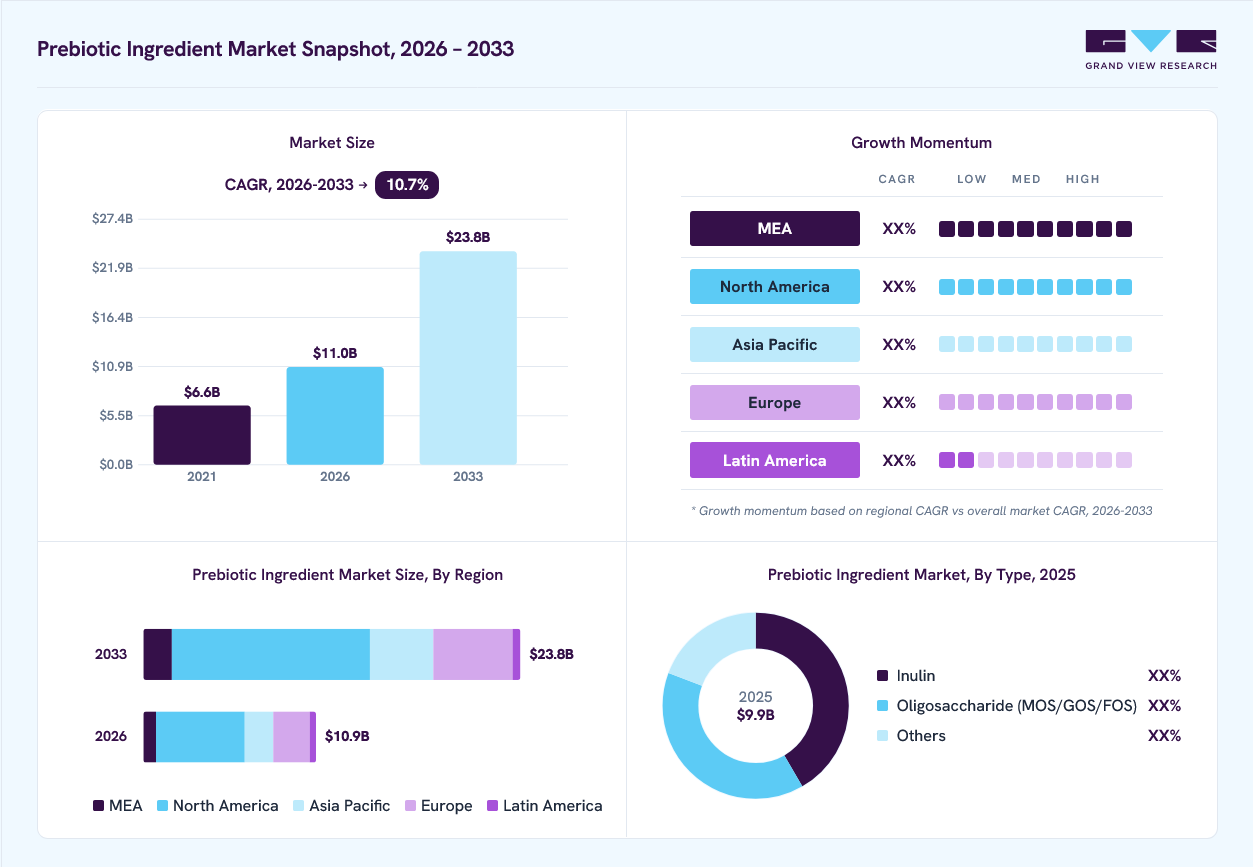
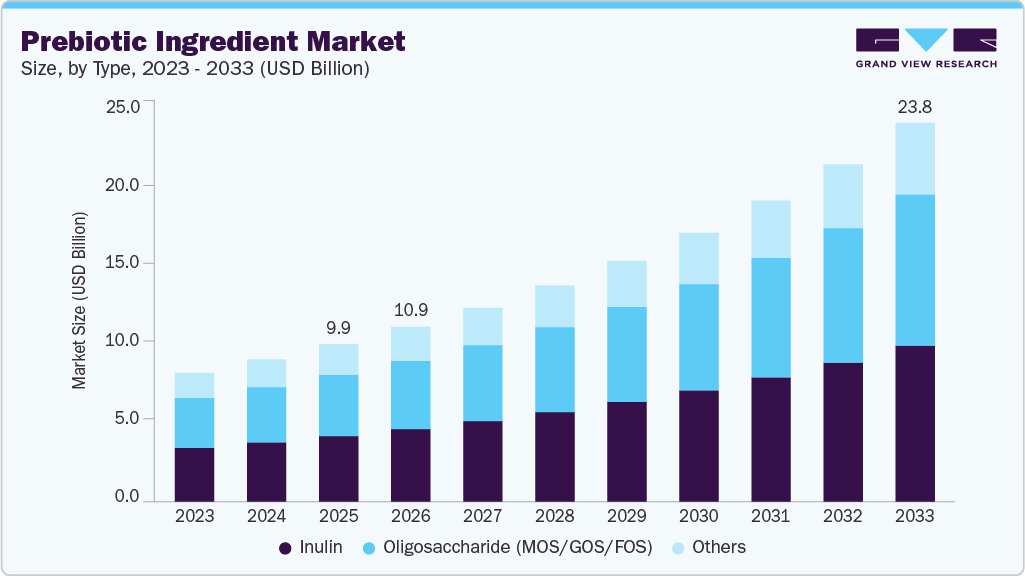
The global prebiotic ingredients market size was valued at USD 9.9 billion in 2025 and projected to grow from USD 11.0 billion in 2026 to USD 23.8 billion by 2033, at a CAGR of 10.7% from 2026 to 2033. North America dominated the market, accounting for a revenue share of 51.2% in 2025. The market is witnessing strong growth as consumers increasingly prioritize gut health, immunity, and overall wellness, driving demand for functional foods and dietary supplements enriched with prebiotic fibers such as inulin, fructo-oligosaccharides (FOS), and galacto-oligosaccharides (GOS).
 Source: Grand View Research, IR Documents, Primary Interviews, Paid DatabasesTo learn more about this report,
 Download Free Sample Report
 Key Market Trends & Insights
- By type: Inulin held the largest revenue share of 41.6% in 2025.
- By application: Food & beverage held the largest revenue share of 80.7% in 2025.
Regional Highlights
- Largest regional market: North America (51.2% revenue share, 2025)
- Fastest-growing regional market: Asia Pacific (fastest CAGR, 2026-2033)
Market Size & Forecast
- Market Size in 2025: USD 9.9 Billion
- Estimated Market Size in 2026: USD 11.0 Billion
- Projected Market Size by 2033: USD 23.8 Billion
- CAGR (2026-2033): 10.7%
Three ways to get this report
Buy it, customize it, or ask a question.Ask an Analyst
Analyst response in 1 business day
- AccessReport author, directly
- Reply timeWithin 1 working day
- No sales callDirect answer only
- FormatEmail reply
- CostFree, no cost
Get the Full Report
What the study covers
- FormatsPDF · Excel · Dashboard
- Timeline2026–2033 annual, 2025 base
- Coverage20+ countries, 5 regions
- Companies10+ key players profiled
Customize the Report
20% free customization
- IncludeCountries, segments, points
- TailorTo your product definition
- ExtendDeeper competitor detail
- OrA fully bespoke study
- Turnaround5–10 working days
Food and beverage manufacturers are incorporating these ingredients into products like yogurt, nutrition bars, and functional beverages to meet the rising demand for clean-label, plant-based, and low-sugar alternatives. Additionally, increasing awareness of the gut microbiome’s role in digestive and metabolic health, along with the growing popularity of preventive healthcare among millennials and younger consumers, is further accelerating the market expansion.The prebiotic ingredients industry is experiencing significant global growth, driven by continuous innovation in product formats, ingredient sources, and functional applications. Beyond traditional uses, niche segments such as prebiotic beverages, synbiotic formulations, and personalized nutrition solutions are gaining strong traction.
 To learn more about this report, Download Free Sample Report
 The global prebiotic ingredients industry is witnessing increasing demand as consumers place greater emphasis on gut health and its connection to overall well-being. In June 2026, NIQ reported that 65% of Canadian consumers considered gut health very important, while another 29% considered it important, indicating broad consumer awareness of digestive wellness. Moreover, 42% of consumers reported consuming prebiotic-rich foods, supporting the increasing incorporation of prebiotic ingredients into everyday food and beverage products.
Demand is also shifting toward food-based approaches to digestive wellness. NIQ reported in 2026 that half of the Canadian consumers viewed food-based approaches as the most effective way to improve gut health, compared with only 8% who primarily relied on supplements. This preference is creating opportunities for prebiotic ingredients in everyday foods and beverages rather than limiting their use to the dietary supplement category.
One of the main drivers is increasing consumer preference for organic and healthy food items, especially those made using clean-label, plant-based, and reduced-calorie ingredients. Prebiotics can be considered natural products because they come from plant sources like chicory roots and whole grains. Many consumers today prefer food products that do not contain artificial preservatives, flavors, or colors. Food processors are increasingly adding prebiotic ingredients to food products to replace unhealthy sugar and fat.
The application scope of prebiotic ingredients is also expanding into beverages. SPINS reported that diet and alternative sodas containing prebiotics and fiber accounted for only 6% of the total beverage market but generated 27% of beverage growth, highlighting the disproportionate contribution of prebiotic- and fiber-positioned products to category expansion. These trends will continue to shape the market in the years ahead, while ongoing advances in ingredient properties will further promote the market.
Market Dynamics
Product developers are increasingly incorporating prebiotic ingredients into everyday products, expanding demand beyond supplements. SPINS reported 172%-unit growth for FOS and 12% for inulin among food and beverage fiber types. In February 2025, The Coca-Cola Company launched Simply Pop, its first prebiotic soda, formulated with 6 grams of prebiotic fiber per 12-ounce can, along with fruit juice, vitamin C, and zinc. The launch demonstrates how major beverage manufacturers are incorporating prebiotic fibers into mainstream products to add digestive-health functionality to familiar formats.
The use of prebiotic ingredients can be constrained by gastrointestinal tolerance, particularly when formulations require relatively high inclusion levels. This creates a formulation challenge for manufacturers because increasing the concentration of fermentable prebiotic fibers can affect consumer tolerance and, consequently, the acceptable dosage and sensory profile of finished products. The issue is particularly relevant for inulin and FOS, which are widely used prebiotic fibers.
Manufacturers have an opportunity to address the dosage and tolerance limitations associated with conventional prebiotic fibers by developing more concentrated and differentiated ingredients. In June 2026, Ingredion acquired Benicaros, an upcycled carrot pomace prebiotic fiber clinically shown to support immune health with an extremely low daily intake. Ingredion specifically positioned the ingredient as addressing the limitations of traditional prebiotics, which require higher daily intake and can present tolerance and formulation challenges. This creates an opportunity for ingredient manufacturers to develop low-dose, clinically substantiated, multifunctional prebiotic fibers for food, beverage, and supplement applications.
Analyst Perspective
The Prebiotic Ingredients market is moving beyond commodity fiber supply toward formulation-led solutions where efficacy, digestive tolerance, and application performance determine supplier value. The strategic opportunity lies in developing differentiated prebiotic systems tailored to specific food, beverage, and dietary supplement applications, particularly where manufacturers need a balance between functional performance and consumer acceptance. The competitive moat will increase with suppliers that can demonstrate clinically supported benefits while solving formulation constraints such as taste, texture, stability, and gastrointestinal tolerance - allowing them to secure higher-value, longer-term relationships with food and nutraceutical manufacturers rather than competing primarily on ingredient cost.
Type Insights
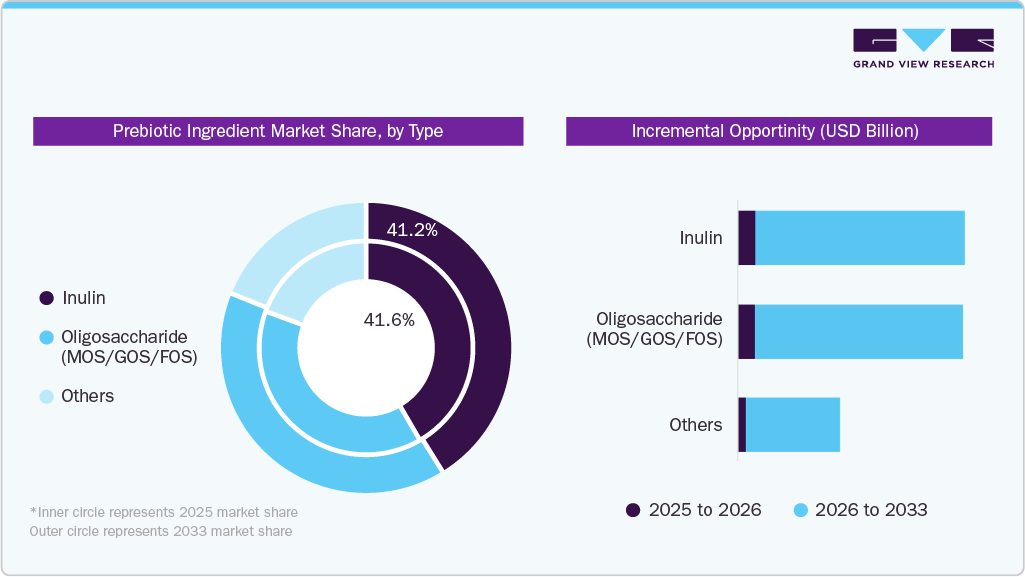
The inulin segment dominated the prebiotic ingredients industry, with a revenue share of 41.6% in 2025, owing to its widespread use as a functional fiber in food, beverage, and dietary supplement applications. Inulin, primarily derived from chicory root, is known for promoting digestive health by stimulating the growth of beneficial gut bacteria. In addition, it serves as a low-calorie sugar and fat replacer, making it well-suited for clean-label and reduced-calorie formulations. Its neutral taste, ease of incorporation, and proven health benefits have contributed to its strong adoption across product categories such as dairy alternatives, bakery products, and functional beverages. As consumer demand for gut-friendly and plant-based ingredients continues to rise, manufacturers are increasingly utilizing inulin innovative formulations, which is expected to support the segment’s growth.
 To learn more about this report, Download Free Sample Report
 The oligosaccharides market segment, comprising fructo-oligosaccharides (FOS), galacto-oligosaccharides (GOS), and mannan-oligosaccharides (MOS), is expected to grow at a CAGR of 11.0% from 2026 to 2033. These components are well known to exhibit targeted prebiotic activity, including improving the balance of the gut microbiota and enhancing immunity. The application of GOS in baby food is common due to its resemblance to human milk oligosaccharides, whereas the addition of FOS in foods and beverages as a functional component is popular for digestive wellness. On the contrary, the use of MOS is gaining popularity in both human and animal nutrition sectors. With several functional attributes and growing application potential, the requirement for oligosaccharides is growing.
Application Insights
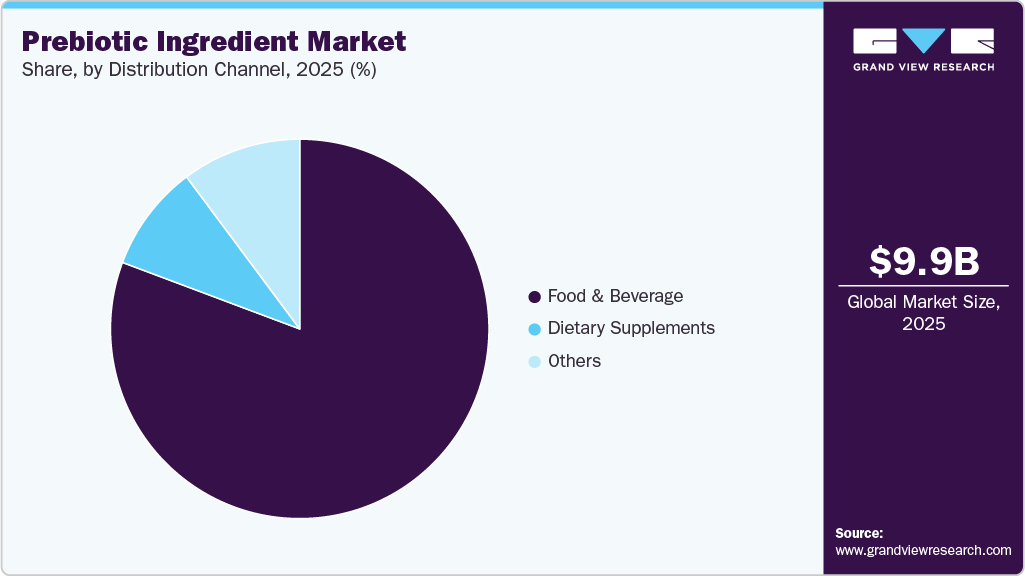
Food & beverages dominated the prebiotic ingredients market, accounting for a revenue share of 80.7% in 2025, contributing to the total revenue. This is mainly because prebiotics are already being added to a wide range of everyday products such as cereals, snack bars, dairy alternatives, and functional drinks. Apart from digestive benefits, they also help improve texture and can be used to reduce sugar content, which makes them useful from a formulation point of view. As consumers try to make healthier choices through regular foods rather than supplements, the demand for prebiotic-enriched foods and beverages remains strong.
 To learn more about this report, Download Free Sample Report
 The market for dietary supplements is expected to grow at a CAGR of 11.6%, fueled by individuals seeking alternative methods to maintain gut health. Powdered, capsule, and gummy supplements are emerging trends, particularly those combining prebiotics and probiotics. Such a category is attracting consumers who seek a specific solution to their health issues or who lack adequate amounts of these ingredients in their regular diet. The rising trend of preventive health awareness will drive the demand for prebiotics in dietary supplements.
Regional Insights
The North America prebiotic ingredients market dominated the global revenue share of 51.2% in 2025, fueled by high consumer awareness around gut health and preventive nutrition, with demand largely driven by functional foods and beverages. Consumers show the greatest interest in the development of functional food and beverage products such as high-fiber snacks, plant-based beverages, and ready-to-drink beverages. Innovation in the use of synbiotics and the incorporation of dietary fiber is gaining momentum in the North American market. In addition to inulin, there is growing demand for resistant starches and other tailor-made fibers, with product formulation geared towards improved sensory experiences.
 To learn more about this report, Download Free Sample Report
 U.S. Prebiotic Ingredients Market Trends
The U.S. prebiotic ingredients industry commands a significant share of North America and is experiencing consistent growth. The consumer trend is toward more convenient, healthy products consumed as part of their daily lives. Prebiotics are increasingly used as an added ingredient in various snacks and drink blends that provide energy, digestive benefits, and support immune function. The ingredients available are expanding to include alternative plant sources and fiber types.
Europe Prebiotic Ingredients Market Trends
The Europe prebiotic ingredients industry accounted for a revenue share of 21.08% in 2025. Europe is one of the dominant regions in the market due to its higher consumer awareness levels and mature functional foods industry. Consumers’ interest in these ingredients is driven by factors such as clean labels, the use of plant-based ingredients, and clinically proven product benefits. Inulin and oligofructose ingredients have a wide application in bakery, cereal, and dairy replacement products. Moreover, Europe features highly regulated market conditions for health claims, promoting clinical validation and high-quality formulations. Sustainable sourcing is another important trend in this industry.
The Germany prebiotic ingredients market plays a key role in Europe, supported by its strong food processing sector and presence of major ingredient manufacturers. The market here emphasizes scientifically backed ingredients, with high demand for inulin and GOS in both food and specialized nutrition products. Innovation is often centered around high-fiber formulations and premium gut-health products, including those targeted at aging populations. German consumers tend to favor products with clear health benefits and traceable sourcing, which has encouraged companies to invest in high-quality, research-driven ingredient development.
Asia Pacific Prebiotic Ingredients Market Trends
The Asia Pacific prebiotic ingredients industry is projected to grow at the fastest CAGR of 11.5% from 2026 to 2033, driven by rising disposable incomes, urbanization, and increasing awareness of nutrition and digestive health. The market is highly diverse, with strong demand across functional foods, infant nutrition, and dietary supplements. Product innovation is heavily influenced by dairy and beverage categories, where prebiotics are added to improve nutritional value. Ingredients such as inulin, resistant dextrin, and GOS are widely used, particularly in products targeting digestive health and immunity. The region’s growth is also supported by expanding distribution networks and increasing penetration of global brands.
China’s prebiotic ingredients market is growing, driven by a rising trend towards health and wellness in urban populations. There is still a focus on infant nutrition, with increased demand for ingredients such as GOS and FOS. Besides, there is increasing consumption of dairy products and drinks that are fortified with prebiotics. Consumers are increasingly seeking products that blend traditional health concepts with modern nutrition, driving the development of tailored prebiotic formulations. Increasingly, companies are combining traditional ideas about health with modern nutritional science to produce products that cater to different age groups.
Middle East & Africa Prebiotic Ingredients Market Trends
The Middle East & Africa prebiotic ingredients industry is estimated to grow with a CAGR of 10.1% from 2026 to 2033, driven by increasing awareness of nutrition and rising demand for fortified food products. Urbanization and changing dietary habits are encouraging the adoption of functional ingredients, particularly in bakery and dairy categories. The market is gradually shifting toward plant-based prebiotics such as inulin, with manufacturers focusing on affordable and accessible products. While regulatory frameworks are still evolving, there is a growing emphasis on improving food quality and nutritional value across the region.
Central & South America Prebiotic Ingredients Market Trends
The Central & South America prebiotic ingredients industry is estimated to grow with a CAGR of 4.8% from 2026 to 2033. The market is opening, fueled by greater awareness of digestive wellness and a larger middle-class demographic. Prebiotic components have been integrated into basic food products like bakery items and drinks, thereby bringing them within reach of many consumers. Consumers are increasingly interested in functional ingredient products that do not burn a hole in their pockets. Innovation in ingredients is in its nascent stages, but there is increasing demand for plant-based and organic options.
Key Prebiotic Ingredients Company Insights
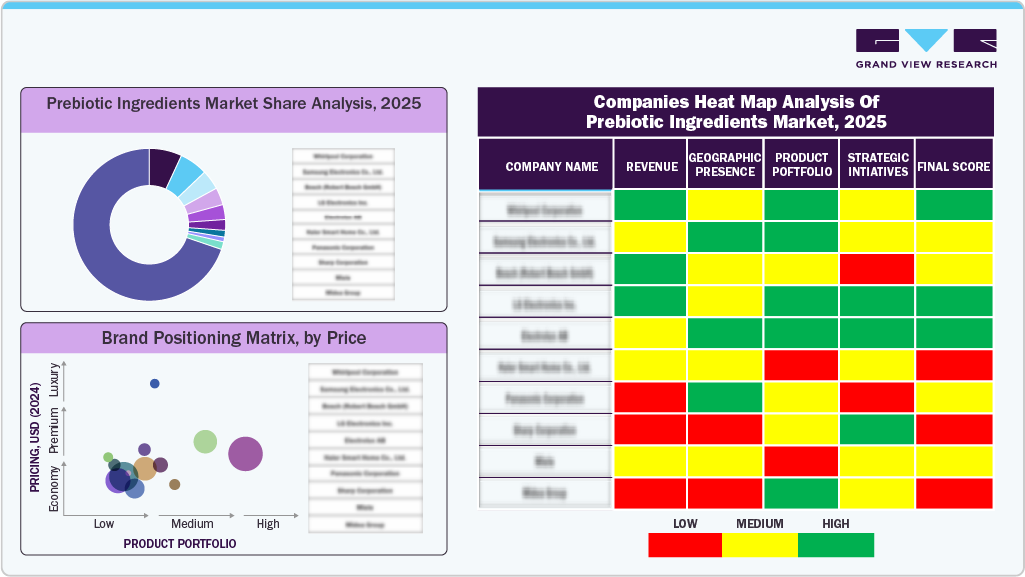
The prebiotic ingredients market is shaped by a mix of large, established ingredient manufacturers and a growing number of smaller, specialized players. The main advantage that top players possess is their global presence and broad distribution channels, combined with close cooperation with food and beverage manufacturers, which enable them to deliver prebiotics at scale for various applications. These companies consistently grow by enhancing the functional capabilities of their ingredients, investing in research, and developing ingredient mixes specifically for health effects such as digestion and immunity. At the same time, smaller, niche companies help move the industry forward through their novel ingredient sources, advanced formulations, and application-specific solutions, such as personalized nutrition and clean labels.
 To learn more about this report, Download Free Sample Report
 Key Prebiotic Ingredients Companies
The following key companies have been profiled for this study of the prebiotic ingredients market.
-
Beneo-Orafti SA
-
Tereos Group
-
Ingredion Inc.
-
Cargill, Inc.
-
DowDuPont Inc.
-
Royal Freisland Campina NV
-
Kerry Group
-
Cosucra-groupe Warcoing SA
-
Sensus BV
-
Nexira
Competitive Benchmarking
Category
Operating Strategies
Competitive Edge
Weakness
Established Players (BENEO-Orafti SA; Tereos Group; Ingredion Inc.; Cargill Inc.; Royal FrieslandCampina N.V.; Kerry Group)
- Focus on expanding functional ingredient portfolios across food, beverage, and nutrition applications.
- Invest in R&D, application development, production capacity, and strategic partnerships to strengthen customer solutions.
- Broad global reach, established customer relationships, and diversified ingredient portfolios support large-scale supply.
- Strong technical expertise and application capabilities enable customized prebiotic and fiber solutions.
- Large-scale operations can create higher production and supply-chain complexity.
- Broad portfolios can make these players less focused on niche prebiotic applications than specialized suppliers.
Emerging Players (Cosucra Groupe Warcoing SA; Sensus B.V.; Nexira; DowDuPont Inc.)
- Concentrate on specialized plant-based fibers, clean-label ingredients, and application-specific prebiotic solutions.
- Expand through product innovation, scientific validation, sustainability positioning, and targeted customer partnerships.
- Strong specialization in selected prebiotic sources enables differentiated ingredient functionality and focused customer support.
- Agility in developing niche formulations and natural-source solutions supports differentiation against diversified suppliers.
- More concentrated product portfolios and narrower raw-material bases can limit diversification.
- Lower scale and market breadth can restrict access to large multinational customers and global distribution networks.
Recent Developments
-
In May 2026, WonderBiotics launched a new Daily Fiber Mix, a prebiotic powder formulated with a blend of four different prebiotic fibers aimed at supporting gut health and metabolic function. The product is designed in a convenient, rapid-dissolve format to address gaps in fiber intake and the growing demand for functional nutrition solutions.
-
In February 2026, Roquette announced that its NUTRIOSE® soluble fiber range received NutraStrong™ Prebiotic Verified certification from SGS NutraSource. This certification validates the ingredient’s clinically supported health benefits and ensures compliance with quality and labeling standards, strengthening trust in science-backed prebiotic solutions.
-
In September 2025, BENEO received regulatory approval in Thailand for a digestive health claim related to its chicory root-derived inulin ingredient. This approval enables clearer on-pack communication of prebiotic benefits and supports the development of functional food products in the region.
- In March 2025, PepsiCo announced the acquisition of Poppi, a fast-growing prebiotic soda company, to strengthen its presence in the functional beverage segment. The move reflects growing interest among major beverage players in gut-health drinks with prebiotic ingredients and low-sugar formulations.
Prebiotic Ingredients Market Report Scope
Report Attribute
Details
Market size in 2025
USD 9.9 billion
Estimated market size in 2026
USD 11.0 billion
Projected market size by 2033
USD 23.8 billion
Growth rate
CAGR of 10.7% from 2026 to 2033
Actuals
2021 - 2025
Forecast period
2026 - 2033
Quantitative units
Revenue in USD million/billion CAGR from 2026 to 2033
Report coverage
Revenue forecast, company ranking, competitive landscape, growth factors, and trends
Segments covered
Type, application, region
Regional scope
North America; Europe; Asia Pacific; Middle East & Africa; Central & South America
Country scope
U.S.; Canada; Mexico; Germany; France; UK; Italy; Spain; China; Japan; India; Australia & New Zealand; Brazil; South Africa; UAE
Key companies profiled
Beneo-Orafti SA; Tereos Group; Ingredion Inc.; Cargill, Inc.; DowDuPont Inc.; Royal Freisland Campina NV; Kerry Group; Cosucra-groupe Warcoing SA; Sensus BV; Nexira
Customization scope
Free report customization (equivalent up to 8 analysts working days) with purchase. Addition or alteration to country, regional & segment scope.
Pricing and purchase options
Avail customized purchase options to meet your exact research needs. Explore purchase options
Global Prebiotic Ingredients Market Report Segmentation
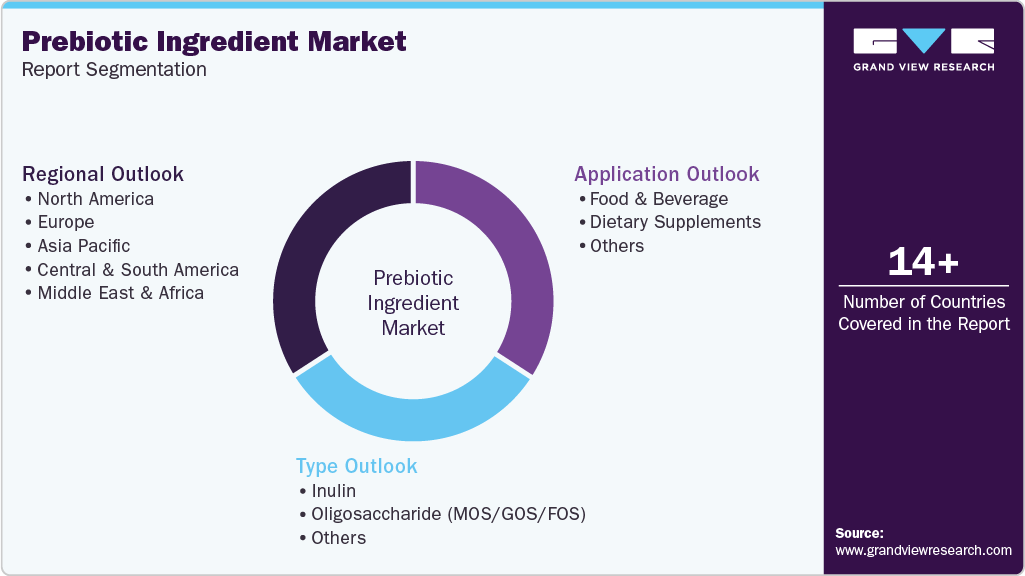
This report forecasts revenue growth at the global, regional & country level and provides an analysis of the latest industry trends and opportunities in each of the sub-segments from 2021 to 2033. For this study, Grand View Research has segmented the prebiotic ingredients market report based on type, application, and region:
 To learn more about this report, Download Free Sample Report
 -
Type Outlook (Revenue, USD Million/Billion, 2021 - 2033)
-
Inulin
-
Oligosaccharide (MOS/GOS/FOS)
-
Others
-
-
Application Outlook (Revenue, USD Million/Billion, 2021 - 2033)
-
Food & Beverage
-
Dietary Supplements
-
Others
-
-
Regional Outlook (Revenue, USD Million/Billion, 2021 - 2033)
-
North America
-
U.S.
-
Canada
-
Mexico
-
-
Europe
-
Germany
-
UK
-
France
-
Italy
-
Spain
-
-
Asia Pacific
-
China
-
Japan
-
India
-
Australia & New Zealand
-
-
Central & South America
-
Brazil
-
-
Middle East & Africa
-
South Africa
-
UAE
-
-
Research Methodology
The prebiotic ingredients market figures in this report are based on a proven research process that combines executive interviews with secondary research from proprietary databases, company filings, and recognized regulatory and institutional sources. Market size is built through value-chain sizing-reconciling supply-side and demand-side estimates-and triangulated with bottom-up and top-down approaches. Every estimate passes multiple levels of expert validation before publication, with each prebiotic ingredients segment quantified using the revenue-capture definitions in the table below.
Segment Definition
Segment - Type
Revenue capture definition
Inulin
This segment includes the sales of inulin-based prebiotic ingredients derived primarily from chicory root and other plant sources. Revenue is generated through their use in food, beverages, dietary supplements, and functional nutrition products.
Oligosaccharides (MOS/GOS/FOS)
This segment includes the sales of mannan-oligosaccharides (MOS), galacto-oligosaccharides (GOS), and fructo-oligosaccharides (FOS) used to support digestive and gut health. Revenue is generated through their incorporation into functional foods, beverages, infant nutrition, animal nutrition, and dietary supplements.
Others
This segment includes the sales of prebiotic ingredients other than inulin, MOS, GOS, and FOS, including resistant starches, beta-glucans, and other specialized fibers. Revenue is generated through their use in functional foods, beverages, supplements, and nutrition formulations.
Segment - Application
Revenue capture definition
Food & Beverage
This segment includes the sales of prebiotic ingredients used in food and beverage products to support digestive health and enhance functional value. Revenue is generated through their incorporation into dairy products, bakery, beverages, cereals, and other functional foods.
Dietary Supplements
This segment includes the sales of prebiotic ingredients used in dietary supplements such as powders, capsules, tablets, and gummies. Revenue is generated through products formulated to support gut health and digestive wellness.
Others
This segment includes the sales of prebiotic ingredients used in applications outside food, beverages, and dietary supplements. Revenue is generated through specialized applications such as animal nutrition, infant nutrition, and other functional formulations.
Estimation Model
Layer
Guiding Question
Description
Market Demand Layer
What is the addressable demand?
Estimate the addressable consumer pool based on digestive‑health awareness and demand for functional food and beverage products.
Ingredient Adoption Layer
Who uses prebiotic ingredients?
Apply category‑specific adoption rates across food, beverages, dietary supplements, and animal nutrition to derive the active prebiotic ingredient user base.
Application Layer
Where are prebiotics incorporated?
Apply prebiotic incorporation rates across applicable product categories and formulations to estimate ingredient consumption volumes.
Revenue Layer
How is market revenue generated?
Multiply addressable ingredient volumes by average selling prices across prebiotic ingredient types and applications to derive market revenue.
Delivered Customizations
This report has been delivered with the following In-depth customizations
Client Request
Customization Delivered
Value Adds
Global Prebiotic Ingredients Ingredient & Application Landscape
Assessed demand across key prebiotic ingredients, including inulin, FOS, GOS, resistant starch, and other emerging ingredients, across food & beverage, dietary supplements, and other applications.
Supports ingredient portfolio prioritization and identifies high-potential application areas for manufacturers and suppliers.
Global Prebiotic Ingredients Product Innovation & Formulation Assessment
Analyzed recent product launches, formulation trends, ingredient combinations, and delivery formats incorporating prebiotic ingredients across major consumer categories.
Helps identify formulation white spaces and align product development with evolving gut-health and functional nutrition preferences.
Global Prebiotic Ingredients Pricing & Sourcing Landscape
Evaluated raw-material availability, production capacity, pricing considerations, sourcing patterns, and supplier positioning across major markets.
Enables procurement planning, supplier strategy development, and assessment of cost pressures affecting ingredient margins.
Frequently Asked Questions About This Report
Key factors that are driving the prebiotic ingredient market growth include increasing consumption of dairy and cosmetic products, rising disposable income, and increasing research and development activities.
Some key players operating in the prebiotic ingredient market include Beneo-Orafti SA; Tereos Group; Ingredion Inc.; Cargill Inc.; DowDuPont Inc; Royal Freisland Campina NV; Kerry Group; Cosucra-groupe Warcoing SA; Sensus BV; Nexira
The global prebiotic ingredient market size was valued at USD 9.9 billion in 2025 and is estimated at USD 11.0 billion for 2026.
The global prebiotic ingredient market is expected to grow at a CAGR of 10.7% from 2026 to 2033, reaching USD 23.8 billion by 2033.
North America dominated with a 51.2% revenue share in 2025.
Inulin held the largest revenue share of 41.6% in 2025.
In food & beverage segment it is consumed the most holding a share of 80.7% in 2025.
Asia Pacific is the fastest growing regional market with a CAGR from 2026 to 2033.
About the Author(s)
Consumer F&B Research Team
Consumer Goods · Consumer F&BThis report was authored by the consumer f&b research team at Grand View Research - comprising two research analysts, one senior research analyst, and one industry expert - with specialized expertise in the consumer f&b segment of the consumer goods industry. All findings are based on proprietary consumer goods databases, executive interviews, and regulatory analysis, subject to internal peer review prior to publication.
Last Updated:
Speak to Analyst

Customize this report to your needs - add regions, segments, or data points, with 20% free customization.
Or view our licence options:


ISO 9001:2015 & 27001:2022 Certified
We are GDPR and CCPA compliant! Your transaction & personal information is safe and secure. For more details, please read our privacy policy.


