
- Home
- »
- Homecare & Decor
- »
-
Pressure Washer Market Size & Share Report, 2026-2033GVR Report cover
![Pressure Washer Market (2026 - 2033)Report]()
Pressure Washer Market (2026 - 2033)
Size, Share & Trends Analysis Report By Product (Electricity Based, Gas Based, Fuel Based), By Application (Car Washer, Garden Washer, Home Exterior, Industrial), By Region (North America, Europe, Asia Pacific), And Segment Forecasts
Market Size, 2025
$2.2BMarket Estimate, 2026
$2.3BMarket Forecast, 2033
$2.9BCAGR, 2026–2033
3.1%Pressure Washer Market Summary
The global pressure washer market size was valued at USD 2.2 billion in 2025 and is projected to grow from USD 2.3 billion in 2026 to USD 2.9 billion by 2033, at a CAGR of 3.1% from 2026 to 2033. North America dominated the market with the largest revenue share of 35.4% in 2025. Rapid urbanization has led to an increased need for efficient cleaning solutions in both residential and commercial sectors.

Key Market Trends & Insights
- By product: Electric-based pressure washer led the market with the largest revenue share of 40.0% in 2025.
- By application: Garden washer segment led the market with the largest revenue share of 30.7% in 2025.
Regional Highlights
- Largest regional market: North America (35.4% revenue share, 2025)
- Fastest-growing regional market: Asia Pacific (highest CAGR, 2026-2033)
- By country: The pressure washer market in Canada held the largest share in the North America region in 2025.
Market Size & Forecast
- Market Size in 2025: USD 2.2 Billion
- Estimated Market Size in 2026: USD 2.3 Billion
- Projected Market Size by 2033: USD 2.9 Billion
- CAGR (2026-2033): 3.1%
This demand is further amplified by the surge in construction activities worldwide, necessitating pressure washers for cleaning construction sites, heavy equipment, and buildings. The rising number of automated car wash stations, especially in urban areas, also contributes to market growth. Furthermore, the increasing number of vehicles has driven the market for the product in the residential sector as consumer’s washing trend is shifting towards pressure washing rather than traditional methods. Increasing product awareness and its benefits among the consumer is also impacting the market growth. The fact that the washer improves the building’s curb appeal by washing the building regularly is increasing the demand for the product in the residential as well as hospitality sectors.
Increasing professional cleaning start-ups such as UrbanClap are fueling the market growth. The product is basically used for deep cleaning purposes to remove impurities and dirt present in the surroundings of the building. On the other hand, the effective result on car cleaning, patio cleaning, and home exterior cleaning is anticipated to propel the pressure washer market growth in the forecast period. In various countries, the government is also implementing these technologies in the cleaning process of roads and public gardens.
Increased awareness of hygiene and cleanliness, particularly in the wake of the COVID-19 pandemic, drove the demand for thorough cleaning solutions. Innovations in pressure washer technology, such as battery-powered and automated models, have made them more efficient and user-friendly, while their water efficiency addresses global water scarcity concerns. The emergence of professional cleaning start-ups and the growing adoption of pressure washers for home cleaning tasks further bolster the market.
Market Dynamics
Pressure washers are gaining widespread adoption as they provide an efficient, time-saving, and cost-effective solution for cleaning residential, commercial, and industrial surfaces. These machines are increasingly used for applications such as vehicle washing, driveway and pavement cleaning, building exterior maintenance, garden and patio cleaning, equipment washing, and industrial surface preparation. Pressure washers enable users to remove dirt, grease, mold, algae, and other contaminants more effectively than conventional cleaning methods while reducing manual labor and water consumption. The growing emphasis on property maintenance, hygiene standards, and operational efficiency is contributing to increased demand across both residential and commercial sectors. Homeowners are increasingly investing in outdoor cleaning equipment to maintain the appearance and value of their properties, while businesses are adopting pressure washers to improve facility cleanliness and comply with workplace safety and sanitation requirements. Furthermore, ongoing advancements in electric-powered, battery-operated, and smart-connected pressure washers are enhancing ease of use, portability, and cleaning performance.
The increasing consumer focus on outdoor living spaces, home aesthetics, and property value enhancement is emerging as a significant driver for the pressure washer market. Homeowners are investing heavily in outdoor renovations, decks, driveways, fences, swimming pool areas, and landscaped gardens to improve both functionality and visual appeal. As these outdoor surfaces are continuously exposed to dirt, algae, and weather-related wear, regular cleaning and maintenance have become essential to preserve their appearance and longevity. The trend has gained momentum as residential property owners increasingly view exterior maintenance as a cost-effective method of protecting property investments and enhancing curb appeal. Real estate professionals often recommend exterior cleaning before property listings, encouraging the use of pressure washers to restore driveways, sidewalks, walls, roofs, and outdoor recreational spaces. Furthermore, the rising popularity of outdoor entertainment areas and backyard improvement projects has increased demand for efficient cleaning solutions capable of maintaining these spaces throughout the year.
The need for regular maintenance and repair of pressure washers is expected to restrain market growth. Pressure washers operate under high pressure and are exposed to harsh working conditions, making critical components such as pumps, hoses, nozzles, and engines susceptible to wear and tear over time. Improper storage, inconsistent maintenance, and frequent use can lead to equipment breakdowns, reduced performance, and increased operating costs. For residential users, maintenance requirements may discourage adoption, particularly among first-time buyers seeking simple cleaning solutions. Commercial and industrial users often face additional expenses related to servicing, replacement parts, and equipment downtime. These factors can increase the total cost of ownership and limit purchasing decisions among cost-sensitive customers, particularly in developing markets.
The increasing integration of smart technologies, automation, and Internet of Things (IoT) capabilities into cleaning equipment is creating significant growth opportunities in the pressure washer market. Residential, commercial, and industrial users are increasingly seeking intelligent cleaning solutions that improve operational efficiency, reduce maintenance requirements, and enhance user convenience. Manufacturers are responding by developing advanced pressure washers equipped with features such as remote monitoring, automated pressure adjustment, predictive maintenance alerts, mobile application connectivity, and real-time performance diagnostics. Additionally, advancements in battery technology, sensor integration, and equipment design are expanding the capabilities of next-generation pressure washers. Smart pressure regulation systems can automatically adjust water pressure based on the surface being cleaned, helping reduce water consumption and minimize the risk of surface damage. As industries continue to embrace digitalization and operational efficiency initiatives, the demand for intelligent and connected pressure washing solutions is expected to increase substantially, creating lucrative opportunities for manufacturers that invest in innovation, automation, and user-centric product development.
Analyst Perspective
The pressure washer market is benefiting from a structural shift in how consumers and businesses approach property maintenance, asset preservation, and cleaning efficiency. Growing investments in residential housing, commercial real estate, industrial facilities, and transportation infrastructure have significantly expanded the installed base of assets requiring routine cleaning and upkeep. At the same time, rising labor costs and increasing expectations around cleanliness are encouraging end users to adopt mechanized cleaning solutions that deliver superior performance while reducing time and operational effort. Technology-driven differentiation is expected to become a key competitive factor. Manufacturers that successfully incorporate battery-powered systems, smart monitoring capabilities, advanced pump technologies, and water-conservation features will be better positioned to capture premium market segments. As infrastructure assets age, property owners place greater emphasis on exterior maintenance, and businesses focus on operational efficiency, pressure washers are expected to transition from discretionary cleaning equipment to an essential component of long-term asset management strategies.
Product Insights
Based on product, the electric-based pressure washer led the market with the largest revenue share of 40.0% in 2025 and is expected to grow at the fastest CAGR over the forecast period. Electric pressure washers are known for their convenience, affordability, and ease of use, making them a popular choice among residential users. It is also quieter and more environmentally friendly compared to their gas-powered counterparts, appealing to eco-conscious consumers. The increasing availability of advanced, feature-rich electric models further enhances their market appeal. Additionally, the rising adoption of electric pressure washers in commercial settings due to their efficiency and low maintenance requirements contributes to the segment's strong market presence.

The fuel-based segment is expected to grow at a CAGR of 3.6% over the forecast period. Fuel-based pressure washers offer higher power and pressure capabilities compared to electric models, making them ideal for heavy-duty cleaning tasks in industrial and commercial settings. They are particularly effective in areas where electricity may not be readily available, providing flexibility and convenience for users. Additionally, advancements in fuel efficiency and emission control technologies are making these machines more environmentally friendly, which appeals to a broader range of consumers.
The gas-based segment accounts for a significant market share and is anticipated to witness considerable growth in the forecast period. The segment finds its major application in industrial usage as it is more powerful compared to other segments. The stubborn stains in the industries and the amount of waste that the industries produce can be managed by the gas-based segments.
Application Insights
Based on application, the garden washer segment led the market with the largest revenue share of 30.7% in 2025. The increasing popularity of home gardening and outdoor landscaping has driven demand for garden washers, as these are essential for maintaining cleanliness and aesthetics in gardens and outdoor spaces. Additionally, the rising trend of DIY home improvement projects has boosted the adoption of garden washers among homeowners. The growing awareness of the benefits of regular garden maintenance, such as pest control and enhanced plant health, further supports market growth.
The home exterior segment is expected to grow at the fastest CAGR over the forecast period. The increasing trend of home improvement and renovation projects has fueled demand for efficient cleaning solutions for home exteriors. Pressure washers are essential for maintaining the cleanliness and appearance of driveways, patios, decks, and home facades. Additionally, the growing awareness of the benefits of regular exterior cleaning, such as preventing mold and mildew growth and enhancing curb appeal further supports market growth. The availability of advanced, high-performance pressure washers designed specifically for exterior use also attracts more consumers.
Regional Insights
North America dominated the pressure washer market with the largest revenue share of 35.4% in 2025. The high demand for efficient cleaning solutions across residential, commercial, and industrial sectors is a significant contributor. The popularity of DIY home improvement projects and the increasing number of construction activities further boost the market. Additionally, the region's awareness of health and hygiene, combined with the availability of a wide range of advanced pressure washer models, supports market growth.

U.S. Pressure Washer Market Trends
The U.S. pressure washer market is expected to grow significantly over the forecast period. The increasing demand for efficient cleaning solutions across residential, commercial, and industrial sectors plays a major role. The growing trend of DIY home improvement projects, coupled with rising awareness of hygiene and cleanliness, particularly in the post-pandemic era, further boosts market demand. Additionally, the expanding construction industry and the surge in outdoor activities necessitate the use of pressure washers for maintenance and cleaning purposes. The continuous innovations in pressure washer technology, offering enhanced performance and user convenience, also contribute to the market's robust growth.
The pressure washer market in Canada held the largest share in the North America region in 2025.
Europe Pressure Washer Market Trends
Europe pressure washer market was identified as a lucrative region in 2024 owing to the increasing popularity of home improvement projects and the rising demand for efficient cleaning solutions in both residential and commercial sectors. The growing awareness of hygiene and cleanliness, especially in the post-pandemic era, has further driven the market. Additionally, the presence of key market players and the availability of advanced pressure washer models cater to the diverse needs of consumers.
Asia Pacific Pressure Washer Market Trends
Asia Pacific pressure washer market is expected to grow at the fastest CAGR of 4.2% over the forecast period. The increasing industrialization and urbanization in countries such as China, India, and Japan are fueling the demand for efficient cleaning solutions. Additionally, the rise in construction activities and the growing awareness of cleanliness and hygiene are boosting the market. The expanding middle-class population with higher disposable incomes is also contributing to the increased adoption of pressure washers in residential settings.
Key Pressure Washer Company Insights
Some key companies in the pressure washer market include Revive Powerwashing Inc., Alfred Kärcher SE & Co. KG, and others. Several key players are pursuing various strategic initiatives, such as mergers, acquisitions, and partnerships with other leading companies.
-
Revive Powerwashing Inc. is known for its innovative and high-quality pressure washers designed for both residential and commercial use. The company focuses on providing efficient cleaning solutions that cater to various cleaning needs, from home exteriors to industrial applications.
-
Alfred Kärcher SE & Co. KG, based in Germany, is a leading manufacturer of resource-conserving and efficient cleaning systems. The company offers a wide range of pressure washers under its home & garden and professional categories. Kärcher's products are known for their high performance and excellent price/performance ratio.
Key Pressure Washer Companies
The following key companies have been profiled for this study on the pressure washer market.
-
Revive Powerwashing Inc.
-
Alfred Kärcher SE & Co. KG,
-
Generac Power Systems, Inc.
-
AR North America
-
Simpson & Company Limited
-
DEWALT
-
Stanley Black & Decker, Inc.
-
CRAFTSMAN
-
RYOBI Limited
-
Sun Joe
Competitive Benchmarking
Category
Operating Strategies
Competitive Edge
Weakness
Established Players (Alfred Kärcher SE & Co. KG, Generac Power Systems, Stanley Black & Decker, DEWALT, RYOBI)
- Expand product portfolios across residential, commercial, and industrial applications while investing in battery-powered technologies, smart cleaning solutions, and global distribution networks.
- Strengthen aftermarket services, dealer partnerships, and e-commerce presence to enhance customer reach and retention.
- Strong brand recognition, extensive distribution networks, diversified product offerings, established dealer relationships, and significant R&D capabilities.
- Ability to serve multiple end-use industries and benefit from economies of scale.
- Higher operational and manufacturing costs due to global operations.
- Slower product development cycles and greater exposure to raw material price fluctuations and supply chain disruptions.
Emerging Players (Sun Joe, Active Products Inc., Greenworks Tools, Westinghouse Outdoor Power Equipment)
- Focus on affordable, feature-rich pressure washers targeting residential and light commercial users.
- Leverage direct-to-consumer channels, online marketplaces, cordless innovations, and niche product differentiation to gain market share.
- Faster product innovation cycles, competitive pricing strategies, strong online visibility, and the ability to quickly respond to evolving consumer preferences.
- Greater flexibility in introducing specialized and portable cleaning solutions.
- Limited global distribution capabilities, lower brand awareness in commercial and industrial segments, and challenges in scaling operations and aftermarket service networks.
Recent Developments
-
In April 2024, Makita launched the 40V max XGT 1,300 psi 1.5 GPM Pressure Washer (GWH01), designed for diverse cleaning applications such as worksites and driveways. Utilizing 40V max batteries compatible with a wide range of equipment and tools, the GWH01 aims to provide a portable and powerful solution for high-pressure washing tasks. Tyler Brown, associate product manager at Makita U.S.A. Inc., emphasized the product's innovative design, which seeks to enhance the efficiency of home and workspace maintenance.
-
In January 2024, Dylect, a prominent name in the electronics equipment sector, launched its new range of high-pressure washers in India. The product lineup includes the DYLECT Ultra Force, DYLECT Ultra Power, DYLECT Ultra Flow, and DYLECT Ultra Clean, with prices ranging from USD 59.5 to USD 107.0. These washers are available on Amazon and are designed to enhance vehicle maintenance in the mid-premium segment of auto accessories.
Pressure Washer Market Report Scope
Report Attribute
Details
Market size value in 2025
USD 2.2 billion
Estimated Market Size in 2026
USD 2.3 billion
Projected Market Size by 2033
USD 2.9 billion
Growth rate
CAGR of 3.1% from 2026 to 2033
Base year for estimation
2025
Historical data
2021 - 2024
Forecast period
2026 - 2033
Quantitative units
Revenue in USD million/billion and CAGR from 2026 to 2033
Report coverage
Revenue forecast, company ranking, competitive landscape, growth factors, and trends
Segments covered
Product, application, region
Regional scope
North America; Europe; Asia Pacific; Latin America; MEA
Country scope
U.S.; Canada; Mexico; Germany; UK; France; Italy; Spain; China; Japan; India; South Korea; Australia & New Zealand; Brazil; Turkey
Key companies profiled
Revive Powerwashing Inc.; Alfred Kärcher SE & Co. KG,; Generac Power Systems, Inc.; AR North America; Simpson & Company Limited; DEWALT; Stanley Black & Decker, Inc.; CRAFTSMAN; RYOBI Limited; Sun Joe
Customization scope
Free report customization (equivalent up to 8 analysts' working days) with purchase. Addition or alteration to country, regional & segment scope.
Pricing and purchase options
Avail customized purchase options to meet your exact research needs. Explore purchase options
Global Pressure Washer Market Report Segmentation
This report forecasts revenue growth at global, regional, and country levels and provides an analysis of the latest industry trends in each of the sub-segments from 2021 to 2033. For this study, Grand View Research has segmented the global pressure washer market report based on product, application, and region:
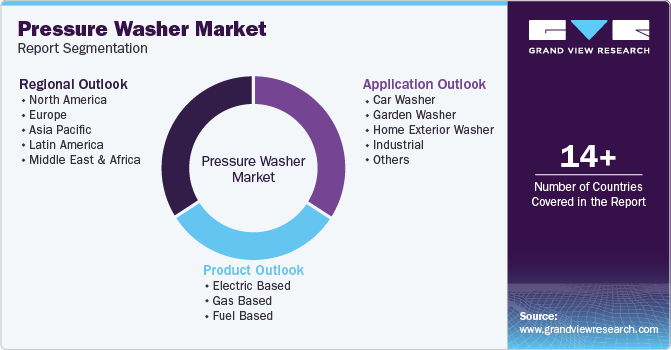
-
Product Outlook (Revenue, USD Million, 2021 - 2033)
-
Electric Based
-
Gas Based
-
Fuel Based
-
-
Application Outlook (Revenue, USD Million, 2021 - 2033)
-
Car Washer
-
Garden Washer
-
Home Exterior Washer
-
Industrial
-
Others
-
-
Regional Outlook (Revenue, USD Million, 2021 - 2033)
-
North America
-
U.S.
-
Canada
-
Mexico
-
-
Europe
-
Germany
-
UK
-
France
-
Italy
-
Spain
-
-
Asia Pacific
-
China
-
Japan
-
India
-
Australia & New Zealand
-
South Korea
-
-
Latin America
-
Brazil
-
-
Middle East and Africa (MEA)
-
Turkey
-
-
Research Methodology
(a) Segment Definition
Segment - Type
Revenue capture definition
Electric Based
This segment covers the revenues generated through the sales of electric-based pressure washers, which utilize electricity as the primary power source to operate the motor and pump system that generates high-pressure water streams for cleaning applications. Electric pressure washers are widely used for residential and light commercial cleaning tasks due to their ease of operation, lower maintenance requirements, quieter performance, and environmentally friendly characteristics. These products are commonly used for cleaning driveways, bicycles, motorcycles, and passenger vehicles. For example, electric pressure washers are used by homeowners for driveway cleaning, property maintenance companies for routine exterior cleaning, and car owners for washing vehicles at home.
Gas Based
This segment covers the revenues generated through the sales of gas-based pressure washers, which are powered by gasoline engines and are designed to deliver higher pressure output and greater mobility compared to electric models. Gas pressure washers are typically utilized for heavy-duty cleaning applications where access to electrical power may be limited. These machines are commonly employed in construction sites, agricultural operations, industrial facilities, and professional cleaning services for removing mud, grease, paint, and stubborn debris from large surfaces and equipment
Fuel Based
This segment covers the revenues generated through the sales of fuel-based pressure washers, which operate using fuel-powered engines such as diesel or other liquid fuels to provide high-performance cleaning capabilities for demanding industrial and commercial applications. Fuel-based pressure washers are preferred in environments requiring extended operating hours, high durability, and powerful cleaning performance. These systems are extensively used in manufacturing plants, mining operations, transportation hubs, oil and gas facilities, shipyards, and large-scale infrastructure maintenance projects.
(b) Estimation Model
Asset Ownership Layer
Equipment Accessibility Layer
Cleaning Adoption Layer
Monetisation Layer
Who owns assets that require pressure washing?
Who can access or purchase pressure washers?
Who actively uses pressure washers
How much revenue is generated?
Identify the total stock of residential, commercial, industrial, and institutional assets that require periodic cleaning and maintenance. The addressable asset base includes apartment complexes, office buildings, warehouses, manufacturing facilities, agricultural properties, and vehicle fleets. Regional data on homeownership rates, building construction, and vehicle ownership is applied to estimate the total population of assets that generate demand for pressure washing equipment and cleaning solutions.
Apply region-specific economic and distribution factors to the addressable asset base, including disposable income levels, retail network penetration, e-commerce accessibility, and equipment rental availability. For commercial and industrial users, procurement budgets, infrastructure investments, and facility maintenance expenditures are considered. This layer filters the total asset base to derive the number of households, businesses, and institutions that can realistically acquire or access pressure washing equipment.
Apply pressure washer ownership and usage rates across residential, commercial, and industrial end users. Adoption is influenced by factors such as property maintenance awareness, cleaning frequency requirements, labor cost considerations, and the growing preference for mechanized cleaning solutions. This layer converts the reachable user base into active pressure washer users, including homeowners, professional cleaning contractors, property management companies, industrial maintenance teams, and agricultural operators.
Estimate market revenue by multiplying active users by average spending on pressure washing equipment and related products. Revenue is generated through the sale of electric, gas powered, and fuel powered pressure washers across residential, commercial, and industrial applications. Additional revenue streams include accessories, replacement components, maintenance services, aftermarket products, and upgrade purchases. The combination of new equipment sales and recurring aftermarket spending provides the basis for estimating total pressure washer market revenue.
Delivered Customizations
This report has been delivered with the following In-depth customizations
Client Request
Customization Delivered
Value Adds
Residential Cleaning & DIY Maintenance Trends
Conducted a focused analysis of residential pressure washer demand covering driveway cleaning, and deck maintenance, vehicle washing, outdoor furniture cleaning, home exterior care, and the adoption of electric and battery-powered pressure washers among DIY consumers.
Helps stakeholders identify high-growth residential applications, evaluate consumer purchasing behavior, and assess product development opportunities in the home maintenance and outdoor cleaning segments.
Commercial Cleaning & Facility Maintenance Adoption Trends
Evaluated adoption trends across commercial buildings, retail facilities, hospitality establishments, warehouses, and property management services, including demand for professional-grade pressure washers, cleaning efficiency requirements, and facility maintenance practices.
Provides insights into evolving commercial cleaning requirements, outsourcing trends, and attractive end-use segments to support market expansion and customer acquisition strategies.
Smart Cleaning Equipment & IoT Opportunity Assessment
Assessed market readiness for connected pressure washers featuring remote monitoring, predictive maintenance, automated pressure control, and digital fleet management capabilities..
Supports strategic planning by identifying technology-driven growth opportunities and differentiating premium product segments within the pressure washer market.
Frequently Asked Questions About This Report
The global pressure washer market size was estimated at USD 2.2 billion in 2025 and is expected to reach USD 2.3 billion in 2026.
Some key players operating in the pressure washer market include Revive Powerwashing Inc.; Karcher; Dewalt; Stanley Black & Decker Ltd.; Generac Power System Inc.; AR North America; Simpson; SunJoe; Ryobi; and Craftsman.
Key factors that are driving the market growth include growing demand for cleaning applications such as car washing, pool cleaning, and floor cleaning, combined with shift in consumer preferences towards pressure washing over traditional methods.
Asia Pacific is the fastest-growing region over the forecast period.
The global pressure washer market is expected to grow at a compound annual growth rate of 3.1% from 2026 to 2033 to reach USD 2.9 billion by 2033
North America dominated the pressure washer market with a share of 35.4% in 2025. This is attributable to high usage of different types of pressure washers for various purposes, such as car washing, grill washing, and patio washing, coupled with higher spending capacities of consumer groups in the region.
The electricity-based segment led with a 40.0% revenue share in 2025, while fuel based is the fastest-growing segment.
The garden washer segment led with a 30.7% revenue share in 2025, while the home exterior is the fastest-growing segment.
About the Author(s)
Homecare & Decor Research Team
Consumer Goods · Homecare & DecorThis report was authored by the homecare & decor research team at Grand View Research - comprising two research analysts, one senior research analyst, and one industry expert - with specialized expertise in the homecare & decor segment of the consumer goods industry. All findings are based on proprietary consumer goods databases, executive interviews, and regulatory analysis, subject to internal peer review prior to publication.
Last Updated:
Speak to Analyst


Customize this report to your needs — add regions, segments, or data points, with 20% free customization.
Or view our licence options:


ISO 9001:2015 & 27001:2022 Certified
We are GDPR and CCPA compliant! Your transaction & personal information is safe and secure. For more details, please read our privacy policy.


