
- Home
- »
- Petrochemicals
- »
-
Propane Market Size, Share, Global Industry Report, 2018-2025GVR Report cover

Propane Market (2018 - 2025) Size, Share & Trends Analysis Report By End-Use (Industrial, Commercial, Residential, Transportation, Agriculture, Chemicals and Refineries), By Region, And Segment Forecasts
Industry Insights
The global propane market size was estimated at 195.3 million tons in 2016. Worldwide increasing energy demand created high consumption in industrial and commercial end-use is a key growth driving factor for the industry.
Propane is a coherent part of globally rising commercial end-use industry. This end-use will foresee high traction globally due to growing hospitality industry in MEA and APAC regions. Qatar will witness the fastest growth in commercial end-use due to FIFA World Cup 2022 which will create an enormous requirement for hotels and restaurants in the country. This phenomenon is expected to increase demand in next eight years.
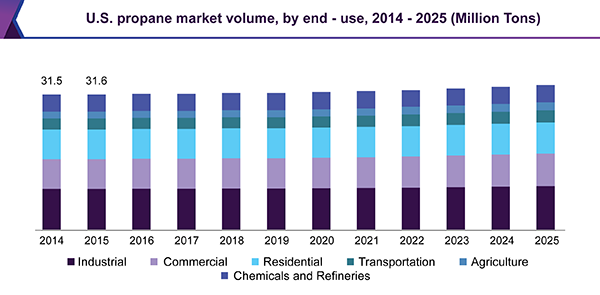 Source: Grand View Research, IR Documents, Primary Interviews, Paid DatabasesTo learn more about this report,
 Download Free Sample Report
 Apart from energy, it is also utilized as an intermediate product for production of propylene and ethylene. Increasing applications in various industries along with growing demand for higher efficiency (British Thermal Unit) fuels in automotive and industries are major growth drivers.
The product is also getting traction in commercial, agriculture, and residential sectors which initiated several legislative actions and regulations concerning safe use. Industrial was the largest end-use industry in 2016 and is expected to continue dominating global propane market owing to growing industrial applications.
 To learn more about this report, Download Free Sample Report
 Depletion of non-renewable resources; crude oil and increasing environmental concerns have invigorated research of various innovative sustainable technologies that employ bio-based raw materials for production. Strengthening governmental and federal regulations which are likely to restrict traditional processing from non-renewable resources can be overwhelmed using innovative sustainable technologies.
Most manufacturers are focusing on sustainable Good Manufacturing Practices and endeavoring to increase efficiency, conserve natural resources, and optimally use available resources. These initiatives are further expected to boost growth over the forecast period.
Growing population coupled with rapid industrialization in developing countries has also driven federal governments to increase their manufacturing spending to cater rising demand. Although, this product is gaining traction in developed countries and will show a significant opportunity in developing countries before the end of this decade.
Recently, there has been a growing spur towards the provision of high-quality products to retain loyal customers, since low switching costs have reduced supplier power in recent years. Manufacturers are thus actively involved in product development & research, technological advancement, and strategic collaborations to progress their standing in the global propane market.
Key manufacturers are importing LPG to reduce reliance on local companies. The pricing and various other strategic initiatives depend on top industry players. Although, price does not depend on LPG since production cost is much higher than raw material making it one of the costliest fuels available globally. However, cost per Kg varies widely between regions.
The limited supply due to weak demand continued from past few years and will likely show an ongoing trend in future. LPG itself is a cheap substitute of propane which is restricting its market globally. Various other alternatives such as natural gas, LNG, and more are also shifting way’s in which customers fulfill their energy needs.
LPG is derived from crude oil during atmospheric distillation process, and after purification, it is sold at much cheaper rate than propane which requires a sophisticated production mechanism. The Shale gas and Shale oil have triggered a revolution in manufacturing, impacting energy sources, and petrochemical footprints. Shale has caused a fundamental shock to LNG which is traditionally considered as stable or predictable.
High prices of natural gas at the beginning of the 20th century created a demand for low cost-high efficiency product which emerged as shale. The U.S. has vast reserves of shale which can convert this net importer country to a net exporter. With the help of advanced technology, manufacturers succeeded to produce propane from shale gas which is of high-quality produced at affordable cost. Although, technology required for shale is complicated and costly as compared to traditional cracking methods.
Market Dynamics
The increasing utilization of propane as a major component of liquefied petroleum gas (LPG) for residential heating, cooking, industrial fuel, and commercial energy applications is a key factor driving market growth. Propane is widely used owing to its clean-burning characteristics, high energy efficiency, portability, and ease of storage and transportation.
Rapid urbanization, increasing energy requirements, and rising adoption of LPG in developing economies are supporting propane demand globally. In addition, the expansion of propane usage in industrial heating, agriculture, and transportation applications is expected to further strengthen market consumption over the forecast period.
HThe propane market is significantly influenced by fluctuations in crude oil and natural gas production as propane is primarily derived from natural gas processing and petroleum refining activities. Variations in upstream production levels, geopolitical uncertainties, refinery operating rates, and energy market dynamics can create substantial pricing instability.
Furthermore, increasing focus on renewable energy adoption and decarbonization initiatives across several regions may gradually impact long-term demand growth for conventional hydrocarbon-based fuels. Such factors can create uncertainty in supply-demand balance and market expansion prospects.
End-Use Insights
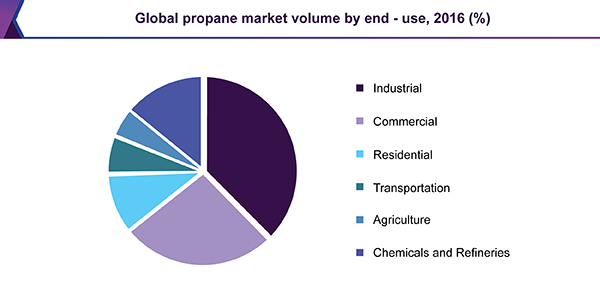
Industrial emerged as a leading end-use segment and accounted for over 37.7% of total revenue in 2016. Growth of metal manufacturing sector, particularly in Middle Eastern and Asian economies, is touted as a key demand driver for the industrial sector in next eight years.
Low labor cost and decent operating expenses in Asia Pacific region help end-use industries to consume expensive products for their use. The Industrial segment is anticipated to remain a fast-growing end-use industry owing to increasing demand for manufactured goods. In Industrial segment, metal workers use small tanks for cutting torches. Semi-portable and portable heaters which run on the gas, keep construction and road workers warm in winters. It is also used to heat asphalt for highway construction and repairs.
 To learn more about this report, Download Free Sample Report
 The forklift trucks powered by propane can safely operate inside a factory and warehouse due to neat burning feature of gas. Further, clean burning characteristic makes it ideal for various industrial applications such as cutting & brazing, preheating, soldering, heat treatment and shrink-wrapping. It is a specialty gas used in mixtures to calibrate process control analyzers in petrochemical industry.
The product is also used in as a refrigerant, as an aerosol propellant, and in refrigerant blends. Other applications include controlled atmospheres in metallurgy, efficiency testing of gas burners & engines, calibration gas mixtures, and production of different chemicals. The commercial end-use is second largest segment due to high consumption in hotels and restaurants for food preparation.
In North America, a large number of restaurants are cooking their food using only propane gas. In the U.K., LPG supplied to restaurants or commercial food establishments are 100% propane thus every restaurant and hotel, even street vendors are preparing food using this gas as fuel. Apart from cooking, it is also utilized for space and water heating in commercial establishments.
Regional Insights
Rapid industrialization and high GDP growth rate in emerging economies such as India, China, and Mexico are expected to lift manufacturing and commercial sectors. In 2015, India had the highest GDP growth rates of 7.5%. It is projected to boost production activities across Asia Pacific, generating greater demand for downstream chemical processing over the forecast period.
Europe was the leading region and accounted for over 29.8% of the total revenue in 2016. Emerging economies in region, particularly in Eastern Europe, have been registering strong economic growth. Population growth and bettering living standards shall shape the future demand course in the region.
It is used in homes for heating water, refrigerating foods, lighting, feeding fireplaces, cooking, and air conditioning. The houses in North America and Europe usually have a large tank that stores the gas under pressure as a liquid. The average residential tanks have a capacity between 500 and 1,000 gallons of liquid fuel. Millions of people globally use propane-powered grills.
Recreational vehicles (RVs) are also equipped with appliances which run on this fuel since it serves as a portable energy source for hot water, refrigeration, and cooking. The U.S. was the largest producer and consumer in the world. High economic growth supports U.S. rapid urbanization and increasing preference to housing sector. People in the country are migrating to urban cities for higher earnings.
Asia Pacific followed North America and accounted for over 21.5% of the total revenue in 2016. Growth of consumption in the U.S. and Canada is primarily dependent on regulations regarding quality and safety. The region is characterized by standardized policies concerning production, storage, and supply of gases. Also, raw material availability and massive reserve of shale gas are also expected to drive growth over forecast period.
Propane Market Share Insights
The global market is highly competitive in nature, with the top six companies accounting for maximum share in 2016, signifying the industry to be concentrated. Key industry participants include ExxonMobil, BP, Chevron Corp., Royal Dutch Shell, Total SA, and Sinopec.
Application development and customized end-users are expected to be key parameters for being competitive, with mergers & acquisitions and capacity expansion being undertaken as an attempt to diversify end-use portfolios and gain market share.
Competitive Benchmarking
Operating Strategies
Competitive Edge
Weakness
Mature Players: Exxon Mobil Corporation, Chevron Corporation, Royal Dutch Shell PLC, BP p.l.c., Saudi Aramco, China National Petroleum Corporation (CNPC), Phillips 66
- Portfolio expansion is increasingly focused on strengthening NGL processing, refining assets, and LPG export infrastructure to support global propane demand.
- Investments are being directed toward export terminals, storage capacity additions, and integrated supply chain capabilities to improve international market access.
- Supply agreements with petrochemical, residential, industrial, and transportation sectors continue to support demand stability.
- Strong upstream integration across oil & gas production, refining, and NGL processing provides feedstock security.
- Large export infrastructure and global logistics networks support reliable supply capabilities.
- Diversified energy portfolios and financial strength provide resilience against market fluctuations.
- Earnings remain sensitive to crude oil and natural gas price volatility.
- Carbon reduction policies and long-term energy transition trends may affect fossil fuel demand.
- Large operational footprints can create exposure to geopolitical and regulatory risks.
Emerging Players: Enterprise Products Partners, Suburban Propane Partners LP, Ferrellgas Partners LP, AmeriGas Propane, Superior Plus Corp., DCC plc, UGI Corporation
- Regional participants are expanding distribution networks and strengthening supply capabilities for residential, agricultural, transportation, and commercial fuel applications.
- Efforts are increasingly being directed toward logistics optimization and localized storage infrastructure.
- Companies are also exploring renewable propane and lower-carbon fuel opportunities to diversify offerings.
- Strong regional customer networks support faster response to local demand patterns.
- Distribution-focused models strengthen penetration across end-use markets.
- Greater operational flexibility enables adaptation to changing regional market requirements.
- Lower upstream integration compared to major oil and gas producers can impact supply security.
- Limited scale may restrict competitiveness in international propane trade markets.
- Dependence on regional consumption patterns can affect long-term growth potential.
Report Scope
Attribute
Details
Base year for estimation
2016
Actual estimates/Historical data
2014 - 2016
Forecast period
2017 - 2025
Market representation
Volume in Million Tons, revenue in USD Billion and CAGR from 2017 to 2025
Regional scope
North America, Europe, Asia Pacific, Latin America, Middle East & Africa
Country scope
U.S., Canada, Germany, U.K., China, India, Mexico, GCC region
Report coverage
Revenue forecast, company share, competitive landscape, growth factors and trends
15% free customization scope (equivalent to 5 analyst working days)
If you need specific market information, which is not currently within the scope of the report, we will provide it to you as a part of customization
Segments covered in the reportThis report forecasts revenue growth at global, regional & country levels and provides an analysis on the industry trends in each of the sub-segments from 2014 to 2025. For the purpose of this study, Grand View Research has segmented the global propane market on the basis of end-use and region:
-
End-Use Outlook (Volume, Million Tons; Revenue, USD Billion, 2014 - 2025)
-
Industrial
-
Commercial
-
Residential
-
Transportation
-
Agriculture
-
Chemicals and Refineries
-
-
Regional Outlook (Volume, Million Tons; Revenue, USD Billion, 2014 - 2025)
-
North America
-
The U.S.
-
Canada
-
-
Europe
-
Germany
-
France
-
The U.K.
-
-
Asia Pacific
-
China
-
India
-
Japan
-
-
Latin America
-
Mexico
-
-
Middle East & Africa
-
GCC
-
-
Delivered Customizations
This report has been delivered with the following In-depth customizations
Client Request
Customization Delivered
Value Adds
Regional Segmentation
Detailed evaluation of propane demand and supply dynamics across North America, Europe, Asia Pacific, Latin America, and Middle East & Africa with country-level analysis covering residential LPG usage, petrochemical feedstock consumption, industrial heating demand, transportation fuel adoption, and agricultural applications. The study additionally reviews export-import patterns and regional production capacities.
Identify regions with stronger consumption intensity and supply concentration. Support market prioritization, infrastructure planning, and regional business expansion decisions.
Competitive Benchmarking
Comparative assessment of propane producers and suppliers based on production capacity, refinery and NGL processing capabilities, storage infrastructure, export terminal presence, distribution network strength, strategic developments, and downstream market penetration. Includes vendor landscape mapping across upstream producers, processors, and propane distributors.
Deliver visibility into supply-side leadership, infrastructure strength, and competitive positioning across the propane ecosystem. Support strategic partnerships and benchmarking against industry participants.
Pricing Trend Analysis
Analysis of propane price movements considering crude oil fluctuations, natural gas production trends, seasonal demand changes, refinery operating rates, export activity, and inventory levels. Includes assessment of regional price differentials and supply-demand impact on pricing behavior.
Improve understanding of cost movement patterns and market volatility drivers. Support procurement planning, pricing strategy formulation, and supply risk management.
About the Author(s)
Petrochemicals Research Team
Bulk Chemicals · PetrochemicalsThis report was authored by the petrochemicals research team at Grand View Research - comprising two research analysts, one senior research analyst, and one industry expert - with specialized expertise in the petrochemicals segment of the bulk chemicals industry. All findings are based on proprietary bulk chemicals databases, executive interviews, and regulatory analysis, subject to internal peer review prior to publication.
Last Updated:
Speak to Analyst

Customize this report to your needs - add regions, segments, or data points, with 20% free customization.
Or view our licence options:


ISO 9001:2015 & 27001:2022 Certified
We are GDPR and CCPA compliant! Your transaction & personal information is safe and secure. For more details, please read our privacy policy.


