
- Home
- »
- Advanced Interior Materials
- »
-
Pulverizing System Market Size & Share Report, 2026-2033GVR Report cover

Pulverizing System Market (2026 - 2033)
Size, Share & Trends Analysis Report By Product (Impact Pulverizers, Hammer Pulverizers, Pin Mills, Jet Pulverizers), By End Use (Food Processing, Chemicals & Specialty Chemicals, Plastics & Rubber), By Region, And Segment Forecasts
Market Size, 2025
$3.4BMarket Estimate, 2026
$3.5BMarket Forecast, 2033
$4.9BCAGR, 2026–2033
4.6%Pulverizing System Market Summary
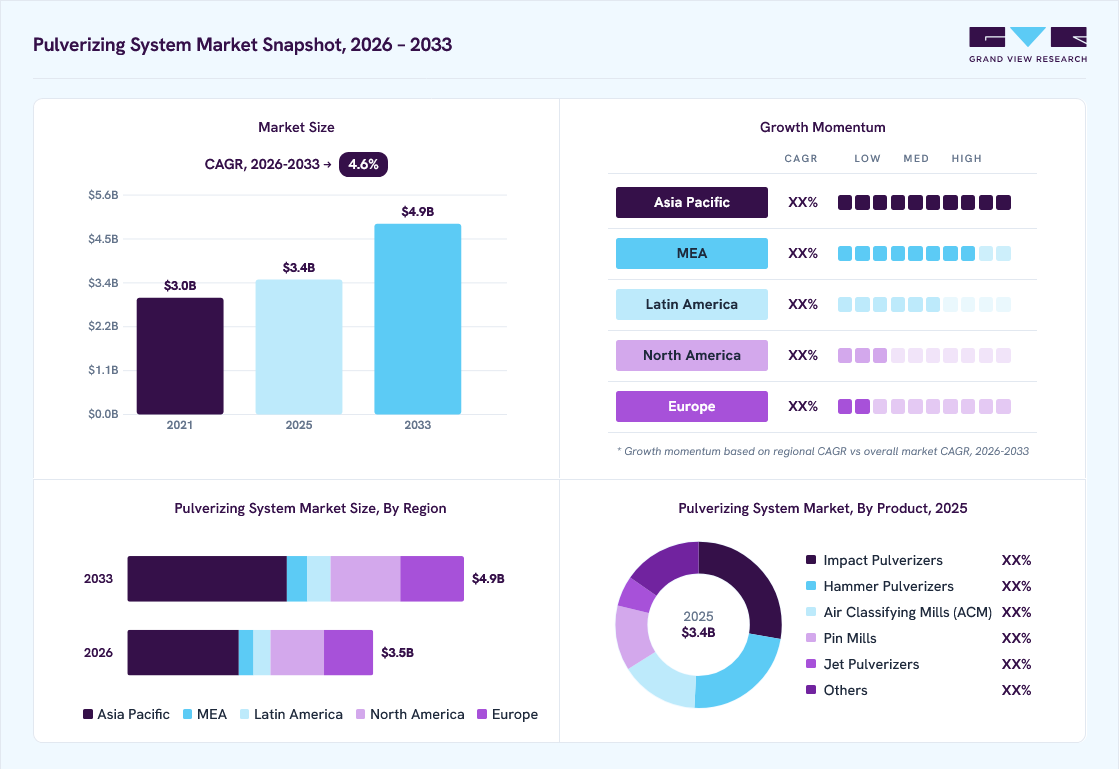
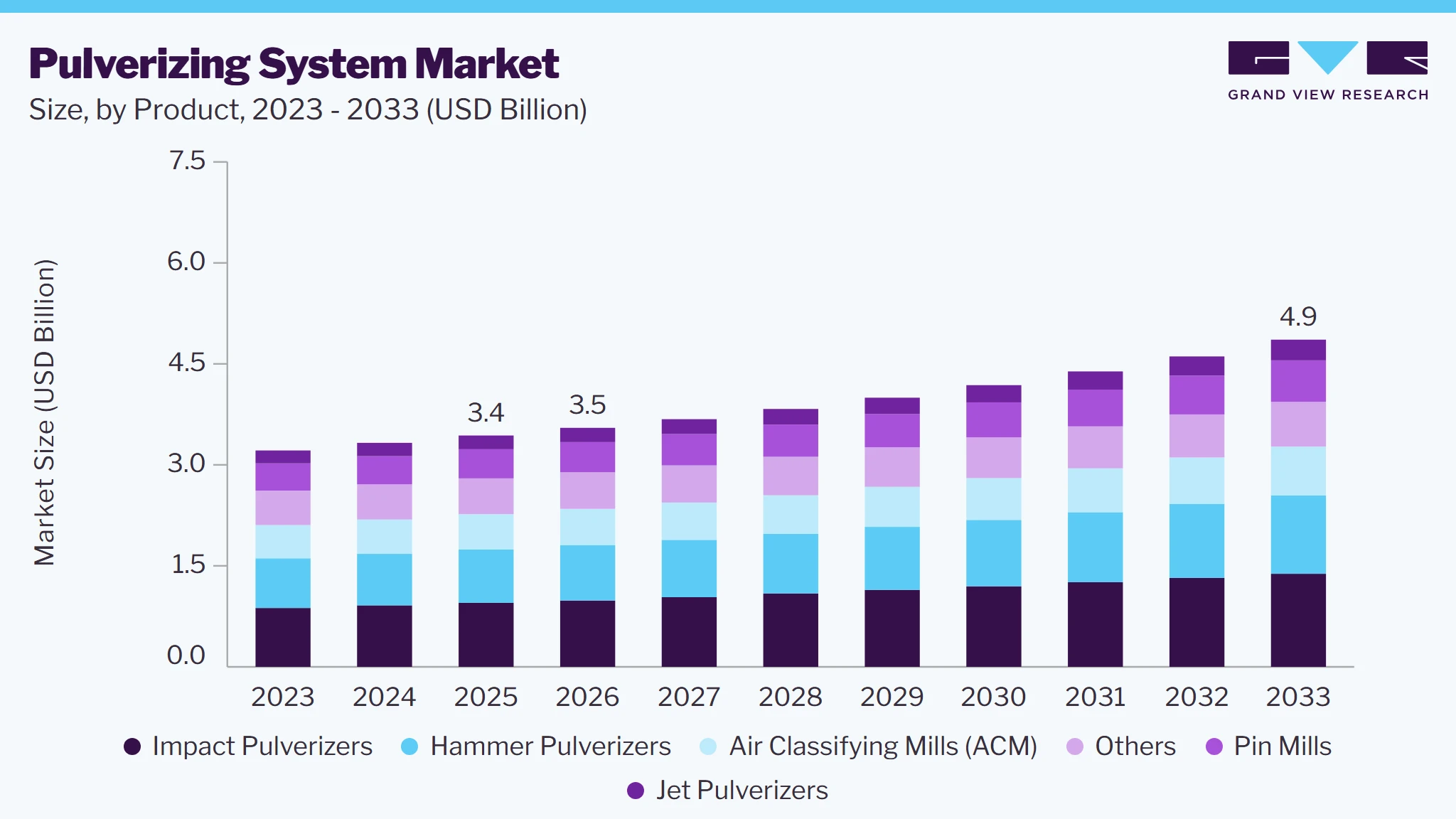
The global pulverizing system market size was valued at USD 3.4 billion in 2025 and is projected to grow from USD 3.5 billion in 2026 to USD 4.9 billion by 2033, at a CAGR of 4.6% from 2026 to 2033. Asia Pacific dominated the market, accounting for a revenue share of 45.1% in 2025. Industries are adopting efficient size reduction and material processing solutions across chemical, pharmaceutical, food, mineral, plastic, and other manufacturing applications. Rising industrial production is driving demand for pulverizing systems capable of handling higher material volumes while maintaining consistent particle size, product quality, and processing efficiency.
 Source: Grand View Research, IR Documents, Primary Interviews, Paid DatabasesTo learn more about this report,
 Download Free Sample Report
 Key Market Trends & Insights
- By product: the jet pulverizers segment is projected to grow at a CAGR of 5.5% during the forecast period.
- By end use: the food processing segment dominated the market in 2025, holding 24.2% market share.
Regional Highlights
- Largest regional market: Asia Pacific (45.1% revenue share, 2025)
- By country: China held the largest market share in 2025.
Market Size & Forecast
- Market Size in 2025: USD 3.4 Billion
- Estimated market size in 2026: USD 3.5 Billion
- Projected Market Size by 2033: USD 4.9 Billion
- CAGR (2026-2033): 4.6%
Three ways to get this report
Buy it, customize it, or ask a question.Ask an Analyst
A direct answer, usually in 1 working day
- AccessReport author, directly
- Reply timeWithin 1 working day
- No sales callDirect answer only
- FormatEmail reply
- CostFree, no cost
Get the Full Report
What the study covers
- FormatsPDF · Excel · Dashboard
- Timeline2026–2033 annual, 2025 base
- Coverage20+ countries, 5 regions
- Companies10+ key players profiled
Customize the Report
20% free customization
- IncludeCountries, segments, points
- TailorTo your product definition
- ExtendDeeper competitor detail
- OrA fully bespoke study
- Turnaround5–10 working days
 To learn more about this report, Download Free Sample Report
 Market Dynamics
Increasing demand for fine and ultrafine materials is supporting growth, particularly where controlled particle size is required for downstream processing, formulation, and product performance. Manufacturers are increasingly investing in pulverizing equipment that provides higher throughput, improved energy efficiency, and consistent processing.
Growth in industrial production is increasing demand for pulverizing systems that process raw materials into the required particle sizes. Chemical, pharmaceutical, food, mineral, and plastic manufacturers require size reduction during different stages of production. Higher manufacturing volumes increase the need for equipment capable of continuous processing and consistent output. Expansion of processing facilities and increases in production capacity are therefore supporting demand for pulverizing systems across different industrial applications and regions.
High equipment and maintenance costs can limit the adoption of pulverizing systems, particularly among small and medium-sized manufacturers. The overall investment may include the pulverizer, feeding equipment, dust collection systems, controls, installation, and supporting equipment. Regular maintenance and replacement of grinding components can further increase operating expenses. These costs may encourage manufacturers with limited production volumes to delay equipment purchases or continue using existing systems instead of investing in new pulverizing equipment.
Increasing automation of manufacturing operations creates opportunities for pulverizing system manufacturers. Automated feeding, process controls, particle size monitoring, and material handling can reduce manual intervention and improve production consistency. Integration with broader production lines can also support continuous processing and better control of operating conditions. Demand for automated manufacturing in pharmaceutical, chemical, food, mineral, and plastic processing facilities can therefore create opportunities for suppliers offering pulverizing systems compatible with automated production environments.
Market Concentration & Characteristics
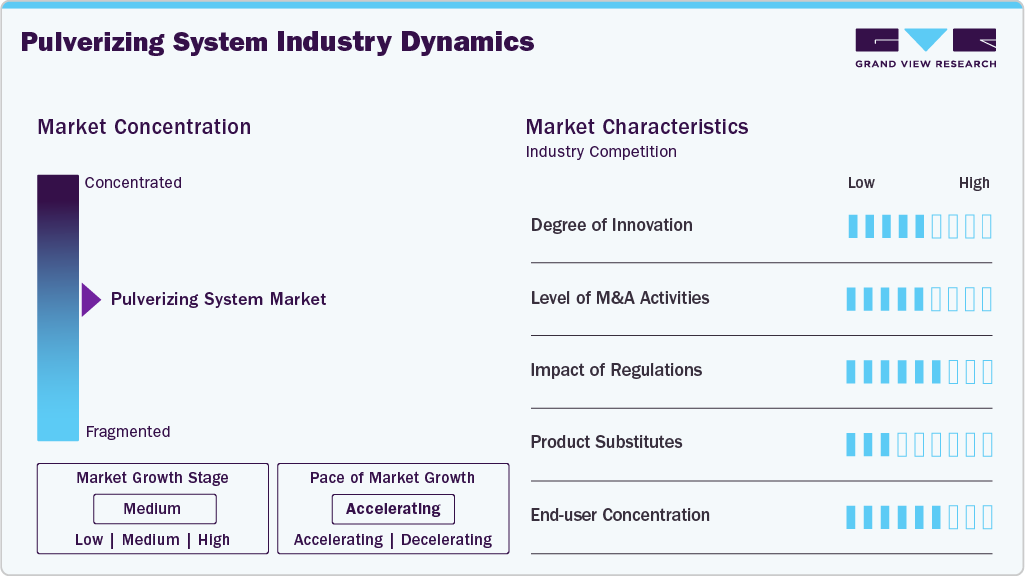
The market is moderately fragmented, with global manufacturers, regional equipment suppliers, and specialized machinery companies competing across diverse industrial applications. Companies differentiate through pulverizing capacity, particle size control, energy efficiency, equipment configuration, automation, and application suitability. Regional manufacturers compete on pricing, customization, and local service, while established companies benefit from broader product portfolios, technical capabilities, distribution networks, and established customer relationships across multiple industries.
Manufacturers are improving systems to achieve better particle size control, higher processing capacity, lower energy use, and easier operation. Developments include improved grinding mechanisms, automated controls, better material feeding, and process monitoring. Equipment is also being designed to handle different materials and meet specific requirements in various industries.
 To learn more about this report, Download Free Sample Report
 Regulations are shaping the market through requirements related to worker safety, dust control, noise, emissions, energy consumption, and equipment operation. OSHA regulations address workplace safety and exposure to dust, while ATEX and NFPA standards cover risks related to combustible dust and explosion protection. EPA regulations address air emissions and particulate matter, and ISO 12100 focuses on machinery safety and risk reduction. These requirements encourage manufacturers to incorporate dust collection, enclosed systems, machine guarding, ventilation, and safety controls into pulverizing equipment.
Analyst Perspective
The industry is expected to expand as manufacturers across food processing, chemicals and specialty chemicals, pharmaceuticals, plastics and rubber, minerals and metals, and agriculture and fertilizers require efficient size reduction and controlled particle sizes. Demand is likely to remain strong in applications requiring consistent powder characteristics, higher processing capacity, and improved production efficiency. Market development will depend on equipment cost, material characteristics, required particle size, automation requirements, energy consumption, processing capacity, and equipment replacement cycles.
Product Insights
The impact pulverizers segment accounted for the largest revenue share of 27.7% in 2025. Industries are adopting efficient size reduction and material processing solutions that offer high-speed particle reduction and can process various materials. Demand for higher production capacity and consistent particle sizes across manufacturing operations is expected to support their adoption, particularly where rapid and continuous processing is required.
The jet pulverizers segment is projected to register the fastest CAGR of 5.5% during the forecast period, with increasing demand for fine and ultrafine particle sizes in pharmaceutical, chemical, mineral, and specialty material processing. Jet pulverizers use high-velocity air or gas for particle reduction without conventional grinding surfaces, making them suitable for heat-sensitive materials. Growing requirements for controlled particle sizes and contamination-free processing are supporting their use in specialized applications.
End Use Insights
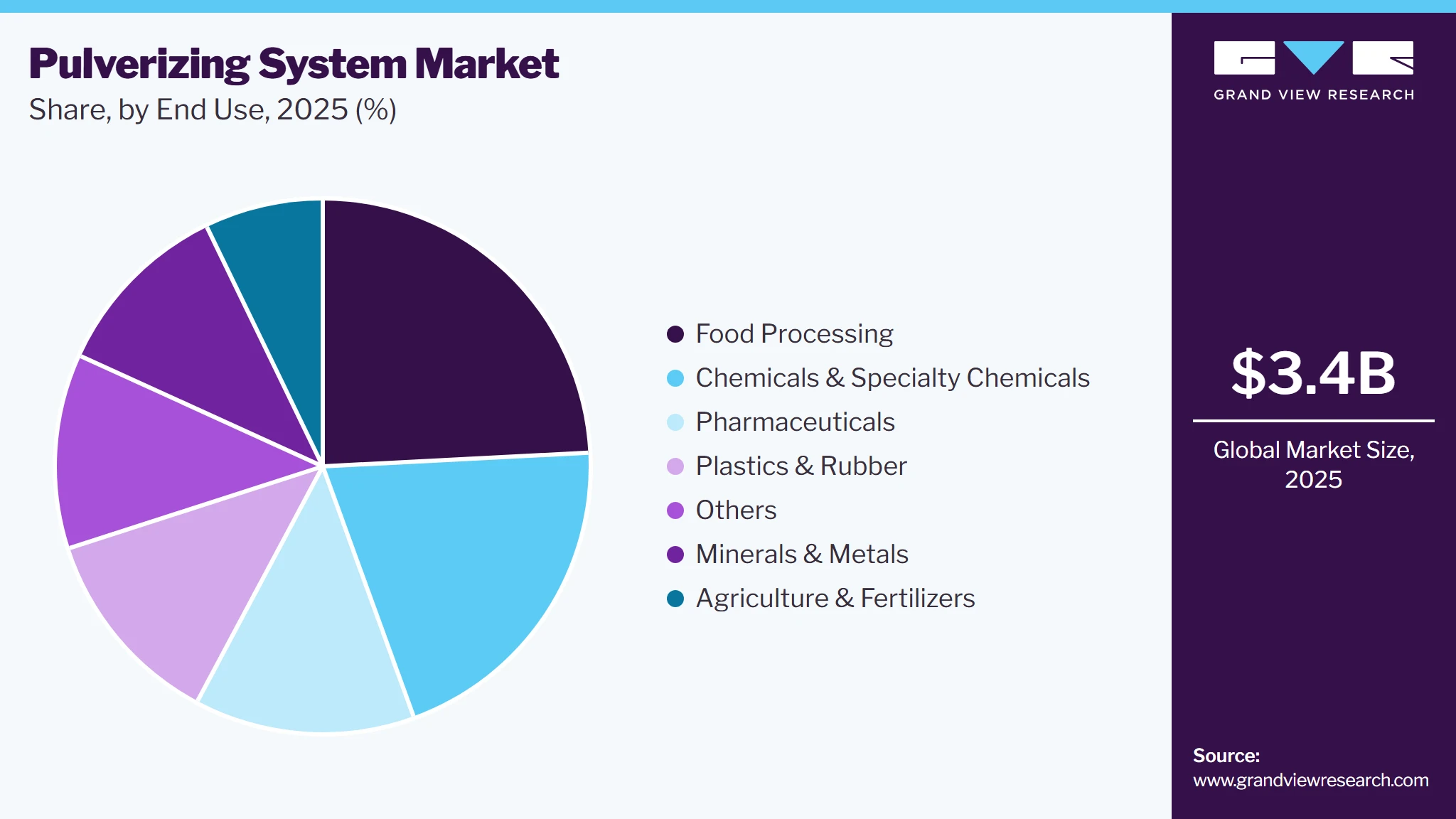
The food processing segment accounted for the largest revenue share of 24.2% in 2025. Manufacturers are increasing production of processed foods, requiring controlled particle sizes, fueling the demand for pulverizing systems. These systems are used for spices, grains, ingredients, and other food materials to achieve the required consistency. Rising demand for processed and packaged foods, along with increasing food production capacity, is expected to support the adoption of pulverizing systems.
 To learn more about this report, Download Free Sample Report
 The pharmaceuticals segment is projected to register the fastest CAGR of 5.9% during the forecast period, driven by the need for precise particle size reduction of active pharmaceutical ingredients and excipients. Pulverizing systems provide consistent particle sizes required for formulation, mixing, and dosage production. Rising pharmaceutical manufacturing, increasing demand for powdered formulations, and greater emphasis on controlled processing are expected to further support segment growth.
Regional Insights
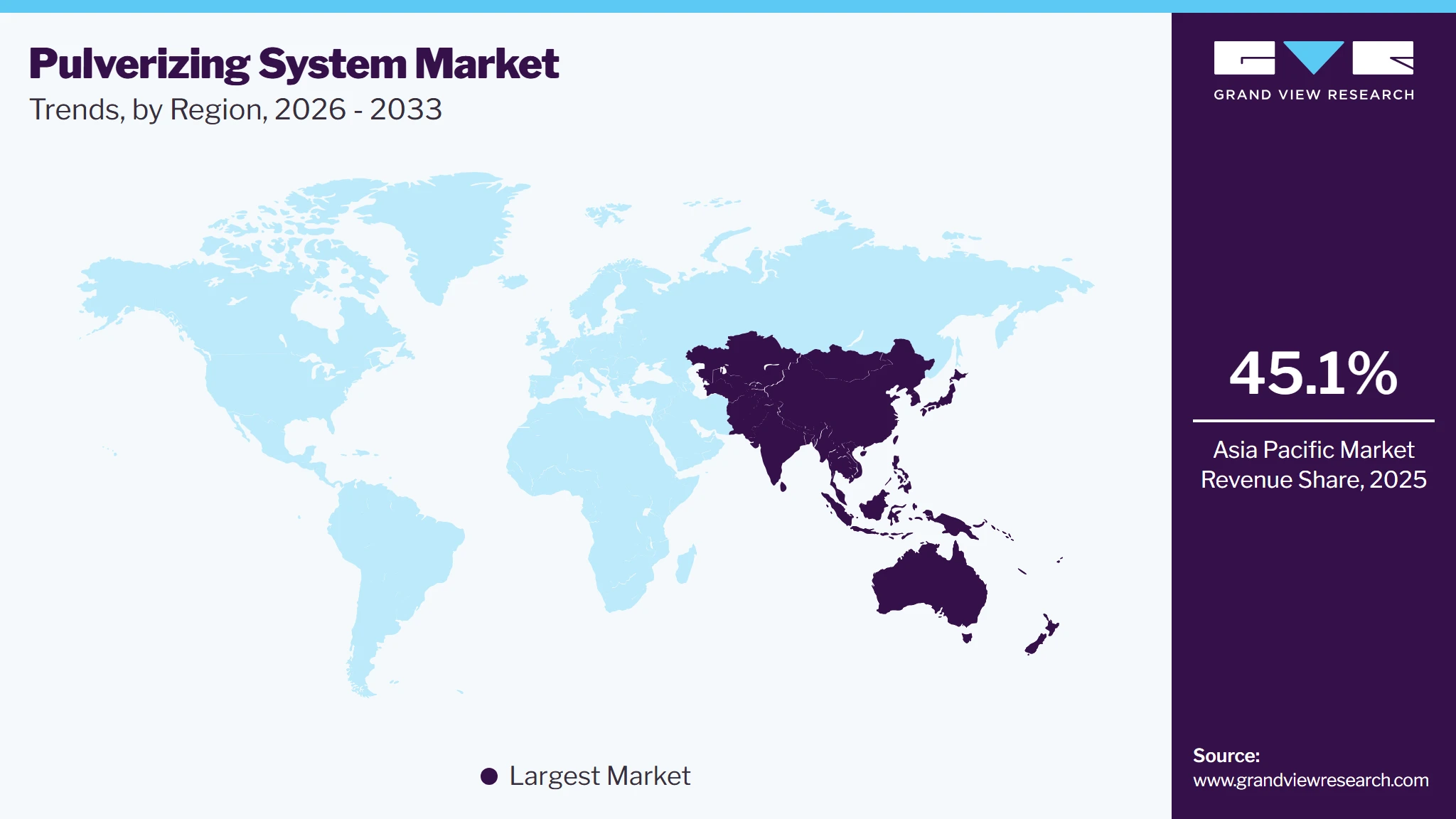
The Asia Pacific pulverizing system market accounted for the largest revenue share of 45.1% in 2025, and is also expected to witness the fastest CAGR from 2026 to 2033. The growth is due to expanding pharmaceutical, food processing, chemical, plastics, mineral, and manufacturing industries. Manufacturers are also adopting automated systems to improve production capacity and particle size consistency. Growth in pharmaceutical and food manufacturing, infrastructure development, and expansion of mineral processing activities are expected to further support demand for pulverizing systems across the region.
 To learn more about this report, Download Free Sample Report
 The pulverizing system market in China represents a significant market within Asia Pacific, as increasing manufacturing output is creating requirements for equipment capable of handling higher material volumes and maintaining consistent particle sizes. Investments in industrial production capacity and process automation are supporting equipment adoption. Demand for pulverizing systems in pharmaceutical ingredients, food materials, chemicals, and mineral processing is expected to remain an important contributor to market development.
North America Pulverizing System Market Trends
The pulverizing system market in North America is growing, as established food processing industries are adopting automated packaging systems to improve production efficiency, maintain product quality, and extend shelf life. Growth in organized retail, refrigerated food distribution, and ready-to-eat food consumption is further supporting equipment demand. Adoption of automated vacuum packaging technologies is also increasing among large-scale food manufacturers and processors.
U.S. Pulverizing System Market Trends
The pulverizing system market in the U.S. is expected to remain a major market because it already has a mature industrial base of power plants, cement plants, and mining operations that rely on pulverization for fuel preparation and material processing. Much of the current demand is coming from upgrading this equipment to more energy-efficient, lower-emission technology rather than building new capacity. Rising chronic disease rates are also boosting pharmaceutical production, which needs finely and uniformly pulverized ingredients, while growing processed food consumption is driving demand for food-grade grinding equipment.
Europe Pulverizing System Market Trends
The pulverizing system market in Europe is expected to grow, as demand for consistent particle size and efficient material processing is supporting the use of these systems. Manufacturers are also focusing on energy consumption along with workplace safety. Replacement of older equipment and increasing adoption of automated processing systems are expected to contribute to market growth across European manufacturing and processing facilities.
The Germany pulverizing system market is supported by strict EU and national environmental regulations, particularly rules pushing manufacturers to cut energy consumption and emissions in mineral and material processing. Demand is also supported by strong end-use industries where rising consumer health-consciousness and strict product safety and quality standards require precise, contamination-controlled particle processing.
The pulverizing system market in the UK is supported by the increasing production of processed materials, which is creating demand for equipment capable of controlled particle size reduction. Manufacturers are upgrading processing facilities to improve productivity and consistency while reducing manual operations.
Middle East & Africa Pulverizing System Market Trends
The pulverizing system market in the Middle East and Africa presents an emerging market, with a projected CAGR of 4.6% from 2026 to 2033. It offers opportunities through the expansion of manufacturing activities. Investments in industrial facilities and processing capacity are creating demand for size-reduction equipment. Mineral processing and food production are important application areas, while pharmaceutical manufacturing is gradually increasing its equipment requirements.
The Saudi Arabia pulverizing system market is emerging as an important market within the Middle East due to the expansion of domestic processing capacity, which is creating demand for equipment used for raw material size reduction and particle size control. Growth in food and pharmaceutical manufacturing is expected to support equipment adoption, while industrial facility development and modernization are increasing requirements for efficient processing systems.
Latin America Pulverizing System Market Trends
The pulverizing system market in Latin America is supported by food and agricultural processing, which represent important application areas. Pharmaceutical manufacturing is supporting additional demand for controlled size reduction. Investments in production capacity, equipment modernization, and automation are expected to support the adoption of pulverizing systems across the region.
Key Pulverizing System Company Insights
Some of the key players operating in the pulverizing system market include Hosokawa Micron Group, Siempelkamp Size Reduction Solutions, and NETZSCH Grinding & Dispersing.
-
NETZSCH Grinding & Dispersing is a Germany-based company headquartered in Selb, Bavaria. It develops and manufactures equipment and systems for grinding, dispersing, classifying, and processing materials. Its portfolio includes mills, classifiers, laboratory equipment, and complete processing systems used in industries such as chemicals, pharmaceuticals, food, minerals, ceramics, and other industrial applications.
-
Siempelkamp Size Reduction Solutions is a Germany-based machinery manufacturer specializing in size-reduction and material-processing equipment. The company develops machines and systems for grinding, pulverizing, shredding, and recycling various materials. Its equipment is used across plastics, chemicals, food, minerals, wood, and other industrial processing applications, with solutions designed for different material and particle-size requirements.
Key Pulverizing System Companies
The following key companies have been profiled for this study on the pulverizing system market.
-
Hosokawa Micron Group
-
Siempelkamp Size Reduction Solutions
-
NETZSCH Grinding & Dispersing
-
ALPA Powder Technology
-
FLSmidth
-
Bühler AG
-
Prater Industries, Inc.
-
Bepex International LLC
-
Bradley Pulverizer Company
-
Sturtevant, Inc.
-
SBM
-
Shanghai Clirik Machinery Co., Ltd.
-
Retsch GmbH
-
EPIC powder Machinery Co., Ltd.
-
Jiangyin Peixin Machinery Technology Co., Ltd.
Competitive Benchmarking
Category
Operating Strategies
Competitive Edge
Weakness
Established Players (e.g., Hosokawa Micron Group, Siempelkamp Size Reduction Solutions, NETZSCH Grinding & Dispersing, FLSmidth, Prater Industries, Inc.)
- Develop pulverizing, grinding, milling, classifying, and size-reduction systems for chemical, pharmaceutical, food, mineral, plastic, and other industrial applications.
- Strengthen market reach through distributors, industrial equipment dealers, OEM relationships, customization, application engineering, and technical service networks.
- Established expertise in size-reduction and material-processing technologies.
- Broad equipment portfolios, established customer relationships, global distribution networks, and technical service capabilities support market presence across multiple industrial applications.
- Higher equipment and customization costs can increase investment requirements for customers.
- Complex processing systems may require installation, operator training, maintenance, and technical support, creating adoption barriers for smaller manufacturers.
Emerging & Regional Players (e.g., SBM, Shanghai Clirik Machinery Co., Ltd., EPIC Powder Machinery Co., Ltd., Jiangyin Peixin Machinery Technology Co., Ltd.)
- Develop pulverizers, grinding mills, classifiers, and integrated powder-processing systems for minerals, chemicals, pharmaceuticals, food, plastics, and other applications.
- Expand through regional distributors, OEM integration, industrial partnerships, customized equipment, and application-specific systems.
- Flexible product development allows equipment to be adapted to different production capacities, materials, and particle-size requirements.
- Regional presence can support localized customer service, competitive pricing, and shorter equipment delivery times.
- Smaller regional scale and service networks may limit geographic coverage compared with established suppliers.
- Narrower technology portfolios and fewer resources for large-scale automation, research and development, and international technical support can limit participation in complex projects.
Recent Developments
-
In March 2026, NETZSCH inaugurated a new production facility in Goa, India, expanding its manufacturing capabilities in India. The facility is expected to increase production capacity and strengthen local supply for grinding, dispersing, and powder-processing equipment, supporting growing demand from pharmaceutical, chemical, food, mineral, and other industrial processing applications.
-
In April 2025,Qlar, formerly Schenck Process, opened a new pulverizer test center in Bangalore, India. The facility enables testing and evaluation of pulverizing equipment for different materials and processing requirements.
Pulverizing System Market Report Scope
Report Attribute
Details
Market size value in 2025
USD 3.4 billion
Estimated market size in 2026
USD 3.5 billion
Revenue forecast in 2033
USD 4.9 billion
Growth rate
CAGR of 4.6% from 2026 to 2033
Historical data
2021 - 2024
Forecast period
2026 - 2033
Quantitative units
Revenue in USD billion and CAGR from 2026 to 2033
Report coverage
Revenue forecast, company ranking, competitive landscape, growth factors, and trends
Segments covered
Product, end use, region.
Regional scope
North America; Europe; Asia Pacific; Latin America; Middle East & Africa
Country scope
U.S.; Canada; Mexico; UK; Germany; France; Italy; Spain; China; Japan; India; Australia; South Korea; Brazil; Argentina; UAE; Saudi Arabia; South Africa
Key companies profiled
Hosokawa Micron Group; Siempelkamp Size Reduction Solutions; NETZSCH Grinding & Dispersing; ALPA Powder Technology; FLSmidth; Bühler AG; Prater Industries, Inc.; Bepex International LLC; Bradley Pulverizer Company; Sturtevant, Inc.; SBM; Shanghai Clirik Machinery Co., Ltd.; Retsch GmbH; EPIC Powder Machinery Co., Ltd.; Jiangyin Peixin Machinery Technology Co., Ltd.
Customization scope
Free report customization (equivalent up to 8 analysts working days) with purchase. Addition or alteration to country, regional & segment scope.
Pricing and purchase options
Avail customized purchase options to meet your exact research needs. Explore purchase options
Global Pulverizing System Market Report Segmentation
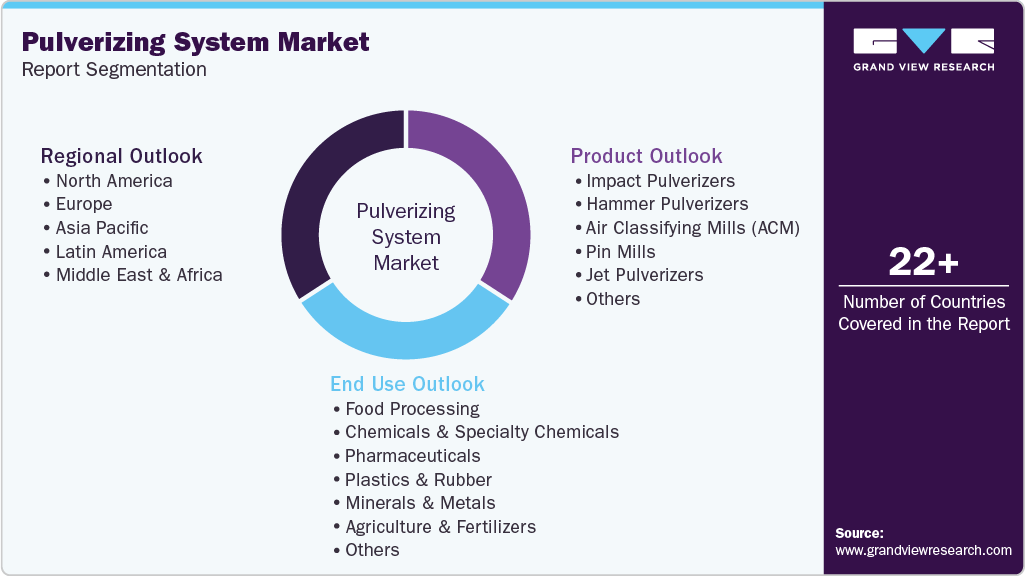
This report forecasts revenue growth at global, regional, and country levels and provides an analysis of the latest industry trends in each of the sub-segments from 2021 to 2033. For this study, Grand View Research has segmented the global pulverizing system market report based on product, end use, and region.
 To learn more about this report, Download Free Sample Report
 -
Product Outlook (Revenue, USD Billion, 2021 - 2033)
-
Impact Pulverizers
-
Hammer Pulverizers
-
Air Classifying Mills (ACM)
-
Pin Mills
-
Jet Pulverizers
-
Others
-
-
End Use Outlook (Revenue, USD Billion, 2021 - 2033)
-
Food Processing
-
Chemicals & Specialty Chemicals
-
Pharmaceuticals
-
Plastics & Rubber
-
Minerals & Metals
-
Agriculture & Fertilizers
-
Others
-
-
Regional Outlook (Revenue, USD Billion, 2021 - 2033)
-
North America
-
U.S.
-
Canada
-
Mexico
-
-
Europe
-
Germany
-
Spain
-
France
-
Italy
-
UK
-
-
Asia Pacific
-
China
-
India
-
Japan
-
Australia
-
South Korea
-
-
Latin America
-
Brazil
-
Argentina
-
-
Middle East and Africa
-
Saudi Arabia
-
UAE
-
South Africa
-
-
Research Methodology
The pulverizing system market figures in this report are based on a proven research process that combines executive interviews with secondary research from proprietary databases, company filings, and recognized regulatory and institutional sources. Market size is built through value-chain sizing-reconciling supply-side and demand-side estimates-and triangulated with bottom-up and top-down approaches. Every estimate passes multiple levels of expert validation before publication, with each pulverizing system segment quantified using the revenue-capture definitions in the table below.
Segment Definition
Segment - Product
Revenue Capture Definition
Impact Pulverizers
Revenue is generated from sales of impact pulverizers used for high-speed size reduction of minerals, chemicals, food ingredients, and other materials.
Hammer Pulverizers
Revenue is captured from hammer pulverizers used to reduce materials into smaller particles across food, agriculture, chemical, and mineral processing.
Air Classifying Mills (ACM)
Revenue is obtained from air classifying mills used for fine grinding and particle classification in pharmaceutical, chemical, mineral, and food processing.
Pin Mills
Revenue is generated from pin mills used for fine and uniform particle size reduction across food, pharmaceutical, chemical, and specialty material applications.
Jet Pulverizers
Revenue is captured from jet pulverizers used to produce fine and ultrafine powders for pharmaceutical, chemical, mineral, and specialty material processing.
Others
Revenue is obtained from other pulverizing systems used for specialized size reduction requirements across diverse industrial material processing applications.
Segment-End Use
Revenue Capture Definition
Food Processing
Revenue is generated from pulverizing systems used to process spices, grains, ingredients, and other food materials requiring controlled particle sizes.
Chemicals & Specialty Chemicals
Revenue is captured from pulverizing systems used for size reduction of chemicals, pigments, additives, compounds, and specialty chemical materials.
Pharmaceuticals
Revenue is obtained from pulverizing systems used to reduce active ingredients and excipients into controlled particle sizes for pharmaceutical manufacturing.
Plastics & Rubber
Revenue is generated from pulverizing systems used to process plastic and rubber materials into particles for recycling, compounding, and manufacturing.
Minerals & Metals
Revenue is captured from pulverizing systems used to reduce minerals and metal-containing materials into required particle sizes for processing.
Agriculture & Fertilizers
Revenue is obtained from pulverizing systems used to process agricultural materials, fertilizers, seeds, grains, and related products into controlled particle sizes.
Others
Revenue is generated from pulverizing systems used across additional applications requiring material size reduction, grinding, or powder processing capabilities.
Estimation Model
Layer Name
Key Question
Description
Industrial End-Use Demand Layer
Where is demand for pulverizing systems generated?
Assess demand across Food Processing, Chemicals & Specialty Chemicals, Pharmaceuticals, Plastics & Rubber, Minerals & Metals, Agriculture & Fertilizers, and Others. Demand is evaluated based on production volumes, material-processing requirements, particle-size requirements, processing capacity, automation levels, facility expansion, and equipment replacement needs.
Processing Facility & Equipment Demand Layer
Where is demand for new pulverizing systems created?
Evaluate investments in food-processing, chemical, pharmaceutical, plastics, rubber, mineral-processing, and agricultural facilities. New facility development, production capacity expansion, processing-line additions, automation upgrades, modernization, and replacement of existing size-reduction equipment are assessed to determine requirements for new pulverizing systems.
Technology & Product Adoption Layer
Which pulverizing system configurations are being purchased?
Analyze equipment demand across Impact Pulverizers, Hammer Pulverizers, Air Classifying Mills (ACM), Pin Mills, Jet Pulverizers, and Others. Adoption is assessed based on material characteristics, required particle size, production volume, processing temperature, energy requirements, throughput, automation level, equipment capacity, and suitability for specific industrial applications.
Revenue Conversion Layer
How is market revenue estimated?
Convert estimated pulverizing system demand into annual revenue based on the sales value of new equipment across defined product, end-use, and geographic segments. Revenue estimates incorporate equipment sold directly by manufacturers and through distributors, dealers, OEMs, system integrators, and industrial equipment suppliers.
Delivered Customizations
This report has been delivered with the following In-depth customizations
Client Request
Customization Delivered
Value Adds
Competitive Benchmarking
A comprehensive benchmarking assessment was conducted across pulverizing system manufacturers, covering product portfolios, grinding and size-reduction technologies, automation capabilities, particle-size ranges, processing capacity, material suitability, geographic presence, product development, and market positioning.
Enables comparison of equipment portfolios, technological capabilities, application coverage, customization capabilities, distribution networks, and supplier positioning to support competitive analysis and strategic planning.
Regional Segmentation
A detailed regional assessment was conducted across North America, Europe, Asia Pacific, Latin America, and the Middle East & Africa, examining pulverizing system demand across food processing, chemicals and specialty chemicals, pharmaceuticals, plastics and rubber, minerals and metals, agriculture and fertilizers, and other applications. Industrial production, processing capacity, automation investment, facility expansion, and equipment replacement requirements were considered.
Helps stakeholders identify regional demand variations, evaluate end-use potential, assess equipment adoption patterns, and identify geographic markets with higher requirements for pulverizing systems.
Opportunity Assessment
Growth opportunities were evaluated across major end-use industries, with emphasis on industrial production expansion, particle-size control, processing efficiency, automation, energy efficiency, capacity expansion, and adoption of impact pulverizers, hammer pulverizers, air classifying mills, pin mills, and jet pulverizers.
Supports identification of addressable growth areas, equipment development priorities, investment opportunities, application expansion potential, and strategies for strengthening competitive positioning in the global pulverizing system market.
Frequently Asked Questions About This Report
The jet pulverizers segment is projected to grow at a CAGR of 5.5% during the forecast period.
Key trends shaping the pulverizing system market include increasing automation, demand for finer particle sizes, development of energy-efficient equipment, integration of process monitoring and controls, growing pharmaceutical and specialty chemical applications, equipment customization, and increasing adoption of systems supporting continuous and high-capacity processing.
India is projected to register the fastest growth in the pulverizing system market.
The global pulverizing system market size was valued at USD 3.4 billion in 2025 and is projected to reach USD 3.5 billion in 2026.
The market is expected to grow at a CAGR of 4.6% from 2026 to 2033, reaching approximately USD 4.9 billion by 2033.
Key factors driving the pulverizing system market include rising industrial production, increasing demand for fine and controlled particle sizes, expansion of pharmaceutical and chemical manufacturing, growth in food processing, higher mineral processing activity, automation of size-reduction processes, and demand for improved processing efficiency.
Asia Pacific dominated the global pulverizing system market, accounting for the largest revenue share of 45.1% in 2025.
The food processing segment dominated the global market in 2025 holding 24.2% market share.
Hosokawa Micron Group, Siempelkamp Size Reduction Solutions, NETZSCH Grinding & Dispersing, ALPA Powder Technology, FLSmidth, Bühler AG, Prater Industries, Inc., Bepex International LLC, Bradley Pulverizer Company, Sturtevant, Inc., SBM, Shanghai Clirik Machinery Co., Ltd., Retsch GmbH, EPIC Powder Machinery Co., Ltd., Jiangyin Peixin Machinery Technology Co., Ltd.
About the Author(s)
Advanced Interior Materials Research Team
Advanced Materials · Advanced Interior MaterialsThis report was authored by the advanced interior materials research team at Grand View Research - comprising two research analysts, one senior research analyst, and one industry expert - with specialized expertise in the advanced interior materials segment of the advanced materials industry. All findings are based on proprietary advanced materials databases, executive interviews, and regulatory analysis, subject to internal peer review prior to publication.
Last Updated:
Speak to Analyst

Customize this report to your needs - add regions, segments, or data points, with 20% free customization.
Or view our licence options:


ISO 9001:2015 & 27001:2022 Certified
We are GDPR and CCPA compliant! Your transaction & personal information is safe and secure. For more details, please read our privacy policy.


