
- Home
- »
- Next Generation Technologies
- »
-
QR Code Payment Market Size & Share Report, 2026-2033GVR Report cover

QR Code Payment Market (2026 - 2033)
Size, Share & Trends Analysis Report By Offerings (Solution, Services), By Solution (Static QR Code, Dynamic QR Code), By Payment Type, By Transaction Channel, By End-user, By Region, And Segment Forecasts
Market Size, 2025
$14.3BMarket Estimate, 2026
$16.6BMarket Forecast, 2033
$61.7BCAGR, 2026–2033
20.7%QR Code Payment Market Summary
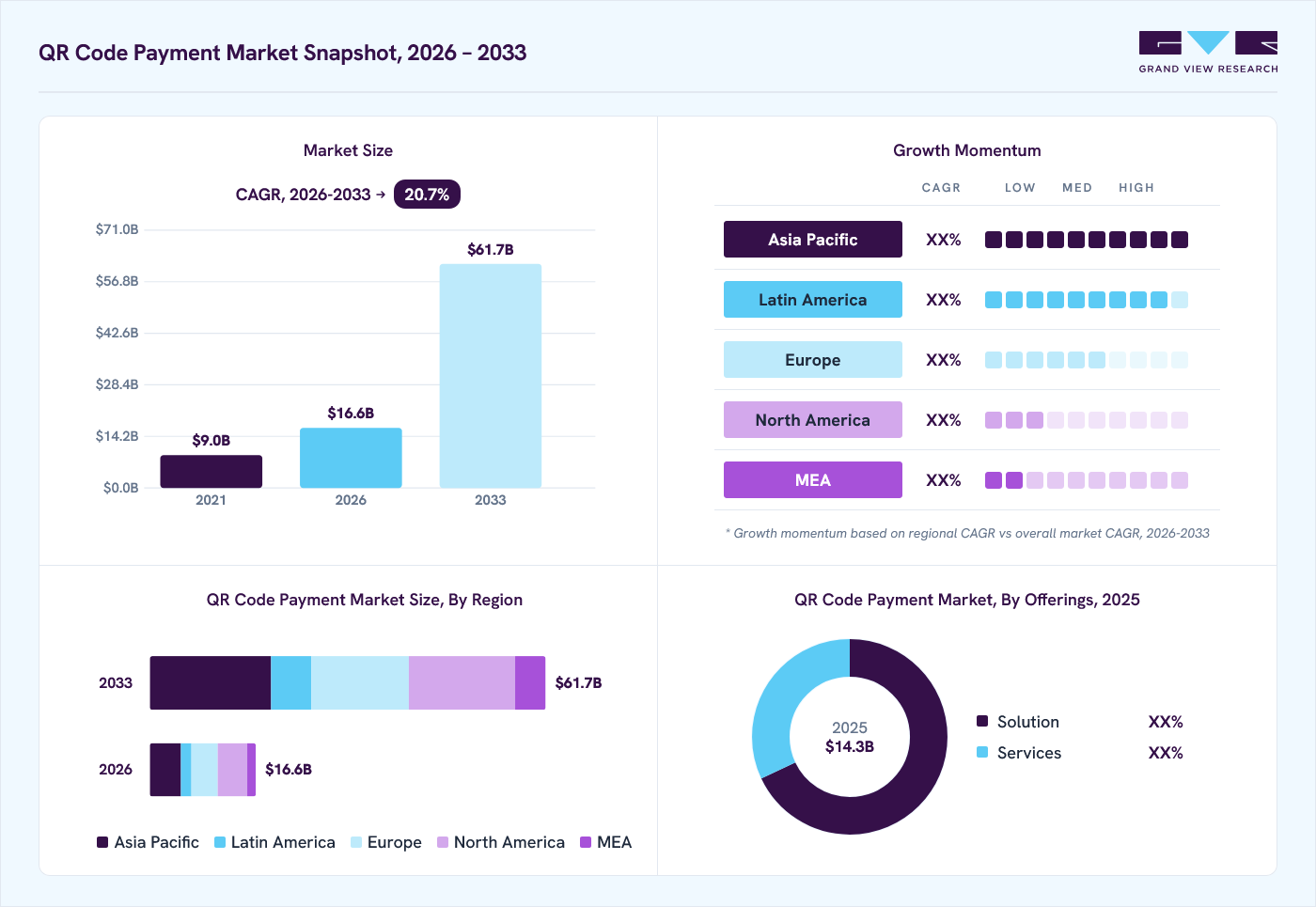
The global QR code payment market size was valued at USD 14.3 billion in 2025 and is projected to grow from USD 16.6 billion in 2026 to USD 61.7 billion by 2033, at a CAGR of 20.7% from 2026 to 2033. Asia Pacific dominated the market, accounting for a revenue share of 29.2% in 2025. The market has seen a surge in QR adoption in recent years, driven by several factors. One of the key drivers is the rise of smartphone usage, particularly in developing countries such as India.
 Source: Grand View Research, IR Documents, Primary Interviews, Paid DatabasesTo learn more about this report,
 Download Free Sample Report
 Key Market Trends & Insights
- By offering: Solutions segment dominated the market, with a revenue share of 67.9% in 2025.
- By payment type: Push payment segment held the largest market share of 57.9% in 2025.
- By end user: Restaurant segment held the largest revenue share in 2025.
Regional Highlights
- Largest regional market: Asia Pacific (29.2% revenue share, 2025)
- By country: The China held the largest revenue share in the Asia Pacific.
Market Size & Forecast
- Market size in 2025: USD 14.3 Billion
- Estimated market size in 2026: USD 16.6 Billion
- Projected market size by 2033: USD 61.7 Billion
- CAGR (2026-2033): 20.7%
Three ways to get this report
Buy it, customize it, or ask a question.Ask an Analyst
A direct answer, usually in 1 working day
- AccessReport author, directly
- Reply timeWithin 1 working day
- No sales callDirect answer only
- FormatEmail reply
- CostFree, no cost
Get the Full Report
What the study covers
- FormatsPDF · Excel · Dashboard
- Timeline2026–2033 annual, 2025 base
- Coverage20+ countries, 5 regions
- Companies10+ key players profiled
Customize the Report
20% free customization
- IncludeCountries, segments, points
- TailorTo your product definition
- ExtendDeeper competitor detail
- OrA fully bespoke study
- Turnaround5–10 working days
As more people gain access to affordable smartphones, they are increasingly turning to QR code payments as a convenient and easy way to make transactions. Moreover, the rapid adoption of digital payments is another key driver fueling the market growth. With consumers increasingly moving away from cash and towards electronic payments, merchants are looking for new ways to offer digital payment options. QR code payments provide a simple and cost-effective way to make transactions without requiring expensive point-of-sale terminals or other hardware. In addition, QR code payments are also gaining popularity due to their ease of use. Customers can simply scan a QR code using their smartphone camera and complete a transaction in seconds. The ease of use is particularly appealing to younger consumers accustomed to using their smartphones for a wide range of activities, including shopping and banking.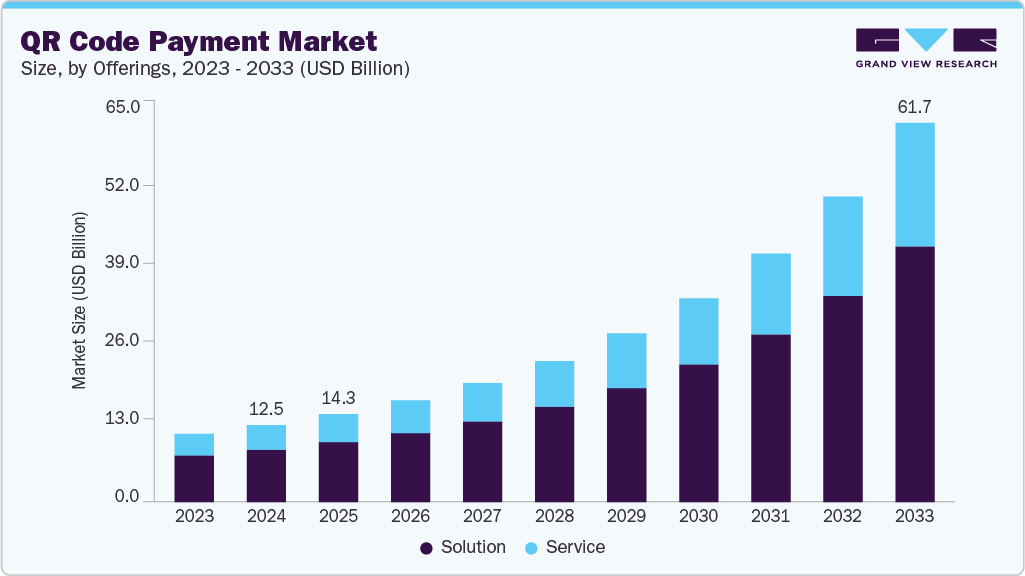 To learn more about this report, Download Free Sample Report
 As more and more people rely on smartphones for their daily activities, including banking and financial transactions, the convenience of using QR code payments becomes even more apparent. Moreover, the proliferation of mobile wallets and digital payment applications that support QR code payments is also driving the market's growth. These apps allow users to easily store their payment information and initiate transactions with just a few taps on their mobile devices, making it a more seamless and user-friendly payment option. As a result, businesses are increasingly adopting QR code payment systems to cater to the growing number of customers who prefer mobile-based payment options.
Moreover, the advent of e-commerce also propels the QR code payment market growth. As online shopping continues to grow, merchants are looking for new ways to offer secure and convenient payment options to their customers. QR code payments provide an ideal solution, allowing customers to make payments quickly and securely using their smartphones without needing credit cards or other payment methods. Unlike traditional credit card payments, which require customers to enter sensitive information such as their card number and expiration date, QR code payments use encryption and other security measures to protect customer data.
However, one of the significant hindrances to the QR code payment growth is the lack of standardization. Different QR code payment providers use different QR code payment gateways, standards, and protocols, leading to confusion among merchants and consumers. This fragmentation has limited the market's growth as users need multiple payment applications to scan different QR codes, which is inconvenient. To overcome this restraint, industry players must establish a universal standard for QR codes that enables them to be interoperable across different payment providers, which is already a reality in India.
Market Dynamics
The QR code payment market is experiencing strong growth driven by rising smartphone adoption, expanding digital payment ecosystems, government initiatives promoting cashless transactions, and increasing merchant acceptance of low-cost payment technologies. The market benefits from the convenience, scalability, and contactless nature of QR code transactions, which have accelerated consumer adoption across retail, transportation, hospitality, healthcare, and e-commerce sectors. However, concerns related to cybersecurity risks, fraudulent QR codes, and varying levels of digital literacy continue to challenge market expansion.
The increasing adoption of smartphones and the expansion of mobile internet connectivity are driving the growth of the QR code payment market. Smartphones have become the primary device for digital transactions, enabling consumers to make payments instantly by scanning QR codes through banking applications, digital wallets, or merchant payment platforms. The widespread availability of affordable smartphones, particularly in emerging economies across the Asia Pacific, Latin America, and Africa, has significantly expanded the addressable user base for QR code-based transactions. As more consumers gain access to mobile banking services, QR code payments are becoming an increasingly convenient alternative to cash and card-based transactions.
Growing mobile internet penetration has further accelerated the adoption of QR code payments by enabling real-time transaction processing and seamless integration with digital financial services. Governments, financial institutions, and payment service providers are promoting digital payment ecosystems to improve financial inclusion and reduce reliance on cash. The ease of deployment, low infrastructure requirements, and support for contactless transactions have encouraged merchants of all sizes to adopt QR code payment solutions, contributing to sustained global market growth.
Security concerns associated with digital payments remain a significant restraint for the QR code payment market. Fraudsters can exploit vulnerabilities through malicious QR codes, phishing attacks, fake merchant codes, and unauthorized redirection to fraudulent payment portals. Consumers may unknowingly scan tampered QR codes placed over legitimate merchant codes, resulting in financial losses and reduced confidence in QR-based payment systems. As transaction volumes increase, the risk of cyberattacks and data breaches becomes a growing concern for payment providers, merchants, and end users.
The lack of awareness regarding secure payment practices further amplifies these risks, particularly among first-time digital payment users. Businesses and financial institutions must invest heavily in fraud detection systems, transaction monitoring tools, encryption technologies, and customer education initiatives to mitigate security threats. Despite ongoing improvements in payment security frameworks, concerns regarding privacy, data protection, and transaction safety continue to slow adoption among certain consumer segments and businesses, especially in regions with less mature cybersecurity infrastructure.
The growing digitalization of small and medium-sized enterprises presents a significant opportunity for the QR code payment market. Many SMEs, micro-merchants, street vendors, and independent retailers seek affordable payment acceptance solutions that do not require expensive point-of-sale terminals or complex banking infrastructure. QR code payment systems offer a cost-effective alternative, enabling merchants to accept digital payments via printed or digital QR codes. This low barrier to entry is encouraging widespread adoption among businesses that were previously reliant on cash transactions.
As governments and financial institutions continue promoting financial inclusion and digital commerce, SMEs are increasingly integrating QR code payments into their operations to enhance customer convenience and improve transaction efficiency. The expansion of e-commerce, food delivery services, local retail networks, and digital marketplaces is driving additional demand for QR code-based payment acceptance. Moreover, advancements such as interoperable QR standards, cross-border QR payment networks, and integration with loyalty programs and business management platforms are expected to unlock new growth opportunities for payment providers serving the SME segment.
Analyst Perspective
The QR code payment market is experiencing robust growth as consumers and merchants increasingly adopt convenient, low-cost, and contactless digital payment solutions. Rising smartphone penetration, expanding mobile wallet usage, government initiatives promoting cashless economies, and growing merchant acceptance are accelerating market expansion across both developed and emerging economies. While cybersecurity concerns and fragmented payment ecosystems remain challenges, ongoing advancements in interoperability standards, real-time payment infrastructure, and cross-border QR payment networks are expected to strengthen adoption.
Offerings Insights
Based on offering, the solution segment led the market with the largest revenue share of 67.9% in 2025. The QR code payment system is often customizable, which means that it can be tailored to the specific needs of a business, such as integrating with existing POS systems or online stores. This level of flexibility and customization has made solution-based offerings particularly appealing to small and medium-sized businesses that require a payment solution that can grow and evolve with their needs. Moreover, the versatility allows businesses to provide a payment experience that suits their customers' preferences and can help increase sales and revenue.
The services segment is anticipated to register significant growth over the forecast period. The segment includes professional and managed services. The complexity of QR code payment systems requires specialized knowledge and expertise, which many businesses do not have in-house. As a result, they rely on professional and managed service providers to design, implement, and manage their QR code payment systems. These providers offer a range of services, including consulting, design, implementation, customization, integration, testing, and ongoing maintenance and support. Moreover, the increasing adoption of QR code payments by businesses and consumers has led to a growing demand for professional and managed services.
Solution Insights
The dynamic QR code segment dominated the market in 2024 and accounted for a revenue share of 64.01%. Dynamic QR codes can be generated in real-time and can contain different amounts or data depending on the transaction, making them highly versatile. The flexibility allows businesses to create personalized payment experiences for their customers, such as offering discounts or promotions based on purchase history or customer data. In addition, dynamic QR codes are more secure when compared to static QR codes because they can be encrypted with unique transaction information, preventing fraudulent transactions. As a result, security has made dynamic QR codes a popular choice for businesses, particularly those in high-risk industries such as e-commerce and finance.
The static QR code segment is expected to register significant growth over the forecast period. The segment's growth can be attributed to its simplicity, low cost, and ease of implementation. Static QR codes can be generated quickly and easily without the need for additional software or hardware, making static QR a cost-effective option for small and medium-sized businesses. Moreover, static QR codes are easy to implement and can be used in various settings, such as printed on receipts or displayed on screens, making them a flexible option for businesses. Furthermore, static QR codes are used for a range of transactions, from small retail purchases to bill payments, making them a popular choice for businesses in a range of industries.
Payment Type Insights
Based on payment type, push payment led the market with the largest revenue share of 57.9% in 2025. Push payments allow customers to initiate the transaction by scanning the QR code and authorizing the payment, which is then pushed from their account to the merchant's account. As a result, it allows complete control to customer over each transaction and must explicitly authorize each payment, reducing the risk of fraudulent transactions or unauthorized charges. In addition, push payments are often used for one-time purchases, such as in-store retail transactions or online shopping, which can help further reduce the risk of fraud, propelling the segment's growth further.
The pull payments segment is anticipated to register significant growth over the forecast period. Pull payments allow merchants to generate a QR code and present it to the customer, who then scans the code and authorizes the payment, which is then pulled from their account to the merchant's account. As a result, the customer does not need to initiate each transaction, making pull payments a popular considerable option for recurring payments, such as subscriptions or bill payments. Moreover, pull payments offer a seamless payment experience for customers, as they can complete transactions quickly and easily with just a few clicks, improving customer satisfaction and loyalty, particularly for businesses that prioritize convenience and ease of use. Furthermore, pull payments can be more cost-effective for businesses, particularly those that process a high volume of recurring payments.
Transaction Channel Insights
Based on transaction channel, face-to-face led the market with the largest revenue share of 59.2% in 2025. One of the main advantages of the face-to-face transaction channel is its familiarity with customers. Many customers are already accustomed to using QR codes for various purposes, such as accessing content or promotions, which makes scanning a QR code during a transaction natural and intuitive. Moreover, the face-to-face transaction channel is highly secure, as the customer and the merchant are physically present. Consequently, it reduces the risk of fraud and unauthorized charges, providing added peace of mind for customers and merchants.
The remote segment is anticipated to register significant growth over the forecast period. The remote transaction channel growth can be attributed to its convenience and accessibility for customers, particularly in the wake of the COVID-19 pandemic. The channel involves customers scanning a QR code the merchant presents during a remote transaction, such as online shopping or ordering takeout from a restaurant. One of the main advantages of the remote transaction channel is its accessibility. Customers can complete transactions from the comfort of their homes or on-the-go, without visiting a store or restaurant physically. This has become increasingly important during the pandemic, as more customers have shifted to online shopping and remote ordering to reduce their risk of exposure.
End-user Insights
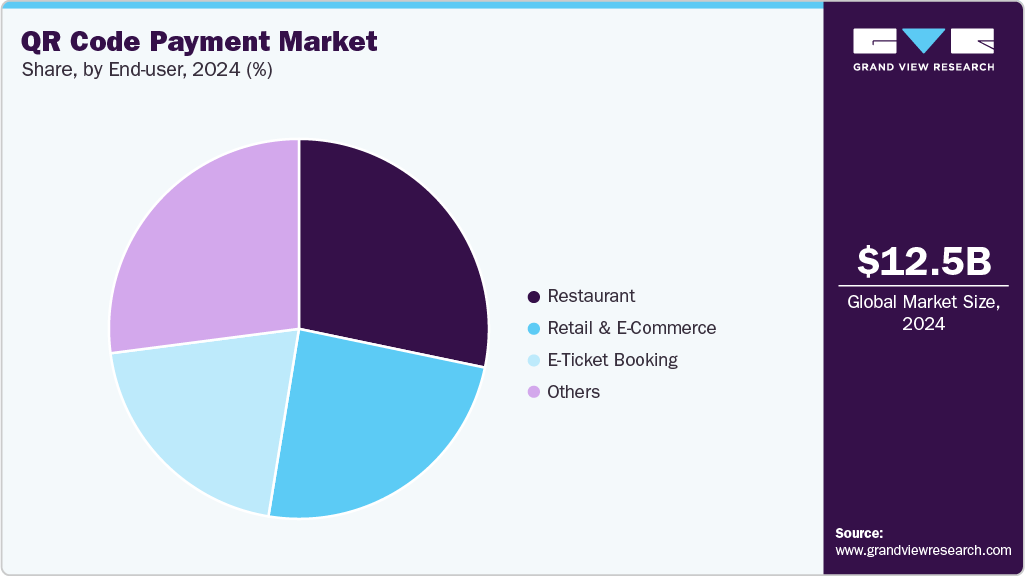
Based on end user, the restaurant segment led the market with the largest revenue share of 28.3% in 2025. QR Code payment methods can help reduce transaction costs for restaurants, particularly those that process a high volume of small transactions, as they can avoid costly credit card processing fees. It allows restaurants to improve their profitability and competitiveness. In addition, QR Code payments offer added benefits for restaurants during the COVID-19 pandemic, as they can help reduce the risk of transmission by reducing physical contact between customers and staff. Furthermore, QR Code payments can help restaurants improve customer engagement and loyalty by offering personalized promotions and loyalty rewards to customers using QR Code payments.
 To learn more about this report, Download Free Sample Report
 The retail & e-commerce segment is anticipated to register the fastest growth due to the increasing adoption of mobile payments and digital wallets among consumers. QR Code payments offer a secure and convenient payment option for customers who prefer to use their mobile devices for shopping and payments. The retail and e-commerce industries are highly competitive and customer-centric, making it essential for businesses to offer fast and convenient payment options that meet their customers' evolving needs and preferences. As a result, QR code payments have emerged as a popular and effective solution in this regard, driving the segment's growth.
Regional Insights
The North America QR code payments market is expected to emerge at a significant rate over the forecast period. The region's growth is attributable to several factors, including high smartphone penetration, the popularity of digital payments, and a robust financial infrastructure. With a highly developed and mature economy, North America has a large and affluent consumer base that values convenience and speed in payment transactions. The increasing adoption of mobile payments and digital wallets has fueled the growth of QR code payments in the region, with major players such as PayPal, Square, and Venmo offering QR code payment solutions. Moreover, the region has a highly competitive retail industry that has embraced QR code payments to offer customers a fast and convenient checkout experience.
U.S. QR Code Payment Market Trends
The U.S. QR code payments market is poised for continued expansion, driven by contactless trends, merchant and platform support, and advances in dynamic QR technology. While consumer awareness and preference for traditional payments present headwinds, growing integration in retail and improved security will push adoption higher over the next few years.
Asia Pacific QR Code Payment Market Trends
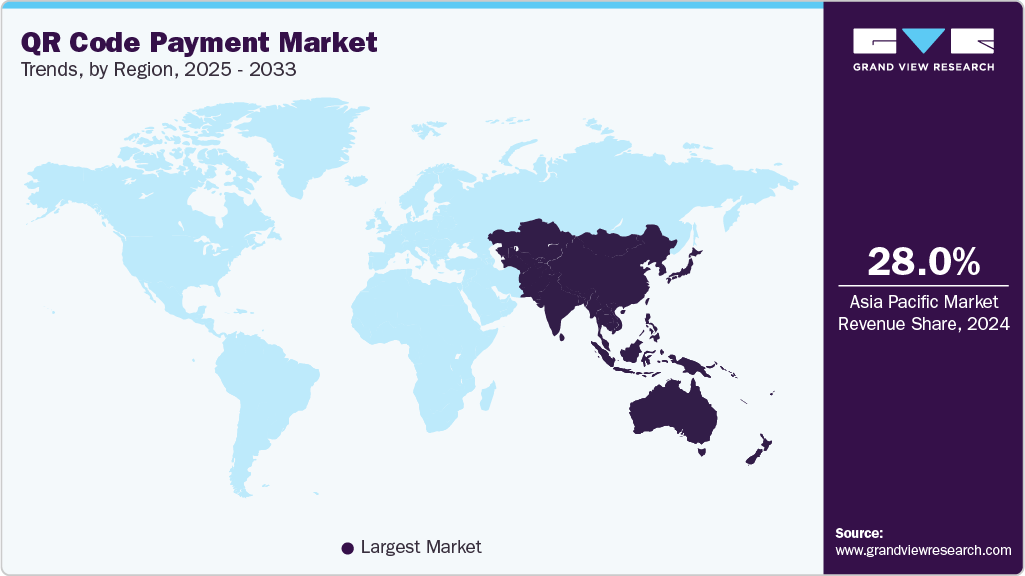
Asia Pacific dominated the global QR code payment market with the largest revenue share of 29.2% in 2025. The region's growth can be attributable to several factors, including a large and growing population, high smartphone penetration, and a significant unbanked population. The region has diverse economies, from highly developed countries such as Japan, Singapore, and South Korea, to emerging markets such as India, Indonesia, and Vietnam. In many of these markets, QR code payments have emerged as a popular and convenient payment option, particularly among younger and tech-savvy consumers who value speed, convenience, and security in their payment transactions.
 To learn more about this report, Download Free Sample Report
 China QR code payment held the largest revenue share in the Asia Pacific. The QR code payment market in China is driven by a combination of technological readiness, consumer behavior, and strong digital infrastructure. With over a billion smartphone users and widespread access to high-speed mobile internet, China provides the ideal environment for QR-based transactions. The country's leading digital platforms, Alipay and WeChat Pay, have seamlessly integrated QR payment functionality into their apps, making it a routine part of daily life, from shopping at malls to buying from street vendors.
India the QR code payment market in India has witnessed rapid growth, primarily driven by the widespread adoption of the Unified Payments Interface (UPI). QR codes have played a central role in this expansion, enabling seamless and contactless payments for both consumers and merchants. The simplicity of scanning a QR code to make a payment, combined with real-time transaction processing, has made it the preferred method for person-to-merchant (P2M) transactions. A key enabler of this growth is BharatQR, a unified and interoperable QR standard launched by the National Payments Corporation of India (NPCI) in collaboration with card networks like RuPay, Visa, and Mastercard. BharatQR allows users to pay across different platforms using a single standardized code, eliminating the need for separate POS terminals or proprietary codes.
Europe QR Code Payment Market Trends
The European Payments Initiative (EPI) introduced Wero, an innovative digital wallet that is changing the way people in Europe transact. Following a successful launch in Germany in July 2024, the solution is now available in France, with plans to expand across Europe by 2026-2027. Wero supports both in-person and online QR code payments and is built on SEPA instant transfer infrastructure. It aims to enhance cross-border payment efficiency, reduce dependence on global card networks, and strengthen Europe’s domestic payment ecosystem.
The Germany QR code payment market is expanding rapidly, fueled by the country's increasing shift toward digital payments and the growing preference for contactless transactions. Consumers and businesses alike are embracing QR codes for their convenience, speed, and cost-effectiveness, particularly in sectors like retail, food & beverage, and public transportation. The COVID-19 pandemic further accelerated adoption, as hygiene concerns pushed demand for touch-free payment methods.
Key QR Code Payment Company Insights
Some of the key players operating in the QR code payment market include PaymentCloud, Clover Network, LLC, Revolut Technologies Inc., Nearex Pte Ltd., ACI Worldwide, Ecentric Payment Systems, Block, Inc. (Square), UnionPay International, LINE Pay Corporation, PayPal, Inc. Market players in the QR code payment market are implementing various strategic initiatives to expand their market presence, enhance their product offerings, and improve customer experience. Moreover, the players are also investing in advanced technology and infrastructure to improve the efficiency and security of QR code payments, including using blockchain and biometric authentication. Furthermore, companies focus on improving user experience and accessibility with user-friendly interfaces, multilingual support, and easy integration with other payment systems. These strategic initiatives are helping market players stay ahead in the rapidly evolving QR code payments landscape.
-
PayPal Holdings, Inc. is a leading global fintech company headquartered in San Jose, California, offering a broad suite of digital payment solutions tailored for consumers and merchants worldwide. Its core platforms include PayPal, Venmo, Zettle, Braintree, Xoom, Hyperwallet, and Honey. As part of its omnichannel payment strategy, PayPal supports QR code payments through both the PayPal and Venmo apps, enabling users to make in-person purchases by scanning merchant QR codes or allowing merchants to scan user-generated codes. This solution is particularly popular with small businesses and service providers looking for low-cost, contactless payment options. The QR code feature is integrated with PayPal's transaction security, real-time notifications, and loyalty program compatibility.
-
PaymentCloud is a U.S.-based payment services provider that specializes in setting up merchant accounts for low-, medium-, and high-risk businesses, offering tailored solutions across in-person, online, and mobile channels. It serves as an aggregator, working with multiple acquiring banks and gateways to provide customized processing for clients who may struggle with traditional providers. PaymentCloud supports QR code payments through its integration with a range of leading POS hardware providers, including Clover, Verifone, Ingenico, and others. These hardware solutions are equipped with built-in QR scanning capabilities, enabling merchants to accept a wide variety of payment types quickly and securely. Using these devices, customers can make payments via digital wallets such as Apple Pay and Google Pay by scanning a QR code displayed on the terminal or printed on receipts.
Key QR Code Payment Companies:
The following key companies have been profiled for this study on the QR code payment market.
-
PaymentCloud
-
Clover Network, LLC
-
Revolut Technologies Inc.
-
Nearex Pte Ltd.
-
ACI Worldwide
-
Ecentric Payment Systems
-
Block, Inc. (Square)
-
UnionPay International
-
LINE Pay Corporation
-
PayPal, Inc.
Competitive Benchmarking
Category
Operating Strategies
Competitive Edge
Weakness
Established Players (ACI Worldwide, PayPal, Inc., UnionPay International)
- Focus on expanding digital payment ecosystems through continuous investments in QR code payment infrastructure, mobile wallet integration, real-time payment processing, fraud prevention technologies, and cross-border payment capabilities.
- Strong global or regional brand recognition, extensive merchant and consumer networks, robust payment processing infrastructure, advanced security and compliance capabilities, and the ability to support high transaction volumes.
- Higher operational and compliance costs due to extensive regulatory requirements across multiple jurisdictions.
Emerging Players (PaymentCloud, Nearex Pte Ltd.)
- Focus on agile and innovative payment solutions tailored to specific merchant segments and regional markets.
- Investments are directed toward cloud-based payment platforms, simplified merchant onboarding, value-added services, and customized QR code payment solutions for SMEs and niche industries.
- Greater flexibility, faster deployment timelines, and the ability to address niche market requirements with customized solutions.
- Limited geographic presence, smaller merchant and consumer bases, lower brand recognition, and fewer financial resources compared with established competitors.
Recent Developments
-
In May 2025, Revolut Technologies Inc. announced to establish its new Western European headquarters in Paris and would apply for a French banking license to support its regional growth. This move underscores Revolut's commitment to expanding its services in Europe, particularly in France, where it aims to offer enhanced financial products under local regulatory oversight. The Paris HQ will serve as a hub for operations across Western Europe, reinforcing Revolut's presence in the region. The banking license, once approved, will allow Revolut to provide more localized services, including deposit protection under French law, boosting customer trust and market competitiveness.
-
In December 2022, Matera, a Brazilian firm that provides QR code technology and instant payment solutions to financial institutions, launched its operations in the U.S. and established new headquarters in San Francisco. The expansion was driven by the quick adoption of Pix, an instant payment system developed by the Central Bank of Brazil. The move aims to expand Matera's international presence and keep up with the rapidly changing payments landscape.
QR Code Payment Market Report Scope
Report Attribute
Details
Market size in 2025
USD 14.3 billion
Estimated market size in 2026
USD 16.6 billion
Projected market size by 2033
USD 61.7 billion
Growth rate
CAGR of 20.7% from 2026 to 2033
Base year for estimation
2025
Historical data
2021 - 2024
Forecast period
2026 - 2033
Quantitative units
Revenue in USD million/billion and CAGR from 2026 to 2033
Report coverage
Revenue forecast, company ranking, competitive landscape, growth factors, and trends
Segments covered
Offering, payment type, transaction channel, end user, region
Regional scope
North America; Europe; Asia Pacific; Latin America; MEA
Country scope
U.S.; Canada; Mexico; U.K.; Germany; France; China; Japan; India; Australia; South Korea; Brazil; Saudi Arabia ; UAE; South Africa
Key companies profiled
PaymentCloud, Clover Network, LLC, Revolut Technologies Inc., Nearex Pte Ltd., ACI Worldwide, Ecentric Payment Systems, Block, Inc. (Square), UnionPay International, LINE Pay Corporation, PayPal, Inc.
Customization scope
Free report customization (equivalent up to 8 analysts' working days) with purchase. Addition or alteration to country, regional & segment scope.
Pricing and purchase options
Avail customized purchase options to meet your exact research needs. Explore purchase options
Global QR Code Payment Market Report Segmentation
The report forecasts revenue growth at global, regional, and country levels and provides an analysis of the latest industry trends in each of the sub-segments from 2021 to 2033. For this study, Grand View Research has segmented the global QR code payment market report based on offerings, solution, payment type, transaction channel, end-user, and region.
-
Offerings Outlook (Revenue, USD Million, 2021 - 2033)
-
Solution
-
Services
-
-
Solution Outlook (Revenue, USD Million, 2021 - 2033)
-
Static QR code
-
Dynamic QR code
-
-
Payment Type Outlook (Revenue, USD Million, 2021 - 2033)
-
Push Payment
-
Pull Payment
-
-
Transaction Channel Outlook (Revenue, USD Million, 2021 - 2033)
-
Face-to-Face
-
Remote
-
-
End-user Outlook (Revenue, USD Million, 2021 - 2033)
-
Restaurant
-
Retail & E-commerce
-
E-ticket Booking
-
Others
-
-
Regional Outlook (Revenue, USD Million, 2021 - 2033)
-
North America
-
U.S.
-
Canada
-
Mexico
-
-
Europe
-
UK
-
Germany
-
France
-
-
Asia Pacific
-
India
-
China
-
Japan
-
South Korea
-
Australia
-
-
Latin America
-
Brazil
-
-
Middle East & Africa
-
Kingdom of Saudi Arabia (KSA)
-
UAE
-
South Africa
-
-
Research Methodology
The QR code payment market figures in this report are based on a proven research process that combines executive interviews with secondary research from proprietary databases, company filings, and recognized regulatory and institutional sources. Market size is built through value-chain sizing - reconciling supply-side and demand-side estimates - and triangulated with bottom-up and top-down approaches. Every estimate passes multiple levels of expert validation before publication, with each QR code payment segment quantified using the revenue-capture definitions in the table below.
Segment Definition
Segment - Offering
Revenue capture definition
Solution
The solution segment of the QR code payment market comprises software platforms, payment processing systems, QR code generation tools, merchant payment acceptance applications, digital wallet integrations, and transaction management solutions that enable QR code-based payments. Revenue under this segment is captured through the sale, licensing, subscription, or usage-based fees associated with payment software and platforms deployed by banks, payment service providers, fintech companies, merchants, and digital wallet operators.
Services
The services segment includes professional and managed services that support the deployment, integration, operation, and optimization of QR code payment solutions. Revenue is captured from consulting, implementation, system integration, customization, training, technical support, maintenance, managed payment services, and merchant onboarding activities provided by payment technology vendors, fintech firms, and system integrators.
Segment - Payment Type
Revenue capture definition
Push Payment
Push payment is a QR code-based payment method in which the payer initiates and authorizes the transfer of funds directly from their bank account, mobile wallet, or payment application to the merchant or recipient.
Pull Payment
A pull payment is a QR code payment method in which the merchant or service provider initiates a payment request and, upon customer authorization, pulls the specified amount from the customer's linked payment account or digital wallet.
Segment - Transaction Channel
Revenue capture definition
Face-to-Face
Face-to-face transactions refer to QR code payments conducted in a physical setting where the payer and merchant are present at the same location during the transaction. In this channel, customers typically scan a merchant-displayed QR code using a mobile banking application or digital wallet, or merchants scan a customer-generated QR code to complete the payment.
Remote
Remote transactions refer to QR code payments completed without the payer and merchant being physically present at the same location. In this channel, QR codes are shared digitally through websites, mobile applications, emails, social media platforms, invoices, utility bills, or messaging applications, allowing customers to make payments from any location.
Segment - End Use
Revenue capture definition
Restaurant
The restaurant segment includes the use of QR code payment solutions across quick-service restaurants, cafés, food courts, fine-dining establishments, cloud kitchens, and other food service venues. QR codes facilitate seamless, contactless payments, enabling customers to pay directly from their smartphones by scanning codes displayed on tables, bills, menus, or payment counters
Retail & E-Commerce
The retail & e-commerce segment encompasses the adoption of QR code payments across physical retail stores, supermarkets, convenience stores, specialty outlets, online marketplaces, and e-commerce platforms. In physical retail environments, customers scan merchant-presented QR codes to complete purchases, while in e-commerce settings, QR codes can facilitate checkout and mobile payment authentication.
E-Ticket Booking
The e-ticket booking segment refers to the use of QR code payments to purchase tickets and make reservations on digital platforms. This includes transportation tickets, airline bookings, railway and metro tickets, bus services, movie tickets, concerts, sporting events, amusement parks, and other entertainment or travel-related bookings
Others
The others segment includes hospitals, government, and utility.
Estimation Model
Layer Name
Key Question
Description
Digital Payment Infrastructure & Ecosystem Layer
What is the total addressable market for QR code payments?
Evaluates the broader digital payments ecosystem including smartphone penetration, internet connectivity, banking infrastructure, digital wallet adoption, merchant digitization, and government-led cashless payment initiatives. This layer assesses the macroeconomic and technological factors influencing the adoption of QR code payments across developed and emerging economies and determines the overall addressable opportunity for QR-based transaction platforms.
QR Code Payment Adoption & Penetration Layer
What proportion of consumers and merchants utilize QR code payments?
Assesses the penetration of QR code payment solutions across consumers, merchants, financial institutions, and payment service providers. The analysis evaluates adoption by merchant size, industry vertical, transaction frequency, and geographic region. Key factors include mobile payment usage, contactless payment preferences, interoperability standards, financial inclusion initiatives, and merchant acceptance rates that influence market penetration.
Transaction Channel, Payment Type & End-Use Layer
Which transaction channels, payment types, and industries generate demand?
Analyzes demand across payment types such as push payments and pull payments, transaction channels including face-to-face and remote payments, and end-use sectors such as retail & e-commerce, restaurants, transportation, e-ticket booking, healthcare, hospitality, and utility payments. This layer evaluates transaction volumes, consumer behavior, merchant acceptance trends, and industry-specific digital payment requirements that drive QR code payment adoption.
Revenue Monetization Layer
How is market value generated?
Estimates market revenue through QR code payment solutions and associated services. Revenue streams include transaction processing fees, merchant discount rates, platform subscriptions, software licensing, QR code management solutions, payment gateway integration services, merchant onboarding, implementation, maintenance, analytics, fraud management, and value-added financial services. Revenue contributions are aggregated across banks, fintech companies, digital wallet providers, payment processors, merchant acquirers, and technology vendors operating within the QR code payment ecosystem.
Delivered Customizations
This report has been delivered with the following In-depth customizations
Client Request
Customization Delivered
Value Adds
Regional Adoption and Regulatory Landscape Review
Assessment of QR code payment adoption trends across North America, Europe, Asia Pacific, Latin America, and the Middle East & Africa. Analysis of government initiatives, digital payment regulations, interoperability frameworks, central bank policies, and national QR payment programs based on publicly available reports and regulatory publications.
Improved understanding of regional growth opportunities, regulatory environments, and market maturity levels. Supports expansion planning, risk assessment, and prioritization of target markets.
Competitive Landscape and Ecosystem Analysis
Benchmarking of major market participants based on company profiles, product offerings, QR payment capabilities, geographic presence, strategic partnerships, acquisitions, and recent developments. Analysis of payment ecosystem participants including payment service providers, digital wallet companies, banks, fintech firms, and payment networks using publicly available information.
Competitive intelligence for market positioning and differentiation strategies. Identification of partnership opportunities, competitive gaps, expansion strategies, and emerging market trends to support long-term business planning.
Merchant and Consumer Adoption Trends Analysis
Evaluation of merchant acceptance trends, consumer payment preferences, mobile wallet usage, contactless payment adoption, and digital transaction behavior using industry reports, company disclosures, and government statistics. Analysis segmented by merchant size, industry vertical, and region.
Insights into evolving customer behavior and merchant requirements. Supports product development, marketing strategies, customer acquisition planning, and demand forecasting.
Frequently Asked Questions About This Report
Asia Pacific dominant with a 29.2% market share in 2025.
The solutions segment lead with the 67.9% revenue share in 2025, while services segment is expected to grow at the fastest CAGR over the forecast period.
The push payment segment held the largest revenue share in 2025, while pull payment represents significant growing area.
The restaurant held the largest revenue share (28.0)% revenue share in 2025, while retail & e-commerce segment is expected to grow at fastest CAGR over the forecast period.
The increasing adoption of smartphones and the expansion of mobile internet connectivity are driving the growth of the QR code payment market.
The global QR code payment market size was estimated at USD 14.3 billion in 2025 and is expected to reach USD 16.6 billion in 2026.
The global QR code payments market is expected to grow at a compound annual growth rate of 20.7% from 2026 to 2033 to reach USD 61.7 billion by 2033.
Some key players operating in the QR code payment market include PaymentCloud, Clover Network, LLC, Revolut Technologies Inc., Nearex Pte Ltd., ACI Worldwide, Ecentric Payment Systems, Block, Inc. (Square), UnionPay International, LINE Pay Corporation, PayPal, Inc.
About the Author(s)
Next Generation Technologies Research Team
Technology · Next Generation TechnologiesThis report was authored by the next generation technologies research team at Grand View Research - comprising two research analysts, one senior research analyst, and one industry expert - with specialized expertise in the next generation technologies segment of the technology industry. All findings are based on proprietary technology databases, executive interviews, and regulatory analysis, subject to internal peer review prior to publication.
Last Updated:
Speak to Analyst

Customize this report to your needs - add regions, segments, or data points, with 20% free customization.
Or view our licence options:


ISO 9001:2015 & 27001:2022 Certified
We are GDPR and CCPA compliant! Your transaction & personal information is safe and secure. For more details, please read our privacy policy.


