
- Home
- »
- Next Generation Technologies
- »
-
Quantum Sensor Market Size, Growth Report, 2026-2033GVR Report cover

Quantum Sensor Market (2026 - 2033)
Size, Share & Trends Analysis Report By Product Type (Atomic Clocks, PAR Quantum Sensors), By Application (Healthcare, Automotive), By Region (Europe, Asia Pacific), And Segment Forecasts
Market Size, 2025
$900.0MMarket Estimate, 2026
$1,000.0MMarket Forecast, 2033
$1,700.0MCAGR, 2026–2033
7.6%Quantum Sensor Market Summary
The global quantum sensor market was valued at USD 900 million in 2025 and is projected to grow from USD 1,000 million in 2026 to USD 1,700 million in 2033, at a CAGR of 7.6% from 2026 to 2033. The Europe market dominated with a revenue share of approximately 35.0% in 2025. Quantum sensors are finding applications in emerging fields, such as autonomous vehicles, virtual reality, augmented reality, and the Internet of Things (IoT).
Key Market Trends & Insights
- By product type: The atomic clocks segment dominated the market in 2025 with a revenue share of over 35.0%.
- By application: The healthcare segment dominated the market in 2025 with a revenue share of around 35.0%.
Regional Insights
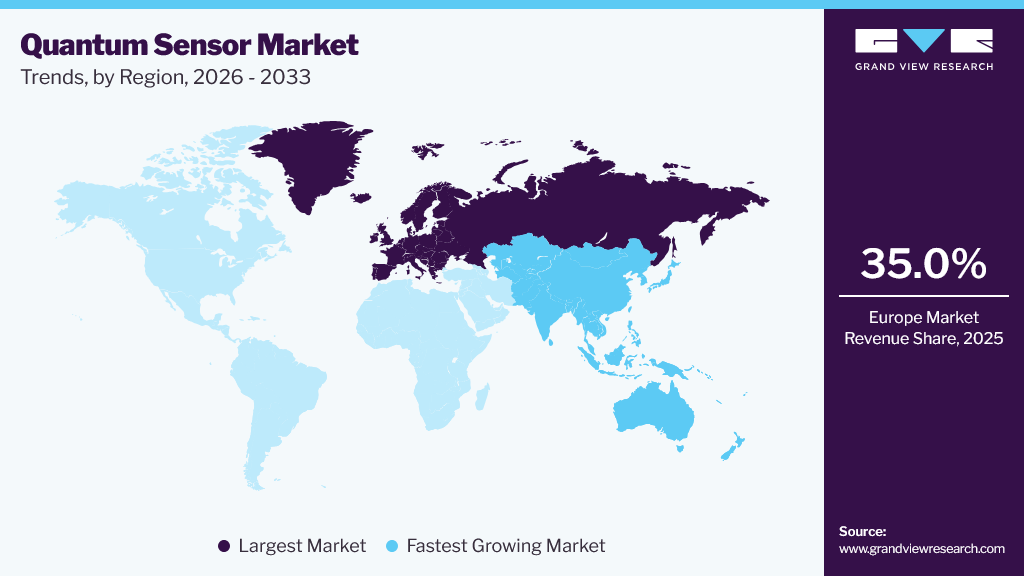
- Largest regional market: Europe (Approximately 35.0% revenue share, 2025)
- Fastest-growing regional market: Asia Pacific (highest CAGR, 2026-2033)
Market Size & Forecast
- Market size in 2025: USD 900 Million
- Estimated market size in 2026: USD 1,000 Million
- Projected market size by 2033: USD 1,700 Million
- CAGR (2026-2033): 7.6%
Three ways to get this report
Buy it, customize it, or ask a question.Ask an Analyst
Analyst response in 1 business day
- AccessReport author, directly
- Reply timeWithin 1 working day
- No sales callDirect answer only
- FormatEmail reply
- CostFree, no cost
Get the Full Report
What the study covers
- FormatsPDF · Excel · Dashboard
- Timeline2026–2033 annual, 2025 base
- Coverage20+ countries, 5 regions
- Companies10+ key players profiled
Customize the Report
20% free customization
- IncludeCountries, segments, points
- TailorTo your product definition
- ExtendDeeper competitor detail
- OrA fully bespoke study
- Turnaround5–10 working days
Quantum sensors can be used for precise positioning and navigation in autonomous vehicles or to create more immersive virtual reality experiences. The expanding application areas, including defense, healthcare, aerospace, and research, open new market opportunities and drive the growth of the quantum sensor industry. For instance, in August 2025, the U.S. Defense Advanced Research Projects Agency (DARPA) launched the first phase of its Robust Quantum Sensors (RoQS) program to develop field-ready quantum sensing technologies capable of operating beyond laboratory environments. The program focuses on developing compact, reliable quantum sensors for applications such as navigation, positioning, threat detection, and situational awareness across ground, air, sea, and space platforms, showcasing the growing adoption of quantum sensors in defense, transportation, and advanced technology.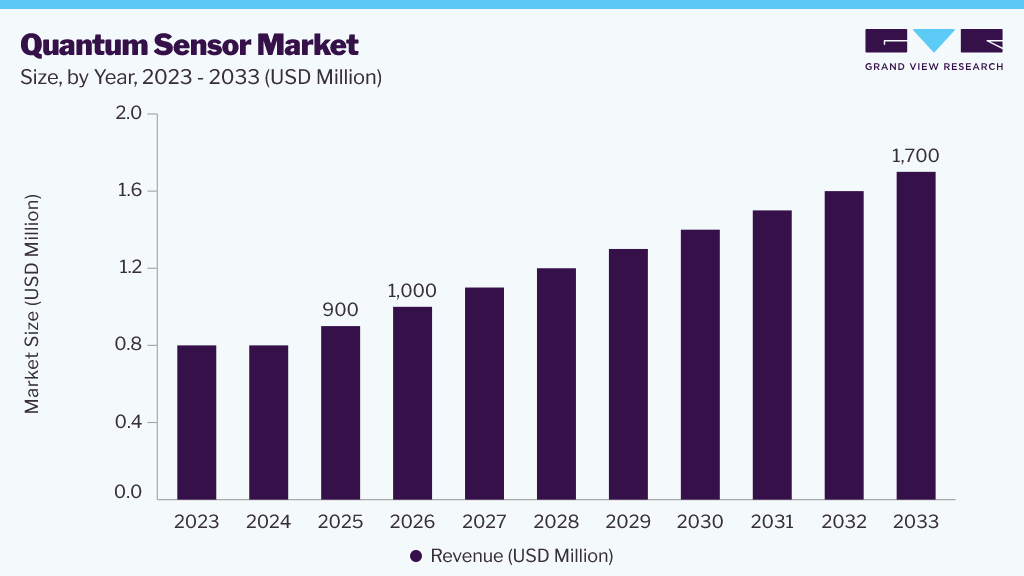 Source: Grand View Research, IR Documents, Primary Interviews, Paid DatabasesTo learn more about this report,
 Download Free Sample Report
 There is a growing trend towards miniaturization and integration of quantum sensors. As technology advances, researchers and manufacturers are developing compact, portable quantum sensors that can be easily integrated into existing systems or used as standalone devices. Miniaturization enables broader applications, increased accessibility, and cost reduction. Moreover, quantum sensors play a crucial role in quantum communication and cryptography. Quantum Key Distribution (QKD) systems rely on quantum sensors to detect and measure quantum states for secure communication.
As the demand for secure communication continues to grow, quantum sensors will be in high demand to support quantum encryption technologies. Governments and private investors are investing significantly in quantum technology research and development. These investments support market growth by fostering innovation, improving infrastructure, and promoting the commercialization of quantum technologies. For instance, in November 2025, the U.S. Department of Energy (DOE) announced USD 625 million in funding to renew its five National Quantum Information Science (QIS) Research Centers, supporting advanced research and development in quantum technologies. The initiative aims to accelerate innovation across quantum computing, communication, sensing, and related applications by strengthening research infrastructure and promoting the commercialization of quantum technologies.
Analyst Perspective
The quantum sensors market is growing due to rising demand for highly accurate sensing solutions. Key applications include defense, aerospace, healthcare, navigation, and scientific research. Governments, research institutions, and companies are increasing investments in quantum technology. Quantum sensors offer opportunities in precision navigation, autonomous systems, secure communication, and medical imaging. However, high development costs, complex manufacturing, and limited commercialization remain key challenges. Advancements in quantum research, sensor miniaturization, and government funding are expected to support growth. Companies expanding production and developing practical applications are well positioned for long-term market opportunities.
Product Type Insights
The atomic clocks segment dominated the market in 2025, accounting for over 35.0% of revenue. Atomic clocks are highly precise devices that measure time based on the oscillations of atoms, typically using the vibrations of atoms within a cesium or rubidium gas. These clocks have numerous applications, including satellite navigation systems, telecommunications, scientific research, and financial transactions. Atomic clocks have historically been a significant revenue generator in the market due to their crucial role in various industries. The increasing demand for precise timekeeping and synchronization in critical applications has contributed to the growth of atomic clocks. For instance, in July 2025, the U.S. National Institute of Standards and Technology (NIST) announced that its ion-based atomic clock achieved a new record as the world’s most accurate clock. The aluminum-ion quantum logic clock demonstrated accuracy up to the 19th decimal place, advancing precision timekeeping and supporting future applications in satellite navigation, telecommunications, scientific research, and advanced synchronization systems.
The Photosynthetically Active Radiation (PAR) quantum sensors segment is expected to grow with the fastest CAGR during the forecast years. Controlled environment agriculture, such as vertical farming and greenhouse cultivation, is gaining traction to enhance crop production efficiency and address food security challenges. As controlled-environment agriculture expands, the demand for PAR quantum sensors is likely to increase. PAR quantum sensors are specialized sensors used to measure the quantity and quality of light in the spectral range plants use for photosynthesis. These sensors are crucial in various fields, including agriculture, horticulture, and ecological research, where understanding and optimizing light conditions are essential for plant growth and productivity. For instance, in June 2025, Signify expanded its smart horticulture lighting solutions for controlled-environment agriculture, focusing on precision lighting strategies to optimize plant growth in greenhouses and indoor farms. The adoption of advanced lighting management systems in such cases increases the need for accurate light measurement tools, including PAR quantum sensors, to monitor photosynthetically active radiation and improve crop yield and resource efficiency.
Application Insights
The healthcare segment dominated the market in 2025, accounting for around 35.0% of revenue. The ongoing technological advancements in quantum sensors are expected to drive further innovation and adoption in healthcare, leading to improved diagnostics, treatment, and patient care. For instance, quantum sensors play a crucial role in MRI technology. Superconducting Quantum Interference Devices (SQUIDs), a type of quantum sensor, are used to detect and measure the weak magnetic fields generated by the body's tissues. This enables the creation of detailed, high-resolution images for the diagnosis and monitoring of various medical conditions.
Quantum sensors, such as magnetometers based on atomic or superconducting technologies, can be employed as highly sensitive magnetic field sensors in automotive applications. These sensors can detect and measure the Earth's magnetic field or magnetic fields generated by nearby objects, enabling applications such as compasses, detection of metallic objects, and collision-avoidance systems. Moreover, these sensors can contribute to environmental monitoring in vehicles. For example, quantum sensors can detect and measure air pollutants, including Nitrogen Oxides (NOx) and volatile organic compounds (VOCs). Integrating these sensors into vehicles can provide real-time air quality data, enabling more effective pollution control and improved passenger health and safety.
Regional Insights
The Europe dominated the market with a revenue share of around 35.0% in 2025. Europe has shown significant interest and investment in quantum technology, including quantum sensors. The European Union’s Quantum Flagship program aims to position Europe as a global leader in quantum technologies. For instance, in March 2025, the European Quantum Industry Consortium (QuIC) released its recommendations for the EU Quantum Strategy, highlighting the need to strengthen Europe’s quantum ecosystem through increased investment, industrial collaboration, infrastructure development, and commercialization of quantum technologies. The recommendations emphasize advancing key quantum fields, including quantum sensing, by improving research-to-market pathways and supporting collaboration between industry, academia, and policymakers, reinforcing Europe’s focus on becoming a global leader in quantum technologies.
 To learn more about this report, Download Free Sample Report
 Asia Pacific Quantum Sensor Market Trends
The Asia Pacific region has seen considerable growth in the market. Countries like China, Japan, and South Korea have invested substantially in quantum research and development. China has been actively promoting quantum technologies. For instance, the Chinese government launched the Quantum Science Satellite (QSS), also known as Micius, a satellite mission focused on quantum communication and experiments in quantum science. The main objective of the QSS mission is to enable long-distance quantum communication using quantum entanglement. In January 2025, researchers at Tohoku University in Japan advanced quantum network technologies by exploring their applications in high-precision scientific measurements, including searches for dark matter using quantum sensing approaches. The development highlights the growing capabilities of quantum networks and quantum technologies in Asia, supporting broader applications of quantum sensing, communication, and advanced research while strengthening the region’s position in the global quantum technology landscape.
North America Quantum Sensor Market Trends
The North America benefits from a strong presence of research institutions, universities, and technology companies focused on quantum technologies. Government initiatives, such as the U.S.-based National Quantum Initiative Act, have supported research and development in quantum technologies. The region has witnessed collaborations among academia, industry, and government organizations to advance quantum sensor applications across sectors such as defense, aerospace, and healthcare. For instance, in March 2025, the Natural Sciences and Engineering Research Council of Canada (NSERC) and the National Research Council of Canada (NRC) announced more than USD 11 million in funding for six collaborative research projects focused on advancing the industrial readiness of quantum sensing technologies. The initiative brings together Canadian universities, industry partners, and research organizations to accelerate the development and commercialization of quantum sensors, strengthening North America’s quantum technology ecosystem across applications such as defense, healthcare, and advanced research.
Key Quantum Sensor Market Companies Insights
The industry is characterized by intense competition, with a few major global competitors holding significant market share. The major focus is on developing new products and collaborating among the key players. For instance, in April 2025, Q-CTRL announced that its quantum sensing-based navigation technology, Ironstone Opal, successfully demonstrated GPS-denied navigation capabilities through real-world ground and airborne trials. The system uses quantum sensors to detect subtle magnetic signals from the Earth, enabling precise positioning without reliance on GPS and highlighting the growing commercialization of quantum sensors for defense, aerospace, autonomous systems, and critical navigation applications.
Key Quantum Sensor Companies
The following key companies have been profiled for this study on the quantum sensor market.
-
Q-CTRL
-
Infleqtion, Inc.
-
IonQ, Inc.
-
SandboxAQ
-
Honeywell International Inc.
-
AOSense, Inc.
-
Exail Technologies
-
ID Quantique SA
-
Qnami AG
-
SBQuantum
Recent Developments
-
In September 2025, IonQ announced an agreement to acquire Vector Atomic, a developer of advanced quantum sensing technologies for positioning, navigation, and timing (PNT) applications. The acquisition expanded IonQ’s presence in the quantum sensing space by adding capabilities such as optical atomic clocks, gravimeters, and inertial sensors, supporting applications across defense, navigation, and critical infrastructure sectors.
-
In August 2025, Q-CTRL was selected by the U.S. Defense Advanced Research Projects Agency (DARPA) for the Robust Quantum Sensors (RoQS) program to develop next-generation quantum sensing technologies. The initiative focused on advancing quantum-based navigation systems capable of operating in environments where GPS signals are degraded, denied, or jammed, accelerating the commercialization of practical quantum sensing solutions.
-
In July 2025, Honeywell was selected by the U.S. Department of Defense’s Defense Innovation Unit (DIU) to participate in the Transition of Quantum Sensing (TQS) program. The program supports the development of quantum sensor-enabled navigation technologies for alternative positioning, navigation, and timing (PNT) and intelligence, surveillance, and reconnaissance (ISR) applications, reflecting growing government investment in quantum sensing capabilities.
Quantum Sensor Market Report Scope
Report Attribute
Details
Market size in 2025
USD 900 million
Estimated market size in 2026
USD 1,000 million
Projected market size by 2033
USD 1,700 million
Growth rate
CAGR of 7.6% from 2026 to 2033
Base year for estimation
2025
Actual data
2021 - 2024
Forecast period
2026 - 2033
Quantitative units
Revenue in USD million, and CAGR from 2026 to 2033
Report coverage
Revenue forecast, company ranking, competitive landscape, growth factors, and trends
Segments covered
Product type, application, region
Regional Scope
North America; Europe; Asia Pacific; Latin America; MEA
Country Scope
U.S.; Canada; UK; Germany; France; China; Japan; India; South Korea; Australia; Brazil; Mexico; The Kingdom of Saudi Arabia (KSA); UAE; South Africa
Key companies profiled
Q-CTRL; Infleqtion, Inc.; IonQ, Inc.; SandboxAQ; Honeywell International Inc.; AOSense, Inc.; Exail Technologies; ID Quantique SA; Qnami AG; SBQuantum
Customization scope
Free report customization (equivalent up to 8 analysts working days) with purchase. Addition or alteration to country, regional & segment scope.
Pricing and purchase options
Avail of customized purchase options to meet your exact research needs. Explore purchase options
Global Quantum Sensor Market Report Segmentation
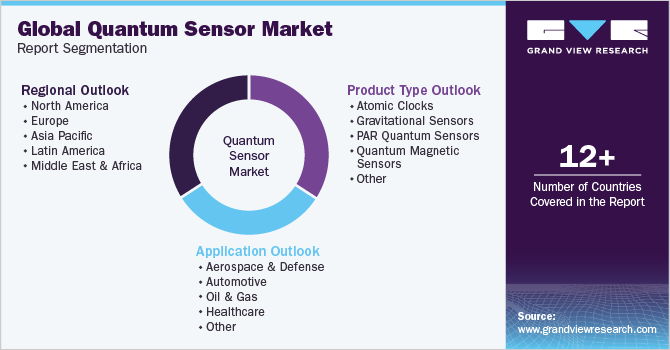
This report forecasts revenue growth and provides an analysis of the latest trends in each of the sub-segments from 2021 to 2033. For this report, Grand View Research has segmented the global quantum sensor market report based on product type, application, and region:
 To learn more about this report, Download Free Sample Report
 -
Product Type Outlook (Revenue, USD Million, 2021 - 2033)
-
Atomic Clocks
-
Gravitational Sensors
-
PAR Quantum Sensors
-
Quantum Magnetic Sensors
-
Other
-
-
Application Outlook (Revenue, USD Million, 2021 - 2033)
-
Aerospace & Defense
-
Automotive
-
Oil & Gas
-
Healthcare
-
Other
-
-
Regional Outlook (Revenue, USD Million, 2021 - 2033)
-
North America
-
U.S.
-
Canada
-
-
Europe
-
U.K.
-
Germany
-
France
-
-
Asia Pacific
-
China
-
Japan
-
India
-
South Korea
-
Australia
-
-
Latin America
-
Brazil
-
Mexico
-
-
Middle East & Africa
-
Kingdom of Saudi Arabia (KSA)
-
UAE
-
South Africa
-
-
Frequently Asked Questions About This Report
The global quantum sensor market size was valued at USD 900.0 million in 2025 and is estimated at USD 1,000.0 million for 2026.
The global quantum sensor market is expected to grow at a CAGR of 7.6% from 2026 to 2033, reaching USD 1,700.0 million.
Key players include Q-CTRL; Infleqtion, Inc.; IonQ, Inc.; SandboxAQ; Honeywell International Inc.; AOSense, Inc.; Exail Technologies; ID Quantique SA; Qnami AG; SBQuantum
Europe dominated with a 35.0% revenue share in 2025.
Atomic clocks segment dominated the quantum sensor market with a share of 35.0% in 2025, while healthcare segment is the fastest-growing segment.
About the Author(s)
Next Generation Technologies Research Team
Technology · Next Generation TechnologiesThis report was authored by the next generation technologies research team at Grand View Research - comprising two research analysts, one senior research analyst, and one industry expert - with specialized expertise in the next generation technologies segment of the technology industry. All findings are based on proprietary technology databases, executive interviews, and regulatory analysis, subject to internal peer review prior to publication.
Last Updated:
Speak to Analyst

Customize this report to your needs - add regions, segments, or data points, with 20% free customization.
Or view our licence options:


ISO 9001:2015 & 27001:2022 Certified
We are GDPR and CCPA compliant! Your transaction & personal information is safe and secure. For more details, please read our privacy policy.


