
- Home
- »
- Advanced Interior Materials
- »
-
Radiant Heating System Market Size Report, 2026-2033GVR Report cover

Radiant Heating System Market (2026 - 2033)
Size, Share & Trends Analysis Report By Product (Electric Systems, Hydronic (Water/Steam) Systems, Gas Systems), By Application (Commercial, Residential, Industrial), By Installation Surface, By Region, And Segment Forecasts
Market Size, 2025
$5.2BMarket Estimate, 2026
$5.4BMarket Forecast, 2033
$8.3BCAGR, 2026–2033
6.2%Radiant Heating System Market Summary
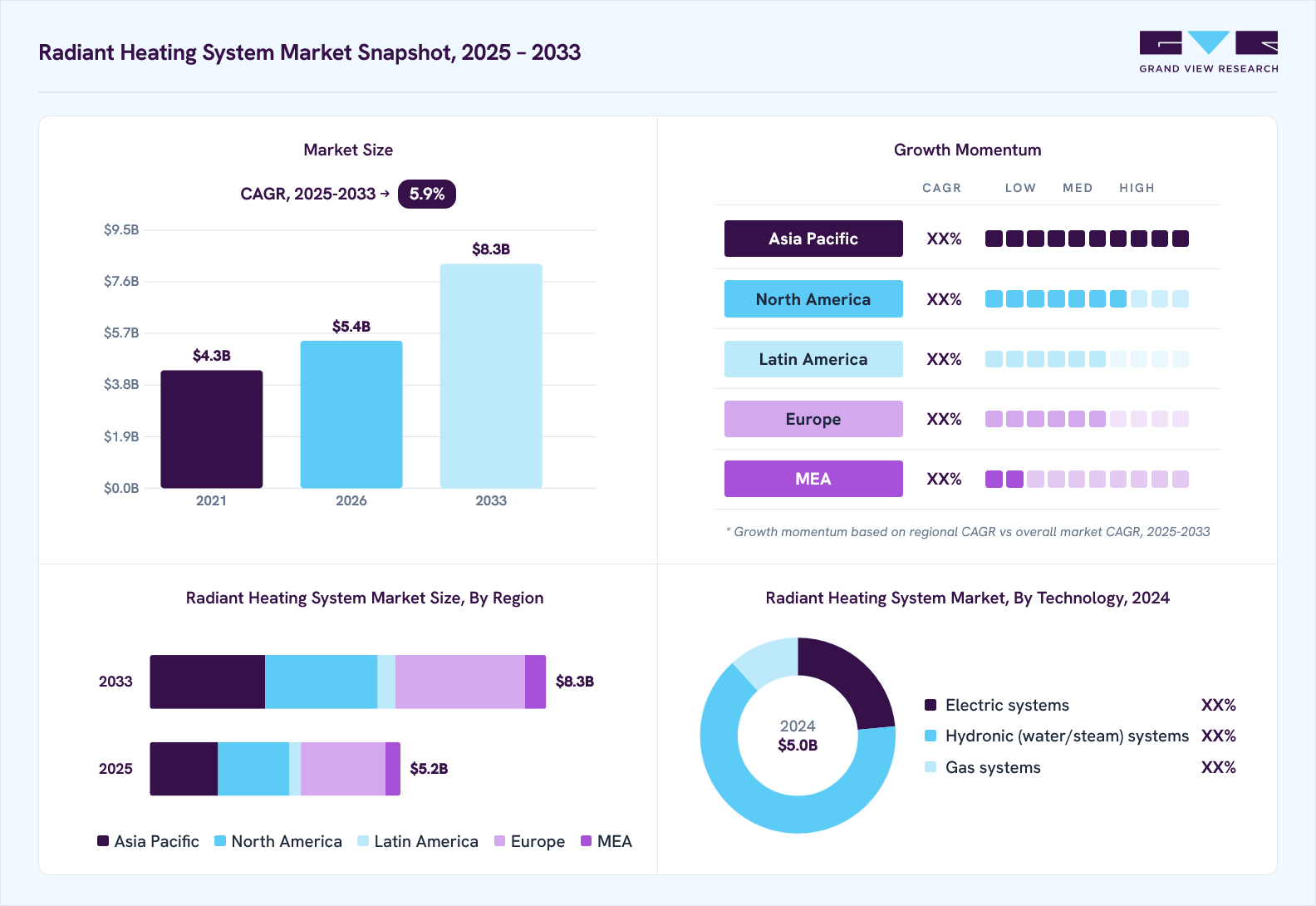
The global radiant heating system market size was valued at USD 5.2 billion in 2025 and is projected to grow from USD 5.4 billion in 2026 to USD 8.3 billion by 2033, at a CAGR of 6.2% from 2026 to 2033. Europe dominated the market, accounting for a revenue share of 33.7% in 2025. The global industry is primarily driven by mounting demand for energy-efficient and sustainable solutions in the residential, commercial, and industrial sectors.
 Source: Grand View Research, IR Documents, Primary Interviews, Paid DatabasesTo learn more about this report,
 Download Free Sample Report
 Key Market Trends & Insights
- By technology: Hydronic (water/steam) systems segment led the market with the largest revenue share of 65.0% in 2025.
- By application: Residential segment led the market with the largest revenue share of 55.1% in 2025.
- By installation surface: Floor segment led the market with the largest revenue share of 73.6% in 2025.
Regional Highlights
- Largest regional market: Europe (33.7% revenue share, 2025)
- By country: The Germany held the largest market share in 2025.
Market Size & Forecast
- Market size in 2025: USD 5.2 Billion
- Estimated market size in 2026: USD 5.4 Billion
- Projected market size by 2033: USD 8.3 Billion
- CAGR (2026-2033): 6.2%
GVR research-powered AIAsk Prism AI about the radiant heating system marketGet cited answers from GVR research on market growth, segments, regulations and forecasts.Start with✓ Source-linked answers ✓ Market-specific context ✓ Traceable figuresExplore Prism AI ↗
Buildings are increasingly viewed as focal points for energy savings, with radiant systems offering significant reductions in operational costs and carbon footprint through innovative heat transfer technologies. This drive for efficiency is amplified by heightened consumer awareness and regulatory mandates focused on sustainability, prompting both new constructions and renovations to integrate advanced radiant heating solutions in pursuit of greener certifications and reduced environmental impact.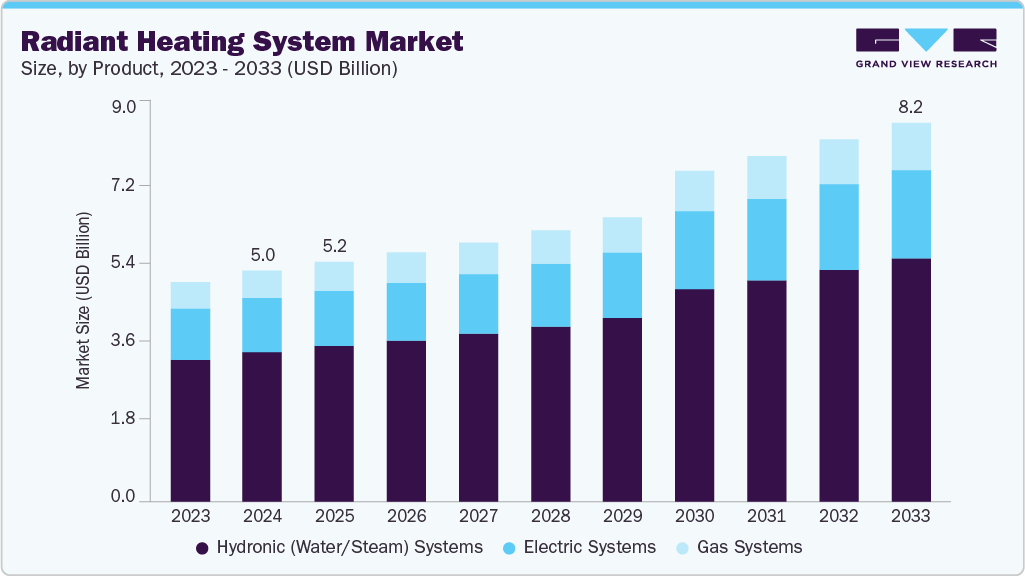 To learn more about this report, Download Free Sample Report
 Technological progress remains a key factor underpinning market expansion, with manufacturers investing heavily in product innovation and integration of smart thermostats, building management systems, and advanced materials for efficient heat exchange. These breakthroughs enable better energy management, remote monitoring, and flexible control, attracting consumers seeking enhanced automation and user experience. The proliferation of smart home solutions and the Internet of Things further drives the transition towards intelligent, interconnected radiant heating infrastructures.
Market Dynamics
The radiant heating system market is driven by the increasing emphasis on energy-efficient building solutions across residential, commercial, and industrial sectors. Growing construction of green buildings and stricter building energy performance standards are encouraging the adoption of radiant heating technologies. Demand is also supported by renovation projects aimed at improving indoor comfort and reducing long-term operating costs. Advancements in hydronic and electric radiant heating systems have enhanced installation flexibility, system reliability, and temperature control. The integration of smart controls and building automation systems is further improving operational efficiency. However, high upfront installation costs and retrofit complexities continue to limit adoption in existing buildings. Variations in regional construction activity and climate conditions also influence market demand. Increasing investments in sustainable infrastructure and low-carbon heating solutions are expanding application opportunities.
Growing emphasis on improving building energy efficiency is accelerating the adoption of radiant heating systems across residential, commercial, and institutional applications. These systems deliver uniform heat distribution while minimizing energy losses associated with forced-air heating. Stringent building energy codes and sustainability regulations are encouraging the use of high-efficiency heating solutions. Rising investments in green buildings and net-zero construction projects are further supporting market demand.
The installation of radiant heating systems requires higher upfront capital investment compared to conventional heating technologies. Retrofitting existing buildings often involves extensive floor modifications, increasing labor requirements and project costs. Longer installation timelines can also discourage adoption in renovation projects. Limited awareness and availability of skilled installers in certain regions further constrain market penetration.
Increasing investments in sustainable construction projects are creating favorable opportunities for radiant heating system manufacturers. The growing adoption of smart buildings is driving demand for heating systems that integrate with automated energy management platforms. Expansion of residential developments and commercial infrastructure is further supporting product deployment. Advances in hydronic and electric radiant heating technologies are broadening application areas across different building types.
Market Concentration & Characteristics
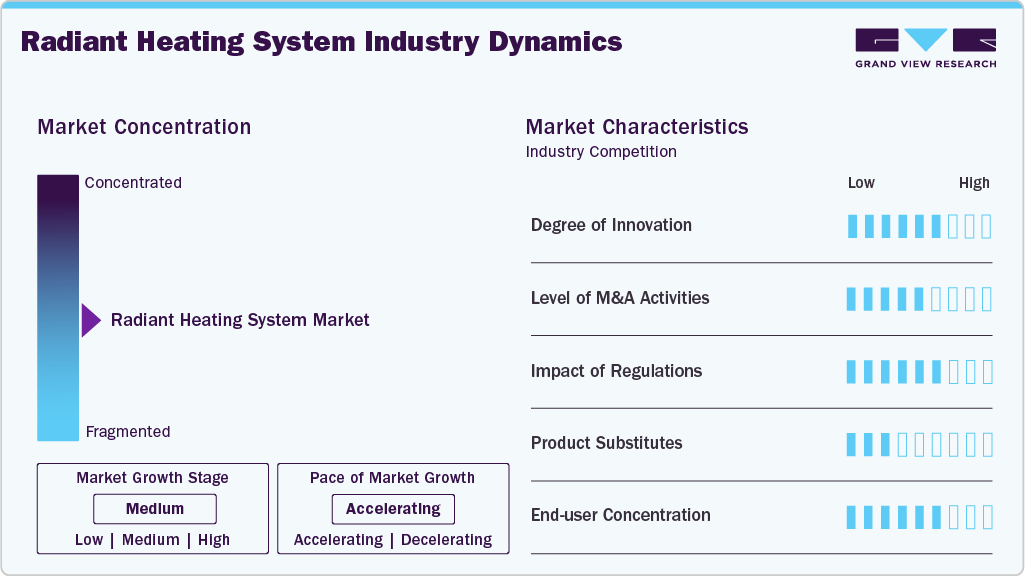
The global radiant heating system industry displays moderate concentration, with both established HVAC giants and innovative niche suppliers competing for market share. While hydronic technologies dominate larger commercial projects due to their energy efficiency, electric systems retain appeal for quick residential installations and retrofits. This mix provides healthy competition, encouraging continuous advancement in product offerings and system performance.
Technological developments are shaping the market’s direction, particularly through integration of smart control systems, IoT-enabled thermostats, advanced thermal storage, and new composite materials. These enhancements improve energy efficiency, installation flexibility, and system durability across different building types. Hybrid approaches that combine radiant heating with ventilation are also gaining traction, helping address diverse climate needs and offering improved air quality management for institutional and commercial applications.
 To learn more about this report, Download Free Sample Report
 Regulatory influence is pronounced, as governments worldwide increase pressure for greener building practices, greater energy efficiency, and reduced emissions. Standards for thermal comfort, energy usage, system safety, and even incentives for adoption of radiant technologies are driving market expansion, especially in new construction and institutional retrofits. Furthermore, product certification protocols and energy-saving mandates necessitate ongoing innovation and compliance from manufacturers.
Analyst Perspective
The global radiant heating system market is experiencing steady growth as building owners increasingly adopt energy-efficient heating solutions that provide improved thermal comfort and lower operating costs. Demand is expanding across residential, commercial, and industrial buildings, supported by new construction activity, building renovation projects, and stricter energy efficiency standards. Hydronic and electric radiant heating systems are gaining wider acceptance for their ability to deliver uniform heat distribution while reducing energy consumption compared with conventional forced-air systems. In addition, the integration of smart thermostats, zoned heating controls, and building automation technologies is improving system performance and user convenience. As governments continue to promote sustainable building practices and low-carbon heating technologies, manufacturers offering high-efficiency, application-specific radiant heating systems are well positioned to benefit from sustained long-term market growth.
Technology Insights
Based on technology, the hydronic (water/steam) systems segment led the market with the largest revenue share of 65.0% in 2025, due to its proven energy efficiency and versatility across residential, commercial, and industrial applications. These systems leverage water as a heat-transfer medium, which allows for consistent distribution of warmth and lower operating costs compared to forced air systems. Their adaptability to various building types, combined with their ability to integrate with renewable energy sources and smart controls, further underpins widespread adoption.
The gas systems segment is expected to grow at the fastest CAGR of 6.5% from 2025 to 2033.The gas radiant heating systems are favored in industrial and commercial applications due to their high heat output and efficiency, which meet the demands of large-scale spaces requiring consistent warmth. In addition, advancements in technologies for safer and cleaner-burning gas systems have enhanced their appeal amidst tightening environmental regulations. The segment also benefits from rising infrastructure development and industrialization in emerging economies, which creates significant demand for reliable and efficient heating solutions powered by gas.
Installation Surface Insights
Based on installation surface, the floor segment led the market with the largest revenue share of 73.6% in 2025, due to its high recycling rates, established collection systems, and economic viability. This dominance is largely due to the superior comfort and efficient heat distribution offered by floor radiant heating systems, which circulate heated water or electric elements beneath the floor surface to provide consistent, uniform warmth. Their seamless integration with various flooring materials and architectural designs makes them highly versatile for residential, commercial, and industrial applications.
 To learn more about this report, Download Free Sample Report
 The wall segment is expected to grow at the fastest CAGR of 5.7% during the forecast period. Radiant wall heating systems provide efficient heat distribution while maintaining aesthetic appeal, making them well-suited for both residential and commercial retrofits as well as new constructions. Advancements in materials and smart control technologies have enhanced their energy efficiency and user convenience, encouraging adoption.
Application Insights
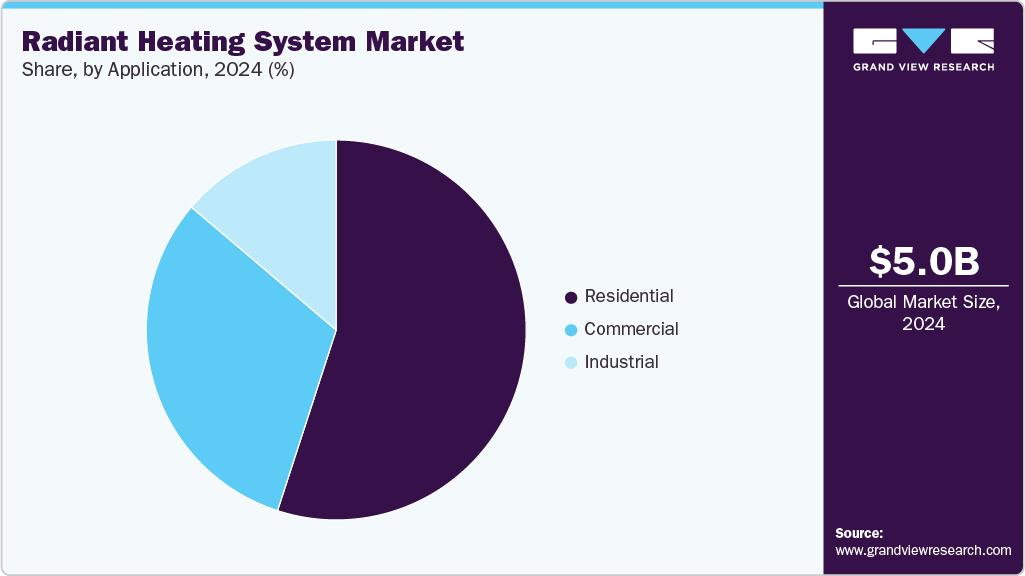
Based on application, the residential segment led the market with the largest revenue share of 55.1% in 2025. This is attributed to increased consumer focus on energy efficiency and thermal comfort in homes, as well as the rising trend of smart home automation incorporating advanced heating technologies. Residential radiant heating systems, particularly underfloor hydronic and electric types, are favored for their ability to provide consistent warmth and improved indoor air quality over traditional heating methods.
The industrial segment is expected to grow at the fastest CAGR of 6.4% during the forecast period. This growth is driven by the escalating need for energy-efficient heating solutions in large industrial spaces such as manufacturing plants, warehouses, and automotive facilities. Radiant heating systems offer superior heat distribution, reducing energy waste and improving operational efficiency, which aligns with increasing industrial sustainability goals.
Regional Insights
The North America radiant heating system market is experiencing steady growth, propelled by government initiatives promoting energy-efficient building technologies and strong consumer preference for smart, sustainable heating solutions. The region’s cold climate, especially in northern areas of the U.S. and Canada, drives demand for efficient and comfortable heating methods. Residential renovations and new constructions integrating radiant systems alongside smart home technologies contribute significantly to market expansion.
U.S. Radiant Heating System Market Trends
The radiant heating system market in the U.S. is growing steadily, fueled by increasing consumer preference for energy-efficient home heating solutions and supportive government initiatives promoting green building technologies. Continuous advancements in smart control systems and the integrating of renewable energy sources are further boosting adoption in residential and commercial sectors. Rising renovation activities in older housing stocks also contribute to market expansion.
The Mexico radiant heating system market is expanding rapidly due to urbanization, modernization of residential and commercial infrastructure, and rising awareness about sustainable heating options. Government incentives and growing construction activities are driving demand for energy-efficient radiant technologies, positioning Mexico as one of the fastest-growing markets in North America. The hydronic radiant heating segment is notably popular given its cost-effectiveness and efficiency.
Europe Radiant Heating System Market Trends
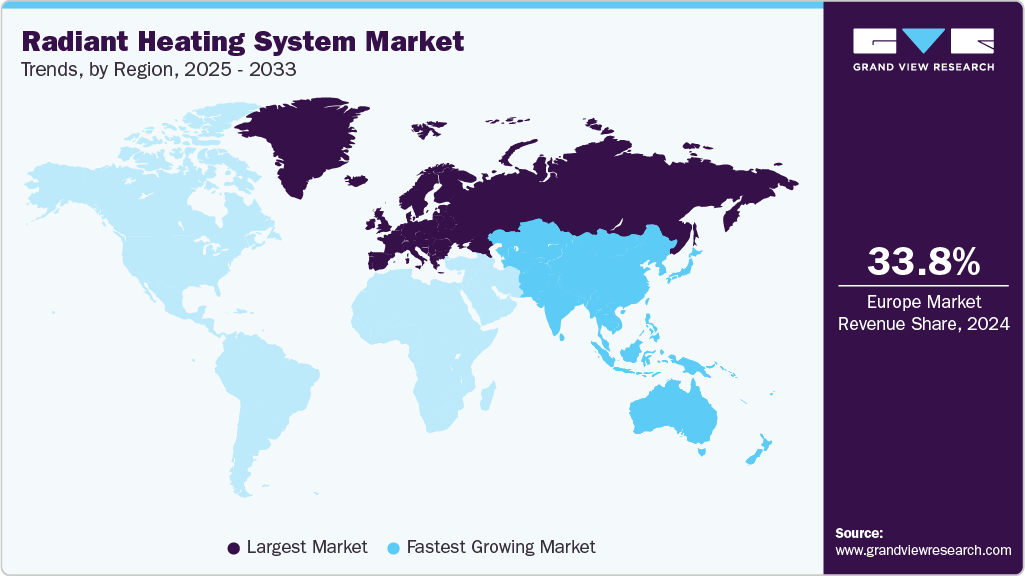
Europe dominated the radiant heating system market with the largest revenue share of 33.7% in 2025. The regional market is driven by stringent energy efficiency regulations and a widespread shift to sustainable construction practices. Countries like Germany, the UK, and the Nordic nations champion green building standards that favor radiant heating solutions for their low energy consumption and high indoor air quality benefits. Moreover, the market growth is bolstered by investments in retrofits of older buildings and new infrastructure projects, with moderate but consistent expansion expected due to mature market saturation.
 To learn more about this report, Download Free Sample Report
 The radiant heating system market in Germany held the largest share in the Europe region in 2025, with significant investments in energy-efficiency mandates and renewables integration, promoting widespread adoption. The country’s focus on reducing carbon emissions through regulations is encouraging extensive retrofit of buildings with advanced radiant systems.
The Italy radiant heating system market growth is driven by a rising inclination toward eco-conscious building practices and energy conservation. The country’s focus on modernizing historical buildings and implementing new energy codes enhances the adoption of radiant heating solutions. Growing awareness and government incentives for green building certifications further bolster the demand for innovative, energy-efficient radiant systems.
Asia Pacific Radiant Heating System Market Trends
The radiant heating system market in Asia Pacific is anticipated to grow at the fastest CAGR during the forecast period, fueled by burgeoning urbanization, rising disposable incomes, and robust construction activity. Emerging economies such as China, India, and Southeast Asian nations are increasingly adopting energy-efficient building solutions in both residential and commercial sectors. Supportive government policies and growing awareness about sustainability further accelerate demand, positioning the Asia Pacific as a key growth engine for the global market in the near term.
The India radiant heating system market is growing steadily due to rising urbanization, infrastructure development, and increased focus on sustainable building practices. Demand is particularly strong in commercial and premium residential sectors adopting hydronic and electric radiant heating solutions for enhanced comfort and energy savings.
The radiant heating system market in China continues to be a key market in the region, with rapid adoption of radiant heating systems supported by government policies encouraging green construction and energy conservation. Urban expansion and increased consumer preference for efficient, comfortable heating solutions fuel the market. Investments in smart home technology integration also propel growth.
Middle East & Africa Radiant Heating System Market Trends
The radiant heating system market in the Middle East & Africa is evolving primarily due to large-scale infrastructure projects and increasing investments in commercial and institutional buildings. The adoption of radiant heating in airports, hotels, and retail developments caters to the need for efficient climate control in harsh environmental conditions. Urbanization and rising construction activities, particularly in key Middle Eastern countries, boost demand for innovative and energy-efficient heating technologies.
The Saudi Arabia radiant heating system market is evolving, gaining momentum through government-led urban development and luxurious residential and commercial projects aligned with Vision 2030 goals. Demand for energy-efficient, high-comfort heating systems is rising, with radiant floor and wall heating becoming increasingly popular choices. Efforts to meet environmental standards further support market growth.
Latin America Radiant Heating System Market Trends
The radiant heating system market in Latin America is growing steadily, supported by rapid urbanization and increased real estate development, especially in Brazil, Mexico, and Argentina. The expansion of hospitality, commercial, and residential construction sectors is fueling demand for energy-efficient radiant heating solutions that improve occupant comfort. Rising disposable incomes and growing awareness around sustainable building practices further strengthen market prospects.
The Brazil radiant heating system market is witnessing steady growth, driven by increased building construction and renovations in urban areas. Growing awareness of energy efficiency and comfort benefits is gradually increasing penetration, supported by regional sustainability initiatives. Market development is ongoing despite some economic and climatic challenges.
Key Radiant Heating System Company Insight
Some of the key players operating in the market include Uponor North America and Rothe Werke GmbH.
-
Uponor North America is a manufacturer focused on plumbing, radiant heating/cooling, fire sprinkler, mechanical piping, and pre‑insulated piping systems, mainly using Cross-linked Polyethylene and PP‑RCT (Polypropylene Random Crystallinity Temperature-resistant) materials. It serves residential and commercial markets in new construction, retrofits, and remodels. Uponor emphasizes innovation, sustainability, and product development - more than 70% of its revenues come from products introduced into the North American market in the past 20 years.
-
ROTH Werke GmbH is a German family-owned company that produces energy systems, sanitary systems, plumbing, heating, cooling, and pipe systems, among other building technology products. It has a strong R&D tradition, over 70 years of experience, and emphasizes sustainability (e.g., green energy, environmentally friendly production) and system integration across energy generation, storage, and use. Its product range includes radiant heating/cooling systems, manifold systems, geothermal heat pumps, and plastic tanks, among.
Key Radiant Heating System Companies
The following key companies have been profiled for this study on the radiant heating system market.
-
Uponor North America
-
ROTH Werke
-
Warmup
-
ProWarm
-
Warmboard, Inc
-
REHAU
-
Watts
-
Radiant Systems, Inc
-
Valsir S.p.A.
-
ThermaRay
-
BlueRidge Company
-
Janes Radiant Heating
-
FloorHeat LLC
-
The Radiant Panel Company
-
ProLine Radiant
-
Reznor LLC
Competitive Benchmarking
Category
Operating Strategies
Competitive Edge
Weakness
Established Players (e.g., Uponor North America, REHAU, Watts, ROTH Werke, Warmup, Valsir S.p.A., Reznor LLC)
- Focus on expanding comprehensive radiant heating product portfolios across residential, commercial, and industrial applications.
Invest in energy-efficient technologies, smart heating controls, and strategic partnerships with contractors and distribution networks.
- Strong global manufacturing capabilities, established distribution channels, and recognized brand presence.
Broad product portfolios, proven product quality, and long-term relationships with builders, HVAC contractors, and project developers.
- High capital investment required for manufacturing, product innovation, and regulatory compliance.
Dependence on construction activity and fluctuations in raw material costs affecting profitability.
Emerging & Regional Players (e.g., ProWarm, Warmboard, Inc., Radiant Systems, Inc., ThermaRay, BlueRidge Company, Janes Radiant Heating, FloorHeat LLC, The Radiant Panel Company, ProLine Radiant)
- Focus on customized radiant heating solutions and niche applications for residential and light commercial projects.
Expand through regional distributor networks, installer partnerships, and customer-focused technical support.
- Greater flexibility in delivering application-specific solutions and responding to regional market requirements.
Faster product customization, specialized expertise, and strong relationships with local contractors and distributors.
- Limited manufacturing capacity and geographic presence compared to global competitors.
Lower financial resources and greater reliance on regional construction demand and distribution partners.
Recent Developments
-
In June 2025, Reznor introduced a new two-stage radiant tube heater designed to deliver enhanced energy efficiency and comfort through dual firing rates. The system automatically adjusts between high and low heat output depending on the environment’s heating needs, reducing energy waste while maintaining consistent warmth. Built with advanced ignition systems, improved reflector designs, and high-quality materials, this heater is ideal for large open spaces like warehouses and commercial facilities where targeted and cost-effective heating is essential.
-
In May 2025, Reznor launched the VZH radiant heater, which is specifically engineered for operation in harsh and corrosive environments, such as maintenance bays, outdoor applications, and parking structures. With durable stainless-steel construction, protective finishes, and resistance to contaminants, the VZH offers long-term reliability where standard radiant heaters may degrade. It includes flexible configuration options, integrated safety features, and service-friendly diagnostics, making it a strong solution for industrial and rugged-use applications requiring robust and consistent heating performance.
Radiant Heating System Market Report Scope
Report Attribute
Details
Market size in 2025
USD 5.2 billion
Estimated market size in 2026
USD 5.4 billion
Projected market size by 2033
USD 8.3 billion
Growth rate
CAGR of 6.2% from 2026 to 2033
Base year for estimation
2025
Historical data
2021 - 2024
Forecast period
2026 - 2033
Quantitative units
Revenue in USD billion and CAGR from 2026 to 2033
Report coverage
Revenue forecast, company ranking, competitive landscape, growth factors, and trends
Segments covered
Technology, application, installation surface, region.
Regional scope
North America; Europe; Asia Pacific; Latin America; Middle East & Africa
Country scope
U.S.; Canada; Mexico; UK; Germany; France; Spain; Italy; China; Japan; India; Australia; South Korea; Brazil; Argentina; Saudi Arabia; South Africa; UAE
Key companies profiled
Uponor North America; ROTH Werke; Warmup; ProWarm; Warmboard, Inc.; REHAU; Watts; Radiant Systems, Inc.; Valsir S.p.A.; ThermaRay; BlueRidge Company; Janes Radiant Heating; FloorHeat LLC; The Radiant Panel Company; Reznor LLC; ProLine Radiant.
Customization scope
Free report customization (equivalent up to 8 analysts' working days) with purchase. Addition or alteration to country, regional & segment scope.
Pricing and purchase options
Avail customized purchase options to meet your exact research needs. Explore purchase options
Global Radiant Heating System Market Report Segmentation
This report forecasts revenue growth at global, regional, and country levels and provides an analysis of the latest industry trends in each of the sub-segments from 2021 to 2033. For this study, Grand View Research has segmented the global radiant heating system market report based on technology, application, installation surface, and region.
 To learn more about this report, Download Free Sample Report
 -
Technology Outlook (Revenue, USD Million, 2021 - 2033)
-
Electric Systems
-
Hydronic (water/steam) Systems
-
Gas Systems
-
-
Application Outlook (Revenue, USD Million, 2021 - 2033)
-
Commercial
-
Residential
-
Industrial
-
-
Installation Surface Outlook (Revenue, USD Million, 2021 - 2033)
-
Floor
-
Wall
-
Ceiling
-
-
Regional Outlook (Revenue, USD Million, 2021 - 2033)
-
North America
-
U.S.
-
Canada
-
Mexico
-
-
Europe
-
Germany
-
France
-
Italy
-
Spain
-
UK
-
-
Asia Pacific
-
China
-
India
-
Japan
-
South Korea
-
Australia
-
-
Latin America
-
Brazil
-
Argentina
-
-
Middle East and Africa
-
Saudi Arabia
-
UAE
-
South Africa
-
-
Research Methodology
The radiant heating system market figures in this report are based on a proven research process that combines executive interviews with secondary research from proprietary databases, company filings, and recognized regulatory and institutional sources. Market size is built through value-chain sizing - reconciling supply-side and demand-side estimates - and triangulated with bottom-up and top-down approaches. Every estimate passes multiple levels of expert validation before publication, with each radiant heating system segment quantified using the revenue-capture definitions in the table below.
Segment Definition
Segment - Technology
Revenue Capture Definition
Electric Systems
Revenue generated from the sale and installation of electric radiant heating systems, including heating cables, mats, and panels used across residential, commercial, and industrial buildings.
Hydronic (Water/Steam) Systems
Revenue generated from the sale and installation of hydronic radiant heating systems that circulate heated water or steam through pipes integrated into building structures.
Gas Systems
Revenue generated from the sale and installation of gas-fired radiant heating systems powered by natural gas or propane for space heating applications.
Segment - Application
Revenue Capture Definition
Commercial
Revenue is generated from the sale and installation of radiant heating systems in offices, retail spaces, healthcare facilities, educational institutions, hospitality establishments, and other commercial buildings.
Residential
Revenue generated from the sale and installation of radiant heating systems in single-family homes, multi-family housing, apartments, and residential renovation projects.
Industrial
Revenue generated from the sale and installation of radiant heating systems in manufacturing plants, warehouses, logistics facilities, workshops, and other industrial buildings.
Segment - Installation Surface
Revenue Capture Definition
Floor
Revenue generated from the sale and installation of radiant heating systems integrated beneath flooring materials to provide uniform indoor heating.
Wall
Revenue generated from the sale and installation of radiant heating systems embedded within wall structures for space heating applications.
Ceiling
Revenue generated from the sale and installation of radiant heating systems installed within ceiling structures to deliver radiant heat across residential, commercial, and industrial facilities.
Estimation Model
Layer Name
Key Question
Description
Building Heating Demand Layer
Where are radiant heating systems required?
Analyze demand across residential, commercial, and industrial buildings. Assess heating requirements, new construction activity, renovation projects, climatic conditions, and the adoption of energy-efficient space heating solutions to establish the addressable market.
Technology Adoption Layer
Which radiant heating technologies are being adopted?
Evaluate adoption of electric, hydronic, and gas radiant heating systems based on energy efficiency, operating costs, building type, installation complexity, climate conditions, and regulatory requirements.
Application & Installation Surface Layer
Where are radiant heating systems being installed?
Segment demand by application (residential, commercial, and industrial) and installation surface (floor, wall, and ceiling). Assess deployment patterns across new construction and retrofit projects based on building design and heating performance requirements.
Revenue Generation Layer
How much market revenue is generated?
Estimate annual shipments of radiant heating systems by technology, application, installation surface, and region. Quantify revenues generated exclusively from the sale of new radiant heating systems. The scope excludes installation, maintenance, repairs, replacement components, controls, and aftermarket services.
Delivered Customizations
This report has been delivered with the following In-depth customizations
Client Request
Customization Delivered
Value Adds
Competitive Benchmarking
A competitive benchmarking analysis was conducted by evaluating leading radiant heating system manufacturers based on product portfolio, heating technologies, manufacturing capabilities, distribution network, strategic initiatives, innovation, and competitive positioning within the radiant heating system market.
This benchmarking enabled stakeholders to assess competitive strengths, identify product and technology differentiation opportunities, understand evolving market strategies, and develop informed competitive positioning and growth plans.
Regional Segmentation
A comprehensive regional analysis was provided across North America, Europe, Asia Pacific, Latin America, and the Middle East & Africa, highlighting regional demand trends, adoption of hydronic and electric radiant heating systems, construction activity, energy-efficiency regulations, and country-level market contributions.
The regional assessment helped stakeholders identify high-growth markets, optimize expansion strategies, allocate investments effectively, and align product offerings with regional building standards, climate conditions, and regulatory requirements.
Opportunity Assessment
A detailed opportunity assessment was conducted by evaluating growth in energy-efficient buildings, green construction initiatives, smart home integration, renovation activities, and advancements in hydronic and electric radiant heating technologies. The analysis identified high-growth opportunities across residential, commercial, and industrial applications.
This assessment enabled stakeholders to prioritize investment opportunities, align product development with evolving customer requirements, strengthen market penetration strategies, and capitalize on demand for sustainable, energy-efficient heating solutions across new construction and retrofit projects.
Frequently Asked Questions About This Report
Based on technology, the hydronic (water/steam) systems segment led the market with the largest revenue share of 65.0% in 2025.
Based on application, the residential segment led the market with the largest revenue share of 55.1% in 2025.
Based on installation surface, the floor segment led the market with the largest revenue share of 73.6% in 2025.
Wall is expected to register the highest CAGR of 5.7% during the forecast period (2026–2033).
The Europe radiant heating system market dominated the market in 2025, accounting for a 33.7% share supported by strict energy efficiency regulations, increasing renovation of older building stock, and expanding adoption of sustainable building standards. Forecasts show considerable growth over the next several years as governments push green building practices and retrofitting.
The global radiant heating system market size was valued at USD 5.2 billion in 2025 and is projected to grow from USD 5.4 billion in 2026.
The global radiant heating system market is expected to grow at a CAGR of 6.2% from 2026 to 2033, reaching USD 8.3 billion by 2033.
The global radiant heating system market is driven by increasing demand for energy-efficient and cost-effective heating solutions, especially in residential and commercial buildings. Growing emphasis on sustainable construction and rising adoption of smart home technologies also fuel market growth.
Some of the key players operating in the global radiant heating system market include Uponor North America, ROTH Werke, Warmup, ProWarm, Warmboard, Inc, REHAU, Watts, Radiant Systems, Inc, Valsir S.p.A., ThermaRay, BlueRidge Company, Janes Radiant Heating, FloorHeat LLC, The Radiant Panel Company, Reznor LLC, and ProLine Radiant.
About the Author(s)
Advanced Interior Materials Research Team
Advanced Materials · Advanced Interior MaterialsThis report was authored by the advanced interior materials research team at Grand View Research - comprising two research analysts, one senior research analyst, and one industry expert - with specialized expertise in the advanced interior materials segment of the advanced materials industry. All findings are based on proprietary advanced materials databases, executive interviews, and regulatory analysis, subject to internal peer review prior to publication.
Last Updated:
Speak to Analyst

Customize this report to your needs - add regions, segments, or data points, with 20% free customization.
Or view our licence options:


ISO 9001:2015 & 27001:2022 Certified
We are GDPR and CCPA compliant! Your transaction & personal information is safe and secure. For more details, please read our privacy policy.


