
- Home
- »
- Biotechnology
- »
-
Recombinant DNA Technology Market Size Report, 2033GVR Report cover

Recombinant DNA Technology Market (2026 - 2033)
Size, Share & Trends Analysis Report By Product (Medical, Non-medical), By Component (Expression System, Cloning Vector), By Application, By End-use, And Segment Forecasts
Market Size, 2025
$834.9BMarket Estimate, 2026
$880.1BMarket Forecast, 2033
$1,248.8BCAGR, 2026–2033
5.4%Recombinant DNA Technology Market Summary
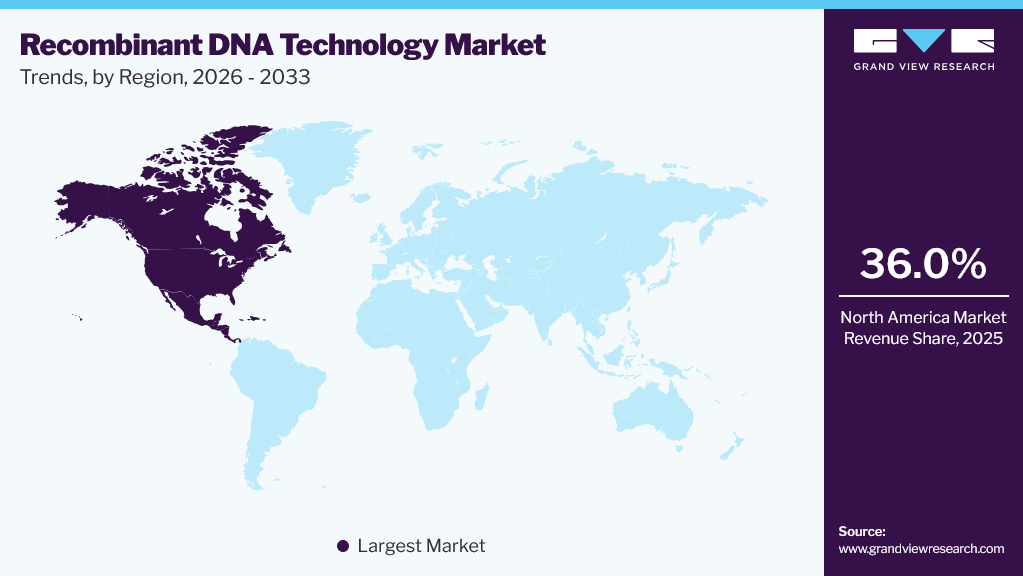
The global recombinant DNA technology market size was valued at USD 834.9 billion in 2025 and is projected to grow from USD 880.1 billion in 2026 to USD 1,248.8 billion by 2033, at a CAGR of 5.4% from 2026 to 2033. North America dominated the market, accounting for the largest revenue share of 36.0% in 2025. The increasing use of genetic engineering in the healthcare, agriculture, and biotechnology industries is the key market driver, driving market growth.
Key Market Trends & Insights
- By product: Medical products dominated the market, with a revenue share of about 54.0% in 2025.
- By component: Cloning vectors dominated the market, with a revenue share of about 59.0% in 2025.
- By application: Health & diseases segment dominated the market, with a revenue share of about 36.0% in 2025.
- By end use: Biotechnology and pharmaceutical segment dominated the market, with a revenue share of about 49.0% in 2025.
Regional Highlights
- Largest regional market: North America (36.0% revenue share, 2025)
- By country: The U.S. dominated the North America market in 2025.
Market Size & Forecast
- Market size in 2025: USD 834.9 Billion
- Estimated market size in 2026: USD 880.1 Billion
- Projected market size by 2033: USD 1,248.8 Billion
- CAGR (2026-2033): 5.4%
Three ways to get this report
Buy it, customize it, or ask a question.Ask an Analyst
Analyst response in 1 business day
- AccessReport author, directly
- Reply timeWithin 1 working day
- No sales callDirect answer only
- FormatEmail reply
- CostFree, no cost
Get the Full Report
What the study covers
- FormatsPDF · Excel · Dashboard
- Timeline2026–2033 annual, 2025 base
- Coverage20+ countries, 5 regions
- Companies10+ key players profiled
Customize the Report
20% free customization
- IncludeCountries, segments, points
- TailorTo your product definition
- ExtendDeeper competitor detail
- OrA fully bespoke study
- Turnaround5–10 working days
Recombinant DNA technology (RDT) is essential for enhancing healthcare by enabling the development of new vaccines and drugs. The demand for RDT is increasing due to the growing need for protein therapeutics and monoclonal antibodies. RDT has revolutionized biological research and has become a vital tool for modifying and enhancing genetic traits in living organisms. The growth of recombinant DNA technology is driven by its expanding applications across healthcare, agriculture, industrial biotechnology, and life sciences research. One of the key drivers is the increasing demand for effective biologics, recombinant therapeutics, vaccines, biosimilars, and gene therapies to address chronic, infectious, and genetic diseases. Continuous advancements in genetic engineering, protein expression, and molecular biology are further accelerating the development of recombinant DNA-based products.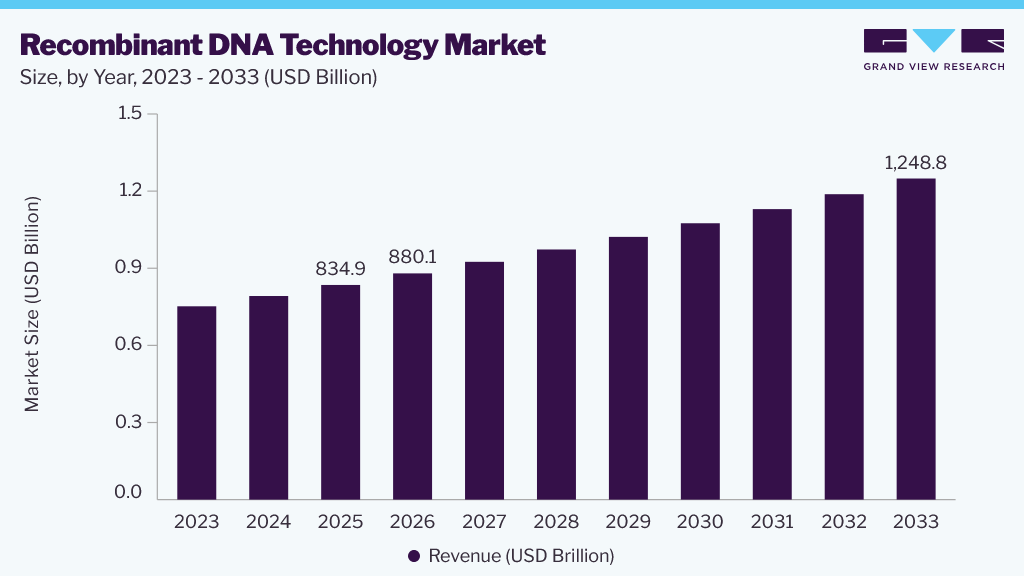 Source: Grand View Research, IR Documents, Primary Interviews, Paid DatabasesTo learn more about this report,
 Download Free Sample Report
The technology's ability to produce therapeutic proteins, hormones, enzymes, vaccines, and other biologics has significantly contributed to its widespread adoption. For instance, the commercial production of recombinant human insulin has transformed diabetes management and remains one of the most successful applications of recombinant DNA technology.
In addition, rapid urbanization, global population growth, declining arable land, and rising food security concerns have accelerated the development of genetically modified crops with improved yield, pest resistance, disease tolerance, and enhanced nutritional value. Recombinant DNA technology is also enabling the development of genetically engineered microorganisms for bioremediation, industrial enzyme production, and biofuel manufacturing, expanding its applications beyond healthcare.
Market growth is further supported by advances in molecular diagnostics, recombinant vaccines, precision medicine, and next-generation therapeutic approaches. The increasing adoption of recombinant DNA technology in agriculture has enabled the development of climate-resilient crops and more sustainable farming practices while reducing dependence on chemical pesticides and fertilizers. Furthermore, rising investments in biotechnology research, synthetic biology, genome editing, and large-scale biomanufacturing, coupled with supportive regulatory initiatives and strategic collaborations between academic institutions, biotechnology companies, and pharmaceutical manufacturers, are expected to drive continued innovation and commercialization of recombinant DNA-based products throughout the forecast period.
Analyst Perspective
The recombinant DNA technology industry is expected to grow steadily, driven by expanding applications in healthcare, agriculture, industrial biotechnology, and life sciences research. Rising demand for recombinant therapeutics, vaccines, monoclonal antibodies, biosimilars, and gene therapies is supporting market growth. Advances in gene editing, synthetic biology, protein expression systems, and biomanufacturing are improving production efficiency and product quality. Increasing investments in biotechnology research, precision medicine, and cell and gene therapy are further accelerating innovation. Supportive regulatory initiatives, public-private collaborations, and outsourcing of biologics manufacturing are also contributing to market expansion. In addition, the growing use of recombinant DNA technology in agriculture, industrial enzymes, and sustainable bioprocesses is creating new opportunities. Overall, continuous technological advancements and expanding end-use applications are expected to drive long-term market growth.
Product Insights
The medical products segment led the market with the largest revenue share of 54.0% in 2025. The technology has revolutionized medicine and has significantly impacted patient treatment. It has improved the treatment of illness by enabling the replacement of diseased or damaged genes with healthy ones. There has been an increase in the need for different genetically engineered products used for healthcare or clinical reasons. For instance, in September 2024, the U.S. Food and Drug Administration (FDA) approved PAVBLU (aflibercept-ayyh), Amgen's recombinant biologic biosimilar for multiple retinal diseases. The approval highlights the expanding commercialization of recombinant DNA-derived biologics and biosimilars for the treatment of complex diseases.
The non-medical segment is expected to grow at the fastest CAGR during the forecast period. The segment includes biotechnology crops and specialty chemicals, in which recombinant DNA technology is extensively used to develop genetically engineered crops with improved yield, pest resistance, disease tolerance, and tolerance to environmental stress. Growing adoption of genome editing and agricultural biotechnology is expected to further drive market expansion. In addition, recombinant DNA technology is increasingly used in industrial biotechnology the produce enzymes, bio-based chemicals, and sustainable bioproducts. Countries including the U.S., Canada, Brazil, Argentina, and India continue to be major adopters of biotechnology crops, supporting the growth of the non-medical segment.
Component Insights
The cloning vectors segment led the market with the largest revenue share of 59.0% in 2025. Worldwide segment growth is attributable to its critical role in cloning and expressing foreign genetic material. Versatile cloning vectors, such as plasmids, viruses, and artificial chromosomes, facilitate the development of genetically modified organisms, therapeutic proteins, and other valuable products by enabling the insertion, amplification, and expression of target genes.
For instance, in July 2024, Charles River Laboratories signed a deal to provide contract development and manufacturing services to AAVantgarde Bio for the manufacture of GMP Plasmid DNA to support their gene therapy program. The partnership shows how there is an increasing need for plasmid DNA, which is a key cloning vector involved in the manipulation of DNA technology to clone genes.
The expression systems segment is expected to grow at a significant CAGR during the forecast period. Expression systems used in RDT can be categorized into four types: mammalian, bacterial, yeast, and baculovirus/insect. Growing demand for high-yield recombinant protein production, improved cell line engineering, and scalable biomanufacturing technologies is accelerating the adoption of advanced expression systems.
Notably, mammalian expression systems have gained significant market presence, particularly with the development of cell lines such as HEK293 and Chinese Hamster Ovary, which offer improved expression yields and scalability.
Application Insights
The health & diseases segment led the market with the largest revenue share of 36.0% in 2025, driven by its potential to develop novel therapeutics and improve existing treatments. rDNA technology enables the production of recombinant proteins, vaccines, and gene therapies that target various diseases more effectively. The ability to modify genetic material has revolutionized the pharmaceutical industry, driving advancements in personalized medicine, targeted drug delivery, and the treatment of genetic disorders. The demand for safer and more efficient healthcare solutions is expected to continue driving market growth.
The environment segment is expected to grow at the fastest CAGR during the forecast period. rDNA enables microorganisms to perform tasks such as bioremediation, waste treatment, and biofuel production, breaking down pollutants and converting biomass into renewable energy sources. Moreover, genetically modified crops are developed for pest resistance, disease tolerance, and tolerance to environmental stress, thereby reducing pesticide use and promoting agricultural sustainability. For instance, in March 2025, Pivot Bio announced the commercial launch of PROVEN G3, its third-generation nitrogen-fixing microbial technology developed using advanced genetic engineering. This innovation makes the process of nitrogen fixation available for crop cultivation and reduces the need for artificial fertilizers.
End-use Insights
The biotechnology & pharmaceutical companies segment led the market with the largest revenue share of 49.0% in 2025. These companies extensively utilize recombinant DNA technology to develop and manufacture recombinant proteins, monoclonal antibodies, vaccines, gene therapies, and other biologics while ensuring product quality, safety, and production efficiency. The increasing adoption of recombinant DNA technology in biopharmaceutical manufacturing is expected to drive significant market growth over the forecast period.
Leading companies such as Pfizer Inc., Sanofi, GenScript Biotech Corporation, Thermo Fisher Scientific Inc., Biogen Inc., Merck & Co., Inc., Amgen Inc., F. Hoffmann-La Roche Ltd, Novartis AG, and Eli Lilly and Company continue to invest in research and development, advanced biomanufacturing technologies, and strategic collaborations to accelerate innovation and expand their recombinant biologics portfolios.
The academic & government research institutes segment is expected to grow at a significant CAGR during the forecast period. These institutions play a critical role in advancing recombinant DNA technology by conducting fundamental research in molecular biology, genetics, synthetic biology, and genome engineering. Their research provides the scientific foundation for the development of novel therapeutics, vaccines, diagnostic tools, and genetically engineered organisms.
Furthermore, collaborations between academic institutions, government research organizations, and biotechnology and pharmaceutical companies facilitate technology transfer, accelerate product development, and support the commercialization of recombinant DNA-based innovations.
Regional Insights
North America dominated the global recombinant DNA technology market with the largest revenue share of 36.0% in 2025, driven by its well-established biotechnology ecosystem, advanced biopharmaceutical industry, and significant investments in biotechnology research and manufacturing. Government agencies and private stakeholders in North America are driving support for biotechnology research, solidifying the region’s leadership in RDT. For instance, in July 2024, Advanced Technology International made its first project awards for the BioMaP-Consortium, which was sponsored by the Department of Health and Human Services of the U.S. The awards support advanced biomanufacturing platforms for domestic production of active pharmaceutical ingredients using engineered biological systems, strengthening the U.S. recombinant DNA manufacturing ecosystem.
 To learn more about this report, Download Free Sample Report
U.S. Recombinant DNA Technology Market Trends
The recombinant DNA technology market in the U.S. accounted for the largest market revenue share in North America in 71.0% in 2025, aided by the higher percentage of worldwide funds allocated to healthcare-related research and development initiatives. This has resulted in major investments in developing and using new methods, such as RDTs, to advance innovative drug and medical treatments. Moreover, a favorable regulatory environment encourages innovation by accelerating approval processes for recombinant products.
Europe Recombinant DNA Technology Market Trends
The recombinant DNA technology market in Europe is identified as a lucrative region in 2025 due to the presence of strong regulatory bodies that address the ethical and scientific issues associated with the use of the technology, which has driven progress at the regional level. In addition, the region benefits from substantial investment in life sciences research and innovation. Collaboration among universities, research institutes, and biopharmaceutical firms is supporting the process of creating recombinant drugs, vaccines, and biologics.
The UK recombinant DNA technology market is expected to grow at a rapid CAGR during the forecast period, due to the growth in demand for new medicines and therapies. RDT is used the produce various medications, such as insulin, growth hormone, and certain vaccines. With the population getting older and more people suffering from chronic diseases, the need for these products is likely to increase. In addition, increasing investments in biotechnology research, genomics, and advanced biomanufacturing, supported by collaborations between pharmaceutical companies, academic institutions, and government-funded research organizations, are accelerating the development and commercialization of recombinant DNA-based products in the UK.
Asia Pacific Recombinant DNA Technology Market Trends
The recombinant DNA technology market in the Asia Pacific is anticipated to witness at a significant CAGR during the forecast period, driven by the expansion of cost-effective biomanufacturing capabilities and increasing biotechnology investments in countries such as China. For instance, in June 2025, WuXi Biologics commenced the construction of a new microbial manufacturing facility in Chengdu, China. This facility uses the EffiX microbial expression system technology from WuXi Biologics to produce high yields of recombinant proteins. It will also have a 15,000-L fermenter that can be scaled up to 60,000 L. The investment strengthens China's position as a cost-effective global biomanufacturing hub and enhances regional capabilities for recombinant biologics production.
The Japan recombinant DNA technology market is expected to grow rapidly in the coming years. Japan ranks among the highest per-capita importers of food and feed produced using modern biotechnology techniques. Improvements to Japan’s regulatory framework for GE crops continue. Moreover, Japan has no major trade barriers that would restrict the import of GE products from Western countries. In addition, the country's strong biopharmaceutical industry, increasing investments in precision medicine and regenerative medicine, and growing adoption of recombinant biologics for the treatment of chronic diseases are driving demand for recombinant DNA technologies in research, drug development, and commercial manufacturing.
Key Recombinant DNA Technology Company Insights
Some key companies in the market include Pfizer Inc., Sanofi, New England Biolabs, Inc., GSK plc, GenScript Biotech Corporation, Thermo Fisher Scientific Inc., Biogen, Merck & Co., Inc., Amgen Inc., Bayer AG, F. Hoffmann-La Roche Ltd, Novartis AG, and Lilly USA, LLC.
Market participants are prioritizing customer acquisition and retention through strategic initiatives such as mergers and acquisitions, partnerships, product launches, capacity expansions, and investments in recombinant protein production, molecular biology technologies, and biologics development.
-
Sanofi is a global healthcare company that researches, develops, manufactures, and markets prescription medicines, vaccines, and specialty care products. The company leverages recombinant DNA technologies across biologics, vaccines, and gene-based therapeutic research to address a broad range of diseases.
-
New England Biolabs, Inc. is a leading supplier of recombinant and native enzymes for life science research. Its portfolio includes products for molecular cloning, PCR, genome editing, synthetic biology, nucleic acid purification, epigenetics, and next-generation sequencing, supporting recombinant DNA research and biopharmaceutical development.
Key Recombinant DNA Technology Companies
The following key companies have been profiled for this study on the recombinant DNA technology market:
-
Pfizer Inc.
-
Sanofi
-
New England Biolabs
-
GSK plc
-
GenScript
-
Thermo Fisher Scientific Inc.
-
Biogen
-
Merck & Co., Inc.
-
Amgen Inc.
-
Bayer AG
-
F. Hoffmann-La Roche Ltd
-
Novartis AG
-
Lilly USA, LLC
Recent Developments
-
In May 2024, GenScript Biotech Corporation expanded its in vitro transcription RNA synthesis portfolio by introducing self-amplifying RNA (saRNA) synthesis services. This technology enables robust protein expression from a small amount of RNA, enhancing vaccine, immunotherapy, and gene therapy development.
-
In March 2024, Eli Lilly and Company announced the presentation of three cancer treatments at the American Association for Cancer Research Annual Meeting. The presentations focused on agents targeting Nectin-4, KRAS G12D, and BRM (SMARCA2), with IND applications planned for 2024.
Recombinant DNA Technology Market Report Scope
Report Attribute
Details
Market size in 2025
USD 834.9 billion
Estimated market size in 2026
USD 880.1 billion
Projected market size by 2033
USD 1,248.8 billion
Growth rate
CAGR of 5.4% from 2026 to 2033
Base year for estimation
2025
Historical data
2021 - 2024
Forecast period
2026 - 2033
Quantitative units
Revenue in USD million/billion, and CAGR from 2026 to 2033
Report coverage
Revenue forecast, company ranking, competitive landscape, growth factors, and trends
Segments covered
Product, component, application, end-use, region
Regional Scope
North America; Europe; Asia Pacific; Latin America; MEA
Country Scope
U.S.; Canada; Mexico; UK; Germany; France; Italy; Spain; Denmark; Sweden; Norway; Japan; China; India; Australia; South Korea; Thailand; Brazil; Argentina; South Africa; Saudi Arabia; UAE; Kuwait
Key companies profiled
Pfizer Inc.; Sanofi; New England Biolabs; GlaxoSmithKline plc; GenScript; Thermo Fisher Scientific Inc.; Biogen; Merck & Co., Inc.; Amgen Inc.; Bayer AG; F. Hoffmann-La Roche Ltd; Novartis AG; Lilly USA, LLC
Customization scope
Free report customization (equivalent to up to 8 analysts working days) with purchase. Addition or alteration to country, regional & segment scope.
Pricing and purchase options
Avail of customized purchase options to meet your exact research needs. Explore purchase options
Global Recombinant DNA Technology Market Report Segmentation
This report forecasts revenue growth at global, regional, and country levels and provides an analysis of the latest industry trends and opportunities in each of the sub-segments from 2021 to 2033. For this study, Grand View Research has segmented the global recombinant DNA technology market report based on product, component, application, end-use, and region:
- Product Outlook (Revenue, USD Billion, 2021 - 2033)
- Medical
- Therapeutic Agent
- Human Protein
- Vaccine
- Non-medical
- Biotech Crops
- Specialty Chemicals
- Other Non-Medical Products
- Medical
- Component Outlook (Revenue, USD Billion, 2021 - 2033)
- Expression System
- Mammalian
- Bacteria
- Yeast
- Baculovirus / Insect
- Other Expression Systems
- Cloning Vector
- Expression System
- Application Outlook (Revenue, USD Billion, 2021 - 2033)
- Food & Agriculture
- Health & Disease
- Human
- Animal
- Environment
- Other Applications
- End Use Outlook (Revenue, USD Billion, 2021 - 2033)
- Biotechnology and Pharmaceutical Companies
- Academic & Government Research Institutes
- Other End Uses
- Regional Outlook (Revenue, USD Billion, 2021 - 2033)
- North America
- U.S.
- Canada
- Mexico
- Europe
- UK
- Germany
- France
- Italy
- Spain
- Denmark
- Sweden
- Norway
- Asia Pacific
- China
- Japan
- India
- Australia
- South Korea
- Thailand
- Latin America
- Brazil
- Argentina
- Middle East & Africa
- South Africa
- Saudi Arabia
- UAE
- Kuwait
- North America
Frequently Asked Questions About This Report
North America dominated with an approximately 36.0% revenue share in 2025.
The global recombinant DNA technology market size was valued at USD 834.9 billion in 2025 and is estimated at USD 880.1 billion for 2026.
The global recombinant DNA technology market is expected to grow at a CAGR of 5.4% from 2026 to 2033, reaching USD 1,248.8 billion.
The medical products accounted for the largest revenue share of approximately 54.0% in 2025.
Key players in the market include Pfizer Inc.; Sanofi; New England Biolabs; GlaxoSmithKline plc; GenScript; Thermo Fisher Scientific Inc.; Biogen; Merck & Co., Inc.; Amgen Inc.; Bayer AG; F. Hoffmann-La Roche Ltd; Novartis AG; Lilly USA, LLC, and others.
About the Author(s)
Biotechnology Research Team
Healthcare · BiotechnologyThis report was authored by the biotechnology research team at Grand View Research - comprising two research analysts, one senior research analyst, and one industry expert - with specialized expertise in the biotechnology segment of the healthcare industry. All findings are based on proprietary healthcare databases, executive interviews, and regulatory analysis, subject to internal peer review prior to publication.
Last Updated:
Speak to Analyst

Customize this report to your needs - add regions, segments, or data points, with 20% free customization.
Or view our licence options:


ISO 9001:2015 & 27001:2022 Certified
We are GDPR and CCPA compliant! Your transaction & personal information is safe and secure. For more details, please read our privacy policy.


