
- Home
- »
- Nutraceuticals & Functional Foods
- »
-
Reconstituted Milk Market Size, Growth Report, 2026-2033GVR Report cover

Reconstituted Milk Market (2026 - 2033)
Size, Share & Trends Analysis Report By Source (Skimmed, Whole), By Application (Milk, Cheese, Yogurt, Ice Cream), By Distribution Channel (B2B, B2C), By Region, And Segment Forecasts
Market Size, 2025
$267.1BMarket Estimate, 2026
$289.8BMarket Forecast, 2033
$514.8BCAGR, 2026–2033
8.6%Reconstituted Milk Market Summary
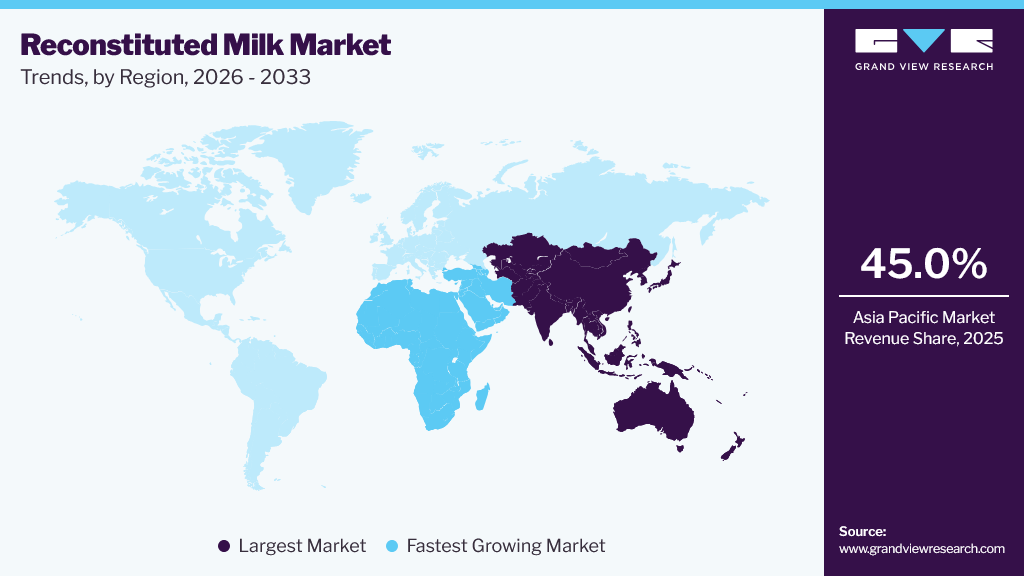
The global reconstituted milk market was valued at USD 267.1 billion in 2025 and is projected to grow from USD 289.8 billion in 2026 to USD 514.8 billion in 2033, at a CAGR of 8.6% from 2026 to 2033. The Asia Pacific market dominated with a revenue share of approximately 45.0% in 2025. The growth of the market is largely driven by factors such as convenience and longer shelf life compared to regular milk.
Key Market Trends & Insights
- By source: The skimmed milk segment held the largest market share of over 45.0% in 2025.
- By application: The milk segment held the largest market share of around 25.0% in 2025.
- By distribution channel: The B2B segment held the largest market share of around 70.0% in 2025.
Regional Highlights
- Largest regional market: Asia Pacific (approximately 45.0% revenue share, 2025)
- Fastest-growing regional market: Middle East & Africa (highest CAGR, 2026-2033)
Market Size & Forecast
- Market size in 2025: USD 267.1 Billion
- Estimated market size in 2026: USD 289.8 Billion
- Projected market size by 2033: USD 514.8 Billion
- CAGR (2026-2033): 8.6%
Three ways to get this report
Buy it, customize it, or ask a question.Ask an Analyst
A direct answer, usually in 1 working day
- AccessReport author, directly
- Reply timeWithin 1 working day
- No sales callDirect answer only
- FormatEmail reply
- CostFree, no cost
Get the Full Report
What the study covers
- FormatsPDF · Excel · Dashboard
- Timeline2026–2033 annual, 2025 base
- Coverage20+ countries, 5 regions
- Companies10+ key players profiled
Customize the Report
20% free customization
- IncludeCountries, segments, points
- TailorTo your product definition
- ExtendDeeper competitor detail
- OrA fully bespoke study
- Turnaround5–10 working days
Additionally, reconstituted milk is a practical choice for consumers living in areas with limited access to fresh milk. Reconstituted milk, with its extended shelf life, is an important resource for emergency preparedness, especially in disaster-prone areas or regions with limited access to fresh milk. It serves as a dependable source of nutrition during emergencies, ensuring a reliable milk supply when fresh options are scarce.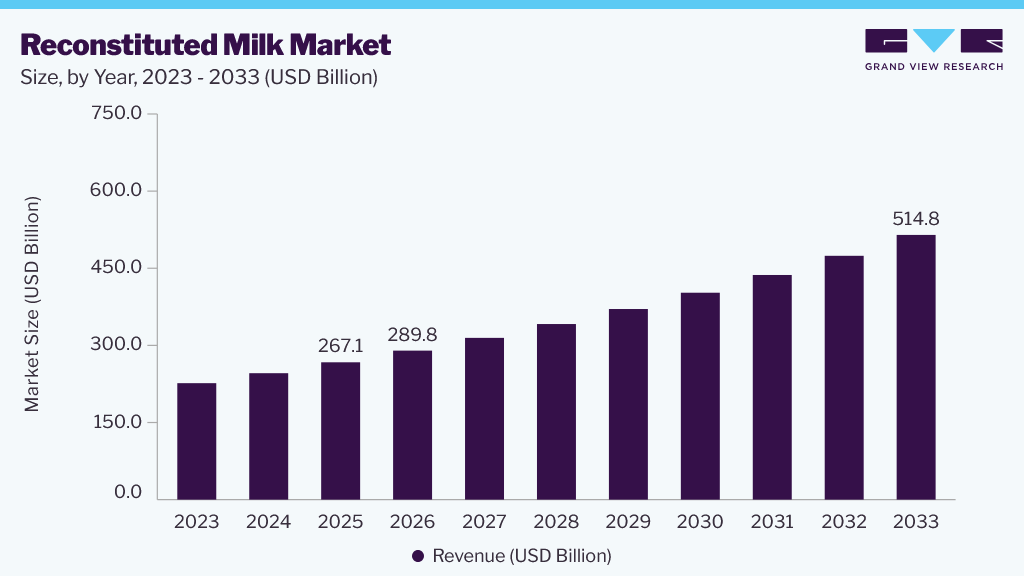 Source: Grand View Research, IR Documents, Primary Interviews, Paid DatabasesTo learn more about this report,
 Download Free Sample Report
 Additionally, individuals in remote areas with limited access to fresh milk can benefit from the long-lasting nature of powdered milk. Its extended shelf life guarantees availability and consumability over an extended period, making it a practical choice in such circumstances. Furthermore, reconstituted milk is more affordable compared to fresh milk. It provides a cost-effective alternative for consumers on a low budget. The production process for powdered milk involves removing moisture from fresh milk, resulting in a lightweight product that is less expensive to transport and store. These cost savings are often passed on to consumers, making reconstituted milk a more economical choice.
Analyst Perspective
The reconstituted milk market is experiencing steady growth, driven by increasing consumer demand for affordable dairy products, a growing need for extended-shelf-life milk solutions, and a growing interest in convenient nutrition. Consumers are increasingly incorporating reconstituted milk into their daily diets due to its essential nutrient content, ease of storage, and year-round availability. The expanding demand for dairy products in emerging economies, growing urbanization, and increasing use of milk powder in food and beverage applications are further supporting market growth. As demand for cost-effective, nutritious, and readily accessible dairy products continues to rise, companies that focus on product quality, formulation enhancement, and application diversification will be well-positioned to capitalize on long-term growth opportunities.
Source Insights
The skimmed milk segment held the largest revenue share of over 45.0% in 2025. The demand for skimmed milk-based reconstituted milk is primarily driven by growing consumer health consciousness and the search for lower-fat alternatives. Skimmed milk, with its reduced fat content, is widely perceived as a healthier option compared to whole milk. Skimmed milk retains essential nutrients, including protein, vitamins, and minerals, making it an appealing choice for health-conscious consumers. As a result, the market for skimmed milk-based reconstituted milk is experiencing notable growth as consumers actively seek healthier dairy options to support their well-being.
The anhydrous milk fat segment is expected to showcase the fastest CAGR over the forecast period. The demand for anhydrous milk fat (AMF) -based reconstituted milk is driven by factors such as its longer shelf life, low moisture content, expanding consumer markets, and its applications in the fast-food industry yogurts.. The longer shelf life and low moisture content of AMF make it a favorable choice for storage and long-distance transportation. Its extended shelf life enables efficient inventory management and reduces the risk of spoilage, making it a reliable option for businesses operating across multiple geographic regions. For instance, California Dairies, Inc. (CDI) expanded its dairy ingredient range by adding Anhydrous Milk Fat (AMF) to its export product offerings, strengthening its ability to serve growing international demand for butterfat ingredients used in reconstituted dairy products, confectionery, and food processing applications. The initiative reflects the industry's increasing focus on high-value milk fat ingredients with extended shelf life and improved transportation efficiency. This expansion is a response to the growing demand for high-quality anhydrous milk fat from customers in the ice cream and confectionery industries.
Application Insights
The milk segment held the largest share, at around 25.0%, in 2025. Reconstitution plays a crucial role in the food processing industry. Concentrated milk solids can be used as ingredients in a wide range of products, including dairy-based desserts, ice creams, baked goods, confectionery, sauces, and beverages. The versatility of reconstituted milk in various food applications contributes to its demand in the industry. Additionally, reconstituted milk retains most of the nutritional properties of fresh milk, including vitamins, minerals, and proteins. It provides a reliable source of essential nutrients. For instance, in September 2025, Hochdorf Swiss Nutrition expanded the commercial availability of its whole-milk and skim-milk powder portfolio for food and beverage manufacturers. The products are specifically designed for applications including reconstituted milk, dairy beverages, yogurt, confectionery, and bakery products, supporting the growing demand for shelf-stable dairy ingredients in international markets.
The yogurt segment is expected to showcase the fastest CAGR during the forecast period. Reconstituted yogurt caters to a range of dietary preferences and restrictions. There are several options for consumers following vegan or dairy-free diets, as reconstituted yogurt can be made with plant-based milks such as soy, almond, or coconut. This allows a wider consumer base to enjoy the taste and benefits of yogurt.
Furthermore, supportive government initiatives worldwide are boosting demand in the segment. For instance, in 2025, the U.S. Food and Drug Administration (FDA) continued to implement and enforce the modernized yogurt standard of identity, which permits the use of reconstituted dairy ingredients in yogurt manufacturing while maintaining compositional and quality requirements. The updated standard specifies minimum levels of milkfat, milk solids, and acidity for yogurt. It also broadens the range of allowable ingredients and permits the use of reconstituted dairy ingredients.
Distribution Channel Insights
The distribution channel segment is bifurcated into B2B and B2C segments. The B2B segment held the largest share of over 65.0% in 2025. The utilization of reconstituted milk in the B2B distribution channel enhances supply chain efficiency. Its non-perishable nature eliminates the need for temperature-controlled storage and transportation, reducing logistical complexity and costs. The extended shelf life of reconstituted milk also reduces the frequency of replenishment, streamlining supply chain operations and ensuring a consistent, dependable milk supply. Further, the versatility of reconstituted milk enables its integration into a wide range of industries, including food manufacturing, hospitality, and catering, thereby expanding its demand in the B2B distribution channel.
The B2C segment is anticipated to grow at a CAGR during the forecast period. Wholesale stores serve customers who prefer to purchase products in bulk. Reconstituted milk is frequently offered in larger packaging options, providing a convenient solution for those seeking to stock up. The availability of bulk reconstituted milk at wholesale stores specifically caters to the needs of businesses, institutions, and households with high milk consumption.
Regional Insights
The Asia Pacific region accounted for a dominant revenue share of around 45.0% in 2025. The convenience and extended shelf life of reconstituted milk make it a compelling option for the fast-paced lifestyles common in many Asian countries. Powdered or UHT (ultra-high-temperature) reconstituted milk, which can be stored without refrigeration for extended periods, provides businesses and consumers with a readily accessible milk supply at home and during travel.
 To learn more about this report, Download Free Sample Report
 The Middle East & Africa reconstituted milk market is expected to grow at a significant CAGR from 2026 to 2033. The increasing demand for convenient food solutions in the region, fueled by rapid urbanization and evolving consumer lifestyles, is driving the market growth. Factors such as the ease of storage, preparation, and consumption, coupled with its versatility, align perfectly with shifting lifestyle preferences in these regions. This market trend opens avenues for businesses to capitalize on the demand for convenient reconstituted milk products.
Key Reconstituted Milk Market Companies Insights
The Reconstituted Milk industry features a range of global, regional, and local players, making it a competitive market. The world’s leading companies are using partnerships, collaborations, acquisitions, mergers, and agreements as strategies to withstand the intense competition and increase their market share. Reconstituted Milk product manufacturers are spending extensively on product enhancement and new product development.
Key Reconstituted Milk Companies
The following key companies have been profiled for this study on the reconstituted milk market:
-
Nestle
-
Lactalis
-
Fonterra
-
Dairy Farmers of America
-
Arla Foods
-
Saputo
-
Pine Hill Dairy
-
Schreiber Foods
-
Mengniu Dairy
-
Meiji Holdings
-
Sodiaal
Recent Developments
-
In March 2026, FrieslandCampina Ingredients completed a strategic expansion of its Borculo facility in the Netherlands, doubling production capacity for whey protein isolate (WPI) and milk fat globule membrane (MFGM). The expansion strengthened the company’s dairy ingredient manufacturing capabilities and supported growing global demand for milk-based nutritional products derived from processed and reconstituted dairy ingredients.
-
In April 2025, Arla Foods became the first additional supplier to join the GDT Pulse platform, introducing European-sourced Skim Milk Powder (SMP). The development expanded global trade channels for milk powders and improved the availability of key ingredients used in reconstituted milk production across dairy and food processing industries.
-
In March 2025, Fonterra announced forecast offer quantities of 35,000 metric tonnes of Whole Milk Powder (WMP) and 21,000 metric tonnes of Skim Milk Powder (SMP) through the Global Dairy Trade (GDT) Pulse platform. The initiative enhanced global access to dairy ingredients used in the production of reconstituted milk, particularly in markets with limited fresh milk supply.
Reconstituted Milk Market Report Scope
Report Attribute
Details
Market size in 2025
USD 267.1 billion
Estimated market size in 2026
USD 289.8 billion
Projected market size by 2033
USD 514.8 billion
Growth rate
CAGR of 8.6% from 2026 to 2033
Base year for estimation
2025
Actual data
2021 - 2024
Forecast period
2026 - 2033
Quantitative units
Revenue in USD billion, and CAGR from 2026 to 2033
Report coverage
Revenue forecast, company ranking, competitive landscape, growth factors, and trends
Segments covered
Source, application, distribution channel, region
Regional Scope
North America; Europe; Asia Pacific; Central & South America; Middle East & Africa
Country Scope
U.S.; Canada; Mexico; UK; Germany; France; Italy; Spain; China; India; Japan; Australia & New Zealand; South Korea; Argentina; Brazil; South Africa; UAE
Key companies profiled
Nestle; Lactalis; Fonterra; Dairy Farmers of America; Arla Foods; Saputo; Pine Hill Dairy; Schreiber Foods.; Mengniu Dairy; Meiji Holdings; Sodiaal
Customization scope
Free report customization (equivalent up to 8 analysts working days) with purchase. Addition or alteration to country, regional & segment scope.
Pricing and purchase options
Avail of customized purchase options to meet your exact research needs. Explore purchase options
Global Reconstituted Milk Market Report Segmentation
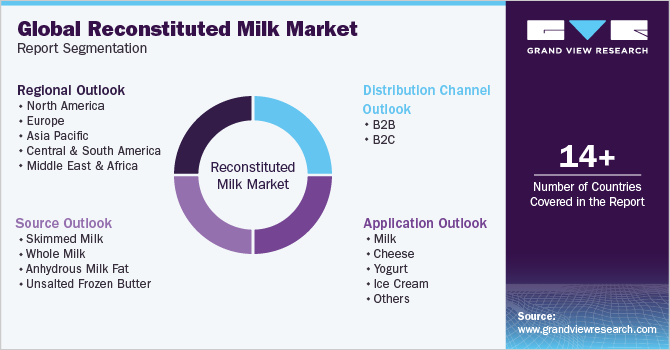
This report forecasts revenue growth at global, regional, and country levels and provides an analysis of the latest industry trends and opportunities in each of the sub-segments from 2021 to 2033. For the purpose of this study, Grand View Research has segmented the global reconstituted milk market report based on source, application, distribution channel, and region:
 To learn more about this report, Download Free Sample Report
 -
Source Outlook (Volume, Kilo Tons; Revenue, USD Million; 2021 - 2033)
-
Skimmed Milk
-
Whole Milk
-
Anhydrous Milk Fat
-
Unsalted Frozen Butter
-
-
Application Outlook (Volume, Kilo Tons; Revenue, USD Million; 2021 - 2033)
-
Milk
-
Cheese
-
Yogurt
-
Ice Cream
-
Others
-
-
Distribution Channel Outlook (Volume, Kilo Tons; Revenue, USD Million; 2021 - 2033)
-
B2B
-
B2C
-
Online
-
Hypermarkets/Supermarkets
-
Wholesale Stores
-
Others
-
-
-
Regional Outlook (Volume, Kilo Tons; Revenue, USD Million; 2021 - 2033)
-
North America
-
U.S.
-
Canada
-
Mexico
-
-
Europe
-
Germany
-
UK
-
France
-
Italy
-
Spain
-
-
Asia Pacific
-
China
-
Japan
-
India
-
Australia & New Zealand
-
South Korea
-
-
Central & South America
-
Argentina
-
Brazil
-
-
Middle East & Africa
-
South Africa
-
UA
-
-
Frequently Asked Questions About This Report
The global reconstituted milk market size was valued at USD 267.1 billion in 2025 and is estimated at USD 289.8 billion for 2026.
The global reconstituted milk market is expected to grow at a CAGR of 8.6% from 2026 to 2033, reaching USD 514.8 billion.
Key players include Nestle; Lactalis; Fonterra; Dairy Farmers of America; Arla Foods; Saputo; Pine Hill Dairy; Schreiber Foods.; Mengniu Dairy; Meiji Holdings; Sodiaal
Asia Pacific dominated with a 45.0% revenue share in 2025.
B2B segment dominated the reconstituted milk market with a share of 70.0% in 2025, while skimmed milk segment is the fastest-growing segment.
About the Author(s)
Nutraceuticals & Functional Foods Research Team
Consumer Goods · Nutraceuticals & Functional FoodsThis report was authored by the nutraceuticals & functional foods research team at Grand View Research - comprising two research analysts, one senior research analyst, and one industry expert - with specialized expertise in the nutraceuticals & functional foods segment of the consumer goods industry. All findings are based on proprietary consumer goods databases, executive interviews, and regulatory analysis, subject to internal peer review prior to publication.
Last Updated:
Speak to Analyst

Customize this report to your needs - add regions, segments, or data points, with 20% free customization.
Or view our licence options:


ISO 9001:2015 & 27001:2022 Certified
We are GDPR and CCPA compliant! Your transaction & personal information is safe and secure. For more details, please read our privacy policy.


