
- Home
- »
- Plastics, Polymers & Resins
- »
-
Recycled Content 3D Printing Filaments Market Report, 2033GVR Report cover

Recycled Content 3D Printing Filaments Market (2026 - 2033)
Size, Share & Trends Analysis Report By Recycled Material (Recycled PLA, Recycled Nylon, Recycled PET/PETG, Recycled ABS, Recycled PP), By End-use (Industrial Manufacturing), By Region, And Segment Forecasts
Market Size, 2025
$125.2MMarket Estimate, 2026
$144.4MMarket Forecast, 2033
$401.8MCAGR, 2026–2033
15.7%Recycled Content 3D Printing Filaments Market Summary
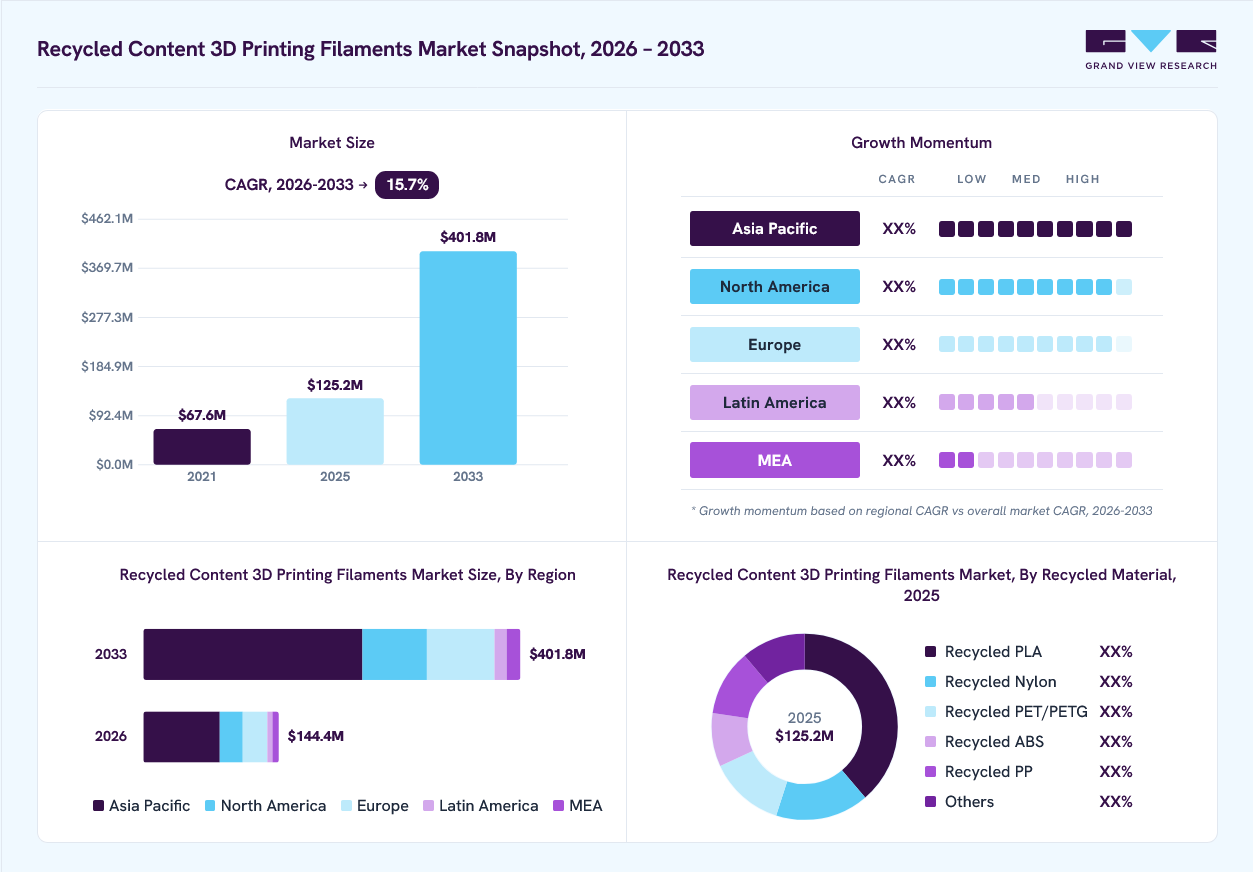
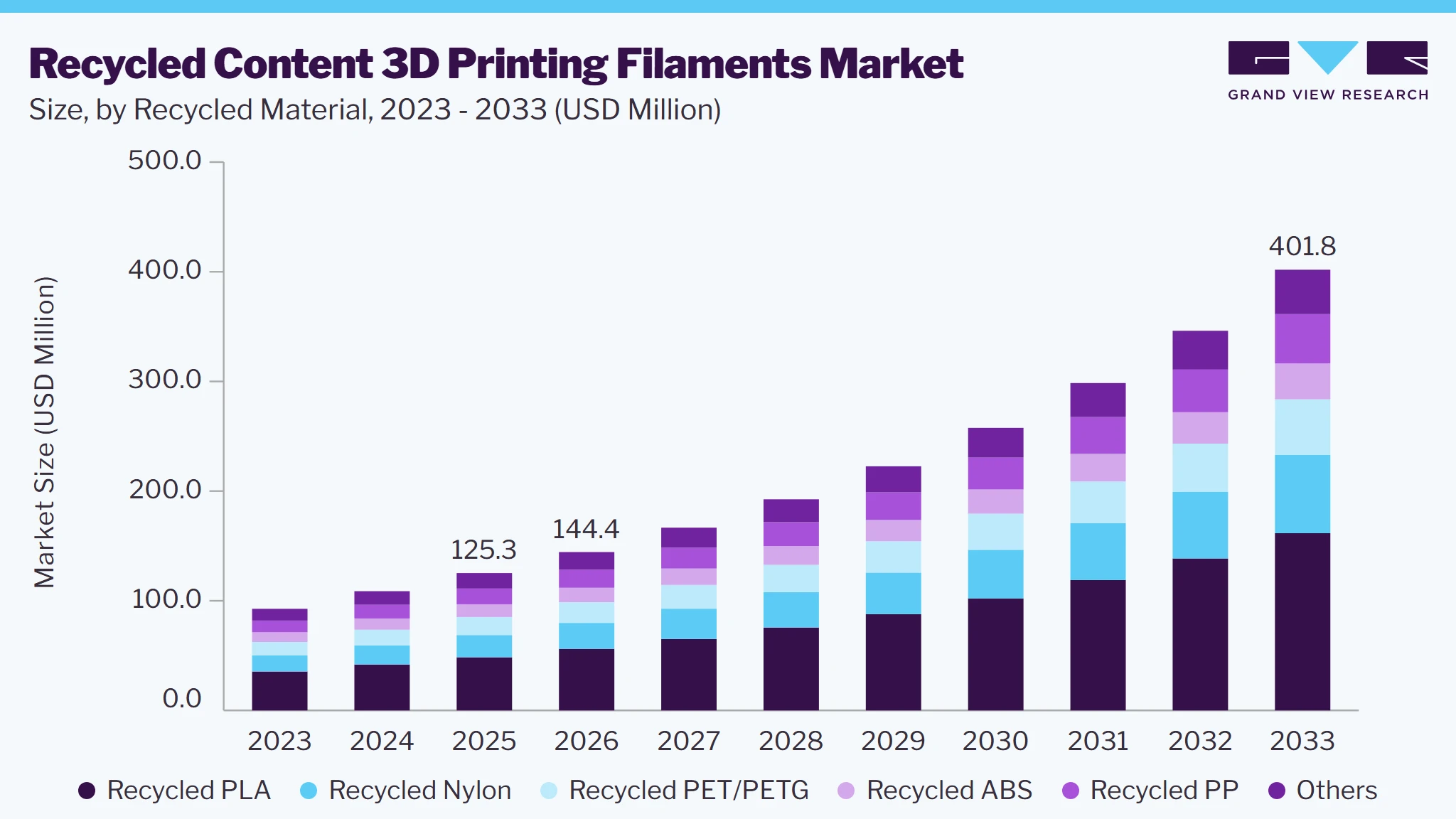
The global recycled content 3D printing filaments market size was valued at USD 125.2 million in 2025 and is projected to grow from USD 144.4 million in 2026 to USD 401.8 million by 2033, at a CAGR of 15.7% from 2026 to 2033. Asia Pacific dominated the market, accounting for the largest revenue share of 56.1% in 2025. The market is driven by growing demand for sustainable and resource-efficient additive manufacturing across industrial manufacturing, automotive, consumer goods, education and research, and aerospace and defense applications.
 Source: Grand View Research, IR Documents, Primary Interviews, Paid DatabasesTo learn more about this report,
 Download Free Sample Report
Key Market Trends & Insights
- By recycled material: Recycled PLA dominated the market, accounting for 38.7% share in 2025.
- By end-use: Industrial manufacturing segment led the market, accounting for 39.3% of share in 2025.
Regional Highlights
- Largest regional market: Asia Pacific (56.1% revenue share, 2025)
- By country: China held the largest share of Asia Pacific in 2025.
Market Size & Forecast
- Market Size in 2025: USD 125.2 Million
- Estimated market size in 2026: USD 144.4 Million
- Projected Market Size by 2033: USD 401.8 Million
- CAGR (2026 - 2033): 15.7%
GVR research-powered AIAsk Prism AI about the recycled content 3D printing filaments marketGet cited answers from GVR research on market growth, segments, regulations and forecasts.Start with✓ Source-linked answers ✓ Market-specific context ✓ Traceable figuresExplore Prism AI ↗
Recycled PLA, nylon, PET/PETG, ABS, and PP filaments offer material reuse, functional performance, and reduced reliance on virgin polymers. Advancements in recycling, filament extrusion, and material formulation are improving printability and consistency, while increasing focus on circular manufacturing, waste reduction, and low-carbon production accelerates adoption.Technological advancements in filament formulation, extrusion, recycling, and quality-control processes are emerging as a key trend in the recycled content 3D printing filament market. Manufacturers are increasingly developing optimized recycled PLA, nylon, PET/PETG, ABS, and PP formulations that improve printability, dimensional stability, mechanical consistency, and processing reliability. Innovations in material engineering and recycling are further expanding the suitability of recycled filaments for industrial manufacturing, automotive, consumer goods, and research applications.
 To learn more about this report, Download Free Sample Report
Growing demand for sustainable, cost-efficient, and resource-conscious manufacturing is a major driver for the recycled content 3D printing filament market. Recycled filaments enable material reuse while supporting rapid prototyping, customized production, and component manufacturing across industrial manufacturing, automotive, consumer goods, education and research, and aerospace and defense applications. Increasing adoption of additive manufacturing and growing emphasis on waste reduction and circular production practices are further accelerating market development.
Expanding adoption of circular manufacturing and plastic waste recovery presents a significant opportunity for the recycled content 3D printing filament market. Increasing focus on converting post-consumer and post-industrial waste into usable feedstock is creating opportunities for recycled PLA, PET/PETG, ABS, nylon, and PP filaments. Manufacturers are developing localized recycling, filament extrusion, and closed-loop approaches that can return discarded printing materials and plastic waste into new products, reducing virgin material consumption and supporting resource efficiency.
Market Dynamics
Consumer goods and toy manufacturers are emerging as a key application segment for the recycled content 3D printing filament market, supported by increasing use of large-scale FFF printing arrays for customized products, packaging inserts, prototypes, and non-visible structural components. Recycled polymers provide a material-efficient option for high-volume additive manufacturing, while enabling manufacturers to reduce virgin plastic consumption and incorporate waste-derived feedstocks into production processes.
Increasing demand for mass customization, rapid product development, and sustainable manufacturing is further accelerating adoption of recycled filaments across consumer goods and toys. Recycled ABS and other polymers can be processed into filaments and used to manufacture functional products with competitive mechanical performance. The demonstrated conversion of waste plastic toys into 3D printing feedstock further supports opportunities for material recovery and closed-loop production.
Processing complexity is emerging as a key restraint for the recycled content 3D printing filament market, driven by the need for advanced sorting, cleaning, drying, filtering, blending, and extrusion to achieve consistent filament quality. These processes are often labor-intensive and increase production overhead, particularly when recycled feedstocks require controlled composition and dimensional consistency. Higher processing costs can reduce the price advantage of recycled filaments and, in some cases, make recycled spools comparable in cost to virgin alternatives.
Automotive applications present a significant opportunity for the recycled content 3D printing filament market, driven by increasing use of additive manufacturing for lightweight prototypes, interior components, fixtures, and customized replacement parts. Recycled polymers and reinforced recycled materials can support material efficiency while enabling design flexibility and localized production. Growing pressure to reduce vehicle weight, material consumption, and environmental impact is further creating opportunities for recycled filaments across automotive development and low-volume manufacturing.
Market Concentration & Characteristics
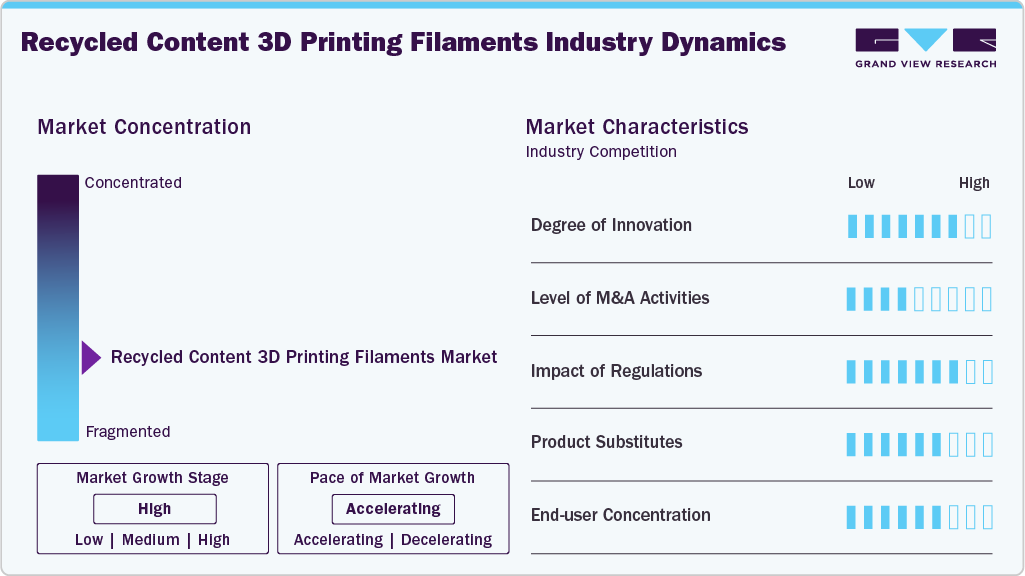
The market growth stage is exponential, and growth is accelerating. The market exhibits fragmentation, with key players dominating the industry landscape. Major companies such as BASF, Prusa Research, BigRep, Taulman3D, Filamentive, ColorFabb, FormFutura, Reflow, 3D-Fuel, GreenGate3D and others play a significant role in shaping the market dynamics. These leading players often drive innovation in the market by introducing new products, technologies, and materials to meet the industry's evolving demands.
The degree of innovation in the recycled content 3D printing filament market is moderate to high, driven by advances in recycled polymer formulation, filament extrusion, quality control, and circular production. Companies including BASF, Prusa Research, BigRep, Taulman3D, Filamentive, ColorFabb, and FormFutura are developing or commercializing materials emphasizing recycled content, consistent printability, mechanical performance, and material efficiency. BigRep, Filamentive, ColorFabb, and FormFutura demonstrate active development of recycled PETG, PLA, and nylon-based solutions.
 To learn more about this report, Download Free Sample Report
Product differentiation and sustainability initiatives are shaping competitive positioning, with Reflow, 3D-Fuel, GreenGate3D, and other specialized suppliers focusing on recycled feedstocks, material consistency, and environmentally responsible filament production. FormFutura and ColorFabb incorporate post-industrial waste into recycled PLA products, while GreenGate3D offers recycled PET-G across multiple colors, and Filamentive provides recycled PETG and recycled nylon options. These developments strengthen material diversity and support broader adoption across functional, educational, prototyping, and production applications.
Analyst Perspective
The recycled content 3D printing filament market is shifting from an eco-niche to a high-performance material segment. Demand across automotive, aerospace, industrial, and consumer sectors will drive growth, with PLA and PETG leading, while nylon, ABS, and PP expand into engineering uses. Regulatory pressure supports adoption, though feedstock inconsistency and high processing costs persist. Leaders like Prusa and Filamentive are advancing traceability and quality control. Long-term success relies on verified recycled content, consistent formulations, and strong ecosystem partnerships.
Recycled Material Insights
The recycled PLA dominated the market across recycled material segmentation in terms of revenue, accounting for 38.7% market share in 2025, and is forecast to grow at an 16.3% CAGR from 2026 to 2033. The segment is driven by increasing adoption of recycled PLA filaments across manufacturing, consumer goods, education, and prototyping applications, supported by PLA’s easy processability and established use in FFF printing. Recycled PLA enables material reuse, waste reduction, and lower reliance on virgin polymers, while advances in recycling, blending, and filament extrusion are improving thermal stability, printability, and mechanical performance, supporting broader adoption across sustainable additive manufacturing applications.
The recycled nylon segment is expected to expand at a 17.1% CAGR in the recycled content 3D printing filaments market over the forecast period. The market is being driven by growing demand for recycled nylon filaments across industrial, automotive, consumer goods, and functional prototyping applications, where materials require high strength, toughness, wear resistance, and thermal performance. Recycled nylon, particularly PA6 and PA12, supports material recovery while retaining useful mechanical and processing properties. Advances in recycling and filament extrusion are improving printability and dimensional stability, supporting broader adoption across demanding additive manufacturing applications.
End-use Insights
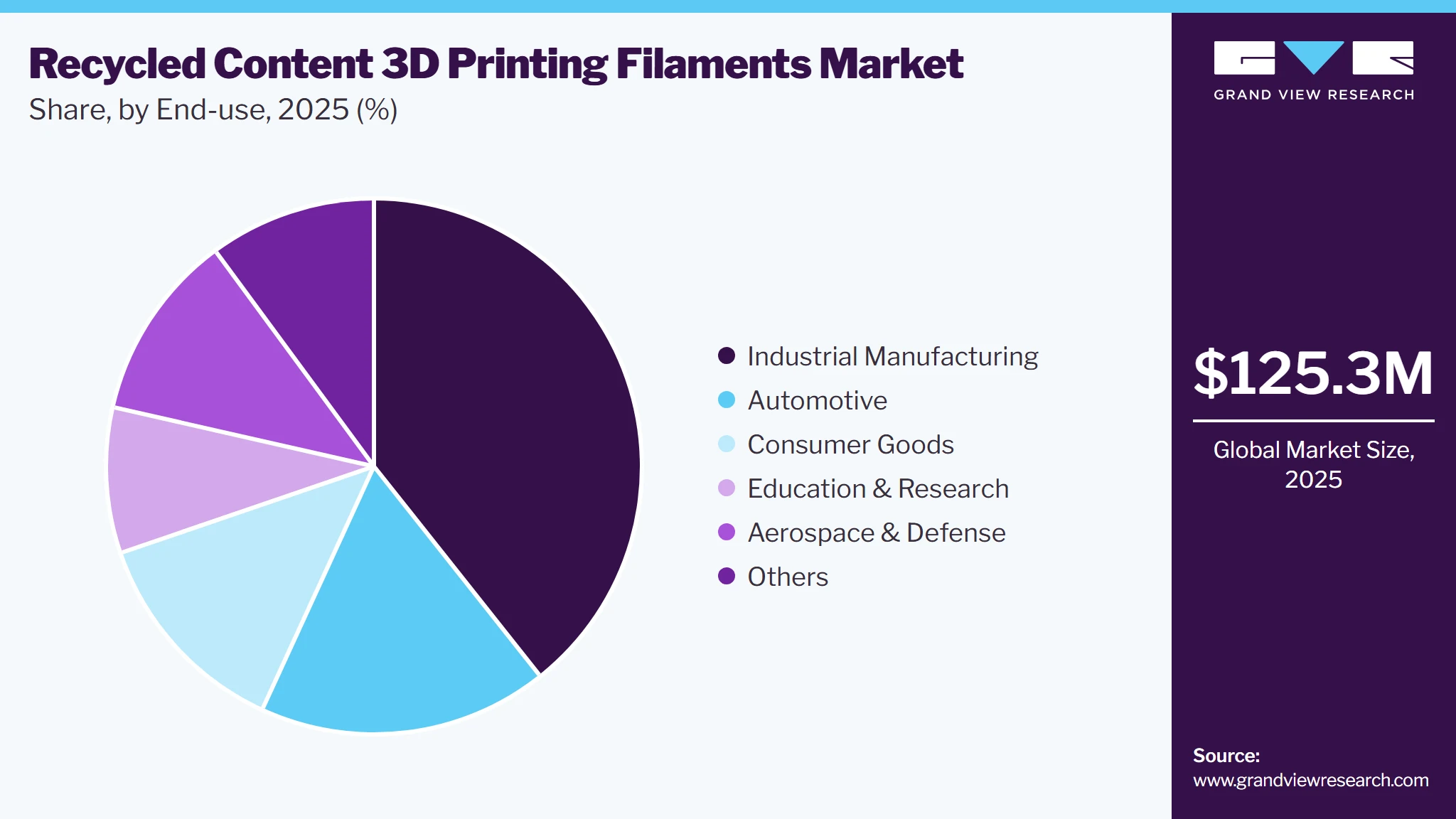
The industrial manufacturing segment led the market by end-use, accounting for 39.3% of revenue in 2025, and is projected to grow at a 16.3% CAGR from 2026 to 2033. The industrial manufacturing segment is being driven by increasing adoption of recycled content 3D printing filaments for prototyping, tooling, fixtures, functional components, and customized production. Recycled PLA, PET/PETG, ABS, nylon, and PP provide material reuse while supporting cost-efficient additive manufacturing and waste reduction. Growing emphasis on circular production, resource efficiency, and lower material consumption is further supporting broader adoption of recycled filaments across industrial manufacturing applications.
 To learn more about this report, Download Free Sample Report
The automotive segment is expected to grow at the fastest CAGR of 16.9% over the forecast period. The automotive segment is being driven by increasing adoption of recycled content 3D printing filaments for prototyping, lightweight components, customized parts, tooling, and low-volume production. Recycled polymers support material efficiency while enabling design flexibility and reduced waste. Growing emphasis on vehicle light weighting, circular manufacturing, and lower environmental impact is further supporting broader adoption of recycled PLA, ABS, PET/PETG, nylon, and reinforced materials across automotive development and manufacturing applications.
Regional Insights
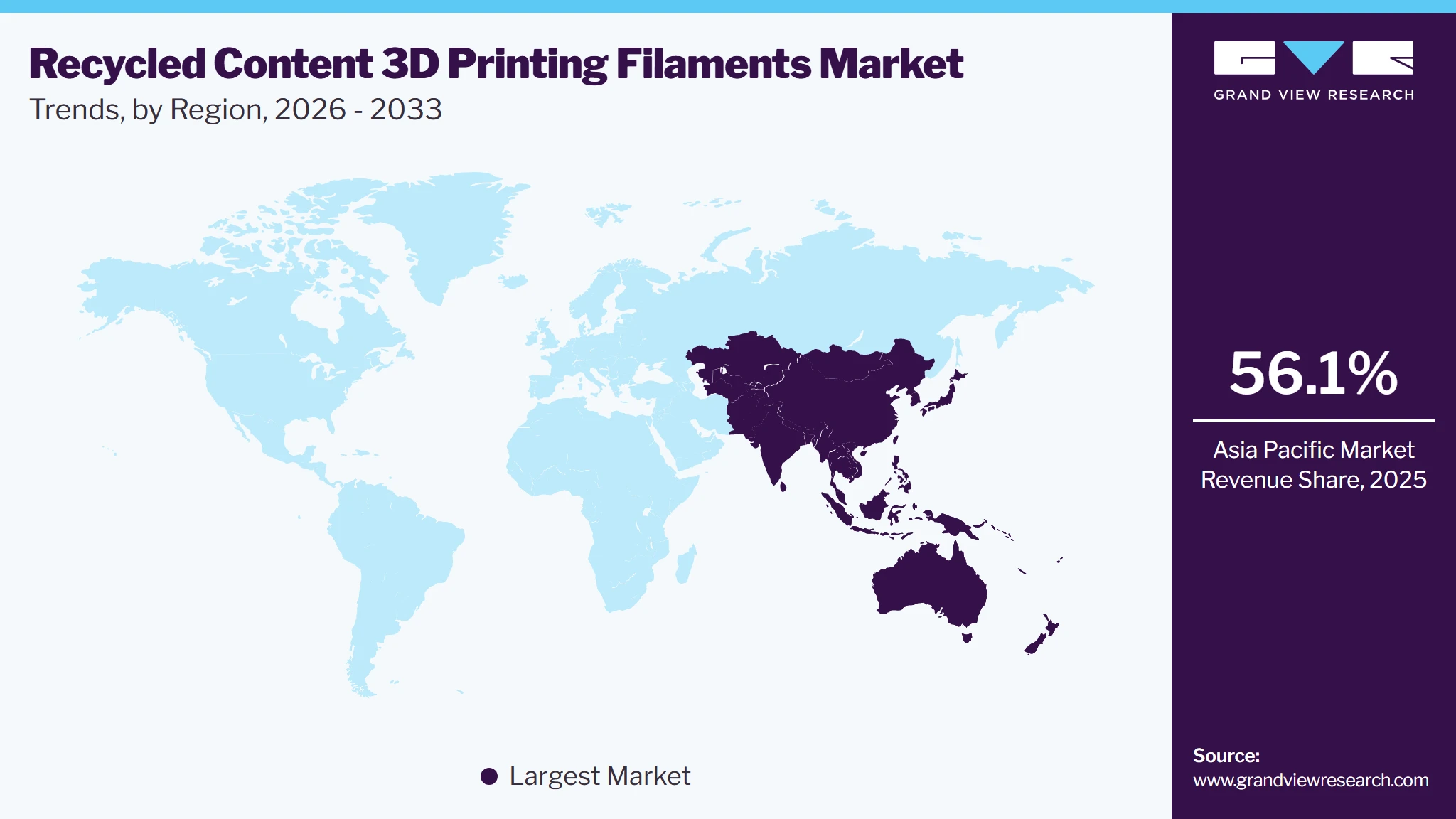
The Asia Pacific recycled content 3D printing filaments market held the largest revenue share of 56.1% in 2025. The region is expected to grow at a CAGR of 16.2% over the forecast period. Rapid industrialization, expanding manufacturing activity, and growing adoption of additive manufacturing are supporting growth of the recycled content 3D printing filament market across Asia Pacific. Increasing investments in automotive, electronics, consumer goods, aerospace, and industrial production are driving demand for sustainable, cost-efficient filament materials. Growing circular economy initiatives, plastic waste recovery, and adoption of recycled polymers are further accelerating regional demand, particularly across China, India, Japan, South Korea, and Southeast Asia.
 To learn more about this report, Download Free Sample Report
India Recycled Content 3D Printing Filaments Market Trends
India’s recycled content 3D printing filaments market is expanding steadily, supported by the rising adoption of additive manufacturing across industrial, automotive, consumer goods, education, and aerospace applications. Increasing demand for sustainable materials, rapid prototyping, and localized production is supporting recycled PLA, PET/PETG, ABS, and nylon filaments. Growing emphasis on circular manufacturing, plastic waste recovery, and resource efficiency is further strengthening market development, with manufacturing representing a leading end-use segment in the country.
North America Recycled Content 3D Printing Filaments Market Trends
North America is a key growth region for the recycled content 3D printing filament market, supported by strong demand for additive manufacturing across industrial, automotive, aerospace, consumer goods, and research applications. The region’s established 3D printing ecosystem, advanced material development, and growing focus on sustainable manufacturing are driving adoption of recycled PLA, PET/PETG, ABS, and nylon filaments. Increasing investments in circular production and plastic waste recovery are further strengthening regional demand.
The U.S. represents a major contributor to regional growth, supported by its extensive additive manufacturing capabilities across automotive, aerospace, industrial, and consumer applications. Rising utilization of recycled filaments for prototyping, tooling, customized components, and low-volume production is accelerating demand. Strong emphasis on material efficiency, waste reduction, and corporate sustainability initiatives is further encouraging manufacturers to develop consistent recycled filament formulations and advanced processing technologies for diverse applications.
Europe Recycled Content 3D Printing Filaments Market Trends
Europe’s recycled content 3D printing filaments market is expanding due to increasing adoption across manufacturing, automotive, consumer goods, education, and aerospace applications. Stringent environmental regulations, circular economy initiatives, and growing demand for sustainable materials are encouraging broader adoption of recycled PLA, PET/PETG, ABS, and nylon filaments. Increasing investments in additive manufacturing, plastic waste recovery, and closed-loop production systems are further strengthening regional market development, particularly across Germany, France, and the UK.
Central & South America Recycled Content 3D Printing Filaments Market Trends
Central & South America’s recycled content 3D printing filaments market is expanding due to increasing adoption across manufacturing, automotive, consumer goods, education, and aerospace applications. Growing interest in sustainable additive manufacturing and plastic waste recovery is driving demand for recycled PLA, PET/PETG, ABS, and nylon filaments. Increasing circular economy initiatives and localized material recovery are further supporting regional market development, particularly in Brazil and Chile.
Middle East & Africa Recycled Content 3D Printing Filaments Market Trends
The recycled content 3D printing filaments market in Middle East and Africa is expanding due to increasing adoption across manufacturing, automotive, education, consumer goods, aerospace, and healthcare applications. Growing investments in additive manufacturing capabilities and industrial diversification are driving demand for recycled PLA, PET/PETG, ABS, and nylon filaments. Increasing focus on circular economy practices, plastic waste recovery, and sustainable production is further strengthening regional market development, particularly in Saudi Arabia and other Gulf countries.
Key Recycled Content 3D Printing Filaments Company Insights
Some of the key players operating in the market include BASF (Forward AM) and Prusa Research
-
BASF (Forward AM) participates in the recycled content 3D printing filaments market through its Forward AM portfolio, offering sustainable additive manufacturing materials, including recycled Ultrafuse rPET and recycled-content PETG pellets. The company emphasizes material performance, circularity, and resource efficiency, supported by lifecycle assessments, recycled packaging, and recycling initiatives. Its materials enable applications including automotive parts, jigs, fixtures, prototyping, and large-scale 3D-printed structures, supporting manufacturers seeking lower-impact production solutions.
-
Prusa Research participates in the recycled content 3D printing filament market through its Prusament portfolio, offering recycled PLA and PETG filaments manufactured in-house from production waste. The company emphasizes strict quality control, material traceability, and lower environmental impact, with recycled filaments maintaining controlled dimensional tolerances and reliable printability. Its recycled materials support prototyping, models, functional parts, and other FFF applications, while its expanded recycled portfolio strengthens circularity within filament manufacturing.
Filamentive and 3D-Fuel are some of the emerging participants in the recycled content 3D printing filaments market.
-
Filamentive participates in the recycled content 3D printing filament market through its portfolio of recycled PLA, PETg, ABS, and rPA12 nylon filaments, using recycled feedstocks from industrial waste streams and MJF powder waste. The company emphasizes sustainable material sourcing, ISO 14021 recycled-content verification, and waste reduction through its PLA recycling scheme. Its materials provide reliable printability for prototyping, consumer products, functional parts, and industrial applications while supporting circularity and reduced virgin polymer consumption.
-
3D-Fuel participates in the recycled content 3D printing filament market through its ReFuel portfolio of recycled PLA+, PETG, and PCTG filaments, produced using manufacturing scraps, out-of-specification material, and production waste. Supported by in-house U.S. manufacturing, the company emphasizes material recovery, consistent filament quality, and waste diversion. Its recycled materials support FFF applications requiring reliable printability while helping reduce landfill waste and dependence on virgin polymer feedstocks.
Key Recycled Content 3D Printing Filaments Companies
The following key companies have been profiled for this study on the recycled content 3D printing filaments market.
-
BASF (Forward AM)
-
Prusa Research
-
BigRep
-
Taulman3D
-
Filamentive
-
ColorFabb
-
FormFutura
-
Reflow
-
3D-Fuel
-
GreenGate3D
Competitive Benchmarking
Operating Strategies
Competitive Edge
Weakness
Mature Players: BASF, Prusa Research, BigRep, Taulman3D, ColorFabb, FormFutura.
- Strong focus on expanding sustainable filament portfolios covering recycled PLA, PET/PETG, nylon, and other engineered materials for prototyping, functional parts, consumer products, and industrial applications.
- Continuous investment in recycled feedstock processing, filament extrusion, material formulation, dimensional consistency, printability, and sustainability to improve product performance and reduce virgin-material consumption.
- Expansion through established distribution channels, printer ecosystems, technical support, material development capabilities, and application-specific filament offerings.
- Established brands, technical expertise, manufacturing capabilities, and broad material portfolios provide strong positioning across additive manufacturing applications.
- Strong sustainability differentiation through recycled-material products. Prusa Research, for example, produces 100% recycled PLA and PETG from its own production waste, while BigRep offers recycled PETG with strength, impact resistance, and chemical resistance.
- ColorFabb and FormFutura strengthen positioning through high-recycled-content PLA products and dedicated recycled filament ranges.
- Investment in controlled feedstock sourcing, sorting, compounding, extrusion, and quality-control processes can increase production costs.
- Recycled feedstock variability can affect color, consistency, and processing characteristics. ColorFabb notes batch-to-batch color variation in its recycled PLA, while Prusa identifies different colors and certain printability limitations for recycled PETG.
- Maintaining consistent mechanical and dimensional performance across recycled materials can require tighter process controls and material qualification.
Emerging Players: Duro-Last, Inc., Versico Roofing Systems, Protan AS, Seaman Corporation
- Focus on specialized recycled filament systems, including recycled PLA, PETG, nylon, and other recycled or sustainable materials for consumer, professional, educational, and industrial printing applications.
- Continuous investment in recycled feedstock sourcing, material formulation, extrusion quality, recycled-content transparency, and application-specific performance.
- Expansion through sustainability-focused product positioning, direct distribution, specialized material portfolios, recycling initiatives, and customer-oriented technical support.
- Sustainability-focused portfolios and high recycled-content offerings provide differentiation among environmentally conscious users and organizations.
- Smaller specialized suppliers can respond rapidly to emerging demand for recycled materials, localized production, and environmentally responsible additive manufacturing.
- Comparatively narrower product portfolios, production scale, and geographic reach can limit exposure relative to larger diversified material and additive-manufacturing companies.
- Dependence on consistent recycled feedstock availability can create challenges in maintaining uniform material properties and supply reliability.
- Smaller production volumes and specialized sustainability positioning can increase sensitivity to feedstock costs, processing requirements, and fluctuations in customer demand.
Recent Developments
-
In May 2025, Stratasys acquired the key assets and operations of Forward AM Technologies GmbH, formerly BASF’s additive manufacturing materials business, establishing the operation as Mass Additive Manufacturing GmbH within Stratasys while retaining the Forward AM brand. The transaction strengthened Stratasys’ polymer additive manufacturing materials portfolio, particularly across SAF and DLP technologies, while expanding its materials expertise and manufacturing ecosystem. Although broader than recycled-content filaments, the acquisition reinforces Stratasys’ position across advanced polymer additive manufacturing.
-
In November 2025, BigRep launched rPLA and rPETG filaments manufactured from 100% post-industrial residual waste, expanding its recycled-material portfolio for large-format additive manufacturing. The new materials are collected, shredded, remixed, and homogenized to produce consistent filament, while maintaining printability and functional performance comparable with conventional materials. The launch strengthens BigRep’s sustainable materials offering, supports waste reduction and circular production, and expands the availability of recycled filaments for prototyping, tooling, functional components, and large-scale 3D-printed applications.
Recycled Content 3D Printing Filaments Market Report Scope
Report Attribute
Details
Market size in 2025
USD 125.2 million
Estimated market size in 2026
USD 144.4 million
Projected market size by 2033
USD 401.8 million
Growth rate
CAGR of 15.7% from 2026 to 2033
Historical data
2021 - 2025
Forecast period
2026 - 2033
Quantitative units
Revenue in USD million/billion, volume in tons, and CAGR from 2026 to 2033
Report coverage
Revenue & volume forecast, competitive landscape, growth factors, and trends
Segments covered
Recycled material, end-use, region
Regional scope
North America; Europe; Asia Pacific; Central & South America; Middle East & Africa
Country scope
U.S.; Canada; Mexico; Germany; UK; France; Italy; Spain; China; India; Japan; South Korea; Australia; Brazil; Argentina; Saudi Arabia; UAE; South Africa
Key companies profiled
BASF (Forward AM;, Prusa Research; BigRep; Taulman3D; Filamentive; ColorFabb; FormFutura; Reflow; 3D-Fuel; GreenGate3D
Customization scope
Free report customization (equivalent to up to 8 analyst working days) with purchase. Addition or alteration to country, regional & segment scope
Pricing and purchase options
Avail customized purchase options to meet your exact research needs. Explore purchase options
Global Recycled Content 3D Printing Filaments Market Report Segmentation
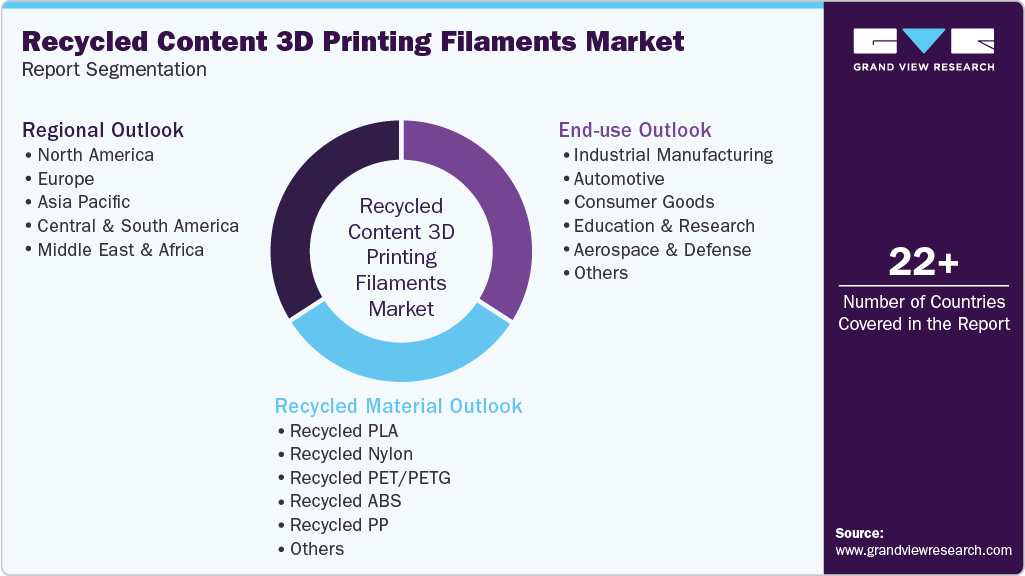
This report forecasts revenue growth at the global, regional, and country levels and provides an analysis of the latest industry trends across sub-segments from 2021 to 2033. For this study, Grand View Research has segmented the global recycled content 3D printing filaments market report based on recycled material, end-use, and region:
 To learn more about this report, Download Free Sample Report
-
Recycled Material Outlook (Volume, Kilotons; Revenue, USD Million, 2021 - 2033)
-
Recycled PLA
-
Recycled Nylon
-
Recycled PET/PETG
-
Recycled ABS
-
Recycled PP
-
Others
-
-
End-use Outlook (Volume, Kilotons; Revenue, USD Million, 2021 - 2033)
-
Industrial Manufacturing
-
Automotive
-
Consumer Goods
-
Education & Research
-
Aerospace & Defense
-
Others
-
-
Regional Outlook (Volume, Kilotons; Revenue, USD Million, 2021 - 2033)
-
North America
-
U.S.
-
Canada
-
Mexico
-
-
Europe
-
Germany
-
UK
-
France
-
Italy
-
Spain
-
-
Asia Pacific
-
China
-
India
-
Japan
-
South Korea
-
Australia
-
-
Central & South America
-
Brazil
-
Argentina
-
-
Middle East & Africa
-
Saudi Arabia
-
UAE
-
South Africa
-
-
Research Methodology
The recycled content 3D printing filaments market figures in this report are based on a proven research process that combines executive interviews with secondary research from proprietary databases, company filings, and recognized regulatory and institutional sources. Market size is built through value-chain sizing-reconciling supply-side and demand-side estimates-and triangulated with bottom-up and top-down approaches. Every estimate passes multiple levels of expert validation before publication, with each recycled content 3D printing filaments segment quantified using the revenue-capture definitions in the table below.
Segment Definition
Segment - Recycled Material
Revenue capture definition
Recycled PLA
Revenue is captured through recycled PLA 3D printing filaments used in FFF applications requiring ease of printing, dimensional stability, surface quality, and material efficiency across prototyping, consumer products, education, research, and low-load industrial applications.
Recycled Nylon
Revenue is generated through recycled nylon 3D printing filaments used in applications requiring high strength, toughness, abrasion resistance, durability, and functional performance across automotive, industrial manufacturing, aerospace, and engineering applications.
Recycled PET/PETG
Revenue is captured through recycled PET/PETG 3D printing filaments used in applications requiring durability, impact resistance, dimensional stability, chemical resistance, and reliable printability across industrial manufacturing, consumer goods, packaging-related components, prototyping, and functional applications.
Recycled ABS
Revenue is generated through recycled ABS 3D printing filaments used in applications requiring toughness, impact resistance, heat resistance, dimensional stability, and durable performance across automotive components, industrial parts, consumer products, prototypes, and functional models.
Recycled PP
Revenue is captured through recycled PP 3D printing filaments used in applications requiring lightweight construction, chemical resistance, fatigue resistance, flexibility, and durability across automotive, industrial manufacturing, consumer goods, packaging components, and functional applications.
Others
Revenue comes from other recycled content 3D printing filament materials and specialized formulations, including recycled TPU, HIPS, PC, PCTG, and reinforced recycled polymer systems used in applications requiring specialized mechanical, thermal, chemical, flexibility, or dimensional performance.
Segment - End-use
Revenue capture definition
Industrial Manufacturing
Revenue is generated through recycled content 3D printing filaments used for prototypes, jigs, fixtures, tooling, machine components, replacement parts, and customized production components requiring durability, dimensional stability, cost efficiency, and material sustainability.
Automotive
Revenue is captured through recycled content 3D printing filaments used for prototypes, interior components, tooling, fixtures, customized replacement parts, and functional automotive components requiring lightweight construction, mechanical performance, design flexibility, and reduced virgin material consumption.
Consumer Goods
Revenue is generated through recycled content 3D printing filaments used for toys, household products, accessories, packaging inserts, customized products, and mass-customized items requiring aesthetic flexibility, durability, cost efficiency, and sustainable material utilization.
Education & Research
Revenue is captured through recycled content 3D printing filaments used in schools, universities, laboratories, and research institutions for educational models, prototypes, experiments, testing, and design projects requiring affordable, accessible, and sustainable additive manufacturing materials.
Aerospace & Defense
Revenue is generated through recycled content 3D printing filaments used for prototypes, tooling, fixtures, training models, cabin components, and non-critical functional parts requiring lightweight construction, dimensional stability, durability, and controlled material performance under demanding applications.
Others
Revenue comes from recycled content 3D printing filaments used across healthcare, architecture, construction, marine, creative industries, and other specialized applications requiring customized geometries, material efficiency, functional performance, and sustainable additive manufacturing solutions.
Estimation Model
Layer Name
Key Question
Description
Top-Down Recycled Content 3D Printing Filaments Demand Assessment Layer
What defines overall market demand?
This layer establishes global demand for recycled content 3D printing filaments across recycled PLA, recycled nylon, recycled PET/PETG, recycled ABS, recycled PP, and other recycled polymer materials used in FFF and related additive manufacturing applications.
End-Use Demand Validation Layer
Where is demand concentrated?
This layer maps demand across industrial manufacturing, automotive, consumer goods, education & research, aerospace & defense, and other applications based on requirements for mechanical strength, durability, dimensional stability, lightweight construction, printability, customization, cost efficiency, and sustainable material utilization.
Consumption-to-Revenue Conversion Layer
How is demand monetized?
This layer converts filament consumption and additive manufacturing volumes into revenue using polymer type, recycled content level, filament diameter, material formulation, reinforcement, product specifications, production costs, regional pricing, distribution margins, printer compatibility, application requirements, order volumes, and purchasing patterns across filament manufacturers, distributors, additive manufacturing service providers, and end users.
Regional Demand Verification Layer
Where is demand validated?
This layer validates demand across North America, Europe, Asia Pacific, Central & South America, and Middle East & Africa using additive manufacturing adoption, industrial production activity, automotive manufacturing, consumer goods production, aerospace and defense investment, recycled polymer availability, sustainability regulations, circular economy initiatives, recycling infrastructure, 3D printing capacity, and regional adoption of recycled filament materials.
Delivered Customizations
This report has been delivered with the following In-depth customizations
Client Request
Customization Delivered
Value Adds
Regional segmentation
Detailed analysis of the Recycled Content 3D Printing Filament Market across North America, Europe, Asia Pacific, Latin America, and Middle East & Africa, covering demand patterns, production capabilities, sustainability regulations, and adoption trends.
Identifies high-growth regions, regional demand drivers, and market expansion priorities.
Competitive benchmarking
Comparative assessment of key participants, including BASF, Prusa Research, BigRep, Taulman3D, Filamentive, ColorFabb, FormFutura, Reflow, 3D-Fuel, and GreenGate3D, based on product portfolio, recycled content capabilities, technology, geographic presence, and sustainability initiatives.
Provides a clear view of competitive positioning, market strengths, strategic differentiation, and emerging player potential.
Opportunity assessment
Identification and evaluation of growth opportunities across sustainable additive manufacturing, closed-loop recycling, mass customization, automotive light weighting, consumer goods, industrial production, and recycling-based filament development.
Helps prioritize attractive revenue pools, emerging applications, strategic investment areas, and long-term market opportunities.
Frequently Asked Questions About This Report
The recycled content 3D printing filaments market was valued at USD 125.2 million in the year 2025 and is expected to reach around USD 144.4 million in 2026.
The recycled content 3D printing filaments market is expected to grow at a compound annual growth rate of 15.7% from 2026 to 2033 to reach around USD 401.8 billion by 2033.
The Recycled PLA in the recycled content 3D printing filaments industry led the plastics in the recycled content 3D printing filaments recycled material market in 2025 with a 38.7% share. Growing demand for sustainable materials, coupled with advances in recycling, compounding, and filament extrusion technologies, is accelerating recycled PLA adoption across industrial manufacturing, automotive, consumer goods, education, and research applications.
The key players in the recycled content 3D printing filaments market are BASF, Prusa Research, BigRep, Taulman3D, Filamentive, ColorFabb, FormFutura, Reflow, 3D-Fuel, and GreenGate3D.
The market is driven by rising demand for sustainable additive manufacturing across industrial, automotive, consumer goods, education, research, and aerospace applications. Advances in recycling, extrusion, and material formulation are improving recycled filament performance, consistency, and adoption.
The Asia Pacific recycled content 3D printing filaments market accounted for the largest share of 56.1% market size in 2025.
India was the leading player in the recycled content 3D printing filaments market and is expected to grow at a compound annual growth rate of 18.7%.
Based on end-use, the industrial manufacturing segment accounted for the largest share of 39.3% market size in 2025. Growing industrial automation, expanding additive manufacturing adoption, and demand for cost-effective, durable components are accelerating recycled content 3D printing filament adoption across prototyping, tooling, fixtures, functional components, and customized parts in industrial manufacturing applications.
The recycled nylon segment, based on recycled material, is expected to grow at a CAGR of 17.1% for the forecast period.
About the Author(s)
Plastics, Polymers & Resins Research Team
Bulk Chemicals · Plastics, Polymers & ResinsThis report was authored by the plastics, polymers & resins research team at Grand View Research - comprising two research analysts, one senior research analyst, and one industry expert - with specialized expertise in the plastics, polymers & resins segment of the bulk chemicals industry. All findings are based on proprietary bulk chemicals databases, executive interviews, and regulatory analysis, subject to internal peer review prior to publication.
Last Updated:
Speak to Analyst

Customize this report to your needs - add regions, segments, or data points, with 20% free customization.
Or view our licence options:


ISO 9001:2015 & 27001:2022 Certified
We are GDPR and CCPA compliant! Your transaction & personal information is safe and secure. For more details, please read our privacy policy.


