
- Home
- »
- Smart Textiles
- »
-
Recycled Denim Fiber Market Size & Share Report, 2033GVR Report cover

Recycled Denim Fiber Market (2026 - 2033)
Size, Share & Trends Analysis Report By Recycling Process (Mechanical Recycling, Chemical Recycling), By Source (Pre-consumer Denim Waste, Post-consumer Denim Waste), By Application, By Region, And Segment Forecasts
Market Size, 2025
$263.7MMarket Estimate, 2026
$291.9MMarket Forecast, 2033
$615.3MCAGR, 2026–2033
11.2%Recycled Denim Fiber Market Summary
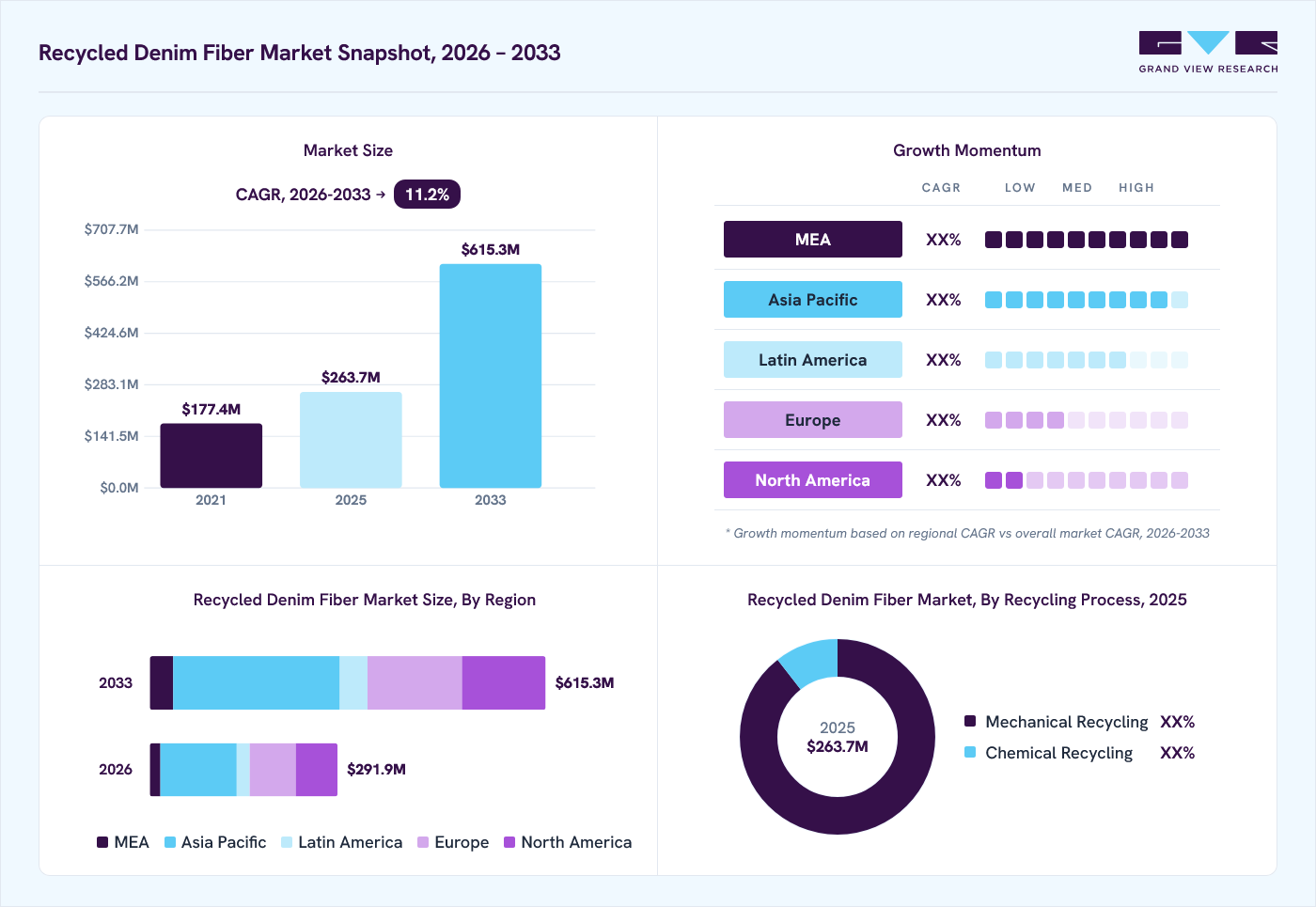
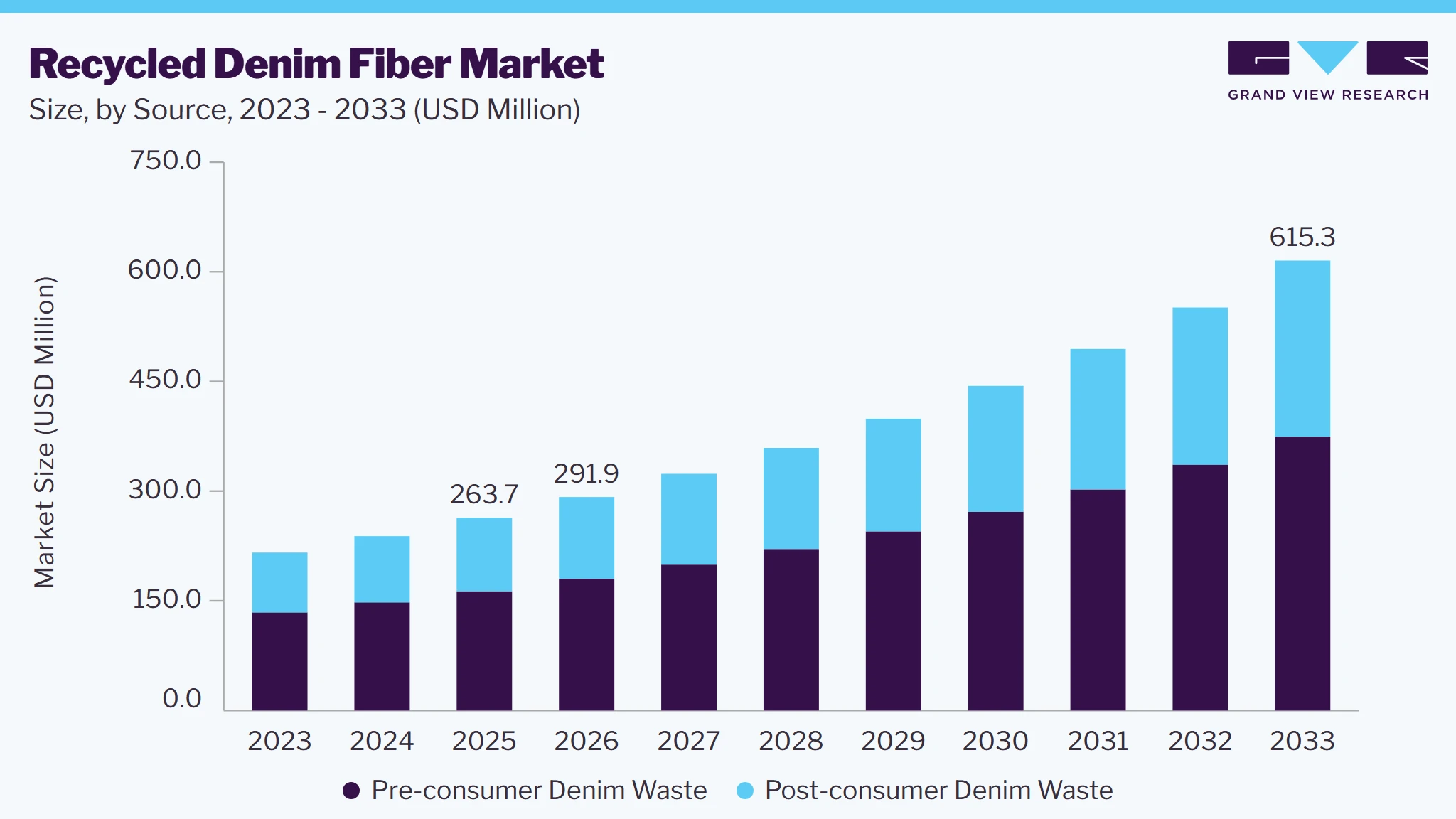
The global recycled denim fiber market size was valued at USD 263.7 million in 2025 and is projected to grow from USD 291.9 million in 2026 to USD 615.3 million by 2033, at a CAGR of 11.2% from 2026 to 2033. Asia Pacific dominated the global market, accounting for the largest revenue share of 40.4% in 2025. The demand for recycled denim fiber is increasing as apparel manufacturers and brands seek to reduce textile waste and lower their dependence on virgin raw materials.
 Source: Grand View Research, IR Documents, Primary Interviews, Paid DatabasesTo learn more about this report,
 Download Free Sample Report
Key Market Trends & Insights
- By recycling process: Chemical recycling is expected to grow at a CAGR of 13.0% from 2026 to 2033
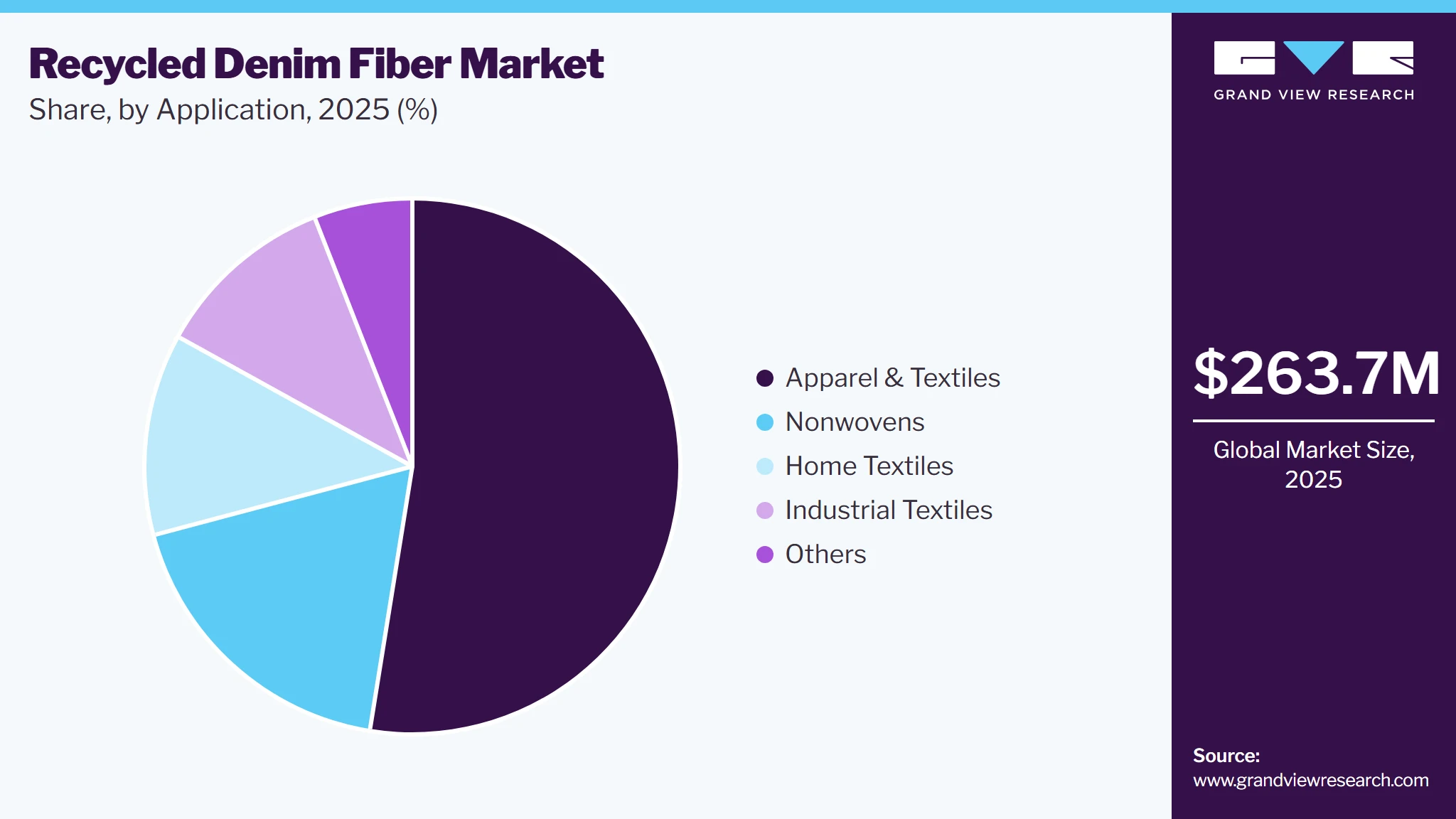
- By application: Apparel & textiles held the largest revenue share of 52.5% in 2025
- By source: the post-consumer denim waste segment is projected to register a CAGR of 11.6% during the forecast period from 2026 to 2033.
Regional Highlights
- Largest regional market: Asia Pacific (40.4% revenue share, 2025)
- Fastest-growing regional market: Middle East & Africa (fastest CAGR, 2026-2033)
- By country: China led Asia Pacific in 2025
Market Size & Forecast
- Market Size in 2025: USD 263.7 Million
- Estimated Market Size in 2026: USD 291.9 Million
- Projected Market Size by 2033: USD 615.3 Million
- CAGR (2026-2033): 11.2%
GVR research-powered AIAsk Prism AI about the recycled denim fiber marketGet cited answers from GVR research on market growth, segments, regulations and forecasts.Start with✓ Source-linked answers ✓ Market-specific context ✓ Traceable figuresExplore Prism AI ↗
Denim is particularly suitable for recycling because large volumes of pre-consumer cutting waste and post-consumer denim garments can be recovered and converted into usable fibers. Growing consumer preference for sustainable fashion is encouraging brands to incorporate recycled materials into denim collections and other textile products. The increasing focus on circularity is also shifting the industry from conventional linear production toward reuse, recycling, and fiber-to-fiber production models.Environmental concerns associated with conventional textile production are acting as a major driver for recycled denim fiber industry’s growth. Cotton cultivation requires substantial land and water resources, while textile manufacturing generates considerable quantities of cutting waste and discarded garments. Recycled denim fiber provides manufacturers with an opportunity to improve resource efficiency while reducing the amount of textile waste directed toward disposal. The growing emphasis on traceability and sustainable sourcing is also encouraging brands to establish stronger relationships with recycling companies and recycled-fiber suppliers.
 To learn more about this report, Download Free Sample Report
Technological advancement is improving the quality and commercial viability of recycled denim fiber. Mechanical recycling remains important for denim waste because discarded fabrics can be sorted, shredded, opened, and processed into reusable fibers. However, repeated mechanical processing can shorten fiber length and affect strength, encouraging manufacturers to develop improved opening and fiber-recovery techniques and blend recycled fibers with stronger virgin or recycled materials. Advanced sorting technologies can improve the separation of suitable textile waste based on fiber composition, color, and contamination.
Market Dynamics
The recycled denim fiber market is being shaped by rising textile waste, growing demand for sustainable, circular fashion materials, brand commitments to recycled content, and the development of textile-to-textile recycling systems. Recycled denim fiber enables manufacturers to convert pre- and post-consumer denim waste into reusable textile inputs, reducing dependence on virgin cotton. The market is also benefiting from greater emphasis on circular supply chains, take-back programs, traceability, and responsible material sourcing. However, the market remains constrained by inconsistent feedstock quality, fiber degradation during mechanical recycling, collection and sorting challenges, and competition from virgin and other recycled fibers.
The increasing adoption of recycled materials across the apparel and fashion industry is a major driver for recycled denim fiber. Denim manufacturers and apparel brands are increasingly seeking alternatives to virgin cotton as sustainability commitments and circular-economy objectives become more prominent. Pre-consumer cutting waste and discarded denim garments provide suitable feedstock that can be mechanically processed into recycled fibers and subsequently incorporated into yarn and fabric production.
Recycled denim fiber can also be blended with virgin cotton or other recycled fibers to achieve the strength and quality requirements of finished products. The expansion of sustainable denim collections and increasing collaboration between brands, recyclers, mills, and fiber producers are therefore creating stronger demand for recycled denim fiber.
The quality and consistency of recycled denim fiber remain important constraints for market development. Mechanical recycling involves opening and shredding denim materials, which can shorten cotton fibers and affect properties such as strength, softness, and spinning performance. Post-consumer denim can also contain zippers, buttons, coatings, elastane, dyes, finishes, and other materials that require additional sorting and separation before recycling. The availability of suitable denim waste varies with collection systems, geographic location, and the composition of discarded garments. These challenges can increase processing requirements and make it difficult to achieve consistent recycled-fiber specifications.
Advanced textile-to-textile recycling technologies present significant opportunities to improve the quality and scalability of recycled denim fiber. Improved mechanical recycling, automated sorting, fiber recovery, and blending technologies can enable greater utilization of denim waste while maintaining more consistent fiber properties. Chemical and other advanced recycling approaches could further expand the ability to recover fibers from blended or difficult-to-process denim materials. The development of closed-loop denim systems, in which discarded garments are collected, recycled, and converted into new textile products, can strengthen connections among brands, recyclers, textile mills, and consumers.
Market Concentration & Characteristics
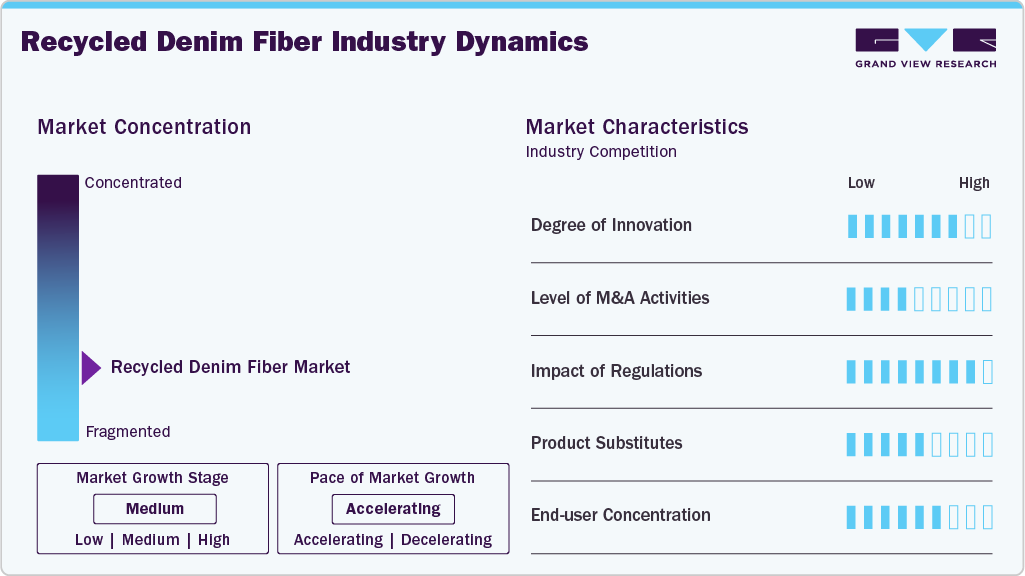
The recycled denim fiber market is fragmented, with competition involving textile recyclers, fiber manufacturers, denim producers, apparel companies, and specialized circular-economy companies. Market participants differentiate themselves through feedstock availability, recycling technology, fiber quality, processing efficiency, recycled-content levels, and traceability. Companies with established textile waste collection networks can benefit from more reliable access to raw materials, while vertically integrated players can improve control over recycling and downstream manufacturing. Partnerships between apparel brands and recyclers are also becoming increasingly important as brands seek consistent supplies of recycled fibers and greater visibility across the recycling value chain.
 To learn more about this report, Download Free Sample Report
The threat from product substitutes is moderate because recycled denim fiber competes with several conventional and sustainable textile materials. Virgin cotton remains a major substitute because of its established supply chain, consistent quality, widespread availability, and familiarity among textile manufacturers. Recycled cotton from non-denim textile waste can provide similar circularity benefits while offering a broader feedstock base. Recycled polyester is another important alternative, particularly for applications requiring greater durability or synthetic-fiber characteristics. Regenerated cellulose fibers and other bio-based or recycled fibers can also compete where manufacturers prioritize softness, sustainability, or specific performance characteristics.
Analyst Perspective
The recycled denim fiber market is positioned for steady expansion as the textile industry shifts toward circular production, resource efficiency, and reduced reliance on virgin cotton. Increasing textile waste, sustainability commitments from apparel brands, and regulatory emphasis on recycling are creating favorable conditions for recycled denim fiber adoption. Market development will depend on the availability and quality of pre- and post-consumer denim waste, the ability of recyclers to maintain fiber strength and consistency, and the cost competitiveness of recycled fibers against virgin and alternative materials. Mechanical recycling is expected to remain important, while advanced recycling technologies could gradually improve fiber quality and expand applications.
Recycling Process Insights
The mechanical recycling segment dominated the recycled denim fiber industry, accounting for the largest revenue share of 89.4% in 2025, supported by its established processing infrastructure and relatively straightforward approach to converting denim waste into reusable fibers. Mechanical recycling involves sorting, cutting, shredding, opening, and carding discarded denim to recover textile fibers for subsequent yarn and fabric production. Its comparatively mature technology and suitability for cotton-rich denim waste make it widely used across existing recycling operations.
The chemical recycling segment is expected to grow at a CAGR of 13.0% over the forecast period, as manufacturers seek higher-quality regenerated fibers from denim and other cotton-rich textile waste. Chemical recycling can dissolve or process cellulosic components and regenerate them into new fibers, potentially overcoming some of the fiber-length and strength limitations associated with mechanical recycling. Research has demonstrated the regeneration of cellulose fibers from waste denim while retaining or removing the original color, depending on the process.
Source Insights
The pre-consumer denim waste segment dominated the recycled denim fiber market, accounting for the largest revenue share of 61.9% in 2025, supported by its relatively consistent composition, easier collection, and lower contamination compared with discarded garments. Cutting scraps, fabric offcuts, and other manufacturing waste can generally be collected directly from textile and apparel production facilities, reducing sorting and preprocessing requirements. These cleaner, more homogeneous waste streams are particularly suitable for mechanical recycling and can yield recycled fibers with more consistent characteristics.
The post-consumer denim waste segment is expected to grow at a CAGR of 11.6% over the forecast period, as collection systems, take-back programs, and textile recycling infrastructure expand. Used jeans and other discarded denim products represent a substantial source of recyclable cotton, but their recovery is more challenging because garments may contain zippers, buttons, labels, elastane, polyester sewing threads, dyes, and other materials. Improvements in sorting, de-trimming, fiber opening, and advanced recycling are helping address these challenges and increase the usability of post-consumer denim.
Application Insights
The apparel & textiles segment dominated the recycled denim fiber industry, accounting for the largest revenue share of 52.5% in 2025, reflecting the direct compatibility of recycled denim fiber with yarn, fabric, and garment production. Recycled denim fibers can be incorporated into denim fabrics, knitted products, and other textile structures, either independently, where fiber properties permit, or through blending with virgin and other recycled fibers. Growing interest in circular fashion and recycled-content apparel is encouraging denim manufacturers and brands to incorporate recovered fibers into new products.
 To learn more about this report, Download Free Sample Report
The nonwovens segment is expected to grow at a CAGR of 11.7% over the forecast period, as recycled denim fibers that are less suitable for high-quality yarn production can be redirected toward open-loop applications. Mechanical recycling can produce shorter fibers through repeated opening and processing, making some recovered material more suitable for fiber webs and nonwoven products than for conventional spun yarns. Recycled textile fibers are already used in applications such as insulation, padding, acoustic materials, and other technical components.
Regional Insights
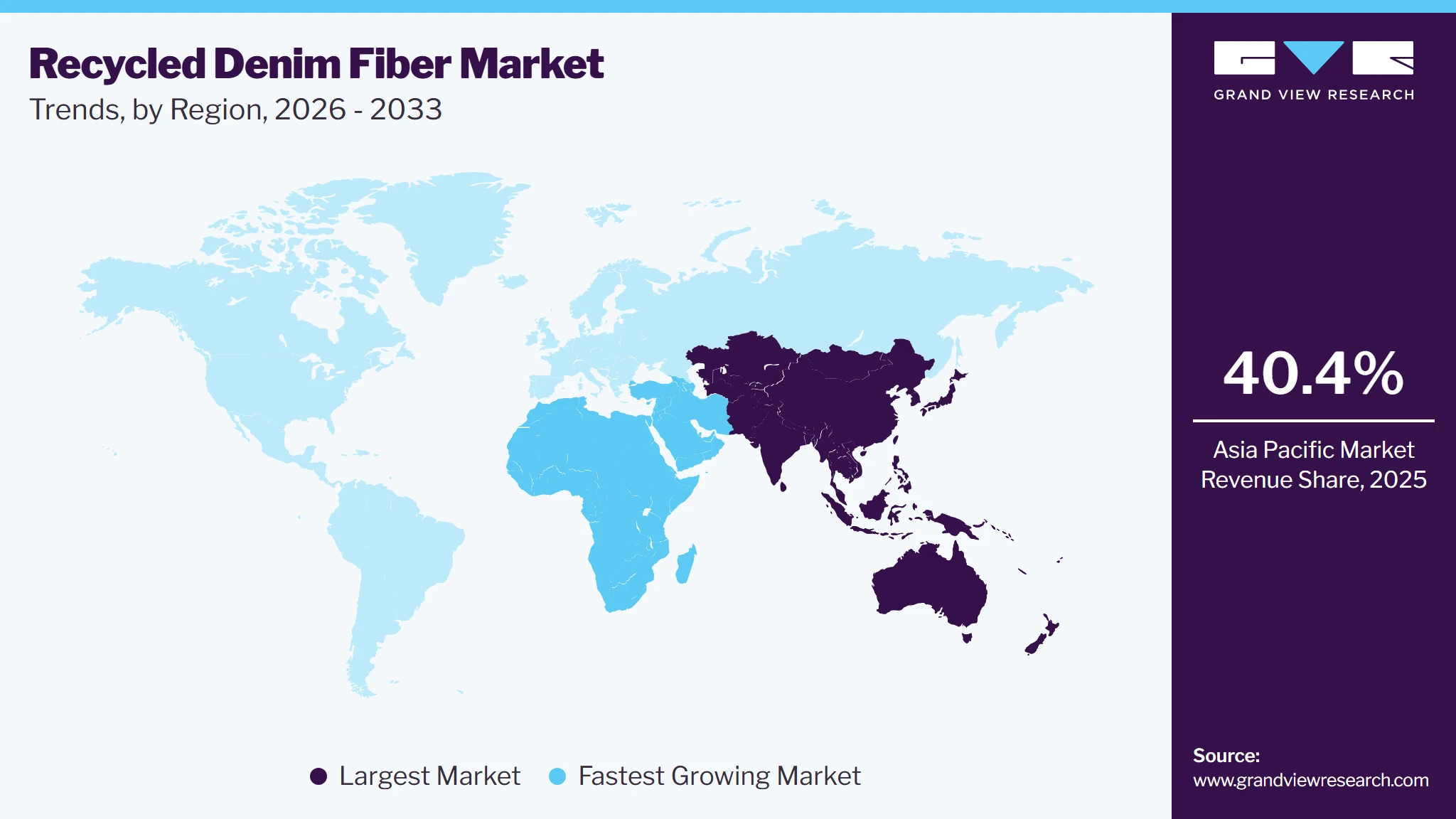
The Asia Pacific recycled denim fiber market dominated with the largest global revenue share of 40.4% in 2025, owing to its extensive textile and apparel manufacturing base, established spinning and yarn production capabilities, and availability of textile processing infrastructure. The region includes major textile and garment-producing economies such as China, India, Bangladesh, Vietnam, and Pakistan, creating a substantial potential customer base for recycled fibers. The concentration of denim mills and garment factories also creates opportunities to collect and recycle pre-consumer denim waste near manufacturing locations.
 To learn more about this report, Download Free Sample Report
The recycled denim fiber market is expected to grow during the forecast period. China is an important market for recycled denim fiber due to its extensive textile manufacturing ecosystem and large-scale capabilities across spinning, weaving, dyeing, garment production, and fiber processing. The country's industrial infrastructure provides recyclers with access to substantial quantities of textile waste generated throughout manufacturing processes. Chinese manufacturers are increasingly focusing on resource efficiency, waste reduction, and sustainable production to meet changing requirements from international customers. The integration of recycling operations with existing spinning and yarn-production facilities can improve the commercial viability of recycled denim fiber.
North America Recycled Denim Fiber Market Trends
North America is an important market for recycled denim fiber due to increasing demand for sustainable apparel and growing attention to textile waste management. Apparel brands, retailers, and textile companies are increasingly incorporating recycled materials into sustainability strategies, creating demand for reliable recycled-fiber suppliers. The United States has a substantial apparel consumption base and generates significant quantities of textile waste, providing a potential feedstock opportunity for recycling companies. The development of collection, sorting, and recycling infrastructure remains important for increasing domestic availability of recycled fibers.
U.S. Recycled Denim Fiber Market Trends
The U.S. is a major demand center due to its large apparel and denim markets and its increasing focus on sustainable materials. Apparel companies and retailers are incorporating recycled fibers into product strategies as consumers and stakeholders place greater emphasis on environmental performance and responsible sourcing. The availability of discarded clothing and other textile waste offers significant potential to expand textile recycling. However, the effectiveness of recycling depends on the development of efficient collection, sorting, processing, and fiber-recovery systems. The U.S. Environmental Protection Agency recognizes discarded clothing as the principal source of textile materials entering municipal solid waste streams, highlighting the importance of improved textile recovery.
Europe Recycled Denim Fiber Market Trends
Europe is expected to remain one of the most important markets for recycled denim fiber due to its strong regulatory focus on circularity, sustainable product design, textile waste reduction, and the use of recycled materials. The European Commission's Sustainable and Circular Textiles Strategy aims for textile products placed on the European market to be more durable, repairable, and recyclable, and to be made largely from recycled fibers. Separate textile collection requirements and increasing emphasis on producer responsibility are also supporting the development of recycling infrastructure.
The recycled denim fiber market in Germany is expected to grow during the forecast period. Germany is an important market in Europe because of its advanced industrial infrastructure, strong environmental focus, and emphasis on resource efficiency and circular manufacturing. German textile and apparel companies are increasingly evaluating recycled materials as part of broader sustainability and resource-management strategies. The country's advanced engineering capabilities create opportunities for the development and adoption of efficient sorting, recycling, automation, and quality-control technologies. Collaboration among textile manufacturers, recycling companies, technology providers, and research institutions can support improvements in recycled-fiber quality and processing efficiency.
Central and South America Recycled Denim Fiber Market Trends
Central and South America presents emerging opportunities for the recycled denim fiber industry as apparel manufacturers, brands, and consumers increasingly focus on sustainable and circular textile production. The region has established textile and garment industries that can support demand for recycled fibers, particularly in countries with strong apparel and denim manufacturing activities. Increasing awareness of textile waste is encouraging manufacturers to explore recycling, reuse, and material recovery solutions. Local recycling capabilities can help reduce waste while creating more localized and traceable textile supply chains.
Middle East & Africa Recycled Denim Fiber Market Trends
The Middle East & Africa recycled denim fiber industry is expected to grow at the fastest CAGR over the forecast period. MEA is an important market for recycled denim fiber, supported by growing sustainability awareness and the gradual development of circular-economy initiatives. Selected countries have textile and apparel manufacturing capabilities that can provide opportunities for recycled-fiber adoption. Development of organized textile collection, sorting, and recycling infrastructure remains important for establishing a reliable supply of denim waste for recycling. International apparel brands operating in the region are also increasing sustainability expectations for suppliers and manufacturing partners.
Key Recycled Denim Fiber Company Insights
Some of the key players operating in the market include Recover Textile Systems, S.L. and Soorty Denim.
-
Recover Textile Systems is a Spain-based textile recycling company specializing in mechanically recycled cotton fibers and blends. Its RDenim product is produced from post-industrial and pre- and post-consumer denim waste, retaining the indigo color and making it suitable for denim applications.
-
Soorty Denim is a vertically integrated denim manufacturer with operations spanning denim fabric and garment production, supported by a strong focus on innovation and sustainability. Its Second Life recycling initiative converts discarded jeans and textile waste into recycled cotton fibers for denim-to-denim and circular textile applications.
Infinited Fiber Company and Evrnu are some of the emerging participants in the recycled denim fiber market.
-
Infinited Fiber Company is a Finnish textile technology company that develops textile-to-textile recycling solutions. Its patented technology converts cellulose-rich textile waste, including discarded cotton garments and jeans, into Infinna, a regenerated fiber designed to provide a cotton-like look and feel.
-
Evrnu is a textile innovation company focused on regenerating textile waste into new engineered fibers. Its Nucycl technology processes cotton-rich textile waste into regenerated lyocell fiber that can be recycled repeatedly, offering an alternative to virgin cotton and polyester.
Key Recycled Denim Fiber Companies
The following key companies have been profiled for this study of the recycled denim fiber market.
-
Recover Textile Systems, S.L.
-
Soorty Denim
-
Candiani Denim
-
Bossa
-
ORTA Anadolu
-
LNJ Denim
-
Evrnu
-
Infinited Fiber Company
-
RE&UP Technologies
-
Circulose
Competitive Benchmarking
Category
Operating Strategies
Competitive Edge
Weakness
Established Players Recover Textile Systems, S.L., Soorty Denim, Candiani Denim, Bossa, ORTA Anadolu, LNJ Denim
- Invest in advanced textile recycling and fiber-processing technologies to convert post-consumer and post-industrial denim waste into high-quality recycled fibers and yarns.
- Expand recycling and production capacity through partnerships with apparel brands, textile manufacturers, recyclers, and sustainability-focused organizations.
- Increase recycled fiber content while improving yarn quality, traceability, durability, and consistency to support large-scale denim production.
- Strong expertise in denim recycling, fiber recovery, yarn production, and sustainable denim manufacturing.
- Established relationships with global apparel brands and textile manufacturers support commercialization and market penetration.
- Integrated capabilities across recycling, spinning, fabric manufacturing, and denim production provide a competitive advantage.
- High capital requirements for recycling equipment, processing infrastructure, and capacity expansion.
- Variability in post-consumer denim waste, including fiber blends, dyes, finishes, and contaminants, can affect recycling efficiency and fiber quality.
- Dependence on reliable textile-waste collection and increasing demand from brands can influence the pace of scaling.
Emerging Players Evrnu, Infinited Fiber Company, RE&UP Technologies, Circulose
- Develop advanced textile-to-textile recycling technologies capable of converting discarded cotton-rich textiles and other textile waste into regenerated or recycled fibers suitable for denim applications.
- Expand through partnerships with fashion brands, recyclers, textile manufacturers, and sustainability organizations to increase adoption of circular fibers.
- Focus on improving fiber quality, recycled content, traceability, process efficiency, and commercial scalability.
- Strong specialization in next-generation textile recycling and regenerated fiber technologies.
- Innovative processes can enable higher-value utilization of textile waste and reduce reliance on virgin raw materials.
- Strong sustainability positioning and partnerships with apparel brands provide differentiation in the circular denim ecosystem.
- Smaller production scale and geographic reach compared with established denim manufacturers and large textile groups.
- Greater dependence on partnerships, financing, feedstock availability, and successful commercial scale-up.
- Challenges remain around collection and sorting of textile waste, processing costs, fiber consistency, scalability, and price competitiveness.
Recent Developments
-
In April 2026, Recover announced a strategic partnership with Prosperity Textile to develop and deliver denim fabrics under the Recover Fabrics platform in Vietnam.
-
In April 2026, RE&UP partnered with Madewell to advance textile circularity; approximately 20,000 pairs of post-consumer jeans were processed and engineered in collaboration with ISKO.
Recycled Denim Fiber Market Report Scope
Report Attribute
Details
Market size in 2025
USD 263.7 million
Estimated market size in 2026
USD 291.9 million
Projected market size by 2033
USD 615.3 million
Growth rate
CAGR of 11.2% from 2026 to 2033
Base year for estimation
2025
Actual estimates/Historical data
2021 - 2024
Forecast period
2026 - 2033
Quantitative units
Revenue in USD million and CAGR from 2026 to 2033
Report coverage
Revenue forecast, company ranking, competitive landscape, growth factors, and trends
Segments covered
Recycling process, source, application, region
Regional scope
North America; Europe; Asia Pacific; Central & South America; Middle East & Africa
Country scope
U.S.; Canada; Mexico; Germany; UK; France; Italy; Spain; China; Japan; India; South Korea; Brazil; Saudi Arabia
Key companies profiled
Recover Textile Systems, S.L.; Soorty Denim; Candiani Denim; Bossa; ORTA Anadolu; LNJ Denim; Evrnu; Infinited Fiber Company; RE&UP Technologies; Circulose
Customization scope
Free report customization (equivalent up to 8 analysts working days) with purchase. Addition or alteration to country, regional & segment scope.
Pricing and purchase options
Avail customized purchase options to meet your exact research needs. Explore purchase options
Global Recycled Denim Fiber Market Report Segmentation
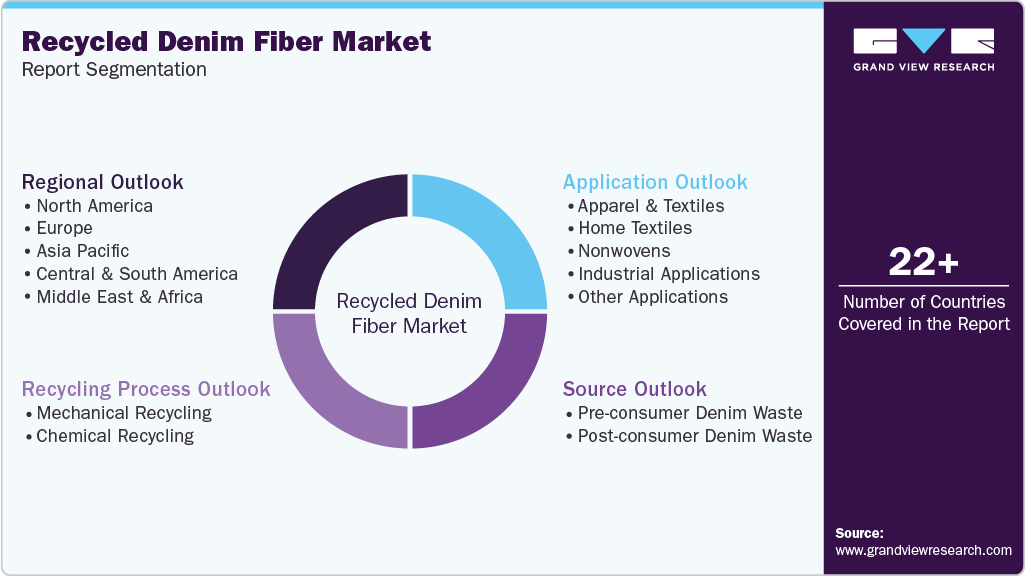
This report forecasts revenue growth at the global, regional & country levels and provides an analysis of the industry trends in each of the sub-segments from 2021 to 2033. For this study, Grand View Research has segmented the global recycled denim fiber market report based on recycling process, source, application, and region:
 To learn more about this report, Download Free Sample Report
-
Recycling Process Outlook (Revenue, USD Million; 2021 - 2033)
-
Mechanical Recycling
-
Chemical Recycling
-
-
Source Outlook (Revenue, USD Million; 2021 - 2033)
-
Pre-consumer Denim Waste
-
Post-consumer Denim Waste
-
-
Application Outlook (Revenue, USD Million; 2021 - 2033)
-
Apparel & Textiles
-
Home Textiles
-
Nonwovens
-
Industrial Applications
-
Other Applications
-
-
Regional Outlook (Revenue, USD Million; 2021 - 2033)
-
North America
-
U.S.
-
Canada
-
Mexico
-
-
Europe
-
UK
-
Germany
-
France
-
Italy
-
Spain
-
-
Asia Pacific
-
China
-
Japan
-
India
-
South Korea
-
-
Central and South America
-
Brazil
-
-
Middle East and Africa
-
Saudi Arabia
-
-
Research Methodology
The recycled denim fiber market figures in this report are based on a proven research process that combines executive interviews with secondary research from proprietary databases, company filings, and recognized regulatory and institutional sources. Market size is built through value-chain sizing-reconciling supply-side and demand-side estimates-and triangulated with bottom-up and top-down approaches. Every estimate passes multiple levels of expert validation before publication, with each recycled denim fiber segment quantified using the revenue-capture definitions in the table below.
Segment Definition
Segment - Recycling Process
Revenue capture definition
Mechanical Recycling
Revenue generated from the sale of recycled denim fibers produced through mechanical recycling processes, where pre-consumer or post-consumer denim waste is collected, sorted, shredded, opened, and processed into recycled cotton fibers without chemically altering the polymer or cellulose structure.
Chemical Recycling
Revenue generated from the sale of recycled denim fibers produced through chemical recycling technologies that dissolve, depolymerize, or otherwise chemically process denim waste to regenerate cellulose or other fiber-forming materials into new textile-grade fibers.
Segment - Source
Revenue capture definition
Pre-consumer Denim Waste
Revenue generated from the sale of recycled denim fibers produced using pre-consumer denim waste, including cutting scraps, fabric offcuts, rejected fabrics, production remnants, and other denim waste generated before garments reach consumers.
Post-consumer Denim Waste
Revenue generated from the sale of recycled denim fibers produced using discarded denim garments and textile products collected after consumer use, including used jeans, jackets, shirts, and other denim apparel diverted from landfill or incineration.
Segment - Application
Revenue capture definition
Apparel & Textiles
Revenue generated from the sale of recycled denim fibers used in apparel and textile products, including jeans, jackets, shirts, workwear, fashion garments, denim fabrics, yarns, and other clothing applications.
Home Textiles
Revenue generated from the sale of recycled denim fibers used in household textile products, including bedding, curtains, upholstery, cushions, rugs, towels, and other home furnishing textiles.
Nonwovens
Revenue generated from the sale of recycled denim fibers used in nonwoven products, including insulation materials, filtration media, padding, automotive nonwovens, wipes, and other engineered textile structures.
Industrial Applications
Revenue generated from the sale of recycled denim fibers used in industrial and technical textile applications, including automotive components, construction materials, acoustic insulation, protective materials, composites, and other industrial products.
Other Applications
Revenue generated from the sale of recycled denim fibers used in applications not classified under apparel and textiles, home textiles, nonwovens, or industrial applications, including specialty products, craft materials, accessories, and emerging applications.
Estimation Model
Layer Name
Key Question
Description
Parent Market Analysis
What is the overall size and growth outlook of the global textile fibers, cotton fibers, recycled textile fibers, and sustainable textile materials market?
The estimation begins by evaluating the broader textile fibers, cotton fibers, recycled textile fibers, and sustainable textile materials market. Global fiber production and consumption, cotton demand, textile manufacturing capacity, apparel production, textile waste generation, recycling infrastructure, and investments in circular and sustainable materials are analyzed to establish the total addressable market for recycled denim fiber.
Recycled Fiber & Denim Waste Penetration Analysis
What proportion of the overall recycled and sustainable textile fiber market is represented by recycled denim fiber across waste sources, fiber types, and processing methods?
This layer estimates the penetration of recycled denim fiber within the broader recycled and sustainable textile fiber market. Adoption is assessed across pre-consumer denim waste, post-consumer denim garments, cutting scraps, discarded denim products, and other cotton-rich textile waste. Penetration is further evaluated across mechanically recycled fibers, chemically recycled fibers, blended recycled fibers, staple fibers, and other recycled recycling processs to determine the market contribution of recycled denim fiber.
Regional & End-use Demand Assessment
Which regions and end-use industries contribute the highest demand for recycled denim fiber?
Market demand is evaluated across major regions based on textile and apparel manufacturing capacity, denim production, availability of textile waste, recycling infrastructure, sustainability regulations, circular economy initiatives, and adoption of recycled materials. Demand is further assessed across apparel and clothing, denim products, home textiles, accessories, footwear, automotive textiles, and other textile applications to determine regional and end-use penetration.
Company Revenue Validation & Market Forecasting
How is the final market size validated and forecast?
Final estimates are validated using company revenues, recycled denim fiber production capacities, textile waste collection and processing capacities, product portfolios, manufacturing facilities, recycling technologies, sustainability partnerships, certifications, and announced capacity expansions. Bottom-up and top-down approaches are triangulated using company-level and industry-level data to generate reliable market estimates and forecasts for recycled denim fiber.
Delivered Customizations
We have successfully delivered the following deep-dive customizations:
Client Request
Customization Delivered
Value Adds
Denim Waste Feedstock & Recycling Potential Assessment
Analyze the availability of pre-consumer and post-consumer denim waste, collection channels, cotton content, sorting requirements, and suitability of different denim waste streams for fiber recycling.
Helps assess feedstock availability, recycling potential, and the key raw-material constraints affecting recycled denim fiber production.
Recycled Fiber Quality & Application Suitability Analysis
Evaluate recycled denim fiber characteristics including fiber length, strength, softness, color consistency, recycled content, blending requirements, and compatibility with spinning and fabric production across major applications.
Helps manufacturers understand where recycled denim fiber can effectively replace virgin fibers and which applications offer the strongest commercial potential.
Denim Circularity & Brand Adoption Analysis
Assess the adoption of recycled denim fiber across denim brands, apparel manufacturers, textile producers, and retailers, along with circular-fashion initiatives, recycled-content strategies, take-back programs, and textile-to-textile recycling partnerships.
Identifies demand-side opportunities, potential customer groups, brand partnerships, and factors influencing the transition toward recycled denim fiber.
Frequently Asked Questions About This Report
The recycled denim fiber market size was valued at USD 263.7 million in 2025 and is estimated at USD 291.9 million in 2026
The recycled denim fiber market is expected to grow at a compound annual growth rate of 11.2% from 2026 to 2033 to reach USD 615.3 million by 2033.
The mechanical recycling segment accounted for the highest revenue share of 89.4% in 2025, driven by its established processes, cost efficiency, and suitability for recycling cotton-rich denim waste.
Asia Pacific held the highest revenue market share of 40.4% in 2025, driven by its large textile manufacturing base, abundant denim production, and growing adoption of sustainable recycling practices.
Rising demand for sustainable textiles, increasing textile waste, growing adoption of circular fashion, and advancements in denim recycling technologies are key factors driving the recycled denim fiber market.
Some key players in the recycled denim fiber market include Recover Textile Systems, S.L., Soorty Denim, Candiani Denim, Bossa, ORTA Anadolu, LNJ Denim, Evrnu, Infinited Fiber Company, Circulose, and RE&UP Technologies.
The post-consumer denim waste segment is the fastest-growing source in the recycled denim fiber market.
The nonwovens segment is the fastest-growing application in the recycled denim fiber market.
The apparel & textiles segment accounted for the largest revenue share of 52.5% in 2025, driven by strong demand for sustainable denim and recycled fibers in clothing and textile manufacturing
About the Author(s)
Smart Textiles Research Team
Advanced Materials · Smart TextilesThis report was authored by the smart textiles research team at Grand View Research - comprising two research analysts, one senior research analyst, and one industry expert - with specialized expertise in the smart textiles segment of the advanced materials industry. All findings are based on proprietary advanced materials databases, executive interviews, and regulatory analysis, subject to internal peer review prior to publication.
Last Updated:
Speak to Analyst

Customize this report to your needs - add regions, segments, or data points, with 20% free customization.
Or view our licence options:


ISO 9001:2015 & 27001:2022 Certified
We are GDPR and CCPA compliant! Your transaction & personal information is safe and secure. For more details, please read our privacy policy.


