
- Home
- »
- Renewable Chemicals
- »
-
Renewable Chemicals Market Size & Share Report, 2033GVR Report cover

Renewable Chemicals Market (2026 - 2033)
Size, Share & Trends Analysis Report By Product (Bio-based Alcohols, Bio-based Hydrocarbons), By Application (Food & Beverage, Packaging, Construction, Agriculture, Electronics), By Region, And Segment Forecasts
Market Size, 2025
$151.3BMarket Estimate, 2026
$164.1BMarket Forecast, 2033
$303.1BCAGR, 2026–2033
9.2%Renewable Chemicals Market Summary
The global renewable chemicals market size was valued at USD 151.3 billion in 2025 and is projected to grow from USD 164.1 billion in 2026 to USD 303.1 billion in 2033, at a CAGR of 9.2% from 2026 to 2033. Asia Pacific dominated the market, accounting for the largest revenue share of 38.2% in 2025. The market growth is supported by the increasing demand for sustainable and bio-based products across packaging, automotive, personal care, healthcare, agriculture, and industrial manufacturing.
Key Market Trends & Insights
- By product: Bio-based alcohols held the largest revenue share of 42.8% in 2025
- By application: Packaging dominated the renewable chemicals industry, accounting for a revenue share of 17.3% in 2025.
Regional Highlights
- Largest regional market: Asia Pacific (38.2% revenue share, 2025)
- By country: China held the largest market share in 2025.
Market Size & Forecast
- Market size in 2025: USD 151.3 Billion
- Estimated market size in 2026: USD 164.1 Billion
- Projected market size by 2033: USD 303.1 Billion
- CAGR (2026-2033): 9.2%
Three ways to get this report
Buy it, customize it, or ask a question.Ask an Analyst
Analyst response in 1 business day
- AccessReport author, directly
- Reply timeWithin 1 working day
- No sales callDirect answer only
- FormatEmail reply
- CostFree, no cost
Get the Full Report
What the study covers
- FormatsPDF · Excel · Dashboard
- Timeline2026–2033 annual, 2025 base
- Coverage20+ countries, 5 regions
- Companies10+ key players profiled
Customize the Report
20% free customization
- IncludeCountries, segments, points
- TailorTo your product definition
- ExtendDeeper competitor detail
- OrA fully bespoke study
- Turnaround5–10 working days
Increasing demand for sustainable and bio-based products, coupled with expanding applications across packaging, automotive, agriculture, personal care, textiles, and industrial manufacturing, is driving the adoption of renewable chemicals. Renewable chemicals are produced from biomass, agricultural residues, vegetable oils, sugars, and other renewable feedstocks, offering lower greenhouse gas emissions and reduced dependence on fossil-based raw materials compared to conventional petrochemicals.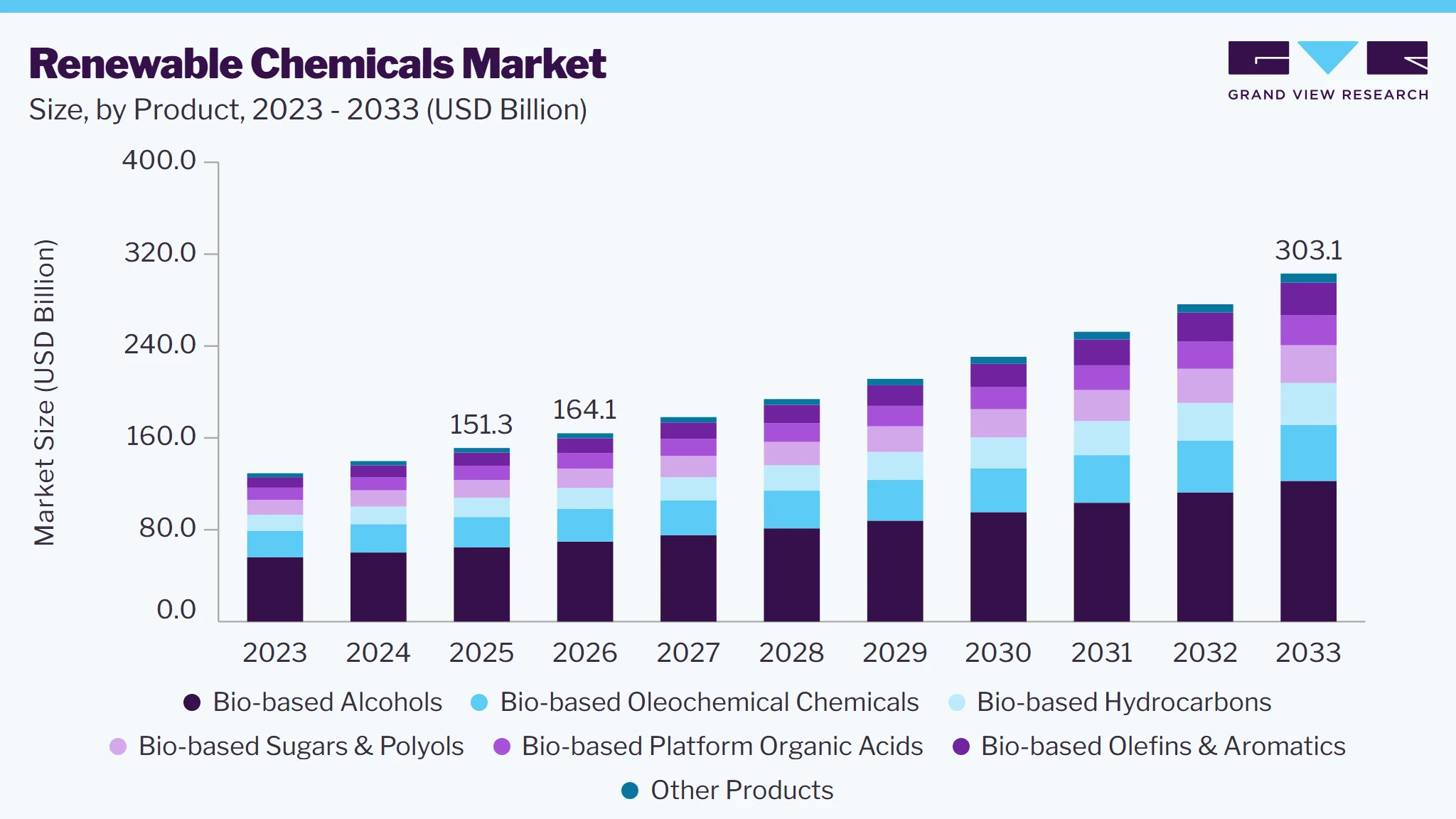 Source: Grand View Research, IR Documents, Primary Interviews, Paid DatabasesTo learn more about this report,
 Download Free Sample Report
 They are widely used in the production of bio-based polymers, solvents, organic acids, alcohols, surfactants, lubricants, and specialty chemicals. Growing regulatory support for decarbonization, increasing corporate sustainability commitments, rising consumer preference for environmentally friendly products, and continued investments in biorefineries, industrial biotechnology, and green chemistry technologies are further accelerating market growth.
Market Dynamics
The renewable chemicals market is driven by increasing demand for sustainable alternatives to petroleum-based chemicals across industries such as packaging, automotive, agriculture, personal care, textiles, and construction. Growing environmental concerns, stringent carbon emission regulations, and corporate commitments toward net-zero targets are accelerating the adoption of bio-based and renewable chemical products. Technological advancements in biomass conversion, industrial biotechnology, and green chemistry are improving production efficiency and expanding commercial applications. Government incentives supporting the bioeconomy, coupled with rising investments in biorefineries and strategic collaborations, continue to strengthen market growth.
The transition toward a circular and low-carbon economy is the primary driver of the renewable chemicals market. Manufacturers are increasingly replacing fossil-based feedstocks with renewable raw materials such as biomass, agricultural residues, vegetable oils, sugar, and waste-derived resources to reduce greenhouse gas emissions and improve sustainability. Consumer preference for environmentally friendly products and stricter regulations on carbon emissions are encouraging industries to incorporate renewable chemicals into packaging, consumer goods, automotive components, coatings, and industrial applications.
Major chemical producers are investing in advanced biorefinery technologies and expanding production capacities to meet rising demand for bio-based solvents, organic acids, alcohols, polymers, and specialty chemicals. These developments are expected to support long-term market expansion.
Renewable chemicals often involve higher production costs than conventional petrochemicals due to expensive biomass feedstocks, advanced processing technologies, and capital-intensive manufacturing facilities. Variability in feedstock quality, seasonal availability, and logistics can also affect production efficiency and supply stability.
The market additionally faces competition from established petrochemical products, particularly when crude oil prices remain relatively low. Scaling up commercial production while maintaining cost competitiveness continues to be a significant challenge for manufacturers, especially in emerging markets with limited bio-based infrastructure.
Growing investments in integrated biorefineries and circular economy initiatives present significant opportunities for renewable chemical manufacturers. Governments and private companies are supporting projects that convert renewable biomass, agricultural waste, municipal waste, and industrial by-products into high-value chemicals, reducing dependence on fossil resources while improving resource efficiency.
Increasing adoption of bio-based materials in sustainable packaging, electric vehicles, textiles, and personal care products is creating new growth avenues. Advances in synthetic biology, precision fermentation, and carbon capture utilization technologies are further expanding the commercial potential of renewable chemicals, enabling manufacturers to diversify product portfolios and improve production economics.
Market Concentration & Characteristics
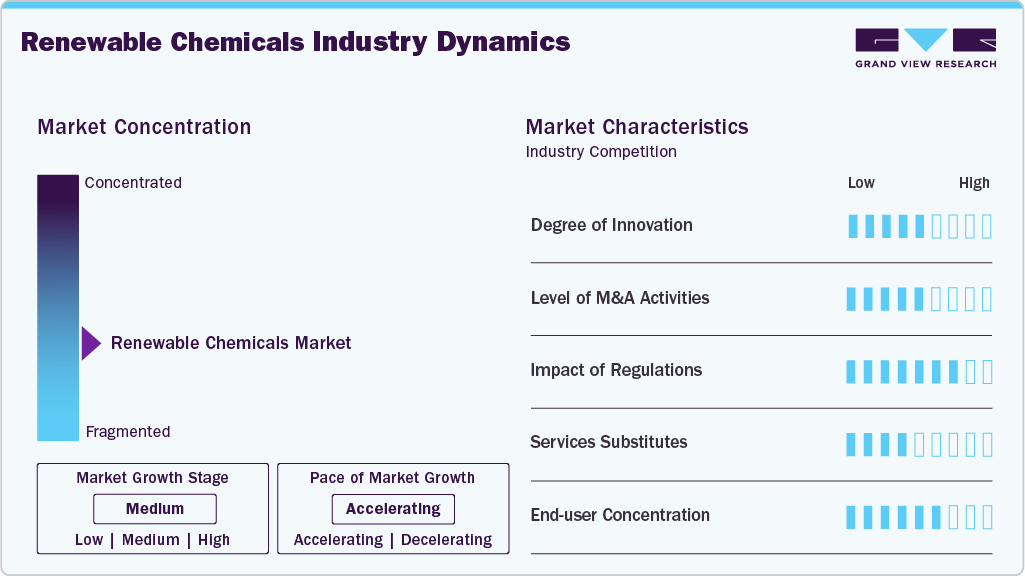
The renewable chemicals market is moderately fragmented, with the presence of both large multinational chemical companies and specialized bio-based chemical manufacturers. Competition is driven by technological innovation, sustainable feedstock sourcing, production efficiency, product performance, regulatory compliance, and long-term partnerships across the value chain. Leading companies are focusing on expanding biorefinery capacity, investing in research and development, forming strategic collaborations, and commercializing next-generation bio-based chemicals to strengthen their competitive position in a rapidly evolving sustainable chemicals industry.
 To learn more about this report, Download Free Sample Report
 Participants in the renewable chemicals market are strengthening their market position through strategic investments in biorefinery capacity, technological innovation, and sustainable feedstock sourcing. Companies are expanding production facilities, forming long-term partnerships across the biomass value chain, and investing in advanced biotechnology and green chemistry processes to improve production efficiency and reduce carbon emissions. Investments in process optimization, regional manufacturing facilities, and circular economy initiatives are helping manufacturers enhance supply reliability, diversify renewable feedstock sources, and meet the growing demand for bio-based chemicals across packaging, automotive, personal care, agriculture, and industrial applications.
Analyst Perspective
The renewable chemicals market is driven by the growing demand for chlorine dioxide in pulp bleaching and the expansion of sustainable paper production worldwide. Rising consumption of packaging paper, tissue products, and specialty paper is encouraging investments in modern pulp manufacturing facilities, increasing the need for renewable chemicals. Improvements in electrolysis technologies and process efficiency are enhancing production preproduction while supporting cost optimization and environmental compliance.
Product Insights
The bio-based alcohols segment dominated the renewable chemicals market, accounting for 42.8% of revenue share in 2025. Their leadership is driven by widespread use in biofuels, solvents, personal care products, pharmaceuticals, and chemical intermediates. Strong demand for bioethanol, biobutanol, and other renewable alcohols, supported by sustainability initiatives and the shift away from fossil-based chemicals, continues to strengthen this segment.
The bio-based olefins & aromatics segment is expected to grow at the fastest CAGR of 12.2% from 2026 to 2033. Growth is fueled by increasing demand for sustainable feedstocks in the production of bio-based plastics, synthetic rubbers, packaging materials, and specialty chemicals. Advancements in biomass conversion technologies and expanding investments in commercial-scale biorefineries are further accelerating segment growth.
Application Insights
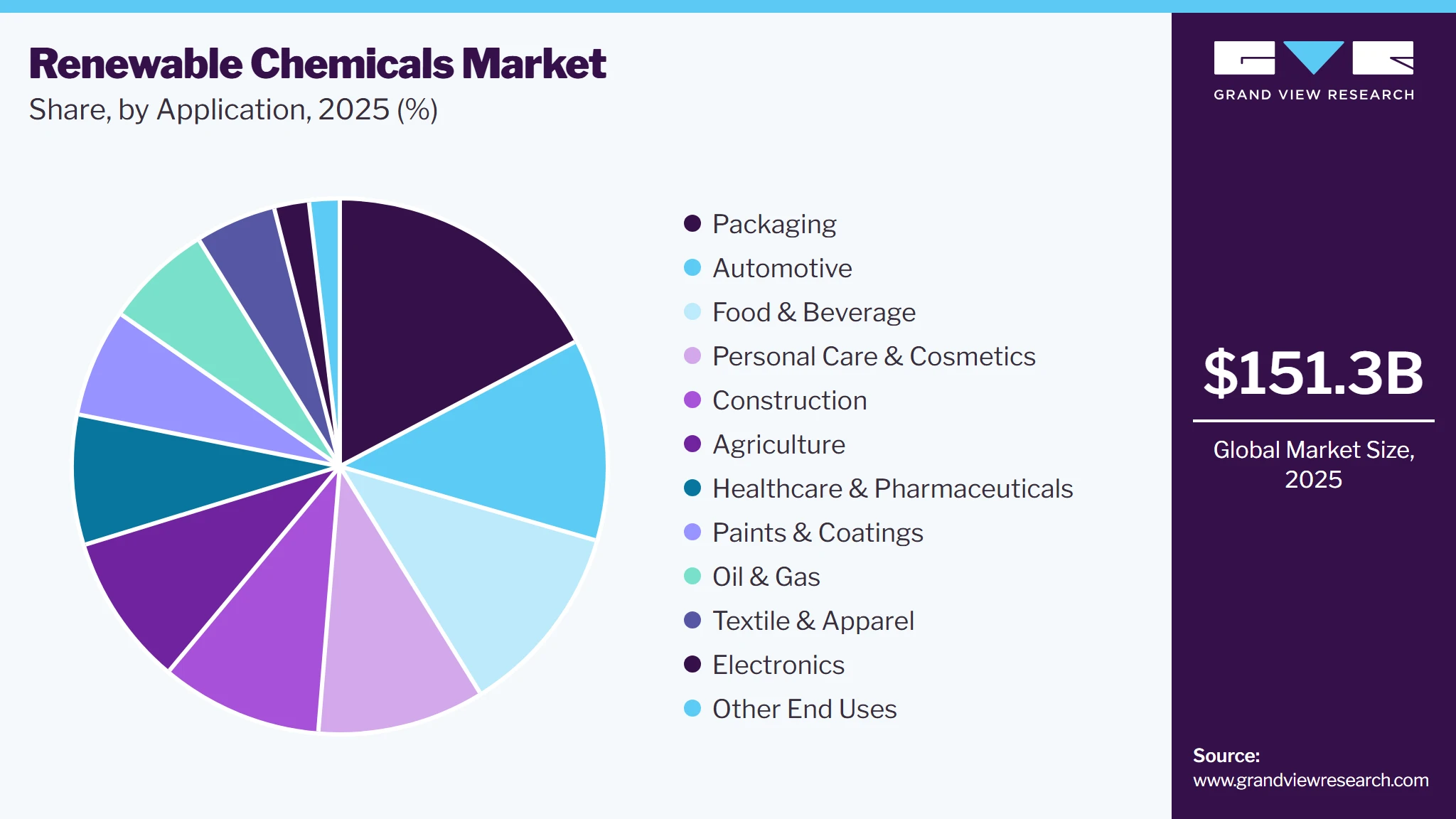
The packaging dominated the renewable chemicals industry, accounting for a revenue share of 17.3% in 2025. Rising demand for sustainable and recyclable packaging materials, increasing regulations on single-use plastics, and growing adoption of bio-based polymers by food, beverage, and consumer goods manufacturers are driving the widespread use of renewable chemicals in this sector.
 To learn more about this report, Download Free Sample Report
 The healthcare & pharmaceuticals segment is expected to grow at the fastest CAGR of 10.2% over the forecast period. Increasing demand for bio-based pharmaceutical ingredients, biodegradable medical materials, specialty solvents, and sustainable excipients, along with expanding investments in green pharmaceutical manufacturing, is supporting rapid growth in this application segment.
Regional Insights
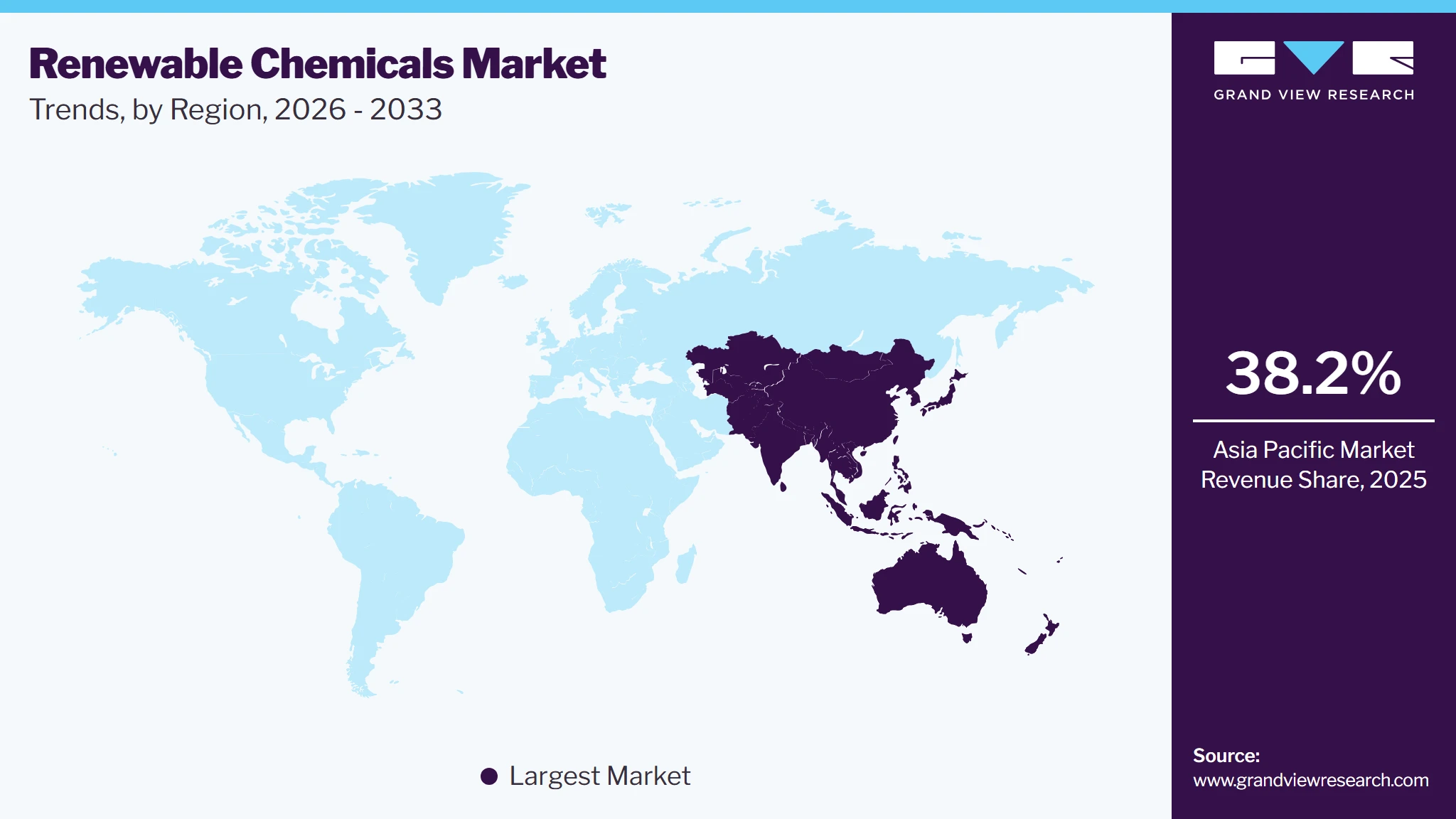
Asia Pacific led the global renewable chemicals market in 2025, accounting for 38.2% of revenue share. The region's leadership is supported by abundant biomass availability, rapid industrialization, favorable government policies promoting bio-based manufacturing, and growing demand from packaging, automotive, textiles, and consumer goods industries. Increasing investments in biorefineries, bio-based polymers, and industrial biotechnology, particularly in China, India, Japan, and Southeast Asia, continue to strengthen regional market growth.
 To learn more about this report, Download Free Sample Report
 China Renewable Chemicals Market Trends
The China renewable chemicals market held the largest share of Asia Pacific in 2025. The country's strong position is driven by its extensive manufacturing base, government initiatives supporting carbon neutrality and green industrial development, and growing investments in bio-based materials and sustainable chemicals. Rising demand from packaging, automotive, construction, and consumer goods sectors, along with expanding production capacities for bio-based chemicals, continues to support market expansion.
North America Renewable Chemicals Market Trends
North America represents a significant market for renewable chemicals, supported by advanced biotechnology capabilities, established biorefinery infrastructure, and increasing adoption of sustainable materials across industrial sectors. Strong regulatory support for decarbonization, rising corporate sustainability commitments, and growing investments in renewable feedstocks and circular economy initiatives are accelerating market growth across the region.
The U.S. leads the North American renewable chemicals industry due to its strong research and development ecosystem, abundant agricultural feedstocks, and increasing commercialization of bio-based chemicals. Investments in precision fermentation, synthetic biology, and next-generation biorefineries, combined with rising demand from packaging, automotive, personal care, and industrial applications, continue to drive market growth.
Europe Renewable Chemicals Market Trends
Europe is a major market for renewable chemicals, driven by stringent environmental regulations, ambitious climate targets, and strong policy support for the circular economy. Increasing adoption of bio-based materials, investments in sustainable manufacturing technologies, and growing demand for renewable chemicals across packaging, automotive, coatings, and consumer products are supporting steady market expansion throughout the region.
Latin America Renewable Chemicals Market Trends
The Latin America renewable chemicals industry is witnessing steady growth, supported by abundant biomass resources, expanding biofuel and bio-based chemical industries, and increasing investments in sustainable industrial development. Countries such as Brazil are leveraging sugarcane and agricultural feedstocks to expand the production of bio-based chemicals, creating new opportunities for regional manufacturers.
Middle East Renewable Chemicals Market Trends
The Middle East renewable chemicals industry is gradually expanding as countries diversify their economies beyond conventional petrochemicals and invest in sustainable industrial development. Growing interest in green hydrogen, carbon utilization technologies, and bio-based chemical production, along with government initiatives promoting low-carbon industries and circular economy practices, is expected to support long-term market growth.
Key Renewable Chemicals Company Insights
Companies operating in the renewable chemicals market are adopting strategies centered on production capacity expansion, process optimization, feedstock diversification, and sustainable manufacturing to strengthen their competitive position. Leading manufacturers are investing in advanced biorefinery technologies, industrial biotechnology, precision fermentation, and green chemistry processes to improve production efficiency and reduce carbon emissions. They are also expanding regional manufacturing facilities, securing renewable feedstock supply, and forming strategic partnerships across the value chain to support the growing demand for bio-based chemicals across packaging, automotive, healthcare, personal care, agriculture, and industrial applications.
-
BASF SE is a leading global producer of renewable chemicals, offering a broad portfolio of bio-based intermediates, solvents, alcohols, and specialty chemicals for diverse industrial applications. The company leverages advanced biotechnology, sustainable feedstocks, a global manufacturing footprint, and strong research capabilities to deliver high-performance, low-carbon chemical solutions. BASF continues to strengthen its market position through investments in bio-based product innovation, sustainable manufacturing technologies, production capacity expansion, and strategic collaborations that enhance operational efficiency and support the transition toward a circular economy.
-
Corbion N.V. is a leading manufacturer of renewable chemicals, specializing in bio-based organic acids, lactic acid, lactides, and other fermentation-derived biochemical products. The company combines advanced fermentation technologies with renewable feedstocks to deliver sustainable chemical solutions for packaging, food, pharmaceuticals, personal care, and industrial applications. Corbion continues to enhance its competitive position through investments in biorefinery expansion, process optimization, product innovation, and strategic partnerships while supporting the growing global demand for bio-based and circular chemical solutions.
Key Renewable Chemicals Companies:
The following key companies have been profiled for this study on the renewable chemicals market.
-
BASF SE
-
Corbion N.V.
-
Braskem S.A.
-
Borregaard ASA
-
NatureWorks LLC
-
Neste Oyj
-
Mitsubishi Chemical Group Corporation
-
Evonik Industries AG
-
Dow Inc.
-
LanzaTech Global, Inc.
-
Genomatica, Inc.
-
Gevo, Inc.
-
Amyris, Inc.
-
Solugen, Inc.
-
Novamont S.p.A.
Company Categorization
Operating Strategies
Competitive Edge
Weaknesses
Mature Players BASF SE; Corbion N.V.; Braskem S.A.; Borregaard ASA; Mitsubishi Chemical Group Corporation; Evonik Industries AG; Dow Inc.; Neste Oyj
- Invest in biorefinery expansion, production capacity, and advanced biotechnology to increase the commercial production of renewable chemicals.
- Strengthen sustainable feedstock sourcing through long-term partnerships and vertically integrated supply chains.
- Focus on green chemistry, precision fermentation, and process optimization to improve production efficiency and reduce carbon emissions.
- Expand global manufacturing footprint and strategic collaborations to address growing demand across packaging, automotive, healthcare, agriculture, and industrial applications.
- Strong global manufacturing footprint and diversified product portfolios provide economies of scale and reliable supply.
- Significant investments in R&D, industrial biotechnology, and sustainable manufacturing support continuous innovation.
- Established customer relationships across multiple end-use industries enhance market penetration and long-term revenue stability.
- Strong financial resources enable capacity expansion, acquisitions, and commercialization of next-generation bio-based technologies.
- High capital expenditure and production costs associated with advanced biorefinery technologies.
- Dependence on renewable feedstock availability and price fluctuations can impact profitability.
- Regulatory compliance and sustainability certification requirements increase operational complexity.
- Large-scale operations may reduce flexibility in rapidly adapting to emerging niche applications and regional market shifts.
Emerging Players NatureWorks LLC; LanzaTech Global, Inc.; Genomatica, Inc.; Gevo, Inc.; Amyris, Inc.; Solugen, Inc.; Novamont S.p.A.
- Focus on commercialization of innovative bio-based chemicals using fermentation, synthetic biology, carbon utilization, and green chemistry technologies.
- Expand strategic partnerships, licensing agreements, and joint ventures to accelerate market penetration.
- Invest in pilot plants and commercial-scale biorefineries to scale production and improve manufacturing efficiency.
- Target high-growth applications such as sustainable packaging, specialty chemicals, personal care ingredients, and low-carbon industrial materials.
- Strong technological innovation and specialization in next-generation renewable chemical production.
- Agile business models enable rapid product development and faster commercialization of new technologies.
- Ability to address niche, high-value applications with differentiated sustainable products.
- Strong focus on low-carbon production technologies and circular economy solutions enhances competitive positioning.
- Limited commercial-scale manufacturing capacity compared to multinational chemical companies.
- High dependence on external funding, partnerships, and technology licensing for expansion.
- Smaller global distribution networks may limit access to international markets.
- Scale-up risks and feedstock supply constraints can affect production consistency and profitability.
Recent Developments
-
InAugust 2026, P2 Science launched Herbenone, a patented renewable aroma chemical derived from sustainably sourced forestry feedstocks using the company's proprietary green chemistry platform. Commercial production commenced at its Connecticut manufacturing facility, expanding P2 Science's portfolio of renewable specialty chemicals for cosmetics and personal care applications while reinforcing its position in sustainable, bio-based chemical innovation.
-
In April 2024, Neste and LOTTE Chemical entered into a strategic collaboration to accelerate the adoption of renewable chemicals and plastics by replacing fossil-based feedstocks with renewable raw materials. Under the agreement, Neste will supply its 100% renewable Neste RE™ feedstock to LOTTE Chemical's manufacturing facilities in South Korea for the production of chemicals and plastics with a lower carbon footprint. The resulting products are intended for applications across packaging, construction, textiles, and electronics, supporting both companies' sustainability and decarbonization objectives.
Renewable Chemicals Market Report Scope
Report Attribute
Details
Market size in 2025
USD 151.3 billion
Estimated market size in 2026
USD 164.1 billion
Projected market size by 2033
USD 303.1 billion
Growth rate
CAGR of 9.2% from 2026 to 2033
Base year for estimation
2025
Historical data
2021 - 2024
Forecast period
2026 - 2033
Quantitative units
Revenue in USD billion and CAGR from 2026 to 2033
Report coverage
Revenue forecast, company ranking, competitive landscape, growth factors, and trends
Segments covered
Product, application, region
Country scope
U.S.; Canada; Mexico; Germany; UK; France; Italy; Spain; China; India; Japan; South Korea; Brazil; Argentina; Saudi Arabia
Key companies profiled
BASF SE; Corbion N.V.; Braskem S.A.; Borregaard ASA; NatureWorks LLC; Neste Oyj; Mitsubishi Chemical Group Corporation; Evonik Industries AG; Dow Inc.; LanzaTech Global, Inc.; Genomatica, Inc.; Gevo, Inc.; Amyris, Inc.; Solugen, Inc.; Novamont S.p.A.
Customization scope
Free report customization (equivalent up to 8 analysts’ working days) with purchase. Addition or alteration to country, regional & segment scope.
Pricing and purchase options
Avail customized purchase options to meet your exact research needs. Explore purchase options
Global Renewable Chemicals Market Report Segmentation
This report forecasts revenue growth at the global, regional & country levels and provides an analysis of the latest industry trends in each of the sub-segments from 2021 to 2033. For this study, Grand View Research has segmented the renewable chemicals market report based on product, application, and region:
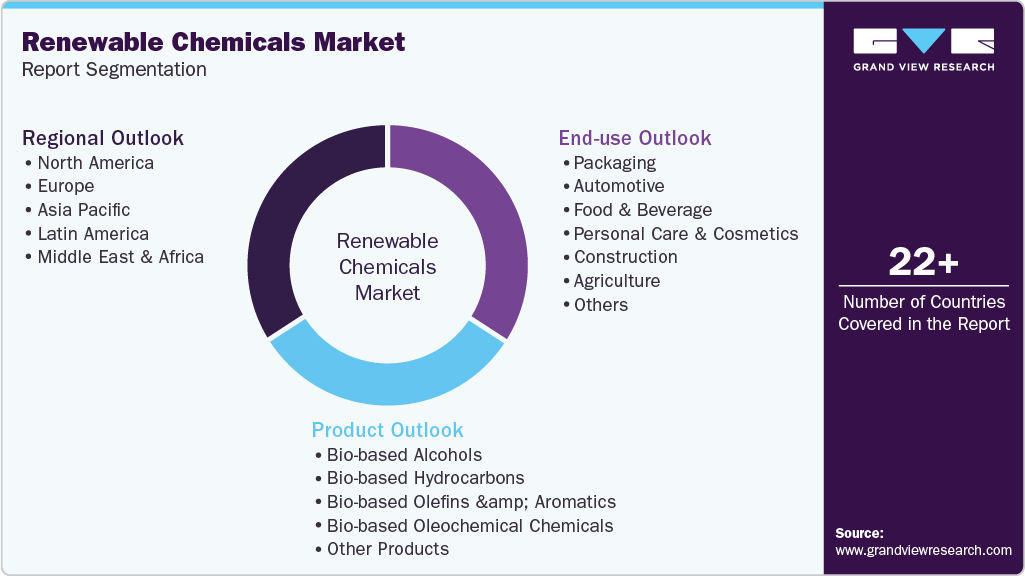 To learn more about this report, Download Free Sample Report
 -
Product Outlook (Revenue, USD Billion, 2021 - 2033)
-
Bio-based Alcohols
-
Bio-ethanol
-
Bio-methanol
-
Bio-butanol
-
Bio-propanol
-
Bio-isopropanol
-
-
Bio-based Hydrocarbons
-
Bio-naphtha
-
Bio-crude-derived
-
Bio-ethane
-
Bio-propane
-
-
Bio-based Olefins & Aromatics
-
Bio-ethylene
-
Bio-propylene
-
Bio-butadiene
-
Bio-benzene
-
Bio-xylene
-
Bio-styrene
-
-
Bio-based Platform Organic Acids
-
Succinic acid
-
Lactic acid
-
Itaconic acid
-
Adipic acid
-
Acetic acid
-
Fumaric acid
-
Gluconic acid
-
-
Bio-based Sugars & Polyols
-
Glycerol
-
Sorbitol
-
Xylitol
-
Mannitol
-
Bio-based polyols
-
-
Bio-based Oleochemical Chemicals
-
Fatty acids
-
Fatty alcohols
-
Fatty amines
-
Methyl esters
-
Tall-oil derivatives
-
Castor-oil derivatives
-
-
Other Products
-
-
Application Outlook (Revenue, USD Billion, 2021 - 2033)
-
Packaging
-
Automotive
-
Food & Beverage
-
Personal Care & Cosmetics
-
Construction
-
Agriculture
-
Healthcare & Pharmaceuticals
-
Paints & Coatings
-
Oil & Gas
-
Textile & Apparel
-
Electronics
-
Other Applications
-
-
Regional Outlook (Revenue, USD Billion, 2021 - 2033)
-
North America
-
U.S.
-
Canada
-
Mexico
-
-
Europe
-
Germany
-
UK
-
France
-
Italy
-
Spain
-
-
Asia Pacific
-
China
-
India
-
Japan
-
South Korea
-
-
Latin America
-
Brazil
-
Argentina
-
-
Middle East & Africa
-
Saudi Arabia
-
South Africa
-
-
Research Methodology
The renewable chemicals market figures in this report are based on a proven research process that combines executive interviews with secondary research from proprietary databases, company filings, and recognized regulatory and institutional sources. Market size is built through value-chain sizing-reconciling supply-side and demand-side estimates-and triangulated with bottom-up and top-down approaches. Every estimate passes multiple levels of expert validation before publication, with each renewable chemicals segment quantified using the revenue-capture definitions in the table below.
Segment Definition
Segment - Product
Revenue capture definition
Bio-based Alcohols
Market revenue is generated through the sale of renewable alcohols such as bioethanol, biobutanol, biomethanol, and other bio-based alcohols used in fuels, solvents, pharmaceuticals, personal care products, and chemical intermediates. Strong demand for low-carbon alternatives across multiple industries supports revenue growth.
Bio-based Hydrocarbons
Revenue is derived from the commercialization of renewable hydrocarbons produced from biomass and waste feedstocks for use in fuels, lubricants, specialty chemicals, and industrial applications. Growing adoption of sustainable hydrocarbon solutions contributes to market expansion.
Bio-based Olefins & Aromatics
Revenue is generated from supplying renewable olefins and aromatic chemicals used as feedstocks for bio-based plastics, synthetic rubbers, packaging materials, fibers, and specialty chemicals. Increasing investments in sustainable polymer production continue to drive demand.
Bio-based Platform Organic Acids
Market value is captured through the sale of renewable organic acids such as lactic acid, succinic acid, citric acid, and itaconic acid used in biodegradable plastics, food ingredients, pharmaceuticals, and industrial chemicals. Expanding bio-based manufacturing supports segment growth.
Bio-based Sugars & Polyols
Revenue comes from supplying renewable sugars and polyols used in food processing, pharmaceuticals, cosmetics, polyurethane production, and fermentation-based chemical manufacturing. Rising demand for naturally derived ingredients and sustainable raw materials supports this segment.
Bio-based Oleochemical Chemicals
Revenue is generated through the production and sale of oleochemicals derived from vegetable oils and animal fats, including fatty acids, fatty alcohols, esters, and glycerin used in detergents, personal care, lubricants, and industrial formulations.
Other Products
Market revenue is captured from other renewable chemicals, including bio-based solvents, surfactants, enzymes, specialty chemicals, and emerging bio-derived intermediates serving diverse industrial and consumer applications.
Segment - Application
Revenue capture definition
Packaging
Sales are primarily driven by renewable chemicals used in the production of bio-based plastics, biodegradable packaging materials, coatings, adhesives, and films that help manufacturers reduce fossil fuel dependence and improve packaging sustainability.
Automotive
Revenue is generated from renewable chemicals used in bio-based plastics, lightweight composites, lubricants, coatings, adhesives, and interior automotive components that support vehicle weight reduction and carbon footprint reduction.
Food & Beverage
Market value is derived from renewable chemicals used in food additives, preservatives, packaging materials, processing aids, and bio-based ingredients that support sustainable food production and packaging solutions.
Personal Care & Cosmetics
Revenue is captured through the use of renewable surfactants, emollients, solvents, fatty alcohols, and specialty ingredients in skincare, haircare, cosmetics, and hygiene products as demand for naturally derived formulations increases.
Construction
Revenue is generated from renewable chemicals incorporated into bio-based adhesives, insulation materials, coatings, sealants, resins, and construction composites designed to improve sustainability and reduce environmental impact.
Agriculture
Market revenue is driven by renewable chemicals used in bio-based fertilizers, crop protection products, soil conditioners, biostimulants, and agricultural formulations that promote sustainable farming practices.
Healthcare & Pharmaceuticals
Revenue is derived from renewable chemicals used in pharmaceutical intermediates, excipients, medical polymers, biodegradable materials, solvents, and specialty ingredients supporting sustainable healthcare manufacturing.
Paints & Coatings
Sales are generated from renewable resins, solvents, additives, and binders used in environmentally friendly paints, coatings, inks, and industrial surface protection products with lower VOC emissions.
Oil & Gas
Revenue is captured through the use of renewable chemicals in drilling fluids, lubricants, corrosion inhibitors, surfactants, and production chemicals that improve operational sustainability and environmental performance.
Textile & Apparel
Market value is generated from renewable chemicals used in textile processing, dyeing auxiliaries, finishing agents, bio-based fibers, and coatings that help reduce the environmental footprint of textile manufacturing.
Electronics
Revenue is generated from renewable chemicals used in specialty solvents, electronic cleaning agents, bio-based polymers, adhesives, and advanced materials utilized in electronic component manufacturing.
Other A
Revenue is captured from renewable chemicals supplied to industrial manufacturing, household products, cleaning formulations, consumer goods, and other emerging applications adopting sustainable chemical alternatives.
Estimation Model
Layer Name
Key Question
Description
Raw Material & Production Layer
What products the supply base?
Identify the sourcing and production of renewable chemicals using renewable feedstocks such as biomass, agricultural residues, sugar crops, vegetable oils, forestry waste, algae, and municipal or industrial waste. Assess production technologies, including industrial biotechnology, fermentation, biomass conversion, catalytic processing, and green chemistry, along with manufacturing capacities, feedstock availability, supply chain dynamics, and major biorefinery hubs supporting commercial production.
Application Adoption Layer
Where are renewable chemicals utilized?
Assess the adoption of renewable chemicals across key end-use industries, including packaging, automotive, healthcare & pharmaceuticals, personal care & cosmetics, food & beverage, construction, agriculture, textiles, electronics, paints & coatings, and industrial manufacturing. Demand is driven by the growing shift toward sustainable materials, regulatory support for low-carbon products, and increasing corporate commitments to reduce fossil-based chemical usage.
Consumption Intensity Layer
How much renewable chemicals are consumed?
Analyze consumption by evaluating the utilization of renewable chemicals across major end-use industries based on production volumes, manufacturing output, sustainability adoption rates, bio-based material substitution, and industrial demand. The assessment considers capacity utilization, biorefinery expansion, feedstock availability, and the commercialization of new bio-based chemical technologies to estimate annual market demand.
Revenue Layer
How is market revenue generated?
Market revenue is generated through the production and commercial sale of renewable chemicals, including bio-based alcohols, hydrocarbons, olefins & aromatics, platform organic acids, sugars & polyols, oleochemicals, and specialty bio-based chemicals. Revenue growth is supported by increasing investments in biorefineries, advancements in industrial biotechnology, strategic partnerships, expanding production capacities, and rising demand for sustainable chemical solutions across multiple end-use industries.
DELIVERED CUSTOMIZATIONS
This report has been delivered with the following In-depth customizations:
Client Request
Customization Delivered
Value Adds
Regional segmentation
The assessment includes region-level market size and forecasts; demand patterns by product and application across packaging, automotive, healthcare & pharmaceuticals, personal care, construction, agriculture, food & beverage, textiles, electronics, and other industries; production capacities; renewable feedstock availability; biorefinery investments; import-export dynamics; regulatory developments; competitive landscape; and supply chain analysis across each region.
Supports regional expansion, production planning, and supply chain optimization by providing insights into feedstock availability, manufacturing hubs, policy support, and end-use demand trends. Helps identify high-growth markets, optimize sourcing strategies, and strengthen partnerships across the renewable chemicals value chain.
Opportunity Assessment
Detailed evaluation of growth opportunities across bio-based polymers, renewable solvents, platform chemicals, sustainable packaging, industrial biotechnology, green chemistry, and next-generation biorefinery projects. The assessment covers investments in advanced biomass conversion technologies, precision fermentation, circular economy initiatives, feedstock diversification, and evolving environmental regulations influencing renewable chemical adoption.
Enables identification of high-growth investment opportunities across the renewable chemicals value chain. Supports strategic capacity expansion, technology investments, product portfolio diversification, and market entry decisions through insights into emerging applications, sustainability trends, and regional industrial development.
Competitive Benchmarking
Comparative assessment of leading renewable chemical manufacturers based on production capacity, manufacturing footprint, feedstock integration, technological capabilities, product portfolio, regional presence, sustainability initiatives, research and development, strategic partnerships, and expansion strategies. The benchmarking also evaluates operational efficiency, innovation capabilities, commercialization of bio-based technologies, and supply chain resilience.
Supports benchmarking against key competitors while identifying opportunities to improve production efficiency, strengthen feedstock security, expand regional presence, and accelerate innovation. Enables informed decisions regarding capacity investments, technology upgrades, strategic collaborations, and long-term competitive positioning within the renewable chemicals market.
Frequently Asked Questions About This Report
Asia Pacific dominated the market, accounting for the largest revenue share of 38.2% in 2025.
The market is driven by increasing demand for sustainable and low-carbon alternatives to petrochemicals, stringent environmental regulations, growing adoption of bio-based materials in packaging and consumer goods, advancements in biorefinery technologies, and rising corporate commitments toward circular economy and carbon neutrality.
Bio-based alcohols held the largest revenue share of 42.8% in 2025, while bio-based olefins & aromatics segment is fastest growing product.
The packaging segment dominated the market, accounting for 17.3% of the global revenue in 2025, while healthcare & pharmaceuticals segment is fastest growing application.
The global renewable chemicals market size was valued at USD 151.3 billion in 2025 and is estimated at USD 164.1 billion in 2026
The global renewable chemicals market is expected to grow at a CAGR of 9.2% from 2026 to 2033, reaching USD 303.1 billion in 2033.
Key players include BASF SE, Cargill, Incorporated, Archer Daniels Midland Company, DuPont, Braskem S.A., Corbion N.V., Mitsubishi Chemical Group, LanzaTech Global, Inc., Borregaard ASA, and NatureWorks LLC.
About the Author(s)
Renewable Chemicals Research Team
Specialty & Chemicals · Renewable ChemicalsThis report was authored by the renewable chemicals research team at Grand View Research - comprising two research analysts, one senior research analyst, and one industry expert - with specialized expertise in the renewable chemicals segment of the specialty & chemicals industry. All findings are based on proprietary specialty & chemicals databases, executive interviews, and regulatory analysis, subject to internal peer review prior to publication.
Last Updated:
Speak to Analyst

Customize this report to your needs - add regions, segments, or data points, with 20% free customization.
Or view our licence options:


ISO 9001:2015 & 27001:2022 Certified
We are GDPR and CCPA compliant! Your transaction & personal information is safe and secure. For more details, please read our privacy policy.


