
- Home
- »
- Renewable Energy
- »
-
Renewable Energy Certificate Market Size, Growth Report, 2026-2033GVR Report cover

Renewable Energy Certificate Market (2026 - 2033)
Size, Share & Trends Analysis Report By Type (Compliance REC, Voluntary REC), By Energy Source (Solar, Wind, Hydropower, Biomass, Geothermal, Gas Power), By Capacity, By Region, And Segment Forecasts
Market Size, 2025
$15.6BMarket Estimate, 2026
$17.5BMarket Forecast, 2033
$44.8BCAGR, 2026–2033
14.4%Renewable Energy Certificate Market Summary
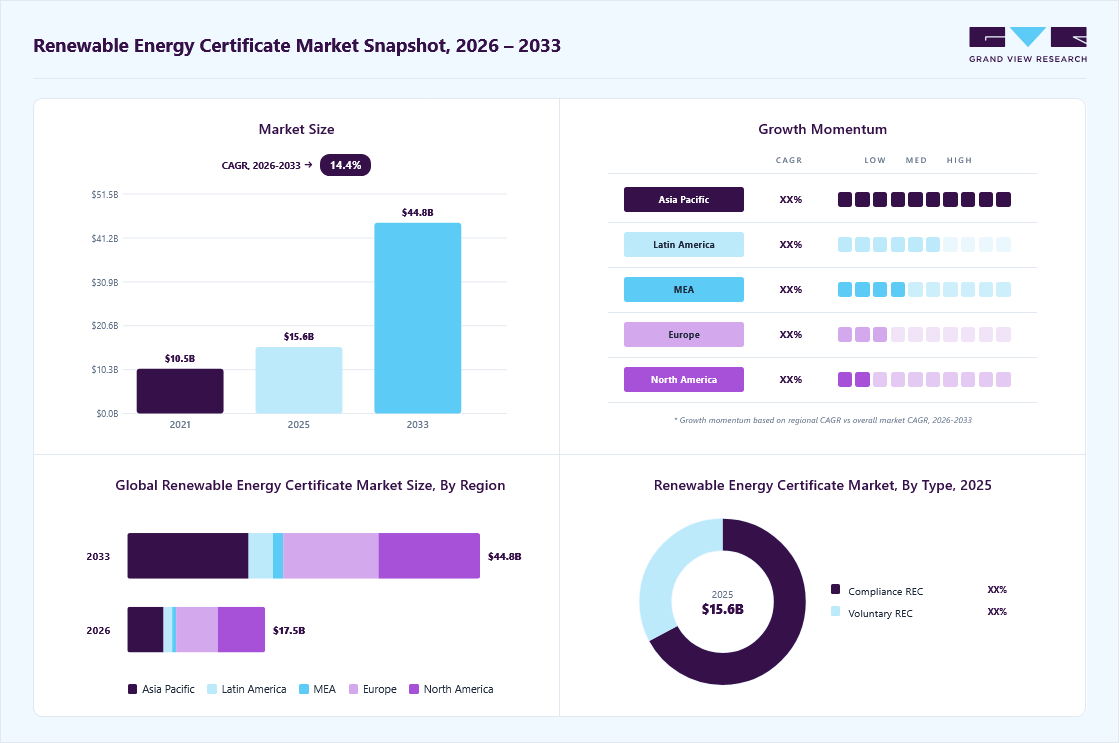
The global renewable energy certificate market size was valued at USD 15.6 billion in 2025 and is projected to grow from USD 17.5 billion in 2026 to USD 44.8 billion by 2033, at a CAGR of 14.4% from 2026 to 2033. North America dominated the global market, accounting for the largest revenue share of 35.0% in 2025. The market is expanding rapidly due to aggressive corporate sustainability goals, increasing government renewable energy mandates, and growing net-zero commitments worldwide.
 Source: Grand View Research, IR Documents, Primary Interviews, Paid DatabasesTo learn more about this report,
 Download Free Sample Report
Key Market Trends & Insights
- By type: Compliance REC segment accounted for the largest revenue share of 67.0% in 2025.
- By energy source: Solar energy segment held the highest market share of 37.5% in 2025.
- By capacity: Above 5,000 kWh segment held the largest revenue share of 43.5% in 2025.
Regional Highlights
- Largest regional market: North America (35.0% revenue share, 2025)
- Fastest-growing regional market: Asia Pacific (highest CAGR, 2026-2033)
- By country: The U.S renewable energy certificate industry is a major contributor to the global market.
Market Size & Forecast
- Market size in 2025: USD 15.6 Billion
- Estimated market size in 2026: USD 17.5 Billion
- Projected market size by 2033: USD 44.8 Billion
- CAGR (2026-2033): 14.4%
Three ways to get this report
Buy it, customize it, or ask a question.Ask an Analyst
Analyst response in 1 business day
- AccessReport author, directly
- Reply timeWithin 1 working day
- No sales callDirect answer only
- FormatEmail reply
- CostFree, no cost
Get the Full Report
What the study covers
- FormatsPDF · Excel · Dashboard
- Timeline2026–2033 annual, 2025 base
- Coverage20+ countries, 5 regions
- Companies10+ key players profiled
Customize the Report
20% free customization
- IncludeCountries, segments, points
- TailorTo your product definition
- ExtendDeeper competitor detail
- OrA fully bespoke study
- Turnaround5–10 working days
Rising demand for transparent tracking and verification of renewable electricity consumption is further accelerating REC adoption across compliance and voluntary markets. The market is experiencing strong growth due to rising corporate renewable electricity procurement and increasing adoption of sustainability reporting frameworks across industries. Organizations are actively purchasing RECs to meet net-zero targets, reduce Scope 2 emissions, and demonstrate compliance with environmental commitments.
 To learn more about this report, Download Free Sample Report
The market is also benefiting from the expansion of digital trading platforms, automated certificate tracking systems, and cross-border renewable energy certification frameworks that are improving transaction transparency and market accessibility. Growing renewable power generation capacity and stronger collaboration between energy producers, certificate traders, and corporate buyers are supporting broader REC market expansion globally.
Drivers, Opportunities & Restraints
The market is primarily driven by increasing corporate sustainability commitments, rising net-zero emission targets, and growing adoption of renewable electricity procurement initiatives such as RE100. Organizations are increasingly purchasing RECs to reduce Scope 2 emissions, comply with ESG reporting requirements, and demonstrate their transition toward clean energy consumption. Supportive government renewable energy mandates and expanding clean energy generation capacity are contributing to higher REC demand across compliance and voluntary markets.
A major opportunity in the renewable energy certificate industry is centered around the development of blockchain-based tracking systems and digital trading platforms for REC management. The integration of blockchain and distributed ledger technology (DLT) is improving transparency, enhancing traceability, reducing transaction costs, and minimizing the risk of double-counting in REC transactions. Growing cross-border renewable energy trading, increasing corporate demand for automated sustainability reporting tools, and rising adoption of digital certificate management solutions are creating new growth avenues for technology providers, energy traders, and environmental market platforms.
However, the renewable energy certificate industry faces challenges due to the lack of standardization across regional and international REC systems. Differences in certification frameworks, tracking mechanisms, eligibility criteria, and regulatory requirements across jurisdictions complicate cross-border REC trading and reduce overall market efficiency. These inconsistencies also increase administrative complexity, create transparency concerns, and limit interoperability between compliance and voluntary renewable energy markets.
The growth of the renewable energy certificate industry is restrained by geographic restrictions and localized regulatory frameworks that limit the import and cross-border use of RECs. In several regions, governments promote domestically generated renewable energy certificates to support local clean energy development, which can increase procurement costs and restrict the formation of a more integrated and efficient global REC trading market.
Type Insights
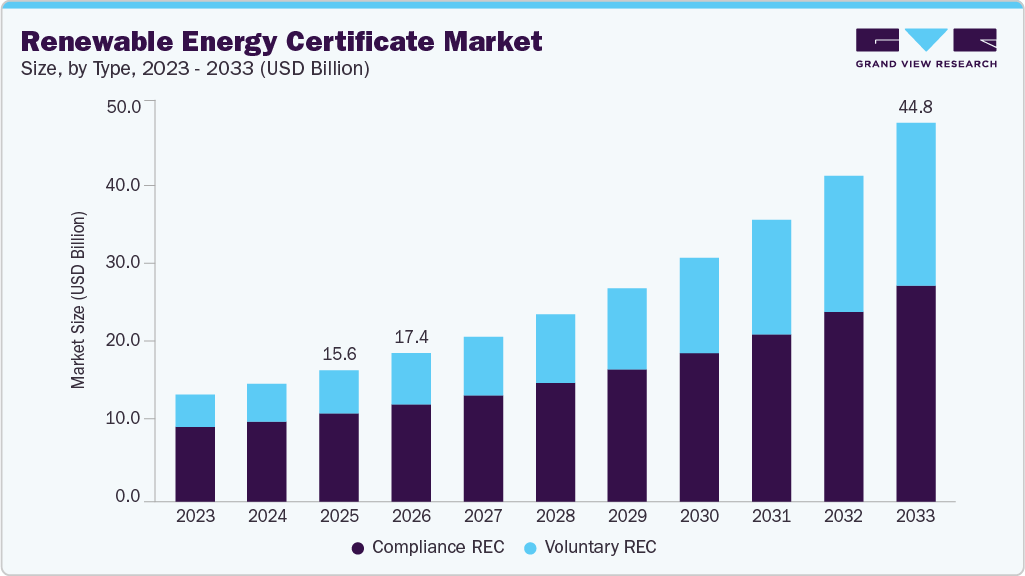
The compliance REC segment accounted for the largest revenue share of 67.0% in 2025, due to the implementation of mandatory renewable energy regulations and renewable portfolio standards across several countries, particularly in North America. Governments and regulatory authorities require utilities and electricity suppliers to source a defined percentage of power from renewable energy sources, creating consistent demand for compliance RECs. Increasing government focus on decarbonization and renewable electricity adoption continues to strengthen the growth of the compliance REC segment globally.
The voluntary REC segment is the fastest-growing segment with a CAGR of 18.3% over the forecast period, driven by rising corporate sustainability initiatives and increasing adoption of net-zero emission targets. Companies across industries are voluntarily purchasing RECs to support renewable electricity procurement goals and fulfill commitments under initiatives such as RE100. Increasing stakeholder and investor pressure for sustainable business practices is encouraging organizations to strengthen their renewable energy sourcing strategies.
Energy Source Insights
The solar energy segment accounted for the largest market revenue share of 37.5% in 2025. This growth is supported by the rapid expansion of solar power generation capacity worldwide and the increasing affordability of photovoltaic (PV) technology. Continuous advancements in solar PV efficiency, declining installation costs, and supportive government incentives have made solar one of the most cost-effective renewable energy sources. The large-scale deployment of utility-scale and distributed solar projects has significantly increased the issuance and trading volume of solar-based RECs.
The gas power energy segment is projected to register the fastest CAGR of 24.4% over the forecast period, driven by the increasing adoption of low-carbon and transitional energy solutions to support grid reliability and cleaner power generation. Growing investments in renewable natural gas, biogas, and hydrogen-blended gas power projects are contributing to the expansion of gas-based environmental attribute certificates in several markets. Rising demand for flexible power generation sources that can complement intermittent renewable energy systems is supporting the growth of this segment.
Capacity Insights
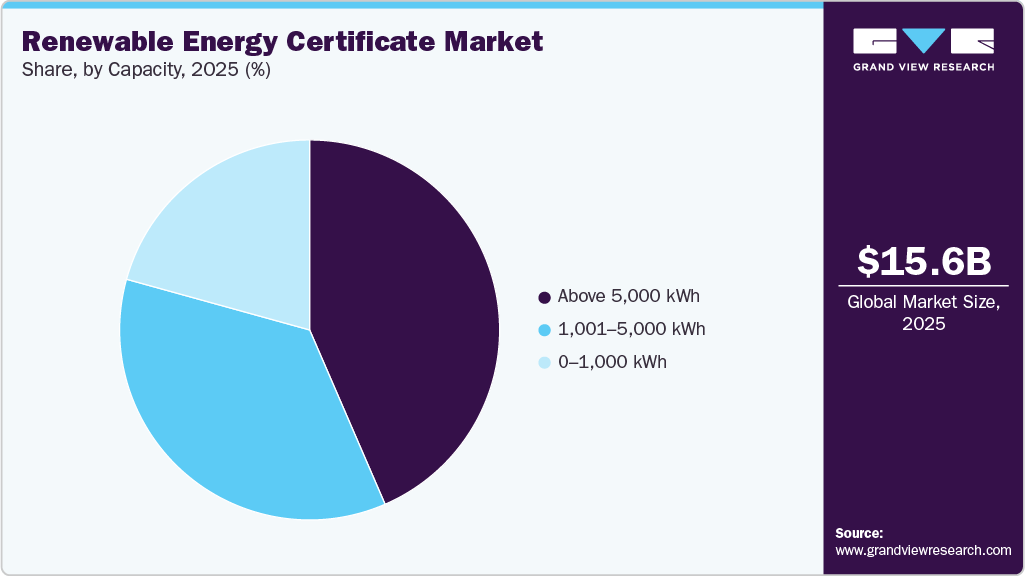
The above 5,000 kWh segment accounted for the largest market share of 43.5% in 2025, due to the large-scale deployment of utility-scale renewable energy projects such as solar parks and wind farms. These projects generate substantial volumes of renewable electricity, leading to higher REC issuance and trading activity. Economies of scale enable large-capacity facilities to reduce the cost per unit of energy generated, making them more financially competitive and efficient in the REC market. Increasing investments in large renewable energy infrastructure projects by utilities and independent power producers are further supporting segment dominance.
 To learn more about this report, Download Free Sample Report
The 1,001-5,000 kWh segment is projected to register the fastest CAGR of 15.5% from 2026 to 2033, supported by increasing renewable electricity procurement by mid-sized commercial and institutional consumers. Businesses, universities, hospitals, and commercial facilities are increasingly purchasing RECs within this capacity range to support sustainability initiatives, reduce Scope 2 emissions, and meet renewable energy targets. The segment is also benefiting from the growing adoption of distributed renewable energy systems and the rising participation of medium-scale organizations in voluntary REC markets.
Regional Insights
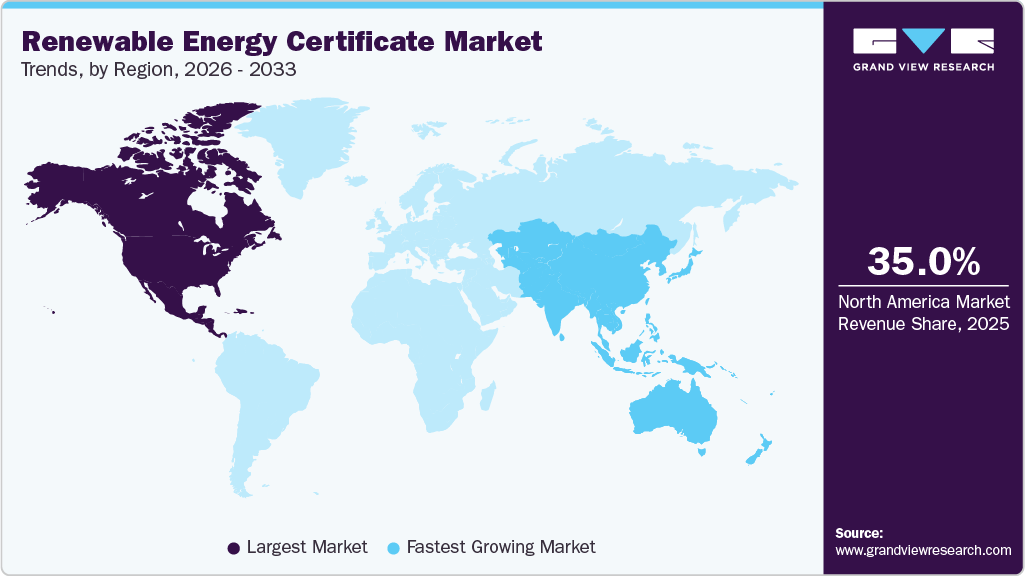
The North America renewable energy certificate market accounted for the largest revenue share of 35.0% due to the presence of well-established renewable energy policies, mandatory renewable portfolio standards, and a highly developed REC trading ecosystem. The region benefits from robust and mature certificate tracking infrastructures, including systems such as M-RETS and other regional REC registries, which ensure transparent issuance, tracking, and retirement of certificates. Strong corporate participation in voluntary renewable energy procurement and increasing investments in renewable power generation are further supporting market dominance across the region.
 To learn more about this report, Download Free Sample Report
U.S. Renewable Energy Certificate Market Trends
The renewable energy certificate market in the U.S.is witnessing fast growth due to the presence of stringent state-level Renewable Portfolio Standards (RPS) and a mature renewable energy trading framework. More than 30 states and the District of Columbia require utilities and electricity suppliers to procure a specified share of power from renewable sources, significantly driving REC demand for compliance purposes. Utilities widely use RECs to address gaps in renewable electricity generation and meet regulatory obligations efficiently. Strong corporate renewable energy procurement, expanding renewable power capacity, and advanced REC tracking systems are further supporting market growth in the country.
Asia Pacific Renewable Energy Certificate Market Trends
The renewable energy certificate market in Asia Pacific is expected to register the fastest CAGR of 19.0%, due to rising corporate sustainability initiatives, increasing renewable energy adoption, and expanding government decarbonization policies across the region. Growing voluntary demand from businesses to meet RE100 commitments, reduce Scope 2 emissions, and strengthen ESG reporting is significantly driving REC purchases. Rapid industrialization, increasing renewable power generation capacity, and the expansion of international REC frameworks such as I-REC are further supporting regional market growth.
The renewable energy certificate market in China is significantly influenced by major regulatory reforms aimed at strengthening renewable energy consumption and carbon reduction efforts. In 2024, the country officially recognized Green Electricity Certificates (GECs) as the sole approved proof of renewable energy consumption, replacing the use of International Renewable Energy Certificates in the domestic market. This regulatory transition created a more unified and standardized REC framework, driving higher certificate demand from utilities, industrial users, and corporates seeking compliance with renewable energy targets.
Europe Renewable Energy Certificate Market Trends
The renewable energy certificate market in Europe is significantly driven by increasing emphasis on renewable energy adoption, carbon neutrality targets, and enhanced transparency in renewable electricity tracking systems. Efforts to strengthen and harmonize the European Energy Certificate System (EECS) standards are improving market credibility and supporting more efficient cross-border certificate trading across European countries. Stringent climate regulations, rising corporate renewable electricity procurement, and growing participation in voluntary green energy markets are further accelerating REC market growth across the region.
Latin America Renewable Energy Certificate Market Trends
The renewable energy certificate market in Latin America is driven by the region’s abundant renewable energy resources and high share of clean power generation across the electricity mix. Countries in the region generate a significant portion of their electricity from renewable sources such as hydropower, wind, solar, and biomass, creating a strong foundation for REC issuance and trading activities. Increasing corporate sustainability initiatives, growing international demand for renewable energy verification, and expanding clean energy investments are further supporting market growth across Latin America.
Middle East & Africa Renewable Energy Certificate Market Trends
The renewable energy certificate market in MEA is supported by increasing renewable energy investments, expanding decarbonization initiatives, and rising demand for internationally recognized clean energy verification mechanisms. Companies across the region are increasingly utilizing RECs to support export competitiveness and comply with evolving carbon regulations such as the European Carbon Border Adjustment Mechanism (CBAM). Growing solar and wind energy deployment, government-led energy transition strategies, and rising corporate sustainability commitments are further contributing to market growth.
Key Renewable Energy Certificate Company Insights
Some of the key participants in the global market include 3Degrees, Inc., Ecohz, EDF Trading Limited, Enel Spa, ENGIE, REDEX, Shell Energy, South Pole, Statkraft, and STX Group. These companies collectively hold a significant market share and play a key role in shaping industry development and competitive dynamics. They are focused on expanding REC trading capabilities, enhancing digital certificate management platforms, and strengthening partnerships with corporates, utilities, and sustainability organizations to support growing renewable energy procurement demand.
Their operations span multiple areas, including REC brokerage, environmental commodities trading, certificate verification, carbon market services, and Energy Attribute Certificate (EAC) management, enabling diversified participation across compliance and voluntary markets. Many companies are also investing in digital technologies, blockchain-enabled tracking systems, and automated compliance solutions to improve transparency, traceability, and transaction efficiency.
As global renewable energy adoption accelerates, market participants are strengthening collaborations with governments, renewable power producers, and corporate buyers to expand market access and simplify renewable electricity reporting. Increasing net-zero commitments, ESG regulations, and corporate decarbonization goals are driving continuous innovation, platform expansion, and geographic diversification across the REC value chain.
Key Renewable Energy Certificate Companies:
The following key companies have been profiled for this study on the renewable energy certificate market.
- 3Degrees, Inc.
- Ecohz
- EDF Trading Limited
- Enel Spa
- ENGIE
- REDEX
- Shell Energy
- South Pole
- Statkraft
- STX Group
Recent Developments
-
In December 2025, STX Group launched its STX Climate Tech platform to simplify the procurement, management, and compliance tracking of Energy Attribute Certificates (EACs), including renewable energy certificates used for Scope 2 decarbonization. The digital platform enables corporates to centralize environmental commodity trading, improve data transparency, and streamline reporting aligned with frameworks such as RE100 and CDP. This development reflects the growing adoption of digitalized and automated REC management solutions aimed at enhancing corporate sustainability compliance and accelerating decarbonization initiatives.
Renewable Energy Certificate Market Report Scope
Report Attribute
Details
Market Definition
The market refers to the global revenue generated from the issuance, trading, and sale of certificates representing electricity produced from renewable energy sources such as solar, wind, hydro, and biomass.
Market size in 2025
USD 15.6 billion
Estimated Market size in 2026
USD 17.5 billion
Projected Market size by 2033
USD 44.8 billion
Growth rate
CAGR of 14.4% from 2026 to 2033
Historical data
2021 - 2025
Forecast period
2026 - 2033
Quantitative units
Revenue in USD million/billion, and CAGR from 2026 to 2033
Report coverage
Revenue forecast, competitive landscape, growth factors, and trends
Segments covered
Type, energy source, capacity, region
Regional scope
North America; Europe; Asia Pacific; Latin America; MEA
Country scope
U.S.; Canada; Mexico; Germany; UK; France; Italy; Spain; China; India; Australia; Japan; South Korea; Brazil; Argentina; UAE; Saudi Arabia; South Africa
Key companies profiled
3Degrees, Inc.; Ecohz; EDF Trading Limited; Enel Spa; ENGIE; REDEX; Shell Energy; South Pole; Statkraft; STX Group
Customization scope
Free report customization (equivalent up to 8 analysts working days) with purchase. Addition or alteration to country, regional & segment scope.
Pricing and purchase options
Avail customized purchase options to meet your exact research needs. Explore purchase options
Global Renewable Energy Certificate Market Report Segmentation
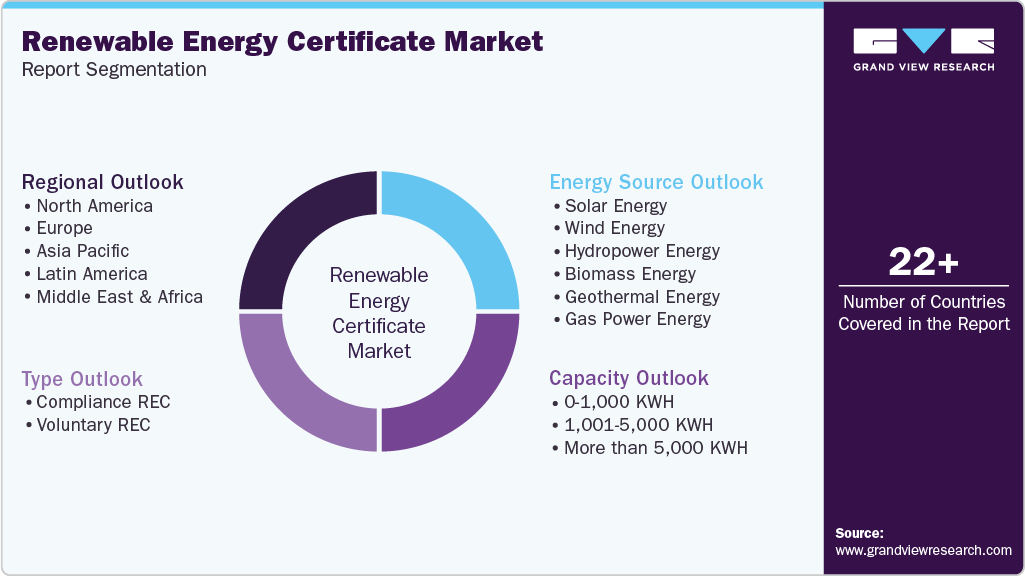
This report forecasts revenue growth at global, regional, and country levels and provides an analysis of the latest industry trends in each of the sub-segments from 2021 to 2033. For this study, Grand View Research has segmented the global renewable energy certificate market report based on type, energy source, capacity, and region:
 To learn more about this report, Download Free Sample Report
-
Type Outlook (Revenue, USD Billion, 2021 - 2033)
-
Compliance REC
-
Voluntary REC
-
-
Energy Source Outlook (Revenue, USD Billion, 2021 - 2033)
-
Solar Energy
-
Wind Energy
-
Hydropower Energy
-
Biomass Energy
-
Geothermal Energy
-
Gas Power Energy
-
-
Capacity Outlook (Revenue, USD Billion, 2021 - 2033)
-
0-1,000 KWH
-
1,001-5,000 KWH
-
More than 5,000 KWH
-
-
Regional Outlook (Revenue, USD Billion, 2021 - 2033)
-
North America
-
U.S.
-
Canada
-
Mexico
-
-
Europe
-
Germany
-
UK
-
France
-
Italy
-
Spain
-
-
Asia Pacific
-
China
-
India
-
Australia
-
Japan
-
South Korea
-
-
Latin America
-
Brazil
-
Argentina
-
-
Middle East & Africa
-
Saudi Arabia
-
UAE
-
South Africa
-
-
Frequently Asked Questions About This Report
The global renewable energy certificate market size was valued at USD 15.6 billion in 2025 and is estimated at USD 17.5 billion for 2026.
North America dominated with a 35.0% revenue share in 2025.
Asia Pacific is the fastest-growing region over the forecast period.
The solar energy segment led with a 37.5% revenue share in 2025, while gas power energy is the fastest-growing energy source.
Above 5,000 kwh segment held the largest share (over 43.0%) in 2025, while 1,001-5,000 kwh is the fastest-growing capacity.
The global renewable energy certificate market is expected to grow at a CAGR of 14.4% from 2026 to 2033, reaching USD 44.8 billion by 2033.
The compliance REC segment led with a 67.0% revenue share in 2025, while voluntary REC is the fastest-growing type.
Key players include 3Degrees, Inc.; Ecohz; EDF Trading Limited; Enel Spa; ENGIE; REDEX; Shell Energy; South Pole; Statkraft; STX Group.
The key factors driving the growth of the global renewable energy certificate market include increasing government renewable energy mandates, rising carbon reduction targets, and expanding corporate sustainability commitments. Growing adoption of net-zero goals and the need to reduce Scope 2 emissions are encouraging organizations and utilities to purchase RECs to validate renewable electricity consumption.
About the Author(s)
Renewable Energy Research Team
Energy & Power · Renewable EnergyThis report was authored by the renewable energy research team at Grand View Research - comprising two research analysts, one senior research analyst, and one industry expert - with specialized expertise in the renewable energy segment of the energy & power industry. All findings are based on proprietary energy & power databases, executive interviews, and regulatory analysis, subject to internal peer review prior to publication.
Last Updated:
Speak to Analyst

Customize this report to your needs - add regions, segments, or data points, with 20% free customization.
Or view our licence options:


ISO 9001:2015 & 27001:2022 Certified
We are GDPR and CCPA compliant! Your transaction & personal information is safe and secure. For more details, please read our privacy policy.


