
- Home
- »
- Electronic & Electrical
- »
-
Residential Backup Power Market Size & Share Report, 2033GVR Report cover

Residential Backup Power Market (2026 - 2033)
Size, Share & Trends Analysis Report By Product (Standby Generators, Home Battery Energy Storage Systems), By Power Capacity (Below 5 kW, 5-10 kW), By Backup Configuration, By Region, And Segment Forecasts
Market Size, 2025
$14.7BMarket Estimate, 2026
$16.0BMarket Forecast, 2033
$27.3BCAGR, 2026–2033
8.0%Residential Backup Power Market Summary
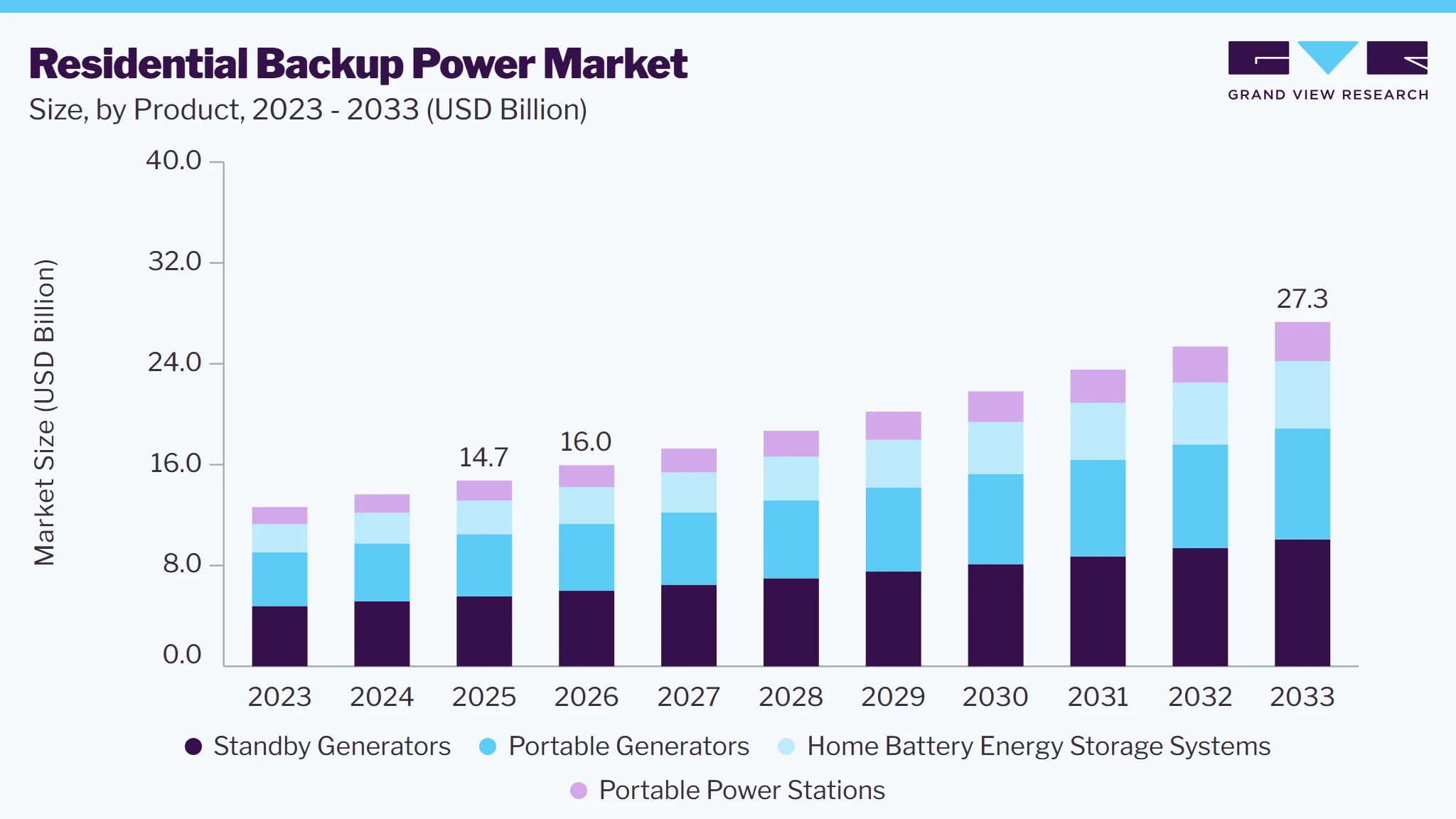
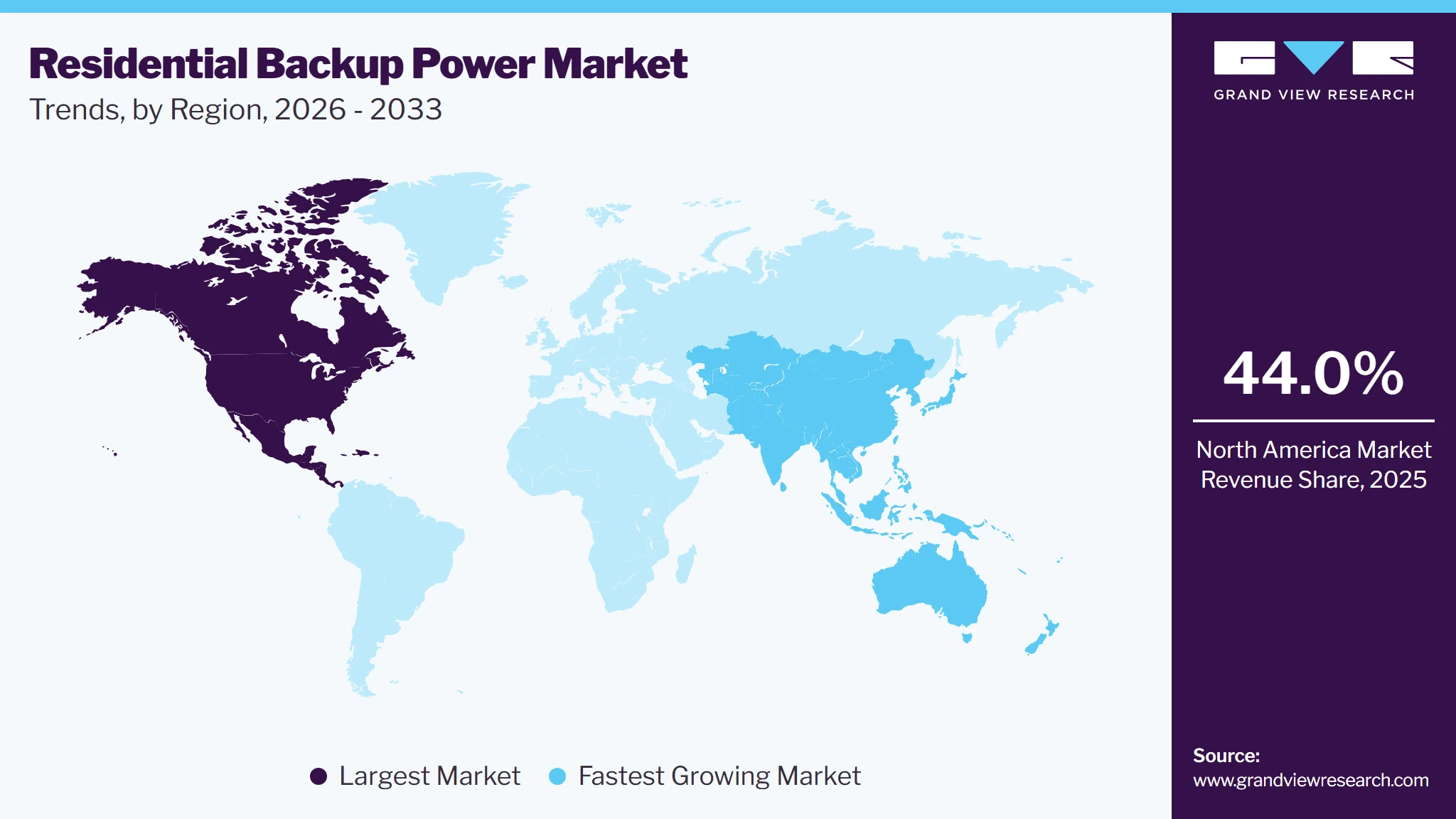
The global residential backup power market size was valued at USD 14.7 billion in 2025 and is projected to grow from USD 16.0 billion in 2026 to USD 27.3 billion by 2033, at a CAGR of 8.0% from 2026 to 2033. North America dominated the global market, accounting for the largest revenue share of 44.0% in 2025, driven by growing concerns about grid reliability, frequent power interruptions, and rising household dependence on uninterrupted electricity. Growing adoption of battery-based and higher-capacity backup solutions is further expanding residential demand.
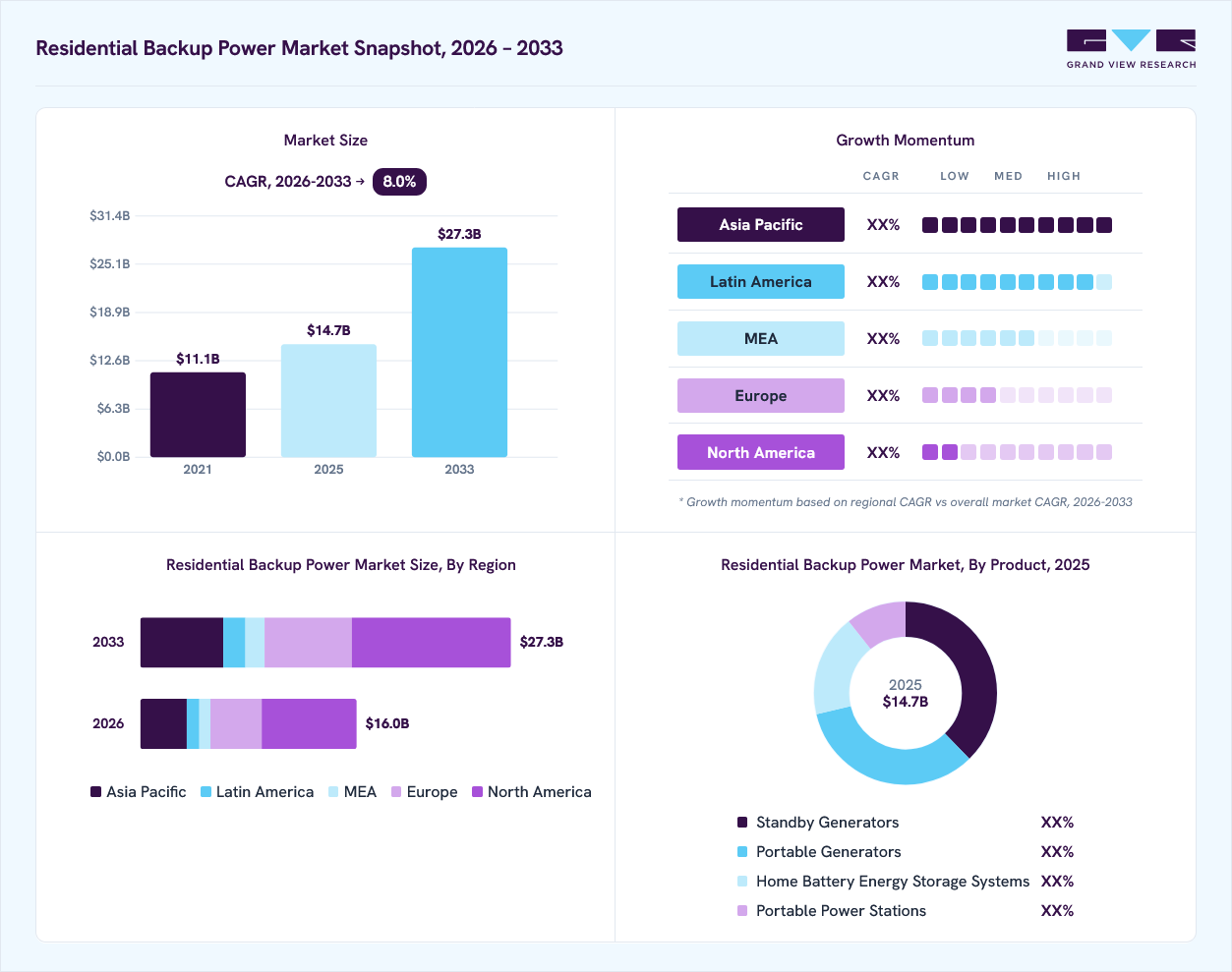 Source: Grand View Research, IR Documents, Primary Interviews, Paid DatabasesTo learn more about this report,
 Download Free Sample Report
Key Market Trends & Insights
- By product: The standby generators residential backup power segment held the largest market share of 37.7 % in 2025.
- By power capacity: The 10-20 kW residential backup power segment dominated the market with the largest revenue share of 33.4% in 2025.
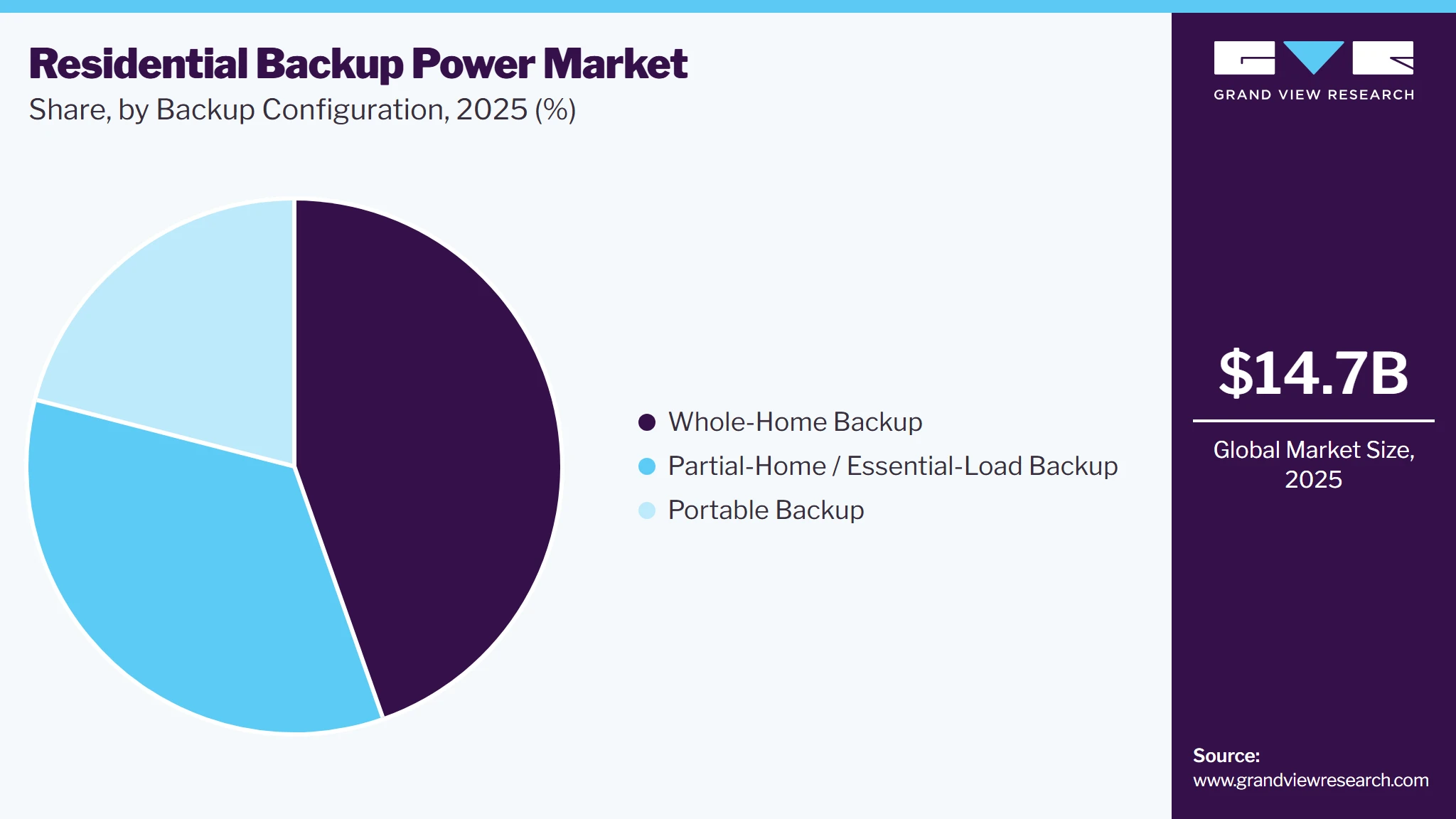
- By backup configuration: The whole-home backup power segment held the largest market share of 44.6% in 2025.
Regional Highlights
- Largest regional market: North America (44.0% revenue share, 2025)
- Fastest-growing regional market: Asia Pacific (highest CAGR, 2026-2033)
- By country: The U.S. dominated North America with the largest revenue share in 2025
Market Size & Forecast
- Market size in 2025: USD 14.7 Billion
- Estimated market size in 2026: USD 16.0 Billion
- Projected market size by 2033: USD 27.3 Billion
- CAGR (2026-2033): 8.0%
Prism AI by Grand View Research Free to tryAsk a question about the residential backup power marketTry asking✓Every figure cited from GVR research Prefer the report? Download free sample →
The increasing frequency and impact of power outages are primary drivers of demand for residential backup power. Extreme weather, grid congestion, aging infrastructure, and supply disruptions are leaving households increasingly exposed to costly interruptions, prompting consumers to invest in generators, batteries, and portable power stations to maintain essential electricity services. A 2025 Nature Communications study found that backup generation was available in only 12% of surveyed U.S. residential customers, while 33% said they would temporarily relocate during a one-day power interruption, highlighting both the consequences of outages and the relatively low penetration of household backup systems.Furthermore, growing consumer interest in alternatives to conventional generator-based backup is expanding demand for battery-based systems and portable power stations. These technologies provide backup without fuel storage, refueling, or combustion-related emissions, while offering greater flexibility for household energy use. For instance, a 2025 survey commissioned by EcoFlow found that 67% of homeowners in California, Texas, and Florida considered home backup power important, while 60% wanted to become less dependent on the grid, and 70% either already had or were interested in a solar-battery solution. This growing interest is supporting the adoption of battery-based backup systems alongside conventional generators.
 To learn more about this report, Download Free Sample Report
Moreover, increasing dependence on electricity for essential household functions is also raising the value of uninterrupted power and supporting demand for higher-capacity backup systems. Internet connectivity, refrigeration, home working, heating and cooling, security systems, and electronic appliances increasingly depend on a continuous power supply, making even relatively short outages disruptive. According to a 2024 L.G. U.S. residential survey, 67% of homeowners reported experiencing a power outage during the previous year; among those affected, 50% experienced an outage lasting more than 30 minutes, and 14% experienced one lasting at least 3 hours. This is increasing demand for systems that can move beyond basic lighting and device charging toward refrigerators, HVAC equipment, communication equipment, and multiple household circuits.
Market Dynamics
Demand is shifting from basic backup for lighting and communications toward systems capable of supporting multiple essential household loads, including refrigerators, HVAC systems, pumps, networking equipment, and other critical circuits. This is increasing demand for higher-capacity standby generators and residential BESS systems and raising the value of each installation. For instance, in 2025, EcoFlow launched OCEAN Pro, a residential energy-storage system offering up to 24 kW of continuous output and designed to support multiple household appliances, including HVAC systems.
High upfront costs remain a major restraint on residential backup power adoption, particularly for permanently installed standby generators and home battery systems. Beyond the equipment itself, homeowners may also incur expenses for installation, electrical upgrades, transfer equipment, and permitting, which increase the total cost of ownership and limit adoption among price-sensitive households. For instance, current U.S. cost data indicate that whole-house generator installation costs range from USD 350 to USD 13,500, with an average of around USD 5,159, depending on your home's power needs.
Low penetration of residential backup systems leaves substantial scope for first-time adoption, particularly as backup technologies become more accessible and product options expand beyond conventional generators. According to a 2024 study published in the Journal of the Association of Environmental and Resource Economists, 14.3% of U.S. households owned a backup generator in 2020, up from 11.8% in 2015, indicating substantial scope for further adoption.
Consumer Insights
 To learn more about this report, Download Free Sample Report
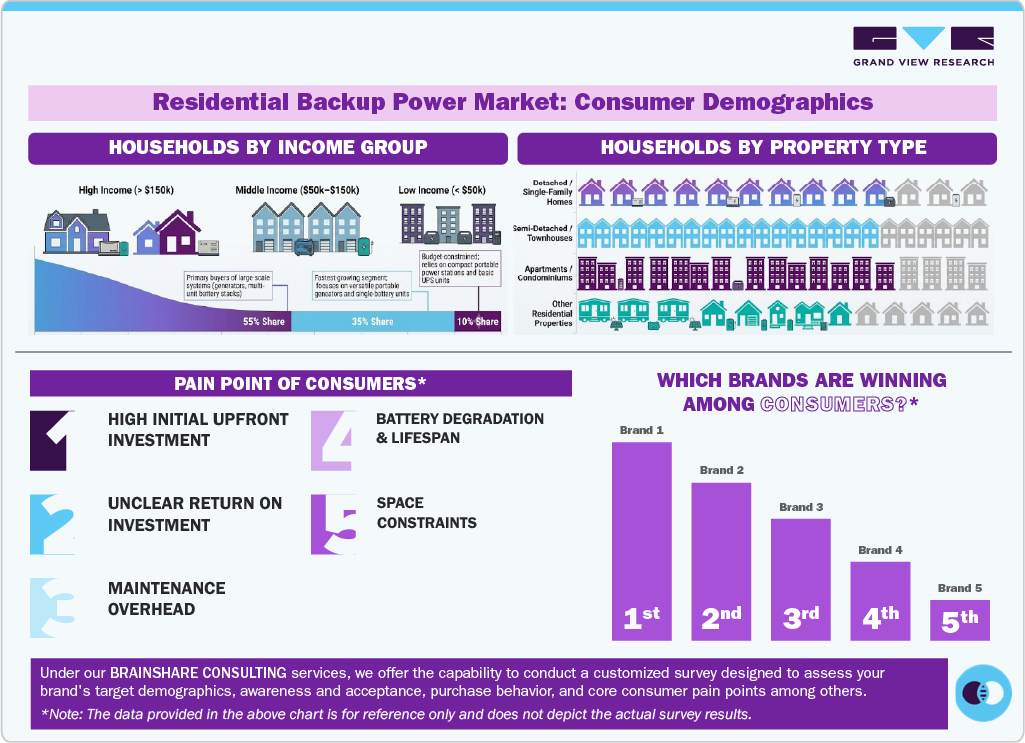
Consumer demand in the residential backup power industry is primarily influenced by household income, property type, outage exposure, and backup requirements, with purchasing decisions increasingly shifting toward solutions that balance reliability, installation flexibility, and long-term energy resilience.
-
High-income households account for the largest share of market demand, driven by stronger adoption of whole-home standby generators and residential battery energy storage systems (BESS) that offer automatic backup, smart energy management, and integration with rooftop solar systems.
-
Middle-income households represent the fastest-growing consumer segment, with demand concentrated in portable generators, essential-load backup systems, and entry-to-mid-range battery storage solutions that provide a balance between affordability and backup capability.
-
Lower-income households primarily purchase cost-effective portable generators and portable power stations, with buying decisions centered on emergency preparedness and essential household power during outages.
By property type, detached and single-family homes account for the largest share of the market, supported by greater installation flexibility and higher power-capacity requirements for whole-home backup. Semi-detached homes and townhouses typically favor essential-load backup solutions with moderate power requirements, while apartments and condominiums rely more heavily on portable power stations and compact battery systems due to installation restrictions and limited available space.
Consumers in the residential backup power industry commonly encounter several pain points and challenges during product selection and ownership.
-
High upfront investment remains the biggest barrier to adopting standby generators and residential BESS.
-
Uncertain return on investment makes purchase decisions difficult for households that experience infrequent outages.
-
Maintenance requirements, battery lifespan concerns, and space limitations also influence product selection, particularly for larger backup systems.
These consumer insights reflect purchasing behavior only within the residential backup power segment. As a result, manufacturers are increasingly prioritizing whole-home backup capabilities, modular battery systems, smart monitoring, automatic transfer functionality, quieter operation, and solar-compatible solutions to address evolving household resilience requirements.
Analyst Perspective
The residential backup power market is evolving beyond traditional generators toward a broader home energy resilience market. Growing grid outages, extreme weather events, and rooftop solar adoption are driving demand for battery energy storage systems, portable power stations, and hybrid solutions. Standby generators continue to hold a significant market share, while consumers increasingly prefer quieter, smarter, and energy-efficient systems. Manufacturers are also integrating app-based monitoring, automatic transfer features, and energy management software to improve reliability and user convenience.
Product Insights
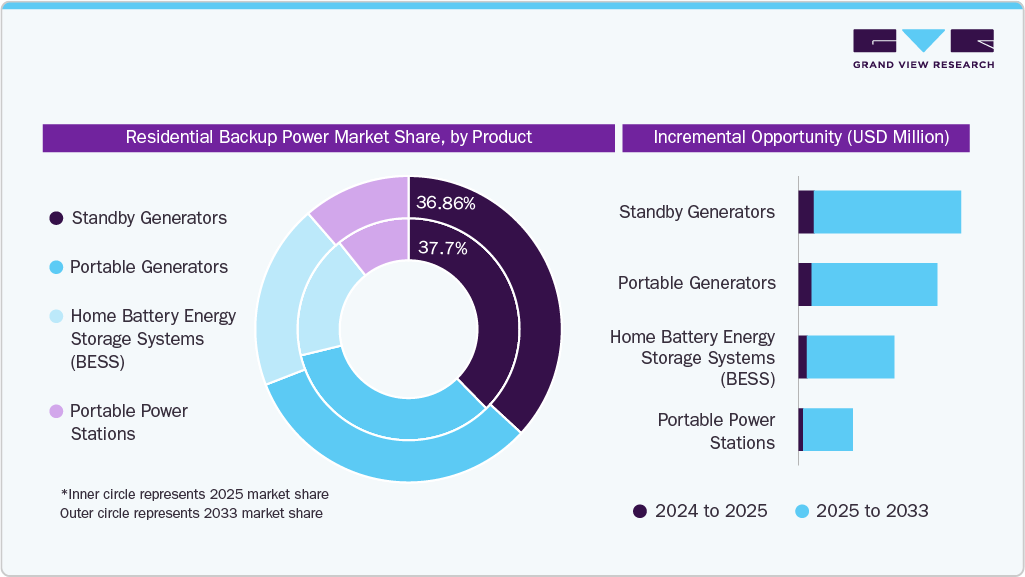
The standby generators segment led the market with the largest revenue share of 37.7% in 2025, driven by rising power outages, extreme weather events, and strong homeowner demand for automatic whole-home backup. Premium permanently installed systems continue to command higher average selling prices while serving larger homes with higher backup loads. Reinforcing this trend, in January 2025, Generac launched its next-generation 10-28 kW home standby generator platform, noting that the U.S. recorded nearly 1.5 billion hours of power outages in 2024, the highest level since it began tracking the metric in 2010.
 To learn more about this report, Download Free Sample Report
The home battery energy storage systems (BESS) segment is projected to grow at the fastest CAGR of 9.0% from 2026 to 2033, driven by rising residential solar adoption, demand for quieter, low-maintenance backup, and greater energy independence. For instance, in January 2026, Ola Electric launched Ola Shakti in India, a residential BESS available in four configurations from 1.5 to 9.1 kWh, with charging times as fast as 2 hours and up to 1.5 hours of backup at full load, positioning battery storage as an alternative to conventional inverters and diesel generators.
Power Capacity Insights
The 10-20 kW residential backup power segment led the market with the largest revenue share of 33.4% in 2025, driven by demand for higher-capacity systems capable of powering multiple household loads, including heat pumps, HVAC systems, and EV chargers. For instance, in June 2026, Sungrow launched PowerHarbor, a residential ESS with 10-30 kW power ratings and storage expandable up to 120 kWh, with up to 150% three-phase unbalanced output for high-demand household appliances.
The below-5-kW residential backup power segment is projected to grow at the fastest CAGR of 8.8% during the forecast period, driven by demand for compact, lower-cost systems that power essential household loads during outages. For instance, in May 2025, Jackery launched the HomePower 3000, a 3,072 Wh portable home backup system with 3,600 W output, 7,200 W surge capacity, and UPS switching within 20 milliseconds, designed to keep essential appliances running during power outages.
Backup Configuration Insights
The residential whole-home backup power segment led the market with the largest revenue share of 44.6% in 2025, supported by demand for higher-capacity systems that can automatically maintain power across multiple household loads, including HVAC, refrigeration, and water pumps. For instance, in January 2025, BLUETTI launched its EnergyPro 6K whole-home backup system, offering 5.8-29 kW of output and 7.68-38.4 kWh of storage, with rooftop solar integration and automatic generator switching.
 To learn more about this report, Download Free Sample Report
The residential portable backup power segment is projected to grow at the fastest CAGR of 8.6% from 2026 to 2033, supported by demand for flexible, lower-installation solutions that can power essential household loads during short-term outages. For instance, in June 2025, Anker SOLIX launched the F3000 portable power station with 3,072 Wh of capacity and 3,600 W of output, expandable to 12.3 kWh, and designed to connect directly to home circuits for backup during power disruptions.
Regional Insights
North America dominated the global residential backup power market with the largest revenue share of 44.0% in 2025, supported by high homeowner awareness of grid reliability and established adoption of generators and battery backup. A 2025 survey of 4,492 U.S. consumers by Lifestory Research found that Generac was the most trusted home-generator brand among homeowners considering a generator, highlighting strong consumer engagement with residential backup solutions
 To learn more about this report, Download Free Sample Report
U.S. Residential Backup Power Market Trends
The residential backup power market in the U.S. accounted for the largest market revenue share in North America in 2025, reflecting its large installed base of home generators and exposure to weather-related outages. According to a Generac article, U.S. homeowners experienced nearly 1.5 billion hours without power in 2024, underscoring the need for residential backup solutions.
Europe Residential Backup Power Market Trends
The residential backup power market in Europe held a significant market revenue share in 2025, driven in particular by the rapid deployment of residential battery storage alongside rooftop solar. According to an article by ReGlobal, in 2025, Europe added 12.3 GWh of residential battery capacity, representing more than 1.5 million battery storage units, while cumulative installations reached nearly 5.4 million households since 2020.
The Germany residential backup power market underpinned by its exceptionally large home-storage base. In 2024, around 580,000 new home battery systems were installed in Germany, taking cumulative home-storage capacity to 15.4 GWh.
The residential backup power market in the UK is projected to grow at a significant CAGR of 8.4% from 2026 to 2033, supported by rising rooftop solar penetration, time-of-use electricity tariffs, and the growing use of batteries to store low-cost electricity for later household consumption. As per an article published by UK Energy Management Group Ltd, UK home battery installations climbed 130% in the first half of 2025, with almost 20,000 systems certified through MCS, according to MCS deployment data. May 2025 set a single-month record of 3,400 batteries, up 112% on May 2024. The trigger is a stack of policy and tariff changes pushing storage into the math of a normal install: zero-rated VAT until March 2027, time-of-use tariffs that reward shifting load, and rooftop solar at 2 million UK installs.
The France residential backup power market is projected to grow at a substantial CAGR of 8.0% from 2026 to 2033. This can be attributed to increasing rooftop solar adoption and the growing use of batteries to maximize household self-consumption of solar generation. For instance, in September 2025, French company Sunology launched Storey, a modular residential battery system with 500 W of nominal power and 2.2 kWh of storage per module, designed specifically to increase household solar self-consumption.
Asia Pacific Residential Backup Power Market Trends
The residential backup power market in the Asia Pacific is projected to grow at the fastest CAGR of 8.6% from 2026 to 2033, driven by strong adoption of residential backup power systems as households seek greater control over electricity costs and reduce reliance on the grid during peak-demand periods. This trend is particularly evident in Australia, where more than 193,000 residential batteries were installed in 2025, adding 4.6 GWh of storage capacity following the introduction of the federal Cheaper Home Batteries Program.
The China residential backup power market is expanding rapidly, owing to its large residential energy-storage manufacturing base, expanding domestic deployment, and growing availability of lower-installation-complexity solutions. For instance, in December 2024, Hithium launched HeroES in Beijing, an installation-free home microgrid system designed for residential energy storage, with initial installation taking about 30 minutes, around 10 times faster than conventional systems, and global deliveries scheduled for Q3 2025.
The residential backup power market in India is projected to grow at a rapid CAGR of 9.5% from 2026 to 2033. This can be attributed to persistent power interruptions and still-limited penetration of household backup systems, leaving significant scope for wider adoption as backup technologies become more affordable. According to an ORF survey of 1,019 residential consumers across 40 cities, 71% experienced power cuts, while use of backup power remained limited, indicating substantial unmet demand for reliable household backup solutions.
Central & South America Residential Backup Power Market Trends
The residential backup power market in Central & South America is projected to grow at a significant CAGR of 8.4% from 2026 to 2033, driven by the expansion of distributed generation and growing interest in behind-the-meter storage to improve household energy self-sufficiency and reduce grid dependence. For instance, in August 2025, Brazil’s Ministry of Mines and Energy and EPE highlighted the growing role of behind-the-meter batteries in consumer units, with distributed generation projected to reach 78.1 GW and around 9.5 million consumers by 2035 in the reference scenario.
Middle East & Africa Residential Backup Power Market Trends
The residential backup power market in the Middle East & Africa is projected to grow at a substantial CAGR of 8.1% from 2026 to 2033, supported by persistent grid reliability challenges in Africa and the increasing adoption of residential solar-plus-storage solutions in the Middle East.
In Africa, Nigeria continues to experience major grid disruptions, forcing households to rely on decentralized backup sources such as generators and solar systems. For instance, on January 27, 2026, Nigeria's national electricity grid recorded its second collapse of the year, with power generation falling from more than 4,500 MW to 0 MW and all 23 grid-connected generation plants losing output. Meanwhile, in the Middle East, Abu Dhabi expanded its Solar Energy Self-Supply Policy to the residential sector in March 2026, allowing villa owners and eligible residential buildings to generate and store electricity using rooftop solar and battery systems.
Key Residential Backup Power Company Insights
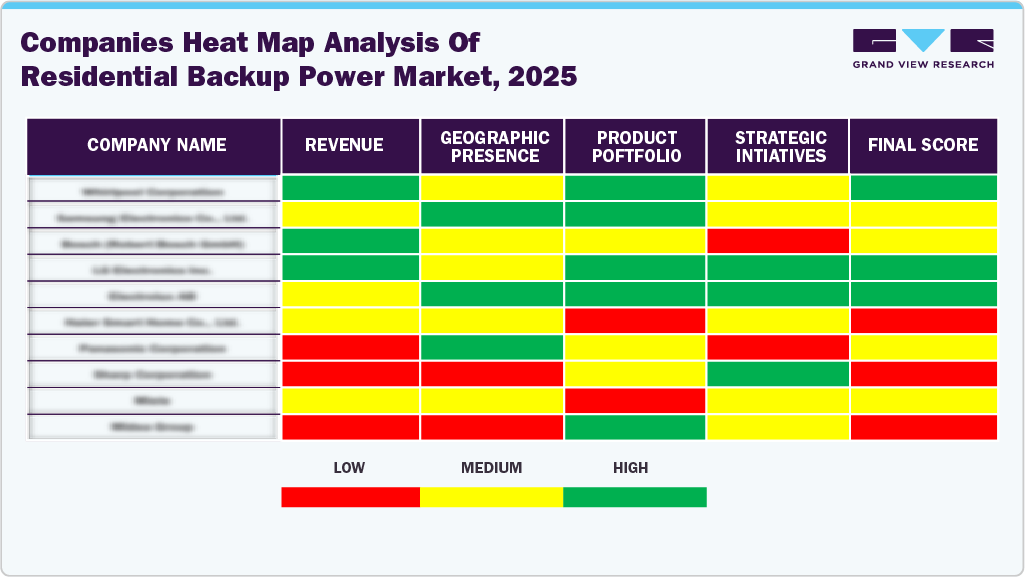
The global residential backup power industry is moderately fragmented, with competition among established generator manufacturers, residential energy storage providers, and fast-growing portable battery power companies. Competitive positioning varies significantly by product type: generator manufacturers benefit from established residential dealer and installation networks, while battery-focused companies compete on energy management, solar integration, modularity, portability, and digital connectivity. Competition is increasingly shifting from standalone backup equipment to integrated home energy resilience systems.
-
Residential Generator Leaders: Generac, Kohler, Cummins, Briggs & Stratton, and Honda maintain strong positions across standby and portable residential generators. Their competitive advantages include established installed bases, dealer and installer networks, high brand recognition, proven reliability, and broad power-capacity coverage. Their primary exposure is the gradual shift in some residential applications toward battery-based backup.
-
Residential BESS & Energy Management Leaders: Tesla, Enphase Energy, and Sonnen compete primarily in residential battery storage and integrated energy-management solutions. Their differentiation comes from solar integration, intelligent energy management, modular storage, whole-home backup, and software-enabled monitoring, positioning them strongly in higher-value residential energy systems.
-
Portable Battery Power Leaders: EcoFlow, BLUETTI, Jackery, and Anker are strengthening the portable power station segment through higher output, expandable battery capacity, fast charging, solar compatibility, and app-based control. Their products increasingly overlap with traditional generator applications, particularly for essential-load and shorter-duration residential backup.
-
Regional / Specialist Participants: A broader group of regional generator, inverter, battery, and power-electronics manufacturers competes through localized distribution, lower manufacturing costs, specialized capacity ranges, and OEM/ODM relationships. These companies are particularly relevant in emerging markets and price-sensitive residential applications.
 To learn more about this report, Download Free Sample Report
Key Residential Backup Power Companies
The following key companies have been profiled for this study on the global residential backup power market:
-
Generac Power Systems
-
Caterpillar
-
Cummins
-
Rehlko (formerly Kohler)
-
Honda
-
Schneider Electric
-
Eaton
-
Tesla
-
ABB
-
Exide Industries
Competitive Benchmarking
Market Participant Categorization
Category
Operating Strategies
Competitive Edge
Established Players (Generac; Cummins; Briggs & Stratton; Kohler; Honda; Eaton)
- Focus on expanding residential backup portfolios across standby generators, portable generators, and increasingly battery-based solutions, while strengthening dealer networks, installation capabilities, smart monitoring, automatic transfer systems, and integrated energy-management offerings. Continue investing in reliability, fuel efficiency, connected controls, and whole-home backup solutions.
- Strong brand recognition, established residential customer bases, extensive dealer and service networks, proven product reliability, broad geographic reach, and strong capabilities in installation and after-sales support.
- Higher operating and distribution costs, greater exposure to mature generator markets, slower product-cycle flexibility, and potential difficulty competing with digital-first battery and portable-power brands on price and speed of innovation.
Emerging Players (EcoFlow; BLUETTI; Jackery; Anker Innovations; Zendure)
- Focus on portable power stations, residential BESS, solar-integrated backup, and modular energy systems, supported by rapid product launches, app-based energy management, online-first distribution, and direct-to-consumer strategies. Target households seeking flexible, quiet, low-maintenance alternatives to conventional generators.
- Faster innovation cycles, strong digital and e-commerce presence, modular product architectures, attractive user experiences, competitive pricing, and strong positioning around battery, solar, and smart-home integration.
- More limited installed base for traditional whole-home systems, smaller physical service and installation networks, lower penetration in conventional generator channels, and comparatively less experience with long-duration, high-capacity residential backup applications.
Recent Developments
-
In January 2025, Generac introduced a new 28 kW air-cooled home standby generator, expanding its residential standby portfolio from 10 kW to 28 kW. The new system adds standard cellular connectivity for remote monitoring and control, enhanced diagnostics, and an updated corrosion-resistant aluminum enclosure.
-
In July 2025, EcoFlow launched OCEAN Pro, a fully integrated residential energy-storage system designed for whole-home backup and solar integration. The system expands EcoFlow's positioning beyond portable power stations into higher-capacity residential BESS, targeting households seeking greater energy independence and backup resilience.
-
In October 2025, EcoFlow launched DELTA Pro Ultra X, a scalable whole-home battery backup system designed for faster residential deployment. The system combines expandable battery storage, high-power output, smart-home integration, and an optional smart panel, with the company positioning installation within seven days.
Residential Backup Power Market Report Scope
Report Attribute
Details
Market size in 2025
USD 14.7 billion
Estimated market size in 2026
USD 16.0 billion
Projected market size by 2033
USD 27.3 billion
Growth rate
CAGR of 8.0% from 2026 to 2033
Base year for estimation
2025
Historical data
2021 - 2025
Forecast period
2026 - 2033
Quantitative units
Revenue in USD million/billion, and CAGR from 2026 to 2033
Report coverage
Revenue forecast, company ranking, competitive landscape, growth factors, and trends
Segments covered
Product, power capacity, backup configuration, region
Regional scope
North America; Europe; Asia Pacific; Central & South America; Middle East & Africa
Country scope
U.S.; Canada; Mexico; Germany; UK; France; Italy; Spain; China; Japan; India; South Korea; Australia & New Zealand; Brazil; South Africa
Key companies profiled
Generac Power Systems; Caterpillar; Cummins; Rehlko; Honda; Schneider Electric; Eaton; Tesla; ABB; Exide Industries
Customization scope
Free report customization (equivalent up to 8 analysts’ working days) with purchase. Addition or alteration to country, regional & segment scope.
Pricing and purchase options
Avail customized purchase options to meet your exact research needs. Explore purchase options
Global Residential Backup Power Market Report Segmentation
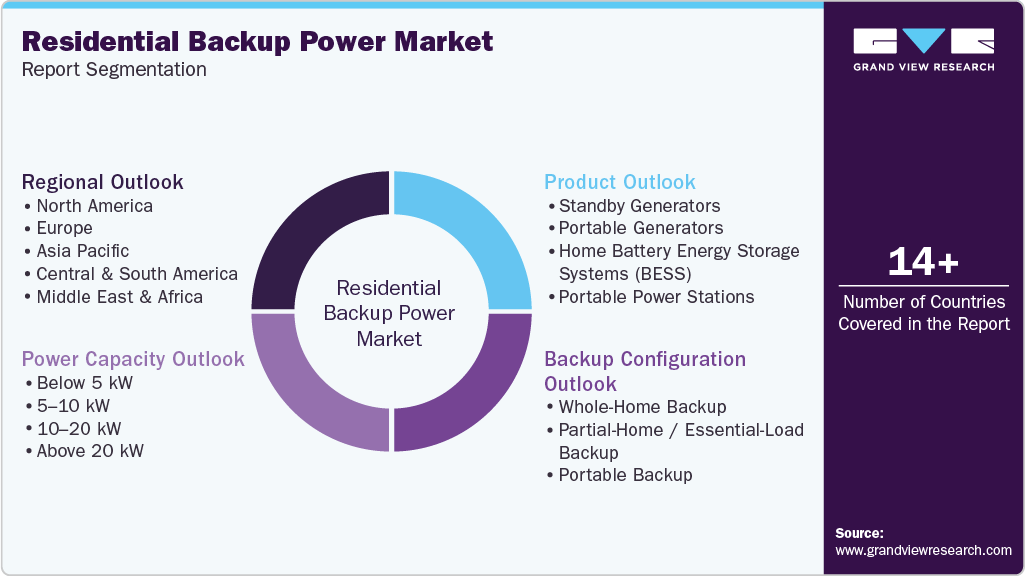
This report forecasts revenue growth at the global, regional & country levels and provides an analysis of the latest trends and opportunities in each sub-segment from 2026 to 2033. For this study, Grand View Research has segmented the global residential backup power market report based on the product, power capacity, backup configuration, and region.
 To learn more about this report, Download Free Sample Report
-
Product Outlook (Revenue, USD Billion, 2021 - 2033)
-
Standby Generators
-
Portable Generators
-
Home Battery Energy Storage Systems (BESS)
-
Portable Power Stations
-
-
Backup Configuration Outlook (Revenue, USD Billion, 2021 - 2033)
-
Whole-Home Backup
-
Partial-Home / Essential-Load Backup
-
Portable Backup
-
-
Power Capacity Outlook (Revenue, USD Billion, 2021 - 2033)
-
Below 5 kW
-
5-10 kW
-
10-20 kW
-
Above 20 kW
-
-
Regional Outlook (Revenue, USD Billion, 2021 - 2033)
-
North America
-
U.S.
-
Canada
-
Mexico
-
-
Europe
-
Germany
-
UK
-
France
-
Italy
-
Spain
-
-
Asia Pacific
-
China
-
Japan
-
India
-
South Korea
-
Australia & New Zealand
-
-
Central & South America
-
Brazil
-
-
Middle East & Africa
-
South Africa
-
-
Research Methodology
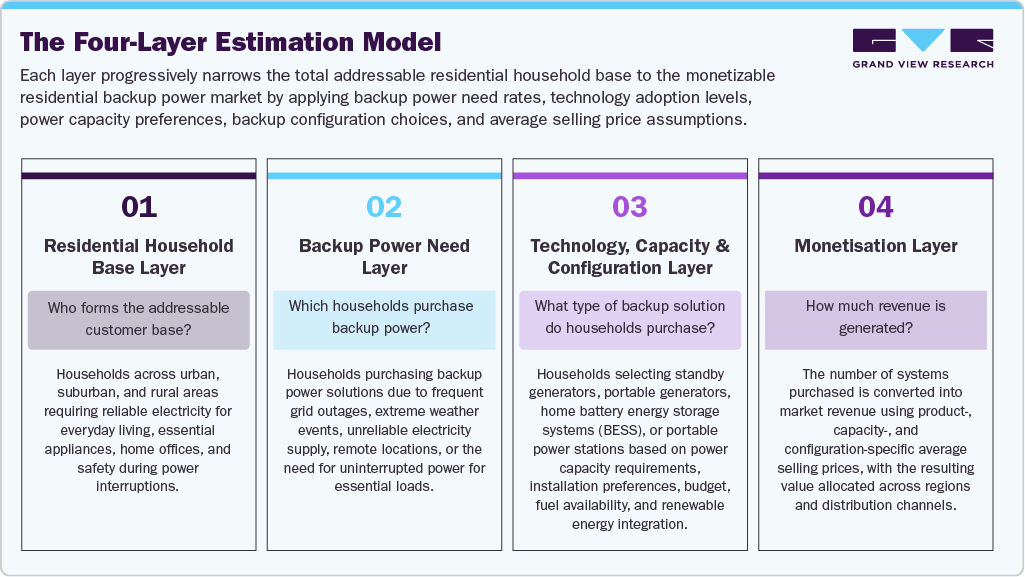
The residential backup power marketfigures in this report are based on a proven research process that combines executive interviews with secondary research from proprietary databases, company filings, and recognized regulatory and institutional sources. Market size is built through value-chain sizing-reconciling supply-side and demand-side estimates-and triangulated with bottom-up and top-down approaches. Every estimate passes multiple levels of expert validation before publication, with eachresidential backup power segment quantified using the revenue-capture definitions in the table below.
Segment Definition
Segment - Product
Revenue capture definition
Standby Generators
Revenue from stationary generator systems sold for residential backup, including the generator and associated components included in the equipment sale. Excludes commercial/industrial applications and separately billed installation and aftermarket services.
Portable Generators
Revenue from portable generators sold for residential backup and emergency power. Excludes commercial/industrial applications, rentals, and separately billed installation and aftermarket services.
Home Battery Energy Storage Systems (BESS)
Revenue from residential battery-storage systems used for backup and power resilience, including batteries, inverters, power electronics, and associated components sold as part of the system. Excludes commercial/industrial and utility-scale storage and separately billed services.
Portable Power Stations
Revenue from consumer portable battery power stations intended for residential or emergency backup, including integrated batteries, inverters, charging systems, and built-in components. Excludes outdoor-only, commercial/industrial applications and separately billed services.
Estimation Model
 To learn more about this report, Download Free Sample Report
Delivered Customizations
This report has been delivered with the following In-depth customizations
Client Request
Customization Delivered
Value Adds
Power Capacity Backup Configuration Product Demand Matri
Developed a three-dimensional demand model quantifying market size, growth, adoption, and product mix across power capacity (Below 5 kW, 5-10 kW, 10-20 kW, Above 20 kW), backup configuration (Whole-Home, Essential-Load / Partial-Home, Portable Backup), and product (Standby Generators, Portable Generators, Home BESS, Portable Power Stations).
Identified high-growth demand pockets, emerging product opportunities, and optimal product-capacity-configuration combinations, supporting portfolio prioritization, product development, and investment decisions.
Generator-to-Battery Transition & Product Positioning Analysis
Assessed the evolving competitive position of standby generators, portable generators, home BESS, and portable power stations across backup duration, power capacity, installation requirements, operating economics, portability, and solar integration.
Identified technology transition opportunities, substitution risks, and whitespace areas, enabling vendors to prioritize battery-led, generator-led, or hybrid product strategies by market.
Replacement Cycle Installed Base Opportunity Analysis
Assessed the residential backup power opportunity by evaluating installed equipment base, replacement cycles, technology upgrades, and incremental household adoption across major backup power product categories.
Identified the replacement-driven versus new-adoption revenue opportunity, highlighting recurring demand pools, upgrade opportunities, and periods of elevated replacement activity to support aftermarket strategy, customer retention, sales forecasting, and long-term revenue planning.
Frequently Asked Questions About This Report
The global residential backup power market size was valued at USD 14.7 billion in 2025 and is estimated at USD 27.3 billion for 2026.
The global residential backup power market is expected to grow at a CAGR of 8.0 % from 2026 to 2033, reaching USD 27.3 billion.
Key factors driving the residential backup power market growth is driven by growing concerns about grid reliability, frequent power interruptions, and rising household dependence on uninterrupted electricity.
North America dominated with a 44.0 % revenue share in 2025.
Asia Pacific is the fastest-growing region over the forecast period.
Standby generators for residential backup power accounted for 37.7% of global revenue in 2025 and home battery energy storage systems (BESS) for residential backup power is anticipated to grow at the fastest rate during the forecast year.
10–20 kW residential backup power held the largest revenue share in 2025, whereas Below-5-kW residential backup power is the fastest-growing segment.
The whole-home backup power accounted for a revenue share of 44.6% in 2025, while the sale of residential portable backup power is growing the fastest.
Key players Generac Power Systems; Caterpillar; Cummins; Rehlko; Honda; Schneider Electric; Eaton; Tesla; ABB; Exide Industries
About the Author(s)
Electronic & Electrical Research Team
Consumer Goods · Electronic & ElectricalThis report was authored by the electronic & electrical research team at Grand View Research - comprising two research analysts, one senior research analyst, and one industry expert - with specialized expertise in the electronic & electrical segment of the consumer goods industry. All findings are based on proprietary consumer goods databases, executive interviews, and regulatory analysis, subject to internal peer review prior to publication.
Last Updated:
Speak to Analyst

Customize this report to your needs - add regions, segments, or data points, with 20% free customization.
Or view our licence options:


ISO 9001:2015 & 27001:2022 Certified
We are GDPR and CCPA compliant! Your transaction & personal information is safe and secure. For more details, please read our privacy policy.


