
- Home
- »
- Consumer F&B
- »
-
Rice Seeds Market Size, Share & Growth Report, 2026-2033GVR Report cover

Rice Seeds Market (2026 - 2033)
Size, Share & Trends Analysis Report By Product (Hybrid, Open-Pollinated Varieties), By Grain Size (Short Grain, Medium Grain, Long Grain), By Region, And Segment Forecasts
Market Size, 2025
$7.8BMarket Estimate, 2026
$8.1BMarket Forecast, 2033
$10.4BCAGR, 2026–2033
3.7%Rice Seeds Market Summary
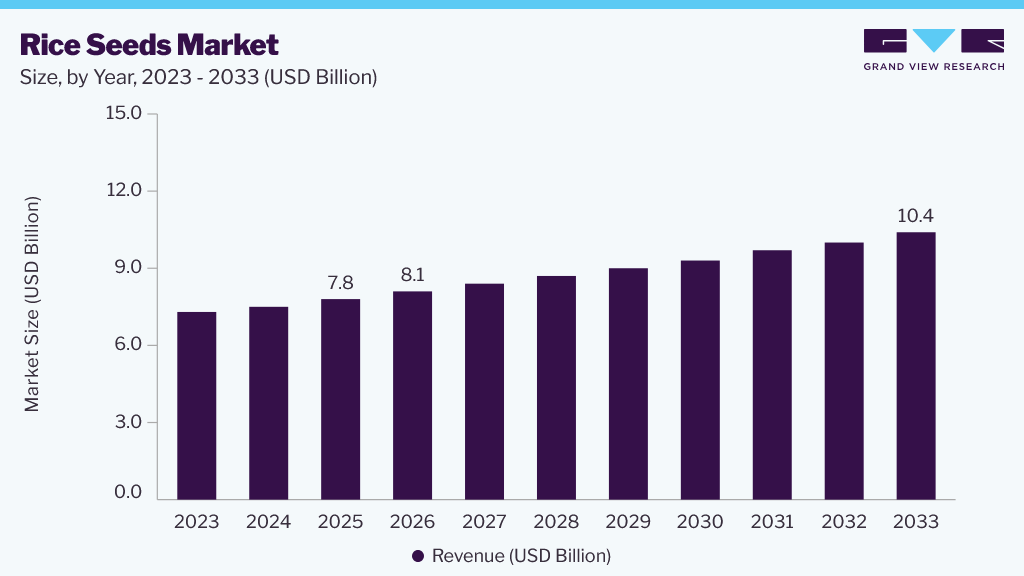
The global rice seeds market size was valued at USD 7.8 billion in 2025 and is projected to grow from USD 8.1 billion in 2026 to USD 10.4 billion by 2033, at a CAGR of 3.7% from 2026 to 2033. Asia Pacific dominated the market, accounting for the largest revenue share of approximately 77.0% in 2025. This growth can be attributed to the rising global population, which is driving an alarming demand for staple foods, including rice.
 Source: Grand View Research, IR Documents, Primary Interviews, Paid DatabasesTo learn more about this report,
 Download Free Sample Report
Key Market Trends & Insights
- By product: The open-pollinated varieties segment held the largest market share of approximately 60.0% in 2025.
- By grain size: The long grain size segment held the largest market share in 2025.
Regional Highlights
- Largest regional market: Asia Pacific (77.0% revenue share, 2025)
- Fastest-growing regional market: North America (highest CAGR, 2026-2033)
Market Size & Forecast
- Market size in 2025: USD 7.8 Billion
- Estimated market size in 2026: USD 8.1 Billion
- Projected market size by 2033: USD 10.4 Billion
- CAGR (2026-2033): 3.7%
Prism AI by Grand View Research Free to tryAsk a question about the rice seeds marketTry asking✓Every figure cited from GVR research Prefer the report? Download free sample →Furthermore, consumers have grown more health-conscious, progressively seeking the nutritional benefits of rice. This has led to an inclination toward organic and specialty rice. Healthily yielded and better-flavored rice seeds have aligned with this trend, further contributing to market growth.
Furthermore, the demand for higher-quality rice crops has driven the adoption of improved seed varieties. This has led to innovative rice breeding techniques, such as the use of genomics and microbiology to develop high-yielding, disease-resistant, and climate-tolerant rice varieties. These advancements enhanced productivity and contributed to the overall growth of the rice seed market.
For instance, hybrid rice seeds offer improved yield potential and better resistance to pests and diseases. The availability of hybrid rice seeds and easy access to agricultural resources have improved the overall ecosystem for rice cultivation. Farmers across regions have increasingly adopted hybrid rice seeds, further driving market growth.
Moreover, government initiatives and private institutions that support farmers played a crucial role in market expansion. These efforts, including providing agricultural credits, contract services, and access to essential inputs such as seeds, pesticides, fertilizers, and machinery, have further contributed to the market expansion.
Analyst Perspective
The global rice seeds market is driven by rising demand for high-yielding crop varieties. Even growing concerns about food security, continuous advancement, and some government-supported schemes through subsidies, credit facilities, and extensive services also drive this market. However, some factors, such as the high cost of hybrid seeds, limited awareness among farmers, and changing climate conditions, are hampering the growth of the market. Key opportunities are helping the rice seed market reach new heights. Sustainable initiatives, biotech seeds, and the expansion of these crops in various regions will shape this market in a more productive way.
Product Insights
The open-pollinated varieties (OPV) of rice seeds segment led the market with the largest revenue share of approximately 60.0% in 2025, owing to the global demand for naturally grown rice. These rice varieties result from the natural pollination of parent plants. These seeds can be self-pollinated or pollinated by insects, birds, and other natural means to preserve genetic diversity. Unlike hybrid seeds, OPVs produce plants identical to their parent plants and are considered standard varieties.
The hybrid rice seeds segment is anticipated to grow at a substantial CAGR during the forecast period, owing to the rising global population and the need for consistent food security. Hybrid rice, obtained by breeding two different parental lines, significantly outperforms conventional rice variants in bridging yield gaps. Farmers find it more productive, as these seeds require less agricultural land to yield. In addition, high-quality hybrid seeds, coupled with innovative breeding technologies, contribute to market growth. These seeds exhibit improved heterosis, resulting in 20-25% yield increases compared to traditional rice varieties.
Grain Size Insights
The long grain size seeds segment accounted for the largest market revenue share in 2025, due to the rising consumer demand for quality. Consumers increasingly sought high-quality rice and favored long-grain varieties for their distinct texture, aroma, and taste. These seeds offer higher yields, disease resistance, adaptability to diverse climates, and culinary versatility, ensuring steady demand. Furthermore, long-grain rice seeds are often associated with healthier eating habits due to their lower glycemic index and potential health benefits. This awareness has significantly driven consumer preferences and contributed to market growth.
The medium-grain rice seeds segment is expected to grow at the fastest CAGR of over 4.0% during the forecast period. These seeds strike an excellent balance between long-grain and short-grain varieties. Their versatility makes them suitable for a wide range of dishes, catering to diverse culinary preferences. Its popularity in international cuisine ensures consistent demand and export potential. Moreover, ongoing research activities have focused on enhancing medium-grain varieties and improving yield, disease resistance, and cooking quality.
Regional Insights
The rice seeds market in North America is anticipated to grow at the fastest CAGR during the forecast period. The rising population in North America has significantly propelled the demand for staple foods, including rice, as nutritious and sustainable options. Health-conscious consumers have increasingly preferred organic and specialty rice varieties, including long-, medium-, and short-grain varieties. Moreover, government initiatives and agricultural institutions have initiated subsidies, research programs, and extension services to encourage farmers to adopt improved rice seed varieties.
U.S. Rice Seeds Market Trends
The rice seed market in the U.S. was driven by the growing demand for hybrid rice seeds. Farmers have increasingly chosen hybrid rice seeds for their affordability, improved pest resistance, and high yields. Moreover, long-grain rice seeds have been widely cultivated in the U.S. for use in various cuisines. Basmati and jasmine varieties, exported in large quantities, have held notable industrial significance.
Asia Pacific Rice Seeds Market Trends
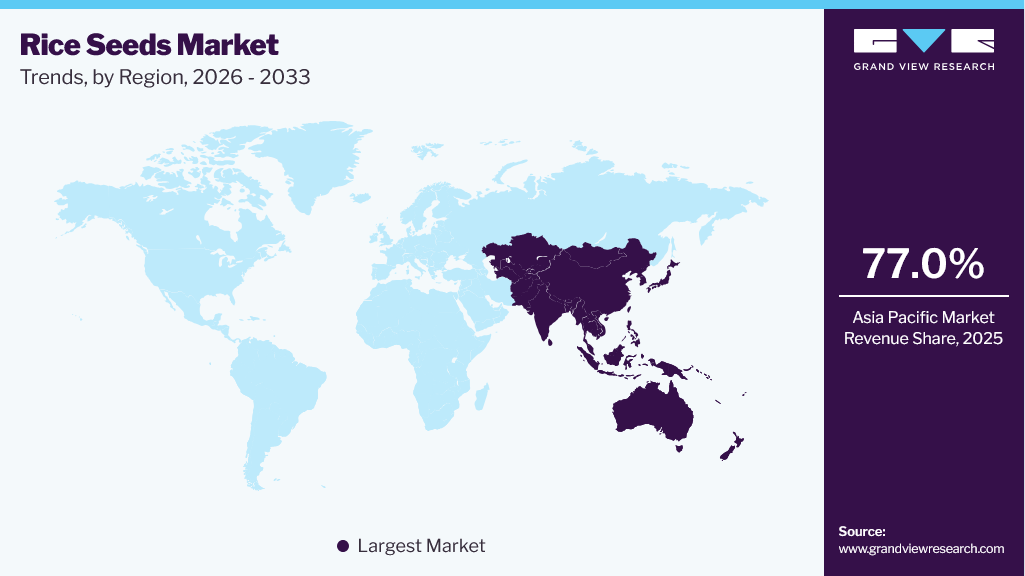
Asia Pacific dominated the global rice seed market with the largest revenue share of approximately 77.0% in 2025. This can be attributed to the growing populations in countries such as India, China, and Indonesia, where rice is a staple food. In addition, the market has seen farmers increasingly seek rice seeds resistant to diseases such as seedling blight and grain rot. Brands including Bayer AG’s Arize Tej Gold and Vina Seed’s Thein Uu8 offer such traits
 To learn more about this report, Download Free Sample Report
Europe Rice Seeds Market Trends
The rice seed market in Europe is anticipated to grow at a significant CAGR during the forecast period. European farmers are becoming more aware of the benefits of using certified and improved rice seeds. Government policies that promote sustainable agriculture and support seed research and development have encouraged hybrid crop production. Furthermore, research and development activities have led to technological advancements in seed breeding, enhancing yield, disease resistance, and overall crop quality.
Key Rice Seeds Company Insights
The global market for rice seeds is fragmented. Key players such as Bayer AG, RiceTec Inc., NUZIVEEDU SEEDS LTD, and others have employed diverse growth strategies to remain competitive. These strategies include product launches, innovations, mergers, acquisitions, collaborations, and a focus on research and development efforts.
- Corteva Agriscience is a publicly traded, global pure-play agriculture company that offers a wide range of agricultural solutions, including seeds, crop protection products, and innovative technologies. In addition, the company draws on scientific achievements from DuPont and Dow AgroSciences to address the challenges farmers face.
- RiceTec Inc. is a provider of hybrid rice seeds. The company develops and produces high-yielding hybrid rice seeds for farmers worldwide. Additionally, the company markets the popular Texmati brand rice in grocery stores across North America.
Key Rice Seeds Companies
The following key companies have been profiled for this study on the global rice seeds market:
-
Bayer AG
-
Advanta Seeds - UPL
-
Corteva Agriscience
-
BASF
-
SL Agritech Corporation (SLAC)
-
Syngenta
-
NUZIVEEDU SEEDS LTD
-
RiceTec Inc.
-
Horizon Ag, LLC
-
Hancock Seed & Company
Recent Developments
-
In January 2026, SAP and Syngenta announced a partnership to accelerate AI-assisted innovations from manufacturing and supply chain to grower-facing products and services.
-
In June 2024, RiceTec, Inc. launched FullPage Rice Cropping Solution with its Indian affiliate, Savannah Seeds, also in collaboration with a global crop protection company, ADAMA. FullPage integrates SmartRice genetics, specifically tailored for direct-seeded rice, SQUAD seed treatment, the unique IMI herbicide tolerance trait, and ADAMA’s Vezir herbicide.
Rice Seeds Market Report Scope
Report Attribute
Details
Market size in 2025
USD 7.8 billion
Estimated market size in 2026
USD 8.1 billion
Projected market size by 2033
USD 10.4 billion
Growth rate
CAGR of 3.7% from 2026 to 2033
Base year for estimation
2025
Historical data
2021 – 2024
Forecast period
2026 – 2033
Quantitative units
Revenue in USD billion/million, and CAGR from 2026 to 2033
Report coverage
Revenue forecast, company ranking, competitive landscape, growth factors, and trends
Segments covered
Product, grain size, region
Regional scope
North America; Europe; Asia Pacific; Latin America; MEA
Country scope
U.S.; Canada; Mexico; France; Italy; Spain; China; India; Indonesia; Vietnam; Philippines; Brazil; Nigeria; Egypt
Key companies profiled
Bayer AG; Advanta Seeds - UPL; Corteva Agriscience; BASF; SL Agritech Corporation (SLAC); Syngenta; NUZIVEEDU SEEDS LTD; RiceTec Inc.; Horizon Ag. LLC; Hancock Seed & Company
Customization scope
Free report customization (equivalent up to 8 analysts working days) with purchase. Addition or alteration to country, regional & segment scope.
Pricing and purchase options
Avail of customized purchase options to meet your exact research needs. Explore purchase options
Global Rice Seeds Market Report Segmentation
This report forecasts revenue growth at global, regional, and country levels and provides an analysis of the latest industry trends and opportunities in each of the sub-segments from 2021 to 2033. For this study, Grand View Research has segmented the global rice seeds market report based on product, grain size, and region:
-
Product Outlook (Revenue, USD Billion, 2021 - 2033)
-
Open-Pollinated Varieties
-
Hybrid
-
-
Grain Size Outlook (Revenue, USD Billion, 2021 - 2033)
-
Short Grain
-
Medium Grain
-
Long Grain
-
-
Regional Outlook (Revenue, USD Billion, 2021 - 2033)
-
North America
-
U.S.
-
Canada
-
Mexico
-
-
Europe
-
Italy
-
Spain
-
France
-
-
Asia Pacific
-
China
-
India
-
Indonesia
-
Vietnam
-
Philippines
-
-
Latin America
-
Brazil
-
-
Middle East and Africa
-
Nigeria
-
Egypt
-
-
Frequently Asked Questions About This Report
The global rice seeds market size was valued at USD 7.8 billion in 2025 and is estimated at USD 8.1 billion for 2026.
The global rice seeds market is expected to grow at a CAGR of 3.7% from 2026 to 2033, reaching USD 10.4 billion by 2033.
Asia Pacific dominated with a 77.0% revenue share in 2025.
Key players include Bayer AG, Advanta Seeds - UPL, Corteva Agriscience, BASF, SL Agritech Corporation (SLAC), Syngenta, NUZIVEEDU SEEDS LTD, RiceTec Inc., Horizon Ag, LLC, Hancock Seed & Company, and others.
The open-pollinated varieties segment accounted for the largest revenue share of approximately 60.0% in 2025.
About the Author(s)
Consumer F&B Research Team
Consumer Goods · Consumer F&BThis report was authored by the consumer f&b research team at Grand View Research - comprising two research analysts, one senior research analyst, and one industry expert - with specialized expertise in the consumer f&b segment of the consumer goods industry. All findings are based on proprietary consumer goods databases, executive interviews, and regulatory analysis, subject to internal peer review prior to publication.
Last Updated:
Speak to Analyst

Customize this report to your needs - add regions, segments, or data points, with 20% free customization.
Or view our licence options:


ISO 9001:2015 & 27001:2022 Certified
We are GDPR and CCPA compliant! Your transaction & personal information is safe and secure. For more details, please read our privacy policy.


