
- Home
- »
- Advanced Interior Materials
- »
-
Roofing Tiles Market Size, Share & Trends Report 2026-2033GVR Report cover

Roofing Tiles Market (2026 - 2033)
Size, Share & Trends Analysis Report By Material (Clay, Concrete, Metal, Composite), By Construction Type (New Construction, Renovation & Replacement), By End Use, By Region, And Segment Forecasts
Market Size, 2025
$14.3BMarket Estimate, 2026
$15.1BMarket Forecast, 2033
$22.4BCAGR, 2026–2033
5.8%Roofing Tiles Market Summary
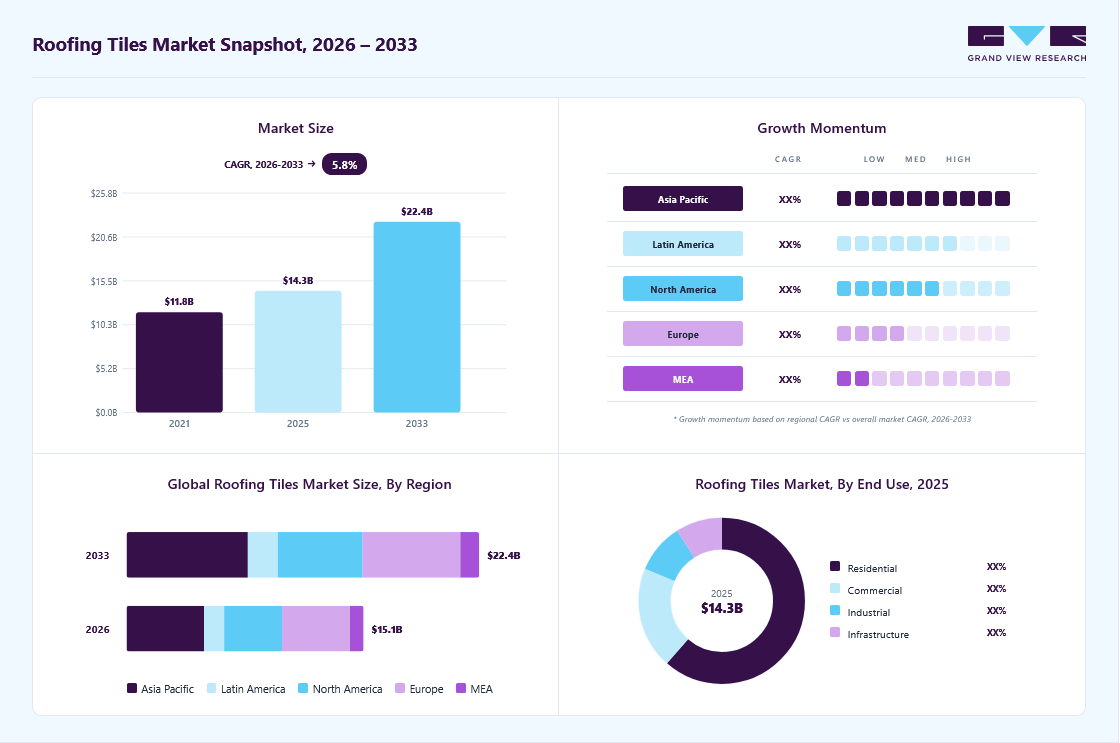
The global roofing tiles market size was valued at USD 14.3 billion in 2025 and is projected to grow from USD 15.1 billion in 2026 to USD 22.4 billion by 2033, at a CAGR of 5.8% from 2026 to 2033. Asia Pacific dominated the market, accounting for a revenue share of 32.5% in 2025. Demand for roofing tiles is being supported by residential construction, commercial development, renovation, and roof replacement activities across major construction markets.
 Source: Grand View Research, IR Documents, Primary Interviews, Paid DatabasesTo learn more about this report,
 Download Free Sample Report
Key Market Trends & Insights
- By construction type: New construction segment held the largest revenue share of 55.7% in 2025.
- By end use: Residential segment dominated the market with a revenue share of 61.4% in 2025.
- By material: Composite segment is projected to register a CAGR of 6.8% during the forecast period from 2026 to 2033.
Regional Highlights
- Largest regional market: Asia Pacific (32.5% revenue share, 2025)
- By country: China held the largest market share in 2025
Market Size & Forecast
- Market size in 2025: USD 14.3 Billion
- Estimated market size in 2026: USD 15.1 Billion
- Projected market size by 2033: USD 22.4 Billion
- CAGR (2026-2033): 5.8%
Three ways to get this report
Buy it, customize it, or ask a question.Ask an Analyst
Analyst response in 1 business day
- AccessReport author, directly
- Reply timeWithin 1 working day
- No sales callDirect answer only
- FormatEmail reply
- CostFree, no cost
Get the Full Report
What the study covers
- FormatsPDF · Excel · Dashboard
- Timeline2026–2033 annual, 2025 base
- Coverage20+ countries, 5 regions
- Companies10+ key players profiled
Customize the Report
20% free customization
- IncludeCountries, segments, points
- TailorTo your product definition
- ExtendDeeper competitor detail
- OrA fully bespoke study
- Turnaround5–10 working days
Increasing housing requirements, urban expansion, and the refurbishment of aging building stock are sustaining consumption, while a growing emphasis on durable and aesthetically appealing roofing systems is driving the adoption of tile-based solutions. Demand patterns vary across regions based on construction practices, climatic conditions, architectural preferences, and the availability of competing roofing materials.The market is also benefiting from continued investment in new buildings and improvements to existing structures. In mature markets, replacement and renovation projects represent an important source of demand, while emerging economies are generating opportunities through the expansion of housing stock and urban infrastructure. Product selection is increasingly influenced by durability, thermal performance, installation requirements, maintenance needs, and compatibility with modern building designs.
 To learn more about this report, Download Free Sample Report
Sustainability and energy-efficiency considerations are further influencing purchasing decisions across the roofing sector. Manufacturers are developing products with improved thermal characteristics, lower material consumption, reduced weight, recycled content, and longer service lives to align with evolving building requirements. These developments are creating opportunities for differentiated roofing solutions while encouraging greater product innovation across established material categories.
Market Dynamics
The roofing tiles market is influenced by a combination of construction activity, renovation and replacement demand, material preferences, building requirements, and evolving expectations for product performance. Increasing residential and commercial development supports market expansion, while structural considerations, installation requirements, and competition from alternative roofing materials can limit adoption in certain applications. At the same time, the shift toward lightweight, durable, energy-efficient, and sustainable roofing solutions is creating new opportunities for manufacturers.
Growing construction activity in residential and commercial buildings is driving sustained demand for roofing tiles, as new structures require durable, weather-resistant roofing systems. Rising housing demand, urban development, the replacement of aging buildings, and the expansion of commercial facilities are driving product adoption in both developed and emerging markets. Roofing tiles are particularly attractive where building owners prioritize service life, architectural appearance, and resistance to varying weather conditions.
The renovation and refurbishment of existing buildings further strengthen demand by creating recurring replacement requirements. In mature construction markets, roof replacement and remodeling provide an important source of consumption, while developing economies benefit from increasing residential construction and commercial development. Improvements in tile designs, finishes, installation systems, and thermal performance are also broadening their suitability across different building designs.
Roofing tiles can require appropriate roof structures, supporting systems, and installation practices to accommodate product weight and ensure long-term performance. Compared with some lightweight roofing alternatives, certain tile products may increase structural requirements and installation complexity, particularly in buildings where weight limitations are important. Skilled installation and proper roof preparation can also increase overall project costs and construction time.
The development of lightweight roofing tiles presents an opportunity for manufacturers to address structural limitations while retaining the durability and aesthetic benefits associated with conventional tile roofing. Composite materials, advanced concrete formulations, and other engineered solutions can enable manufacturers to reduce product weight, improve handling, and expand application opportunities across different building structures.
Sustainability is also creating opportunities for manufacturers to incorporate recycled materials, improve manufacturing efficiency, reduce resource consumption, and develop products with longer service lives. Roofing tiles with improved thermal performance and environmentally preferable material profiles can benefit from growing demand for energy-efficient and sustainable buildings.
Market Concentration & Characteristics
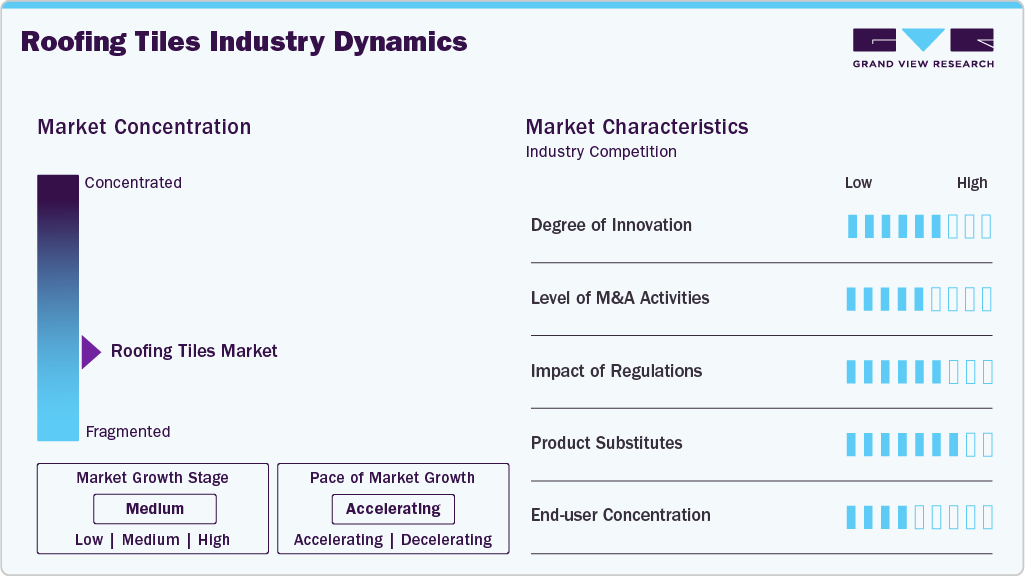
The roofing tiles market is moderately fragmented, with competition comprising large building-material manufacturers, specialized roofing companies, regional producers, and local manufacturers. Market positioning varies considerably by geography because transportation costs, construction practices, raw-material availability, architectural preferences, and distribution networks influence product selection. Established companies generally compete through broad product portfolios, manufacturing capacity, technical capabilities, brand recognition, and extensive distribution networks, while regional manufacturers often compete through localized products, pricing, and customer relationships.
 To learn more about this report, Download Free Sample Report
Roofing tiles face substitution from metal roofing, asphalt shingles, fiber cement roofing, concrete roofing systems, synthetic roofing products, and other roof-covering solutions. Substitution depends on factors such as initial cost, structural requirements, installation speed, climate, maintenance needs, expected service life, aesthetics, and local construction practices. Lightweight and rapidly installed roofing materials can present stronger substitution pressure in applications where structural load and installation efficiency are major considerations.
Analyst Perspective
The roofing tiles market is expected to remain supported by steady residential and commercial construction, renovation and replacement activity, and growing preference for durable and visually appealing roofing solutions. Clay and concrete tiles continue to benefit from established applications and proven performance, while metal and composite tiles are gaining attention where lightweight construction, design flexibility, and improved installation efficiency are prioritized. From an end-use perspective, residential applications are likely to remain a major demand base, whereas commercial and infrastructure development can create additional opportunities for higher-performance roofing systems. Manufacturers that combine material innovation, product durability, sustainable manufacturing, and strong distribution networks are well positioned to capture emerging opportunities across both new construction and replacement markets.
Material Insights
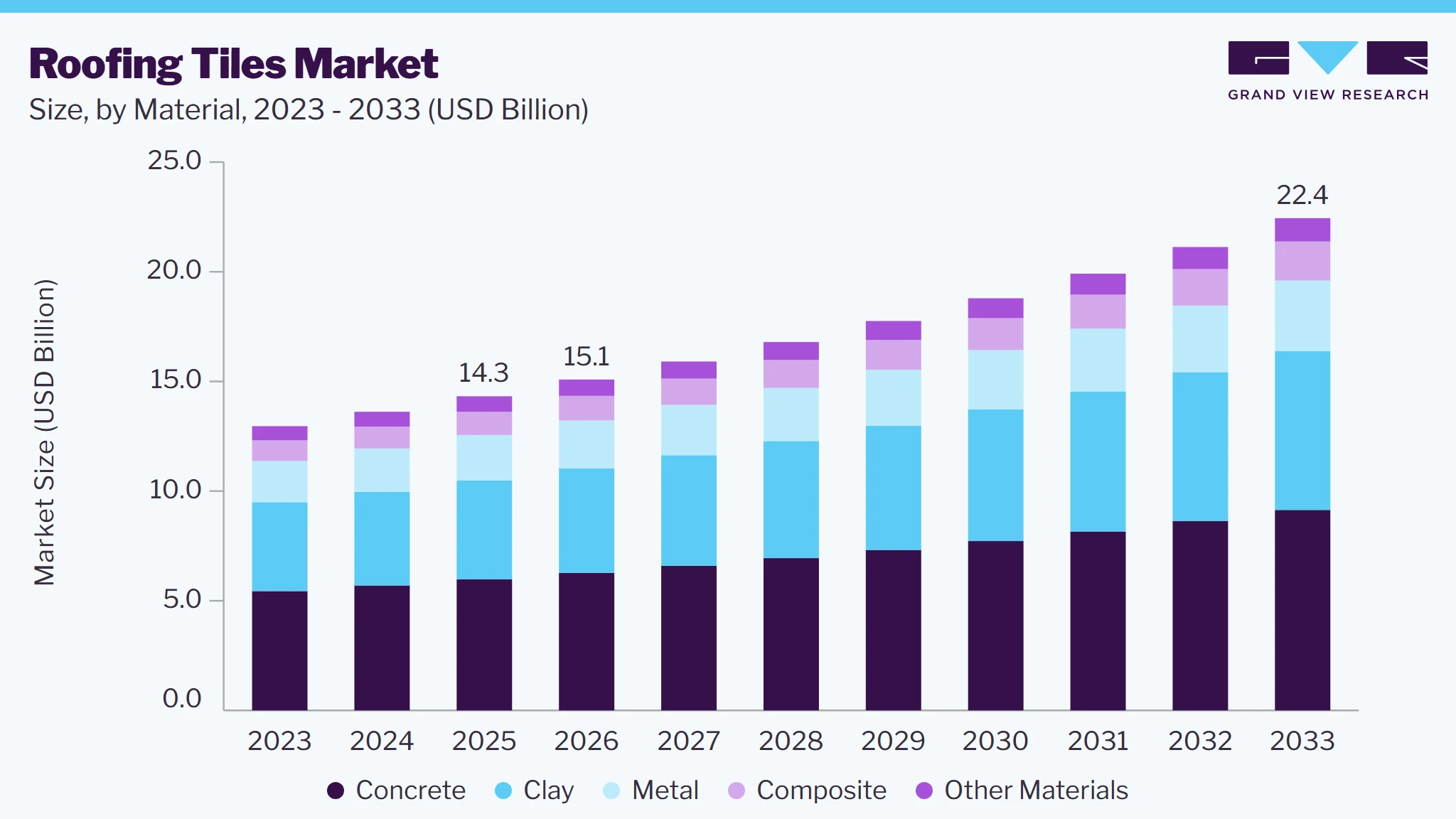
The concrete segment held the highest revenue share of 41.7% in 2025, supported by its established use across residential and commercial construction. Concrete roofing tiles offer a combination of durability, weather resistance, design versatility, and relatively broad availability, making them a preferred option across a range of building applications. Their established manufacturing base and compatibility with conventional roofing practices further support sustained demand.
The composite segment is expected to grow at a CAGR of 6.8% over the forecast period, as building owners and contractors increasingly seek roofing products that combine durability, reduced weight, design flexibility, and improved installation characteristics. Composite tiles can incorporate engineered materials and recycled components, allowing manufacturers to address changing performance and sustainability requirements. Their suitability for renovation projects and applications requiring differentiated aesthetics is also expected to support adoption.
Construction Type Insights
The new construction segment held the largest revenue share of 55.7% in 2025, driven by continued residential and commercial building activity and the installation of roofing systems as part of new projects. Demand is supported by housing development, urban expansion, commercial construction, and new infrastructure projects, where roofing materials are selected during the initial building design and procurement process.
The renovation & replacement segment is expected to grow at a CAGR of 5.1% over the forecast period, as aging buildings require roof refurbishment, partial replacement, or complete reroofing. Growing maintenance requirements across established building stock, combined with homeowners' and property owners' focus on extending roof service life and improving building appearance, is creating additional demand. Replacement activity also provides opportunities for manufacturers to introduce higher-performance and visually differentiated roofing products.
End Use Insights
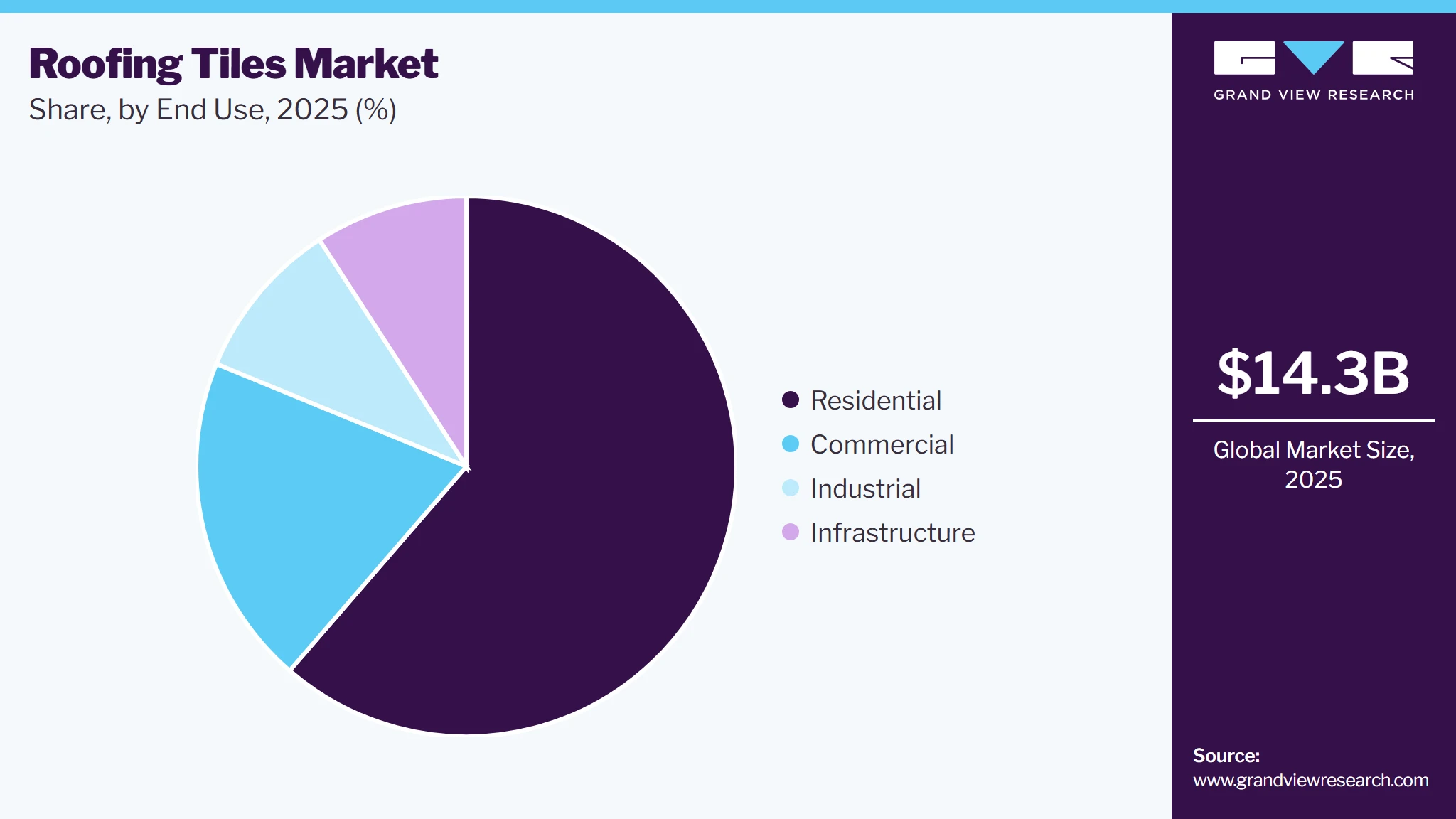
The residential segment accounted for the largest revenue market share of 61.4% in 2025, due to the extensive use of roofing tiles in houses, apartments, townhouses, and other residential structures. Housing construction and reroofing activity provide a broad and recurring demand base, while consumer preferences for durability, aesthetics, weather protection, and architectural compatibility continue to support tile adoption in residential projects.
 To learn more about this report, Download Free Sample Report
The infrastructure segment is expected to grow at a CAGR of 6.4% over the forecast period, as public and civil development projects increasingly require durable roofing systems for transport facilities, utility buildings, public structures, and other infrastructure-related applications. Expansion of infrastructure investment and refurbishment of existing public assets can create opportunities for roofing products with strong weather resistance, long service life, and low maintenance requirements.
Regional Insights
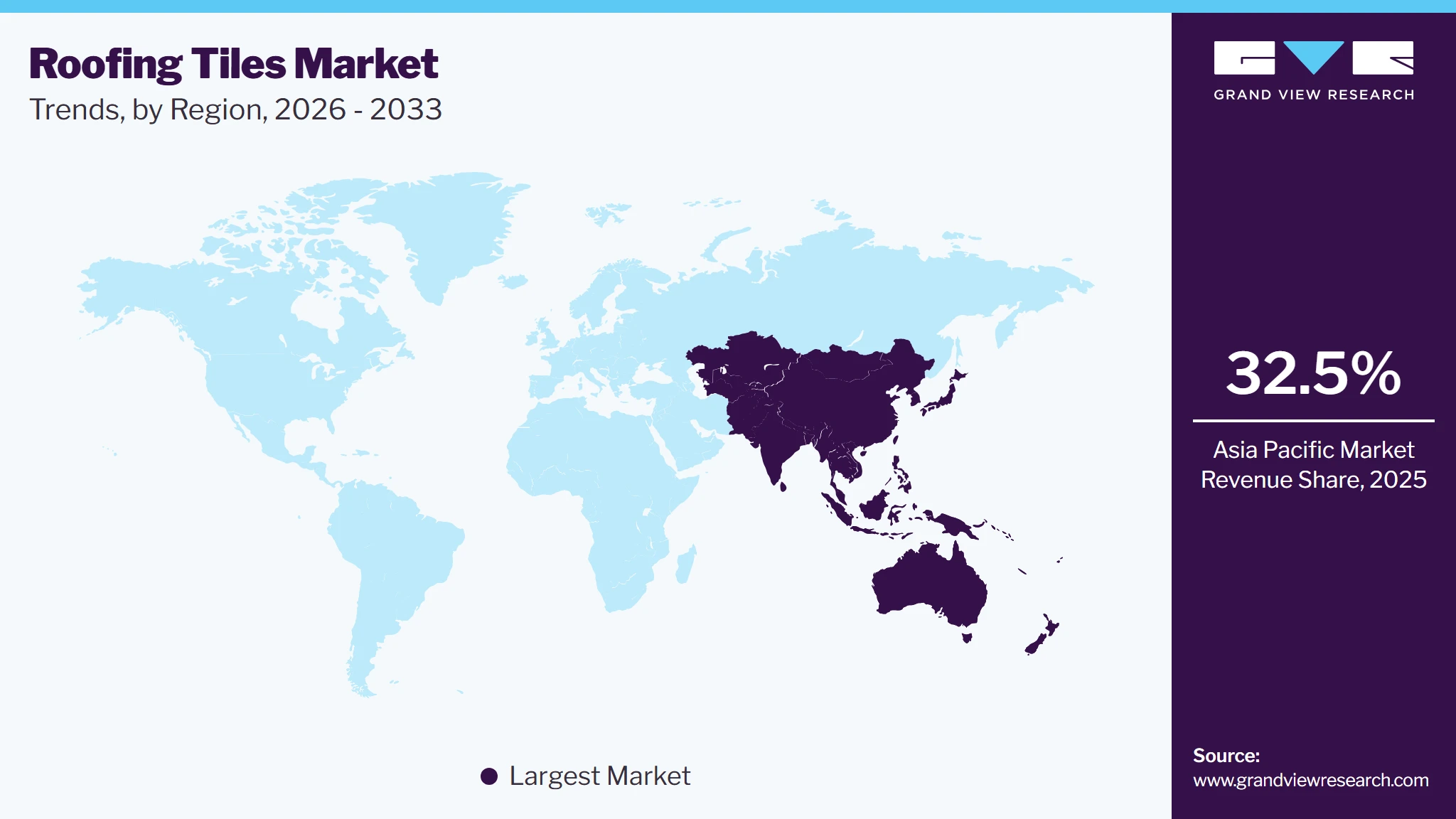
Asia Pacific dominated the global roofing tiles market, accounting for the largest revenue share of 32.5% in 2025, supported by residential construction, urban expansion, commercial development, and renovation activity. Rapid development of housing and urban infrastructure continues to create demand for durable roof-covering materials. China, India, Japan, Australia, and Southeast Asian economies demonstrate diverse preferences based on climate, building practices, and architectural requirements. Manufacturers are increasingly focusing on cost-effective, durable, and visually differentiated products. Sustainability and energy-efficient building practices are also influencing product development across the region.
 To learn more about this report, Download Free Sample Report
China Roofing Tiles Market Trends
The China roofing tiles market remains instrumental due to its large construction sector, extensive residential building activity, and ongoing urban development. Demand is supported by new housing, commercial construction, refurbishment, and redevelopment of existing buildings. Product preferences vary across regions according to climatic conditions, building designs, and local construction practices. Domestic manufacturers benefit from established production capabilities and extensive distribution networks. Increasing attention to construction efficiency and environmental performance is encouraging manufacturers to improve production processes and product characteristics.
North America Roofing Tiles Market Trends
The roofing tiles market in North America is supported by established roofing replacement activity, residential construction, commercial development, and growing interest in durable roofing systems. Product selection is influenced by climate exposure, building codes, installation practices, aesthetics, and lifecycle performance. Roofing tiles are particularly relevant in markets where architectural preferences and weather resistance support their use. Manufacturers are increasingly emphasizing lightweight products, improved installation systems, enhanced durability, and energy performance. Renovation and roof replacement remain important demand-generating activities across the region.
The roofing tiles market in the U.S. has gained traction from residential construction, reroofing, remodeling, and commercial building activity. Demand varies considerably by region because climate, architectural styles, building codes, and exposure to severe weather influence roofing-material selection. Concrete and clay-based tiles have established applications in several residential and commercial segments, particularly where durability and architectural appearance are important. Manufacturers are also developing lightweight and performance-oriented products to address structural considerations and installation requirements.
Europe Roofing Tiles Market Trends
The roofing tiles market in Europe is mature, with significant demand generated by residential construction, renovation, restoration, and replacement of aging roofs. Product selection is strongly influenced by architectural traditions, building regulations, energy-efficiency requirements, and sustainability considerations. Clay and concrete roofing products maintain established applications across several European markets. Manufacturers are increasingly incorporating recycled materials, improving production efficiency, and developing products that support sustainable building practices and improved building-envelope performance.
The Germany roofing tiles market is well-positioned due to residential construction, refurbishment, renovation, and replacement of existing roof systems. Roofing-product selection is influenced by stringent construction requirements, energy-efficiency considerations, durability expectations, and architectural preferences. Clay and concrete tiles have strong applications across the country's residential building stock. Manufacturers are increasingly focusing on sustainable production, product durability, improved installation solutions, and compatibility with modern energy-efficient building systems.
Central and South America Roofing Tiles Market Trends
The roofing tiles market in Central & South America presents opportunities the manufacturers due to residential development, urbanization, commercial construction, and ongoing building refurbishment. Demand is influenced by climatic conditions, construction costs, local architectural styles, and availability of alternative roofing materials. Concrete and clay-based products remain relevant across several markets, particularly in residential construction. Increasing urban development and housing requirements are supporting demand, while manufacturers are focusing on affordable, durable, and locally suitable roofing solutions.
Middle East & Africa Roofing Tiles Market Trends
The roofing tiles market in the Middle East & Africa is influenced by residential development, commercial construction, infrastructure expansion, and diversification of building designs. Climatic conditions, particularly high temperatures and strong solar exposure in parts of the Middle East, increase the importance of weather-resistant and thermally suitable roofing systems. Demand varies substantially across countries because of differences in construction practices and economic development. Growing urbanization and investment in residential and commercial projects are creating opportunities for durable and aesthetically differentiated roofing products.
Key Roofing Tiles Company Insights
Some of the key players operating in the market include Wienerberger AG and BMI Group.
-
Wienerberger AG is an Austria-based building materials manufacturer with a broad portfolio spanning clay roofing tiles, façade solutions, bricks, pavers, and other building products. The company has a strong presence across European roofing markets and serves residential, commercial, and renovation applications through an extensive manufacturing and distribution network.
-
BMI Group is a European roofing and waterproofing solutions provider offering pitched and flat roofing systems, roof tiles, membranes, insulation, and related accessories. The company serves new construction, renovation, and refurbishment projects and operates across multiple European markets through established brands and distribution channels.
Tejas Borja and Ludowici Roof Tile Inc. are some of the emerging market participants in the roofing tiles market.
-
Tejas Borja is a Spanish manufacturer specializing in ceramic roof tiles and complementary roofing solutions. The company offers a broad range of profiles, finishes, and accessories, with a growing focus on ventilated roofing systems and photovoltaic integration for residential and architectural applications.
-
Ludowici Roof Tile Inc. is a U.S.-based manufacturer specializing in premium clay roofing tiles and architectural roof systems. The company is particularly recognized for historically styled and customized clay tile products used in residential, commercial, institutional, and restoration projects.
Key Roofing Tiles Companies
The following key companies have been profiled for this study on the roofing tiles market:
-
Wienerberger AG
-
BMI Group
-
Terreal
-
Marley Ltd
-
Eagle Roofing Products
-
Edilians
-
Ludowici Roof Tile Inc.
-
Tejas Borja
-
Tapco
-
KPG Roofings
Competitive Benchmarking
Category
Operating Strategies
Competitive Edge
Weakness
Established Players (Wienerberger AG, BMI Group, Terreal, Marley Ltd, Eagle Roofing Products, Edilians)
- Expand and diversify roofing tile portfolios across clay, concrete, and other specialized roofing solutions to address varying architectural and climatic requirements.
- Strengthen manufacturing and distribution networks to serve residential, commercial, and renovation markets across established construction regions.
- Invest in product development focused on durability, aesthetics, energy performance, sustainability, and improved installation solutions.
- Strong brand recognition and established positions across major roofing markets.
- Broad product portfolios covering multiple roofing materials, profiles, finishes, and application requirements.
- Extensive relationships with distributors, dealers, contractors, and builders provide broad market access and customer reach.
- Large manufacturing and distribution networks can result in higher operating and logistics costs.
- Exposure to fluctuations in construction activity, energy costs, and raw-material prices can affect profitability.
- Established product portfolios may require continued investment to respond quickly to emerging lightweight, sustainable, and alternative roofing solutions.
Emerging / Specialized Players (Ludowici Roof Tile Inc., Tejas Borja, Tapco, KPG Roofings)
- Focus on specialized roofing products, distinctive designs, and application-specific solutions to differentiate from large diversified manufacturers.
- Expand presence through relationships with architects, roofing contractors, distributors, builders, and specialized construction channels.
- Develop sustainable, lightweight, aesthetically differentiated, and performance-oriented roofing products to address evolving project requirements.
- Strong specialization in particular roofing tile categories, designs, or regional applications.
- Greater flexibility to serve niche architectural requirements and customized roofing projects.
- Focused product portfolios can enable faster adaptation to specific customer preferences and emerging roofing trends.
- More limited geographic reach and distribution networks compared with multinational roofing-material manufacturers.
- Smaller production and financial scale can constrain capacity expansion and large-scale market penetration.
- Greater dependence on regional construction activity, specialized demand, and distributor or contractor relationships can limit growth across broader markets.
Recent Developments
-
In February 2026, Wienerberger signed an agreement to acquire Italcer Group, strengthening its renovation solutions portfolio and expanding its offering across ceramic building-envelope products. The transaction builds on its earlier expansion in roofing through Terreal.
-
In June 2026, Tejas Borja introduced new solutions for ventilated roofs, including an upgraded breathable waterproof membrane with integrated adhesive tape and continued development of photovoltaic integration systems for ceramic roofs.
Roofing Tiles Market Report Scope
Report Attribute
Details
Market size in 2025
USD 14.3 billion
Estimated market size in 2026
USD 15.1 billion
Projected market size by 2033
USD 22.4 billion
Growth rate
CAGR of 5.8% from 2026 to 2033
Base year for estimation
2025
Actual estimates/Historical data
2021 - 2024
Forecast period
2026 - 2033
Quantitative units
Revenue in USD billion and CAGR from 2026 to 2033
Report coverage
Revenue forecast, company ranking, competitive landscape, growth factors, and trends
Segments covered
Material, construction type, end use, region
Regional scope
North America; Europe; Asia Pacific; Middle East & Africa; Central and South America
Country scope
U.S.; Canada; Mexico; Germany; UK; France; Italy; Spain; China; Japan; India; South Korea; Brazil; Saudi Arabia
Key companies profiled
Wienerberger AG; BMI Group; Terreal; Marley Ltd; Eagle Roofing Products; Edilians; Ludowici Roof Tile Inc.; Tejas Borja; Tapco; KPG Roofings
Customization scope
Free report customization (equivalent up to 8 analysts working days) with purchase. Addition or alteration to country, regional & segment scope.
Pricing and purchase options
Avail customized purchase options to meet your exact research needs. Explore purchase options
Global Roofing Tiles Market Report Segmentation
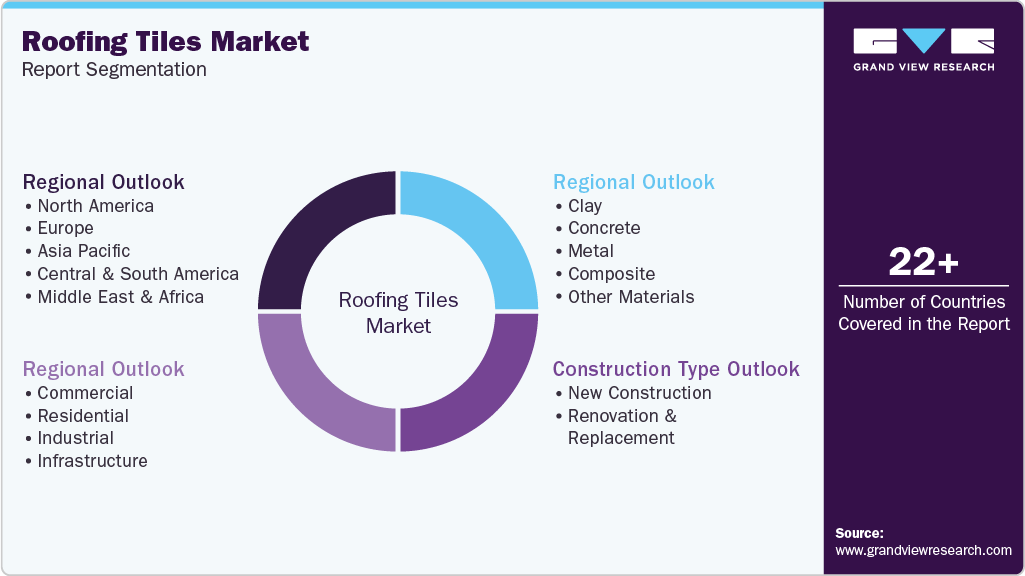
This report forecasts revenue growth at the global, regional & country levels and provides an analysis on the industry trends in each of the sub-segments from 2021 to 2033. For this study, Grand View Research has segmented the global roofing tiles market report on the basis of material, construction type, end use, and region:
 To learn more about this report, Download Free Sample Report
-
Material Outlook (Revenue, USD Billion, 2021 - 2033)
-
Clay
-
Concrete
-
Metal
-
Composite
-
Other Materials
-
-
Construction Type Outlook (Revenue, USD Billion, 2021 - 2033)
-
New Construction
-
Renovation & Replacement
-
-
End Use Outlook (Revenue, USD Billion, 2021 - 2033)
-
Commercial
-
Residential
-
Industrial
-
Infrastructure
-
-
Regional Outlook (Revenue, USD Billion, 2021 - 2033)
-
North America
-
U.S.
-
Canada
-
Mexico
-
-
Europe
-
UK
-
Germany
-
France
-
Italy
-
Spain
-
-
Asia Pacific
-
China
-
Japan
-
India
-
South Korea
-
-
Central and South America
-
Brazil
-
-
Middle East and Africa
-
Saudi Arabia
-
-
Research Methodology
The roofing tiles marketfigures in this report are based on a proven research process that combines executive interviews with secondary research from proprietary databases, company filings, and recognized regulatory and institutional sources. Market size is built through value-chain sizing-reconciling supply-side and demand-side estimates-and triangulated with bottom-up and top-down approaches. Every estimate passes multiple levels of expert validation before publication, with eachroofing tiles segment quantified using the revenue-capture definitions in the table below.
Segment Definition
Segment - Material
Revenue Capture Definition
Clay
Revenue generated from the sale of roofing tiles manufactured primarily from natural clay, including molded, pressed, or formed clay tiles used as roof-covering systems..
Concrete
Revenue generated from the sale of roofing tiles manufactured primarily using cementitious concrete formulations, including molded and pressed concrete tiles used for residential, commercial, industrial, and infrastructure roofing applications.
Metal
Revenue generated from the sale of roofing tiles manufactured primarily from metal substrates, including steel, aluminum, and other metal-based tile profiles designed to provide the appearance or functionality of conventional roofing tiles.
Composite
Revenue generated from the sale of roofing tiles manufactured using two or more material components, such as polymer-based, fiber-reinforced, recycled, or engineered composite formulations, where the combined material structure forms the primary roofing product.
Other Materials
Revenue generated from roofing tiles manufactured primarily from materials not classified under clay, concrete, metal, or composite, including specialized material formulations used for roof-covering applications.
Segment - Construction Type
Revenue Capture Definition
New Construction
Revenue generated from roofing tiles installed as part of newly constructed buildings or structures, where roofing forms part of the original construction project.
Renovation & Replacement
Revenue generated from roofing tiles supplied for the refurbishment, repair, partial replacement, or complete replacement of existing roofing systems on previously constructed buildings and structures.
Segment - End Use
Revenue Capture Definition
Residential
Revenue generated from roofing tiles supplied for detached homes, apartments, condominiums, townhouses, and other residential buildings, including products used in both new residential projects and existing-home roofing applications.
Commercial
Revenue generated from roofing tiles supplied for commercial buildings such as offices, retail establishments, shopping centers, hotels, restaurants, and other privately operated business premises.
Industrial
Revenue generated from roofing tiles supplied for industrial facilities, including manufacturing plants, warehouses, factories, processing facilities, and other buildings primarily used for industrial operations.
Infrastructure
Revenue generated from roofing tiles supplied for infrastructure-related structures and public-use facilities, including transportation facilities, institutional infrastructure, utility buildings, and other structures developed as part of public or civil infrastructure projects.
Estimation Model
Layer Name
Key Question
Description
Parent Market Analysis
What is the overall size and growth outlook of the global roofing materials and construction market?
The estimation begins by evaluating the broader roofing materials and construction market. Global construction activity, residential and commercial development, roof replacement and renovation, urbanization, building activity, climatic conditions, and demand for durable and weather-resistant roofing systems are analyzed to establish the total addressable market for roofing tiles.
Roofing Tile Material Penetration Analysis
What proportion of the broader roofing materials market is represented by different roofing tile materials?
This layer estimates the penetration of Clay, Concrete, Metal, Composite, and Other Materials within the roofing tiles market. Product adoption, material preferences, durability, installation requirements, manufacturing capabilities, cost considerations, architectural preferences, and suitability across different climatic and building conditions are analyzed to determine the revenue contribution of each material category.
End-use & Construction Demand Assessment
Which end-use sectors and construction activities contribute the highest demand for roofing tiles?
Market demand is evaluated across Residential, Commercial, Industrial, and Infrastructure end-use sectors based on construction activity, building development, renovation requirements, roofing replacement cycles, architectural trends, and regional construction practices. Demand is further assessed across New Construction and Renovation & Replacement activities to determine their respective revenue contributions and identify the primary sources of roofing tile demand.
Company Revenue Validation & Market Forecasting
How is the final market size validated and forecast?
The final market estimates are validated using company revenues, roofing tile production capacities, product portfolios, manufacturing facilities, plant expansions, distribution networks, project activity, product launches, partnerships, and secondary research. Bottom-up and top-down approaches are triangulated to generate reliable market size estimates and long-term forecasts for the Roofing Tiles Market.
Delivered Customizations
We have successfully delivered the following deep-dive customizations:
Client Request
Customization Delivered
Value Adds
Material & Product Performance Benchmarking
Comparative assessment of Clay, Concrete, Metal, Composite, and Other Materials based on durability, weight, weather resistance, thermal properties, aesthetics, maintenance requirements, installation complexity, and expected service performance.
Helps identify material-level competitive advantages, product positioning gaps, and opportunities for portfolio differentiation across roofing applications.
Roofing System & Application Assessment
Evaluation of roofing tile suitability across different building requirements, including roof design, climatic exposure, structural considerations, installation conditions, and application across residential, commercial, industrial, and infrastructure projects.
Supports product-to-application matching, identifies high-potential use cases, and helps manufacturers prioritize product development and commercial opportunities based on specific project requirements.
Sustainability & Product Innovation Assessment
Analysis of developments in lightweight formulations, recycled and alternative raw materials, energy-efficient roofing solutions, manufacturing efficiency, low-waste production, and product designs aimed at improving lifecycle performance and environmental impact.
Helps companies identify emerging innovation areas, strengthen sustainability positioning, anticipate evolving customer requirements, and prioritize future R&D and product-development initiatives.
About the Author(s)
Advanced Interior Materials Research Team
Advanced Materials · Advanced Interior MaterialsThis report was authored by the advanced interior materials research team at Grand View Research - comprising two research analysts, one senior research analyst, and one industry expert - with specialized expertise in the advanced interior materials segment of the advanced materials industry. All findings are based on proprietary advanced materials databases, executive interviews, and regulatory analysis, subject to internal peer review prior to publication.
Last Updated:
Speak to Analyst

Customize this report to your needs - add regions, segments, or data points, with 20% free customization.
Or view our licence options:


ISO 9001:2015 & 27001:2022 Certified
We are GDPR and CCPA compliant! Your transaction & personal information is safe and secure. For more details, please read our privacy policy.


