
- Home
- »
- Petrochemicals
- »
-
Rubber Process Oil Market Size & Share Report, 2026-2033GVR Report cover

Rubber Process Oil Market (2026 - 2033)
Size, Share & Trends Analysis Report By Product (Aromatic, Paraffinic, Naphthenic), By End Use (Tyre, Footwear, Wire & Cable Covering, Flooring Materials, Paints & Coatings, Adhesive & Sealants), By Region, And Segment Forecasts
Market Size, 2025
$2.4BMarket Estimate, 2026
$2.5BMarket Forecast, 2033
$3.3BCAGR, 2026–2033
4.4%Rubber Process Oil Market Summary
The global rubber process oil market size was valued at USD 2.4 billion in 2025 and is projected to grow from USD 2.5 billion in 2026 to USD 3.3 billion by 2033, at a CAGR of 4.4% from 2026 to 2033. Asia Pacific dominated the market with the largest revenue share of 44.9% in the global market in 2025. The market is expanding steadily due to its essential role in improving rubber processing efficiency and end-product performance.
 Source: Grand View Research, IR Documents, Primary Interviews, Paid DatabasesTo learn more about this report,
 Download Free Sample Report
 Key Market Trends & Insights
- By product: Aromatic segment held the largest market share of 37.8% in 2025.
- By end use: Tyre segment held the largest market share of 22.2% in 2025.
Regional Highlights
- Largest regional market: Asia Pacific (44.9% revenue share, 2025).
- Fastest-growing regional market: Europe (highest CAGR, 2026-2033).
Market Size & Forecast
- Market size in 2025: USD 2.4 Billion
- Estimated market size in 2026: USD 2.5 Billion
- Projected market size by 2033: USD 3.3 Billion
- CAGR (2026-2033): 4.4%
Three ways to get this report
Buy it, customize it, or ask a question.Ask an Analyst
A direct answer, usually in 1 working day
- AccessReport author, directly
- Reply timeWithin 1 working day
- No sales callDirect answer only
- FormatEmail reply
- CostFree, no cost
Get the Full Report
What the study covers
- FormatsPDF · Excel · Dashboard
- Timeline2026–2033 annual, 2025 base
- Coverage20+ countries, 5 regions
- Companies10+ key players profiled
Customize the Report
20% free customization
- IncludeCountries, segments, points
- TailorTo your product definition
- ExtendDeeper competitor detail
- OrA fully bespoke study
- Turnaround5–10 working days
These oils are widely used to enhance flexibility, dispersion, and durability in rubber compounds, making them indispensable across tyre manufacturing, automotive components, and industrial rubber applications worldwide. Growth in the market is closely tied to rising demand for rubber products across transportation, construction, and consumer goods industries. Increasing vehicle production and replacement tyre demand continue to drive large-scale consumption of rubber compounds, especially in emerging economies. Rubber process oils help manufacturers achieve consistent quality, reduce energy consumption during processing, and maintain cost efficiency, which strengthens their adoption across high-volume manufacturing operations.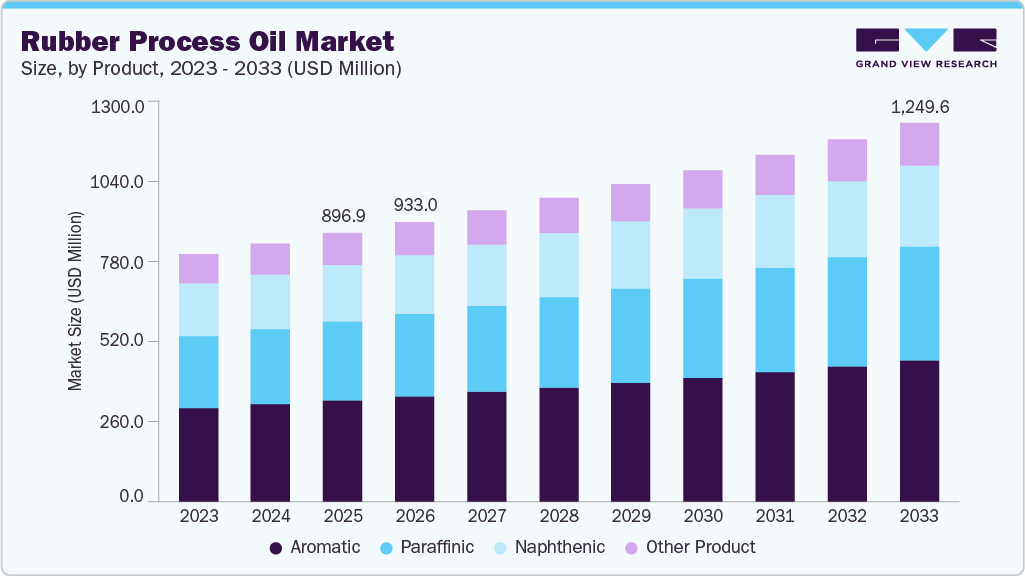 To learn more about this report, Download Free Sample Report
 Regulatory changes and shifting material preferences are reshaping the competitive landscape. Restrictions on high-PAH aromatic oils have encouraged manufacturers to develop safer and more refined alternatives, leading to greater uptake of paraffinic, naphthenic, and bio-based oils. This transition has pushed suppliers to focus on formulation performance, environmental compliance, and long-term material stability, which has increased product differentiation and value creation within the market. This evolution is accelerating growth in the environmentally rubber process oil market by aligning innovation with sustainability and regulatory expectations.
Regional manufacturing trends also play a significant role in shaping demand patterns. Asia Pacific remains a major production hub due to its concentration of tyre and rubber goods manufacturers, while Europe shows strong momentum through innovation and regulatory alignment. Investments in sustainable processing solutions, premium automotive components, and specialty rubber products continue to expand application scope, positioning the rubber process oil market for consistent growth over the forecast period.
Market Dynamics
Rubber process oils are widely used in tire manufacturing to improve elasticity, filler dispersion, processing efficiency, and overall rubber performance characteristics. Rapid growth in global automobile production, increasing vehicle parc, and rising replacement tire demand are significantly driving the consumption of rubber process oils worldwide. Expanding transportation, logistics, and infrastructure development activities across emerging economies such as China, India, Brazil, and Southeast Asian countries are further supporting the demand for commercial and passenger vehicle tires, thereby strengthening market growth.
The global automotive and tire industries are witnessing continuous expansion supported by rising urbanization, increasing disposable incomes, and growth in industrial transportation activities. In addition, growing demand for high-performance and fuel-efficient tires is encouraging manufacturers to adopt advanced rubber formulations and specialty process oils. Increasing investments in tire production capacities and expansion of automotive manufacturing facilities across developing economies are expected to further accelerate the growth of the global rubber process oils market over the forecast period.
Stringent environmental regulations associated with the use of high aromatic and toxic rubber process oils are emerging as a major restraint for the market. Regulatory authorities across Europe and North America are increasingly restricting the usage of polycyclic aromatic hydrocarbon (PAH)-based oils owing to their environmental and health-related concerns. Compliance with evolving environmental standards and transition toward low-aromatic, bio-based, and sustainable alternatives are increasing operational and reformulation costs for manufacturers. In addition, volatility in crude oil prices and growing preference for eco-friendly rubber processing materials are expected to restrain the growth of conventional rubber process oils over the forecast period.
Market Concentration & Characteristics
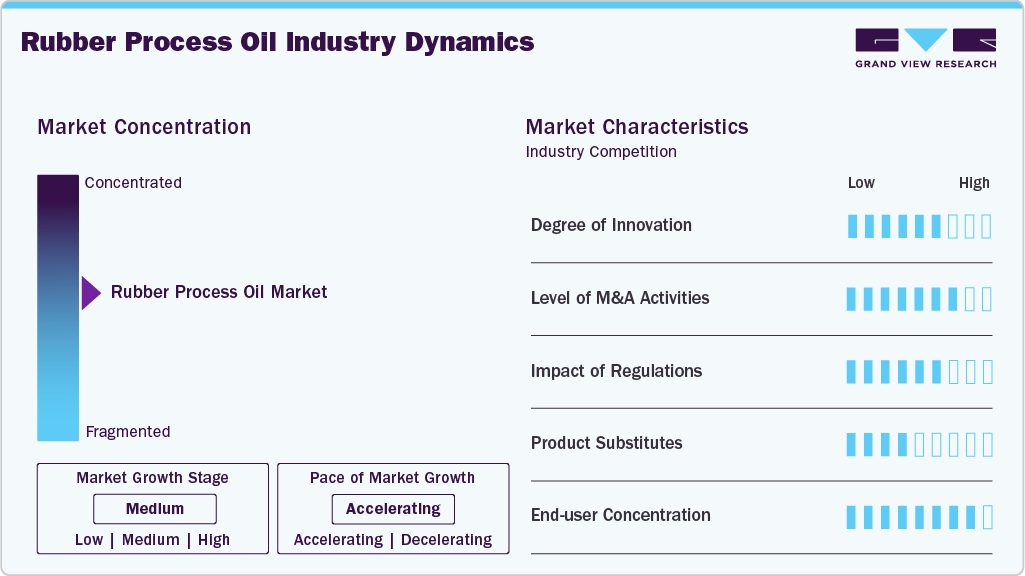
The rubber process oil market shows a moderately concentrated structure, shaped by the presence of established petroleum refiners alongside specialized chemical manufacturers. Competition is influenced by long-term supply relationships with tyre and rubber product producers, as consistency in quality and formulation compatibility is critical. Entry barriers remain moderate due to refining requirements, regulatory compliance, and the need for technical expertise, which encourages stability among existing participants while limiting rapid new entry.
 To learn more about this report, Download Free Sample Report
 Market characteristics are defined by strong price sensitivity, evolving regulatory frameworks, and increasing emphasis on product differentiation. Buyers prioritize performance reliability, regulatory compliance, and supply continuity, leading to extended qualification cycles for new products. At the same time, demand is gradually shifting toward environmentally compliant and specialty oils, prompting suppliers to invest in formulation refinement and sustainable alternatives. These dynamics support steady competition while encouraging innovation focused on compliance, performance, and long-term customer retention.
Product Insights
The aromatic segment dominated the rubber process oil market in 2025, accounting for 37.8% of total revenue, primarily due to its superior solvency and strong compatibility with synthetic rubbers such as SBR and BR. These oils enhance filler dispersion and processing efficiency, making them widely preferred in tire manufacturing and heavy-duty rubber applications. Despite increasing regulatory pressure related to PAH content, their cost-effectiveness and established use in high-volume applications continued to support market leadership.
The paraffinic segment is projected to register the fastest growth, with a CAGR of 4.8% from 2026 to 2033, driven by rising demand for low-toxicity and environmentally compliant rubber process oils. Paraffinic oils offer excellent oxidation stability, low volatility, and improved aging resistance, making them suitable for premium tires, automotive components, and light-colored rubber products. Additionally, stricter environmental regulations and a gradual shift away from aromatic oils are accelerating adoption across developed and emerging markets.
End Use Insights
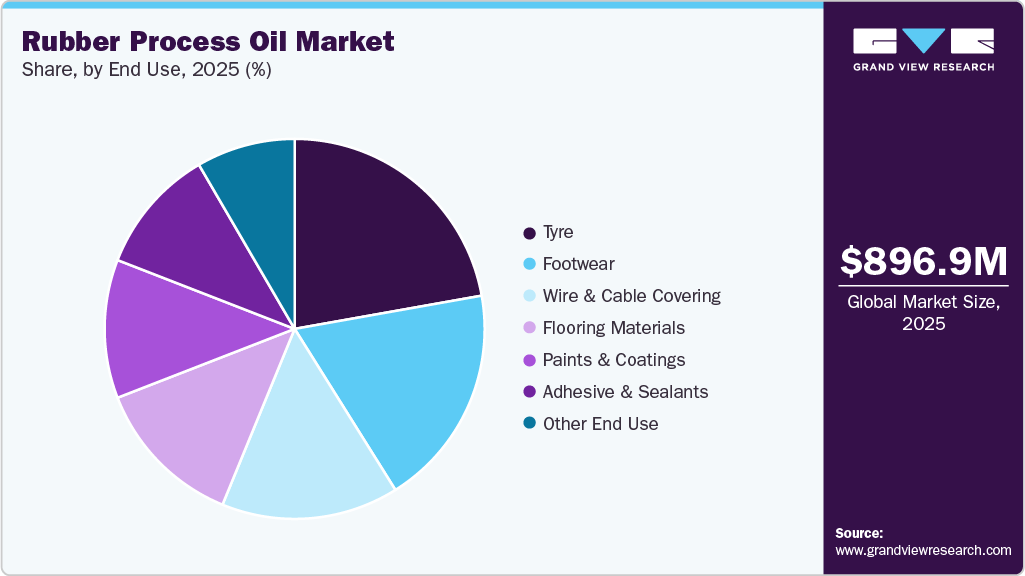
The tyre segment led the rubber process oil market in 2025, accounting for 22.2% of total revenue, driven by its extensive use in both passenger and commercial vehicle tyres. Rubber process oils are essential in tyre formulations to improve elasticity, abrasion resistance, and processability. Consistent replacement demand, rising vehicle ownership, and large-scale tyre manufacturing-particularly in Asia Pacific-continued to sustain strong consumption volumes and reinforced the segment’s leading market position.
 To learn more about this report, Download Free Sample Report
 The footwear segment is expected to grow at the fastest rate, registering a CAGR of 5.1% from 2026 to 2033, supported by increasing demand for comfortable, lightweight, and durable footwear. Rubber process oils enhance flexibility and cushioning in soles, making them critical for athletic, casual, and industrial footwear. Rapid urbanization, rising disposable incomes, and expanding sports and leisure activities in emerging economies are further accelerating growth in this segment.
Regional Insights
Asia Pacific Rubber Process Oil Market Trends
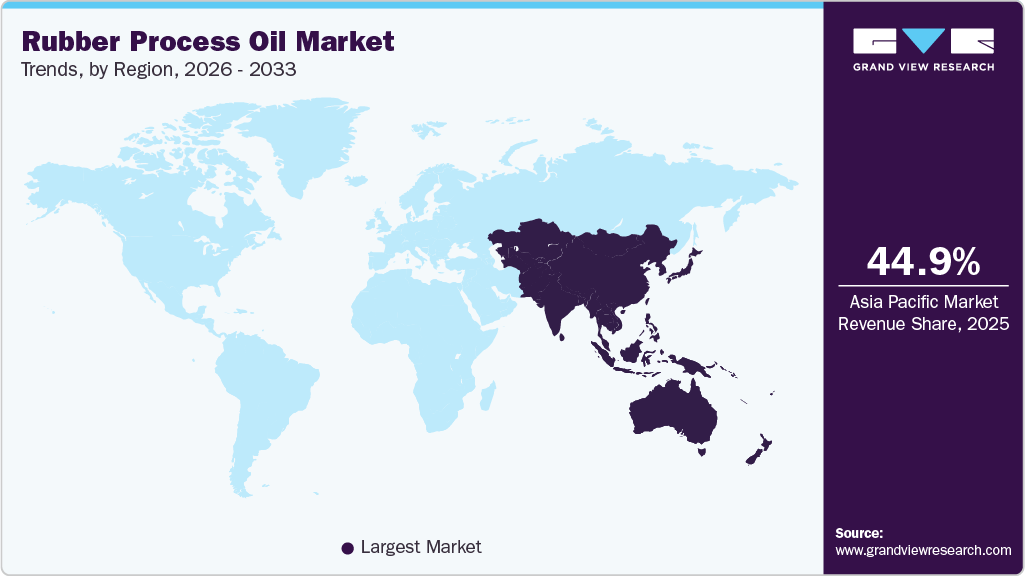
Asia Pacific held the largest share of the rubber process oil market in 2025, accounting for 44.9% of revenue, supported by its strong concentration of tyre and rubber goods manufacturing. High consumption of natural and synthetic rubber across automotive, industrial, and consumer applications continues to sustain demand. Competitive production costs, expanding manufacturing capacity, and steady domestic consumption in major economies reinforce the region’s dominant market position.
 To learn more about this report, Download Free Sample Report
 China held over 54.9% revenue share of the Asia Pacific rubber process oil market.China rubber process oil market presents a major growth engine for the rubber process oil market due to its extensive tyre manufacturing capacity and large domestic vehicle market. High production volumes, expanding infrastructure projects, and strong export-oriented rubber goods manufacturing sustain large-scale consumption. While cost efficiency remains important, increasing regulatory oversight is gradually encouraging the use of more refined and compliant process oils across automotive and industrial applications.
North America Rubber Process Oil Market Trends
The North America rubber process oil market is shaped by a mature automotive and industrial manufacturing base, with steady demand from tyre replacement and engineered rubber goods. Producers in the region prioritize performance consistency, regulatory compliance, and supply reliability, which supports demand for refined and specialty process oils. Environmental standards influence product selection, encouraging the use of low-toxicity formulations across automotive components, construction materials, and industrial equipment.
U.S. rubber process oil market is driven by high replacement tyre demand and strong production of automotive and industrial rubber components. Domestic manufacturers focus on process efficiency and long service life of rubber products, increasing reliance on high-quality process oils. Regulatory oversight and customer preference for compliant materials continue to shift demand toward refined paraffinic and specialty oils, particularly in automotive, transportation, and industrial applications.
Europe Rubber Process Oil Market Trends
Europe is projected to grow at the fastest rate, with a CAGR of 4.9% from 2026 to 2033, driven by increasing preference for high-performance and environmentally compliant rubber process oils. The region’s strict regulatory environment has accelerated the shift toward refined and specialty formulations. Demand from premium automotive, industrial, and specialty rubber applications, combined with continuous product innovation, is supporting faster growth relative to other regions.
Germany rubber process oil market benefits from its advanced automotive sector and strong presence of premium tyre and engineered rubber manufacturers. Demand is closely linked to high-performance requirements, precision manufacturing, and strict material standards. Emphasis on sustainability and regulatory compliance supports increased adoption of refined and environmentally compliant process oils, particularly for automotive components, industrial machinery, and specialty rubber products.
Latin America Rubber Process Oil Market Trends
The Latin America market is influenced by expanding automotive assembly operations and growing demand for replacement tyres and industrial rubber products. Local manufacturing activity, combined with infrastructure development and transportation needs, supports steady consumption of rubber process oils. Price sensitivity remains a key consideration, favoring conventional formulations, while gradual regulatory alignment is encouraging selective adoption of refined and higher-quality oils.
Middle East & Africa Rubber Process Oil Market Trends
The Middle East and Africa rubber process oil market is supported by infrastructure development, mining activity, and growing demand for industrial rubber products. The presence of petrochemical production hubs provides access to feedstock, supporting regional supply. Demand is largely driven by industrial applications, construction equipment, and transportation needs, with increasing focus on durability and performance under harsh operating conditions.
Key Rubber Process Oil Company Insights
The two key dominant manufacturers in the rubber process oil market are Sinopec and Exxon Mobil Corporation.
-
Sinopec operates as a fully integrated energy and chemical enterprise with extensive refining capabilities that support large-scale production of rubber process oils. The company benefits from strong domestic demand, advanced processing infrastructure, and close alignment with tyre and rubber manufacturing industries. Its focus on formulation consistency, cost efficiency, and regulatory alignment strengthens its position across diverse rubber applications.
-
Exxon Mobil Corporation maintains a strong presence in the rubber process oil market through advanced refining technology and a broad portfolio of high-performance oil formulations. The company emphasizes product purity, processing reliability, and long-term performance in rubber compounds. Continuous investment in process optimization and material innovation enables Exxon Mobil to meet evolving quality and compliance requirements across global rubber manufacturing operations.
Key Rubber Process Oil Companies:
The following key companies have been profiled for this study on the rubber process oil market
- Sinopec
- Exxon Mobil Corporation
- PetroChina Company Limited
- Chevron Corporation
- Shell plc
- H&R Group
- Indian Oil Corporation Ltd.
- Repsol S.A.
- Nynas AB
- ORGKHIM Biochemical Holding
Competitive Benchmarking
Operating Strategies
Competitive Edge
Weaknesses
Mature Players: Sinopec, Exxon Mobil Corporation, PetroChina Company Limited, Chevron Corporation, Shell plc, Indian Oil Corporation Ltd., Repsol S.A.
- Invest in advanced refining technologies and low-PAH rubber process oil formulations to comply with evolving environmental regulations.
- Expand global supply networks and strengthen partnerships with tire manufacturers to enhance long-term market presence and customer retention.
- Possess integrated refining infrastructure, strong global distribution capabilities, and diversified petroleum-based product portfolios across industrial sectors.
- Benefit from established brand recognition, large-scale production capacities, and long-term relationships with major tire and rubber manufacturers.
- Face high exposure to crude oil price volatility and stringent environmental compliance requirements impacting operational profitability.
- High capital-intensive operations and slower transition toward sustainable alternatives may affect long-term competitive flexibility.
Emerging Players: H&R Group, Nynas AB, ORGKHIM Biochemical Holding
- Focus on specialty and environmentally compliant rubber process oils targeting niche tire and industrial rubber applications.
- Emphasize customized product development and regional distribution partnerships to strengthen market penetration and customer engagement.
- Benefit from operational flexibility and expertise in specialty low-aromatic and eco-friendly rubber processing oil formulations.
- Offer customized and application-specific solutions tailored to evolving regulatory and performance requirements within the tire industry.
- Operate with comparatively smaller production capacities and limited global distribution networks than multinational oil majors.
- Face challenges in scaling operations and competing on pricing, feedstock sourcing, and supply chain efficiencies with established players.
Recent Developments
-
In January 2026, Farrel Pomini, part of HF GROUP, increased its ownership stake in UK-based WF Recycle-Tech to the majority, reinforcing collaboration to commercialize the company’s patented tyre pyrolysis technology, which converts end-of-life tyres into recovered carbon black and oil.
-
In December 2024, HollyFrontier Specialty Products introduced Circosol™ 5100T, a rubber process oil developed for next-generation tyre applications. The product targets improved performance and regulatory compliance, supporting evolving requirements in modern tyre formulations and advanced rubber compounding technologies.
Rubber Process Oil Market Report Scope
Report Attribute
Details
Market size in 2025
USD 2.4 billion
Estimated market size in 2026
USD 2.5 billion
Projected market size by 2033
USD 3.3 billion
Growth rate
CAGR of 4.4% from 2026 to 2033
Base year for estimation
2025
Historical data
2018 - 2024
Forecast period
2026 - 2033
Quantitative units
Revenue in USD million/billion, volume in kilotons, and CAGR from 2026 to 2033
Report coverage
Revenue forecast, company ranking, competitive landscape, growth factors, and trends
Segments covered
Product, end use, region
Regional scope
North America; Europe; Asia Pacific; Latin America; Middle East & Africa
Country scope
U.S.; Canada; Mexico; Brazil; Argentina; Germany; UK; Italy; Spain; France; China; Japan; South Korea; Saudi Arabia; South Africa; India
Key companies profiled
Sinopec; Exxon Mobil Corporation; PetroChina Company Limited; Chevron Corporation; Shell plc; H&R Group; Indian Oil Corporation Ltd.; Repsol S.A.; Nynas AB; ORGKHIM Biochemical Holding
Customization scope
Free report customization (equivalent to up to 8 analysts’ working days) with purchase. Addition or alteration to country, regional & segment scope.
Pricing and purchase options
Avail customized purchase options to meet your exact research needs. Explore purchase options
Global Rubber Process Oil Market Report Segmentation
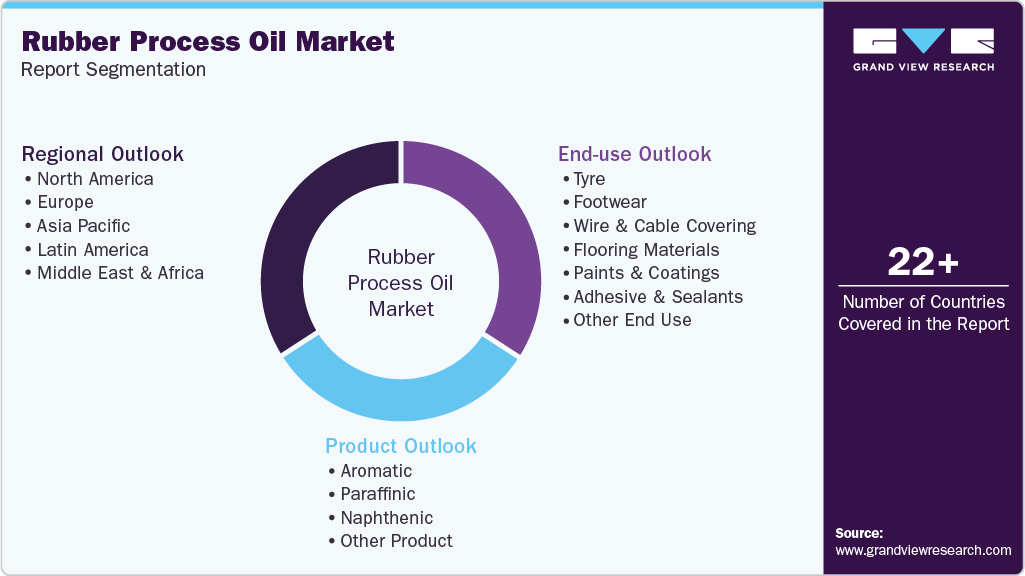
This report forecasts revenue growth at global, regional, and country levels and provides an analysis of the latest industry trends in each of the sub-segments from 2018 to 2033. For this study, Grand View Research has segmented the global rubber process oil market report based on product, end use, and region.
 To learn more about this report, Download Free Sample Report
 -
Product Outlook (Volume, Kilotons; Revenue, USD Million, 2018 - 2033)
-
Aromatic
-
Paraffinic
-
Naphthenic
-
Other Product
-
-
End Use Outlook (Volume, Kilotons; Revenue, USD Million, 2018 - 2033)
-
Tyre
-
Footwear
-
Wire & Cable Covering
-
Flooring Materials
-
Paints & Coatings
-
Adhesive & Sealants
-
Other End Use
-
-
Regional Outlook (Volume, Kilotons; Revenue, USD Million, 2018 - 2033)
-
North America
-
U.S.
-
Canada
-
Mexico
-
-
Europe
-
Germany
-
UK
-
Italy
-
Spain
-
France
-
-
Asia Pacific
-
China
-
Japan
-
India
-
South Korea
-
-
Latin America
-
Brazil
-
Argentina
-
-
Middle East & Africa
-
Saudi Arabia
-
South Africa
-
-
Delivered Customizations
This report has been delivered with the following In-depth customizations
Client Request
Customization Delivered
Value Adds
Competitive Benchmarking
Comparative assessment of key rubber process oil manufacturers based on refining capacity, product portfolio, regional presence, sustainability initiatives, and strategic positioning across tire and industrial rubber applications.
Support competitive positioning and supplier evaluation through detailed understanding of major player capabilities and market differentiation strategies.
Pricing Analysis
Analysis of rubber process oil pricing trends based on crude oil fluctuations, feedstock availability, regulatory compliance costs, and regional supply-demand dynamics across major consuming markets.
Enable procurement optimization, pricing strategy development, and margin management through better visibility into market pricing movements and cost drivers.
Opportunity Assessment
Evaluation of emerging opportunities across eco-friendly process oils, low-PAH formulations, electric vehicle tire applications, and sustainable rubber manufacturing trends.
Identify future growth segments and innovation-driven opportunities to support long-term product development and expansion strategies.
Frequently Asked Questions About This Report
The global rubber process oil market size was valued at USD 2.4 billion in 2025 and is projected to reach USD 2.5 billion in 2026.
The global rubber process oil market is expected to grow at a CAGR of 4.4% from 2026 to 2033, reaching USD 3.3 billion by 2033.
The tyre segment held the market with the largest revenue share in 2025, while footwear is the fastest-growing segment.
Some of the key players operating in the rubber process oil market include Sinopec, Exxon Mobil Corporation, PetroChina Company Limited, Chevron Corporation, Shell plc, H&R Group, Indian Oil Corporation Ltd., Repsol S.A., Nynas AB, ORGKHIM Biochemical Holding.
The market is expanding steadily due to its essential role in improving rubber processing efficiency and end-product performance. These oils are widely used to enhance flexibility, dispersion, and durability in rubber compounds, making them indispensable across tyre manufacturing, automotive components, and industrial rubber applications worldwide.
The aromatic segment held the market with the largest revenue share of 37.8% in 2025, while paraffinic is the fastest-growing segment.
Europe is the fastest-growing region over the forecast period.
Asia Pacific dominated the market with the largest revenue share of 44.9% in 2025.
About the Author(s)
Petrochemicals Research Team
Bulk Chemicals · PetrochemicalsThis report was authored by the petrochemicals research team at Grand View Research - comprising two research analysts, one senior research analyst, and one industry expert - with specialized expertise in the petrochemicals segment of the bulk chemicals industry. All findings are based on proprietary bulk chemicals databases, executive interviews, and regulatory analysis, subject to internal peer review prior to publication.
Last Updated:
Speak to Analyst

Customize this report to your needs - add regions, segments, or data points, with 20% free customization.
Or view our licence options:


ISO 9001:2015 & 27001:2022 Certified
We are GDPR and CCPA compliant! Your transaction & personal information is safe and secure. For more details, please read our privacy policy.


