
- Home
- »
- Advanced Interior Materials
- »
-
Safety Helmets Market Size And Share Report, 2026-2033GVR Report cover

Safety Helmets Market (2026 - 2033)
Size, Share & Trends Analysis Report By Material (Polyethylene, Acrylonitrile Butadiene Styrene, Polycarbonate), By Product (Hard Hats, Bump Caps), By End-use, By Region, And Segment Forecasts
Market Size, 2025
$5.1BMarket Estimate, 2026
$5.5BMarket Forecast, 2033
$9.4BCAGR, 2026–2033
7.9%Safety Helmets Market Summary
The global safety helmets market size was valued at USD 5.1 billion in 2025 and is projected to grow from USD 5.5 billion in 2026 to USD 9.4 billion by 2033, at a CAGR of 7.9% from 2026 to 2033. Europe dominated the global safety helmets market, with a revenue share of 30.0% in 2025. The growth of the safety helmets industry is primarily driven by stringent regulatory standards and heightened enforcement of occupational safety norms across key industrial sectors.
 Source: Grand View Research, IR Documents, Primary Interviews, Paid DatabasesTo learn more about this report,
 Download Free Sample Report
 Key Market Trends & Insights
- By material: Polyethylene material segment held the largest market share of 65.7% in 2025.
- By product: Hard hats segment held the largest market share of 87.7% in 2025.
- By end use: Construction segment held the largest market share of 36.6% in 2025.
Regional Highlights
- Largest regional market: Europe (30.0% revenue share, 2025)
- Fastest-growing regional market: Asia Pacific (highest CAGR, 2026-2033)
Market Size & Forecast
- Market size in 2025: USD 5.1 Billion
- Estimated market size in 2026: USD 5.5 Billion
- Projected market size by 2033: USD 9.4 Billion
- CAGR (2026-2033): 7.9%
Three ways to get this report
Buy it, customize it, or ask a question.Ask an Analyst
Analyst response in 1 business day
- AccessReport author, directly
- Reply timeWithin 1 working day
- No sales callDirect answer only
- FormatEmail reply
- CostFree, no cost
Get the Full Report
What the study covers
- FormatsPDF · Excel · Dashboard
- Timeline2026–2033 annual, 2025 base
- Coverage20+ countries, 5 regions
- Companies10+ key players profiled
Customize the Report
20% free customization
- IncludeCountries, segments, points
- TailorTo your product definition
- ExtendDeeper competitor detail
- OrA fully bespoke study
- Turnaround5–10 working days
Governments and regulatory bodies in several countries have implemented rigorous safety mandates requiring the use of personal protective equipment (PPE), including helmets, across the construction, manufacturing, mining, and transportation industries.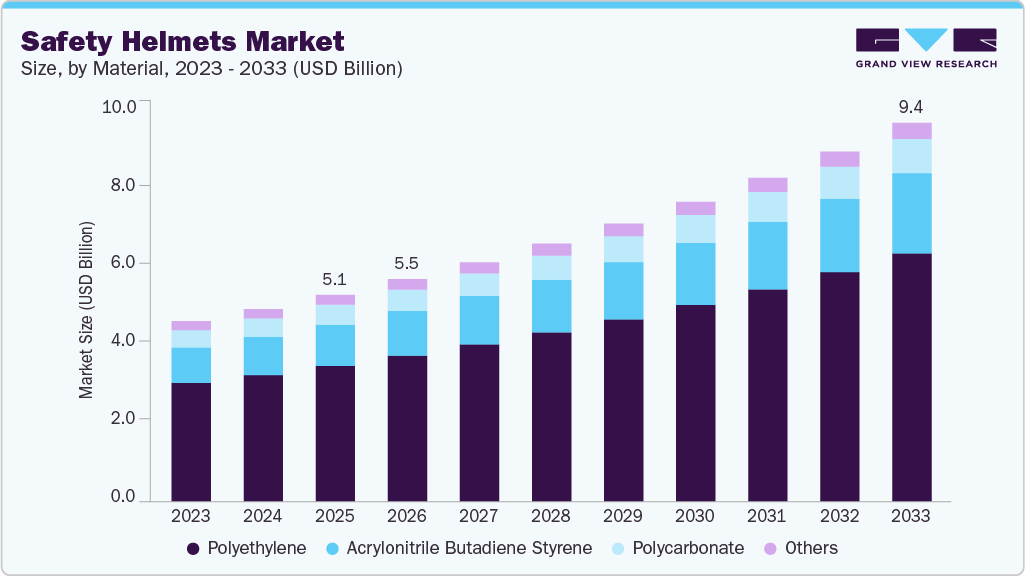 To learn more about this report, Download Free Sample Report
 This regulatory emphasis is further reinforced by increased workplace inspections and penalties for non-compliance, compelling organizations to adopt certified safety helmets that meet international safety standards and reduce legal liabilities. In addition, growing awareness among employers and employees regarding the long-term benefits of enhanced head protection, such as reduced injury rates and lower compensation costs, has bolstered demand for advanced helmet solutions.
 To learn more about this report, Download Free Sample Report
 Market Concentration & Characteristics
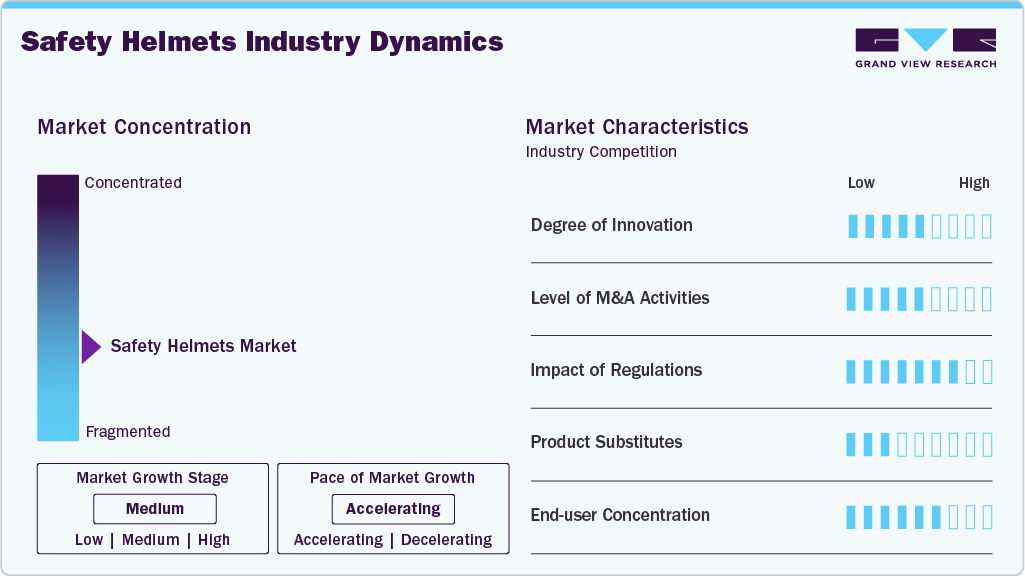
The safety helmets industry is characterized by fragmented competition, with global brands, regional manufacturers, and niche players coexisting. Large institutional buyers in construction, manufacturing, and infrastructure create relatively high end-user concentration in occupational segments, where purchasing decisions are driven by certification, reliability, and scale. In contrast, the consumer and recreational segments are more dispersed and price-sensitive, intensifying competition among smaller, regional suppliers.
From a technology perspective, competition increasingly centers on material innovation and value-added features rather than basic protection. Within the broader safety helmets market, the high performance industrial safety helmets market is accelerating with the adoption of lightweight polymers, composite materials, and emerging smart-helmet functionalities. These improve comfort, durability, and compliance monitoring, raising differentiation and switching costs for professional users. The threat of substitutes is limited in regulated, high-risk environments, as alternatives such as bump caps cannot meet safety requirements, though substitution risk is higher in low-risk or casual applications.
 To learn more about this report, Download Free Sample Report
 Regulations play a decisive role in shaping the structure and demand of the head protection safety helmets market. Mandatory safety standards and certification requirements underpin the consistent demand for compliant helmets while creating barriers to entry for unorganized or low-quality suppliers. Evolving regulations also drive periodic product upgrades and favor manufacturers with strong research and development capabilities, reinforcing quality- and compliance-led competition across the market.
Drivers, Opportunities & Restraints
The regulatory emphasis, reinforced by increased workplace inspections and penalties for non-compliance, is compelling organizations to adopt certified safety helmets to meet international safety standards and reduce legal liabilities. In addition, growing awareness among employers and employees regarding the long-term benefits of enhanced head protection, such as reduced injury rates and lower compensation costs, has bolstered demand for advanced helmet solutions.
Market opportunities are driven by rising infrastructure development, stricter occupational safety enforcement, and growing awareness of workplace risk mitigation. Demand for lightweight, ergonomic, and application-specific helmets is creating scope for product differentiation, while smart helmets with monitoring and connectivity features offer higher-value opportunities in industrial and infrastructure projects. The expansion of organized construction activity and improved safety compliance in emerging economies further present long-term growth opportunities for certified, technology-enabled helmet manufacturers.
The safety helmet industry faces constraints primarily due to price sensitivity and uneven regulatory enforcement across regions. In cost-conscious markets, especially in developing economies, low-priced, non-certified products continue to compete with compliant helmets, exerting pressure on the margins of organized manufacturers. In addition, frequent changes in safety standards increase certification and redesign costs, while limited user compliance due to discomfort, heat buildup, or perceived inconvenience can restrict adoption, particularly in informal work settings.
Material Insights
The polyethylene material segment led the market with the largest revenue share of 65.7% in 2025, primarily driven by its affordability and effectiveness. The low cost of polyethylene helmets makes them accessible to a wider range of consumers, particularly in budget-constrained industries such as construction and manufacturing. Furthermore, rapid urbanization is accelerating infrastructure projects in emerging countries, thereby becoming a driving factor in the growth of the polyethylene safety helmet industry.
The acrylonitrile butadiene styrene segment is expected to grow at the fastest CAGR of 8.7% from 2026 to 2033, due to its durability, dimensional stability, flame-retardant properties, and toughness, thereby lowering the cost of replacing these products. The helmets made from this material are manufactured by injection molding, which is easier, faster, and more cost-effective. Furthermore, with the rise in the automobile, manufacturing, and chemical industries, there is a growth in the demand for these helmets as they are more dent-resistant, protect passengers during accidents, and are resistant to hard chemicals.
Product Insights
The hard hats segment led the market with the largest revenue share of 87.7% in 2025, primarily driven by the increased safety regulations and awareness in multiple industries and workplaces to prevent head injuries and accidents. In addition, there is increased demand for hard hats in the electrical, manufacturing, chemical, and mining industries, as they offer electric shock protection, chemical resistance, and dent resistance. Furthermore, the demand for hard hats is also rising with the surge in these industries. Multiple variations and specifications, and the high functionality of these hard hats make them applicable to a wider range of consumers, driving the growth of the hard hats market.
The bump caps segment is expected to grow at the fastest revenue CAGR of 6.8% from 2026 to 2033, due to their mobility and reduced pressure on the wearer’s neck, making them suitable for protection against overhead objects and for industries with a lower risk of accidents. With the rise in government road construction projects, the demand for bump caps is expected to grow, as these projects are less prone to accidents. The rising demand for lightweight, accessible gear to improve the working experience and the growth of E-commerce platforms, which make it easier for businesses to access a wide range of safety products, are driving factors in the growth of the bump caps market.
End Use Insights
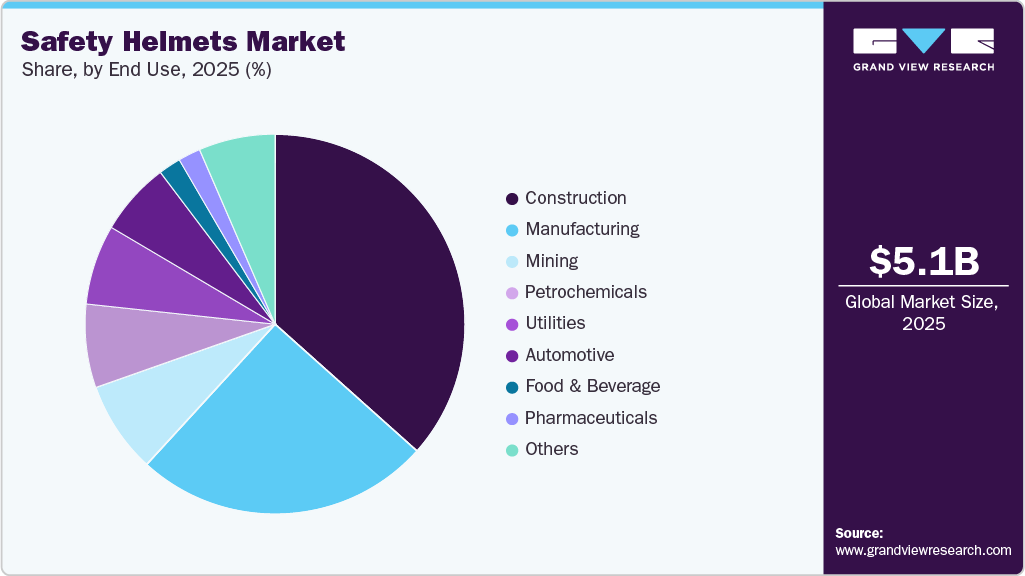
The construction segment led the market with the largest revenue share of 36.6% in 2025, driven by strict occupational safety regulations and enforcement by government and labor authorities. Rapid urbanization and large-scale infrastructure projects increase the number of workers exposed to head injury risks. Growing awareness of workplace safety and employer liability further drives the growth of the construction safety helmets market. In addition, advancements in helmet design, improving comfort and durability, encourage consistent use on sites.
 To learn more about this report, Download Free Sample Report
 The pharmaceutical segment is expected to grow at the fastest CAGR of 9.5% from 2026 to 2033. In the pharmaceutical industry, demand for safety helmets is fueled by stringent health, safety, and GMP compliance requirements in manufacturing and R&D facilities. The presence of heavy equipment, overhead installations, and automated machinery necessitates head protection. Expansion of pharmaceutical manufacturing plants, especially in emerging markets, also contributes to rising demand. Moreover, increased focus on employee safety and risk mitigation drives sustained helmet usage.
Regional Insights
The safety helmets market in North America is expected to grow at a significant CAGR from 2026 to 2033, driven by the expansion of construction projects and industrial activities, as well as increased awareness of worker safety. Within the region, the Mexican smart safety helmets market is gradually gaining traction as digital monitoring and connected safety solutions are increasingly adopted across construction and industrial environments. In addition, government enforcement of mandatory safety standards in the workplace across the region is a driving factor for the growth of the safety helmets industry in North America. Furthermore, multiple workers are assigned to these construction and industrial sites to complete work faster, increasing the demand for safety helmets.
U.S. Safety Helmets Market Trends
The safety helmets market in the U.S. accounted for the largest market revenue share in North America in 2025. Industrialization and urbanization are surging in the U.S., the world’s largest economy. Therefore, industries are major contributors to the growing safety helmet market. Due to the rising population, there is an increase in the construction of buildings where workers need to abide by the government’s safety regulations.
Europe Safety Helmets Market Trends
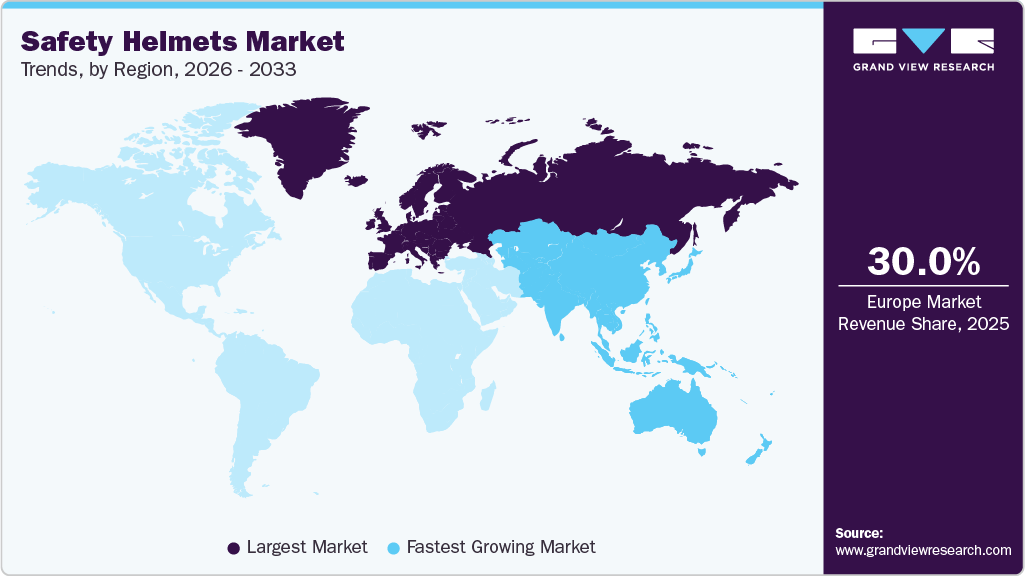
Europe dominated the global safety helmets market with the largest revenue share of 30.0% in 2025. The rapid growth of several industrial sectors in the region has given rise to the demand for safety helmets to prevent accidents in the workplace and enhance worker safety. Stringent regulations by the European government and investment in several infrastructures, such as roads, bridges, and commercial buildings, have fueled the growth of the safety helmets industry. Furthermore, the applicability of safety helmets across oil & chemical, mining, and other industries has contributed to the growth of the safety helmets industry.
 To learn more about this report, Download Free Sample Report
 The safety helmets market in Germany accounted for a significant share of the European market in 2025. Market growth in Germany is supported by the country’s strong industrial base and rigorous occupational safety culture. High activity levels across construction, manufacturing, automotive, chemicals, and energy sectors sustain consistent demand for certified safety helmets, particularly in regulated work environments. Employers in Germany place strong emphasis on compliance, risk mitigation, and worker welfare, which reinforces repeat procurement and replacement demand rather than one-time purchases. Public infrastructure upgrades and maintenance of aging industrial assets further contribute to steady market expansion.
The France safety helmet market is primarily driven by the country’s thriving industrial sectors, which translate into greater urgency for safety helmets and compliance with the French government's safety regulations. The nation’s manufacturers divert considerable resources to advanced technologies in safety helmets, such as built-in communication systems and improved ventilation, thereby driving market growth.
Asia Pacific Safety Helmets Market Trends
The safety helmets market in Asia Pacific is expected to grow at the fastest CAGR over the forecast period. The market's driving factor is the rapid industrialization and urbanization in several countries of the region. In addition, the government's increased investment in infrastructure projects and private industry has boosted blue-collar employment, thereby fostering demand for safety helmets. Furthermore, rising awareness of occupational hazards is prompting industries to invest in high-quality safety helmets, thereby creating a particularly favorable environment for the industrial safety helmets market in the region.
The China safety helmets market is expanding steadily, supported by rapid industrialization, extensive construction activity, and heightened awareness of workplace safety among employers and consumers. The country leads the Asia-Pacific region in safety helmet demand, driven by regulatory emphasis on head protection across heavy industries and large-scale infrastructure projects, as well as the increased use of personal protective gear in motorcycle and bicycle segments. China’s growth trajectory reflects robust investment in urban development and industrial safety compliance.
The safety helmets market in India is experiencing one of the fastest growth rates in Asia Pacific, propelled by rising construction and manufacturing activity, stricter enforcement of safety standards, and growing adoption of certified personal protective equipment (PPE) across industrial sectors. The expansion of infrastructure projects and a growing focus on reducing workplace injuries have increased institutional procurement, while rising income levels have also bolstered demand in consumer helmet segments.
Middle East & Africa Safety Helmets Market Trends
The safety helmets market in the Middle East & Africa is growing at a moderate pace as infrastructure development, construction, and industrial projects expand. Increasing investments in large-scale developments and smart city initiatives, particularly in Gulf Cooperation Council (GCC) countries such as Saudi Arabia and the United Arab Emirates, are driving demand for certified safety helmets in occupational settings. The construction segment remains a dominant driver, supported by urbanization and the need to protect workers in hazardous work environments, while raising awareness of workplace safety continues to underpin steady market growth.
The Saudi Arabia safety helmets market is advancing in line with significant development in the infrastructure and energy sectors. Strong government emphasis on workplace safety, coupled with large-scale construction and industrial projects under national development plans, drives consistent procurement of certified helmets. Regulatory frameworks and growing industrial activity contribute to robust demand for protective headgear in both occupational and project-based environments
Latin America Safety Helmets Market Trends
The safety helmets market in Latin America is being supported by the expansion of construction, manufacturing, mining, and oil & gas activities. The region’s market is advancing as industrial safety compliance improves and infrastructure development projects increase, particularly through investments in mining exploration and the energy sector. Although growth rates are relatively moderate compared with more developed regions, the emphasis on worker safety and broader adoption of personal protective equipment (PPE) are contributing to a gradual rise in demand for safety helmets across key end-use industries.
The Brazil safety helmet market growth is underpinned by increased demand from the construction, mining, and industrial sectors, alongside expanding regulatory efforts to better protect workers. The Latin American region views Brazil as a key growth engine for safety helmets, reflecting both public and private investments in infrastructure and workplace safety initiatives. Expansion in end-use industries and awareness of occupational hazards continue to support market momentum.
Key Safety Helmets Company Insights
Some of the key players operating in the market include 3M and Delta Plus Group:
-
3M is a global company with a vast distribution network spanning over 200 countries and operates through four main business segments, including safety & industrial, healthcare, consumer, and transportation & electronics. The company offers personal protection products for industries like construction and healthcare. With headquarters and research labs in Minnesota, U.S., and a substantial number of manufacturing facilities across several U.S. states, 3M maintains strong domestic production capacity to support its global operations.
-
Delta Plus Group designs and manufactures complete personal and collective protection solutions for professionals across the globe. Combined with its integrated and global logistics organization, the company offers a benchmark service in the protective solutions industry. It has a presence in 30 countries around the world through its 46 subsidiaries, and it distributes its products in over 100 countries.
Key Safety Helmets Companies:
The following key companies have been profiled for this study on the safety helmets market.
- Delta Plus Group
- Bullard
- PIP
- 3M
- MSA Safety
- JSP Ltd.
- Polison Corporation
- Drägerwerk AG & Co. KGaA
- uvex group
- Centurion Safety Products Ltd
- Portwest UC
- Parkson Safety Industrial Corp
- MALLCOM INDIA LIMITED
- JI Safety
- Dursafety Inc.
Recent Developments
-
In August 2025, Bullard launched the Adaptix Type II Safety Helmet, designed to protect against both top and side impacts and engineered for construction, utilities, manufacturing, and industrial applications. The helmet combines a flexible full-brim design, ergonomic comfort, and compatibility with workplace requirements, strengthening Bullard's industrial head-protection portfolio.
-
In June 2025, Dräger launched the HPS AquaRescue helmet for water-rescue and technical-rescue operations, including work at height. The lightweight helmet features an adjustable fit, impact-resistant construction, a three-point chinstrap, and optional accessories such as reflective strips, lighting, and eye protection. The launch expanded Dräger's specialized head-protection portfolio for emergency responders.
-
In November 2024, Bastadgruppen’s Guardio, in partnership with Quin, launched the Armet PRO, an industrial safety helmet equipped with integrated sensor technology. This launch has set a new standard for safety by detecting falls and impacts, reducing the consequences of accidents.
-
In July 2024, MSA Safety introduced the V-Gard H2 Safety Helmet, a new industrial head-protection solution designed to enhance worker safety by combining the V-Gard platform with advanced brain-protection technology. The helmet meets ANSI Z89.1 Type II standard for top and lateral impact protection and offers an optional Multi-Directional Impact Protection System (MIPS), a low-friction layer that can help reduce rotational forces on the brain during angled impacts, potentially lowering the risk of traumatic brain injury.
Safety Helmets Market Report Scope
Report Attribute
Details
Market size in 2025
USD 5.1 billion
Estimated market size in 2026
USD 5.5 billion
Projected market size by 2033
USD 9.4 billion
Growth rate
CAGR of 7.9% from 2026 to 2033
Base year for estimation
2025
Historical data
2021 - 2024
Forecast period
2026 - 2033
Quantitative units
Revenue in USD million/billion and CAGR from 2026 to 2033
Report coverage
Revenue forecast, company ranking, competitive landscape, growth factors, and trends
Segments covered
Material, product, end use, region.
Regional scope
North America; Europe; Asia Pacific; Latin America; Middle East & Africa
Country scope
U.S.; Canada; Mexico; UK; Germany; France; Spain; Italy; Russia; China; Japan; India; Australia; South Korea; Indonesia; Malaysia; Thailand; Brazil; Argentina; Saudi Arabia; UAE; South Africa
Key companies profiled
Delta Plus Group; Bullard; PIP; 3M; MSA Safety; JSP Ltd.; Polison Corporation; Drägerwerk AG & Co. KGaA; uvex group; Centurion Safety Products Ltd; Portwest UC; Parkson Safety Industrial Corp; MALLCOM INDIA LIMITED; JI Safety; Dursafety Inc.
Customization scope
Free report customization (equivalent to 8 analyst working days) with purchase. Addition or alteration to country, regional & segment scope.
Pricing and purchase options
Avail customized purchase options to meet your exact research needs. Explore purchase options
Global Safety Helmets Market Report Segmentation
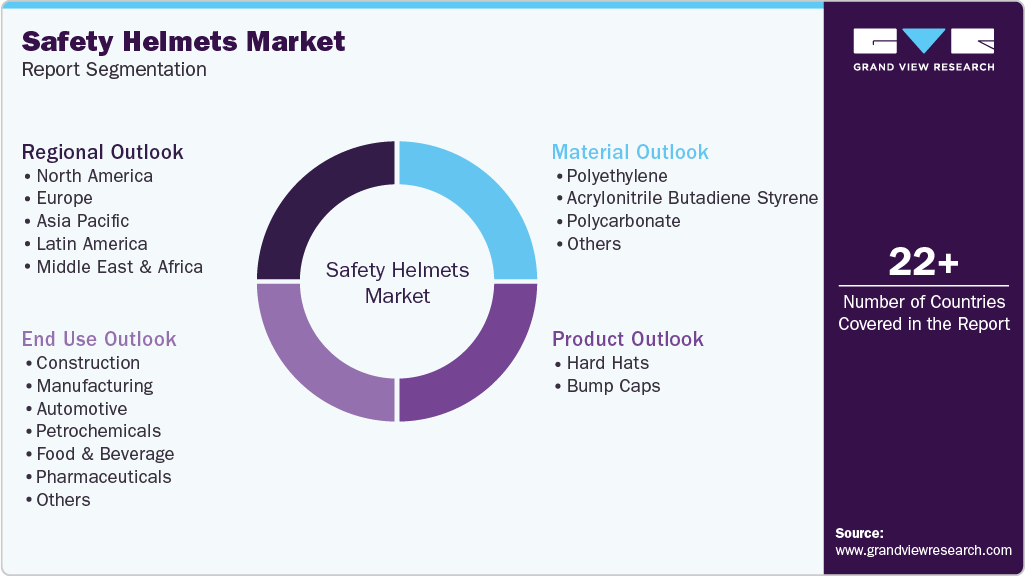
This report forecasts revenue growth at global, regional, and country levels and provides an analysis of the latest industry trends in each of the sub-segments from 2021 to 2033. For this study, Grand View Research has segmented the global safety helmets market report based on material, product, end use, and region.
 To learn more about this report, Download Free Sample Report
 -
Material Outlook (Revenue, USD Million, 2021 - 2033)
-
Polyethylene
-
Acrylonitrile Butadiene Styrene
-
Polycarbonate
-
Others
-
-
Product Outlook (Revenue, USD Million, 2021 - 2033)
-
Hard Hats
-
Type I
-
Type II
-
-
Bump Caps
-
Hard
-
Soft
-
-
-
End Use Outlook (Revenue, USD Million, 2021 - 2033)
-
Construction
-
Manufacturing
-
Automotive
-
Petrochemicals
-
Food & Beverage
-
Pharmaceuticals
-
Mining
-
Utilities
-
Others
-
-
Regional Outlook (Revenue, USD Million, 2021 - 2033)
-
North America
-
U.S.
-
Canada
-
Mexico
-
-
Europe
-
Germany
-
UK
-
France
-
Italy
-
Spain
-
Russia
-
-
Asia Pacific
-
China
-
India
-
Japan
-
Australia
-
South Korea
-
Malaysia
-
Thailand
-
Indonesia
-
-
Latin America
-
Brazil
-
Argentina
-
-
Middle East & Africa
-
Saudi Arabia
-
South Africa
-
UAE
-
-
Frequently Asked Questions About This Report
The key factors driving the global safety helmets market are stringent safety regulations, rising industrial and construction activity, technological advancements in helmet design, and growing awareness of workplace and personal protection.
The polyethylene material segment led with a 65.7% revenue share in 2025, while the acrylonitrile butadiene styrene segment is the fastest-growing.
The hard hats segment led with an 87.7% revenue share in 2025, while the bump caps segment is the fastest-growing.
The construction segment led with a 36.6% revenue share in 2025, while the pharmaceutical segment is the fastest-growing.
The global safety helmets market size was valued at USD 5.1 billion in 2025 and is estimated at USD 5.5 billion for 2026.
The global safety helmets market is expected to grow at a CAGR of 7.9% from 2026 to 2033, reaching USD 9.4 billion by 2033.
Europe dominated with a 30.0% revenue share in 2025.
Asia Pacific is the fastest-growing region over the forecast period.
Key players include Delta Plus Group, Bullard, PIP, 3M, MSA Safety, JSP Ltd., Polison Corporation, Drägerwerk AG & Co. KGaA, uvex group, Centurion Safety Products Ltd, Portwest UC, Parkson Safety Industrial Corp, MALLCOM INDIA LIMITED, JI Safety, Dursafety Inc.
About the Author(s)
Advanced Interior Materials Research Team
Advanced Materials · Advanced Interior MaterialsThis report was authored by the advanced interior materials research team at Grand View Research - comprising two research analysts, one senior research analyst, and one industry expert - with specialized expertise in the advanced interior materials segment of the advanced materials industry. All findings are based on proprietary advanced materials databases, executive interviews, and regulatory analysis, subject to internal peer review prior to publication.
Last Updated:
Speak to Analyst

Customize this report to your needs - add regions, segments, or data points, with 20% free customization.
Or view our licence options:


ISO 9001:2015 & 27001:2022 Certified
We are GDPR and CCPA compliant! Your transaction & personal information is safe and secure. For more details, please read our privacy policy.


