
- Home
- »
- Clothing, Footwear & Accessories
- »
-
Sapphire Jewelry Market Size And Share Report, 2026-2033GVR Report cover

Sapphire Jewelry Market (2026 - 2033)
Size, Share & Trends Analysis Report By Jewelry Type (Rings, Necklaces & Pendants), By Sapphire Type (Natural, Laboratory-Grown), By Sapphire Color, By Price Tier, By Distribution Channel, By Region, And Segment Forecasts
Market Size, 2025
$3.4BMarket Estimate, 2026
$3.6BMarket Forecast, 2033
$5.4BCAGR, 2026–2033
5.8%Sapphire Jewelry Market Summary
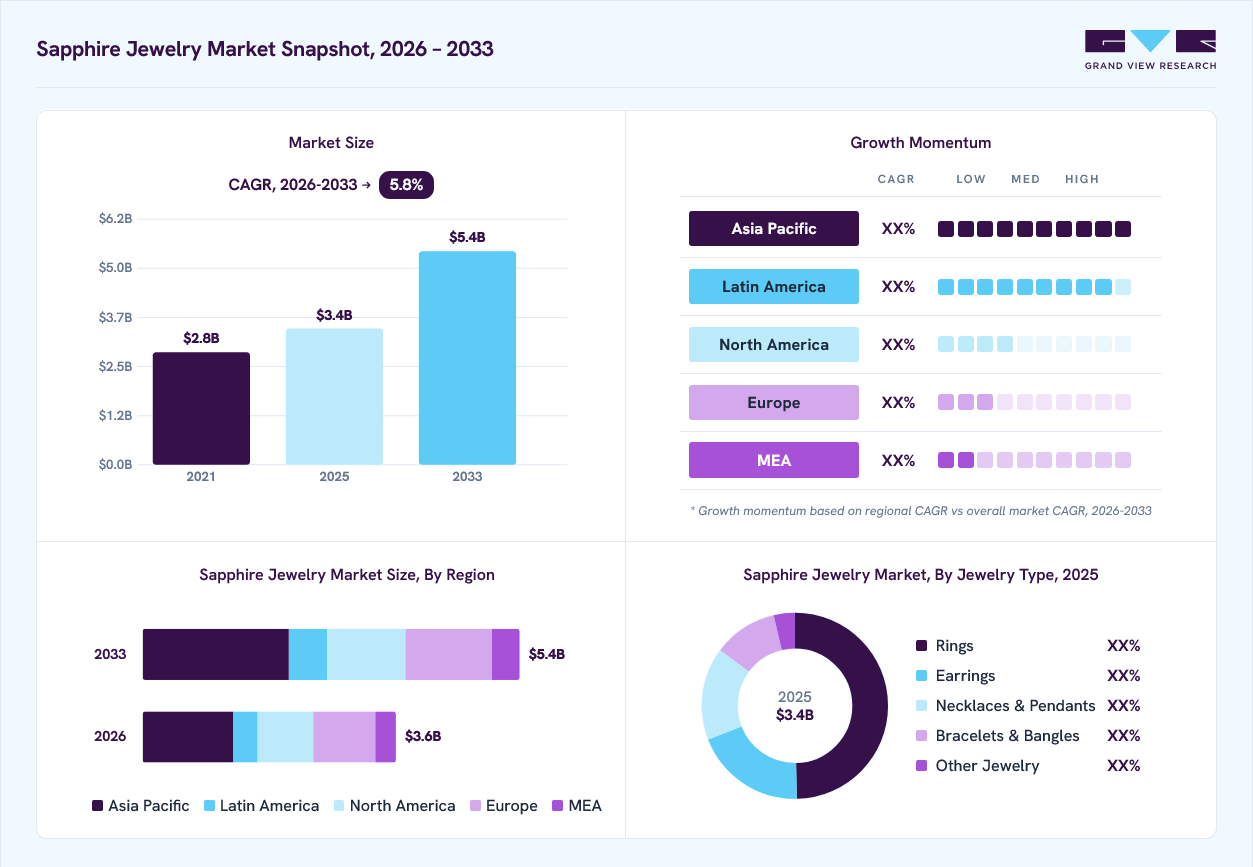
The global sapphire jewelry market size was valued at USD 3.4 billion in 2025 and is projected to grow from USD 3.6 billion in 2026 to USD 5.4 billion by 2033, at a CAGR of 5.8% from 2026 to 2033. Asia Pacific dominated the market, accounting for the largest revenue share of 35.4% in 2025. The industry is driven by increasing consumer preference for colored gemstones, rising demand for distinctive fine and bridal jewelry, premiumization across natural gemstone products, growing acceptance of sapphire as an alternative to traditional diamond-centered jewelry, and expanding availability through branded retail and e-commerce channels.
 Source: Grand View Research, IR Documents, Primary Interviews, Paid DatabasesTo learn more about this report,
 Download Free Sample Report
Key Market Trends & Insights
- By jewelry type: the rings segment dominated the global market with a 49.6% revenue share in 2025.
- By sapphire type: the natural sapphire segment held the largest market share, accounting for 89.9% of global revenue in 2025.
- By sapphire color: the blue sapphire segment represented the largest segment, contributing 61.2% of global revenue in 2025.
- By price tier: the mid-range products segment accounted for the largest share, contributing 39.7% of global revenue in 2025.
- By distribution channel: the specialty jewelry stores segment remained the leading channel, accounting for 44.7% of the global market in 2025.
Regional Highlights
- Largest regional market: Asia Pacific (35.4% revenue share, 2025)
- By country: China held the largest share in 2025
Market Size & Forecast
- Market Size in 2025: USD 3.4 Billion
- Estimated Market Size in 2026: USD 3.6 Billion
- Projected Market Size in 2033: USD 5.4 Billion
- CAGR (2026-2033): 5.8%
Prism AI by Grand View Research Free to tryAsk a question about the sapphire jewelry marketTry asking✓Every figure cited from GVR research Prefer the report? Download free sample →
Consumer interest is also extending beyond conventional blue sapphire toward pink, yellow, green, teal, orange, and other fancy-color stones. GIA specifically identifies the expanding consumer interest in colored stones beyond the traditional "big three," while its engagement-ring guidance highlights the increasing visibility of colored gemstone engagement rings among celebrities and royalty. The continued use of sapphire in engagement and occasion jewelry, therefore, provides a broader demand base than purely fashion-driven gemstone purchases.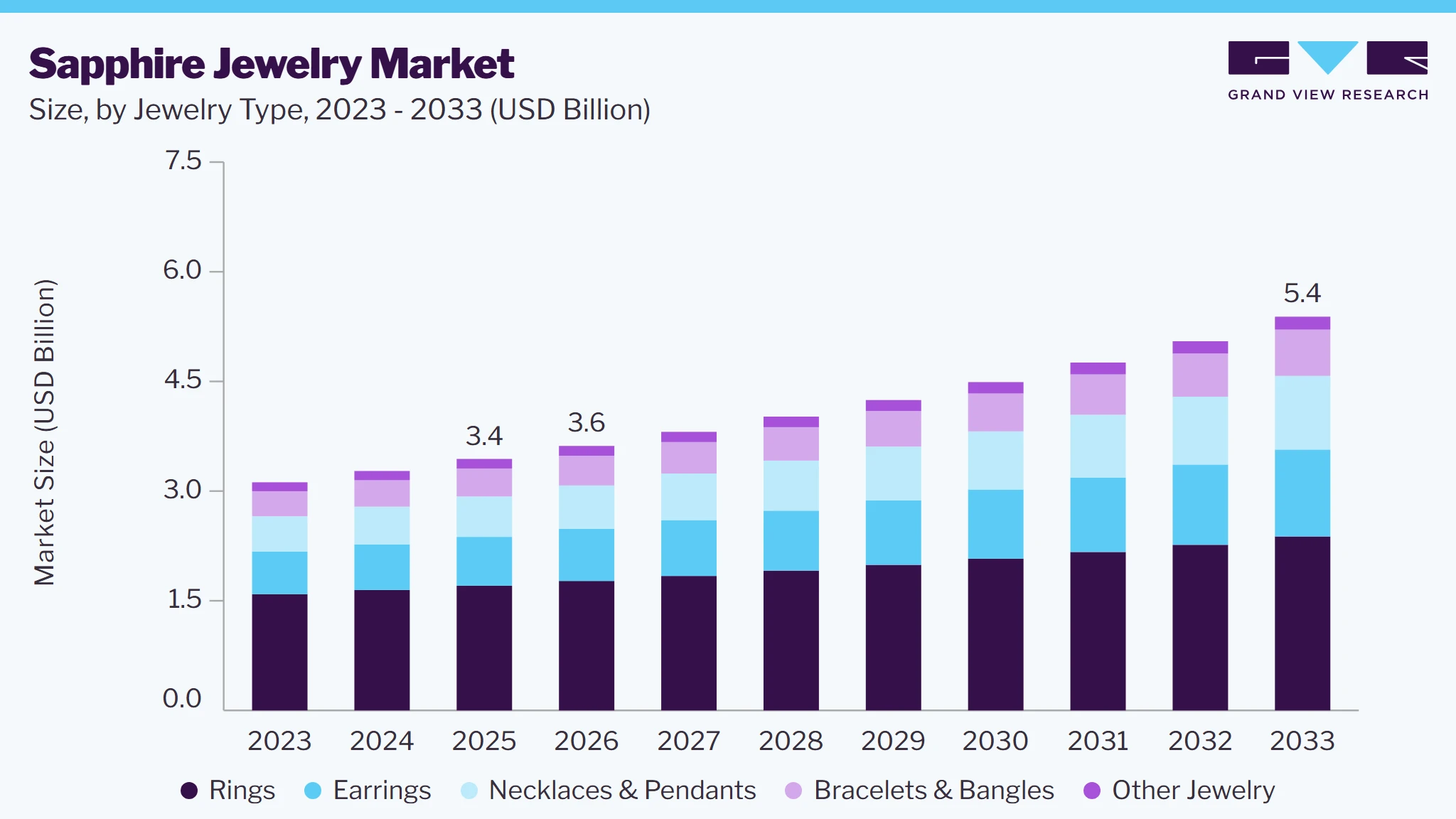 To learn more about this report, Download Free Sample Report
The market is simultaneously becoming more segmented by gemstone quality and provenance. At the upper end, untreated stones with exceptional color, origin, size, and documentation can command substantial premiums. Christie's, for example, recorded a 35.09-carat Kashmir sapphire ring at US$7.36 million, equivalent to approximately US$209,689 per carat, at its Geneva Magnificent Jewels auction. More recently, Sotheby's reported a 15.33-carat Kashmir sapphire ring selling for approximately US$2.0 million in April 2026, illustrating the continuing collector interest in exceptional natural sapphires
Market Dynamics
The industry is supported by the broader shift toward colored gemstones in fine jewelry, alongside continued demand for sapphire's traditional applications in engagement, anniversary, bridal, and luxury jewelry. Sapphire is one of the three major gemstones, alongside ruby and emerald, and is valued for its durability, with a Mohs hardness of 9. GIA notes that sapphire is available in most colors, although blue remains its best-known variety, while color is the most important quality factor for determining the value of sapphire. This combination of durability, color variety, and established luxury positioning allows sapphire to compete across both everyday fine jewelry and high-value collectible pieces.
Consumer preferences are increasingly moving toward jewelry that communicates individuality, color, and personal meaning. Sapphire benefits from this shift because it can function as both a traditional precious gemstone and a distinctive alternative to a diamond center stone. GIA's guidance on colored gemstone engagement rings identifies the growing visibility of colored gemstones among royals, celebrities, and style influencers, while its more recent diamond-alternative guidance specifically positions sapphire as a durable option for everyday engagement-ring wear.
The trend is being reinforced by luxury brands, such as Tiffany & Co., which markets sapphire across its Tiffany Lock, Tiffany Soleste, Elsa Peretti, Tiffany Forever, and other collections, while its current assortment includes blue, pink, and orange sapphire products ranging from relatively accessible pieces to products priced in the tens of thousands of dollars. This broad product architecture allows the company to capture both everyday fine jewelry demand and high-value purchases.
Cartier, Bvlgari, Van Cleef & Arpels, Chopard, Harry Winston, Graff, and Piaget similarly use colored gemstones within their fine- and high-jewelry collections, supporting sapphire's association with luxury craftsmanship rather than positioning it solely as a birthstone or bridal gemstone. This brand-level exposure is important because it introduces sapphire to consumers who may initially enter the colored-gemstone category through fashion or luxury jewelry.
The trend is also visible at the consumer level in Asian markets. GIA's field research in Sri Lanka found that younger and wealthier consumers were showing greater interest in diamonds and natural colored stones, while lighter and less-traditional jewelry designs were gaining popularity.
Natural sapphire does not offer the standardized supply characteristics of manufactured jewelry materials. Individual stones can vary substantially in color, saturation, clarity, size, treatment, and origin, making procurement more complex for jewelry manufacturers and retailers. GIA identifies color as the most important sapphire quality factor and notes that fine blue sapphires with strong saturation can command significantly higher values. It also emphasizes that treatment information should be considered when purchasing sapphire.
Treatment is particularly important because a significant portion of commercial sapphire undergoes enhancement. GIA identifies heat treatment and lattice diffusion as established processes within the sapphire trade, with lattice-diffused stones generally carrying lower values than comparable untreated or conventionally heated stones. For exceptional-quality stones, independent laboratory confirmation of no evidence of heat can materially enhance rarity and value.
Recent gemological research illustrates why treatment and identification remain commercially important. GIA documented cases of beryllium diffusion being used to create pinkish-orange to orange-pink colors resembling rare padparadscha sapphire. The issue became significant because naturally colored padparadscha material is scarce and commands strong premiums.
GIA also reported in 2025 on a 3.54-carat padparadscha sapphire whose color changed during laboratory stability testing, demonstrating that even sophisticated gemstone categories can present identification and stability considerations. For jewelry companies, these factors increase the importance of supplier screening, laboratory reports, treatment disclosure, gemstone grading, and inventory segregation. They can also make it difficult for large retailers to consistently source comparable natural sapphires at predictable costs.
Asia presents a significant opportunity for the sapphire jewelry market because it combines major gemstone-producing and processing centers with some of the world's largest jewelry-consuming markets. Sri Lanka remains a major source of fine sapphires, particularly Ceylon blue and padparadscha, while Thailand's Bangkok and Chanthaburi, India's Jaipur, and China's gemstone-processing centers provide established cutting, treatment, trading, and jewelry-manufacturing ecosystems. The Gem and Jewelry Institute of Thailand (GIT) supports gemstone testing, certification, research, and industry development, while GIA research has highlighted China's growing role in both gemstone production and consumption. This regional ecosystem enables companies to source stones, process them, and convert them into finished jewelry closer to major consumer markets. Companies such as Chow Tai Fook, Luk Fook, Lao Feng Xiang, Kalyan Jewellers, Titan/Tanishq, PNJ, Pranda Jewelry, and Beauty Gems provide established retail or manufacturing platforms through which sapphire jewelry can reach consumers across Asia.
The opportunity is further strengthened by rising premium consumption, organized jewelry retail, tourism, and digital commerce across China, India, Japan, Southeast Asia, and the Gulf-linked Asian trade corridor. In India, Jaipur's established colored-gemstone ecosystem creates opportunities for retailers to combine locally sourced or processed sapphires with branded wedding, occasion, and contemporary jewelry collections. In Sri Lanka, companies such as CJS, Vogue Jewellers, and Zam Gems can leverage the country's sapphire heritage and origin-based positioning, while Japanese brands such as Tasaki can address premium consumers through high-quality craftsmanship and design.Consumer Insights
 To learn more about this report, Download Free Sample Report
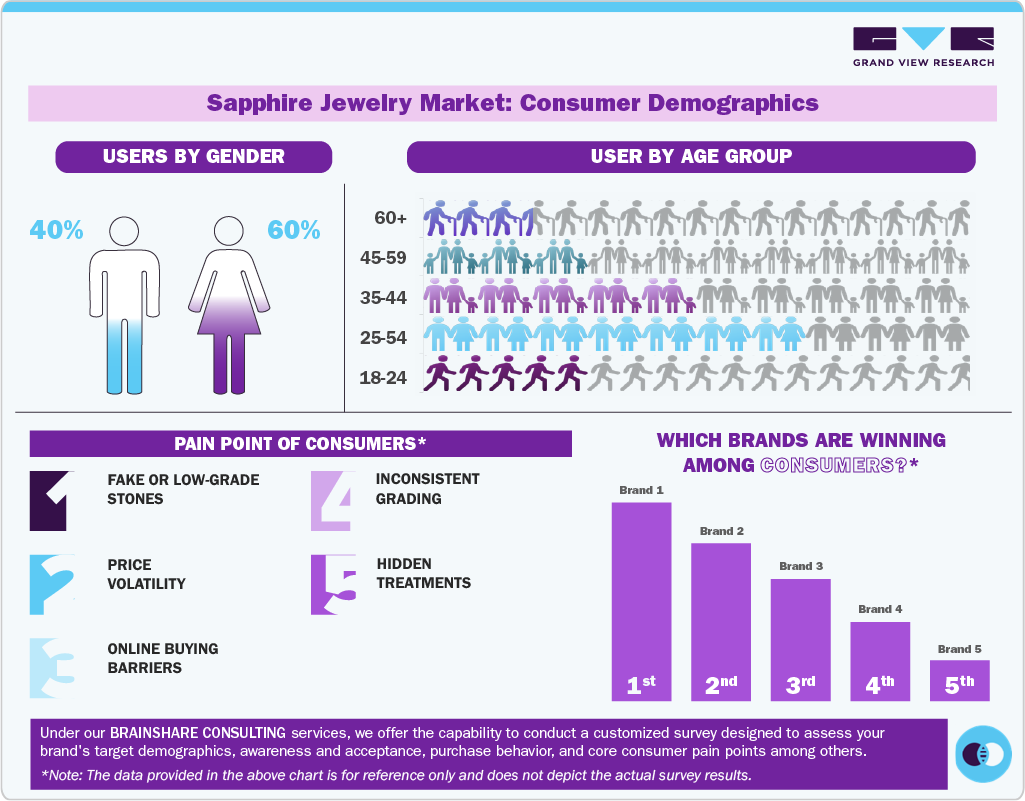
Consumer behavior in the global market is driven by a combination of aesthetic appeal, gemstone color, individuality, symbolic value, quality, and perceived value, with provenance and responsible sourcing becoming increasingly relevant for premium purchases rather than solely by the intrinsic value of the stone. GIA research among younger colored-stone consumers found that aesthetics was the leading purchase consideration at 35%, followed by preciousness at 30%, while naturalness, sustainability/ethics, symbolism, and economic value were additional considerations. Sapphire also benefits from being one of the “Big Three” colored gemstones and from its durability, broad color range, and September birthstone association.
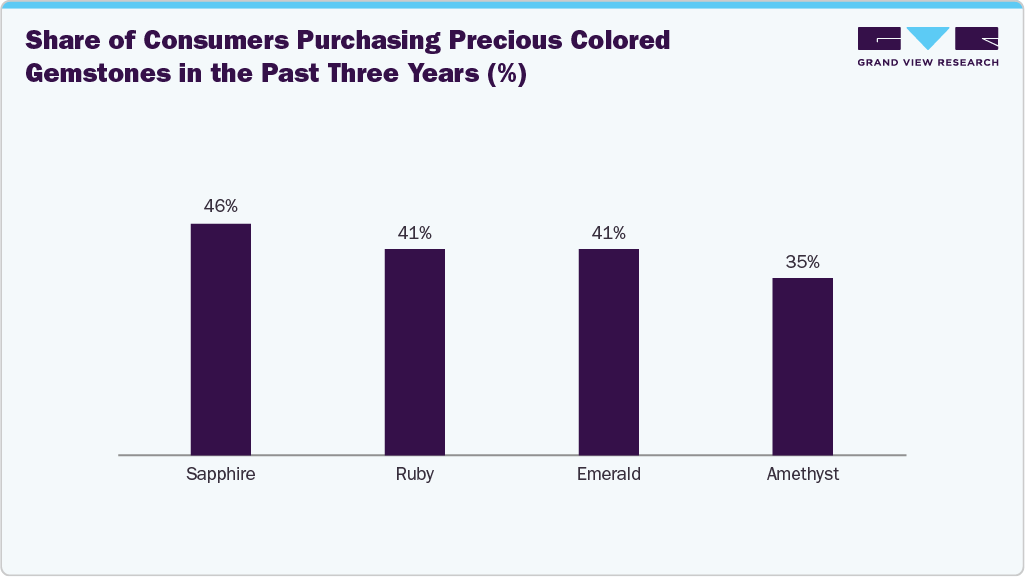
The Plumb Club/MVI consumer study, based on 1,011 U.S. fine-jewelry consumers, found that 93% of respondents liked or loved precious colored gemstones, while 46% had previously purchased sapphire jewelry, making sapphire the most purchased colored gemstone in the study, ahead of ruby and emerald at 41% each. Among consumers aged 23-40, 40% identified sapphire as their favorite gemstone, and approximately half of this group had already purchased sapphire jewelry, indicating strong conversion from preference to purchase among younger consumers.
 To learn more about this report, Download Free Sample Report
-
Women represent an important consumer base, particularly for sapphire rings, earrings, necklaces, and fashion-oriented colored-stone jewelry. A Gemfields consumer study reported that 31% of U.S. women had acquired ruby, emerald, or sapphire jewelry during the preceding two years, increasing to 41% among millennial women.
-
Younger consumers are increasingly relevant to the market, with design, individuality, social-media discovery, and everyday wear influencing purchasing decisions. GIA's Sri Lankan field research found that younger consumers preferred lighter, contemporary jewelry and were more inclined to purchase multiple pieces and change styles frequently.
 To learn more about this report, Download Free Sample Report
-
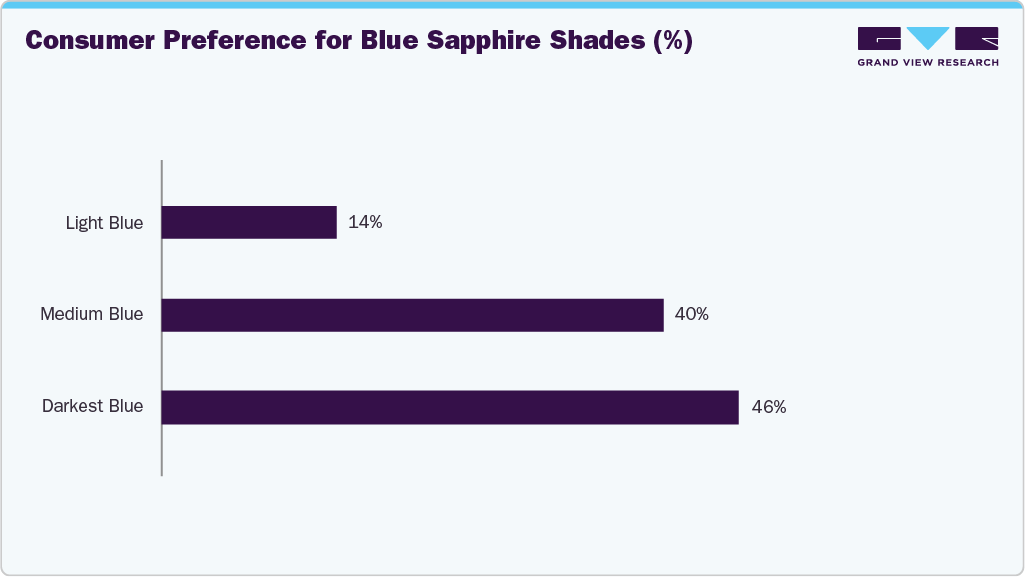
Color and design are major purchase triggers. Blue remains the core sapphire proposition, with 46% of surveyed consumers preferring the darkest blue shade, followed by medium blue at 40% and light blue at 14%. However, consumer interest extends beyond conventional blue sapphire. 78% of respondents liked or loved parti sapphires, 70% expressed interest in black sapphires, and 68% liked or loved fancy sapphires spanning yellow, green, and bluish-green hues. This indicates that consumers are increasingly receptive to distinctive colors and visual characteristics that enable sapphire jewelry to function as a form of personal expression rather than simply as an alternative to diamond jewelry.
-
Bridal jewelry is another important purchase pathway. In the MVI survey, 38% of consumers said they were highly likely to select sapphire for an engagement ring or wedding band, supporting the gemstone's increasing role in non-traditional bridal jewelry. This trend is reinforced by Chubb's analysis, which reported that 40% of younger consumers aged 23-40 selected sapphire as their favorite gemstone and approximately half of this group had already purchased sapphire jewelry. Chubb also identified millennials as increasingly willing to experiment with colored gemstones and seek distinctive pieces for bridal and fashion applications.
-
Provenance and responsible sourcing increasingly influence purchase confidence. The MVI study found that 79% of consumers considered the country of origin very or somewhat important, while 82% considered the treatment of workers at mines or cutting factories important to some degree. Consequently, premium sapphire purchases increasingly involve information validation around gemstone origin, treatment, sourcing practices, and quality rather than being based solely on appearance. This is particularly relevant for natural sapphires, where treatment and provenance can materially influence perceived value.
-
Value and product differentiation also shape the purchase journey. The Plumb Club study found that more than half of retailers identified $800-$2,000 per carat in jewelry as a consumer sweet spot for precious colored gemstones, illustrating the importance of accessible premium price points. At the same time, the strong consumer response to parti and fancy sapphires suggests that differentiated color can create additional demand among buyers seeking distinctive jewelry. The survey also found that 92% of manufacturers and 75% of retailers considered precious colored gemstones a higher-margin category than diamonds, supporting greater retailer interest in expanding colored-gemstone assortments.
-
Laboratory-grown sapphires provide an additional value-oriented pathway. Lab-grown sapphire jewelry is being positioned by manufacturers as an affordable and customizable alternative, with applications spanning blue, pink, white, yellow, green, orange, purple, and multicolor stones. Essentials Jewelry, for example, highlights demand from online and personalized jewelry brands and identifies lab-grown sapphire as part of its manufacturing offering across multiple international markets. However, such manufacturer-level evidence should be treated as an indicator of supply-side positioning rather than as a direct measure of global consumer adoption.
Consumers also face several challenges during the purchase journey, particularly around authenticity, treatments, gemstone quality, origin claims, and price justification. GIA specifically recommends that buyers understand sapphire treatments and obtain laboratory reports when necessary, since heat treatment and lattice diffusion are widely encountered in the market. This makes certification and disclosure increasingly important for premium purchases. At the same time, consumers are becoming more comfortable with online research and digital discovery; Gemfields found that millennials were nearly twice as likely as non-millennials to use social media and mobile devices for jewelry research. Retailers and brands such as Tiffany & Co., Cartier, Blue Nile, James Allen, and Chow Tai Fook therefore benefit from combining physical consultation with detailed online product information, gemstone specifications, certification, and customization. Overall, sapphire jewelry purchasing is shifting toward design-led, information-rich, and increasingly personalized consumption, with repeat purchasing supported by changing fashion preferences and the availability of different sapphire colors, qualities, and price points.
Analyst Perspective
The industry is increasingly shifting toward colored-stone-led luxury, with consumers seeking alternatives to traditional diamond jewelry for engagement rings and statement pieces. Blue sapphire remains the dominant value contributor, supported by strong recognition of Kashmir- and Ceylon-origin stones, while pink and padparadscha sapphires command significant premiums due to rarity and collector demand. The market is also benefiting from growing interest in gemstone provenance, untreated stones, and ethical sourcing, particularly within the high-end segment. Luxury houses are expanding sapphire collections and bespoke offerings, while online certification and digital gemstone education are improving consumer confidence. Supply constraints for high-quality natural sapphires continue to support premium pricing.
Jewelry Type Insights
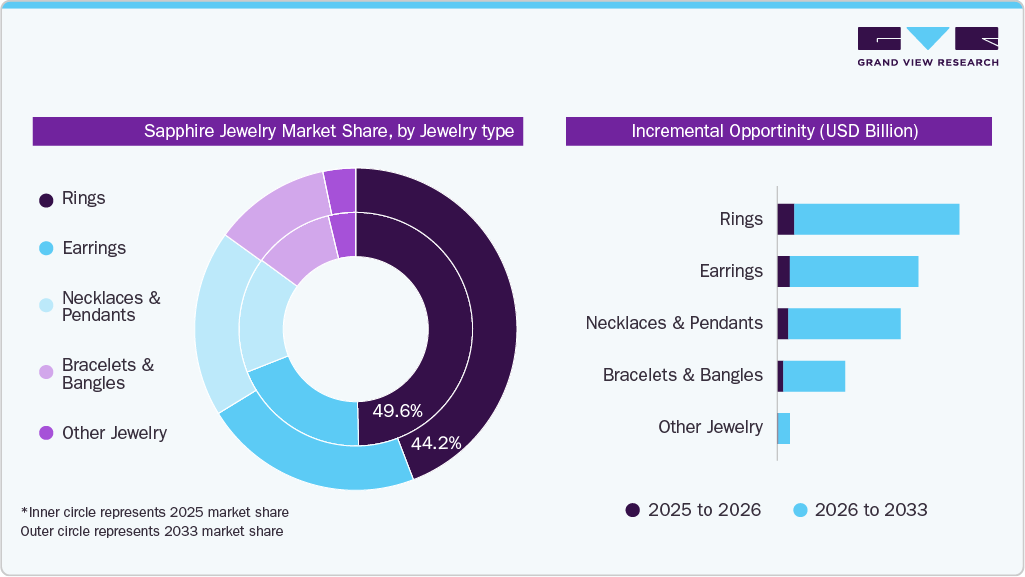
The rings segment accounted for the largest revenue share of 49.6% in 2025, supported by sapphire's strong association with engagement, wedding, anniversary, birthstone, and statement jewelry, where the gemstone can serve as a central stone or complement diamonds. Sapphire's durability also makes it suitable for frequent wear; GIA describes sapphire as a durable gemstone appropriate for daily-worn jewelry. Luxury houses continue to reinforce this positioning: Tiffany & Co. offers sapphire engagement and wedding bands, cocktail rings, stackable rings, and birthstone designs, while Cartier features sapphire solitaire rings within its colored-stone collections.
 To learn more about this report, Download Free Sample Report
The necklaces & pendants segment is projected to register the fastest growth rate of 7.9% during 2026-2033, supported by increasing adoption of sapphire as an everyday colored-stone accent and by demand for versatile gifting and layering pieces. Tiffany's current sapphire assortment includes pendants designed for everyday and occasion wear, while its broader jewelry offering emphasizes personalized and layered necklace styling. The segment also benefits from the ability to incorporate smaller sapphires at different price points, making pendants accessible across mid-range and premium jewelry collections.
Sapphire Type Insights
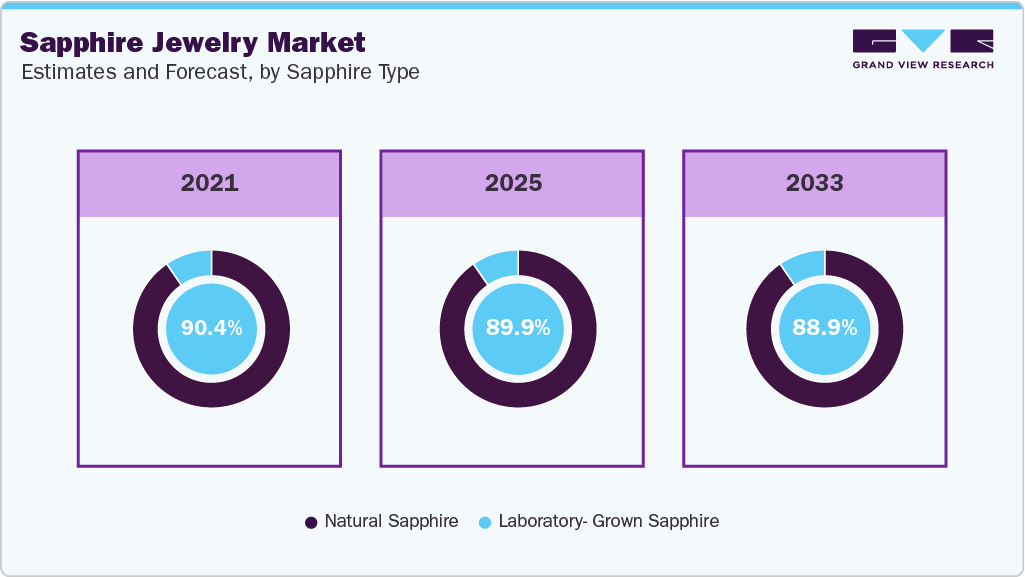
The natural sapphire segment accounted for the largest revenue share of 89.9% in 2025. Its dominance reflects the strong consumer association between sapphire jewelry and naturally occurring gemstones, particularly for premium, bridal, and high-value pieces. Natural sapphire also benefits from provenance and rarity considerations: GIA notes that exceptional untreated sapphires and stones from origins such as Kashmir, Myanmar, Sri Lanka, and Madagascar can command significant premiums. Treatment disclosure and independent certification are consequently important in higher-value purchases.
 To learn more about this report, Download Free Sample Report
The laboratory-grown segment is projected to be the fastest-growing segment, at a 7.1% CAGR from 2026 to 2033. Although it remains a relatively small portion of the market, growth is supported by its lower cost potential, consistent availability, and appeal to consumers seeking alternatives to mined gemstones. GIA notes that synthetic sapphires have been produced for more than a century and are widely encountered in the jewelry trade. Regulatory emphasis on clear disclosure is also strengthening consumer understanding: the U.S. Federal Trade Commission (FTC) requires laboratory-created gemstones to be clearly identified as laboratory-grown or laboratory-created rather than represented as mined stones.
Sapphire Color Insights
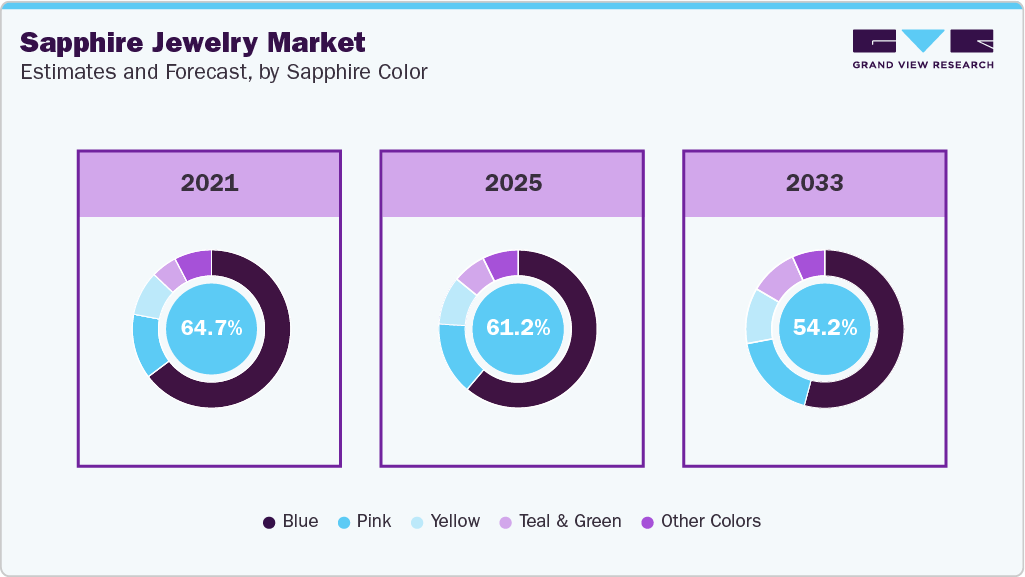
The blue sapphire segment accounted for the largest revenue share of 61.2% in 2025. Blue continues to define consumer perceptions of sapphire and remains the most established color in engagement, bridal, luxury, and fine jewelry. GIA identifies sapphire as the best-known blue gemstone and notes that the most highly valued blue stones typically exhibit strong to vivid saturation and desirable blue-to-violetish-blue tones. Major jewelry houses continue to anchor their sapphire collections around blue stones, while also using them in rings, earrings, pendants, and high jewelry.
 To learn more about this report, Download Free Sample Report
The teal & green segment is projected to register the fastest growth rate of 10.7% from 2026 to 2033. The segment is benefiting from increasing consumer interest in distinctive and non-traditional sapphire colors, particularly among buyers seeking personalized and less conventional jewelry. GIA identifies green among the major fancy-sapphire colors, while industry reporting has highlighted strong retailer interest in teal sapphire. This trend is supported by designers and gemstone specialists offering unconventional color combinations and one-of-a-kind pieces, helping teal and green stones move beyond niche gemstone collectors into contemporary jewelry.
Price Tier Insights
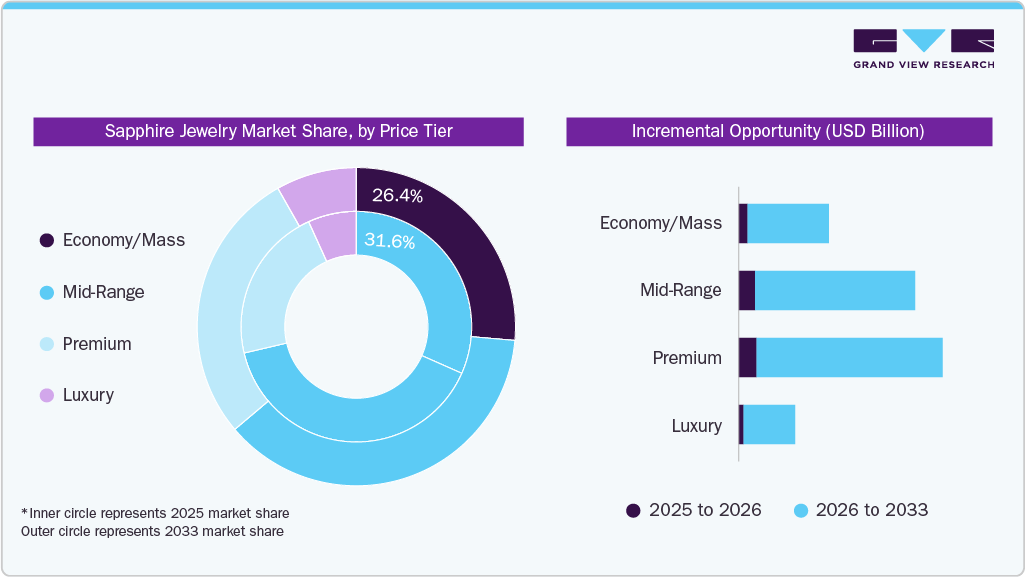
The mid-range sapphire segment accounted for the largest revenue share of 39.7% in 2025. Its leadership reflects the broad consumer base seeking genuine sapphire jewelry without the high price associated with exceptional-origin, large, or untreated gemstones. Mid-range products can incorporate smaller stones, treated natural sapphires, contemporary designs, and gold or silver settings, allowing brands and retailers to offer sapphire across a wider customer base. GIA notes that sapphire prices vary substantially according to color, treatment, quality, and origin, creating considerable room for products at different price points.
 To learn more about this report, Download Free Sample Report
The premium segment is projected to register the fastest growth rate of 9.1% over the forecast period of 2026 to 2033, supported by consumer interest in higher-quality stones, distinctive colors, provenance, craftsmanship, and certification. GIA notes that fine-quality sapphires with no evidence of heat treatment can command a premium, while geographic origin can also materially influence value. Companies such as Tiffany & Co. and Cartier reinforce this premium positioning through sapphire-and-diamond jewelry, high-jewelry pieces, and sophisticated colored-stone collections. Fura Gems provides another example through its traceable Celebration Sapphires collection, which was launched in India through retailers including Senco and PNG.
Distribution Channel Insights
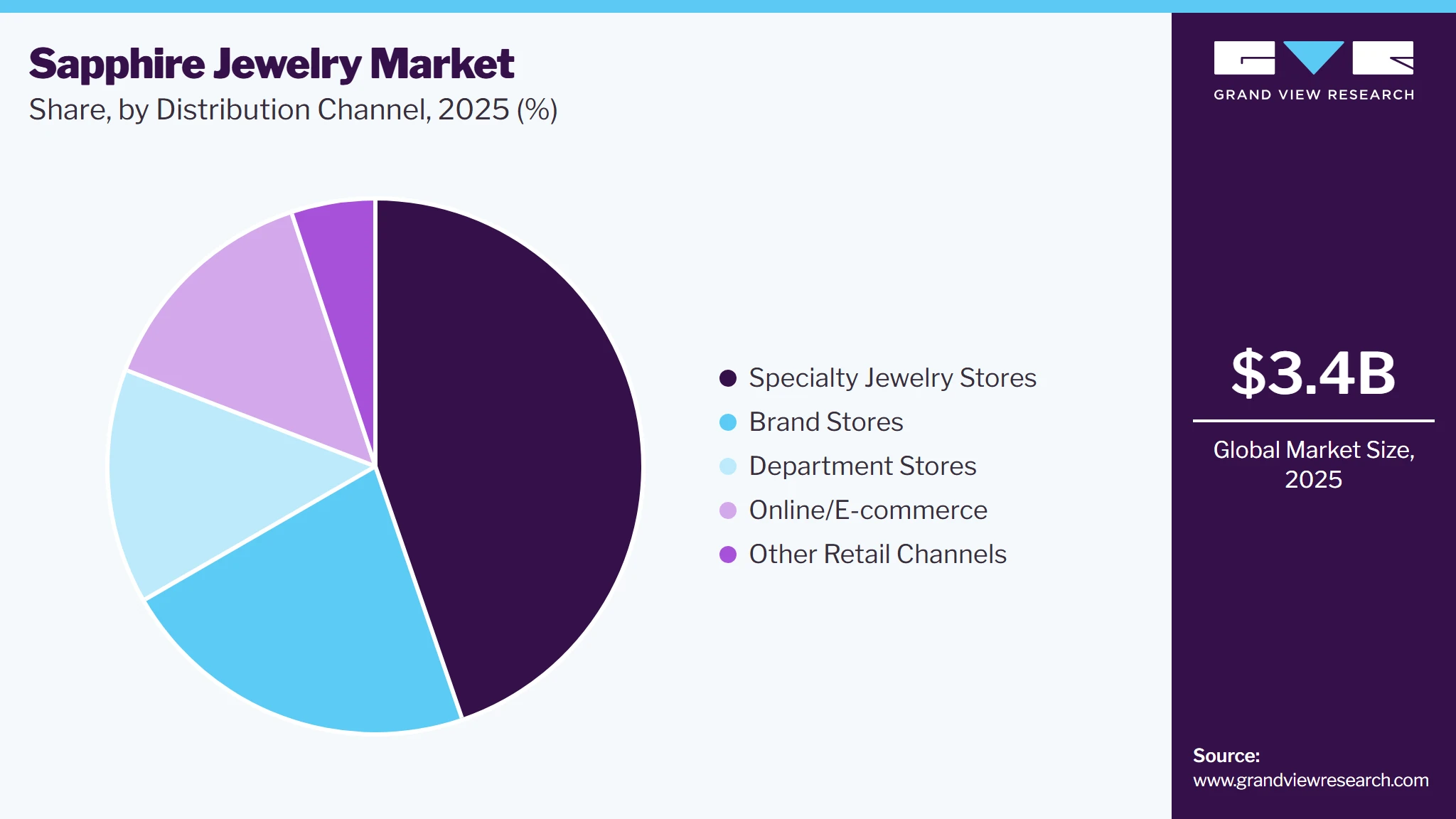
The specialty jewelry stores segment accounted for the largest revenue share of 44.7% in 2025. Their dominance is supported by the complexity of sapphire purchasing, where consumers often want assistance evaluating color, cut, treatment, origin, certification, and gemstone quality before committing to a purchase. GIA specifically recommends working with a jeweler to understand differences in sapphire color and advises obtaining a laboratory report where treatment or exceptional quality is important. Specialist retailers, therefore, have an advantage in explaining gemstone characteristics and building consumer confidence.
 To learn more about this report, Download Free Sample Report
The online/e-commerce segment is projected to register the fastest CAGR of 10.7% from 2026 to 2033, supported by greater availability of detailed gemstone specifications, certification information, high-resolution product imagery, virtual consultations, customization, and direct-to-consumer collections. Established brands are increasingly using digital channels to showcase colored-stone collections, while online specialist retailers provide consumers with broader comparisons of sapphire color, size, treatment, and price. However, trust remains critical because the FTC requires clear disclosure of gemstone treatments and laboratory-created stones in online advertising and at the point of sale.
Regional Insights
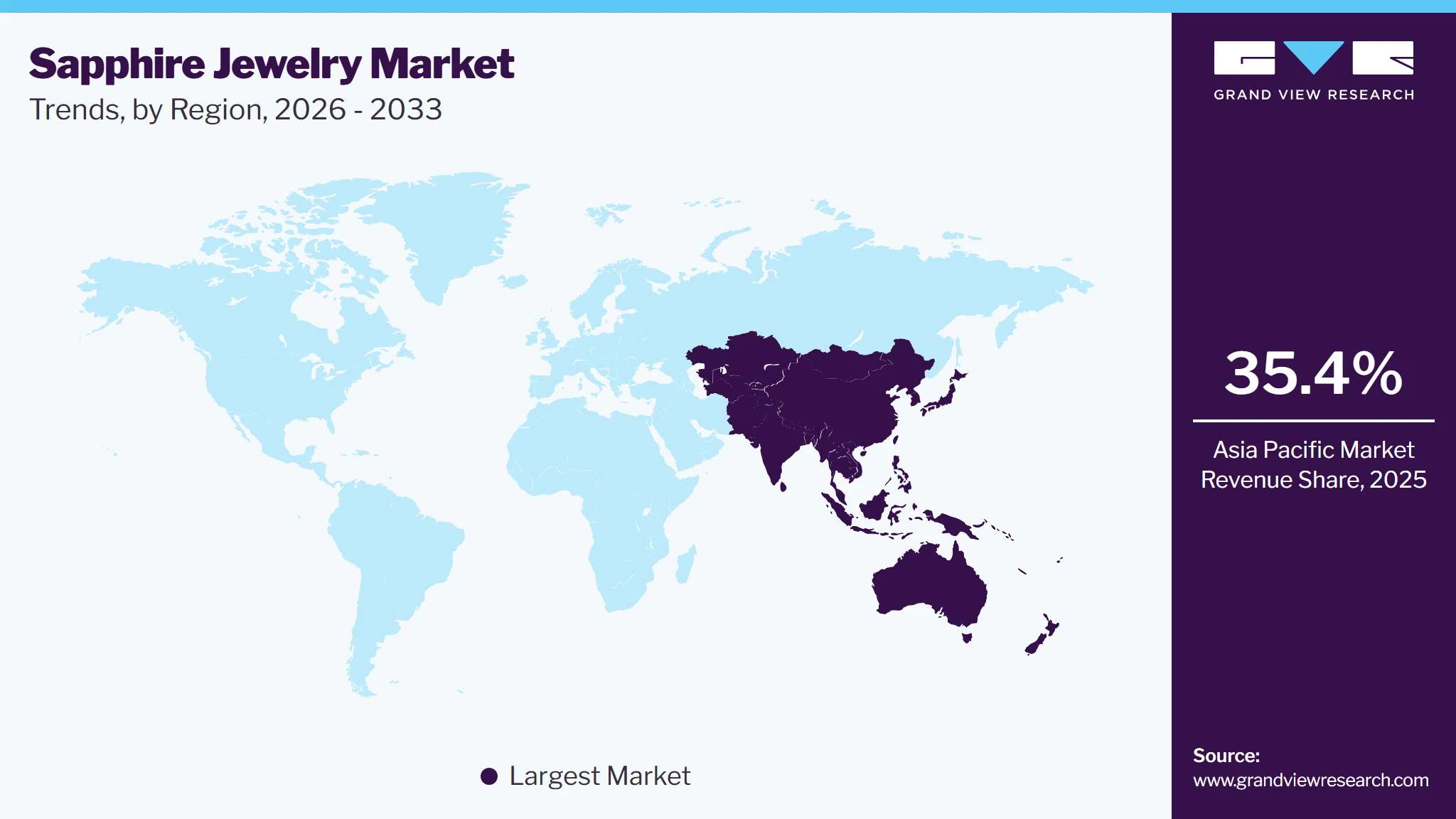
The Asia Pacific sapphire jewelry market accounted for the largest revenue share of 35.4% in 2025, and is projected to register the fastest CAGR of 7.0% from 2026 to 2033. Growth is supported by the region's strong jewelry manufacturing base, expanding middle-class consumer population, increasing expenditure on fine and fashion jewelry, and growing preference for colored gemstones as alternatives to traditional diamond jewelry. China, India, Japan, and Southeast Asian markets are benefiting from rising disposable incomes, e-commerce penetration, bridal jewelry demand, and increasing consumer interest in natural and distinctive sapphire colors. The region's established gemstone cutting, polishing, jewelry manufacturing, and export ecosystem also supports competitive pricing and product availability.
 To learn more about this report, Download Free Sample Report
The China sapphire jewelry market represents the largest market within Asia Pacific, with about 28.43% revenue share in 2025, supported by its large luxury and fine jewelry consumer base, established gemstone processing industry, and extensive omnichannel retail infrastructure. Demand is concentrated in premium rings, earrings, pendants, and statement jewelry, with blue sapphire remaining the dominant color while pink and other fancy-color sapphires gain visibility among younger luxury consumers. Expansion of domestic luxury consumption, social-commerce platforms, livestream retail, and digitally enabled jewelry brands is improving accessibility, while consumers' increasing preference for colored gemstones is creating opportunities beyond conventional diamond jewelry.
The sapphire jewelry market in India is expected to record one of the strongest growth rates with a CAGR of 7.2%. Demand is supported by India's established gemstone cutting and jewelry manufacturing ecosystem, strong wedding and ceremonial jewelry expenditure, rising disposable incomes, and increasing acceptance of colored gemstones in contemporary jewelry. Blue sapphires continue to benefit from established consumer awareness, while pink, yellow, and teal sapphires are gaining traction in premium and designer collections. Expansion of organized jewelry retail and e-commerce is also increasing access to branded sapphire jewelry beyond major metropolitan markets.
North America Sapphire Jewelry Market Trends
The sapphire jewelry market in North America accounted for 22.1% of global revenue in 2025, and is projected to grow at a CAGR of 5.0% from 2026 to 2033. The market benefits from high consumer purchasing power, strong demand for fine and bridal jewelry, established luxury retail networks, and growing interest in colored gemstones. Sapphire engagement rings and anniversary jewelry represent important demand categories, while consumers increasingly value distinctive colors, gemstone provenance, and personalized designs. The U.S. remains the primary market, supported by extensive luxury retail, specialist jewelers, online jewelry platforms, and strong brand presence.
U.S. Sapphire Jewelry Market Trends
The sapphire jewelry market in the U.S. dominated North America with a share of 88.9% in 2025, supported by its large luxury and fine-jewelry consumer base, high discretionary spending, and extensive network of luxury houses, department stores, independent jewelers, and online retailers. Sapphire engagement rings represent an important application, particularly among consumers seeking alternatives to conventional diamond-centered designs. Demand is also supported by growing interest in colored gemstones, vintage-inspired jewelry, personalization, and ethically sourced natural stones. Premium brands such as Tiffany & Co., Cartier, Harry Winston, and other luxury jewelers reinforce demand through high-visibility sapphire collections and high-jewelry offerings.
The Canada sapphire jewelry market is expected to grow at a CAGR of about 6.8% from 2026 to 2033, supported by high household purchasing power, established fine jewelry retail infrastructure, and consumer interest in distinctive gemstone jewelry. Blue sapphire remains the principal demand category, particularly for engagement rings, earrings, and pendants, while pink and other fancy-color sapphires occupy a growing niche in designer and premium jewelry. E-commerce is expanding access to specialist gemstone retailers, while demand for responsibly sourced and traceable gemstones is increasingly relevant among premium consumers.
Europe Sapphire Jewelry Market Trends
The sapphire jewelry market in Europe accounted for 24.7% of global revenue in 2025, and is projected to grow at a CAGR of 4.8% from 2026 to 2033. Europe's position is supported by its concentration of global luxury jewelry houses, long-established jewelry craftsmanship, high-spending consumers, and strong heritage in colored gemstones. France, Italy, the UK, Germany, and Switzerland remain important markets for premium sapphire jewelry, particularly high-jewelry pieces, designer collections, and bespoke products. Demand is increasingly influenced by gemstone rarity, craftsmanship, provenance, and sustainability, while luxury houses continue to use exceptional sapphires as centerpiece stones in high-jewelry collections.
The Germany sapphire jewelry market represents a major European market, with a share of 27.8% in 2025. This is supported by high purchasing power, a developed jewelry retail network, and consumer preference for quality-oriented and durable fine jewelry. Demand is concentrated in premium rings, earrings, pendants, and wedding-related jewelry, with blue sapphire accounting for a substantial share of consumption. Independent jewelers remain important alongside international luxury brands, while online jewelry sales are improving consumer access to a wider range of sapphire qualities and price points.
The sapphire jewelry market in the UK is expected to grow with the CAGR of 6.3%, driven by strong heritage, established luxury retail infrastructure, and sustained consumer interest in colored gemstones. Sapphire has particularly strong visibility in engagement and occasion jewelry, reinforced by the gemstone's historical association with British royal jewelry. Demand is increasingly extending toward contemporary designs, colored-stone combinations, and ethically sourced gemstones. London's concentration of luxury jewelry houses, specialist jewelers, auction houses, and high-net-worth consumers further strengthens the UK's importance within the European sapphire jewelry market.
Central & South America Sapphire Jewelry Market Trends
The sapphire jewelry market in Central & South America accounted for 9.5% of global revenue in 2025, and is projected to grow at a CAGR of 6.8% from 2026 to 2033. Market expansion is supported by rising disposable incomes, increasing urbanization, growing organized jewelry retail, and expanding consumer interest in colored gemstones. Brazil represents the largest market in the region, while Mexico, Colombia, Chile, and Argentina provide additional growth opportunities. Demand remains concentrated in affordable-to-mid-range fine jewelry, although premium sapphire products are gaining traction among higher-income consumers.
The Brazil sapphire jewelry market represents the largest market in Central & South America with approximately 60.5% of total revenue in 2025, supported by its large consumer base, established jewelry manufacturing and retail industry, and strong cultural importance of jewelry for gifting and special occasions. Sapphire jewelry demand is concentrated in rings, earrings, and pendants, while colored gemstones generally benefit from Brazil's broader consumer familiarity with gemstone jewelry. Expansion of organized jewelry chains, branded collections, marketplaces, and social-commerce channels is increasing accessibility, while premium consumers are showing greater interest in distinctive natural gemstones and designer jewelry.
Middle East & Africa Sapphire Jewelry Market Trends
The sapphire jewelry market in the Middle East and Africa accounted for 8.2% of global revenue in 2025, and is projected to grow at a CAGR of 4.4% from 2026 to 2033. The Middle East, particularly the Gulf countries, represents the principal value center because of high luxury-goods expenditure, strong jewelry purchasing culture, tourism, and concentration of high-net-worth consumers. Sapphire jewelry benefits from demand for statement pieces, bridal jewelry, colored-stone combinations, and high jewelry. Across Africa, South Africa and selected North African and Gulf-facing markets provide important opportunities through established jewelry retail and growing access to international brands.
The UAE sapphire jewelry market is a major market within the Middle East, holding approximately 35.3% revenue, driven by high luxury consumption, tourism, premium shopping destinations, and a dense concentration of international jewelry brands. Dubai's luxury retail ecosystem supports demand for high-value sapphire rings, necklaces, earrings, and bespoke jewelry, while consumers and international visitors increasingly seek distinctive colored gemstones. The country's role as a regional luxury-shopping and jewelry-trading hub also enables brands to reach affluent consumers from across the wider Middle East, South Asia, and Africa.
The sapphire jewelry market in South Africa is supported by a developed retail sector, relatively high purchasing power compared with many neighboring markets, and established gemstone and precious-metal expertise. Demand is concentrated in rings, earrings, and occasion jewelry, with blue sapphire remaining the dominant color category. Independent jewelers and specialist gemstone retailers remain important alongside international brands, while increasing online availability and consumer interest in unique colored gemstones are expanding the addressable market. The country's established diamond and precious-stone ecosystem also provides supporting capabilities for premium sapphire jewelry manufacturing and retail.
Key Sapphire Jewelry Companies Insights
The global sapphire jewelry market is highly fragmented, with competition concentrated across international luxury jewelry houses, high-jewelry specialists, colored gemstone-focused brands, and established fine-jewelry manufacturers. Unlike diamond jewelry, sapphire jewelry does not have a single dominant global player because sapphire is typically incorporated selectively within broader colored-gemstone and high-jewelry portfolios. Competitive positioning is therefore driven more by brand equity, access to exceptional natural sapphires, gemstone sourcing, craftsmanship, design exclusivity, retail presence, and pricing power than by sapphire-specific production scale. Leading luxury houses are also expanding colored-stone collections, including blue and fancy-color sapphires, while using high jewelry to showcase rare and exceptionally large stones.
-
Global Luxury Jewelry Houses: Companies such as Tiffany & Co., Cartier, Bvlgari, Van Cleef & Arpels, Harry Winston, Chopard, Piaget, and Buccellati represent the strongest competitive group in the premium and luxury sapphire jewelry segment. These houses leverage global brand recognition, proprietary designs, high-end boutiques, celebrity visibility, and extensive clienteling networks to command substantial premiums over the underlying gemstone value. Tiffany & Co., for example, maintains a dedicated sapphire jewelry portfolio spanning rings, pendants, bracelets and earrings, including blue, pink and orange sapphire designs, while Cartier incorporates sapphire across its colored-stone collections.
-
High-Jewelry & Rare-Gemstone Specialists: Graff and Harry Winston compete disproportionately in the ultra-premium segment, where large, rare and high-quality sapphires are combined with diamonds and precious metals. Their competitive advantage comes from gemstone selection, bespoke craftsmanship, limited production and exceptional price points rather than high unit volumes. Graff, for instance, maintains a dedicated sapphire jewelry portfolio and high-jewelry sapphire offering, with individual sapphire pieces reaching tens of thousands of dollars and bespoke pieces priced on application.
-
Colored-Gemstone & Design-Led Luxury Brands: Van Cleef & Arpels, Bvlgari, Chopard and Piaget strengthen competition through distinctive design languages in which sapphires are combined with diamonds, emeralds, rubies and other colored gemstones. These companies benefit from a strong heritage in colored-stone jewelry and use seasonal collections, high-jewelry showcases and iconic motifs to differentiate sapphire products. Bvlgari, in particular, competes through recognizable collections such as Serpenti, Divas’ Dream and Tubogas, where colored gemstones are integrated into broader luxury jewelry propositions rather than marketed solely as sapphire products.
-
Premium & Independent Fine-Jewelry Participants: Beyond the major luxury houses, the market includes independent jewelers, specialist gemstone retailers, bespoke jewelry designers and regional fine-jewelry manufacturers. These participants compete through custom sapphire selection, personalized designs, untreated/natural gemstone offerings, bespoke engagement rings and comparatively flexible pricing. Their importance is particularly high in markets such as the U.S., India, the Middle East and Southeast Asia, where consumers can purchase sapphire jewelry through specialist jewelers without relying exclusively on international luxury brands.
-
Market share is best interpreted as fragmented rather than concentrated, because most major jewelry companies do not separately disclose sapphire jewelry revenue. Tiffany & Co., Cartier, Bvlgari, Van Cleef & Arpels, Graff and other luxury houses can hold significant shares of the premium and high-jewelry value segment, while regional jewelers and specialist retailers collectively account for a much larger portion of mainstream sapphire jewelry transactions. Consequently, the top luxury brands have strong value share but substantially lower unit share, whereas independent and regional jewelers capture considerable volume through lower-priced rings, earrings, pendants and everyday sapphire jewelry.
-
Premiumization & Product Differentiation: Competition is increasingly shifting toward rare natural sapphires, unheated stones, distinctive color profiles, provenance, large center stones and bespoke craftsmanship. Luxury houses use exceptionally rare gemstones as centerpiece assets for high-jewelry collections, while broader fine-jewelry brands use smaller sapphires to introduce colored gemstones at more accessible price points. Tiffany's sapphire portfolio, for example, spans relatively accessible pieces as well as high-jewelry creations incorporating exceptional sapphires, illustrating the wide price spectrum within the category.
 To learn more about this report, Download Free Sample Report
Key Sapphire Jewelry Companies
The following are the leading companies in the sapphire jewelry market.
-
Tiffany & Co.
-
Cartier
-
Van Cleef & Arpels
-
Bvlgari
-
Harry Winston
-
Chopard
-
Graff
-
Piaget
-
Buccellati
-
Mikimoto
Competitive Benchmarking
Category
Operating Strategies
Competitive Edge
Weakness
Established Luxury Players (Tiffany & Co.; Cartier; Van Cleef & Arpels; Bvlgari; Harry Winston; Chopard)
Expand sapphire jewelry collections across engagement rings, earrings, necklaces, bracelets, and high-jewelry pieces, while emphasizing exceptional gemstone quality, provenance, craftsmanship, and heritage. Strengthen flagship boutiques, authorized retail networks, and digital channels while using celebrity placements, high-jewelry launches, and exclusive collections to maintain desirability.
Exceptional global brand recognition, strong customer loyalty, extensive luxury retail networks, and deep expertise in gemstone sourcing and high jewelry. Established relationships with affluent consumers and strong storytelling around heritage, craftsmanship, and iconic designs support premium pricing.
High operating and retail costs and substantial dependence on affluent discretionary spending. Large brand structures can also make product development and assortment changes slower than smaller design-led competitors.
Emerging & Regional Players (The Queen’s Flowers Corp; Multiflora Corp; Rosebud Ltd; Karen Roses Ltd; Washington Bulb Co Inc)
Focus on exceptional gemstones, intricate craftsmanship, limited-edition collections, and distinctive design signatures. Target high-net-worth consumers through private appointments, flagship boutiques, specialist retailers, exhibitions, and high-jewelry events. Emphasize rarity, craftsmanship, customization, and gemstone-led designs to differentiate offerings.
Strong specialization in high jewelry, distinctive craftsmanship, and access to affluent and ultra-high-net-worth customers. Expertise in exceptional gemstones and elaborate designs enables strong differentiation and premium positioning, particularly in bespoke and one-of-a-kind sapphire pieces.
Smaller scale and narrower customer reach than the largest global luxury houses. Greater reliance on high-net-worth consumers and high-value purchases can increase sensitivity to luxury spending cycles and economic uncertainty.
Recent Developments
-
In March 2026, Japanese jewelry brand Motherhouse launched its new “Irodori Sapphire” collection, featuring Sri Lankan sapphires with multiple colors within individual stones, including ocean blue and green hues. The collection highlights the growing use of multicolored and naturally distinctive sapphires and emphasizes Sri Lankan gemstone provenance.
-
In November 2025, Le Vian launched its Montana Sapphire Ombré™ Collection, featuring American-mined Montana sapphires arranged in color-gradient designs. The collection combines locally sourced sapphires with distinctive color mapping and storytelling around the origin of the gemstones, supporting the trend toward domestic sourcing, provenance and differentiated colored sapphires in fine jewelry.
-
In October 2025, Christie’s presented “The Royal Blue,” a necklace featuring 16 rare Kashmir royal-blue sapphires totaling 104.61 carats, at its Hong Kong Luxury Week. Estimated at US$13-19 million, the piece was positioned as the most valuable jewel offered at auction in Asia in 2025, highlighting continued collector demand for rare, untreated and historically significant sapphires.
-
In October 2025, Christie’s launched its Jewels Online autumn auction featuring a 16.58-carat Kashmir cabochon sapphire and diamond ring with an estimated value of US$800,000-1.2 million. The inclusion of exceptional sapphire pieces in major international auctions reflects sustained demand for high-quality colored gemstones in the luxury and investment jewelry segment.
-
In February 2024, FURA Gems launched “Celebration Sapphires,” a mine-to-market pink sapphire jewelry program in India, developed with manufacturers including Jewelex, Kama Jewelry, KGK, Laxmi Diamond and others. The collection was distributed through six major Indian retailers, marking a notable move toward traceable sapphire supply chains and direct integration between gemstone mining, jewelry manufacturing and retail.
-
In May 2024, Platinum Guild International India and Vummidi Bangaru Jewellers introduced the Platinum Evara Multi Sapphire Collection, comprising 70 pieces using blue, violet, pink, green, yellow, orange and white sapphires. The collection incorporated both uncut and cabochon stones across rings, earrings, pendants, bracelets and necklaces, demonstrating increasing emphasis on multi-color sapphire jewelry and non-traditional sapphire designs.
Global Sapphire Jewelry Market Report Scope
Report Attribute
Details
Market size in 2025
UDA 3.4 billion
Estimated market size in 2026
USD 3.6 billion
Projected market size by 2033
USD 5.4 billion
Growth rate
CAGR of 5.8% from 2026 to 2033
Base year
2025
Actuals
2021 - 2025
Forecast period
2026 - 2033
Quantitative units
Revenue in USD billion and CAGR from 2026 to 2033
Report coverage
Revenue forecast, company ranking, competitive landscape, growth factors, and trends
Segments covered
Jewelry type, sapphire type, sapphire color, price tier, distribution channel, regional
Regional scope
North America; Europe; Asia Pacific; Central & South America; Middle East & Africa
Country scope
U.S.; Canada; Mexico; UK; Germany; France; Italy; Spain; China; India; Japan; Australia & New Zealand; South Korea; Brazil; UAE; South Africa
Key companies profiled
Tiffany & Co.; Cartier; Van Cleef & Arpels; Bvlgari; Harry Winston; Chopard; Graff; Piaget; Buccellati; Mikimoto
Customization scope
Free report customization (equivalent up to 8 analysts’ working days) with purchase. Addition or alteration to country, regional & segment scope.
Pricing and purchase options
Avail customized purchase options to meet your exact research needs. Explore purchase options
Global Sapphire Jewelry Market Report Segmentation
This report forecasts revenue growth at global, regional & country levels and provides an analysis of the latest trends and opportunities in each of the sub-segments from 2026 to 2033. For this study, Grand View Research has segmented the global sapphire jewelry market report on the basis of jewelry type, sapphire type, sapphire color, price tier, distribution channel, and region.
-
Jewelry Type Outlook (Revenue, USD Billion, 2021 - 2033)
-
Rings
-
Earrings
-
Necklaces & Pendants
-
Bracelets & Bangles
-
Other Jewelry
-
-
Sapphire Type Outlook (Revenue, USD Billion, 2021 - 2033)
-
Natural Sapphire
-
Laboratory-Grown Sapphire
-
-
Sapphire Color Outlook (Revenue, USD Billion, 2021 - 2033)
-
Blue
-
Pink
-
Yellow
-
Teal & Green
-
Other Colors
-
-
Price Tier Outlook (Revenue, USD Billion, 2021 - 2033)
-
Economy/Mass
-
Mid-Range
-
Premium
-
Luxury
-
-
Distribution Channel Outlook (Revenue, USD Billion, 2021 - 2033)
-
Specialty Jewelry Stores
-
Brand Stores
-
Department Stores
-
Online/E-commerce
-
Other Retail Channels
-
Regional Outlook (Revenue, USD Billion, 2021 - 2033)
-
North America
-
U.S.
-
Canada
-
Mexico
-
-
Europe
-
Germany
-
UK
-
France
-
Italy
-
Spain
-
-
Asia Pacific
-
China
-
India
-
Japan
-
Australia & New Zealand
-
South Korea
-
-
Central & South America
-
Brazil
-
-
Middle East & Africa
-
UAE
-
South Africa
-
-
-
Research Methodology
The sapphire jewelry market figures in this report are based on a proven research process that combines executive interviews with secondary research from proprietary databases, company filings, and recognized regulatory and institutional sources. Market size is built through value-chain sizing-reconciling supply-side and demand-side estimates-and triangulated with bottom-up and top-down approaches. Every estimate passes multiple levels of expert validation before publication, with each sapphire jewelry segment quantified using the revenue-capture definitions in the table below.
Segment Definition
Segment - Jewelry Type
Revenue capture definition
Rings
Covers sapphire-set rings across engagement, wedding, fashion, cocktail, statement, and everyday jewelry categories. Includes rings featuring natural or laboratory-grown sapphires, with sapphire stones incorporated as center stones, side stones, or accent stones. Covers products sold through specialty jewelry stores, brand stores, department stores, online channels, and other retail formats.
Earrings
Covers sapphire earrings including studs, drop earrings, hoops, huggies, chandeliers, and other decorative formats. Includes earrings using natural or laboratory-grown sapphires as primary or accent gemstones, across different metal settings and designs. Covers products marketed as fine, premium, luxury, or accessible jewelry through both physical and digital retail channels.
Necklaces & Pendants
Covers sapphire necklaces, pendants, chokers, chains with sapphire settings, solitaire pendants, and multi-stone designs. Includes natural and laboratory-grown sapphires incorporated as center or accent stones, across different necklace constructions, precious-metal settings, and design formats. Covers products sold through organized jewelry retailers, brand outlets, department stores, e-commerce platforms, and other channels.
Bracelets & Bangles
Covers sapphire bracelets and bangles, including tennis bracelets, chain bracelets, cuff designs, charm bracelets, and rigid or flexible bangle formats. Includes jewelry incorporating natural or laboratory-grown sapphires as primary or accent stones, across varied metal settings and designs. Covers products distributed through physical jewelry retailers, brand stores, department stores, online platforms, and other retail channels.
Other Jewelry
Covers sapphire jewelry products outside rings, earrings, necklaces, pendants, bracelets, and bangles. Includes brooches, pins, anklets, body jewelry, cufflinks, tie accessories, and other wearable sapphire-adorned pieces. Includes products using natural or laboratory-grown sapphires and covers their sale through specialty stores, brand outlets, department stores, online platforms, and other retail channels.
Segment - Sapphire Type
Revenue capture definition
Natural Sapphire
Covers jewelry incorporating naturally occurring sapphires extracted from geological deposits and subsequently cut, polished, treated, graded, and mounted into jewelry. Includes untreated and commercially accepted treated natural sapphires across different colors, qualities, sizes, origins, and gemstone grades. Covers natural sapphire jewelry sold across all specified jewelry types, price tiers, and distribution channels.
Laboratory-Grown Sapphire
Covers jewelry incorporating sapphires produced through controlled laboratory processes, including synthetic or lab-created sapphire gemstones used for jewelry applications. Includes stones manufactured with comparable sapphire chemical and physical characteristics and incorporated into different jewelry designs. Covers laboratory-grown sapphire jewelry across rings, earrings, necklaces, bracelets, other jewelry, price tiers, and specified distribution channels.
Segment - Sapphire Color
Revenue capture definition
Blue
Covers jewelry featuring blue sapphires across light, medium, deep, vivid, royal, cornflower, and other commercially recognized blue shades. Includes both natural and laboratory-grown stones used as center or accent gemstones across jewelry categories. Covers blue sapphire products spanning economy, mid-range, premium, and luxury pricing and sold through physical and online retail channels.
Pink
Covers jewelry featuring pink sapphires ranging from pale and pastel pink through vivid, intense, and deeper pink shades. Includes natural and laboratory-grown pink sapphires incorporated into different jewelry forms and settings. Covers products across economy, mid-range, premium, and luxury price tiers, including pieces sold through specialty retailers, brand stores, department stores, e-commerce, and other channels.
Yellow
Covers jewelry incorporating yellow sapphires across pale, bright, golden, intense, and other commercially available yellow shades. Includes natural and laboratory-grown stones used as center or accent gemstones in various jewelry designs. Covers yellow sapphire jewelry across different product categories, price tiers, and distribution channels, including specialty jewelry stores, brand outlets, department stores, online platforms, and other retailers.
Teal & Green
Covers jewelry featuring teal, bluish-green, green, and related commercially recognized sapphire shades. Includes natural and laboratory-grown sapphires used as primary or accent stones across different jewelry designs and metal settings. Covers products across economy, mid-range, premium, and luxury price tiers and their sales through specialty stores, brand stores, department stores, online channels, and other retail formats.
Other Colors
Covers sapphire jewelry featuring colors outside the defined blue, pink, yellow, teal, and green categories. Includes purple, orange, white, colorless, padparadscha, multicolored, and other commercially available sapphire shades. Includes natural and laboratory-grown stones across jewelry types, price tiers, and retail channels, covering products sold through specialty stores, brand outlets, department stores, e-commerce, and other retailers.
Segment - Price Tier
Revenue capture definition
Economy/Mass
Covers sapphire jewelry positioned for broad consumer accessibility and characterized by comparatively lower retail prices within the sapphire jewelry category. Includes products using smaller, lower-grade, treated, or laboratory-grown sapphires and simpler settings. Covers relevant rings, earrings, necklaces, bracelets, and other jewelry sold through mass-oriented retailers, selected jewelry stores, department stores, online marketplaces, and other channels.
Mid-Range
Covers sapphire jewelry positioned between mass-market and premium offerings, generally combining moderate gemstone quality, design complexity, material quality, and branded or organized retail positioning. Includes natural and laboratory-grown sapphire pieces across jewelry categories and colors. Covers products sold through specialty jewelry stores, department stores, brand stores, e-commerce platforms, and other organized retail channels.
Premium
Covers higher-value sapphire jewelry featuring comparatively better gemstone quality, larger or more distinctive stones, refined craftsmanship, precious-metal settings, recognized brands, or elevated design characteristics. Includes natural and selected laboratory-grown sapphire products across jewelry categories and colors. Covers premium offerings distributed through specialty jewelry stores, brand stores, department stores, e-commerce platforms, and other retail channels.
Luxury
Covers high-value and luxury-positioned sapphire jewelry featuring exceptional gemstone quality, larger or rare sapphires, superior craftsmanship, precious-metal settings, heritage designs, or prestigious brand positioning. Includes high-end natural sapphire jewelry and selected bespoke or limited-edition pieces. Covers products sold through luxury jewelry boutiques, flagship brand stores, selected department stores, private channels, and online luxury platforms.
Segment - Distribution Channel
Revenue capture definition
Specialty Jewelry Stores
Covers sapphire jewelry sold through dedicated jewelry retailers and specialty stores primarily focused on jewelry and gemstone products. Includes independent jewelers, organized jewelry chains, multi-brand jewelry retailers, and specialist gemstone retailers. Covers sales of rings, earrings, necklaces, bracelets, and other sapphire jewelry across natural and laboratory-grown stones, colors, and price tiers.
Brand Stores
Covers sapphire jewelry sold directly through branded retail outlets operated by jewelry manufacturers, luxury houses, or dedicated jewelry brands. Includes company-owned stores, flagship boutiques, franchise or authorized brand outlets, and other dedicated branded retail formats. Covers branded sapphire jewelry across product categories, gemstone types, colors, price tiers, and relevant geographic markets.
Department Stores
Covers sapphire jewelry sold through department stores and large multi-category retail establishments that maintain dedicated jewelry sections or counters. Includes branded and multi-brand sapphire jewelry offered within department-store retail environments. Covers natural and laboratory-grown sapphire products across jewelry types, colors, and price tiers, including sales through physical stores and department store-operated digital platforms.
Online/E-commerce
Covers sapphire jewelry purchased through digital retail platforms, including brand websites, jewelry retailer websites, online marketplaces, and other dedicated e-commerce platforms. Includes direct-to-consumer and third-party online sales of rings, earrings, necklaces, bracelets, and other jewelry. Covers natural and laboratory-grown sapphires across colors and price tiers sold through digital channels.
Other Retail Channels
Covers sapphire jewelry distributed through retail channels outside specialty jewelry stores, brand stores, department stores, and dedicated e-commerce platforms. Includes luxury boutiques, duty-free stores, auction-related retail, travel retail, exhibitions, pop-up stores, and other relevant physical or hybrid formats. Covers sapphire jewelry across product types, gemstone categories, colors, and price tiers.
Estimation Model
Layer
Guiding Question
Description
Fine Jewelry Consumer Base Layer
Who represents the potential sapphire jewelry customer base?
Start with the population of jewelry‑buying consumers and narrow it to consumers purchasing fine jewelry rather than costume jewelry. Overlay income, age, gender, marriage/engagement activity, gifting occasions, and jewelry expenditure to establish the potential consumer base for precious gemstone jewelry.
Colored Gemstone Affinity Layer
Who is likely to consider sapphire jewelry?
Apply consumer preference and purchase‑incidence rates for precious colored gemstones to the fine‑jewelry consumer base. Sapphire should be treated separately from ruby or emerald because available consumer research identifies sapphire as the leading purchased/preferred precious colored gemstone.
Sapphire Jewelry Purchase Layer
Who actually purchases sapphire jewelry and how frequently?
Convert sapphire‑interested consumers into annual purchasers using purchase incidence, repeat‑purchase behavior, jewelry occasion demand, and product preferences across rings, earrings, necklaces/pendants, and bracelets. Incorporate bridal/engagement demand, birthstone purchases, self‑purchase and gifting, as well as natural versus lab‑created sapphire adoption.
Monetisation Layer
How much revenue is generated?
Multiply annual sapphire jewelry units by product‑specific ASPs, differentiated by sapphire quality, size, color, treatment, metal, natural/lab‑created status, and brand positioning. Premium natural blue and fancy‑color sapphires should carry substantially higher ASPs than commercial‑grade or lab‑created stones.
Delivered Customizations
This report has been delivered with the following In-depth customizations
Client Request
Customization Delivered
Value Adds
Cross-segmentation: Sapphire Color Jewelry Type Price Tier Opportunity Analysis
Cross-analysis of blue, pink, yellow, teal & green and other colors against rings, earrings, necklaces & pendants, bracelets & bangles, and economy/mass, mid-range, premium and luxury price tiers. The analysis identifies which colors are concentrated in engagement/wedding jewelry, everyday fine jewelry, statement pieces and collector-oriented products.
Reveals where blue sapphire remains the core commercial category while pink, yellow and unusual colors provide differentiation and premiumization opportunities. It also captures the fact that rare colors and exceptional stones can behave very differently from mainstream commercial sapphires; for example, premium padparadscha and high-quality blue stones can command substantially different pricing dynamics.
Sapphire Quality, Treatment & Certification Opportunity Mapping
Detailed assessment of sapphire jewelry by natural stone status, heat treatment, unheated status, certification, origin documentation, color quality, clarity, and carat weight, mapped against price tiers and jewelry types. The analysis distinguishes commercial-quality heated stones from certified, unheated and origin-confirmed sapphires used in premium and luxury jewelry.
Identifies the factors responsible for the large price differences within apparently similar sapphire jewelry. Particularly useful for understanding the premium attached to unheated, certified and origin-confirmed stones. Current market observations indicate a widening gap between investment-grade certified sapphires and uncertified commercial material, making this a strong basis for premium pricing and product positioning.
Sapphire Jewelry Competitive Positioning & Brand Portfolio Benchmarking
Benchmarking of leading luxury jewelry houses and specialist sapphire jewelry brands based on sapphire sourcing, color assortment, natural-stone positioning, craftsmanship, design language, price architecture, customization, certification/provenance communication, distribution footprint and celebrity/heritage associations.
Identifies competitive white spaces between heritage luxury, contemporary fine jewelry and accessible gemstone jewelry. It also shows whether brands compete primarily through gemstone rarity, craftsmanship, design, heritage, brand prestige or price, helping identify opportunities for differentiated positioning.
Frequently Asked Questions About This Report
The global sapphire jewelry market size was valued at USD 3.4 billion in 2025 and is estimated at USD 3.6 billion in 2026.
The global sapphire jewelry market is expected to grow at a CAGR of 5.8% from 2026 to 2033, reaching USD 5.4 billion by 2033.
The Rings segment led the market with a 49.6% revenue share in 2025, while Necklaces & Pendants are projected to be the fastest-growing jewelry type segment at a 7.9% CAGR.
Asia Pacific dominated the market with a 35.4% revenue share in 2025.
Key factors include rising consumer preference for colored gemstones in fine jewelry, increasing demand for natural sapphires, growing popularity of sapphire engagement rings, expanding availability of laboratory-grown sapphires, increasing online jewelry sales, and rising interest in personalized and premium jewelry.
Tiffany & Co.; Cartier; Van Cleef & Arpels; Bvlgari; Harry Winston; Chopard; Graff; Piaget; Buccellati; Mikimoto
The Natural Sapphire segment dominated the market with approximately 89.9% of the revenue share in 2025, while Laboratory-Grown Sapphire is expected to grow at a faster rate during the forecast period.
Specialty Jewelry Stores held the largest revenue share of 44.7% in 2025.
The blue sapphire segment represented the largest segment, contributing 61.2% of global revenue in 2025.
About the Author(s)
Clothing, Footwear & Accessories Research Team
Consumer Goods · Clothing, Footwear & AccessoriesThis report was authored by the clothing, footwear & accessories research team at Grand View Research - comprising two research analysts, one senior research analyst, and one industry expert - with specialized expertise in the clothing, footwear & accessories segment of the consumer goods industry. All findings are based on proprietary consumer goods databases, executive interviews, and regulatory analysis, subject to internal peer review prior to publication.
Last Updated:
Speak to Analyst

Customize this report to your needs - add regions, segments, or data points, with 20% free customization.
Or view our licence options:


ISO 9001:2015 & 27001:2022 Certified
We are GDPR and CCPA compliant! Your transaction & personal information is safe and secure. For more details, please read our privacy policy.


