
- Home
- »
- Communications Infrastructure
- »
-
Satellite Modem Market Size, Share & Trends Report, 2033GVR Report cover
![Satellite Modem Market (2026 - 2033)Report]()
Satellite Modem Market (2026 - 2033)
Size, Share & Trends Analysis By Channel Type (SCPC, TDMA / VSAT, Carrier-in-Carrier), By Frequency Band (C-band, X-band, Ka-band, Ku-band, Multi-band / Agile), By Application, By Region, And Segment Forecasts
Market Size, 2025
$1.4BMarket Estimate, 2026
$1.5BMarket Forecast, 2033
$3.0BCAGR, 2026–2033
10.4%Satellite Modem Market Summary
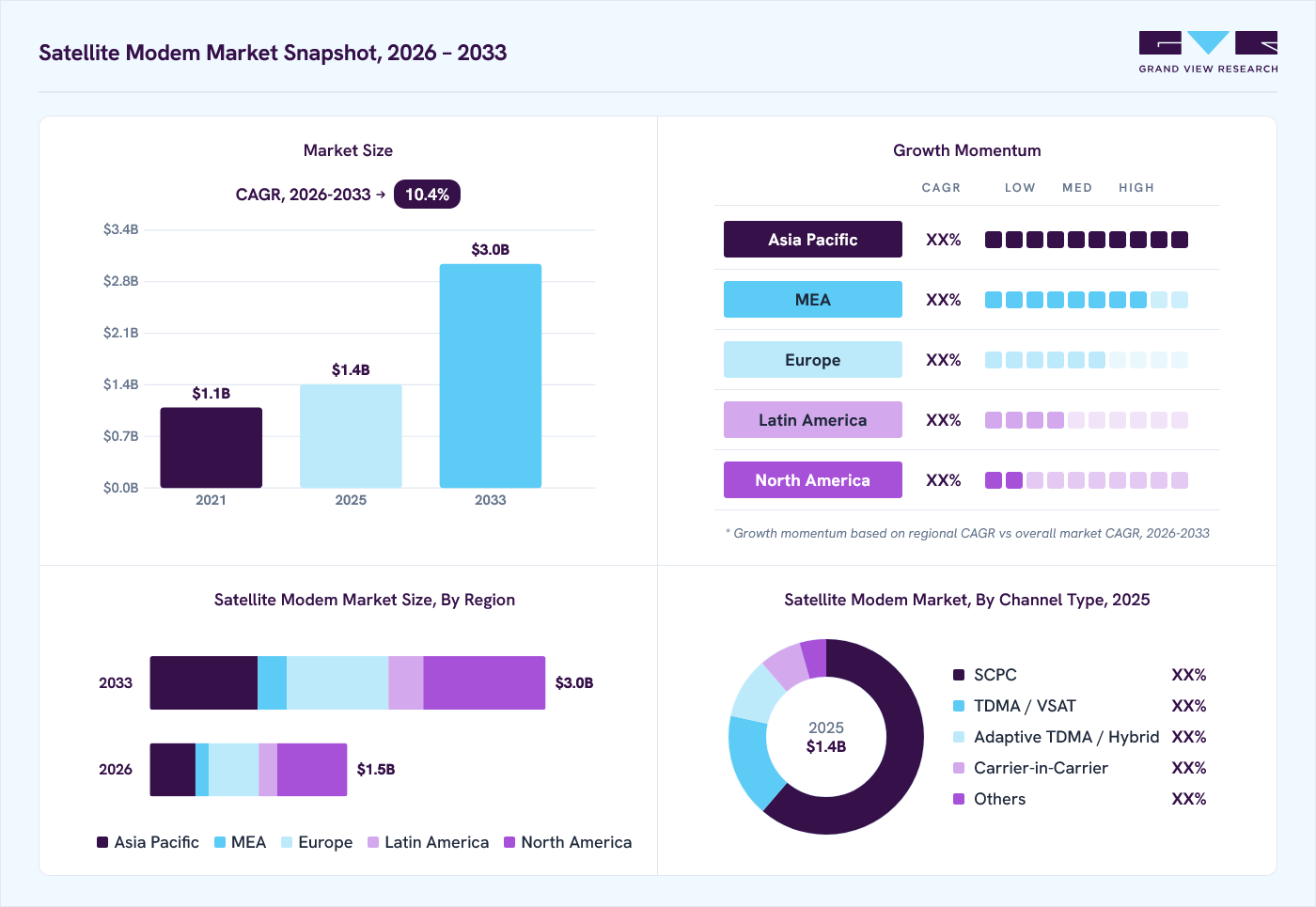
The global satellite modem market size was valued at USD 1.4 billion in 2025 and is projected to grow from USD 1.5 billion in 2026 to USD 3.0 billion by 2033, at a CAGR of 10.4% from 2026 to 2033. North America dominated the market, accounting for the largest revenue share of 36.2% in 2025. The growing demand for high-speed and reliable connectivity is driving the adoption of satellite modems across commercial, government, defense, and mobility applications.
Key Market Trends & Insights
- By channel type: The SCPC segment led the market and accounted for 61.2% of the global revenue in 2025.
- By frequency band: The Ku-band segment led the market and accounted for 43.1% of the global revenue in 2025.
- By application: The government & defense segment accounted for the largest market revenue share in 2025.
Regional Highlights
- Largest regional market: North America (36.2% revenue share, 2025)
- Fastest-growing regional market: Asia Pacific (highest CAGR, 2026-2033)
- By country: The U.S. held the largest market share in 2025.
Market Size & Forecast
- Market size in 2025: USD 1.4 Billion
- Estimated market size in 2026: USD 1.5 Billion
- Projected market size by 2033: USD 3.0 Billion
- CAGR (2026-2033): 10.4%
The growing adoption of TDMA/VSAT (Time Division Multiple Access/Very Small Aperture Terminal) is driving market growth. These solutions enable reliable connectivity in remote areas where terrestrial networks are limited or unavailable. TDMA allows multiple users to share satellite capacity efficiently. This makes VSAT suitable for enterprise networks, cellular backhaul, maritime, government, and remote industrial applications. Increasing demand for dependable connectivity is further driving the adoption of TDMA/VSAT solutions.The integration of 5G Non-Terrestrial Network (NTN) technology is enhancing satellite modem capabilities by enabling satellite networks to communicate with conventional 5G systems. This allows satellite modems to support connectivity in remote and underserved areas where terrestrial mobile networks are limited or unavailable. 5G NTN also enables more seamless communication between satellites, mobile networks, and connected devices, enhancing network coverage and flexibility. The technology is particularly useful for applications such as broadband, cellular backhaul, transportation, maritime communication, and emergency connectivity. As 5G NTN adoption expands, satellite modems are becoming increasingly capable of supporting integrated, high-capacity communication networks.
The regulatory framework is expanding access to spectrum for satellite communication terminals used in aviation and maritime applications to support growing connectivity requirements. It enables the use of additional Ku-band and Ka-band frequencies for Earth Stations in Motion (ESIMs), improving the capacity and reliability of satellite-based communication services. The framework also establishes technical conditions, including transmission power limits and minimum separation distances, to minimize interference with existing terrestrial and satellite networks. In addition, relevant licensing conditions are being updated to facilitate the deployment of ESIMs across aircraft and vessels. These regulatory developments are expected to support the wider adoption of high-capacity satellite connectivity for broadband, backhaul, and other mobility-focused applications.
The high cost of satellite modem equipment, antennas, and related network infrastructure can limit adoption among cost-sensitive users. Installation often requires specialized equipment, professional setup, and ongoing maintenance, which increases the investment. These costs can make satellite connectivity less attractive compared with terrestrial broadband solutions in areas where fiber or mobile networks are readily available. As a result, the initial investment and operating expenses can restrict the adoption of satellite modems among smaller businesses and users.
Market Dynamics
The market is being driven by increasing demand for reliable connectivity across remote, mobile, and mission-critical environments. The expansion of high-throughput satellites, LEO and MEO constellations, and software-defined satellite networks is increasing the need for flexible and high-performance modem platforms. Integration with 4G/5G networks, cloud infrastructure, and edge computing is further broadening applications across government, cellular backhaul, enterprise, maritime, and aeronautical communications. At the same time, high equipment costs, spectrum constraints, and interoperability requirements remain important adoption challenges. Moreover, the market is shifting toward software-defined, multi-band, multi-orbit, and intelligent satellite modem solutions.
Many remote and geographically dispersed locations continue to face limited access to terrestrial broadband infrastructure because fiber and cellular networks require significant investment and extensive deployment time. This challenge is particularly relevant for rural areas, offshore facilities, remote industrial locations, transportation networks, and emergency communication requirements. Satellite connectivity can cover large geographical areas without requiring extensive terrestrial infrastructure, creating sustained demand for satellite modem equipment. Growing demand for broadband connectivity, cellular backhaul, enterprise networking, and government communications is therefore driving market expansion.
Satellite modems enable communication between satellite terminals, gateways, and networks by performing modulation, demodulation, error correction, traffic management, and protocol processing. Advanced modem platforms increasingly support higher data rates, adaptive coding and modulation, improved bandwidth utilization, and flexible network configurations. These capabilities allow satellite operators and users to provide stable connectivity in locations where terrestrial infrastructure is unavailable or economically difficult to deploy. As remote connectivity requirements expand, demand for satellite modem equipment is expected to increase through commercial and institutional applications.
Satellite modem deployment can require considerable upfront investment because modems typically operate within a broader satellite communication infrastructure. Users may need antennas, RF equipment, amplifiers, network management systems, installation services, satellite capacity, and technical integration, in addition to the modem itself. Additional engineering may be required to configure frequency bands, waveforms, security requirements, and network architecture. These requirements can increase the overall cost of ownership and delay adoption among smaller enterprises and price-sensitive users.
The impact is particularly significant in applications where traffic requirements are relatively low or terrestrial connectivity is already available at competitive prices. Organizations must also consider recurring satellite capacity costs, maintenance, spectrum requirements, and equipment upgrades. Complex integration requirements can extend procurement cycles for government, defense, maritime, and aeronautical deployments. As a result, customers increasingly prefer integrated, multifunctional modem platforms that reduce infrastructure complexity and improve long-term cost efficiency.
The expansion of GEO, MEO, and LEO satellite networks is creating significant opportunities for modem manufacturers to develop platforms that support multiple satellite architectures. Conventional modem systems were often designed for specific satellite networks, frequency bands, and waveforms. However, emerging multi-orbit networks require greater flexibility in managing connectivity conditions, switching between networks, and optimizing available bandwidth. Software-defined modem architectures can address this requirement by enabling functionality and waveforms to be modified via software rather than requiring a complete hardware replacement.
The adoption of multi-orbit connectivity is increasing demand for intelligent features such as automated beam switching, adaptive coding and modulation, dynamic traffic management, and network orchestration. This creates opportunities for vendors with strong software development, waveform technology, and multi-band capabilities. Vendors offering flexible modem platforms can serve government, defense, maritime, aeronautical, enterprise, and cellular backhaul applications. The transition toward software-defined and multi-orbit satellite networks is therefore expected to create new revenue opportunities for advanced modem manufacturers.
Market Concentration & Characteristics
The satellite modem industry is moderately consolidated, with a group of established players holding strong positions while several specialized and regional companies compete across specific applications and technologies. Leading vendors have established capabilities in modem design, satellite networking, high-throughput communication, and software-defined solutions, creating relatively high barriers to entry for new participants. At the same time, the market is not fully concentrated, as smaller providers can compete by offering specialized products for defense, maritime, enterprise, broadcast, and remote connectivity applications. This competitive structure results in strong competition around product performance, bandwidth efficiency, interoperability, reliability, and application-specific capabilities.
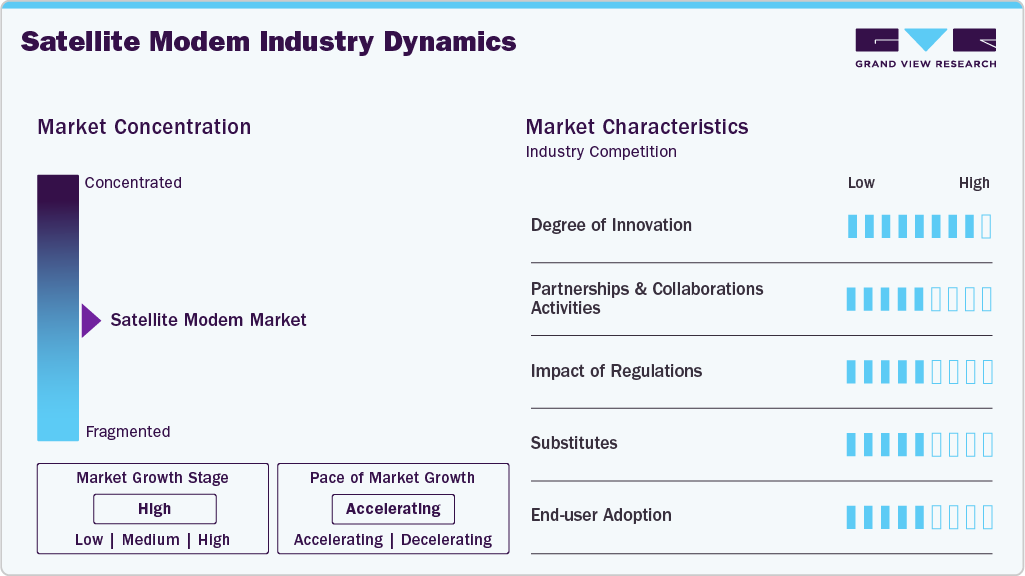
The market characteristics indicate a high degree of innovation, supported by the shift toward software-defined, high-throughput, multi-orbit, and flexible modem architectures. Partnerships and collaborations remain important as vendors seek to integrate modem technologies with satellite operators, network platforms, and next-generation communication systems. The impact of regulations is moderate to high, as spectrum allocation, licensing, interoperability, and equipment requirements influence product development and deployment. Substitutes have a moderate impact because terrestrial fiber and wireless networks can replace satellite connectivity in areas with strong infrastructure, but they are less suitable for remote, maritime, aeronautical, and other difficult-to-reach locations. Moreover, end-user adoption is increasing as organizations require reliable connectivity across remote locations, supporting an accelerating market environment.
Analyst Perspective
The market is transitioning from conventional fixed-function equipment toward flexible, software-defined, high-throughput, and multi-orbit platforms. Growth is supported by increasing demand for reliable connectivity across cellular backhaul, government and defense, enterprise, maritime, aeronautical, and remote infrastructure applications. Adaptive waveforms, multi-band operation, intelligent beam switching, network virtualization, and improved bandwidth efficiency are becoming important technology priorities. Future investments are expected to focus on modem platforms capable of supporting multiple satellite architectures and changing network requirements. Competitive positioning is increasingly influenced by software capabilities, interoperability, cybersecurity, and the ability to integrate modem technology into broader satellite ground infrastructure.
Channel Type Insights
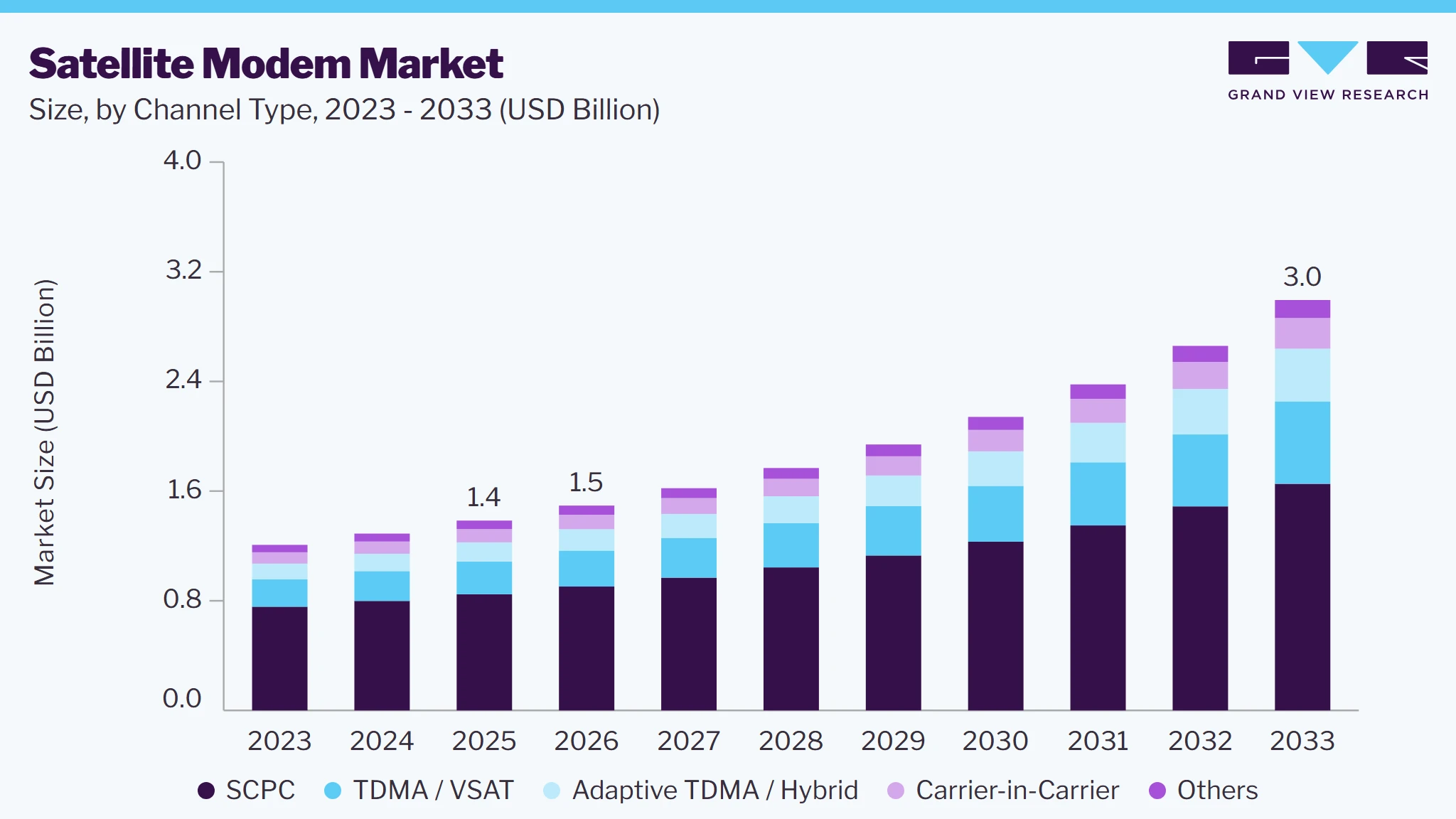
The SCPC segment accounted for 61.2%, the largest share of global revenue in 2025. This segment dominance in the market is due to its reliable point-to-point connectivity and consistent bandwidth allocation. It is widely used in applications requiring continuous, dedicated communication links, including government, defense, enterprise, and backhaul networks. Its established infrastructure and predictable performance continue to support strong adoption.
The Adaptive TDMA / hybrid segment is projected to grow at the fastest CAGR over the forecast period. Adaptive TDMA and hybrid solutions are expected to see rapid growth as satellite networks increasingly require flexible, efficient bandwidth utilization. These technologies enable dynamic sharing of capacity across users and support changing traffic requirements. The growing adoption of multi-orbit and integrated satellite networks is further increasing the demand for flexible modem architecture.
Frequency Band Insights
The Ku-band segment accounted for the largest share of global revenue in 2025. The segment growth can be attributed to its established use across commercial and government satellite communication networks. It supports applications such as broadband connectivity, backhaul, broadcasting, and military communications. Existing satellite infrastructure and widespread terminal deployment continue to strengthen its market position.
The Ka-band segment is projected to grow at the fastest CAGR over the forecast period. Ka-band is expected to see the fastest growth as demand for high-capacity, high-throughput satellite connectivity increases. The technology is increasingly used for tactical communications, broadband services, and next-generation satellite networks. Government and defense modernization programs are also supporting Ka-band adoption for high-capacity communications and data-intensive applications.
Application Insights
Government and defense accounted for the largest share of global revenue in 2025. The growing need for secure, resilient, and high-capacity satellite communications is accelerating growth in the segment. Defense organizations use satellite modems to support command and control, intelligence, surveillance, logistics, video, and battlefield communications. Increasing investment in resilient and interoperable SATCOM infrastructure is further supporting demand from this segment.
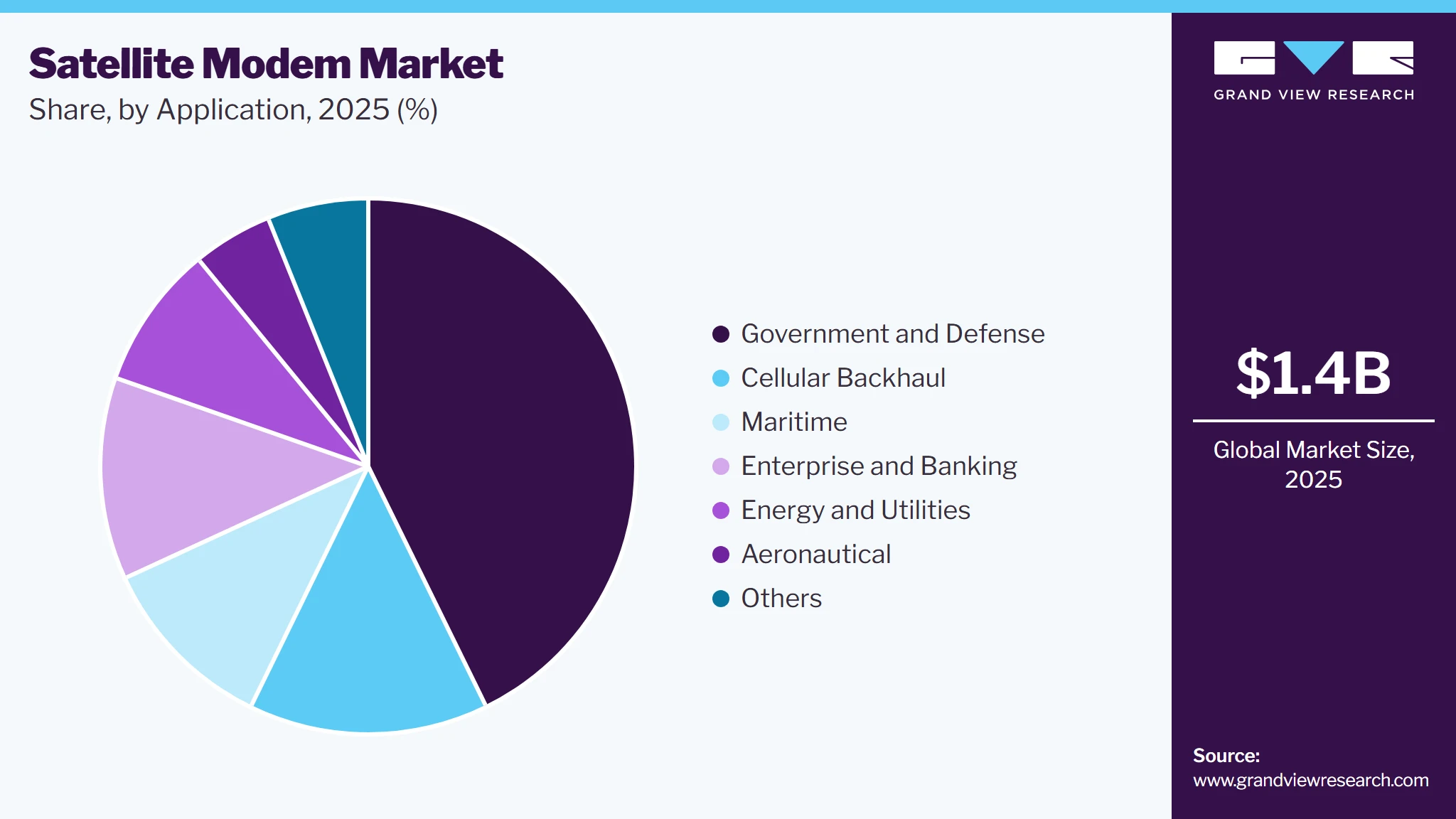
Cellular Backhaul is projected to grow at the fastest CAGR over the forecast period. The cellular backhaul segment is expected to grow rapidly as demand for reliable connectivity across remote and underserved cellular sites increases. Satellite modems enable cellular operators to connect base stations with core networks in areas where fiber, microwave, or other terrestrial backhaul infrastructure is unavailable or costly to deploy. The expansion of 4G and 5G networks, particularly in rural and geographically challenging locations, is creating additional demand for satellite-based backhaul solutions. The deployment of high-throughput and multi-orbit satellite networks is further creating opportunities for advanced satellite modem solutions with higher capacity and lower latency.
Regional Insights
North America satellite modem market led the global market, accounting for 36.2% of global revenue in 2025, driven by extensive use of satellite connectivity across broadband, defense, enterprise communications, cellular backhaul, and remote infrastructure. The region benefits from advanced satellite networks and the increasing deployment of high-throughput, low-latency satellite systems. These developments are creating demand for satellite modems capable of supporting higher data rates, flexible network configurations, and reliable connectivity across remote and mobile environments.

U.S. Satellite Modem Market Trends
The satellite modem market in the U.S. held the largest market share in 2025, supported by strong demand for satellite broadband, government communications, defense applications, and connectivity in underserved areas. Satellite systems provide voice, video, audio, and data services, creating demand for advanced ground equipment and modem technologies. The expansion of next-generation GSO and NGSO satellite networks is further driving demand for high-capacity, low-latency satellite modems.
Asia Pacific Satellite Modem Market Trends
The satellite modem market in the Asia Pacific is projected to grow at the fastest CAGR over the forecast period. The region has a large geographic area, remote communities, expanding digital infrastructure, and a growing demand for broadband connectivity. Satellite communication is particularly valuable in areas where terrestrial networks are difficult to deploy, supporting applications across telecommunications, government, maritime, energy, and enterprise sectors. Increasing investment in satellite broadband and integrated space-ground communication networks is creating opportunities for higher-performance satellite modem solutions.
China satellite modem marketheld a dominant share in the Asia Pacific market. China is developing its satellite communication capabilities to support broadband, fixed, and mobile communications, broadcasting, and integrated space-ground networks. The country's focus on expanding satellite communication services and low-Earth-orbit satellite internet is creating opportunities for satellite modems used in broadband and other data communication applications. Growing integration between satellite and terrestrial networks is expected to increase demand for modem technologies that support high-speed, flexible connectivity.
The satellite modem market in Japanis expected to grow at a significant CAGR over the forecast period. Japan represents a potential growth market for satellite modems due to its demand for resilient communication infrastructure, particularly across geographically dispersed and disaster-prone areas. Satellite connectivity can complement terrestrial networks by providing communication services when conventional infrastructure is unavailable or disrupted. Demand from government, telecommunications, maritime, enterprise, and emergency communications applications is driving the need for reliable, high-performance satellite modem solutions.
Europe Satellite Modem Market Trends
The satellite modem market in Europe held a significant market share. Europe is experiencing increasing demand for satellite modems as satellite connectivity becomes an important component of broadband, government communications, transportation, and remote connectivity infrastructure. The region is focusing on integrating satellite networks with terrestrial communication systems to improve coverage and network resilience. Growing requirements for secure, high-capacity satellite communications are driving demand for advanced modem technologies across commercial and government applications.
The UK satellite modem marketis supported by growing demand for satellite broadband and connectivity across rural, maritime, aviation, emergency-service, and enterprise applications. Regulatory initiatives that expand spectrum access and enable NGSO satellite systems are creating opportunities for higher-capacity satellite connectivity. The increasing availability of satellite broadband services is expected to drive demand for modems capable of delivering high-speed, low-latency communication.
The satellite modem market in Germanyheld the largest share in Europe, due to the growing use of satellite communications for broadband, data communication, IoT, maritime, aeronautical, and government applications. The country is also strengthening secure satellite communication infrastructure, supporting demand for reliable ground communication equipment and advanced satellite modems. The development of secure satellite communication infrastructure is expected to further support applications requiring resilient connectivity when terrestrial communication networks are unavailable.
Key Satellite Modem Company Insights
Key players operating in the satellite modem include Comtech Telecommunications Corp., DATUM SYSTEMS, Gilat Satellite Networks, Hughes Network Systems, LLC, an EchoStar company. ORBCOMM, NOVELSAT, ST Engineering, Viasat, Inc., WORK Microwave GmbH, and Intellian Technologies, Inc. are key players in the market, focusing on software-defined modems, multi-orbit connectivity, high-throughput satellite systems, adaptive waveforms, and multi-band technologies to strengthen market share and address evolving satellite connectivity requirements.
-
Comtech Telecommunications Corp. is a global communications technology company. It develops mission-critical solutions for government, defense, public safety, commercial, and infrastructure customers. Its Satellite Modems portfolio enables reliable and efficient satellite connectivity. These modems support mobile networks, backhaul, government communications, enterprise connectivity, and mobility applications.
-
DATUM SYSTEMS develops satellite and troposcatter communication modems. Its solutions support different satellite networks and communication systems. The company serves applications across cellular backhaul, oil and gas, maritime, aeronautical, emergency response, government, defense, and enterprise sectors.
Key Satellite Modem Companies
The following key companies have been profiled for this study on the satellite modem market:
-
Comtech Telecommunications Corp.
-
DATUM SYSTEMS
-
Gilat Satellite Networks.
-
Hughes Network Systems, LLC, an EchoStar company.
-
ORBCOMM.
-
NOVELSAT
-
ST Engineering
-
Viasat, Inc.
-
WORK Microwave GmbH
-
Intellian Technologies, Inc.
Competitive Benchmarking
Operating Strategies
Competitive Edge
Weaknesses
Mature Players: Comtech Telecommunications Corp., Gilat Satellite Networks, Hughes Network Systems, LLC, an EchoStar company, Viasat, Inc.
- Mature players in the market operate with broad satellite communication portfolios that cover modem technology, satellite networking, broadband connectivity, government communications, mobility, and enterprise applications.
- Their strategies emphasize development of advanced modem platforms, integration with satellite ground infrastructure, and long-term relationships with operators, governments, enterprises, and communication service providers.
- Mature players gain a competitive advantage through strong market presence, broad product portfolios, established customer relationships, extensive engineering capabilities, and experience with large-scale satellite deployments.
- Their ability to combine modem hardware with network management, satellite infrastructure, software, and connectivity services strengthens their overall market position.
- These companies face challenges related to broad portfolios can result in higher development and integration complexity.
- Established suppliers also need to maintain compatibility with legacy satellite networks while transitioning customers toward software-defined, multi-orbit, and next-generation architectures.
Emerging Players: NOVELSAT, WORK Microwave GmbH, ST Engineering
- Emerging players in the satellite modem are focus on specialized satellite communication technologies and application-specific modem and ground-segment solutions.
- Their strategies emphasize high-performance equipment, customization, specialized connectivity requirements, professional satellite networks, government applications, mobility, and advanced ground infrastructure.
- Emerging players gain market traction through specialized engineering capabilities allow them to address demanding professional, enterprise, government, broadcast, mobility, and satellite ground-segment requirements.
- Their more focused portfolios can also support faster customization and specialized deployments where highly configurable modem technology is required.
- Emerging players face limitations due to their competitive reach is more focused on specialized satellite communication requirements and selected end-use applications.
- This narrower market coverage can reduce their ability to compete across large-scale, diversified satellite communication deployments.
Recent Developments
-
In May 2026, YTTEK Technology launched its HyperSDR all-in-one satellite modem at SatelliteAsia 2026. The software-defined modem supports X- and Ku-band frequencies and combines RF and modem functions on a single platform. The technology has been validated through satellite data reception from FORMOSAT-5, Landsat-8, and Landsat-9. The company is also developing an X- and Ku-band SDR payload for LEO satellites.
-
In September 2025, Comtech Telecommunications Corp. announced that its SLM-5650B software-defined satellite modem became the first sovereign-certified modem to receive Government Terminal Certification to operate on SES’s O3b mPOWER MEO satellite constellation. The modem provides high-throughput and low-latency hybrid communications for U.S. Department of Defense and coalition customers. It supports defense waveforms such as STANAG 4486 Ed3, DSSS, and DVB-S2X, while allowing additional waveforms to be added for future mission requirements.
Satellite Modem Market Report Scope
Report Attribute
Details
Market size in 2025
USD 1.4 billion
Estimated market size in 2026
USD 1.5 billion
Projected market size by 2033
USD 3.0 billion
Growth rate
CAGR of 10.4% from 2026 to 2033
Historical data
2021 - 2025
Forecast period
2026 - 2033
Quantitative units
Revenue in USD billion, and CAGR from 2026 to 2033
Report coverage
Revenue forecast, company ranking, competitive landscape, growth factors, and trends
Segments covered
Channel type, frequency band, application, region
Regional scope
North America; Europe; Asia Pacific; Latin America; MEA
Country scope
U.S.; Canada; Mexico; Germany; UK; France; China; Japan; India; South Korea; Australia; Brazil; Saudi Arabia; UAE; South Africa
Key companies profiled
Comtech Telecommunications Corp.; DATUM SYSTEMS; Gilat Satellite Networks; Hughes Network Systems, LLC, an EchoStar company; ORBCOMM; NOVELSAT; ST Engineering; Viasat, Inc.; WORK Microwave GmbH; Intellian Technologies, Inc.
Customization scope
Free report customization (equivalent up to 8 analysts working days) with purchase. Addition or alteration to country, regional & segment scope.
Pricing and purchase options
Avail customized purchase options to meet your exact research needs. Explore purchase options
Global Satellite Modem Market Report Segmentation
The report forecasts revenue growth at global, regional, and country levels and provides an analysis of the latest industry trends in each of the sub-segments from 2021 to 2033. For this study, Grand View Research has segmented the global satellite modem market report based on channel type, frequency band, application, and region:
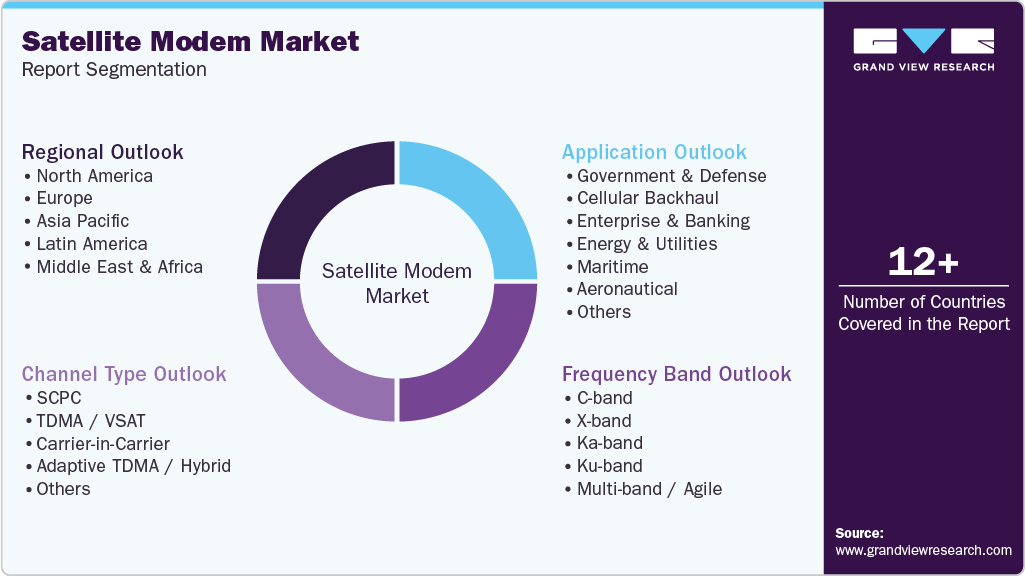
-
Channel Type Outlook (Revenue, USD Billion, 2021 - 2033)
-
SCPC
-
TDMA / VSAT
-
Carrier-in-Carrier
-
Adaptive TDMA / Hybrid
-
Others
-
-
Frequency Band Outlook (Revenue, USD Billion, 2021 - 2033)
-
C-band
-
X-band
-
Ka-band
-
Ku-band
-
Multi-band / Agile
-
-
Application Outlook (Revenue, USD Billion, 2021 - 2033)
-
Government and Defense
-
Cellular Backhaul
-
Enterprise and Banking
-
Energy and Utilities
-
Maritime
-
Aeronautical
-
Others
-
-
Regional Outlook (Revenue, USD Billion, 2021 - 2033)
-
North America
-
U.S.
-
Canada
-
Mexico
-
-
Europe
-
Germany
-
UK
-
France
-
-
Asia Pacific
-
China
-
India
-
Japan
-
South Korea
-
Australia
-
-
Latin America
-
Brazil
-
-
Middle East & Africa (MEA)
-
UAE
-
Saudi Arabia
-
South Africa
-
-
Research Methodology
The satellite modem market figures in this report are based on a proven research process that combines executive interviews with secondary research from proprietary databases, company filings, and recognized regulatory and institutional sources. Market size is built through value-chain sizing-reconciling supply-side and demand-side estimates-and triangulated with bottom-up and top-down approaches. Every estimate passes multiple levels of expert validation before publication, with each satellite modem segment quantified using the revenue-capture definitions in the table below.
Segment Definition
Segment - Channel Type
Revenue capture definition
SCPC
The segment revenue is generated from satellite modem hardware, embedded software, licenses, and associated support solutions used for dedicated single-carrier satellite links. Revenue includes equipment deployed for point-to-point and dedicated high-availability connectivity.
TDMA / VSAT
The segment revenue is generated from VSAT modem hardware, TDMA-capable modem platforms, network licenses, software, and related management or support services used in shared satellite access networks.
Carrier-in-Carrier
The segment revenue is generated from modem hardware, waveform software, licenses, and processing capabilities that allow multiple carriers to share satellite transponder capacity through carrier-in-carrier technology.
Adaptive TDMA / Hybrid
The segment revenue is generated from modem platforms supporting adaptive TDMA, hybrid TDMA/SCPC, and dynamically configurable access methods, including hardware, software-defined waveforms, licenses, and technical support.
Others
The segment revenue is generated from satellite modem products, software, and related services supporting proprietary, specialized, or mixed channel architecture outside the major channel categories.
Segment - Frequency Band
Revenue capture definition
C-band
The segment revenue is generated from C-band-compatible satellite modems, waveform software, licenses, and related solutions used for professional, government, enterprise, and communication applications.
X-band
The segment revenue is generated from X-band satellite modem hardware, waveform software, secure communication capabilities, and related support solutions used primarily for mission-critical and government applications.
Ka-band
The segment revenue is generated from Ka-band satellite modem hardware, software-defined waveforms, licenses, and networking capabilities supporting high-throughput satellite connectivity.
Ku-band
The segment revenue is generated from Ku-band satellite modem hardware, waveform licenses, networking capabilities, and support solutions used across VSAT, mobility, broadcast, enterprise, and government applications.
Multi-band / Agile
The segment revenue is generated from software-defined or multi-band modem platforms capable of operating across multiple satellite frequency bands, including waveform licenses, configuration software, and technical support.
Segment - Application
Revenue capture definition
Government and Defense
The segment revenue is generated from ruggedized and secure satellite modems, waveform licenses, encryption-enabled capabilities, and related support solutions supplied for government, military, intelligence, tactical, and mission-critical communications.
Cellular Backhaul
The segment revenue is generated from satellite modems, acceleration software, network-management capabilities, and related equipment used to transport mobile network traffic between remote cellular sites and core networks.
Enterprise and Banking
The segment revenue is generated from satellite modem hardware, network software, security capabilities, and support services deployed for enterprise branches, financial institutions, corporate networks, and business continuity applications.
Energy and Utilities
The segment's revenue is generated from satellite modems and related networking solutions that connect remote energy, utility, pipeline, mining, and infrastructure assets to centralized operations.
Maritime
The segment revenue is generated from satellite modem hardware, mobility waveforms, network-management capabilities, and associated support solutions installed on commercial, offshore, defense, and other maritime platforms.
Aeronautical
The segment revenue is generated from airborne satellite modems, aviation-oriented equipment, mobility waveforms, software licenses, and related connectivity-management solutions deployed on aircraft.
Others
The segment revenue is generated from satellite modem equipment, software, and support solutions used for applications outside government, cellular, enterprise, energy, maritime, aeronautical, and broadcast applications.
Estimation Model
Layer Name
Key Question
Description
Market Scope and Segmentation
What constitutes the Satellite Modem Market?
The market includes satellite modem hardware, modem platforms, embedded software, and relevant modem licenses. The market is segmented by channel type, frequency band, and application. Products such as standalone antennas, amplifiers, and satellite capacity are excluded unless modem functionality is included. This layer establishes the overall market boundary.
Bottom-Up Revenue Estimation
How much revenue is generated by satellite modem suppliers?
Revenue is estimated by evaluating satellite modem portfolios and assessing product sales across different applications and frequency bands. Company product portfolios, deployment activities, product launches, and pricing assumptions are considered. Supplier-level revenues are aggregated to determine the overall market size.
Top-Down Market Validation
Does the estimated market align with broader SATCOM demand?
The estimate is validated against satellite communication infrastructure deployment, VSAT expansion, broadband requirements, cellular backhaul demand, and government SATCOM programs. Growth in high-throughput satellite and multi-orbit networks is also considered. Regional connectivity requirements are assessed to identify markets with stronger modem deployment potential.
Triangulation and Forecasting
What is the most defensible market size and future growth trajectory?
Bottom-up supplier estimates are compared with top-down market indicators to develop the final market estimate. Historical adoption, technology development, multi-orbit deployment, and application-level demand are incorporated into the forecast. Scenario analysis is used to account for variations in satellite deployment, modem pricing, and technology adoption. The final forecast represents the expected development of the Satellite Modem Market.
Delivered Customization
We have successfully delivered the following deep-dive customizations:
Client Request
Customization Delivered
Value Adds
Regional Satellite Modem Market Opportunity Assessment
Country/region-wise market sizing and forecasts
Analysis of demand, adoption trends, and regulatory landscape
Identification of high-growth regions and investment hotspots
Identified region-specific growth opportunities
Supported expansion and go-to-market strategy
Enabled informed regional investment decisions
Cross-Segmentation Analysis for the Satellite Modem Market
Criss-cross market analysis by channel type, frequency band, application
Demand and adoption assessment across key segments
Segment attractiveness and growth potential benchmarking
Identified high-potential market segments
Supported targeted frequency band positioning and marketing strategy
Improved customer and segment prioritization
Competitive Benchmarking and Strategic Positioning in the Satellite Modem Market
Benchmarking of key competitors across frequency bands, pricing, partnerships, and innovation
Comparative assessment of market share, capabilities, and strategies
Analysis of competitive strengths, gaps, and differentiation areas
Identified competitive white spaces and growth gaps
Supported strategic positioning and differentiation
Enabled data-driven competitive strategy development
Frequently Asked Questions About This Report
The SCPC segment accounted for 61.2%, the largest share of global revenue in 2025. This segment dominance in the satellite modem market due to its reliable point-to-point connectivity and consistent bandwidth allocation.
The global satellite modem market size was valued at USD 1.4 billion in 2025 and is estimated at USD 1.5 billion in 2026.
The global satellite modem market is expected to grow at a compound annual growth rate of 10.4% from 2026 to 2033, reaching USD 3.0 billion by 2033.
North America Satellite Modem led the global market and accounted for 36.2% of the global revenue in 2025, due to the extensive use of satellite connectivity across broadband, defense, enterprise communications, cellular backhaul, and remote infrastructure.
The growing demand for high-speed and reliable connectivity is driving the adoption of satellite modems across commercial, government, defense, and mobility applications.
Some key players operating in the satellite modem market include Comtech Telecommunications Corp., DATUM SYSTEMS, Gilat Satellite Networks., Hughes Network Systems, LLC, an EchoStar company., ORBCOMM., NOVELSAT, ST Engineering, Viasat, Inc., WORK Microwave GmbH, Intellian Technologies, Inc.
Ku-band segment accounted for the largest share of global revenue in 2025 while ka-band segment is projected to grow at the fastest CAGR over the forecast period.
The government and defense accounted for the largest share of global revenue in 2025, while cellular backhaul is projected to grow at the fastest CAGR over the forecast period.
U.S. held the largest market share in 2025.
About the Author(s)
Communications Infrastructure Research Team
Technology · Communications InfrastructureThis report was authored by the communications infrastructure research team at Grand View Research - comprising two research analysts, one senior research analyst, and one industry expert - with specialized expertise in the communications infrastructure segment of the technology industry. All findings are based on proprietary technology databases, executive interviews, and regulatory analysis, subject to internal peer review prior to publication.
Last Updated:
Speak to Analyst


Customize this report to your needs — add regions, segments, or data points, with 20% free customization.
Or view our licence options:


ISO 9001:2015 & 27001:2022 Certified
We are GDPR and CCPA compliant! Your transaction & personal information is safe and secure. For more details, please read our privacy policy.


