
- Home
- »
- Pharmaceuticals
- »
-
Saudi Arabia Total Parenteral Nutrition Market Report, 2033GVR Report cover

Saudi Arabia Total Parenteral Nutrition Market (2025 - 2033) Size, Share & Trends Analysis Report By Product (Premix TPN Bags Used By Hospitals For Internal Compounding), By Packaging Volume (>1L, 250ml), By Customer, By End Use, By Region (Central, Western), And Segment Forecasts
Saudi Arabia Total Parenteral Nutrition Market Summary
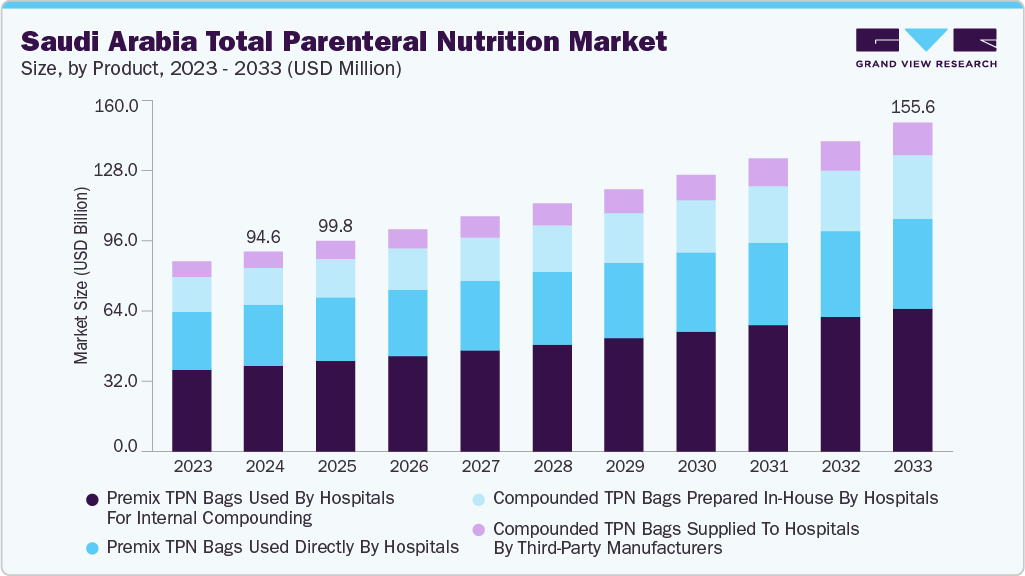
The Saudi Arabia total parenteral nutrition market size was valued at USD 94.64 million in 2024 and is projected to USD 155.64 million by 2033, growing at a CAGR of 5.71% from 2025 to 2033. The rising prevalence of chronic diseases and the increasing number of premature births are significant factors contributing to market growth. In addition, growing healthcare infrastructure and health system reforms are some other factors fueling market growth further.
The growing prevalence of chronic and lifestyle diseases in Saudi Arabia is a key driver of the Total Parenteral Nutrition (TPN) market. According to a systematic review published in the Saudi Pharmaceutical Journal in November 2024, titled "A Systematic Review of Obesity Burden in Saudi Arabia: Prevalence and Associated Co-Morbidities," the prevalence of obesity among adults and adolescents in Saudi Arabia ranges from 20% to 39%, respectively. The study also highlights the most common obesity-related complications (ORCs), with hypertension affecting 67.6%, type 2 diabetes impacting 60.7%, and hypercholesterolaemia observed in 51.3% of the population.
 Source: Grand View Research, IR Documents, Primary Interviews, Paid DatabasesTo learn more about this report,
 Download Free Sample Report
In addition, the Ministry of Health and the Gulf Health Council state that the four primary non-communicable diseases, such as cancer, cardiovascular diseases, diabetes, and chronic respiratory diseases, cause around 22,000 deaths in the country, accounting for 35% of the total deaths in the country. Furthermore, the incidence of cancer is also rising, with 28,113 new cases reported in 2022, further highlighting the pressing healthcare challenges facing Saudi Arabia. Thus, the clinical significance of these trends is reflected in rapidly escalating demand for advanced inpatient, outpatient, and home-based nutritional therapies.
Furthermore, the rising number of premature births is a key factor contributing to the growth of the Saudi Arabia total parenteral nutrition (TPN) market due to the specialized medical care required for preterm infants. In Saudi Arabia, premature birth remains a significant public health issue, contributing to neonatal morbidity and placing a strain on healthcare resources. A research article published in the PubMed Central Journal in November 2024 reported a pooled preterm birth prevalence of 7.89 per 100 live births for single pregnancies in the Saudi population. Alarmingly, this rate rises to 91.3 per 100 live births for multiple pregnancies. These statistics, derived from a thorough review of electronic medical records in major cities such as Riyadh, Al-Khobar, Abha, and Jeddah, underscore the substantial burden that preterm birth places on the national healthcare system.
Moreover, the expansion of healthcare infrastructure and ongoing health system reforms are core drivers of the Total Parenteral Nutrition (TPN) market in Saudi Arabia. As part of the Vision 2030 initiative, the Kingdom is undertaking a comprehensive modernization strategy aimed at expanding hospital networks, critical care units, and specialized nutrition centers to meet the evolving needs of its population. The government is placing increasing emphasis on enhancing healthcare facilities to accommodate this growth.
According to the General Authority for Statistics, in 2023, the total number of hospitals in Saudi Arabia was 499, with 23.8 hospital beds per 10,000 people. This rapid expansion of infrastructure supports the broader adoption of TPN by facilitating advanced pharmacy compounding, establishing dedicated clinical nutrition departments, and enabling seamless integration between inpatient and outpatient services.
Market Concentration & Characteristics
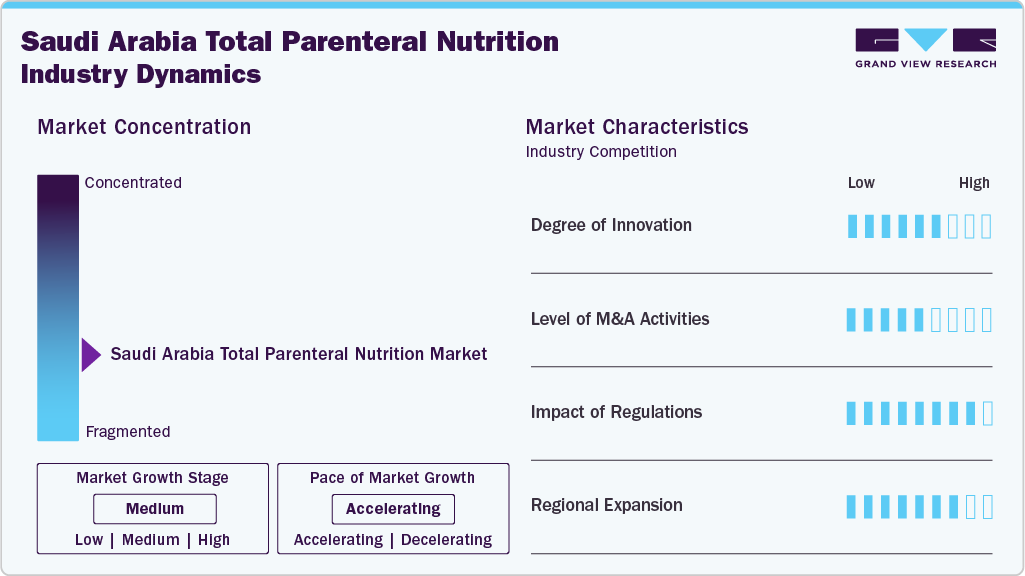
The chart below illustrates the relationship between industry concentration, industry characteristics, and industry participants. The x-axis represents the level of industry concentration, ranging from low to high. The y-axis represents various industry characteristics, including industry competition, level of partnerships & collaboration activities, degree of innovation, impact of regulations, and regional expansion. The Saudi Arabia total parenteral nutrition market is fragmented. The degree of innovation and the level of merger & acquisition activities is moderate. Moreover, the impact of regulations and the regional expansion of industry is high.
Saudi Arabia total parenteral nutrition market is characterized by a moderate degree of innovation, with companies launching new, sophisticated compounding devices. For instance, in May 2025, MediServ, in partnership with B. Braun Melsungen AG and B. Braun Al Arabia, launched the APEX TPN Compounding System in Riyadh. This system automates parenteral nutrition workflows, integrating with EasyComp software for validated, sterile, and precise TPN compounding.
 To learn more about this report, Download Free Sample Report
The industry is experiencing a moderate level of merger and acquisition activities undertaken by several key players. This is due to the desire to gain a competitive advantage in the industry, enhance technological capabilities, and consolidate in a rapidly growing market.
The regulatory framework governing the Saudi Arabia Total Parenteral Nutrition (TPN) market is shaped by the Saudi Food and Drug Authority (SFDA), which establishes comprehensive guidelines for registering, approving, manufacturing, and importing parenteral nutrition products. The SFDA requires all TPN formulations-multi-chamber bags, compounded admixtures, and raw input ingredients-to meet stringent quality standards, including compliance with international pharmacopeias, sterility assurance, and detailed product labeling. The Ministry of Health (MOH) governs TPN procurement standards and clinical usage protocols within Saudi public healthcare facilities. MOH procurement employs centralized tendering systems that prioritize compliance with SFDA-approved product lists, competitive pricing, and supplier reliability.
The industry is witnessing high geographical expansion. Companies and healthcare providers within the Saudi Arabia total parenteral nutrition industry seek geographic expansion strategies to expand their product and service offerings.
Regional Insights
Based on region, the central region held the largest market share of 34.54% in 2024. The region’s extensive healthcare infrastructure, comprising major public and private hospitals such as King Faisal Specialist Hospital and King Khalid University Hospital, supports significant TPN demand. In addition, the rising number of childbirth-related complications drives market growth further. For instance, according to the data published in the Frontiers in Public Health Journal in September 2022, the incidence of preterm, early term, and post-term delivery was 8.4%, 29.8%, and 1.4%, respectively. Furthermore, the region’s sizeable population and concentration of specialized healthcare professionals enable the widespread implementation of multidisciplinary nutrition support teams that facilitate tailored TPN regimens.
Comparative analysis of health clusters in the Central sector of Saudi Arabia
However, the western region is anticipated to grow at the fastest CAGR over the forecast period. As a commercial and religious hub attracting millions of pilgrims annually, the region experiences substantial demand for advanced clinical nutrition services, including TPN. Healthcare infrastructure in cities like Jeddah features numerous tertiary hospitals and specialized care units, catering to a diverse patient population with complex nutritional needs. A few notable hospitals include King Faisal Specialist Hospital & Research Center, Fakeeh Care Group, National Guard Hospital, Saudi German Hospital, Sulaiman Al Habib Group, etc. Furthermore, government health initiatives, with the establishment of health clusters, drive market growth.
Product Insights
Based on product, the premix TPN bags used by hospitals for internal compounding held the largest market share of 42.79% in 2024. Saudi hospitals widely utilize Premix TPN bags for internal compounding to streamline and standardize parenteral nutrition preparation processes. Hospitals utilize these standardized premix base solutions as foundational components to prepare customized TPN formulations tailored to individual patient needs. By using premixed amino acids, dextrose, and lipid emulsions as inputs, hospital pharmacies ensure precision, sterility, and consistency during the compounding process. This approach allows clinicians to adjust nutrient concentrations according to the metabolic, age, and disease-specific requirements of patients, particularly in neonatal and oncology units.
The compounded TPN bags supplied to hospitals by third-party manufacturers segment is expected to grow at the fastest CAGR during the forecast period. This segment is gaining traction as healthcare institutions increasingly outsource TPN preparation to specialized compounding centers. These suppliers offer customized, sterile parenteral nutrition formulations tailored to hospital protocols and patient-specific nutritional requirements. Outsourcing compounding enhances hospital pharmacy efficiency by reducing the need for on-site sterile compounding facilities, thereby minimizing operational complexity, labor costs, and contamination risks.
Packaging Volume Insights
Based on packaging volume, >1L segment held the largest market share of 46.21% in 2024. The >1000 ml TPN segment in Saudi Arabia targets adult patients with high energy, protein, and fluid requirements, commonly found in intensive care, oncology, and advanced chronic disease settings. These large-volume parenteral nutrition solutions are crucial for managing prolonged critical illness, major trauma, multi-organ dysfunction, and severe malnutrition. Hospitals select >1000 ml bags for patients whose metabolic and hydration needs exceed standard TPN volumes, promoting enhanced tissue repair, immune recovery, and comprehensive nutritional support.
The 250ml segment is anticipated to grow at the fastest CAGR over the forecast period. Pharmaceutical manufacturers offer these formulations to provide a consistent balance of macro- and micronutrients, enabling a reliable transition from acute to maintenance phases of nutritional therapy. Hospitals utilize 250 ml TPN bags for post-surgical recovery, oncology patients undergoing chemotherapy, and pediatric patients requiring short-term parenteral support, leveraging their stability and dosage precision to achieve controlled metabolic outcomes.
Customer Insights
Based on the customer, the B2G segment held the largest market share of 55.20% in 2024. This segment encompasses Ministry of Health (MOH) hospitals, government hospitals, Group Purchasing Organizations (GPOs), and centralized tenders. The segment benefits from large-volume procurement contracts and multi-year tender agreements, enabling cost efficiencies and standardized supply across public healthcare entities. Government hospitals under MOH operate the largest network of facilities, driving substantial demand for TPN products through institutional tenders and GPO-managed purchasing frameworks. For instance, in July 2023, NATIONAL UNIFIED PROCUREMENT COMPANY (NUPCO), Saudi Arabia, released a tender for Securing Parenteral Nutrition Solutions and Medicines in Pharmaceuticals.
The B2B segment is projected to grow at the fastest CAGR during the forecast period. The Saudi Arabia B2B private sector for Total Parenteral Nutrition (TPN) comprises large private hospital chains and standalone specialty hospitals with distinct procurement behaviors. Large chains tend to centralize purchasing for consistency and to leverage volume discounts, often utilizing bulk contracts with regional or global suppliers. These chains invest in automated compounding technologies and maintain robust clinical nutrition programs integrating pharmacists and dietitians. Standalone specialty hospitals often implement tailored procurement strategies to meet their specific needs, which may involve multiple smaller suppliers and customized stocking.
End Use Insights
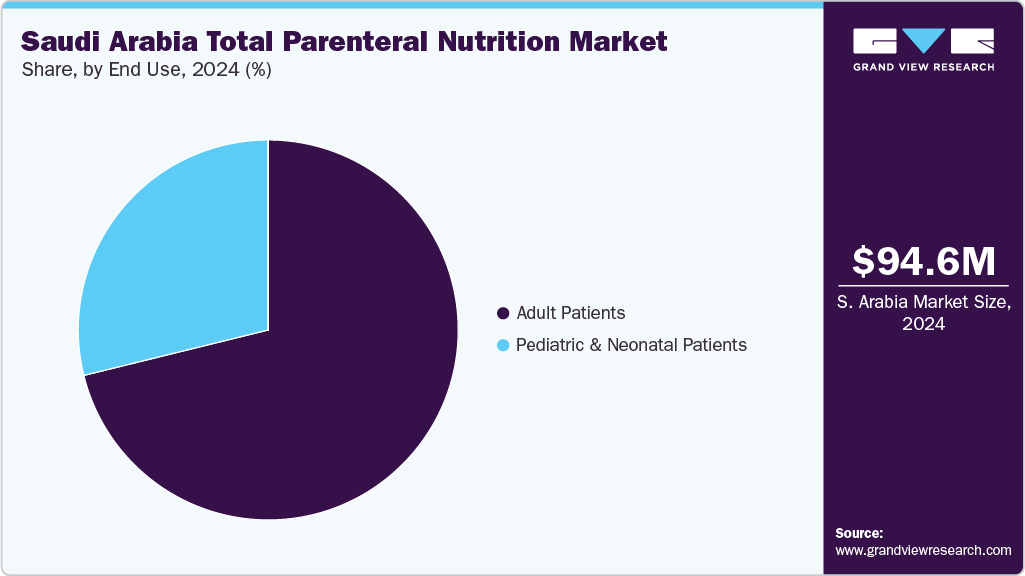
Based on end use, the adult patients segment held the largest market share of 71.16% in 2024. This growth is driven by rising prevalence of chronic illnesses, increasing rates of complex surgeries, and greater recognition of nutrition's role in critical illness recovery. Tertiary hospitals and specialized centers across Riyadh, Jeddah, Dammam, and other urban hubs routinely deliver TPN to adults suffering from gastrointestinal failures, cancer, trauma, and postoperative complications. MOH-led national protocols favor evidence-based assessment, individualized formulations, and pharmacist-led compounding to minimize risks and optimize outcomes.
 To learn more about this report, Download Free Sample Report
The pediatric & neonatal patients’ segment is anticipated to grow at the fastest CAGR from 2025 to 2033. The pediatric and neonatal segment is a dynamically growing sector driven by the rising awareness of pediatric malnutrition and increasing neonatal intensive care admissions. The government’s Vision 2030 initiative prioritizes the enhancement of pediatric critical care infrastructure and clinical nutrition education, which positively impacts TPN utilization and optimization across tertiary and specialized care units in the country.
Key Saudi Arabia Total Parenteral Nutrition Company Insights
Key players operating in the Saudi Arabia total parenteral nutrition market are undertaking various initiatives to strengthen their market presence and increase the reach of their products and services. Strategies such as new product launches and partnerships play a key role in propelling market growth.
Key Saudi Arabia Total Parenteral Nutrition Companies:
- Ministry of National Guard Health Affairs (MNGHA) (King Abdulaziz Medical City-Jeddah)
- King Faisal Specialist Hospital and Research Center
- King Saud University Medical City
- King Salman Hospital
- Al Mouwasat
- Saudi Center for Total Parenteral Nutrition (SCTPN)
- Dr. Soliman Fakeeh Hospital, Jeddah
- Armed Forces Hospital Southern Region
- Baxter International Inc.
- Fresenius Kabi AG
- B. Braun Medical Inc.
- Grifols, S.A.
- Aculife (Nirma Limited)
- Pfizer
- Pharmaceutical Solutions Industry (PSI)
Prism AI by Grand View Research Free to tryAsk a question about the saudi arabia total parenteral nutrition marketTry asking✓Every figure cited from GVR research Prefer the report? Download free sample →Recent Developments
-
In April 2025, the Fakeeh Care group opened Dr. Soliman Fakeeh Hospital in Madinah. It officially began operations in April 2025 and has a capacity of 200 beds and 26 ICU beds, seven operating theatres, and 49 clinics. It is built over 73,500 square meters and aims to provide comprehensive healthcare services to meet the needs of Madinah's residents and visitors.
-
In December 2024, Saudi Center for Total Parenteral Nutrition (SCTPN), in partnership with Tamkeen - Enable Healthcare Holding Company, launched the Digital eTPN (electronic Total Parenteral Nutrition) platform. It is the first national prescription and order management platform for sterile preparations in Saudi Arabia. Initially set up to serve 63 peripheral Ministry of Health hospitals, it provides an integrated end-to-end solution enabling access to critical sterile preparations for millions of patients across the Kingdom.
Saudi Arabia Total Parenteral Nutrition Market Report Scope
Report Attribute
Details
Market size value in 2025
USD 99.79 million
Revenue forecast in 2033
USD 155.64 million
Growth rate
CAGR of 5.71% from 2025 to 2033
Actual data
2021 - 2024
Forecast period
2025 - 2033
Quantitative units
Revenue in USD million and CAGR from 2025 to 2033
Report coverage
Revenue forecast, company ranking, competitive landscape, growth factors, and trends
Segments covered
Product, region, packaging volume, customer, end use
Country scope
Saudi Arabia
Key companies profiled
Primary Competitors:
Ministry of National Guard Health Affairs (MNGHA) (King Abdulaziz Medical City-Jeddah); King Faisal Specialist Hospital and Research Center; King Saud University Medical City; King Salman Hospital; Al Mouwasat; Saudi Center for Total Parenteral Nutrition (SCTPN); Dr. Soliman Fakeeh Hospital, Jeddah; Armed Forces Hospital Southern RegionSecondary Competitors:
Baxter International Inc.; Fresenius Kabi AG; B. Braun Medical Inc.; Grifols, S.A.; Aculife (Nirma Limited); Pfizer;Pharmaceutical Solutions Industry (PSI)
Customization scope
Free report customization (equivalent up to 8 analysts working days) with purchase. Addition or alteration to country, regional & segment scope.
Pricing and purchase options
Avail customized purchase options to meet your exact research needs. Explore purchase options
Saudi Arabia Total Parenteral Nutrition Market Report Segmentation
This report forecasts, revenue growth at country level and provides an analysis of the latest industry trends in each of the sub-segments from 2021 to 2033. For this study, Grand View Research has segmented Saudi Arabia total parenteral nutrition market report based on product, region, packaging volume, customer, and end use.
-
Product Outlook (Revenue, USD Million, 2021 - 2033)
-
Premix TPN bags used by hospitals for internal compounding
-
Premix TPN bags used directly by hospitals
-
Compounded TPN bags prepared in-house by hospitals
-
Compounded TPN bags supplied to hospitals by third-party manufacturers
-
-
Region Outlook (Revenue, USD Million, 2021 - 2033)
-
Central
-
Western
-
Eastern
-
Southern
-
Northern
-
-
Packaging Volume Outlook (Revenue, USD Million, 2021 - 2033)
-
>1 L
-
500 mL
-
250 mL
-
<100 mL
-
-
Customer Outlook (Revenue, USD Million, 2021 - 2033)
-
B2G
-
B2B
-
B2C
-
-
End Use Outlook (Revenue, USD Million, 2021 - 2033)
-
Adult Patients
-
Pediatric & Neonatal Patients
-
About the Author(s)
Pharmaceuticals Research Team
Healthcare · PharmaceuticalsThis report was authored by the pharmaceuticals research team at Grand View Research - comprising two research analysts, one senior research analyst, and one industry expert - with specialized expertise in the pharmaceuticals segment of the healthcare industry. All findings are based on proprietary healthcare databases, executive interviews, and regulatory analysis, subject to internal peer review prior to publication.
Last Updated:
Speak to Analyst

Customize this report to your needs - add regions, segments, or data points, with 20% free customization.
Or view our licence options:


ISO 9001:2015 & 27001:2022 Certified
We are GDPR and CCPA compliant! Your transaction & personal information is safe and secure. For more details, please read our privacy policy.


