
- Home
- »
- Organic Chemicals
- »
-
Secondary Refrigerants Market Size & Share Report, 2033GVR Report cover

Secondary Refrigerants Market (2026 - 2033)
Size, Share & Trends Analysis Report By Product (Glycols, Salt Brines, Carbon Dioxide), By End-use (Commercial Refrigeration, Industrial Refrigeration, Heat Pumps, Air Conditioning), By Region, And Segment Forecasts
Market Size, 2025
$873.7MMarket Estimate, 2026
$937.7MMarket Forecast, 2033
$1,466.7MCAGR, 2026–2033
6.6%Secondary Refrigerants Market Summary
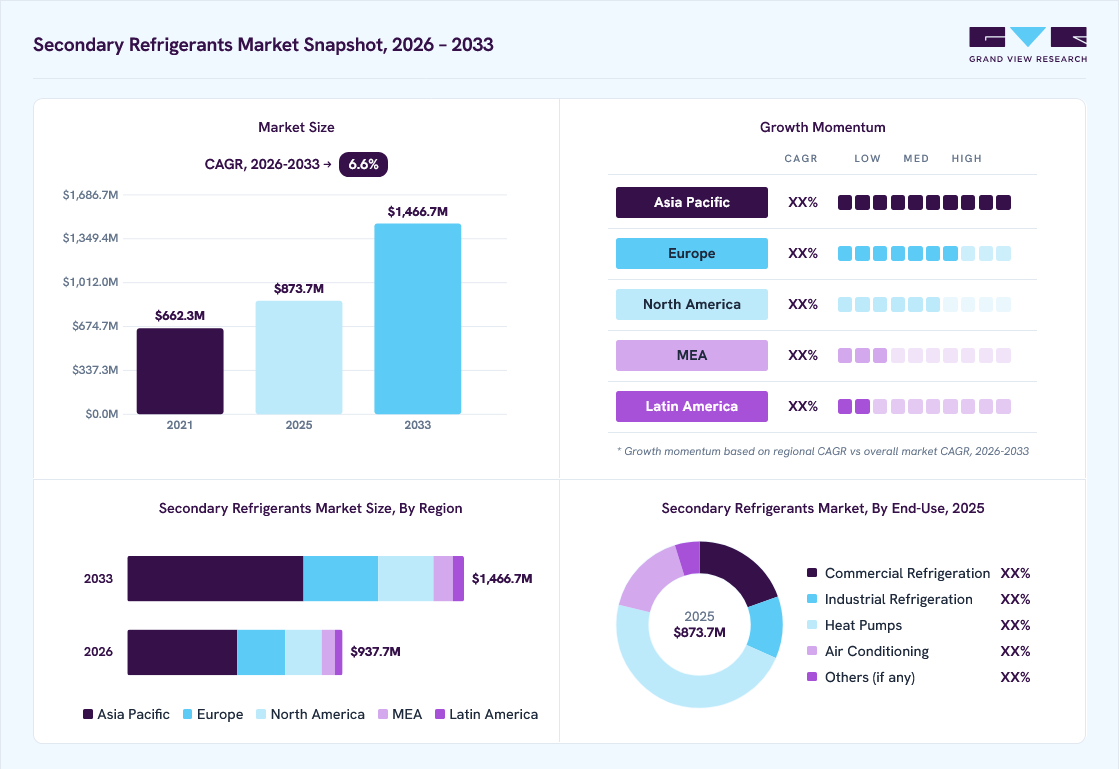
The global secondary refrigerants market size was valued at USD 873.7 million in 2025 and is projected to grow from USD 937.7 million in 2026 to USD 1,466.7 million by 2033, at a CAGR of 6.6% from 2026 to 2033. Asia Pacific dominated the market, accounting for a revenue share of 50.9% in 2025. The industry is expected to experience significant growth due to rising demand for energy-efficient cooling systems.
 Source: Grand View Research, IR Documents, Primary Interviews, Paid DatabasesTo learn more about this report,
 Download Free Sample Report
Key Market Trends & Insights
- By product: Glycols segment accounted for the highest market share, representing 45.5% of total revenue in 2025.
- By end use: Heat pumps held a dominant position, contributing 47.2% of total revenue in 2025.
Regional Highlights
- Largest regional market: Asia Pacific (50.9% revenue share, 2025)
- By country: The U.S. held the largest market share in 2025.
Market Size & Forecast
- Market size in 2025: USD 873.7 Million
- Estimated market size in 2026: USD 937.7 Million
- Projected market size by 2033: USD 1,466.7 Million
- CAGR (2026-2033): 6.6%
Prism AI by Grand View Research Free to tryAsk a question about the secondary refrigerants marketTry asking✓Every figure cited from GVR research Prefer the report? Download free sample →
Government regulations aimed at reducing greenhouse gas emissions and the increasing adoption of sustainable cooling technologies are primary drivers of the market. Secondary refrigerants are liquids that transmit heat from the substance being cooled to the heat exchanger, where the primary refrigerant absorbs the heat. Typically, secondary refrigerants are non-corrosive, non-toxic, incombustible, inexpensive, and chemically stable. They possess several advantageous properties, including high specific heat, excellent heat transfer characteristics, low viscosity, and enhanced safety during use. Additionally, secondary refrigerants help to reduce harmful environmental impacts.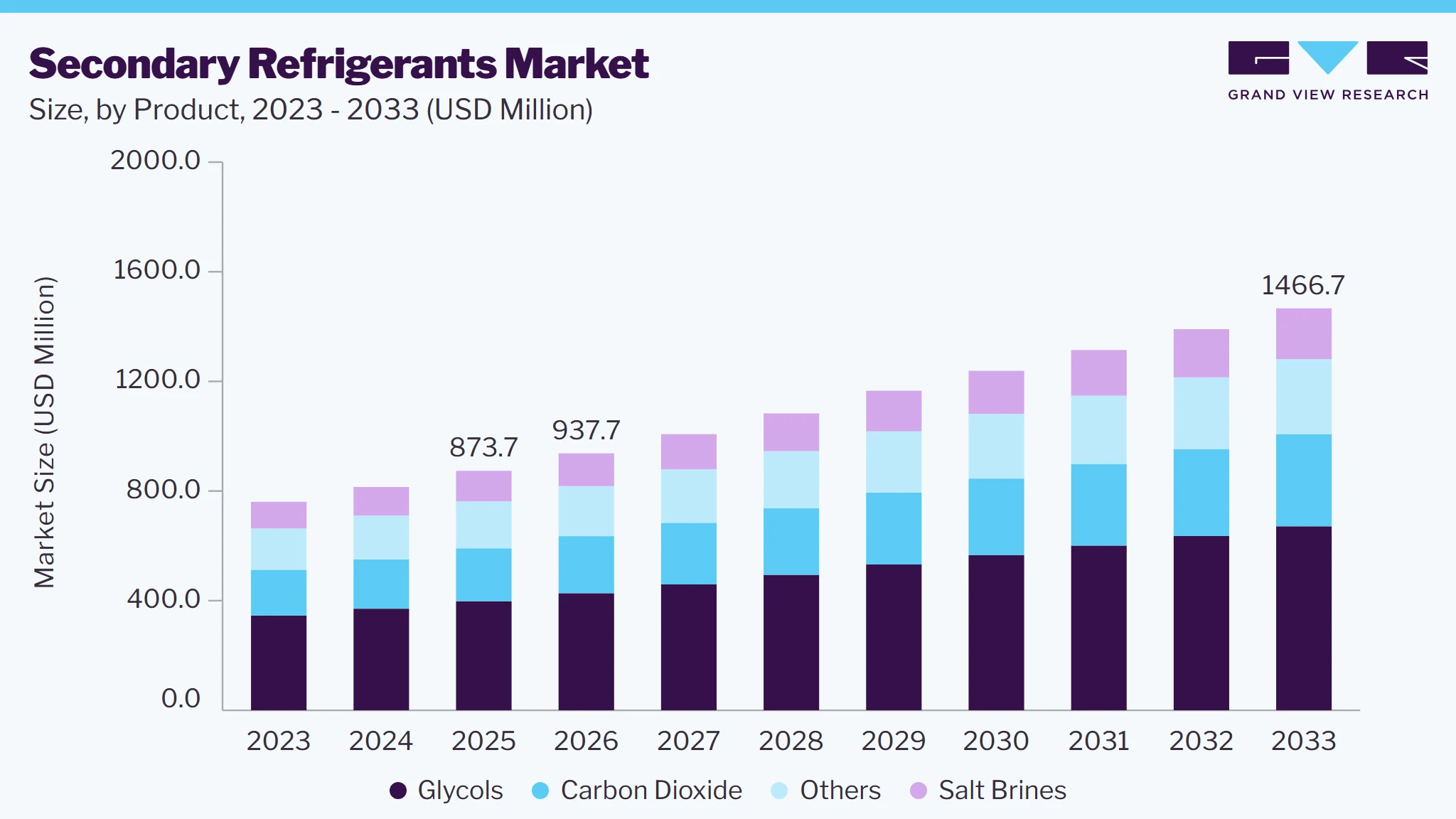 To learn more about this report, Download Free Sample Report
Secondary refrigerants, such as propylene glycol, calcium chloride brine, and oils, are utilized in various low-temperature applications, including commercial refrigeration, industrial refrigeration, and heat pumps. Chilled water is a secondary refrigerant in high-temperature applications, such as air conditioning. Additionally, these refrigerants help minimize pressure losses in the vapor compression cycle, thereby increasing efficiency. They are widely employed across several end-user industries, including food and beverages, oil and gas, chemicals, pharmaceuticals, and plastics.
Market Dynamics
The secondary refrigerants market is driven by the global transition toward environmentally sustainable cooling technologies and increasing regulatory pressure to reduce greenhouse gas emissions. Growing adoption of indirect refrigeration systems across commercial, industrial, and district cooling applications is accelerating the demand for efficient heat transfer fluids with low environmental impact. Rising investments in cold chain infrastructure, food processing facilities, pharmaceuticals, and data centers are further supporting market expansion. Technological advancements have led to the development of high-performance secondary refrigerants offering improved thermal conductivity, corrosion protection, and extended operational life, enhancing system efficiency while reducing maintenance costs. In addition, the increasing integration of heat pumps and energy-efficient HVAC systems in residential and commercial buildings is creating new growth opportunities for manufacturers. However, the market faces challenges related to higher initial installation costs, compatibility concerns with existing refrigeration systems, and fluctuations in raw material prices.
The growing emphasis on reducing greenhouse gas emissions and improving energy efficiency is a major driver of the secondary refrigerants market. Regulatory authorities across developed and emerging economies are encouraging the transition toward refrigeration systems that minimize the use of high-global-warming-potential (GWP) primary refrigerants. Secondary refrigerants support indirect cooling architectures by reducing the refrigerant charge required in a system, thereby lowering the risk of leakage and improving environmental performance. This shift aligns with corporate sustainability goals and evolving environmental compliance standards, encouraging end users to modernize refrigeration infrastructure.
The expansion of energy-intensive sectors such as food retail, cold storage, pharmaceuticals, and industrial processing is further strengthening market demand. Businesses are increasingly investing in advanced cooling technologies that deliver consistent thermal performance while optimizing operating efficiency and lifecycle costs. Secondary refrigerants also contribute to enhanced system reliability and flexible plant design, making them an attractive solution for large-scale refrigeration and HVAC installations where energy optimization and operational safety are strategic priorities.
One of the primary restraints affecting the secondary refrigerants market is the high upfront investment associated with indirect refrigeration systems and the complexity of retrofitting existing facilities. Implementing secondary refrigerant systems often requires additional components such as heat exchangers, circulation pumps, insulated piping networks, and advanced control systems, resulting in higher capital expenditure compared to conventional direct expansion systems. Existing refrigeration infrastructure may also require significant engineering modifications to ensure compatibility with secondary refrigerants, increasing installation time and project costs. These financial and technical challenges can discourage adoption, particularly among small and medium-sized enterprises with limited capital budgets. The need for specialized design expertise, skilled maintenance personnel, and periodic system optimization adds to the total cost of ownership, slowing market penetration in cost-sensitive industries despite the long-term benefits of improved energy efficiency and environmental performance.
The rapid deployment of heat pump technologies and district cooling networks presents a significant growth opportunity for the secondary refrigerants market. Governments and private organizations are investing in energy-efficient heating and cooling solutions to support decarbonization initiatives and reduce dependence on fossil fuel-based systems. Secondary refrigerants play a vital role in these applications by facilitating efficient heat transfer across centralized networks while maintaining operational stability under varying temperature conditions.
Urbanization, smart city developments, and increasing investments in sustainable infrastructure are expected to accelerate the adoption of centralized thermal energy systems. As commercial complexes, hospitals, educational institutions, and residential communities seek integrated climate control solutions, the demand for advanced secondary refrigerants with superior thermal efficiency and long service life is expected to rise. Manufacturers have opportunities to introduce innovative formulations that improve corrosion resistance, enhance heat transfer performance, and comply with evolving environmental regulations, thereby expanding their presence across emerging infrastructure projects.
Analyst Perspective
The secondary refrigerants market is increasingly prioritizing energy efficiency, environmental compliance, and operational safety in cooling systems. Demand is being supported by the transition toward low-GWP refrigeration technologies and the expansion of cold chain infrastructure, food processing, and district cooling projects. Glycol-based fluids continue to dominate due to their proven performance, while carbon dioxide-based solutions are gaining traction as sustainable alternatives. Product innovation focused on thermal efficiency, corrosion resistance, and extended service life is strengthening competitive differentiation. Although higher installation costs remain a challenge, long-term regulatory support and investments in sustainable HVAC and refrigeration infrastructure are expected to sustain market expansion.
Product Insights
Based on product, the glycols segment accounted for the highest market share, representing 45.5% of total revenue in 2025. The effectiveness of glycols in providing freeze protection for closed-loop ventilation, refrigeration systems, air conditioning (HVAC), water-based heating, and cooling systems is driving demand in the market.
Carbon dioxide (CO2) is increasingly recognized as a sustainable and eco-friendly option in the secondary refrigerant market. It operates efficiently at low temperatures and is non-toxic, making it suitable for various applications, including food preservation and commercial refrigeration. Additionally, compared to many traditional refrigerants, CO2 has a low global warming potential, aligning with environmental regulations and sustainability goals.
End-use Insights
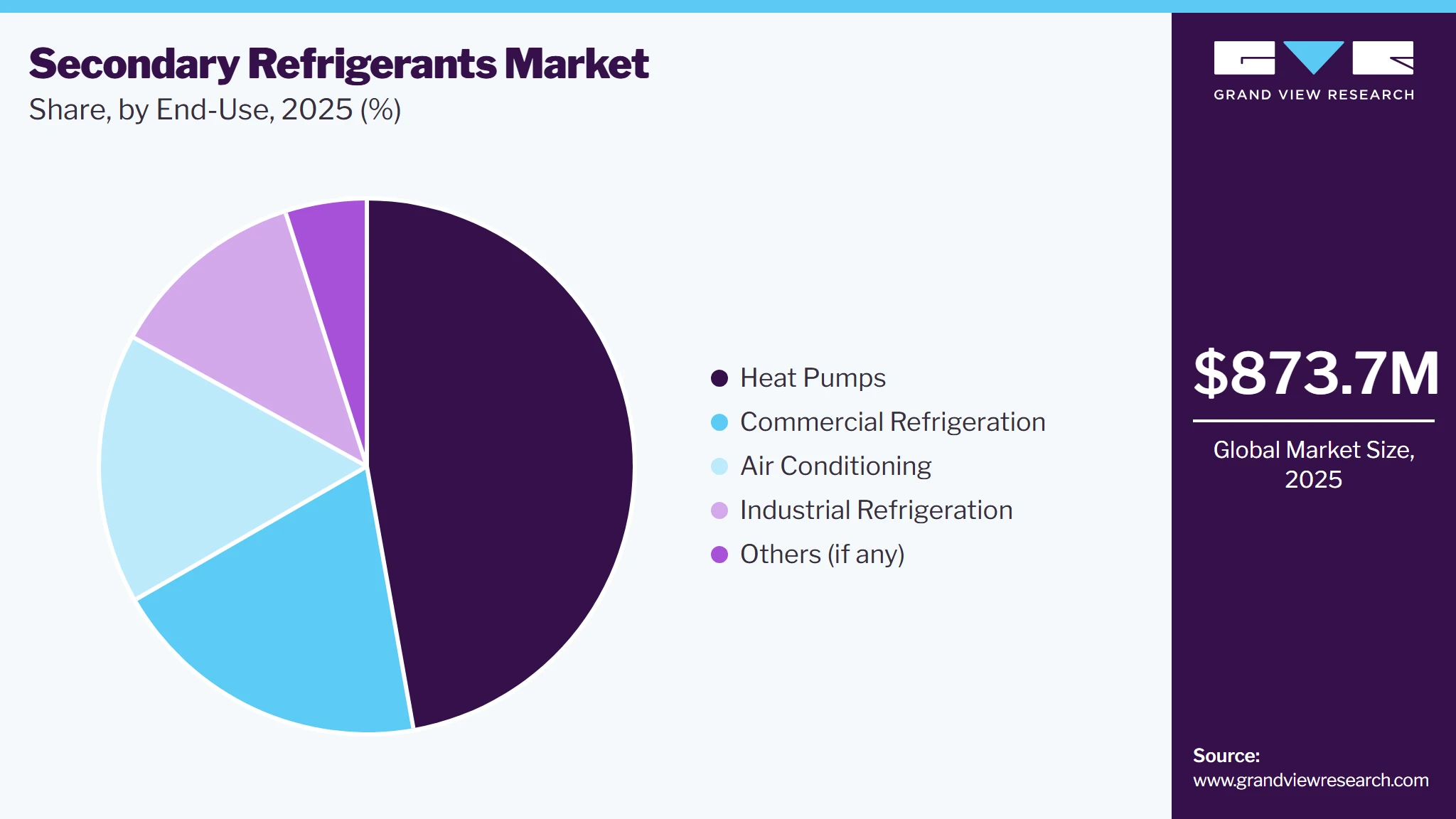
By end use, heat pumps held a dominant position, contributing 47.2% of total revenue in 2025. Heat pumps serve as a key application segment in the secondary refrigerant market by efficiently transferring heat from one area to another, often using a refrigerant to facilitate the process. They can be used for heating and cooling, making them versatile in residential and commercial applications. By leveraging secondary refrigerants, heat pumps enhance energy efficiency and performance while reducing environmental impact.
 To learn more about this report, Download Free Sample Report
Air conditioning represents a significant segment in the market, where secondary refrigerants transfer heat away from the cooling loads. These refrigerants, often water or glycol solutions, facilitate efficient temperature regulation in air conditioning systems, enhancing performance and energy efficiency. Using secondary refrigerants, systems can operate with lower energy costs and reduced environmental impact.
Regional Insights
North America secondary refrigerants market is experiencing growth. The North America region is expected to grow due to a rise in construction activity leading to a rise in demand for air conditioning in the region. The increasing food & beverage industry is also expected to positively impact the demand for products in the market.
U.S. Secondary Refrigerants Market Trends
Thesecondary refrigerants market in the U.S. is driven by a well-established industrial base and advancements in commercial refrigeration, heat pumps, and industrial refrigeration. Strong demand for secondary refrigerants in sectors such as food & beverage, commercial space, and industrial refrigeration support market growth.
Asia Pacific Secondary Refrigerants Market Trends
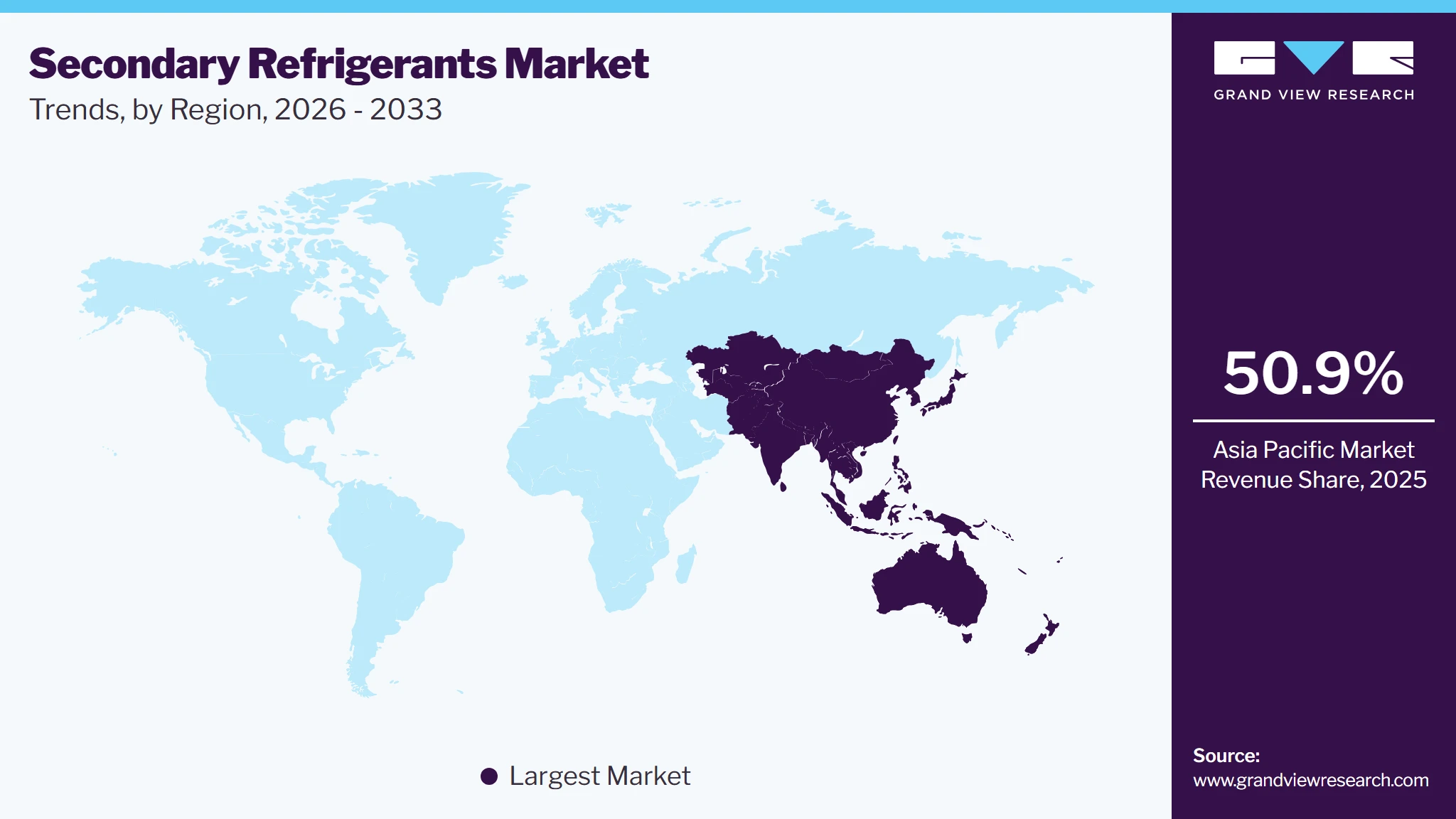
Asia Pacific dominated the secondary refrigerants market with the highest revenue share of 50.9% in 2025. The growing demand for refrigeration and air conditioning systems in countries like China and India supports this dominance. Additionally, the push for energy-efficient solutions and stricter environmental regulations further boosts the market's growth in this area. The increasing focus on sustainable practices also enhances the adoption of secondary refrigerants in various sectors.
 To learn more about this report, Download Free Sample Report
China accounted for 37.4% of the Asia Pacific secondary refrigerants market in 2025. China secondary refrigerants market is driven by rapid industrialization in metallurgy, chemicals, and food and beverage sectors. These industries rely on secondary refrigerants for processes such as cooling and preservation, further boosting market growth.
Europe Secondary Refrigerants Market Trends
The secondary refrigerants market in Europe is experiencing significant growth and is expected to expand the market substantially during the forecast period. Environmental regulations and government support initiatives drive this rapid growth. Additionally, the Asia Pacific region is anticipated to exhibit significant growth due to the development of the renewable energy sector and an increasing demand for refrigerants with low global warming potential (GWP) and ozone depletion potential (ODP), in line with government initiatives.
Latin America Secondary Refrigerants Market Trends
Thesecondary refrigerants market in Latin America is expected to grow, due to its growing industrial sector and the increasing demand for efficient cooling solutions. The region's focus on sustainable practices and regulatory support for eco-friendly refrigerants further strengthens its position in the global market.
Middle East & Africa Secondary Refrigerants Market Trends
Thesecondary refrigerants market in the Middle East and Africa region is experiencing growth due to the rising demand for energy-efficient cooling solutions and the expansion of the industrial and commercial sectors. Additionally, increasing temperatures and a focus on sustainable practices drive the adoption of secondary refrigerants in various applications, including HVAC systems and food processing.
Key Secondary Refrigerants Company Insights
Some of the key players operating in the market include Dow and Linde Plc
-
Linde plc is a global leader in industrial gases and engineering, providing high-purity gases, technologies, and solutions across various industries, including commercial refrigeration, industrial refrigeration, energy, and chemicals. Headquartered in the UK, the company operates in over 100 countries, delivering essential gases such as oxygen, nitrogen, and hydrogen. Linde is also a key player in carbon capture, hydrogen energy, and sustainable industrial solutions. Its advanced engineering division specializes in cryogenic and gas processing technologies. With a strong focus on innovation and sustainability, Linde continues to drive efficiency and environmental progress in the global industrial sector.
-
BASF SE is a chemical manufacturing company with a presence across Asia Pacific, North America, Central & South America, Europe, and the Middle East & Africa. The company operates through six business segments, namely chemical, material, industrial solutions, surface technologies, agricultural solutions, and nutrition & care. The chemical segment includes petrochemicals and intermediaries. The material segment comprises performance polymers and monomers. The Industrial Solutions segment includes performance chemicals and dispersions & pigments. The agricultural solution segment includes products for farming, landscape management, and pest control. The nutrition & care segment is further sub-segmented into nutrition & health and care. The company provides a wide range of surfactants for textile, paint & coatings, homecare, and food processing industries.
Key Secondary Refrigerants Companies:
The following key companies have been profiled for this study on the secondary refrigerants market.
-
Dow
-
BASF SE
-
Evonik Industries
-
Eastman Chemical Company
-
Clariant
-
The Lubrizol Corporation
-
The Linde Group
-
Temper Technology Ab
-
A-Gas International
-
Tazzetti S.P.A.
Competitive Benchmarking
Category
Operating Strategies
Competitive Edge
Weakness
Established Players (Dow, BASF SE, Evonik Industries, Eastman Chemical Company, Clariant, The Lubrizol Corporation, The Linde Group)
- Invest in advanced R&D to develop low-GWP and high-efficiency secondary refrigerants.
- Leverage integrated global manufacturing and distribution networks to ensure supply continuity.
- Focus on long-term contracts with industrial refrigeration, HVAC, and food processing customers.
- Expand product portfolios through sustainability initiatives, acquisitions, and strategic partnerships.
- Strong global brand recognition and established customer relationships across multiple industries.
- Extensive technical expertise supported by significant research and innovation capabilities.
- Large-scale production facilities enabling economies of scale and cost efficiency.
- Comprehensive regulatory compliance and broad international distribution footprint.
- Large organizational structures can slow product development and commercial decision-making.
- High operational and compliance costs associated with global manufacturing assets.
- Dependence on mature markets may limit growth potential in certain regions.
- Complex supply chains increase exposure to raw material price fluctuations and logistics disruptions.
Emerging Players (Tazzetti S.p.A., Temper Technology AB, A-Gas International)
- Target niche applications such as district cooling, natural refrigerant systems, and specialty heat transfer fluids.
- Develop customized formulations tailored to regional customer requirements.
- Strengthen market presence through collaborations with local distributors and OEMs.
- Emphasize flexible production capabilities and rapid response to evolving market needs.
- Greater agility in responding to changing environmental regulations and customer preferences.
- Ability to introduce specialized products for emerging refrigeration technologies.
- Strong focus on customer-specific technical support and application engineering.
- Competitive positioning in regional markets through specialized product offerings and responsive service.
- Limited manufacturing capacity compared to multinational competitors.
- Lower brand visibility and smaller international distribution networks.
- Restricted financial resources for large-scale capital investments and research programs.
- Greater dependence on regional demand and third-party suppliers for business expansion.
Recent Developments
-
In December 2024, Clariant commenced construction of a second production line at its Cangzhou facility in Hebei Province, China, to manufacture the multifunctional additive Nylostab S-EED. This expansion, in partnership with Beijing Tiangang Auxiliary Co., Ltd., aims to meet the increasing demand from China's nylon industry, particularly in the textiles, automotive, and packaging sectors. The first production line, operational since 2021, has reached full capacity and earned a strong reputation for quality. Nylostab S-EED enhances nylon products by improving color stability, heat resistance, and process efficiency.
-
In February 2022, Linde announced a long-term agreement with BASF to supply hydrogen and steam to BASF's new hexamethylenediamine (HMD) facility in Chalampé, France. As part of this agreement, Linde will design, build, own, and operate a second hydrogen production plant at the Chalampé chemical park, effectively doubling its existing capacity at the site. The new plant is expected to commence operations in the first half of 2024 and will also serve Linde's local merchant customers, addressing the growing demand for hydrogen in the region.
Secondary Refrigerants Market Report Scope
Report Attribute
Details
Market size in 2025
USD 873.7 million
Estimated market size in 2026
USD 937.7 million
Projected market size by 2033
USD 1,466.7 million
Growth rate
CAGR of 6.6% from 2026 to 2033
Base year for estimation
2025
Historical data
2021 - 2024
Forecast period
2026 - 2033
Quantitative units
Revenue in USD million/million, Volume in Kilotons and CAGR from 2026 to 2033
Report coverage
Revenue forecast, company ranking, competitive landscape, growth factors, and trends
Segments covered
Product, end use, region
Regional scope
North America, Europe, Asia Pacific, Latin America, Middle East & Africa
Country scope
U.S., Canada, Mexico, Germany, UK, France, Italy, Spain, China, India, Japan, South Korea, Brazil, Argentina, Saudi Arabia, South Africa.
Key companies profiled
Dow; Tazzetti S.P.A.; Evonik Industries; Eastman Chemical Company; Clariant; The Lubrizol Corporation; The Linde Group; Temper Technology Ab, BASF SE; A-Gas International
Customization scope
Free report customization (equivalent up to 8 analysts' working days) with purchase. Addition or alteration to country, regional & segment scope.
Pricing and purchase options
Avail customized purchase options to meet your exact research needs. Explore purchase options
Global Secondary Refrigerants Market Report Segmentation
This report forecasts revenue and volume growth at global, regional, and country levels and provides an analysis of the latest industry trends in each of the sub-segments from 2021 to 2033. For this study, Grand View Research has segmented the global secondary refrigerants market report on the basis of product, end-use, and region.
 To learn more about this report, Download Free Sample Report
-
Product Outlook (Volume, Kilotons; Revenue, USD Million, 2021 - 2033)
-
Glycols
-
Salt Brines
-
Carbon Dioxide
-
Other Products
-
-
End-use Outlook (Volume, Kilotons; Revenue, USD Million, 2021 - 2033)
-
Commercial Refrigeration
-
Industrial Refrigeration
-
Heat Pumps
-
Air Conditioning
-
Other End Use
-
-
Regional Outlook (Volume, Kilotons; Revenue, USD Million, 2021 - 2033)
-
North America
-
U.S.
-
Canada
-
Mexico
-
-
Europe
-
Germany
-
UK
-
France
-
Italy
-
Spain
-
-
Asia Pacific
-
China
-
India
-
Japan
-
South Korea
-
-
Latin America
-
Brazil
-
Argentina
-
-
Middle East & Africa
-
Saudi Arabia
-
South Africa
-
-
Research Methodology
The secondary refrigerants market figures in this report are based on a proven research process that combines executive interviews with secondary research from proprietary databases, company filings, and recognized regulatory and institutional sources. Market size is built through value-chain sizing - reconciling supply-side and demand-side estimates - and triangulated with bottom-up and top-down approaches. Every estimate passes multiple levels of expert validation before publication, with each secondary refrigerants segment quantified using the revenue-capture definitions in the table below.
Segment Definition
Segment - Product
Revenue capture definition
Glycols
Market earnings stem from the widespread utilization of ethylene glycol- and propylene glycol-based fluids in refrigeration, HVAC, and industrial cooling systems. Their excellent freeze protection, thermal stability, and heat transfer capabilities make them the preferred choice across multiple cooling applications.
Salt Brines
Sales within this category are supported by the deployment of calcium chloride, sodium chloride, potassium formate, and related brine solutions in low-temperature refrigeration processes. Their economical operation and dependable cooling performance encourage adoption across cold storage and food processing facilities.
Carbon Dioxide
Income from this segment is fueled by the increasing implementation of carbon dioxide as a secondary heat transfer medium in indirect refrigeration installations. Rising preference for environmentally responsible cooling technologies and natural refrigerant systems continues to strengthen commercial demand.
Other Products
This category encompasses specialty heat transfer fluids, including alcohol-based formulations, potassium acetate solutions, and engineered refrigerant blends designed for specialized industrial processes. Ongoing product innovation and customized application requirements continue to support business expansion.
Segment - End Use
Revenue capture definition
Commercial Refrigeration
Business growth is supported by the application of secondary refrigerants in supermarkets, convenience stores, restaurants, hospitality establishments, and refrigerated display equipment. Increasing investments in energy-efficient food preservation systems continue to strengthen demand across the commercial sector.
Industrial Refrigeration
Market value is created through the adoption of secondary refrigerants in manufacturing facilities, cold warehouses, pharmaceutical production, chemical processing, and beverage operations. The need for reliable temperature management and operational efficiency encourages widespread implementation.
Heat Pumps
Demand from this segment is attributed to the integration of secondary refrigerants into residential, commercial, and industrial heat pump installations. Expanding deployment of sustainable heating technologies and energy-efficient building solutions is accelerating product adoption.
Air Conditioning
Growth within this application is driven by the incorporation of secondary refrigerants into centralized HVAC systems, district cooling networks, healthcare facilities, commercial buildings, and data centers. Greater emphasis on reducing energy consumption and improving cooling efficiency supports market expansion.
Other End Uses
Additional market opportunities arise from specialized applications such as ice rinks, marine refrigeration, renewable energy projects, thermal energy storage, and process cooling systems. Continuous infrastructure development and advancements in thermal management technologies contribute to sustained segment growth.
Estimation Model
Layer Name
Key Question
Description
Raw Material & Production Layer
What forms the supply base?
Evaluate the global production landscape of secondary refrigerants by examining the availability of key feedstocks such as ethylene glycol, propylene glycol, calcium chloride, sodium chloride, potassium formate, carbon dioxide, and other specialty heat transfer fluids. Assess manufacturing technologies, blending processes, purification methods, production capacities, regional manufacturing clusters, and supply chain networks that ensure a stable supply for refrigeration, HVAC, industrial cooling, and district energy applications.
Application Adoption Layer
Where are secondary refrigerants consumed?
Examine the distribution of secondary refrigerants across major application sectors including commercial refrigeration, industrial refrigeration, heat pumps, air conditioning, and other specialized cooling systems. Adoption trends are shaped by stricter environmental regulations, increasing investment in energy-efficient infrastructure, growth in cold chain logistics, rising deployment of district cooling systems, and expanding use of sustainable refrigeration technologies.
Consumption Intensity Layer
How much secondary refrigerants are utilized?
Measure consumption volumes by analyzing system installation rates, refrigerant fill requirements, cooling capacity, and replacement demand across diverse applications. This assessment covers supermarkets, cold storage facilities, food processing plants, pharmaceutical manufacturing, chemical processing, commercial buildings, heat pump installations, data centers, and district cooling networks to estimate annual usage across regional markets.
Revenue Layer
How is market revenue generated?
Market value is created through the manufacturing, distribution, and commercialization of glycol-based fluids, salt brines, carbon dioxide-based secondary refrigerants, and specialty heat transfer formulations. Revenue expansion is supported by advancements in fluid performance, compliance with environmental regulations, increasing adoption of low-global-warming-potential cooling solutions, product innovation, aftermarket replacement demand, and the growing installation of energy-efficient refrigeration and HVAC systems worldwide.
Delivered Customizations
This report has been delivered with the following In-depth customizations
Client Request
Customization Delivered
Value Adds
Regional Segmentation
The study provides detailed country-level insights across major secondary refrigerants markets. The assessment examines manufacturing capacities, consumption trends, regulatory developments, import-export activities, infrastructure investments, and demand across commercial refrigeration, industrial refrigeration, heat pumps, air conditioning, and other cooling applications.
Helps stakeholders identify high-growth markets, evaluate regional demand patterns, understand competitive positioning, assess production capabilities, and prioritize expansion strategies in rapidly developing refrigeration and HVAC markets.
Trade Assessment
The report offers a comprehensive evaluation of historical and current trade flows for glycol-based refrigerants, salt brines, carbon dioxide, and specialty heat transfer fluids. The analysis covers import-export volumes, leading producing and consuming countries, pricing movements, supply chain structures, regional manufacturing concentration, and sourcing trends influencing global product availability.
Supports informed procurement decisions by highlighting sourcing opportunities, trade dependencies, pricing fluctuations, logistics risks, and international supply chain dynamics, enabling businesses to strengthen resilience and optimize supplier networks.
Opportunity Assessment
The study identifies growth opportunities across commercial refrigeration, industrial refrigeration, district cooling, heat pump installations, air conditioning systems, cold chain logistics, pharmaceutical storage, food processing, and emerging thermal energy applications. It further evaluates opportunities created by the transition toward low-GWP refrigerants, energy-efficient cooling technologies, sustainability initiatives, and infrastructure modernization.
Assists organizations in identifying attractive investment areas, aligning product portfolios with evolving industry requirements, accelerating market entry strategies, and capitalizing on long-term growth prospects driven by environmental regulations and energy efficiency initiatives.
Frequently Asked Questions About This Report
The global secondary refrigerants market size was estimated at USD 873.7 million in 2025 and is expected to reach USD 937.7 million in 2026.
The global secondary refrigerants market is expected to grow at a compound annual growth rate of 6.6% from 2026 to 2033 to reach USD 1,466.7 million by 2033.
Some key players operating in the polyurethane market include Dow; Tazzetti S.P.A.; Evonik Industries; Eastman Chemical Company; Clariant; The Lubrizol Corporation; and others.
Based on product, the glycols segment accounted for the highest market share, representing 45.5% of total revenue in 2025. The segment's leadership was supported by the widespread use of ethylene glycol and propylene glycol owing to their superior heat transfer efficiency, freeze protection capabilities, and compatibility with commercial and industrial refrigeration systems.
By end use, heat pumps held a dominant position, contributing 47.2% of total revenue in 2025. The segment's leadership was supported by increasing deployment of energy-efficient heating systems, favorable decarbonization policies, and rising adoption of sustainable thermal management solutions across residential, commercial, and industrial sectors.
The secondary refrigerants market is primarily driven by the growing adoption of low-global-warming-potential (GWP) cooling solutions and increasingly stringent environmental regulations governing refrigerant emissions. Rising investments in cold chain infrastructure, industrial refrigeration, energy-efficient HVAC systems, and district cooling projects are further accelerating market growth.
Asia Pacific dominated the secondary refrigerants market with the highest revenue share of 50.9% in 2025. Rapid expansion of cold chain infrastructure, industrial refrigeration capacity, and energy-efficient HVAC installations across China, India, Japan, and Southeast Asia continues to reinforce the region's market leadership.
About the Author(s)
Organic Chemicals Research Team
Bulk Chemicals · Organic ChemicalsThis report was authored by the organic chemicals research team at Grand View Research - comprising two research analysts, one senior research analyst, and one industry expert - with specialized expertise in the organic chemicals segment of the bulk chemicals industry. All findings are based on proprietary bulk chemicals databases, executive interviews, and regulatory analysis, subject to internal peer review prior to publication.
Last Updated:
Speak to Analyst

Customize this report to your needs - add regions, segments, or data points, with 20% free customization.
Or view our licence options:


ISO 9001:2015 & 27001:2022 Certified
We are GDPR and CCPA compliant! Your transaction & personal information is safe and secure. For more details, please read our privacy policy.


