
- Home
- »
- Network Security
- »
-
Security And Vulnerability Management Market Report, 2033GVR Report cover

Security And Vulnerability Management Market (2026 - 2033)
Size, Share & Trends Analysis Report By Component (Software, Services), By Type (Cloud Security, Network Security), By Target, By Deployment, By Enterprise Size, By Vertical, By Region, And Segment Forecasts
Market Size, 2025
$17.6BMarket Estimate, 2026
$18.8BMarket Forecast, 2033
$30.1BCAGR, 2026–2033
7.0%Security And Vulnerability Management Market Summary
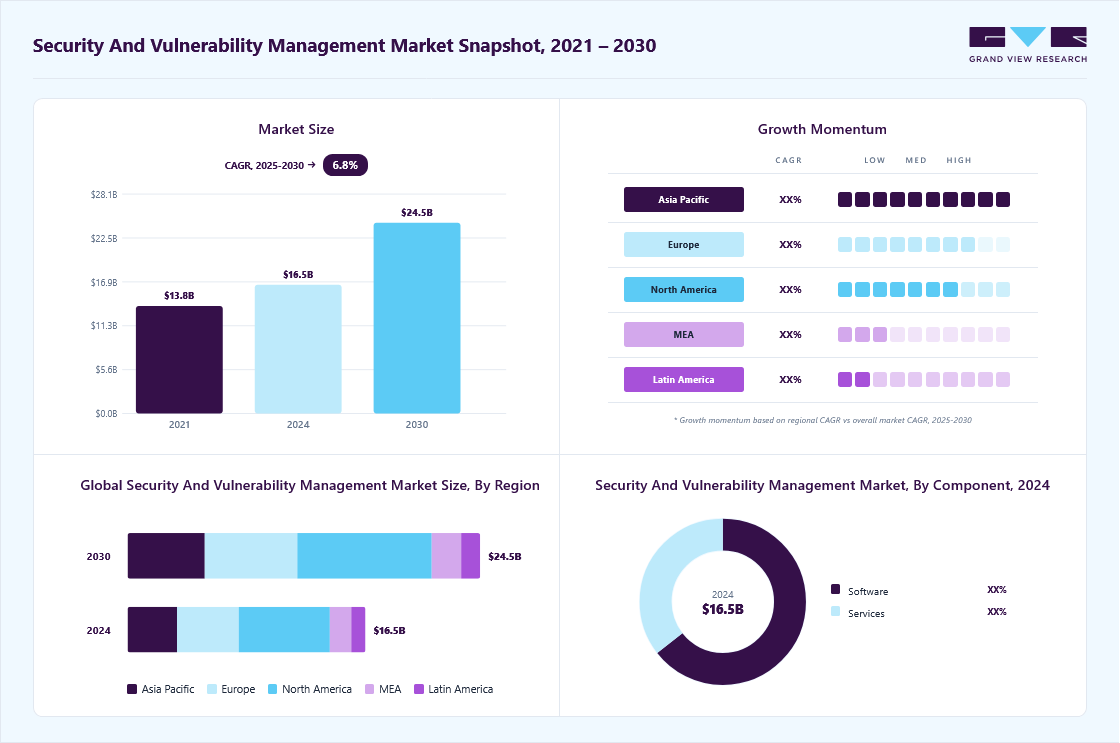
The global security and vulnerability management market size was valued at USD 17.6 billion in 2025 and is projected to grow from USD 18.8 billion in 2026 to USD 30.1 billion by 2033, at a CAGR of 7.0% from 2026 to 2033. North America dominated the market, accounting for a revenue share of 40.3% in 2025. The market is expanding due to the rising volume and sophistication of cyberattacks, prompting organizations to strengthen their vulnerability management capabilities.
 Source: Grand View Research, IR Documents, Primary Interviews, Paid DatabasesTo learn more about this report,
 Download Free Sample Report
 Key Market Trends & Insights
- By component: The software segment dominated the market, with a revenue share of 64.8% in 2025
- By type: The infrastructure protection segment held the largest market share of 26.2% in 2025
- By target: The content management vulnerabilities segment held the largest market share in 2025
- By deployment: The cloud segment held the largest market share in 2025
- By enterprise size: The large enterprises segment held the largest market share in 2025
- By vertical: The defense/government segment held the largest revenue share in 2025
Regional Highlights
- Largest regional market: North America (40.3% revenue share, 2025)
- Fastest-growing regional market: Asia Pacific (highest CAGR, 2026-2033)
- By country: The U.S. held the largest market share in 2025
Market Size & Forecast
- Market size in 2025: USD 17.6 Billion
- Estimated market size in 2026: USD 18.8 Billion
- Projected market size by 2033: USD 30.1 Billion
- CAGR (202-2033): 7.0%
Three ways to get this report
Buy it, customize it, or ask a question.Ask an Analyst
Analyst response in 1 business day
- AccessReport author, directly
- Reply timeWithin 1 working day
- No sales callDirect answer only
- FormatEmail reply
- CostFree, no cost
Get the Full Report
What the study covers
- FormatsPDF · Excel · Dashboard
- Timeline2026–2033 annual, 2025 base
- Coverage20+ countries, 5 regions
- Companies10+ key players profiled
Customize the Report
20% free customization
- IncludeCountries, segments, points
- TailorTo your product definition
- ExtendDeeper competitor detail
- OrA fully bespoke study
- Turnaround5–10 working days
Growing adoption of IoT devices and API-centric architectures is increasing the need for advanced security solutions. Additionally, stringent regulatory and compliance requirements across sectors such as financial services, healthcare, and manufacturing are accelerating solution deployment. The increasing shift toward cloud-based security offerings, coupled with rising demand for comprehensive and integrated vulnerability management platforms, is further supporting market growth. This growth is driven by the increasing frequency and complexity of cyber threats, pushing organizations to prioritize robust vulnerability management solutions.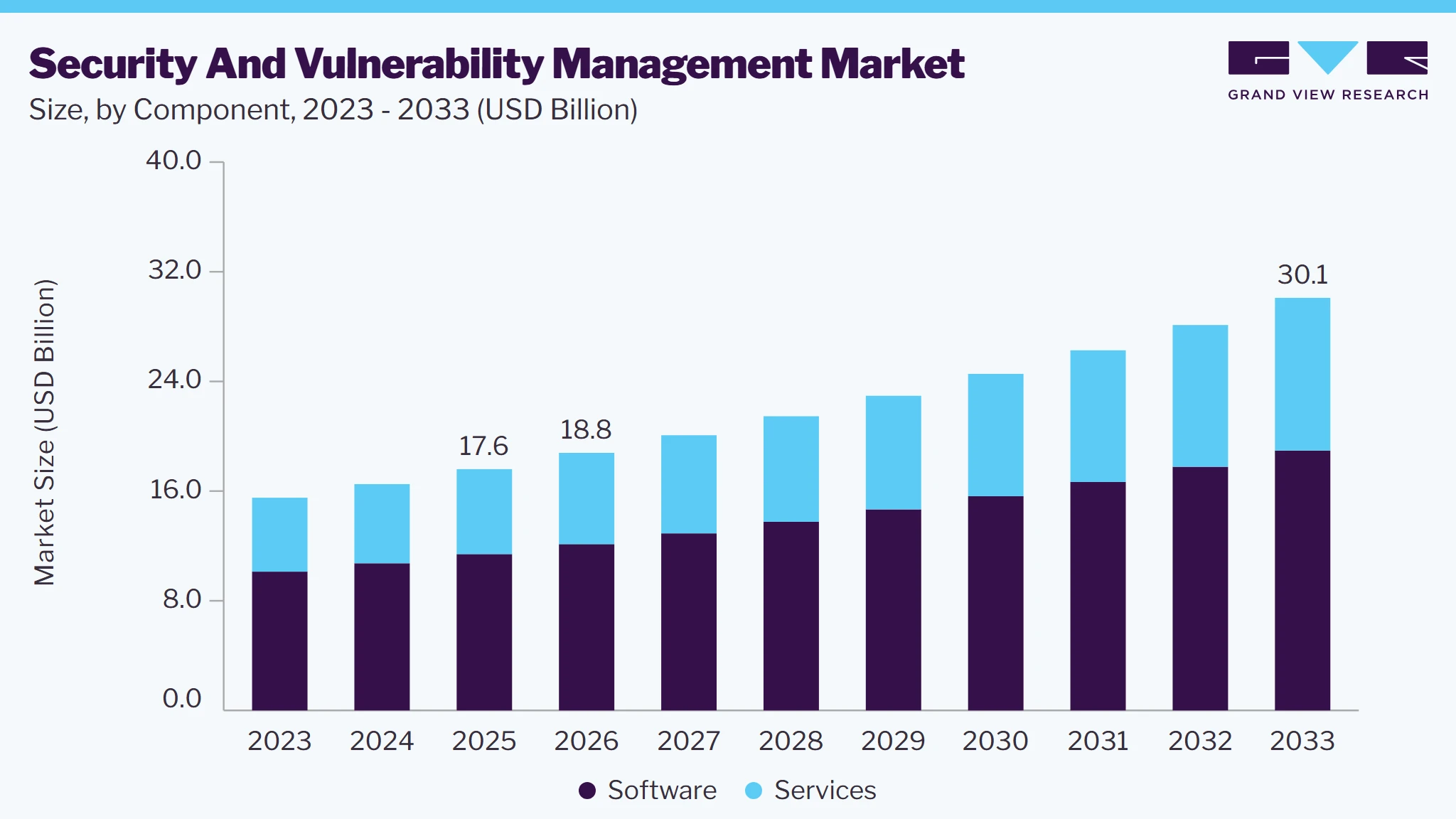 To learn more about this report, Download Free Sample Report
 The rapid adoption of IoT and API-driven technologies further creates demand for advanced security systems. In addition, stringent regulatory frameworks across industries like finance, healthcare, and manufacturing are contributing to higher adoption rates. Cloud-based security solutions and a surge in demand for integrated vulnerability management platforms also propel market expansion.
The growth of the security and vulnerability management industry is primarily driven by the rising cyber-attacks, which have increased the demand for proactive security measures. Organizations are transitioning from traditional IT infrastructure to cloud and hybrid environments, necessitating advanced tools to identify and address vulnerabilities. The widespread adoption of remote work and BYOD policies has expanded attack surfaces, prompting enterprises to invest in robust threat detection and management systems. In addition, sectors such as healthcare, BFSI, and government are adopting vulnerability management solutions to comply with stringent data protection regulations and safeguard necessary information. The surge in IoT devices and API-centric applications has created new opportunities for threat actors, emphasizing the need for real-time monitoring and mitigation strategies. Moreover, the growing awareness about ransomware attacks is leading organizations to allocate higher budgets for security solutions.
Technological advancements, such as AI and machine learning, are playing a significant role in enhancing vulnerability detection and threat intelligence capabilities. These technologies enable predictive analytics and automation, helping organizations efficiently manage and prioritize vulnerabilities. The integration of advanced tools into Security Incident & Event Management (SIEM) platforms provides organizations with holistic approaches to mitigate threats. Increasing demand for subscription-based models and managed security services is further supporting market expansion, especially among small and medium enterprises. The market also benefits from strategic collaborations and acquisitions by major players to expand their offerings and regional footprints.
Market Dynamics
The security and vulnerability management market is experiencing strong momentum as organizations contend with an increasingly sophisticated threat landscape characterized by ransomware, zero-day exploits, supply chain attacks, and AI-enabled cyber threats. Enterprises are shifting from periodic vulnerability assessments to continuous exposure management, leveraging automation, threat intelligence, and risk-based prioritization to identify and remediate vulnerabilities in real time. The rapid expansion of cloud-native applications, hybrid work environments, and interconnected digital ecosystems has broadened attack surfaces, prompting greater investment in integrated security platforms that combine vulnerability assessment, threat detection, asset visibility, and compliance management within a unified framework.
Another key market trend is the growing adoption of artificial intelligence and machine learning within vulnerability management solutions to improve threat prediction, reduce false positives, and accelerate incident response. Regulatory requirements such as data protection laws, critical infrastructure security mandates, and industry-specific compliance standards are further compelling organizations to strengthen cybersecurity governance. In addition, the rise of DevSecOps practices and the increasing use of APIs, containers, and Internet of Things (IoT) devices are driving demand for proactive security approaches that embed vulnerability management throughout the software development lifecycle. As a result, cloud-delivered and managed security services are gaining traction, particularly among organizations seeking scalable, cost-effective solutions to address evolving cyber risks.
The growing sophistication and frequency of cyberattacks remain the primary drivers of the Security and Vulnerability Management market. Organizations are increasingly facing ransomware attacks, advanced persistent threats (APTs), supply chain compromises, insider threats, and zero-day vulnerabilities that can cause significant financial, operational, and reputational damage. As enterprises continue to digitize operations and migrate critical workloads to cloud environments, maintaining visibility into potential vulnerabilities has become a strategic priority. Security and vulnerability management solutions enable organizations to continuously identify, assess, prioritize, and remediate risks before threat actors can exploit them, making these platforms an essential component of modern cybersecurity strategies.
Additionally, the rapid adoption of remote and hybrid work models, cloud-native applications, IoT devices, and API-driven architectures has significantly expanded enterprise attack surfaces. Regulatory requirements such as GDPR, NIS2, HIPAA, PCI-DSS, and various national cybersecurity frameworks are further compelling organizations to strengthen their security posture and implement continuous vulnerability monitoring programs. As a result, enterprises across sectors including BFSI, healthcare, government, manufacturing, and telecommunications are increasing investments in automated vulnerability management platforms to improve cyber resilience and ensure compliance with evolving security regulations.
Despite strong market demand, the implementation and management of vulnerability management solutions remain challenging for many organizations. Modern IT environments often consist of on-premises infrastructure, multi-cloud deployments, SaaS applications, endpoints, containers, and IoT devices, creating highly fragmented ecosystems that are difficult to secure. Organizations frequently struggle to consolidate vulnerability data from multiple security tools, prioritize remediation efforts effectively, and manage an overwhelming number of alerts. This complexity can lead to delayed responses, increased operational costs, and reduced effectiveness of security programs.
Another significant restraint is the global shortage of qualified cybersecurity professionals. As cyber threats become more sophisticated, organizations require skilled personnel capable of conducting vulnerability assessments, analyzing threat intelligence, and managing remediation processes. However, the demand for cybersecurity expertise continues to outpace supply, particularly in emerging economies and mid-sized enterprises. Limited budgets and resource constraints often prevent organizations from fully leveraging advanced security technologies, resulting in slower adoption rates and creating challenges in maintaining comprehensive vulnerability management frameworks.
The integration of artificial intelligence (AI), machine learning (ML), and automation into vulnerability management solutions presents a substantial growth opportunity for market participants. Organizations are increasingly seeking intelligent platforms that can automatically detect vulnerabilities, correlate threat data, prioritize risks based on business impact, and accelerate remediation workflows. AI-driven capabilities help reduce false positives, improve operational efficiency, and enable security teams to focus on high-priority threats. The growing adoption of Continuous Threat Exposure Management (CTEM) and risk-based vulnerability management approaches is further driving demand for advanced analytics and predictive security technologies.
At the same time, the increasing shift toward cloud computing, DevSecOps methodologies, and managed security services is creating new avenues for market expansion. Organizations are moving away from traditional point solutions in favor of integrated, cloud-native security platforms that provide real-time visibility across hybrid and multi-cloud environments. Small and medium-sized enterprises are embracing Security-as-a-Service (SECaaS) and managed vulnerability management offerings to access enterprise-grade protection without significant upfront investments. As digital transformation initiatives continue across industries, vendors offering scalable, AI-enabled, and cloud-delivered vulnerability management solutions are expected to benefit from substantial growth opportunities over the forecast period.
Analyst Perspective
The security and vulnerability management market is rapidly evolving from traditional periodic vulnerability scanning tools into continuous, intelligence-driven exposure management ecosystems. Organizations are increasingly prioritizing real-time visibility, risk-based vulnerability prioritization, and automated remediation as cyber threats become more sophisticated and persistent. The convergence of cloud computing, DevSecOps practices, API-driven architectures, and IoT expansion is significantly broadening enterprise attack surfaces, making unified vulnerability management platforms a critical component of modern cybersecurity strategies. At the same time, the shift toward integrated security platforms combining endpoint, network, application, and cloud security-reflects a broader industry movement toward consolidation and operational efficiency in security operations centers (SOCs).
Component Insights
Based on component, the software segment led the market with the largest revenue share of 64.8% in 2025. This growth is driven by the rising need for automated and scalable solutions to combat evolving cyber threats. Organizations increasingly adopt vulnerability scanners, threat intelligence, and Security Incident & Event Management (SIEM) platforms to proactively identify and mitigate risks. The growing trend of cloud adoption has also boosted the demand for software-based security tools tailored for hybrid and multi-cloud environments. Advanced features such as real-time monitoring, predictive analytics powered by AI, and seamless integration with existing IT ecosystems have further contributed to the segment's dominance.
The services segment is anticipated to exhibit the fastest CAGR over the forecast period. This growth is fueled by the increasing reliance on professional services, such as consulting, deployment, pen testing, and incident response, to address complex security challenges. The rising number of cyberattacks necessitates expert assistance in threat assessment and mitigation, especially for organizations lacking in-house security teams. Managed security service providers (MSSPs) are also gaining traction as companies seek to outsource continuous monitoring and management to specialists. The demand for incident response services is particularly high, given the growing need for rapid containment and recovery from cyber breaches.
Type Insights
Based on type, the infrastructure protection segment led the market with the largest revenue share of 26.2% in 2025. This dominance is attributed to the increasing focus on safeguarding critical infrastructure, such as data centers, industrial facilities, and government networks, from cyber threats. Rapid digital transformation across industries has expanded the attack surfaces for infrastructure, driving investments in advanced security tools. As businesses increasingly adopt hybrid and cloud-based architectures, infrastructure protection solutions that offer real-time monitoring and incident prevention continue to see strong demand.
The cloud security segment is anticipated to exhibit the fastest CAGR over the forecast period. This growth is driven by the widespread adoption of cloud computing across industries, which has significantly expanded the attack surface for businesses. The shift to hybrid and multi-cloud environments demands advanced security solutions to protect sensitive data and workloads. Features such as real-time threat monitoring, encryption, and automated vulnerability patching make cloud security solutions a priority for enterprises. In addition, regulatory requirements for data protection and compliance are accelerating the adoption of specialized cloud security tools.
Target Insights
Based on target, the content management vulnerabilities segment led the market with the largest revenue share of 34.9% in 2025, driven by the need to protect content management systems (CMS) used by organizations across various industries. As CMS platforms often store vast amounts of sensitive data, they become prime targets for cybercriminals seeking unauthorized access to valuable information. The increasing number of attacks, including ransomware and SQL injections, makes it essential for businesses to adopt vulnerability management solutions tailored to CMS. As businesses increasingly rely on these platforms for web content, collaboration tools, and customer data, the demand for specialized security measures continues to rise.
The API vulnerabilities segment is anticipated to exhibit the fastest CAGR over the forecast period. The increasing reliance on APIs drives this rapid growth to facilitate communication between applications, cloud services, and third-party services across various industries. As the adoption of API-driven solutions grows, so do the security risks associated with them, such as data leaks, injection attacks, and unauthorized access. The complexity and volume of API traffic create additional challenges in detecting and managing vulnerabilities. Consequently, organizations are prioritizing API security to mitigate risks associated with potential breaches.
Deployment Insights
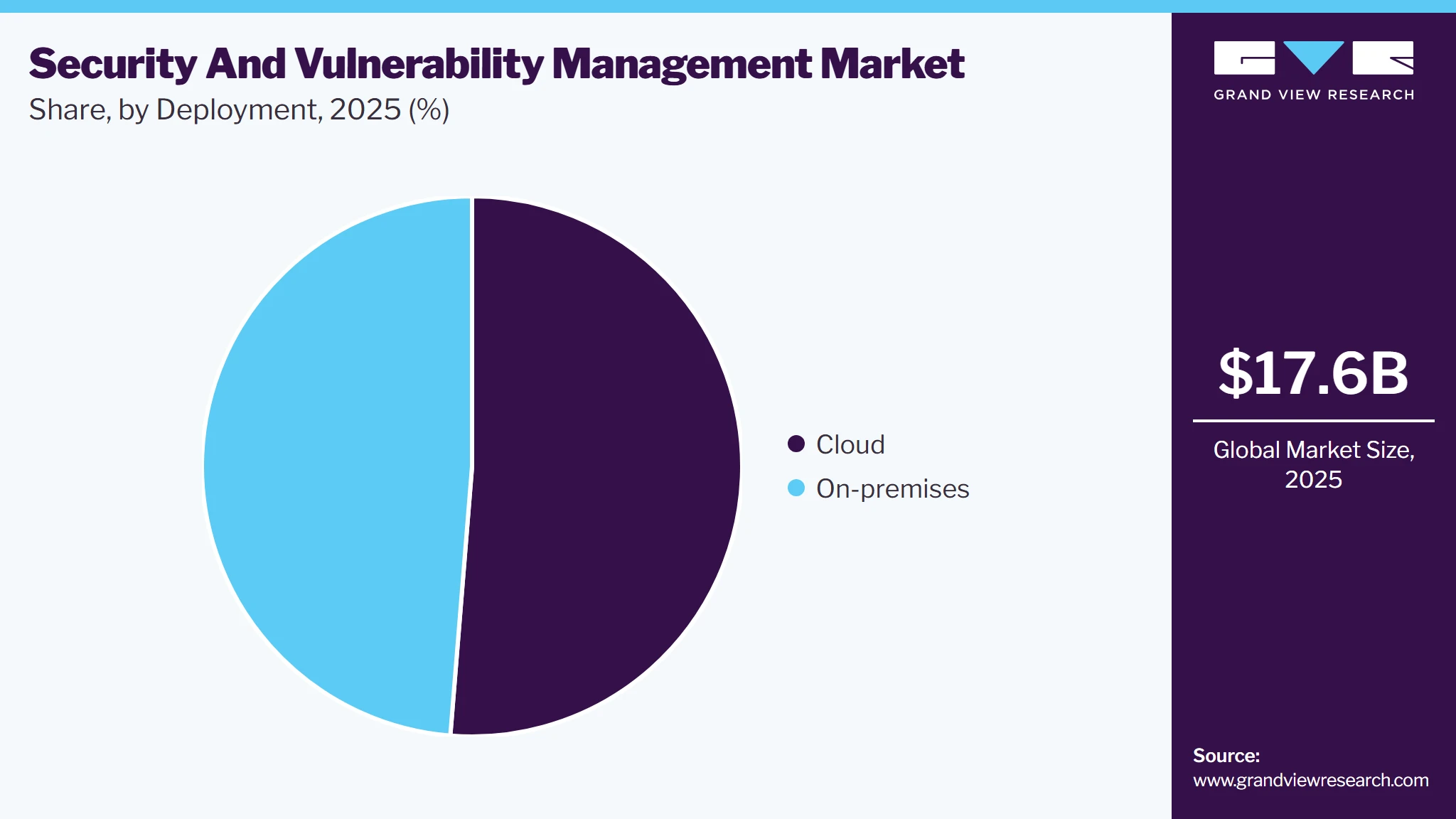
Based on the deployment, the cloud segment led the market with the largest revenue share of 51.3% in 2025 due to the rapid shift of enterprises to cloud-based infrastructure and applications. As organizations increasingly move their data, applications, and services to the cloud, the risk of cyberattacks targeting cloud environments grows. Cloud platforms often host sensitive business-critical information, driving the demand for continuous monitoring, vulnerability assessment, and threat mitigation. The adoption of hybrid and multi-cloud architectures has further compounded the complexity of security management, fostering the need for integrated security tools. With an increasing number of regulations on data protection and compliance, organizations are relying more on advanced cloud security solutions to safeguard their digital assets.
 To learn more about this report, Download Free Sample Report
 The on-premises segment is anticipated to exhibit the fastest CAGR over the forecast period due to the continued reliance of many organizations on traditional IT infrastructures. While cloud adoption is growing, certain industries, mainly in highly regulated sectors such as healthcare, finance, and government, are maintaining on-premises deployments for greater control over their data and security measures. These sectors require customized, high-performance security solutions for their sensitive information, which drives demand for robust on-premises vulnerability management tools. In addition, the need for enterprises to meet compliance requirements and security standards often leads them to deploy on-premises systems that offer better data sovereignty and compliance capabilities.
Enterprise Size Insights
By enterprise size, the large enterprises segment led the market, accounting for 72.9% of revenue in 2025 due to the increased complexity and scale of operations that require high-security infrastructures. Large enterprises often operate across multiple regions and industries, making them prime targets for cyberattacks and necessitating advanced vulnerability management systems to protect vast amounts of sensitive data. With large volumes of transactions, diversified digital services, and diverse IT ecosystems, these enterprises prioritize comprehensive, multi-layered security strategies. In addition, large enterprises typically have dedicated security teams and significant budgets to invest in high-quality vulnerability management solutions, enabling them to deploy a mix of software and services tailored to their specific needs.
The SMEs segment is anticipated to exhibit the fastest CAGR over the forecast period as these businesses increasingly recognize the importance of cybersecurity. While SMEs traditionally lagged behind larger enterprises in terms of cybersecurity investment, the growing frequency of cyberattacks targeting smaller businesses has raised awareness. As SMEs undergo digital transformation, with increasing reliance on cloud-based applications and remote work, the need for cost-effective, scalable security solutions is becoming essential. Advancements in managed security services and subscription-based software solutions make it more feasible for SMEs to implement comprehensive vulnerability management practices.
Vertical Insights
Based on vertical, the defense/government segment led the market with the largest revenue share of 26.1% in 2025 due to the need to protect national security infrastructure, sensitive data, and classified information. Government agencies and defense organizations handle vast amounts of highly confidential information, making them prime targets for cyberattacks and other threats. As a result, there is a significant investment in advanced security solutions to detect, assess, and mitigate vulnerabilities in their systems. In addition, stringent regulatory compliance and national security mandates further require the implementation of the highest levels of security measures. The increasing adoption of digital technologies, such as cloud computing, IoT, and AI within government operations, has expanded the attack surface, requiring comprehensive vulnerability management tools.
The BFSI (Banking, Financial Services, and Insurance) segment is anticipated to exhibit the fastest CAGR over the forecast period due to the sector's increasing vulnerability to cyber threats. As BFSI institutions accelerate digital transformation with online banking, mobile applications, and payment platforms, their exposure to data breaches, ransomware, and phishing attacks grows. The need to secure sensitive financial data, prevent fraud, and comply with stringent regulatory requirements is driving significant investments in advanced security and vulnerability management solutions. In addition, the push for secure API management, fraud prevention tools, and strong authentication systems further fuel market growth. With customers demanding higher data protection standards, BFSI organizations are prioritizing security infrastructure upgrades, propelling the segment's rapid expansion.
Regional Insights
North America dominated the global security and vulnerability management market, with the largest revenue share of 40.3% in 2025 due to the region's advanced technological infrastructure and high adoption of digital transformation across industries. The U.S., as a global hub for major tech companies, financial institutions, and defense organizations, faces significant cyber threats, driving the need for robust security solutions. Strict regulatory frameworks, such as CCPA (California Consumer Privacy Act) and GDPR compliance, have further prompted organizations to invest heavily in vulnerability management tools.
 To learn more about this report, Download Free Sample Report
 U.S. Security And Vulnerability Management Market Trends
The security and vulnerability management market in the U.S. held the largest share of the North American market in 2025 due to the increase in the number of cyber threats targeting infrastructure, enterprises, and government entities. The rapid adoption of emerging technologies such as cloud computing, IoT, and AI has expanded the attack surface, driving organizations to invest in advanced security solutions to manage vulnerabilities effectively.
Europe Security And Vulnerability Management Market Trends
The security and vulnerability management industry in Europe is expected to witness significant growth over the forecast period, driven by increasing cybersecurity threats targeting industries such as finance, healthcare, and government. Countries such as Germany, the UK, and France are at the forefront, with high investments in cybersecurity due to their large-scale industrial and economic activities.
Asia Pacific Security And Vulnerability Management Market Trends
The security and vulnerability management industry in the Asia Pacific region is anticipated to register the fastest CAGR over the forecast period due to the rapid digital transformation and expanding adoption of advanced technologies such as cloud computing, IoT, and AI across the region. Developing economies such as India, China, and Southeast Asian nations are experiencing exponential growth in IT infrastructure and digital services, which has increased their vulnerability to cyberattacks. The growing adoption of 5G and the proliferation of remote work models have expanded the cyber threat, driving demand for advanced security solutions.
Key Security And Vulnerability Management Company Insights
Some key companies in the security and vulnerability management industry include AT&T Intellectual Property, CrowdStrike IBM Corporation, and Microsoft.
-
AT&T Intellectual Property offers comprehensive solutions designed to enhance organizational cybersecurity. The AT&T Managed Vulnerability Program adopts a risk-based approach, providing complete visibility for on-premises, cloud, web applications, and operational technology assets. This program includes threat hunting to detect existing compromises and offers solutions tailored for both IT and operational technology environments.
-
IBM Corporation is a prominent player in the security and vulnerability management industry, offering a comprehensive suite of services and solutions designed to help organizations identify, assess, and mitigate security risks. IBM's approach encompasses advisory, integration, and managed security services, leveraging both proprietary and partner technologies to deliver tailored security programs. A key component of IBM's offerings is its Vulnerability Management and Scanning Services. Through its X-Force Red team, IBM provides deployment, support, and premium scanning services using clients' preferred scanning solutions. The team collaborates with organizations to prioritize applications and systems, configuring scanning tools to identify vulnerabilities comprehensively and meet security and regulatory requirements.
Key Security And Vulnerability Management Companies:
The following key companies have been profiled for this study on the security and vulnerability management market.
-
AT&T Intellectual Property.
-
CrowdStrike
-
Cisco Systems, Inc.
-
Fortra, LLC
-
IMB Corporation
-
Microsoft
-
Qualys, Inc.
-
Rapid7
-
RSI Security.
-
Tenable, Inc.
Competitive Benchmarking
Category
Operating Strategies
Competitive Edge
Weakness
Mature Players (AT&T Intellectual Property, CrowdStrike, Cisco Systems, Fortra, IBM, Microsoft, Qualys, Rapid7, RSI Security, Tenable)
- Mature vendors are heavily investing in AI-driven vulnerability detection, continuous exposure management (CTEM), and automated risk prioritization to enhance threat response speed and accuracy.
- They are expanding their ecosystems through integrated cybersecurity platforms, combining endpoint security, cloud security, SIEM, and vulnerability management under unified security operations frameworks.
- Strong global presence with large enterprise customer bases, trusted brand reputation, and deep penetration in BFSI, government, and critical infrastructure sectors.
- Advanced and comprehensive product portfolios offering end-to-end security coverage including vulnerability scanning, threat intelligence, incident response, and compliance management.
- High pricing and complex deployment models can lead to longer implementation cycles and increased total cost of ownership, especially for mid-sized organizations.
- Product complexity and broad feature sets may result in steeper learning curves and higher dependency on specialized cybersecurity expertise for effective utilization.
Emerging Players (QualiWare ApS, ValueBlue, RSI Security)
- Emerging vendors focus on simplified, cloud-native, and agile vulnerability management solutions tailored for SMEs and mid-market enterprises.
- They emphasize rapid deployment, user-friendly interfaces, and integration with DevSecOps pipelines and lightweight security operations tools to improve adoption speed.
- High flexibility and faster innovation cycles enable quicker adaptation to evolving cybersecurity requirements and niche use cases such as API and application vulnerability management.
- Lower cost structures and simplified solutions provide greater accessibility for organizations with limited cybersecurity budgets or maturity levels.
- Limited global footprint and smaller partner ecosystems restrict their ability to scale across large multinational enterprises and regulated industries.
- Lower R&D budgets compared to hyperscalers and major cybersecurity vendors may constrain advanced innovation in AI-driven analytics, threat intelligence, and integrated security platforms.
Recent Developments
-
In January 2025, Absolute Software Corporation expanded its Absolute Resilience Platform to include integrated patch management, vulnerability scanning, remediation, workflow automation, and remote endpoint recovery. This unified approach enhances security, reduces endpoint management costs, and improves resilience, ensuring continuous protection against threats and disruptions.
-
In January 2025, Hackuity.io partnered with cloud security provider Wiz, Inc., joining the Wiz Integration Network (WIN) to enhance risk-based vulnerability management. The integration enables seamless workflows, prioritizes threats using Hackuity.io’s True Risk Score (TRS), and helps IT teams focus on the most critical vulnerabilities.
-
In August 2024, Critical Start, Inc. launched its Vulnerability Management Service (VMS) and Vulnerability Prioritization to help organizations assess, manage, and reduce cyber risks. The fully managed service, integrated with Qualys VMDR, offloads operational tasks for security teams, providing vulnerability scanning, monitoring, and detailed reporting to enhance risk visibility and management.
Security And Vulnerability Management Market Report Scope
Report Attribute
Details
Market size in 2025
USD 17.6 billion
Estimated market size in 2026
USD 18.8 billion
Projected market size by 2033
USD 30.1 billion
Growth rate
CAGR of 7.0% from 2026 to 2033
Base year for estimation
2025
Historical data
2021 - 2024
Forecasts period
2026 - 2033
Quantitative units
Revenue in USD million/billion and CAGR from 2026 to 2033
Report coverage
Revenue forecasts, company market share analysis, competitive landscape, growth factors, and trends
Segments covered
Component, type, deployment, target, enterprise size, vertical, region
Regional scope
North America; Europe; Asia Pacific; Latin America; MEA
Country scope
U.S.; Canada; Mexico; Germany; UK; France; China; Japan; India; South Korea; Australia; Brazil; South Africa; UAE; KSA
Key companies profiled
AT&T Intellectual Property.; CrowdStrike; Cisco Systems, Inc.; Fortra, LLC; IMB Corporation; Microsoft; Qualys, Inc.; Rapid7; RSI Security; Tenable, Inc.
Customization scope
Free report customization (equivalent to up to 8 analysts' working days) with purchase. Addition or alteration to country, regional & segment scope.
Pricing and purchase options
Avail customized purchase options to meet your exact research needs. Explore purchase options
Global Security And Vulnerability Management Market Report Segmentation
This report forecasts revenue growth at global, regional, and country levels and provides an analysis of the latest industry trends in each of the sub-segments from 2021 to 2033. For this study, Grand View Research has segmented the global security and vulnerability management market report based on the component, type, target, deployment, enterprise size, vertical, and region.
-
Component Outlook (Revenue, USD Million, 2021 - 2033)
-
Software
-
Vulnerability Scanners
-
Patch Management
-
Security Incident & Event Management
-
Risk Assessment
-
Threat Intelligence
-
Others
-
-
Services
-
Professional Services
-
Consulting & Deployment
-
Pen Testing
-
Vulnerability Assesment
-
Incident Response
-
Support & Maintenance
-
Managed Services
-
-
-
Type Outlook (Revenue, USD Million, 2021 - 2033)
-
Endpoint Security
-
Cloud Security
-
Network Security
-
Application Security
-
Infrastructure Protection
-
Data Security
-
Others (Wireless Security, Web & Content Security)
-
-
Target Outlook (Revenue, USD Million, 2021 - 2033)
-
Content Management Vulnerabilities
-
IoT Vulnerabilities
-
API Vulnerabilities
-
Others
-
-
Deployment Outlook (Revenue, USD Million, 2021 - 2033)
-
Cloud
-
On-premises
-
-
Enterprise Size Outlook (Revenue, USD Million, 2021 - 2033)
-
Large Enterprises
-
SMEs
-
-
Vertical Outlook (Revenue, USD Million, 2021 - 2033)
-
BFSI
-
Healthcare
-
Defense/Government
-
IT and Telecom
-
Energy
-
Retail
-
Manufacturing
-
Others
-
-
Regional Outlook (Revenue, USD Million, 2021 - 2033)
-
North America
-
U.S.
-
Canada
-
Mexico
-
-
Europe
-
UK
-
Germany
-
France
-
-
Asia Pacific
-
China
-
India
-
Japan
-
Australia
-
South Korea
-
-
Latin America
-
Brazil
-
-
MEA
-
UAE
-
South Africa
-
KSA
-
-
Research Methodology
The security and vulnerability management market figures in this report are based on a proven research process that combines executive interviews with secondary research from proprietary databases, company filings, and recognized regulatory and institutional sources. Market size is built through value-chain sizing - reconciling supply-side and demand-side estimates - and triangulated with bottom-up and top-down approaches. Every estimate passes multiple levels of expert validation before publication, with each security and vulnerability management segment quantified using the revenue-capture definitions in the table below.
Segment Definition
Segment - Component
Revenue Capture Definition
Software
Revenue is generated through vulnerability assessment platforms, vulnerability scanners, security analytics software, threat exposure management solutions, risk prioritization tools, patch management software, attack surface management platforms, continuous monitoring solutions, and subscription-based SaaS security offerings.
Services
Revenue is earned through security consulting, vulnerability assessment and penetration testing (VAPT), managed security services, incident response, remediation support, implementation, integration, security audits, compliance assessments, training, and ongoing maintenance and support services.
Segment - Type
Revenue Capture Definition
Endpoint Security
Revenue is generated through endpoint protection platforms, endpoint detection and response (EDR) solutions, endpoint vulnerability scanning, device security management, threat prevention tools, and endpoint monitoring services.
Cloud Security
Revenue is captured through cloud workload protection, cloud security posture management (CSPM), cloud vulnerability assessment solutions, cloud-native application protection platforms (CNAPP), security monitoring, and managed cloud security services.
Network Security
Revenue is generated through network vulnerability assessment tools, intrusion detection and prevention systems, firewall management solutions, network access control platforms, security monitoring tools, and related consulting services.
Application Security
Revenue is earned through application vulnerability testing solutions, static and dynamic application security testing (SAST/DAST), software composition analysis (SCA), DevSecOps security tools, API security testing, and application risk management services.
Infrastructure Protection
Revenue is generated through security solutions protecting servers, databases, virtual environments, data centers, critical infrastructure assets, operational technology (OT) environments, and infrastructure vulnerability management platforms.
Data Security
Revenue is captured through data loss prevention (DLP) solutions, data encryption platforms, sensitive data discovery tools, data risk assessment software, information protection solutions, and compliance-focused security services.
Others
Revenue is generated through wireless network security solutions, web application firewalls (WAF), secure web gateways, email and content security platforms, browser security solutions, and related managed security services.
Segment - Target
Revenue Capture Definition
Content Management Vulnerabilities
Revenue is generated through vulnerability scanning, security monitoring, patch management, configuration assessment, and risk mitigation solutions designed for content management systems (CMS), digital content platforms, and web publishing environments.
IoT Vulnerabilities
Revenue is captured through IoT device discovery, asset visibility solutions, firmware vulnerability assessment tools, connected device security platforms, IoT threat monitoring, and vulnerability remediation services.
API Vulnerabilities
Revenue is generated through API security testing, API discovery and monitoring platforms, runtime API protection solutions, vulnerability assessment tools, threat detection systems, and API governance services.
Others
Revenue is earned through solutions addressing vulnerabilities across mobile applications, industrial control systems (ICS), operational technology (OT) environments, containerized applications, software supply chains, and emerging digital assets.
Segment - Deployment
Revenue Capture Definition
Cloud
Revenue is captured through cloud-delivered vulnerability management platforms, SaaS-based security solutions, cloud-hosted threat intelligence services, cloud security monitoring, managed detection services, and subscription-based security offerings.
On-premises
Revenue is generated through perpetual software licenses, on-premises vulnerability management deployments, infrastructure integration services, hardware-supported security solutions, software maintenance contracts, upgrades, and technical support services.
Segment - Enterprise Size
Revenue Capture Definition
Large Enterprises
Revenue is captured through enterprise-wide vulnerability management programs, large-scale security operations, attack surface management initiatives, compliance and governance projects, managed security services, and multi-year software licensing agreements.
SMEs
Revenue is generated through cost-effective vulnerability assessment solutions, cloud-based security platforms, managed security services, compliance monitoring tools, endpoint protection solutions, and subscription-based cybersecurity offerings tailored to small and medium-sized businesses.
Segment - Vertical
Revenue Capture Definition
BFSI
Revenue is generated through vulnerability management solutions supporting fraud prevention, regulatory compliance, digital banking security, payment system protection, cyber risk management, and financial infrastructure security.
Healthcare
Revenue is captured through security solutions protecting electronic health records (EHRs), connected medical devices, healthcare applications, patient data, regulatory compliance programs, and healthcare IT infrastructure.
Defense/Government
Revenue is generated through vulnerability assessment platforms, threat intelligence solutions, critical infrastructure protection, cyber defense programs, national security initiatives, and government compliance-focused security services.
IT and Telecom
Revenue is earned through security solutions supporting network infrastructure protection, cloud security, application security, service delivery platforms, telecom infrastructure monitoring, and cybersecurity governance programs.
Energy
Revenue is captured through vulnerability management solutions protecting energy grids, utilities infrastructure, industrial control systems, operational technology environments, smart energy platforms, and critical energy assets.
Retail
Revenue is generated through cybersecurity solutions supporting e-commerce security, payment system protection, customer data security, POS system monitoring, supply chain security, and omnichannel retail infrastructure protection.
Manufacturing
Revenue is captured through security solutions supporting Industry 4.0 environments, smart factories, industrial IoT security, operational technology protection, supply chain security, and manufacturing process resilience.
Others
Revenue is generated through deployments across education, transportation, media and entertainment, hospitality, logistics, construction, and other industries requiring vulnerability management, cyber risk mitigation, regulatory compliance, and digital asset protection.
Estimation Model
Layer
Question
Analysis
Enterprise & Digital Exposure Base Layer (Total Addressable Market - TAM)
Who can potentially use security and vulnerability management solutions?
This layer includes the entire universe of organizations exposed to cyber risks, including enterprises, SMEs, government bodies, and critical infrastructure operators. It covers all entities with digital assets such as networks, endpoints, cloud workloads, applications, APIs, IoT devices, and data systems. Any organization undergoing digitalization, remote work adoption, or regulatory compliance requirements falls under this layer, as all are potential targets of cyber threats and therefore require baseline security visibility and vulnerability awareness.
Security Readiness & Infrastructure Layer (Serviceable Available Market - SAM)
Who can technically adopt security and vulnerability management solutions?
This layer narrows the TAM to organizations with established IT infrastructure, cloud adoption strategies, cybersecurity frameworks, and security operations capabilities. It includes enterprises actively using or planning to use tools such as SIEM, endpoint protection, cloud security platforms, DevSecOps pipelines, and IT governance systems. Organizations with hybrid IT environments, multi-cloud deployments, and regulatory compliance obligations represent the most suitable adopters of vulnerability management solutions.
Active Security Adoption Layer (Serviceable Obtainable Market - SOM)
Who actively utilizes security and vulnerability management solutions today?
This layer includes organizations that have already deployed vulnerability management platforms and are actively using continuous monitoring, automated scanning, risk-based vulnerability prioritization, penetration testing integration, and exposure management tools. Key adopters include BFSI, healthcare, government, IT & telecom, and large enterprises with mature cybersecurity operations. These organizations regularly invest in advanced capabilities such as threat intelligence integration, attack surface management, and continuous exposure management (CTEM).
Monetization Layer (Revenue Realization)
How is revenue generated?
Revenue is generated through multiple channels including SaaS subscriptions for vulnerability management platforms, perpetual software licensing (on-premises deployments), and cloud-based security services. Additional revenue streams include consulting services, implementation and integration projects, managed security services (MSSP offerings), penetration testing (VAPT), compliance audits, training, and ongoing support contracts. Vendors also monetize through premium modules such as AI-driven risk prioritization, API security testing, IoT vulnerability assessment, and enterprise-wide exposure management platforms.
Delivered Customizations
This report has been delivered with the following In-depth customizations
CLIENT REQUEST
CUSTOMIZATION DELIVERED
VALUE ADDS
Cyber Threat Landscape & Risk Exposure Analysis
Conducted a detailed assessment of evolving cyber threat vectors including ransomware, zero-day exploits, API attacks, IoT vulnerabilities, cloud misconfigurations, and supply chain risks impacting enterprise security posture.
Helps organizations understand emerging threat patterns, prioritize security investments, and strengthen proactive vulnerability management strategies across digital environments.
Regulatory Compliance & Security Governance Impact Study
Analyzed the impact of global and regional regulations such as GDPR, NIS2, HIPAA, PCI-DSS, and cybersecurity mandates on vulnerability management adoption across industries.
Supports compliance-driven investment planning, risk mitigation strategies, and alignment of security frameworks with evolving legal and regulatory requirements.
Competitive Benchmarking & Vendor Positioning Analysis
Evaluated key market players including Microsoft, IBM, Cisco, CrowdStrike, Tenable, Qualys, and Rapid7 across product capabilities, innovation strategies, AI integration, and platform consolidation trends.
Provides actionable insights into competitive differentiation, technology leadership, pricing strategies, and market positioning for strategic decision-making.
Frequently Asked Questions About This Report
The global security and vulnerability management market size was estimated at USD 17.6 billion in 2025 and is expected to reach USD 18.8 billion in 2026.
North America dominated with 40.3% revenue share in 2025.
Some key players operating in the security and vulnerability management market include AT&T Intellectual Property.; CrowdStrike; Cisco Systems, Inc.; Fortra, LLC; IMB Corporation; Microsoft; Qualys, Inc.; Rapid7; RSI Security; Tenable, Inc.
Key factors that are driving the market growth include rising cyber threats & attacks and expansion of Managed Security Services (MSSP)
Asia Pacific is the fastest-growing region over the forecast period.
The software segment led with a 64.8% revenue share in 2025, while services segment is the fastest-growing segment.
The infrastructure protection segment led with a 26.2% revenue share in 2025, while cloud security segment is the fastest-growing segment.
The content management vulnerabilities segment led revenue share in 2025, while API vulnerabilities segment is the fastest-growing segment.
The global security and vulnerability management market is expected to grow at a compound annual growth rate of 7.0% from 2026 to 2033 to reach USD 30.1 billion by 2033.
About the Author(s)
Network Security Research Team
Technology · Network SecurityThis report was authored by the network security research team at Grand View Research - comprising two research analysts, one senior research analyst, and one industry expert - with specialized expertise in the network security segment of the technology industry. All findings are based on proprietary technology databases, executive interviews, and regulatory analysis, subject to internal peer review prior to publication.
Last Updated:
Speak to Analyst

Customize this report to your needs - add regions, segments, or data points, with 20% free customization.
Or view our licence options:


ISO 9001:2015 & 27001:2022 Certified
We are GDPR and CCPA compliant! Your transaction & personal information is safe and secure. For more details, please read our privacy policy.


