
- Home
- »
- Network Security
- »
-
Security Orchestration, Automation, And Response Market 2033GVR Report cover

Security Orchestration, Automation, and Response Market (2026 - 2033)
Size, Share & Trends Analysis Report By Component (Solution, Services), By Application, By Deployment Mode, By Enterprise Size, By Vertical, By Region, And Segment Forecasts
Market Size, 2025
$2.3BMarket Estimate, 2026
$2.6BMarket Forecast, 2033
$6.7BCAGR, 2026–2033
14.7%Security Orchestration, Automation & Response Market Summary
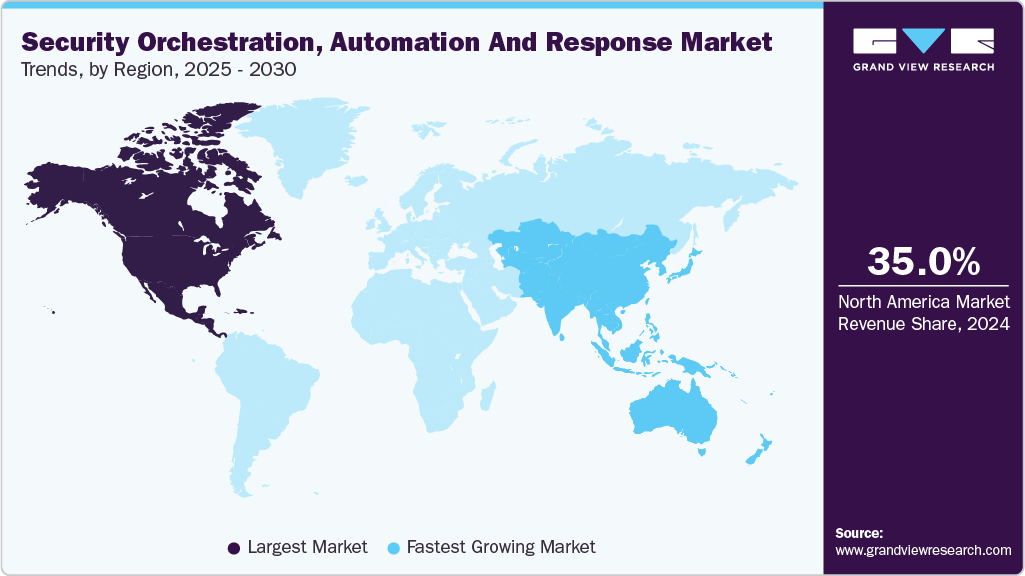
The global security orchestration, automation, and response market size was valued at USD 2.3 billion in 2025 and is projected to grow from USD 2.6 billion in 2026 to USD 6.7 billion by 2033, at a CAGR of 14.7% from 2026 to 2033. The North America market dominated, with a revenue share of 39.7% in 2025. The market is a rapidly growing segment of cybersecurity that helps organizations streamline and automate security operations.
 Source: Grand View Research, IR Documents, Primary Interviews, Paid DatabasesTo learn more about this report,
 Download Free Sample Report
 Key Market Trends & Insights
- By Component: Solutions segment dominated the market, with a revenue share of 75.7% in 2025
- By Deployment: Cloud-based segment dominated the market, with a revenue share of 61.7% in 2025
- By Enterprise Size: Large enterprises segment dominated the market in 2025
- By Application: Incident response segment dominated the market in 2025
- By Vertical: IT and telecom segment held the largest market share in 2025
Regional Highlights
- Largest regional market: North America (39.7% revenue share, 2025)
- Fastest-growing regional market: Asia Pacific (highest CAGR, 2026–2033)
- By country: The U.S. held the largest market share in 2025
Market Size & Forecasts
- Market size in 2025: USD 2.3 Billion
- Estimated market size in 2026: USD 2.6 Billion
- Projected market size by 2033: USD 6.7 Billion
- CAGR (2026–2033): 14.7%
Three ways to get this report
Buy it, customize it, or ask a question.Ask an Analyst
Analyst response in 1 business day
- AccessReport author, directly
- Reply timeWithin 1 working day
- No sales callDirect answer only
- FormatEmail reply
- CostFree, no cost
Get the Full Report
What the study covers
- FormatsPDF · Excel · Dashboard
- Timeline2026–2033 annual, 2025 base
- Coverage20+ countries, 5 regions
- Companies10+ key players profiled
Customize the Report
20% free customization
- IncludeCountries, segments, points
- TailorTo your product definition
- ExtendDeeper competitor detail
- OrA fully bespoke study
- Turnaround5–10 working days
Security orchestration, automation, and response (SOAR) platforms integrate multiple security tools, automate repetitive tasks, and accelerate incident detection and response through centralized workflows and analytics. As digital infrastructures expand and cyber threats become more frequent and sophisticated, traditional manual processes struggle to manage the growing volume of security alerts. By automating triage, investigations, and response playbooks, SOAR solutions improve operational efficiency, reduce response times, and enable security teams to focus on high-priority threats.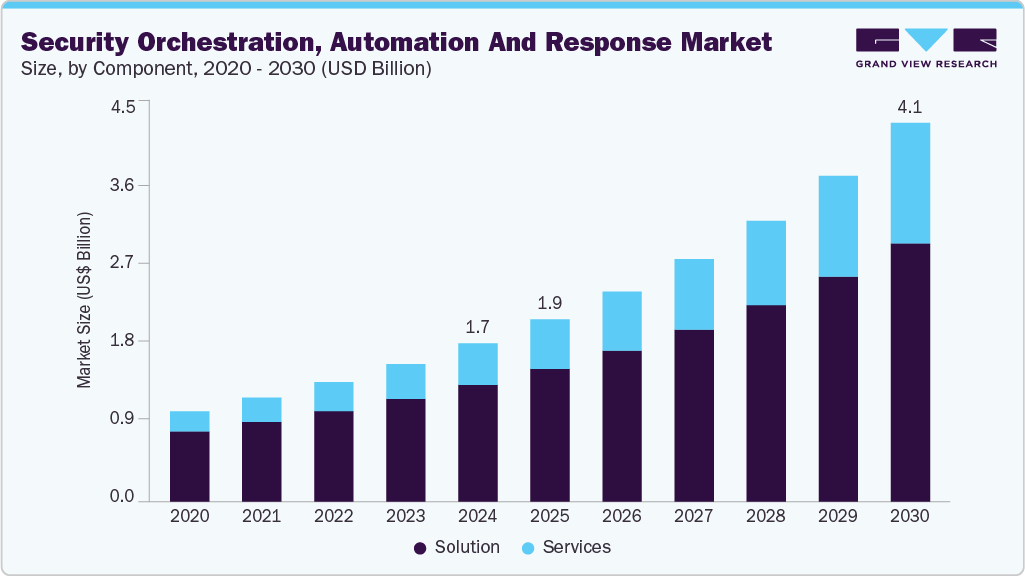 To learn more about this report, Download Free Sample Report
 SOAR platforms integrate various security tools, automate routine tasks, and enhance incident response through centralized dashboards and analytics. They help Security Operations Centers (SOCs) manage rising threat volumes, optimize workflows, and improve response times. With expanding digital infrastructures, organizations face a growing attack surface that strains cybersecurity teams. Traditional manual methods are no longer sufficient for handling complex, high-volume alerts. SOAR solutions automate triage, response playbooks, and investigations, allowing analysts to focus on critical threats. The growing frequency and complexity of cyberattacks ranging from ransomware and phishing to advanced persistent threats have made swift and effective incident response a critical need for organizations. Traditional manual response methods are often too slow to contain rapidly evolving threats, increasing the risk of data breaches, financial losses, and reputational damage.
SOAR (Security Orchestration, Automation, and Response) platforms address this challenge by automating repetitive tasks, correlating data from multiple security tools, and executing predefined response playbooks in real time. This enables faster detection, triage, and mitigation of incidents, minimizing the impact on operations. By reducing response time from hours to minutes, SOAR empowers security teams to stay ahead of attackers and ensure consistent, policy-driven responses. Additionally, automation reduces analyst fatigue and error rates, especially in high-alert environments. As threat actors become more sophisticated, organizations increasingly rely on SOAR to scale their defenses and enhance cyber resilience across diverse IT environments.
The adoption of SOAR is expected to grow among organizations due to its superior capabilities and applications across areas such as threat intelligence, compliance management, workflow management, and response procedures. SOAR offers orchestration layers that are highly effective in implementing plugins, such as common use cases, processes, and technologies, which help create pre-built workflows. These pre-built security workflows can then be automated, and the technology stack can be connected to handle routine tasks and processes. Thus, it assists security monitoring teams in taking fast responses against potential security threats and is aimed at supporting security orchestration, automation, and response (SOAR) market growth.
Vendor lock-in is a major factor hampering the market growth as proprietary SOAR platforms limit integration with other tools, restricting flexibility and customization. This can make it difficult for organizations to switch vendors or scale their security operations as needs evolve. Such dependency raises concern about long-term costs, adaptability, interoperability often delays purchasing decisions, as businesses prioritize future-proofing and operational agility.
Market Dynamics
The Security Orchestration, Automation, and Response (SOAR) market is witnessing strong growth as organizations increasingly adopt AI-driven security operations to address the rising volume and complexity of cyber threats. Enterprises are integrating SOAR platforms with extended detection and response (XDR), security information and event management (SIEM), cloud-native security, and threat intelligence solutions to create unified and automated security ecosystems. The growing adoption of hybrid and multi-cloud environments, coupled with the expansion of remote work and connected devices, has significantly increased the attack surface, driving demand for intelligent automation that reduces alert fatigue, improves analyst productivity, and accelerates incident response.
Another key market trend is the increasing use of generative AI and machine learning to enhance SOAR capabilities, including automated threat investigation, contextual alert prioritization, and adaptive response playbooks. Organizations across BFSI, healthcare, government, manufacturing, and critical infrastructure are investing in SOAR solutions to strengthen cyber resilience while addressing the shortage of skilled cybersecurity professionals. At the same time, rising regulatory requirements for cybersecurity reporting, data protection, and operational resilience are encouraging enterprises to deploy automated security orchestration platforms that improve compliance, standardize incident response, and reduce operational risks.
The increasing frequency and sophistication of cyberattacks have become one of the primary drivers of the Security Orchestration, Automation, and Response (SOAR) market. Organizations across industries are facing a surge in ransomware, phishing, business email compromise (BEC), insider threats, and advanced persistent threats (APTs), resulting in a significant rise in security alerts. As digital transformation, cloud adoption, and connected devices continue to expand the attack surface, security operations centers (SOCs) are under growing pressure to detect and respond to threats quickly while minimizing operational disruptions.
Traditional manual security processes are no longer sufficient to manage the growing complexity and volume of incidents. SOAR platforms automate alert triage, incident investigation, threat intelligence enrichment, and response playbooks, significantly reducing response times and improving analyst productivity. By enabling faster containment of cyber threats, reducing alert fatigue, and enhancing operational efficiency, SOAR solutions help organizations strengthen cyber resilience while optimizing the performance of their cybersecurity teams.
Despite the increasing adoption of SOAR platforms, implementation remains challenging due to the complexity of integrating these solutions with existing cybersecurity infrastructures. Many organizations operate in diverse environments consisting of legacy security tools, cloud platforms, endpoint protection solutions, identity management systems, and third-party applications. Ensuring seamless interoperability across these technologies often requires extensive customization, workflow development, and ongoing maintenance, increasing deployment complexity.
In addition, successful SOAR implementation requires experienced cybersecurity professionals capable of designing automated playbooks, fine-tuning workflows, and managing continuous optimization. The shortage of skilled cybersecurity personnel, coupled with high deployment and training costs, creates barriers for small and medium-sized enterprises (SMEs). These factors can extend implementation timelines and delay return on investment, limiting broader adoption in cost-sensitive organizations.
The growing integration of artificial intelligence (AI), machine learning (ML), and generative AI into cybersecurity platforms is creating significant opportunities for the SOAR market. AI-powered SOAR solutions can automatically prioritize alerts, identify attack patterns, recommend remediation actions, and continuously optimize response playbooks based on evolving threat intelligence. These capabilities enable organizations to improve threat detection accuracy, reduce manual intervention, and accelerate incident response across increasingly complex IT environments.
At the same time, the rapid migration toward hybrid and multi-cloud infrastructures is driving demand for centralized and automated security management. Organizations require SOAR platforms that can orchestrate security operations across cloud workloads, endpoints, networks, and SaaS applications while maintaining compliance with evolving cybersecurity regulations. As enterprises continue to invest in cloud security, Zero Trust architectures, and extended detection and response (XDR) strategies, SOAR vendors have substantial opportunities to deliver scalable, AI-enabled automation platforms that improve operational resilience and reduce cybersecurity risks.
Analyst Perspective
The Security Orchestration, Automation, and Response (SOAR) market is evolving into a critical pillar of modern cybersecurity operations as organizations transition toward fully integrated and automated Security Operations Centers (SOCs). The increasing sophistication of cyber threats, combined with rapid expansion of cloud, hybrid IT, and API-driven ecosystems, is driving strong demand for unified security automation platforms. Enterprises are increasingly consolidating fragmented security tools such as SIEM, XDR, EDR, and threat intelligence systems into centralized SOAR-enabled environments to reduce response time, minimize alert fatigue, and improve operational efficiency. From an analyst perspective, the market is shifting from basic workflow automation toward intelligent, AI-driven orchestration platforms capable of predictive threat response and adaptive decision-making.
Component Insights
Based on component, the solution segment led the market with the largest revenue share of 75.7% in 2025. Organizations require faster, more consistent responses as cyber threats grow more sophisticated. SOAR solutions address this by offering automated playbooks that enable immediate action based on predefined protocols. This minimizes dwell time, reduces the impact of attacks, and ensures compliance with incident response standards. Additionally, SOAR platforms are built to integrate seamlessly with existing security infrastructure, such as SIEM systems, endpoint detection and response (EDR), and ticketing tools without requiring major architectural changes. This interoperability enhances the overall efficiency of security operations, allowing organizations to maximize the value of their current tools while improving coordination and response capabilities.
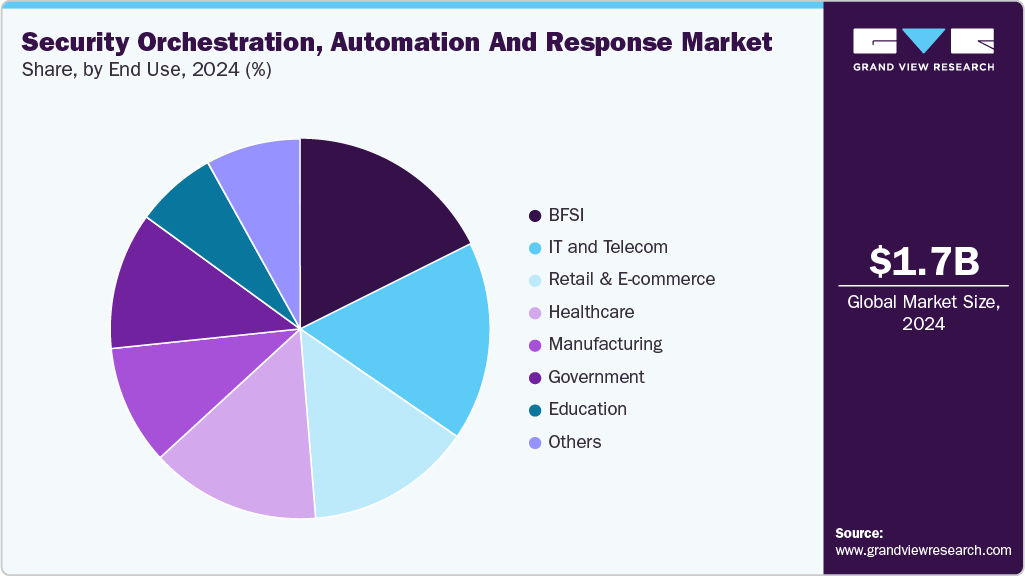
The services segment is expected to grow at a significant CAGR during the forecast period. The security orchestration, automation, and response services segment includes maintenance, deployment, consultation, customer support, and training services. The growing demand for security orchestration, automation, and response solutions and software in various end-use industries, such as BFSI, IT and Telecom, retail, and healthcare to strengthen their security capabilities are the primary factors expected to support the segment growth in the security orchestration, automation, and response (SOAR) market over the forecast period.
Deployment Mode Insights
Based on the deployment, the cloud-based segment led the market with the largest revenue share of 61.7% in 2025. As organizations migrate their workloads to cloud environments to gain agility, scalability, and cost savings, their IT infrastructures become more complex and distributed. This transition significantly increases the attack surface, exposing more vulnerabilities across cloud, on-premises, and hybrid systems. To address these challenges, cloud-native SOAR solutions are gaining traction. These platforms are designed to orchestrate and automate security operations across diverse environments, enabling faster detection, analysis, and response to threats. Their ability to seamlessly integrate with cloud services and scale dynamically makes them ideal for modern enterprises seeking to secure their expanding digital footprint while maintaining operational efficiency and compliance in a rapidly evolving threat landscape.
The on-premises segment is expected to register a CAGR of 13.3% during the forecast period. On-premise security orchestration, automation, and response provide in-house SOAR software and solution offerings that ensures better control and security assurance across their networks, applications, and devices. Further, it offers organizations the utmost flexibility in adopting workflows, forming, and managing integrations, or building processes from scratch based on their focus areas and dynamic security environment. Thus, the defined factors are expected to strengthen the growth of the on-premise segment in the security orchestration, automation, and response (SOAR) market.
Enterprise Size Insights
Based on the enterprise size, the large enterprises segment led the market with the largest revenue share of 52.2% in 2025. Large enterprises manage extensive IT infrastructures spanning multiple locations, resulting in thousands of daily security alerts from various systems and devices. This overwhelming volume makes it challenging for security teams to manually analyze and prioritize threats effectively. SOAR platforms address this by automating the triage process filtering, correlating, and categorizing alerts based on severity and context. Automated incident response workflows enable faster handling of routine threats, freeing analysts to focus on critical, high-priority incidents. This not only improves operational efficiency but also reduces analyst fatigue and the risk of errors caused by alert overload
 To learn more about this report, Download Free Sample Report
 The SMEs segment is expected to register the highest CAGR of 16.3% during the forecast period. The demand for SOAR is growing among SMEs as it helps organizations with limited budgets and resources effectively handle their security postures. SOAR offers a sophisticated approach and automated processes requiring limited human interventions, effectively conserving time and money. The following capabilities assisting SMEs in saving costs and resources along with enhancing security awareness are the key factors driving the demand in the following segment.
Application Insights
Based on the application, the incident response segment led the market with the largest revenue share of 37.6% in 2025. As cyberattacks grow more frequent and complex, organizations face increasing pressure to respond quickly and effectively to minimize damage. Traditional manual incident response methods often struggle to keep pace with the evolving threat landscape. SOAR platforms address this challenge by automating and streamlining incident response processes, enabling security teams to detect, analyze, and contain threats faster. By leveraging automated workflows and predefined playbooks, SOAR significantly reduces the Mean Time to Respond (MTTR), ensuring that incidents are handled promptly and consistently. This rapid response capability helps limit operational downtime, reduces potential financial and reputational losses, and strengthens overall cybersecurity resilience in an increasingly hostile environment.
The threat intelligence segment is expected to grow at a significant CAGR during the forecast period. SOAR helps organizations in bridging the gap between threat intelligence and response-sharing processes. It collects security alert information and metrics from integrated security tools and external feeds, allowing a centralized representation in the SOAR platform. The SOAR security solution allows analysts to correlate information from different sources, prioritize alerts, filter out false positives, and identify the critical security tasks that require more effort and time. Thus, the application of security orchestration, automation, and response in areas of threat intelligence is expected to drive the market demand.
End-use Insights
The BFSI segment accounted for the largest market share in 2024. The BFSI sector faces elevated risks of cyber threats and financial fraud due to its handling of sensitive personal and transactional data, making it a frequent target for cybercriminals. SOAR platforms address these risks by automating key functions such as threat detection, incident triage, and response, enabling real-time mitigation of threats and reducing potential fraud. Additionally, BFSI institutions operate under strict regulatory frameworks like GDPR, PCI-DSS, GLBA, and FFIEC. SOAR solutions aid in compliance by automating documentation, enforcing security policies, and maintaining detailed audit trails. This ensures regulatory alignment while enhancing the speed, consistency, and accountability of incident response across the financial ecosystem.
The retail & e-commerce segment is expected to grow at a CAGR of 18.1% during the forecast period. The growth of omnichannel retailing including web, mobile apps, in-store systems, and social commerce has significantly expanded the attack surface for retailers. This complexity increases the likelihood of cyber threats across multiple entry points. SOAR platforms address this by offering centralized visibility and coordination, allowing security teams to monitor, detect, and respond to incidents across all digital touchpoints efficiently. This ensures consistent protection and faster incident resolution in multi-channel retail environments.
Regional Insights
North America dominated the global Security orchestration, automation, and response market, with the largest revenue share of 39.7% in 2025. North America leads in adopting advanced cybersecurity technologies, with many enterprises already having mature and layered security infrastructures. This readiness allows seamless integration of SOAR platforms, enabling incident response automation, improving operational efficiency, and significantly reducing response times to evolving threats across complex digital environments.
 To learn more about this report, Download Free Sample Report
 U.S. Security Orchestration, Automation, and Response Market Trends
The Security orchestration, automation, and response market in the U.S. held the largest share of the North American market in 2025. The U.S. hosts leading SOAR vendors such as Palo Alto Networks, IBM, Splunk, and Rapid7, fostering a highly innovative cybersecurity landscape. This strong vendor presence ensures continuous product advancement, widespread availability, and active partner ecosystems, all accelerating market adoption and enhancing customer access to advanced SOAR solutions.
Europe Security Orchestration, Automation, and Response Market Trends
The security orchestration, automation, and response (SOAR) market in Europe is expected to grow at a CAGR of 16.1% from 2025 to 2033. Europe has some of the world’s most stringent data protection laws, including the General Data Protection Regulation (GDPR) and the NIS2 Directive. These frameworks mandate rapid breach detection, response, and documentation making SOAR solutions essential for compliance and efficient incident management.
The UK security orchestration, automation, and response (SOAR) market is expected to grow rapidly in the coming years. The UK frequently faces advanced cyber threats, including nation-state attacks targeting critical infrastructure, finance, and government sectors. SOAR helps security teams automate threat detection, accelerate response, and maintain operational continuity against increasingly complex attacks.
The Germany security orchestration, automation, and response (SOAR) market held a substantial market share in 2024. As a leader in advanced manufacturing and automation (Industry 4.0), German industries are increasingly targeted by cyberattacks. SOAR platforms help protect operational technology (OT) and industrial control systems (ICS) by integrating IT and OT security and automating incident response.
Asia Pacific Security Orchestration, Automation, and Response Market Trends
The security orchestration, automation, and response (SOAR) market in the Asia Pacific is expected to grow at the highest CAGR of 18.4% from 2025 to 2033. The rising technology adoption, including connected web applications, IoT devices, and interface technologies across industries such as BFSI, IT and Telecom, retail, and others, is increasing the demand for robust security solutions in the region. SOAR ensures cost-effectiveness by reducing dependency on security analysts and helping emerging and small players in the region to handle security challenges more effectively are the key factors expected to drive the demand for security orchestration, automation, and response solutions and services in the Asia Pacific region.
The security orchestration, automation, and response (SOAR) market in China held a substantial market share in 2024. China’s massive digital infrastructure expansion, including widespread cloud migration and smart city initiatives, increases the complexity and scale of IT environments. SOAR solutions are essential to automate security operations and manage threats efficiently across hybrid and multi-cloud systems.
The Japan security orchestration, automation, and response (SOAR) Market held a substantial market share in 2024. With the growing adoption of cloud services and digital technologies, Japanese enterprises require advanced security automation to manage distributed environments and hybrid cloud setups. SOAR platforms facilitate centralized orchestration and consistent response across diverse IT assets.
The security orchestration, automation, and response (SOAR) market in India is growing due to India’s rapid digital growth, cloud adoption, and initiatives like Digital India which has broadened the IT environment and increased cyber risks. SOAR solutions play a vital role by automating security processes, enabling efficient threat management and response across complex, hybrid, and distributed infrastructure, enhancing overall cybersecurity resilience.
Key Security Orchestration, Automation And Response Company Insights
The key market players in the global security orchestration, automation, and response (SOAR) market include Corporation, Splunk Inc., Palo Alto Networks, Microsoft Corporation, Logpoint, Rapid7, ServiceNow, Siemplify, Fortinet, Inc., Swimlane SOAR, SentinelOn, BlackBerry Limited., AT&T, KnowBe4, Inc., and Tines. The companies are focusing on various strategic initiatives, including new Solution development, partnerships & collaborations, and agreements to gain a competitive advantage over their rivals. The following are some instances of such initiatives.
Key Security Orchestration, Automation, And Response Companies
The following key companies have been profiled for this study on the security orchestration, automation, and response (SOAR) market.
-
AT&T
-
BlackBerry Limited.
-
Fortinet, Inc.
-
Google - Siemplify
-
IBM Corporation
-
KnowBe4, Inc.
-
Logpoint
-
Microsoft Corporation
-
Palo Alto Networks
-
Rapid7
-
SentinelOn
-
ServiceNow
-
Splunk Inc.
-
Swimlane SOAR
-
Tines
Competitive Benchmarking
Category
Operating Strategies
Competitive Edge
Weakness
Mature Players (IBM Corporation; Microsoft Corporation; Palo Alto Networks; Fortinet, Inc.; Splunk Inc.; ServiceNow; Google Siemplify; AT&T)
- Focus on delivering enterprise-grade SOAR platforms integrated with SIEM, XDR, EDR, cloud security, and IT service management ecosystems. Strong emphasis on AI/ML-powered automation, end-to-end security orchestration, and cloud-native SOC modernization. Expansion through bundled cybersecurity suites and platform consolidation strategies.
- Strong global presence, deep enterprise adoption, and highly scalable security infrastructures. Advanced threat intelligence capabilities, strong ecosystem integration, and high trust among BFSI, government, telecom, and large enterprises. Ability to offer full-stack security operations platforms with compliance-ready frameworks.
- High cost of ownership, complex deployment and integration across heterogeneous environments, and potential vendor lock-in due to tightly coupled ecosystems. Limited flexibility for highly customized or lightweight SOC environments.
Emerging Players (Logpoint; Rapid7; Swimlane SOAR; SentinelOne; Tines; BlackBerry Limited)
- Focus on cloud-native, API-first, and modular SOAR solutions designed for fast deployment and seamless integration with existing security stacks. Strong emphasis on low-code/no-code automation, workflow orchestration, and DevSecOps-aligned security operations. Targeting mid-market enterprises, MSSPs, and agile digital-native organizations.
- High flexibility, faster onboarding, and strong customization capabilities. Cost-effective deployment models and strong appeal for organizations seeking lightweight, interoperable SOAR solutions. Strong innovation in automation workflows and integration simplicity.
- Limited global-scale threat intelligence infrastructure compared to hyperscale vendors. Less comprehensive end-to-end security ecosystem coverage and reliance on third-party integrations for full SOC functionality. Smaller enterprise footprint and lower brand dominance in highly regulated industries.
Recent Developments
-
In April 2025, Splunk announced that Splunk SOAR is now offered as a native SaaS on Microsoft Azure, enabling automation of security workflows and faster response by integrating Azure services and third-party tools. It supports Microsoft Sentinel, Defender, and Entra ID, allowing users to enhance threat detection and streamline security operations efficiently.
-
In April 2025, Rapid7 introduced its Managed Detection & Response (MDR) for Enterprise, a fully managed and customizable service designed for complex, distributed environments. This offering provides 24/7 protection, integrating proprietary and legacy systems, and tailoring detection logic to specific organizational needs. It enhances threat monitoring and streamlines incident response through close collaboration between Rapid7's Security Operations Center and internal teams.
-
In March 2025, Tines expanded its partnership with Elastic to offer an integrated solution combining Elastic's Search AI Platform with Tines' Workflow Automation. This collaboration aims to enhance security and observability by providing AI-driven analytics and automated workflows, enabling faster issue resolution, improved operational efficiency, and reduced costs for organizations.
Security Orchestration, Automation, And Response Market Report Scope
Report Attribute
Details
Market size in 2025
USD 2.3 billion
Estimated Market Size in 2026
USD 2.6 billion
Projected Market Size in 2033
USD 6.7 billion
Growth rate
CAGR of 14.7% from 2026 to 2033
Base year for estimation
2025
Historical data
2021 - 2024
Forecasts period
2026 - 2033
Quantitative units
Revenue in USD billion/billion and CAGR from 2026 to 2033
Report coverage
Revenue forecasts, company market share analysis, competitive landscape, growth factors, and trends
Segments covered
Component, deployment, enterprise size, application, vertical, region
Regional scope
North America; Europe; Asia Pacific; Latin America; MEA
Country scope
U.S.; Canada; Mexico; Germany; UK; France; Italy; Spain; China; Japan; India; South Korea; Australia; Brazil; Saudi Arabia; South Africa; UAE
Key companies profiled
IBM Corporation; Splunk Inc.; Palo Alto Networks; Microsoft Corporation; Logpoint; Rapid7; ServiceNow; Google - Siemplify; Fortinet, Inc.; Swimlane SOAR; SentinelOn; BlackBerry Limited.; AT&T; KnowBe4, Inc.; Tines
Customization scope
Free report customization (equivalent to up to 8 analysts' working days) with purchase. Addition or alteration to country, regional & segment scope.
Pricing and purchase options
Avail customized purchase options to meet your exact research needs. Explore purchase options
Global Security Orchestration, Automation & Response Market Report Segmentation
This report forecasts market Size growth at global, regional, and country levels and provides an analysis of the latest industry trends in each of the sub-segments from 2021 to 2033. For this study, Grand View Research has segmented the global security orchestration, automation, and response (SOAR) market report based on component, application, deployment mode, organization size, end-use, and region:
-
Component Outlook (Revenue, USD Million, 2021 - 2033)
-
Solution
-
Services
-
-
Application Outlook (Revenue, USD Million, 2021 - 2033)
-
Threat Intelligence
-
Network Forensics
-
Incident Response
-
Compliance
-
Others
-
-
Deployment Mode Outlook (Revenue, USD Million, 2021 - 2033)
-
Cloud
-
On-premise
-
-
Organization Size Outlook (Revenue, USD Million, 2021 - 2033)
-
SMEs
-
Large enterprises
-
-
End-use Outlook (Revenue, USD Million, 2021 - 2033)
-
Government
-
Retail & E-commerce
-
Healthcare
-
Banking, Financial Services, and Insurance (BFSI)
-
IT and Telecom
-
Manufacturing
-
Education
-
Others
-
-
Regional Outlook (Revenue, USD Million, 2021 - 2033)
-
North America
-
U.S.
-
Canada
-
Mexico
-
-
Europe
-
Germany
-
UK
-
France
-
-
Asia Pacific
-
China
-
India
-
Japan
-
South Korea
-
Australia
-
-
Latin America
-
Brazil
-
-
Middle East & Africa
-
U.A.E
-
Saudi Arabia
-
South Africa
-
-
Research Methodology
The security orchestration, automation, and response market figures in this report are based on a proven research process that combines executive interviews with secondary research from proprietary databases, company filings, and recognized regulatory and institutional sources. Market size is built through value-chain sizing-reconciling supply-side and demand-side estimates-and triangulated with bottom-up and top-down approaches. Every estimate passes multiple levels of expert validation before publication, with each security orchestration, automation, and response segment quantified using the revenue-capture definitions in the table below.
Segment Definition
Component
Revenue Capture Definition
Solution
Revenue generated from SOAR platforms and software solutions that provide security workflow orchestration, automated incident response, threat intelligence integration, alert triage, case management, and security tool integration across SIEM, XDR, EDR, and cloud security environments.
Services
Revenue from professional and managed services including SOAR deployment, integration with existing security ecosystems, workflow design, playbook development, customization, training, consulting, and ongoing managed security operations support provided by vendors and MSSPs.
Deployment
Revenue Capture Definition
Cloud-based
Revenue generated from SaaS-based SOAR platforms delivered via cloud infrastructure, including subscription fees, usage-based pricing, automated workflow execution, and integration with cloud-native security tools and APIs.
On-premises
Revenue from licensed SOAR software and deployed security orchestration systems installed within enterprise data centers, including perpetual licensing, maintenance contracts, and internal security infrastructure integration.
Enterprise Size
Revenue Capture Definition
Large Enterprises
Revenue generated from advanced, scalable SOAR platforms with deep automation, AI-driven orchestration, multi-source integration, custom workflows, compliance automation, and enterprise-wide SOC transformation capabilities.
Small and Medium-sized Enterprises (SMEs)
Revenue from standardized, cost-effective SOAR solutions offering basic to moderate automation capabilities, pre-built playbooks, and simplified integration for organizations with limited SOC maturity and cybersecurity budgets.
Application
Revenue Capture Definition
Threat Intelligence
Revenue from SOAR-enabled enrichment and automation of threat intelligence feeds, correlation of indicators of compromise (IOCs), and automated dissemination of actionable threat insights across security systems.
Network Forensics
Revenue generated from automated investigation of network traffic, security logs, and event data to reconstruct attack paths, identify anomalies, and support root-cause analysis.
Incident Response
Revenue from automated detection, triage, escalation, and remediation of security incidents through predefined and adaptive response playbooks within SOC environments.
Compliance
Revenue generated from automating regulatory reporting, audit trails, policy enforcement, and security governance workflows aligned with standards such as GDPR, HIPAA, ISO 27001, and others.
Others
Revenue from additional SOAR use cases such as security ticketing automation, vulnerability management workflows, IT operations security integration, and custom security orchestration processes.
Vertical
Revenue Capture Definition
BFSI
Revenue from SOAR deployments in banking, financial services, and insurance organizations for fraud detection automation, regulatory compliance, incident response, and protection of financial transaction systems.
IT and Telecom
Revenue generated from SOAR adoption in IT services, telecom operators, and cloud providers for managing large-scale security events, network incidents, and automated SOC operations.
Retail & E-commerce
Revenue from SOAR solutions used to protect digital storefronts, payment systems, customer data platforms, and online transaction ecosystems from cyber threats.
Healthcare
Revenue generated from SOAR adoption in hospitals, healthcare providers, and digital health platforms for protecting patient data, ensuring compliance, and automating incident response.
Manufacturing
Revenue from securing industrial networks, IoT-enabled production systems, and smart manufacturing environments through automated threat detection and response.
Government
Revenue generated from SOAR deployment in public sector and defense organizations for critical infrastructure protection, cyber defense automation, and national security operations.
Education
Revenue from SOAR adoption in universities, schools, and research institutions for protecting academic networks, student data, and digital learning environments.
Others
Revenue from additional sectors such as energy & utilities, logistics, travel & hospitality, and other digitally dependent industries requiring automated cybersecurity operations.
Estimation Model
Layer No.
Layer
Question
Analysis
01
Security Exposure Layer (TAM)
Who can potentially require SOAR solutions?
All organizations with digital operations exposed to cyber threats form the total addressable market. This includes enterprises, SMEs, cloud-native companies, BFSI institutions, government agencies, healthcare providers, telecom operators, energy & utilities, and critical infrastructure operators that face high volumes of security alerts, multi-vector cyberattacks, and increasing operational risk from ransomware, phishing, and APTs.
02
Security Operations Readiness Layer (SAM)
Who can technically adopt SOAR platforms?
Organizations with established or developing Security Operations Centers (SOCs), SIEM/XDR deployments, cloud or hybrid IT environments, and centralized security monitoring capabilities represent the serviceable market. These include enterprises using endpoint detection and response (EDR), threat intelligence platforms, cloud security tools, and API-driven ecosystems that can integrate automated security orchestration workflows.
03
Active SOAR Adoption Layer (SOM)
Who actively deploys SOAR today?
Organizations currently implementing SOAR solutions for automated incident response, alert triage, and security workflow orchestration. Key adopters include large enterprises, BFSI institutions, government cybersecurity agencies, managed security service providers (MSSPs), and digital-first companies that require real-time threat response, compliance automation, and SOC efficiency optimization.
04
Revenue Realization Layer
How is revenue generated?
Revenue is generated through subscription-based SOAR platforms (cloud/SaaS), on-premise licensing, managed detection and response (MDR) and MSSP offerings, professional services (integration, customization, and consulting), and value-added services such as automated playbook development, AI-driven threat intelligence integration, workflow optimization, and ecosystem integration with SIEM, XDR, and cloud security platforms.
Delivered Customizations
This report has been delivered with the following In-depth customizations
Client Request
Customization Delivered
Value Adds
SOAR adoption readiness & operational maturity assessment
Evaluated enterprise SOC maturity, including existing SIEM/XDR/EDR deployments, incident response workflows, alert management processes, and level of automation across security operations. Assessed readiness for SOAR integration across cloud, hybrid, and on-premise environments.
Helps organizations identify automation gaps, improve SOC efficiency, and prioritize SOAR deployment strategies aligned with digital transformation maturity.
SOAR architecture & ecosystem integration review
Assessed integration of SOAR platforms with existing cybersecurity ecosystems including SIEM, XDR, EDR, threat intelligence platforms, ITSM tools, cloud security stacks, and identity management systems. Reviewed suitability of cloud-native vs. hybrid SOAR deployment models.
Enables optimized security orchestration, improved interoperability across tools, reduced incident response time, and enhanced end-to-end visibility across security operations.
Competitive benchmarking & vendor positioning
Benchmarked key SOAR providers including IBM Corporation, Microsoft Corporation, Palo Alto Networks, Splunk Inc., ServiceNow, Fortinet, Rapid7, Swimlane SOAR, Tines, Logpoint, Google (Siemplify), SentinelOne, BlackBerry Limited, AT&T, and KnowBe4 on parameters such as automation depth, AI-driven orchestration, integration capability, scalability, and SOC transformation support.
Supports vendor evaluation, procurement decisions, and digital SOC modernization strategies by providing clear differentiation across enterprise-grade and emerging SOAR platforms.
Frequently Asked Questions About This Report
Some key players operating in the user and entity behavior analytics market include IBM Corporation, Splunk Inc., Palo Alto Networks, Microsoft Corporation, Logpoint, Rapid7, ServiceNow, Siemplify, Fortinet, Inc., Swimlane SOAR, SentinelOn, BlackBerry Limited., AT&T, KnowBe4, Inc., and Tines.
The rising cybersecurity skill gap constantly drives the demand for automated threat detection and response processes. The demand for SOAR is rising among organizations because it can alleviate alert fatigue, automate routine tasks, and simplify threat detection and response processes. It helps organizations to focus on complex and critical threats that require more effort and time by automating a series of processes such as threat detection, alert sharing, and documenting sources of cyber threats. Security orchestration, automation, and response solution utilize the gathered information and activates playbooks that use automation and orchestration to execute response tasks. It frees up security teams allowing them to focus on critical security projects and business objectives.
Asia Pacific is the fastest-growing region over the forecast period.
The solution segment led with a 75.7% revenue share in 2025, while services segment is the fastest-growing segment.
The cloud-based segment led with a 61.7% revenue share in 2025 and is also the fastest-growing segment.
The large enterprises segment led with a 52.2% revenue share in 2025, while the small and medium-sized enterprises segment is the fastest-growing segment.
The global security orchestration automation and response market size was estimated at USD 2.3 billion in 2025 and is expected to reach USD 2.6 billion by 2026.
The global SOAR market is expected to grow at a compound annual growth rate of 14.7% from 2026 to 2033 to reach USD 6.7 billion in 2033.
North America dominated with 39.7% revenue share in 2025.
About the Author(s)
Network Security Research Team
Technology · Network SecurityThis report was authored by the network security research team at Grand View Research - comprising two research analysts, one senior research analyst, and one industry expert - with specialized expertise in the network security segment of the technology industry. All findings are based on proprietary technology databases, executive interviews, and regulatory analysis, subject to internal peer review prior to publication.
Last Updated:
Speak to Analyst

Customize this report to your needs - add regions, segments, or data points, with 20% free customization.
Or view our licence options:


ISO 9001:2015 & 27001:2022 Certified
We are GDPR and CCPA compliant! Your transaction & personal information is safe and secure. For more details, please read our privacy policy.


