
- Home
- »
- Next Generation Technologies
- »
-
Seismic Services Market Size & Share Report, 2026-2033GVR Report cover

Seismic Services Market (2026 - 2033)
Size, Share & Trends Analysis Report By Service (Data Acquisition, Data Processing, Data Interpretation), By Technology, By Deployment, By Application, By Region, and Segment Forecasts
Market Size, 2025
$9.8BMarket Estimate, 2026
$10.2BMarket Forecast, 2033
$14.5BCAGR, 2026–2033
5.1%Seismic Services Market Summary
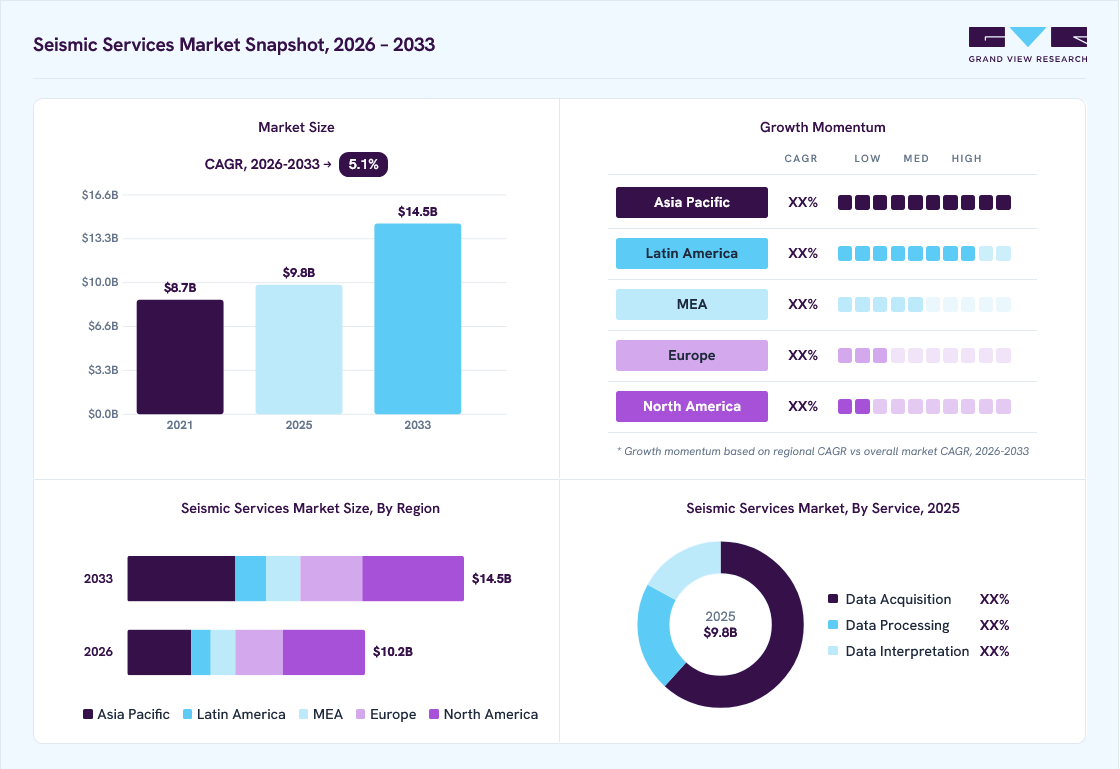
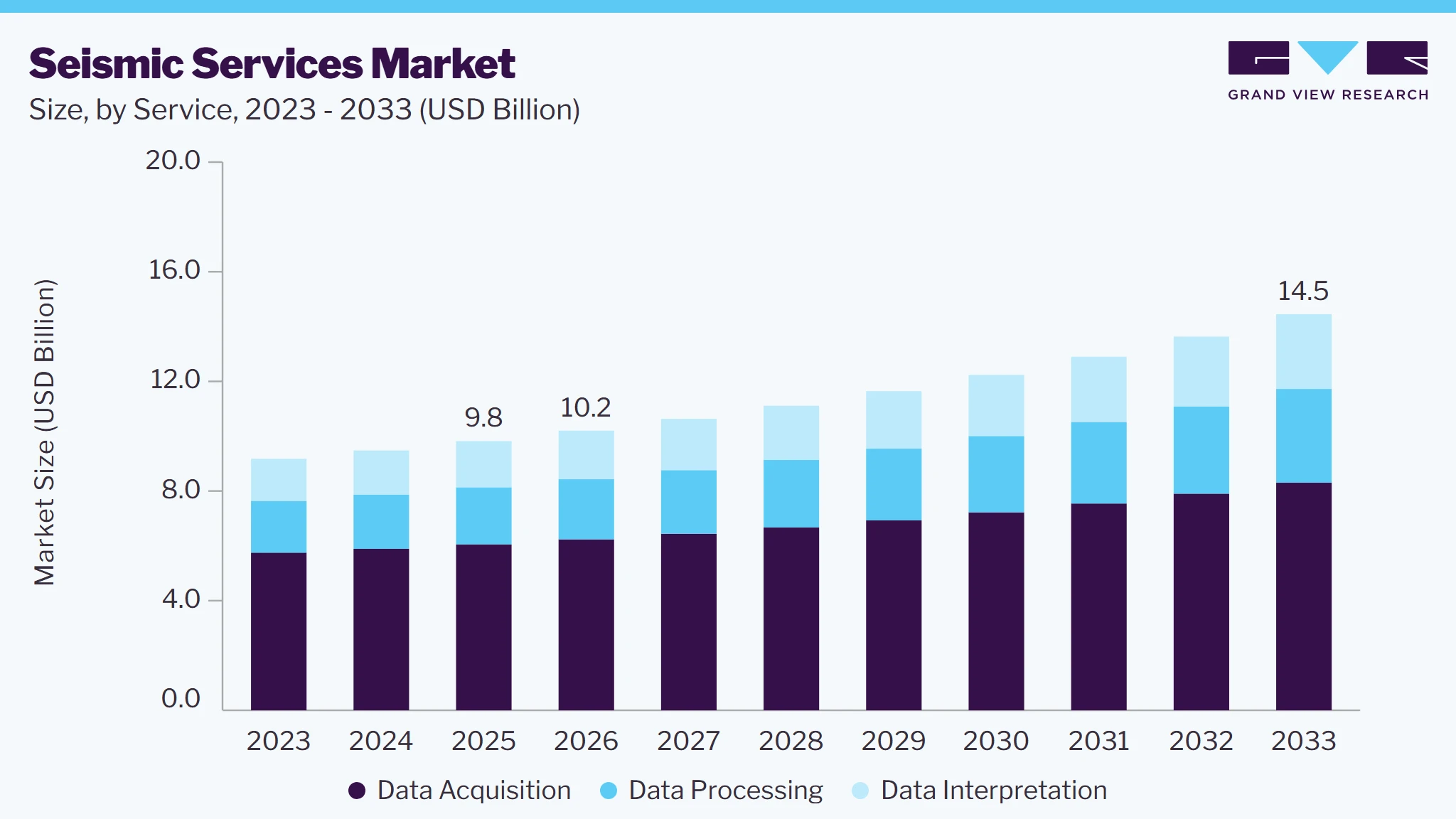
The global seismic services market size was valued at USD 9.8 billion in 2025 and is projected to grow from USD 10.2 billion in 2026 to USD 14.5 billion by 2033, at a CAGR of 5.1% from 2026 to 2033. The market in North America dominated with a revenue share of 35.2% in 2025. Market growth is primarily driven by the increasing demand for oil & gas exploration and production, rising adoption of advanced 3D and 4D seismic imaging technologies, growing offshore exploration activities, expansion of mining and mineral exploration, increasing deployment of CCUS and geothermal projects, and the need for high-resolution subsurface characterization to improve resource discovery and development decisions.
 Source: Grand View Research, IR Documents, Primary Interviews, Paid DatabasesTo learn more about this report,
 Download Free Sample Report
 Key Market Trends & Insights
- By service: Data acquisition segment held the largest market share of 61.6% in 2025.
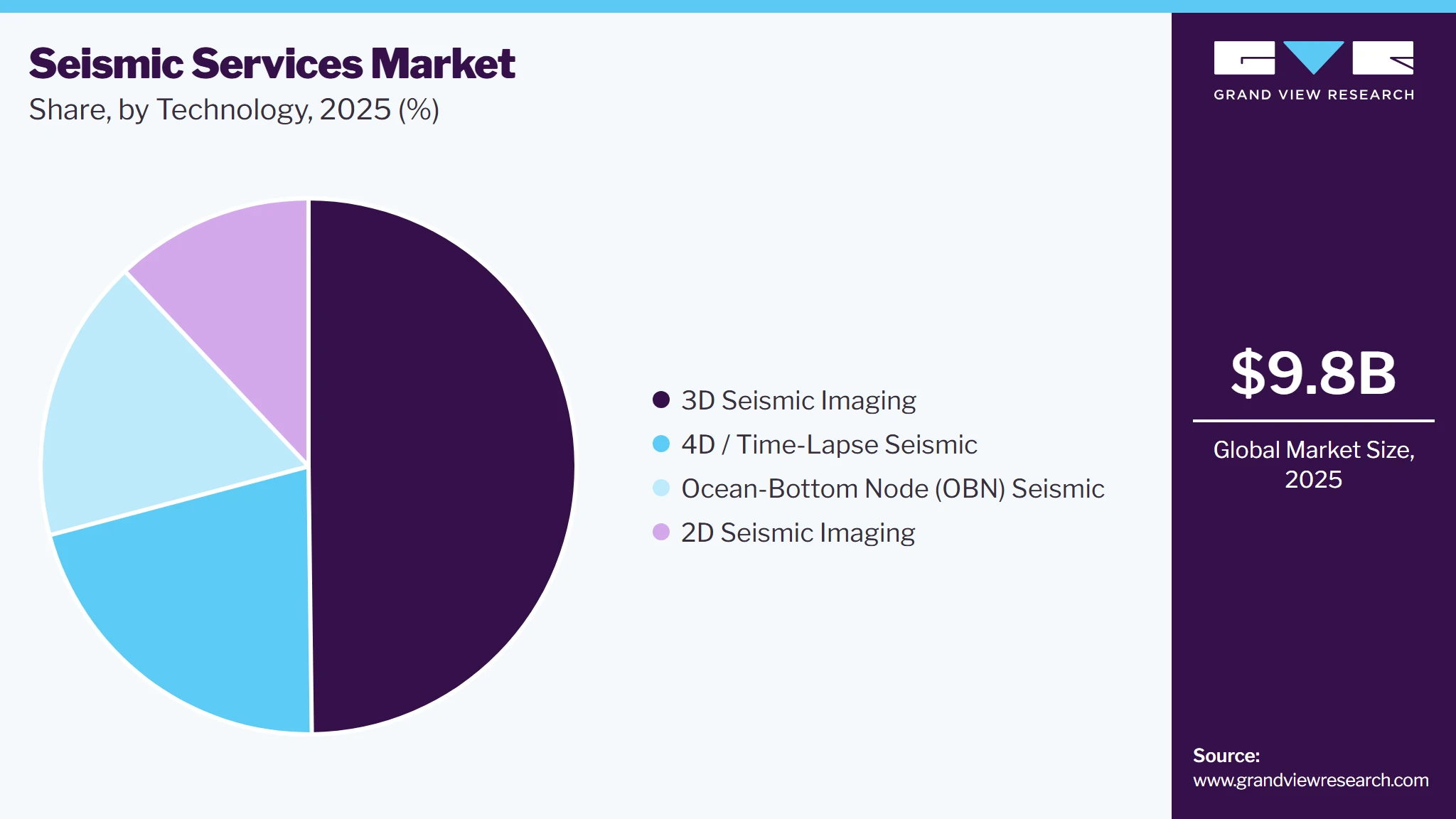
- By technology: 3d seismic imaging segment held the largest market share of 49.8% in 2025.
- By deployment: Onshore segment held the largest market share of 58.7% in 2025.
- By application: Oil & gas segment held the largest market share of 59.9% in 2025.
Regional Highlights
- Largest regional market: North America (35.2% revenue share, 2025)
- Fastest-growing regional market: Asia Pacific (highest CAGR, 2026-2033)
- By country: The U.S. held the largest market share in 2025
Market Size & Forecast
- Market size in 2025: USD 9.8 Billion
- Estimated market size in 2026: USD 10.2 Billion
- Projected market size by 2033: USD 14.5 Billion
- CAGR (2026-2033): 5.1%
Three ways to get this report
Buy it, customize it, or ask a question.Ask an Analyst
Analyst response in 1 business day
- AccessReport author, directly
- Reply timeWithin 1 working day
- No sales callDirect answer only
- FormatEmail reply
- CostFree, no cost
Get the Full Report
What the study covers
- FormatsPDF · Excel · Dashboard
- Timeline2026–2033 annual, 2025 base
- Coverage20+ countries, 5 regions
- Companies10+ key players profiled
Customize the Report
20% free customization
- IncludeCountries, segments, points
- TailorTo your product definition
- ExtendDeeper competitor detail
- OrA fully bespoke study
- Turnaround5–10 working days
 To learn more about this report, Download Free Sample Report
 Market Dynamics
The seismic services industry is shaped by increasing exploration and development of oil & gas resources, expansion of offshore and unconventional exploration activities, growing mineral exploration, and rising requirements for accurate subsurface characterization. Demand is further influenced by the need to improve exploration success rates, optimize drilling and field development decisions, monitor reservoir behavior, and assess complex geological formations.
The growing need to accurately characterize complex subsurface formations is driving demand for advanced seismic services across oil & gas, mining, geothermal, CCUS, and infrastructure applications. High-resolution seismic imaging enables operators to identify geological structures, faults, reservoirs, mineralized zones, and other subsurface characteristics with greater accuracy, supporting exploration planning, resource evaluation, well placement, and field development.
The growing use of advanced acquisition techniques, full-waveform inversion, and high-performance seismic processing is further improving imaging quality and subsurface interpretation. In addition, the expansion of seismic applications into CCS, geothermal energy, mining, and subsurface monitoring is increasing the need for detailed characterization of geological formations, supporting continued demand for advanced seismic services. Operators seek to reduce exploration risks, improve drilling outcomes, and maximize resource recovery, thereby driving the demand for sophisticated seismic acquisition, processing, and interpretation services, which is expected to increase.
Seismic surveys require significant investment in specialized equipment, survey vessels or field crews, seismic sources, sensors, data acquisition systems, computing infrastructure, and technical expertise. Offshore and remote-area surveys can involve additional logistical and environmental challenges, increasing project costs and execution complexity. Furthermore, seismic data processing and interpretation require specialized professionals and advanced computational capabilities, which can create barriers for smaller operators and organizations with limited budgets. Fluctuations in oil & gas exploration expenditure can lead to delays or reductions in seismic survey programs, constraining market growth.
The development of emerging subsurface energy applications is creating new opportunities for seismic service providers beyond conventional oil & gas exploration. Growing investment in carbon capture, utilization & storage is increasing the need for seismic surveys to characterize storage formations, establish geological baselines, assess containment structures, and monitor injected CO₂ over time. Similarly, the expansion of geothermal projects is increasing demand for seismic techniques to identify faults, fractures, and subsurface heat-bearing formations and support well targeting. These applications create opportunities for providers to diversify beyond hydrocarbon-focused projects and develop specialized seismic monitoring, imaging, and interpretation capabilities.
Market Concentration & Characteristics
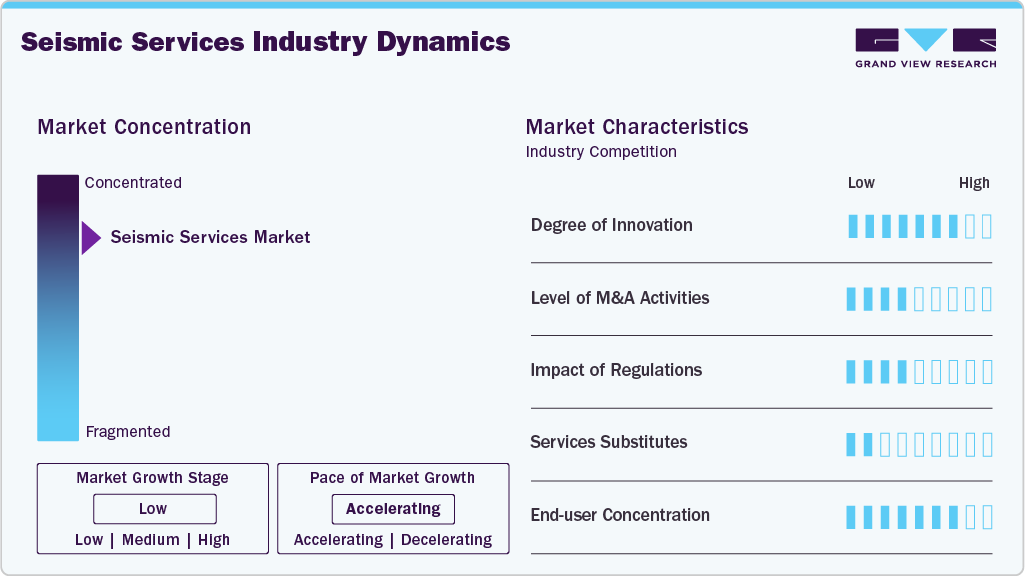
The seismic services industry is moderately concentrated, with competition among established global geophysical service providers, specialized seismic contractors, technology companies, and regional service firms offering data acquisition, processing, interpretation, imaging, and monitoring services across onshore and offshore environments. The market is characterized by high technical expertise, specialized equipment requirements, large-scale project execution capabilities, data quality, imaging accuracy, processing efficiency, and strong relationships with mining companies, energy developers, and government organizations.
 To learn more about this report, Download Free Sample Report
 Technology capabilities, geographic operating presence, fleet and equipment availability, processing infrastructure, technical expertise, and the ability to execute complex surveys play important roles in competitive positioning. The growing adoption of automated interpretation, and AI-assisted analysis is encouraging service providers to invest in next-generation technologies and computational capabilities. High capital requirements, technical expertise, established customer relationships, project execution experience, and regulatory knowledge create barriers for new entrants, while fluctuations in exploration budgets and competition for large contracts can pressure pricing.
Analyst Perspective
The market is evolving from conventional seismic surveying toward high-resolution, data-intensive, digitally enabled, and application-specific subsurface imaging and monitoring solutions. Furthermore, the market is expanding across infrastructure development, carbon capture and storage (CCS), and subsurface monitoring applications, supported by advances in seismic acquisition, processing, imaging, and data analytics technologies. These developments are broadening the application scope of seismic services while increasing demand for more accurate, efficient, and data-driven subsurface characterization and monitoring solutions.
Service Insights
The data acquisition segment led the market with the largest revenue share of 61.6% in 2025, driven by the increasing need to collect high-quality subsurface data for exploration, reservoir characterization, resource evaluation, and development planning across various sectors. Demand is particularly supported by continued exploration of complex and deeper geological formations, where high-density seismic acquisition is required to improve imaging quality and reduce geological uncertainty. The growing adoption of wireless and cable-free nodal systems, high-channel-count sensors, ocean-bottom nodes, advanced seismic sources, and distributed acoustic sensing is further accelerating segment growth.
The data processing segment is expected to grow at the fastest CAGR of 6.5% from 2026 to 2033, supported by the increasing volume and complexity of seismic datasets, growing adoption of advanced imaging and processing techniques, and rising demand for faster and more accurate subsurface interpretation. The growing use of legacy seismic data for reprocessing and reservoir characterization is also creating recurring demand for processing services, while cloud-native workflows and AI-assisted interpretation are shortening turnaround times and allowing operators to extract greater value from existing datasets.
Technology Insights
The 3D seismic imaging segment led the market with the largest revenue share of 49.8% in 2025, driven by its ability to provide detailed volumetric representations of subsurface formations, making it particularly valuable for hydrocarbon exploration, reservoir characterization, drilling optimization, mineral exploration, and complex geological assessment. Demand is accelerating as operators increasingly move toward deeper, more structurally complex, and higher-risk exploration areas where conventional 2D seismic cannot provide sufficient spatial resolution. The adoption of wide-azimuth acquisition, longer-offset surveys, high-density nodal systems, advanced migration techniques, FWI, and AI-enabled processing is improving the quality and interpretability of 3D datasets.
 To learn more about this report, Download Free Sample Report
 The 4D / time-lapse seismic segment is projected to grow at the fastest CAGR from 2026 to 2033, as energy operators increasingly require continuous or periodic monitoring of subsurface changes during field production and development. 4D seismic enables operators to compare seismic datasets acquired at different times to identify fluid movement, pressure changes, reservoir depletion, water breakthrough, and changes in reservoir behavior, thereby supporting improved production management and recovery optimization.
Deployment Insights
The onshore segment led the market with the largest revenue share of 58.7% in 2025, fueled by extensive land-based exploration and development activities. Demand is driven by continued exploration of conventional and unconventional hydrocarbon resources, mineral resource mapping, geological hazard assessment, and subsurface characterization for infrastructure and energy projects. The increasing deployment of wireless nodal receivers, cable-free seismic systems, high-channel-count land acquisition equipment, distributed acoustic sensing, and lightweight autonomous sensors is accelerating growth by reducing field logistics, improving crew mobility, and enabling higher-density surveys across challenging terrains.
The offshore segment is anticipated to grow at the fastest CAGR from 2026 to 2033, fueled by increased exploration and development of deepwater and ultra-deepwater hydrocarbon resources, as well as growing offshore energy and marine infrastructure activity. The technical complexity of offshore formations and higher costs associated with drilling in deepwater environments are increasing the need for high-quality seismic imaging to reduce exploration risk and optimize well placement. Growth is being accelerated by 3D and 4D seismic, long-offset and wide-azimuth streamers, ocean-bottom nodes, multicomponent acquisition, and advanced imaging technologies, which provide improved imaging beneath salt, basalt, and other complex geological structures.
Application Insights
The oil & gas segment led the market with the largest revenue share of 59.9% in 2025, driven by continued hydrocarbon exploration and production activities, increasing deepwater resource development, rising demand for high-resolution 3D and 4D seismic imaging for reservoir characterization, and the need to reduce drilling risks and optimize well placement and reservoir recovery. Furthermore, the continued development of mature and unconventional hydrocarbon fields, increasing adoption of advanced seismic acquisition and processing technologies, and growing use of seismic data for reservoir monitoring and enhanced oil recovery are strengthening demand for seismic services across the oil & gas value chain.
The carbon capture, utilization & storage (CCUS) segment is expected to grow at the fastest CAGR from 2026 to 2033, fueled by the increasing development of large-scale carbon storage projects and the need to verify the safe and permanent containment of injected CO₂. Seismic surveys are used to characterize potential storage formations, identify faults and structural boundaries, establish baseline subsurface conditions, and monitor changes in the storage complex following injection. Growth is being accelerated by regulatory monitoring requirements, expansion of dedicated CO₂ storage hubs, 3D baseline surveys, 4D time-lapse monitoring, OBN technologies, permanent seismic monitoring systems, and advanced imaging and interpretation tools.
Regional Insights
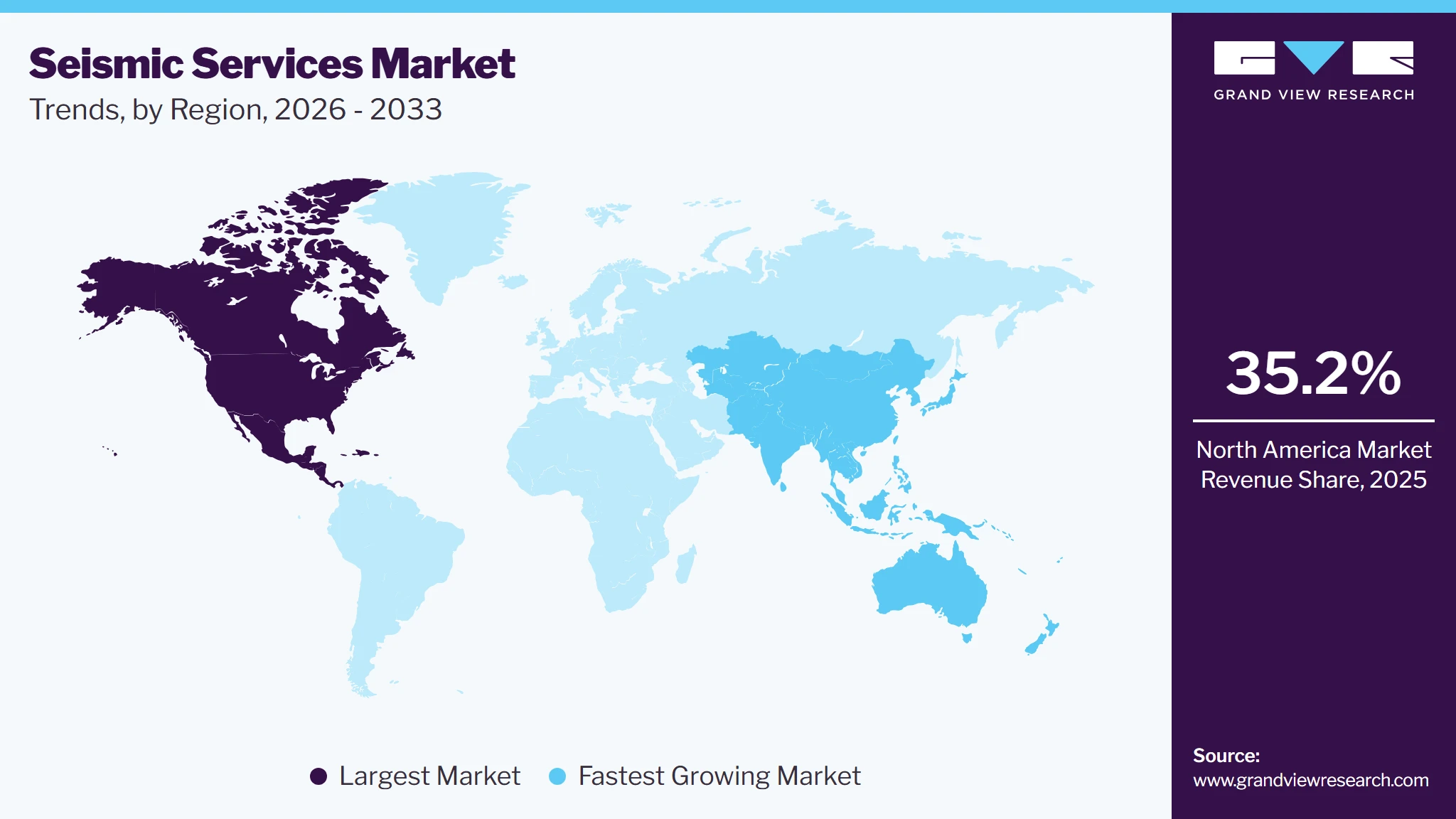
The North America seismic services market held the largest revenue share of 35.2% in 2025, driven by the large installed base of mature hydrocarbon fields and increasing requirements for reservoir monitoring and enhanced recovery. Operators are using repeat seismic surveys and advanced interpretation to better understand reservoir depletion, fluid movement, and remaining resource potential. In addition, the region’s expanding CCUS ecosystem is creating demand for subsurface characterization and monitoring, particularly around large-scale carbon storage hubs. Strong geophysical infrastructure, advanced computing capabilities, and the presence of experienced seismic contractors further support market development.
 To learn more about this report, Download Free Sample Report
 U.S. Seismic Services Market Trends
The seismic services market in the U.S. accounted for the largest market revenue share in North America in 2025, fueled by the large-scale development of unconventional resources, particularly shale and tight oil and gas formations. Continuous drilling activity across major basins is generating demand for detailed subsurface mapping to improve well placement and field development planning. The increasing use of seismic data for reservoir characterization, fracture-zone identification, and development optimization is driving demand for services. Furthermore, the expansion of carbon storage projects and Gulf Coast energy infrastructure is creating new applications for seismic monitoring and subsurface assessment in the U.S.
Europe Seismic Services Market Trends
The seismic services market in Europe accounted for a significant revenue share in 2025, driven by the energy transition and repurposing of existing subsurface expertise toward non-hydrocarbon applications. Development of CO₂ storage sites, offshore wind farms, geothermal resources, and subsea infrastructure is creating new requirements for geological and seabed characterization. The region's mature offshore infrastructure also enables seismic companies to leverage existing technical capabilities for emerging energy projects, helping offset slower conventional exploration activity.
The UK seismic services market is fueled by the development of North Sea carbon storage infrastructure and efforts to extend the productive life of mature offshore assets. Increasing requirements for geological characterization, monitoring, measurement, and verification of CO₂ storage sites are creating new seismic opportunities. At the same time, mature-field operators are using advanced seismic monitoring to identify bypassed resources and improve recovery. Growing offshore wind deployment is providing another application for subsurface and seabed survey services.
The seismic services market in Germany presents a distinct opportunity, driven by geothermal exploration and renewed interest in subsurface carbon storage. Seismic techniques are increasingly valuable for mapping deep geological formations, identifying faults and fractures, and assessing potential geothermal reservoirs. Growing attention to domestic energy resilience and underground infrastructure is encouraging more detailed geological assessment, while the country's engineering capabilities support the adoption of sophisticated seismic processing and interpretation technologies.
Asia Pacific Seismic Services Market Trends
The seismic services market in the Asia Pacific is expected to grow at the fastest CAGR of 7.8% from 2026 to 2033, characterized by rapidly increasing energy consumption and the need to expand domestic resource availability, creating a broad pipeline of exploration and subsurface assessment projects. In addition to hydrocarbons, growing mineral exploration, geothermal development, offshore infrastructure, and marine construction are diversifying seismic applications. The region's wide variation in geological conditions also encouraging deployment of different acquisition approaches, ranging from conventional land surveys to advanced marine and nodal systems.
The China seismic services market is strongly influenced by national energy security objectives and by state-owned energy companies' efforts to improve domestic resource recovery. Increasing exploration of technically complex formations is encouraging greater use of high-resolution seismic imaging and advanced interpretation. In addition, the country's expanding offshore infrastructure and emerging carbon storage initiatives are creating demand for marine subsurface characterization. Large-scale domestic investment in energy and geophysical technologies further supports the development of local seismic capabilities.
The seismic services market in Japan is increasingly supported by geothermal development, geological hazard assessment, and carbon capture and storage initiatives rather than conventional domestic hydrocarbon exploration. Seismic surveys are important for understanding complex volcanic and tectonic structures associated with geothermal resources and for assessing suitable underground formations for CO₂ storage. The country's exposure to earthquakes also supports continued demand for detailed subsurface and geological studies, creating applications beyond traditional resource exploration.
Key Seismic Services Company Insights
Some of the key players operating in the seismic services industry include SLB Limited and Furgo N.V., among others
-
SLB Limited is a highly established global energy technology and oilfield services company with nearly a century of industry experience and operations across more than 100 countries. Its seismic services portfolio covers 2D, 3D, and 4D seismic processing and imaging, advanced subsurface characterization, seismic interpretation, reservoir monitoring, and digital workflows. The company continues to invest in advanced technologies such as full-waveform inversion, reverse-time migration, AI, and cloud-based seismic processing, supporting its strong position in exploration, reservoir development, and energy-transition applications.
-
Fugro N.V. is an established global Geo-data specialist providing geophysical, geotechnical, and surveying services across more than 50 countries. Its seismic business provides offshore seismic acquisition and imaging services for oil & gas, offshore wind, CCUS, and other marine energy applications, supported by advanced acquisition, processing, remote processing, and cloud-based capabilities. With an extensive project track record and global marine fleet, Fugro has a well-established position in the seismic services market.
Some of the emerging players operating in the global market include Shearwater GeoServices Holding AS and SAExploration Holdings, Inc., among others
-
Shearwater GeoServices Holding AS is a technology-driven marine geophysical company specializing in seismic acquisition, processing, imaging, and multi-client data services. The company operates a large marine seismic fleet and has developed proprietary technologies and in-house R&D capabilities focused on improving subsurface imaging. In addition to conventional oil & gas exploration, the company is expanding into carbon storage and other energy-transition applications, positioning it as a strong growth-oriented player in marine seismic services.
-
SAExploration Holdings, Inc. is a global provider of seismic data acquisition and geophysical services, with capabilities spanning onshore, transition-zone, shallow-water, and ocean-bottom seismic operations. The company provides program design, surveying, drilling, recording, field processing, quality control, logistics, and marine geophysical acquisition services, with expertise in challenging and remote environments. Its focus on advanced wireless nodal systems, ocean-bottom seismic, and complex-terrain acquisition supports its positioning as a specialized growth player in the seismic services market.
Key Seismic Services Companies
The following key companies have been profiled for this study on the global seismic services market.
-
BGP Inc. (CNPC)
-
China Oilfield Services Limited (COSL)
-
Fugro N.V.
-
Halliburton Company
-
SAExploration Holdings, Inc.
-
SeaBird Exploration PLC
-
Shearwater GeoServices Holding AS
-
SLB Limited
-
TGS Group
-
VIRIDIEN S.A.
Competitive Benchmarking
Operating Strategies
Competitive Edge
Weaknesses
Mature Players: SLB Limited, Furgo N.V., BGP Inc. (CNPC), China Oilfield Services Limited (COSL)
- Invests in advanced seismic imaging, AI-enabled processing, cloud-based workflows, and reservoir monitoring technologies.
- Focuses on offshore and onshore Geo-data, geophysical surveying, site characterization, and seismic services across energy and infrastructure markets.
- Strong offshore geophysical expertise and global project execution capabilities.
- Multidisciplinary Geo-data portfolio enables cross-selling across seismic, geotechnical, surveying, and site-characterization services
- Offshore operations are capital-intensive and exposed to weather and project-cycle risks.
- A diversified Geo-data portfolio can reduce the relative focus on seismic services compared with specialized seismic providers.
Emerging Players: Shearwater GeoServices Holding AS, SAExploration Holdings, Inc.
- Focus on specialized seismic acquisition, processing, and imaging services, particularly marine, ocean-bottom, transition-zone, and challenging onshore environments.
- Expand into multi-client seismic programs, advanced acquisition technologies, and emerging applications such as CCUS.
- Specialized technical expertise enables competition in complex seismic acquisition projects.
- Agile operating models allow these companies to pursue niche opportunities and develop application-specific seismic solutions.
- Smaller global scale and financial resources compared with major integrated service providers.
- Greater exposure to seismic exploration cycles, project availability, vessel utilization, and fluctuations in oil & gas spending.
Recent Developments
-
In June 2026, Viridien S.A. and Aker BP entered into a five-year strategic partnership to expand collaboration in multi-client ocean-bottom node (OBN) seismic data acquisition, imaging, and technology development on the Norwegian Continental Shelf.
-
In November 2025, Shearwater GeoServices Holding AS announced the commencement of its third season of multi-client 3D seismic data acquisition in the Pelotas Basin offshore Brazil, in partnership with Searcher Seismic and supported by industry funding.
-
In October 2025, SLB Limited and AIQ announced a collaboration to advance the deployment of AIQ’s ENERGYai agentic AI solution across ADNOC’s subsurface operations. The collaboration includes developing AI workflows for geology, seismic exploration, and reservoir modeling, supported by SLB’s Lumi data and AI platform.
Seismic Services Market Report Scope
Report Attribute
Details
Market size in 2025
USD 9.8 billion
Estimated market size in 2026
USD 10.2 billion
Projected market size by 2033
USD 14.5 billion
Growth rate
CAGR of 5.1% from 2026 to 2033
Base year for estimation
2025
Historical data
2021 - 2024
Forecast period
2026 - 2033
Quantitative units
Revenue in USD billion and CAGR from 2026 to 2033
Report coverage
Revenue forecast, company share, competitive landscape, growth factors, and trends
Segments covered
Service, technology, deployment, application, region
Regional scope
North America; Europe; Asia Pacific; Latin America; Middle East and Africa
Country scope
U.S.; Canada; Mexico; UK; Germany; France; China; Japan; India; South Korea; Australia; Brazil; UAE; KSA; South Africa
Key companies profiled
BGP Inc. (CNPC); China Oilfield Services Limited (COSL); Fugro N.V.; Halliburton Company; SAExploration Holdings, Inc.; SeaBird Exploration PLC; Shearwater GeoServices Holding AS; SLB Limited; TGS Group; VIRIDIEN S.A.
Customization scope
Free report customization (equivalent to up to 8 analyst working days) with purchase. Addition or alteration to country, regional & segment scope.
Pricing and purchase options
Avail customized purchase options to meet your exact research needs. Explore purchase options
Global Seismic Services Market Report Segmentation
This report forecasts revenue growth at global, regional, and country levels and provides an analysis of the latest industry trends in each of the sub-segments from 2021 to 2033. For this study, Grand View Research has segmented the global seismic market report based on service, technology, deployment, application, and region.
-
Service Outlook (Revenue, USD Billion, 2021 - 2033)
-
Data Acquisition
-
Data Processing
-
Data Interpretation
-
-
Technology Outlook (Revenue, USD Billion, 2021 - 2033)
-
2D Seismic Imaging
-
3D Seismic Imaging
-
4D / Time-Lapse Seismic
-
Ocean-Bottom Node (OBN) Seismic
-
-
Deployment Outlook (Revenue, USD Billion, 2021 - 2033)
-
Onshore
-
Offshore
-
-
Application Outlook (Revenue, USD Billion, 2021 - 2033)
-
Oil & Gas
-
Mining & Mineral Exploration
-
Offshore Energy & Marine
-
Carbon Capture, Utilization & Storage (CCUS)
-
Geothermal Energy
-
Civil Engineering & Infrastructure
-
Others
-
-
Regional Outlook (Revenue, USD Billion, 2021 - 2033)
-
North America
-
U.S.
-
Canada
-
Mexico
-
-
Europe
-
UK
-
Germany
-
France
-
-
Asia Pacific
-
China
-
Japan
-
India
-
South Korea
-
Australia
-
-
Latin America
-
Brazil
-
-
Middle East and Africa
-
UAE
-
KSA
-
South Africa
-
-
Research Methodology
The seismic services market figures in this report are based on a proven research process that combines executive interviews with secondary research from proprietary databases, company filings, and recognized regulatory and institutional sources. Market size is built through value-chain sizing-reconciling supply-side and demand-side estimates-and triangulated with bottom-up and top-down approaches. Every estimate passes multiple levels of expert validation before publication, with each seismic services segment quantified using the revenue-capture definitions in the table below.
Segment Definition
Service
Revenue Capture Definition
Data Acquisition
Revenue is generated through the provision of seismic survey acquisition services, including deployment and operation of seismic sources, sensors, geophones, streamers, ocean-bottom nodes, recording systems, and field crews to collect raw subsurface seismic data across onshore and offshore environments.
Data Processing
Revenue is generated through the processing of raw seismic datasets using noise attenuation, signal enhancement, deconvolution, velocity modeling, migration, imaging, and advanced computational algorithms to produce high-quality seismic volumes suitable for geological and geophysical analysis.
Data Interpretation
Revenue is generated through seismic interpretation services that analyze processed seismic datasets to identify geological structures, faults, horizons, reservoirs, lithological features, and other subsurface characteristics used for exploration, resource evaluation, and field development decisions.
Technology
Revenue Capture Definition
2D Seismic Imaging
Revenue is generated through the provision of two-dimensional seismic survey and imaging services that acquire and process seismic data along linear profiles to characterize subsurface structures, primarily for regional geological mapping, reconnaissance, and preliminary exploration.
3D Seismic Imaging
Revenue is generated through three-dimensional seismic survey, processing, and imaging services that generate detailed volumetric representations of subsurface formations for reservoir characterization, exploration, drilling planning, and field development.
4D / Time-Lapse Seismic
Revenue is generated through repeat seismic surveys and time-lapse imaging services that monitor changes in subsurface reservoirs over time, enabling assessment of fluid movement, pressure changes, production effects, reservoir performance, and CO₂ plume migration.
Ocean-Bottom Node (OBN) Seismic
Revenue is generated through ocean-bottom seismic services involving the deployment, retrieval, recording, and processing of seabed sensor nodes to acquire high-quality, wide-azimuth and multicomponent seismic data, particularly in complex offshore environments.
Deployment
Revenue Capture Definition
Onshore
Revenue is generated through land-based seismic survey services, including seismic source generation, sensor deployment, field recording, data processing, and interpretation for subsurface exploration and characterization across terrestrial environments.
Offshore
Revenue is generated through marine seismic services involving vessels, towed streamers, ocean-bottom nodes, marine sources, and associated processing and interpretation activities to image subsea geological formations and support offshore exploration, development, and infrastructure projects.
Application
Revenue Capture Definition
Oil & Gas
Revenue is generated through seismic acquisition, processing, and interpretation services used to identify hydrocarbon-bearing formations, characterize reservoirs, optimize well locations, evaluate field development opportunities, and monitor reservoir performance.
Mining & Mineral Exploration
Revenue is generated through seismic surveys and interpretation services used to map subsurface geological structures, identify mineralized zones, delineate ore bodies, and evaluate geological formations for mineral exploration and mine development.
Offshore Energy & Marine
Revenue is generated through seismic and geophysical survey services supporting offshore wind, marine infrastructure, subsea development, cable routing, site characterization, and other offshore energy and marine construction activities.
Carbon Capture, Utilization & Storage (CCUS)
Revenue is generated through seismic survey, imaging, monitoring, and interpretation services used to characterize subsurface storage formations, assess containment structures, establish baseline conditions, and monitor the movement and containment of injected CO₂.
Geothermal Energy
Revenue is generated through seismic exploration and interpretation services used to identify faults, fractures, reservoirs, and other subsurface geological features that support geothermal resource assessment, well targeting, and project development.
Civil Engineering & Infrastructure
Revenue is generated through near-surface seismic surveying and subsurface imaging services used to assess ground conditions, geological structures, foundations, tunnels, transportation corridors, dams, and other infrastructure sites.
Others
Revenue is generated through specialized seismic services for applications such as natural hazard assessment, environmental investigations, academic and geological research, groundwater studies, and other subsurface characterization activities.
Estimation Model
Layer No.
Key Questions
Description
End-User Adoption Layer
Who are the potential adopters?
Identifies oil & gas companies, mining and mineral exploration companies, offshore energy developers, geothermal operators, CCUS project developers, marine and infrastructure companies, engineering and construction firms, government agencies, and research organizations that use seismic services to characterize subsurface formations, identify geological structures, assess resource potential, plan wells and infrastructure, and monitor subsurface changes.
Seismic Services Provider Layer
Who supplies seismic services and solutions?
Evaluates seismic contractors, geophysical service companies, technology providers, and specialized survey firms offering data acquisition, data processing, data interpretation, seismic imaging, reservoir characterization, and monitoring services. This layer considers providers serving onshore and offshore environments and offering conventional as well as advanced seismic solutions.
Seismic Deployment Layer
Where are seismic services being used?
Maps deployment across onshore and offshore environments, including oil & gas exploration and production areas, mining regions, offshore energy projects, geothermal sites, CCUS storage locations, marine environments, civil engineering projects, infrastructure corridors, and other areas requiring subsurface characterization.
Technology & Imaging Layer
What technologies influence adoption?
Evaluates 2D seismic imaging, 3D seismic imaging, 4D/time-lapse seismic, ocean-bottom node (OBN) seismic, advanced seismic sensors, marine streamers, seismic sources, high-performance computing, automated processing, imaging algorithms, AI-assisted interpretation, and advanced signal-processing technologies that improve subsurface resolution, imaging accuracy, processing speed, and geological interpretation.
Delivered Customizations
This report has been delivered with the following in-depth customizations
Client Request
Customization Delivered
Value Adds
Market Sizing, Segmentation & Growth Opportunity Assessment
Assessed the global Seismic Services Market size, historical trends, forecast growth outlook, and detailed segmentation by service type (Data Acquisition, Data Processing, Data Interpretation), technology (2D Seismic Imaging, 3D Seismic Imaging, 4D / Time-Lapse Seismic, Ocean-Bottom Node (OBN) Seismic), deployment (Onshore, Offshore), and application (Oil & Gas, Mining & Mineral Exploration, Offshore Energy & Marine, Carbon Capture, Utilization & Storage (CCUS), Geothermal Energy, Civil Engineering & Infrastructure, Others).
Enables seismic service providers, geophysical contractors, oil & gas companies, mining companies, offshore energy developers, CCUS operators, geothermal companies, and infrastructure stakeholders to identify high-growth service and technology segments, prioritize service expansion, optimize resource allocation, develop specialized seismic capabilities, and capture emerging revenue opportunities.
Regional Market Demand & Growth Opportunity Assessment
Assessed seismic services demand across North America, Europe, Asia Pacific, Latin America, and the Middle East & Africa, considering oil & gas exploration and production activity, mineral exploration, offshore energy development, infrastructure investment, geothermal resource development, CCUS deployment, marine projects, and adoption of advanced seismic imaging and monitoring technologies.
Provides actionable insights into regional growth opportunities, market-entry priorities, investment hotspots, and competitive positioning, enabling seismic service providers and industry stakeholders to prioritize high-potential geographies, strengthen local operating capabilities, target emerging exploration and development projects, and align service portfolios with regional demand patterns.
Competitive Landscape & Strategic Positioning Analysis
Evaluated the competitive environment across major seismic service providers, geophysical contractors, data processing companies, seismic technology providers, and specialized interpretation firms, comparing service portfolios, acquisition capabilities, imaging technologies, data-processing expertise, interpretation capabilities, onshore and offshore presence, geographic coverage, technological innovation, partnerships, contracts, and recent developments.
Enables companies to benchmark their market position, identify service and technology gaps, assess differentiation opportunities, evaluate capabilities across acquisition, processing, and interpretation, prioritize technology investments, strengthen strategic partnerships, and improve competitive positioning across oil & gas, mining, offshore energy, CCUS, geothermal, and infrastructure applications.
Frequently Asked Questions About This Report
North America accounted for the largest share of 35.2% in 2025.
The increasing demand for oil & gas exploration and production, rising adoption of advanced 3D and 4D seismic imaging technologies, growing offshore exploration activities, expansion of mining and mineral exploration, increasing deployment of CCUS and geothermal projects, and the need for high-resolution subsurface characterization to improve resource discovery and development decisions are the key factors driving the market growth.
BGP Inc. (CNPC); China Oilfield Services Limited (COSL); Fugro N.V.; Halliburton Company; SAExploration Holdings, Inc.; SeaBird Exploration PLC; Shearwater GeoServices Holding AS; SLB Limited; TGS Group; VIRIDIEN S.A. are the key players operating in the market.
3D Seismic Imaging segment held the largest market revenue share in 2025.
Onshore segment led the market with the largest revenue share in 2025.
Oil & Gas segment held the largest market revenue share in 2025.
The global seismic services market size was valued at USD 9.8 billion in 2025 and is estimated at USD 10.2 billion for 2026.
The global seismic services market is expected to grow at a CAGR of 5.1% from 2026 to 2033, reaching USD 14.5 billion by 2033.
By Service, the data acquisition segment held the largest market share of 61.6% in 2025.
About the Author(s)
Next Generation Technologies Research Team
Technology · Next Generation TechnologiesThis report was authored by the next generation technologies research team at Grand View Research - comprising two research analysts, one senior research analyst, and one industry expert - with specialized expertise in the next generation technologies segment of the technology industry. All findings are based on proprietary technology databases, executive interviews, and regulatory analysis, subject to internal peer review prior to publication.
Last Updated:
Speak to Analyst

Customize this report to your needs - add regions, segments, or data points, with 20% free customization.
Or view our licence options:


ISO 9001:2015 & 27001:2022 Certified
We are GDPR and CCPA compliant! Your transaction & personal information is safe and secure. For more details, please read our privacy policy.


