
- Home
- »
- Advanced Interior Materials
- »
-
Selective Laser Melting In Mining Market Size Report, 2033GVR Report cover

Selective Laser Melting In Mining Market (2026 - 2033)
Size, Share & Trends Analysis Report By Component (Equipment, Materials, Services, Others), By Region (North America, Europe, Asia Pacific, Latin America, MEA), And Segment Forecasts
Market Size, 2025
$93.4MMarket Estimate, 2026
$103.0MMarket Forecast, 2033
$235.8MCAGR, 2026–2033
12.6%Selective Laser Melting In Mining Market Summary
The global selective laser melting in mining market size was valued at USD 93.4 million in 2025 and is projected to grow from USD 103.0 million in 2026 to USD 235.8 million by 2033, at a CAGR of 12.6% from 2026 to 2033. The market in Asia Pacific dominated with a revenue share of 47.6% in 2025. Selective Laser Melting (SLM) in mining involves using high-powered lasers to fuse metal powders layer by layer, creating complex components for mining equipment.
 Source: Grand View Research, IR Documents, Primary Interviews, Paid DatabasesTo learn more about this report,
 Download Free Sample Report
Key Market Trends & Insights
- By component: Equipment segment held the largest market share of 55.7% in 2025.
Regional Highlights
- Largest regional market: Asia Pacific (47.6% revenue share, 2025)
- Fastest-growing regional market: Middle East & Africa (highest CAGR, 2026-2033)
- By country: China held the largest market share in 2025
Market Size & Forecast
- Market size in 2025: USD 93.4 Million
- Estimated market size in 2026: USD 103.0 Million
- Projected market size by 2033: USD 235.8 Million
- CAGR (2026-2033): 12.6%
Prism AI by Grand View Research Free to tryAsk a question about the selective laser melting in mining marketTry asking✓Every figure cited from GVR research Prefer the report? Download free sample →
This technology enhances part durability, reduces material waste, and supports on-site manufacturing efficiency. The growth of the market is driven by the increasing need for on-demand manufacturing of metal spare parts at remote mining locations. Mining operations frequently encounter challenges related to equipment downtime, often stemming from delays in part replacement and logistical limitations. SLM technology enables the on-site or near-site production of complex components, thereby minimizing inventory requirements and reducing repair timelines. This flexibility improves operational efficiency and reduces costs associated with equipment maintenance and transportation.Advancements in materials science and printing precision are strengthening the adoption of SLM in the mining sector. Improvements in metal powders, laser power, and process stability have enhanced the mechanical strength and durability of printed parts. Mining companies are now utilizing SLM to produce wear-resistant tools, drilling components, and pump parts that can withstand extreme conditions. The technology’s capability to produce high-quality, functional components has increased trust among mining engineers and equipment manufacturers, encouraging wider industrial deployment.
 To learn more about this report, Download Free Sample Report
Another significant driver is the design flexibility that SLM offers compared to traditional manufacturing. It enables engineers to create parts with complex internal geometries, optimized weight distribution, and integrated functions. This design freedom helps in reducing overall equipment weight and energy consumption while improving performance. Mining machinery and vehicles benefit from such innovations, as lighter and more efficient components contribute to longer equipment life and reduced fuel usage during operations.
Rising cost pressures and disruptions in global supply chains are also encouraging mining companies to invest in additive manufacturing capabilities. SLM reduces dependence on centralized suppliers and allows localized production of critical components. This resilience is particularly valuable in remote mining regions, where logistical delays can lead to substantial production losses. By incorporating SLM facilities, companies ensure greater self-reliance and continuity in operations while achieving long-term cost savings.
Sustainability initiatives in the mining sector further support the growth of SLM adoption. The technology reduces material waste by producing near-net-shape parts, allowing for the reuse of leftover powder material. It also supports part refurbishment and component recycling, which extend product life cycles and align with industry goals to lower carbon emissions. As environmental regulations tighten and sustainability becomes integral to mining operations, SLM stands out as a cleaner and more efficient manufacturing approach.
Market Dynamics
The global selective laser melting (SLM) in mining market is witnessing steady growth, driven by the mining industry's increasing focus on digital manufacturing, operational efficiency, and reduced equipment downtime. SLM technology enables the production of complex, high-strength metal components with superior mechanical properties, making it well suited for manufacturing and repairing critical mining equipment such as drill bits, pump impellers, wear components, nozzles, brackets, and customized spare parts. As mining companies adopt predictive maintenance, digital inventories, and on-site additive manufacturing, demand for SLM solutions is increasing, particularly in remote mining operations where conventional spare-part procurement involves long lead times and high logistics costs.
Mining companies are increasingly investing in advanced manufacturing technologies to improve equipment reliability, reduce maintenance costs, and enhance operational efficiency. Unplanned equipment failures can result in substantial production losses, particularly in large-scale surface and underground mining operations where replacement components often require long procurement lead times. Selective Laser Melting (SLM) enables the rapid production of complex metal parts with high dimensional accuracy and mechanical strength, allowing operators to manufacture critical spare parts on demand rather than maintaining extensive inventories.
The growing demand for critical minerals, including copper, lithium, nickel, cobalt, and rare earth elements required for electric vehicles, renewable energy infrastructure, and energy storage systems, is further driving investment in mining capacity and equipment modernization. New mining projects are increasingly deploying technologically advanced machinery designed for higher productivity and improved sustainability, creating greater demand for high-performance, lightweight, and wear-resistant components that can be efficiently manufactured using SLM.
Despite its advantages, the adoption of SLM in mining is constrained by the high cost of industrial metal additive manufacturing systems, metal powders, and post-processing equipment. Producing mining-grade components requires specialized alloys, stringent quality control, and skilled personnel, increasing operational expenses. In addition, the relatively small build volume and slower production speed of SLM compared with conventional casting or forging limit its suitability for manufacturing large mining components.
The expansion of digital mining initiatives and localized manufacturing capabilities presents significant growth opportunities for the selective laser melting in mining market. Mining companies are increasingly establishing digital inventories and regional additive manufacturing centers to produce spare parts closer to mine sites, reducing transportation costs and supply chain risks. Advances in high-performance metal powders, multi-laser SLM systems, artificial intelligence-enabled process monitoring, and automated post-processing are improving production speed, component quality, and cost efficiency.
Analyst Perspective
The global selective laser melting (SLM) in mining market is poised for sustained growth as mining companies increasingly adopt additive manufacturing to improve equipment reliability, shorten maintenance cycles, and reduce operational costs. Rising investments in digital mining, localized spare-part production, and advanced metal additive manufacturing technologies, coupled with the need for more resilient and sustainable supply chains, are expected to accelerate SLM adoption across mining equipment manufacturing, maintenance, and repair applications.
Component Insights
Based on the component, the equipment segment led the market with the largest revenue share of 55.7% in 2025. The equipment segment is experiencing strong growth due to the increasing adoption of advanced 3D printing systems, which enhance operational efficiency and reduce material wastage. Mining companies are integrating SLM equipment to produce complex metal components with high precision for use in drilling tools, wear-resistant parts, and customized machinery. The demand is further supported by the capability of SLM machines to manufacture lightweight and durable components that extend the lifespan of mining equipment, reducing downtime and maintenance costs.
These materials offer superior mechanical strength, heat resistance, and corrosion resistance, making them ideal for manufacturing mining components such as drill bits, pump housings, and structural parts. The shift toward lightweight yet durable materials has gained prominence as mining companies seek to reduce equipment weight while maintaining structural integrity under harsh operational environments.
Regional Insights
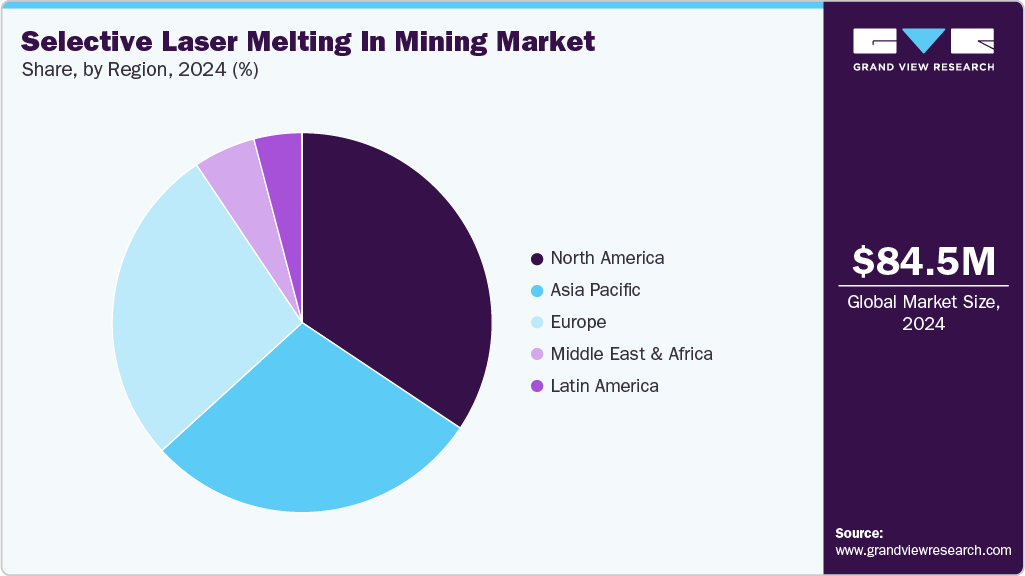
North America accounted for the significant market revenue share of 25.2% in 2025. The North America selective laser melting in mining industry is strongly adopting SLM as companies focus on improving productivity, equipment reliability, and operational efficiency. The technology allows for rapid manufacturing of high-strength metal components directly from digital designs, enabling miners to reduce lead times for critical spare parts. Growing investments in advanced 3D printing infrastructure across the U.S. and Canada are further supporting the integration of SLM into mining operations. This shift is driven by the need to minimize equipment downtime, optimize resource utilization, and enhance sustainability through reduced material waste.
 To learn more about this report, Download Free Sample Report
U.S. Selective Laser Melting In Mining Market Trends
In the U.S. selective laser melting in mining industry, SLM is experiencing rapid growth as companies strive to enhance operational resilience and reduce their dependence on conventional manufacturing supply chains. The technology enables American miners to produce durable metal components with high geometric accuracy, supporting applications such as replacement parts for drills, pumps, and excavation tools. The U.S. government’s emphasis on advanced manufacturing and digital transformation within the industrial sector has also encouraged the adoption of SLM, particularly in remote mining regions where sourcing spare parts is time-consuming and costly.
Asia Pacific Selective Laser Melting In Mining Market Trends
Asia Pacific dominated the selective laser melting in mining market with the largest revenue share of 47.6% in 2025. The selective laser melting in mining industry in Asia-Pacific is gaining momentum as companies’ transition to advanced manufacturing and local production of complex components. Nations such as China, Japan, and Australia are investing heavily in additive manufacturing technologies to enhance operational efficiency and self-sufficiency in equipment supply. The growing emphasis on precision engineering, reduced material waste, and energy-efficient production has led mining equipment manufacturers to explore SLM for producing intricate parts used in extraction and processing machinery. Government initiatives promoting smart manufacturing are further accelerating the integration of this technology across regional industries.
Europe Selective Laser Melting In Mining Market Trends
The European selective laser melting in mining industry is steadily gaining importance as the region focuses on technological innovation and sustainable manufacturing practices. Countries such as Germany, the UK, and Sweden are at the forefront of adopting additive manufacturing solutions to optimize mining operations and equipment performance. European companies are leveraging SLM to produce complex geometries in metal components, reduce material wastage, and improve mechanical strength in harsh mining environments. The strong presence of advanced manufacturing infrastructure and supportive EU policies toward digital transformation are also fostering wider adoption of SLM technologies in the industrial and mining sectors.
Middle East & Africa Selective Laser Melting In Mining Market Trends
The selective laser melting in mining industry in Middle East & Africa is anticipated to grow at the fastest CAGR over the forecast period, as SLM is gradually emerging as a promising technology with the region focusing on modernizing its industrial base and reducing dependence on imported machinery components. Countries such as Saudi Arabia, the UAE, and South Africa are exploring metal additive manufacturing to enhance operational efficiency in mining and heavy industries. The growing investments in technological infrastructure and industrial diversification, under initiatives such as Saudi Vision 2030, are creating opportunities for SLM adoption in equipment production and maintenance. The ability of SLM to produce intricate metal parts with high precision aligns well with the region’s goal of building self-reliant and technologically advanced mining operations.
Latin America Selective Laser Melting In Mining Market Trends
The selective laser melting in mining industry in Latin America is anticipated to grow over the forecast period as SLM gaining traction in the Latin American mining market, as regional economies work toward industrial modernization and sustainable resource extraction. Countries such as Brazil, Chile, and Peru are investing in additive manufacturing technologies to strengthen their mining supply chains and reduce reliance on imported components. The growing focus on digital transformation, energy-efficient production, and waste reduction is encouraging mining equipment manufacturers to explore SLM for the fabrication of precision parts. Local initiatives promoting innovation and advanced engineering are helping accelerate the adoption of this technology within key mining regions.
Key Selective Laser Melting In Mining Company Insights
Some of the key players operating in the market include Nikon SLM Solutions AG, 3T Additive Manufacturing, and others.
-
Nikon SLM Solutions AG is a Germany-based pioneer in metal additive manufacturing, recognized for developing and commercializing advanced Selective Laser Melting (SLM) systems. The company became part of Nikon Corporation, which strengthened its global innovation and manufacturing capabilities. Nikon SLM Solutions focuses on high-precision, high-speed metal 3D printing systems tailored for industrial-scale production. Its technology enables the fabrication of intricate, durable, and lightweight metal components suited for applications in aerospace, automotive, energy, and mining.
-
3T Additive Manufacturing is a UK-based company recognized for its advanced metal additive manufacturing capabilities, particularly in the use of SLM for producing high-performance parts. The company has established expertise in developing complex geometries and lightweight components that meet the rigorous requirements of industries such as aerospace, automotive, and mining.
Key Selective Laser Melting In Mining Companies:
The following key companies have been profiled for this study on the selective laser melting in mining market.
- 3T Additive Manufacturing
- Additive Industries
- DMG Mori AG
- EOS GmbH
- Farsoon Technologies
- GE Additive
- Nikon SLM Solutions AG
- Renishaw plc
- Trumpf GmbH + Co. KG
- Wipro 3D
Competitive Benchmarking
Category
Operating Strategies
Competitive Edge
Weakness
Established Players (e.g., Nikon SLM Solutions AG; EOS GmbH; Renishaw plc; GE Additive; Trumpf GmbH + Co. KG)
- Prioritize the development of high-productivity metal additive manufacturing platforms with advanced multi-laser technology, automation, and integrated quality monitoring for industrial-scale production.
- Strengthen market presence through strategic collaborations with mining equipment OEMs, research institutions, and industrial manufacturers while expanding global sales and service networks.
- Continuously invest in process optimization, software integration, and new alloy qualification to improve component reliability, production efficiency, and application diversity.
- Possess extensive technical expertise, strong intellectual property portfolios, and well-established global distribution and after-sales support networks.
- Offer comprehensive additive manufacturing ecosystems combining hardware, software, process validation, and engineering services, enabling end-to-end customer solutions.
- Benefit from strong brand recognition, large installed equipment bases, and proven experience serving highly regulated industrial sectors.
- High research, manufacturing, and customer support costs increase operational expenditure and require continuous capital investment.
- Revenue growth depends on industrial capital expenditure cycles, making demand vulnerable to fluctuations in mining and manufacturing investments.
- Longer sales cycles and complex qualification requirements can delay equipment adoption, particularly in conservative industrial environments.
Emerging & Regional Players (e.g., Additive Industries; DMG Mori AG; Farsoon Technologies; 3T Additive Manufacturing; Wipro 3D)
- Focus on application-specific additive manufacturing solutions, contract production services, and customized metal component development for regional mining and industrial customers.
- Expand market reach through technology partnerships, localized manufacturing capabilities, and cost-competitive equipment offerings tailored to emerging markets.
- Differentiate through flexible engineering support, rapid prototyping, and specialized material development for wear-resistant and high-performance mining components.
- Greater agility enables faster product customization, shorter development cycles, and quicker response to customer-specific manufacturing requirements.
- Competitive pricing strategies and localized technical support improve accessibility for small and mid-sized mining companies adopting additive manufacturing.
- Strong regional relationships and specialized engineering expertise allow effective participation in niche industrial and aftermarket opportunities.
- Limited global brand visibility and smaller installed equipment bases restrict penetration into large multinational mining companies.
- Lower financial resources can constrain investments in large-scale R&D, international expansion, and advanced manufacturing infrastructure.
- Dependence on regional market demand and third-party material suppliers may limit long-term competitiveness against larger global manufacturers.
Recent Development
- In June 2024, DMG MORI introduced its next-generation LASERTEC 30 SLM metal 3D printer, marking a significant step forward in additive manufacturing technology with the launch of its quad laser system and expanded build volume of 325 x 325 x 400 mm. The new machine features a floating process chamber to manage thermal expansion, an interchangeable build container for rapid material changeovers, and the automated rePLUG powder module system.
Selective Laser Melting In Mining Market Report Scope
Report Attribute
Details
Market definition
The market size represents the total economic value of all 3D printing activity in the mining sector that uses SLM technology.
Market size in 2025
USD 93.4 million
Estimated market size in 2026
USD 103.0 million
Projected market size by 2033
USD 235.8 million
Growth rate
CAGR of 12.6% from 2026 to 2033
Base year for estimation
2025
Historical data
2021 - 2024
Forecast period
2026 - 2033
Quantitative units
Revenue in USD million and CAGR from 2026 to 2033
Report coverage
Revenue forecast, company ranking, competitive landscape, growth factors, and trends
Segments covered
Component, region
Regional scope
North America; Europe; Asia Pacific; Latin America; Middle East & Africa
Country scope
U.S.; Canada; Mexico; Finland; Sweden; Poland; Russia; China; India; Australia; Brazil; South Africa; Iran
Key companies profiled
Nikon SLM Solutions AG; EOS GmbH; Renishaw plc; GE Additive; Trumpf GmbH + Co. KG; Additive Industries; DMG Mori AG; Farsoon Technologies; 3T Additive Manufacturing; Wipro 3D
Customization scope
Free report customization (equivalent up to 8 analysts' working days) with purchase-addition or alteration to country, regional & segment scope.
Pricing and purchase options
Avail customized purchase options to meet your exact research needs. Explore purchase options
Global Selective Laser Melting In Mining Market Report Segmentation
This report forecasts revenue growth at global, regional, and country levels and provides an analysis of the latest industry trends in each of the sub-segments from 2021 to 2033. For this study, Grand View Research has segmented the global selective laser melting in mining market report based on component and region:
 To learn more about this report, Download Free Sample Report
-
Component Outlook (Revenue, USD Million, 2021 - 2033)
-
Equipment
-
Materials
-
Services
-
Others
-
-
Regional Outlook (Revenue, USD Million, 2021 - 2033)
-
North America
-
U.S.
-
Canada
-
Mexico
-
-
Europe
-
Finland
-
Sweden
-
Poland
-
Russia
-
-
Asia Pacific
-
China
-
India
-
Australia
-
-
Latin America
-
Brazil
-
-
Middle East & Africa
-
South Africa
-
Iran
-
-
Research Methodology
The selective laser melting in mining Market figures in this report are based on a proven research process that combines executive interviews with secondary research from proprietary databases, company filings, and recognized regulatory and institutional sources. Market size is built through value-chain sizing - reconciling supply-side and demand-side estimates - and triangulated with bottom-up and top-down approaches. Every estimate passes multiple levels of expert validation before publication, with each selective laser melting in mining segment quantified using the revenue-capture definitions in the table below.
Segment Definition
Component
Revenue Capture Definition
Equipment
Revenue in this segment is generated from the sale of industrial Selective Laser Melting (SLM) systems used to manufacture and repair metal components for mining applications. It includes laser powder bed fusion machines, laser sources, build chambers, powder handling units, inert gas systems, monitoring hardware, and integrated additive manufacturing platforms deployed by mining companies, OEMs, and contract manufacturers.
Materials
This segment captures revenue from consumable materials required for the SLM process, including metal powders such as stainless steel, tool steel, titanium alloys, aluminum alloys, nickel-based superalloys, cobalt-chromium alloys, and copper alloys. It also includes specialty powders engineered for high wear resistance, corrosion resistance, and high-temperature performance in demanding mining environments.
Services
Revenue is derived from value-added services supporting SLM adoption, including component design optimization, topology optimization, prototype development, contract additive manufacturing, equipment installation, maintenance, calibration, operator training, process validation, quality inspection, certification, and post-processing services such as heat treatment, machining, and surface finishing.
Others
This segment includes software solutions, digital workflow platforms, simulation tools, process monitoring systems, spare parts, accessories, powder recycling systems, and other supporting technologies that enhance the efficiency, traceability, and performance of Selective Laser Melting operations in the mining industry.
Estimation Model
Layer Name
Key Question
Description
Mining Equipment & Fleet Deployment Layer
Where does demand originate?
The market assessment begins by evaluating the installed base and procurement of mining equipment that can benefit from Selective Laser Melting (SLM). This includes drilling systems, excavators, loaders, haul trucks, crushers, conveyors, pumps, mineral processing equipment, and underground machinery. Equipment deployment across surface, underground, and mineral processing operations forms the foundation for estimating the potential demand for SLM-produced components.
SLM Technology & Material Adoption Layer
What supports component production?
This layer evaluates the adoption of industrial SLM systems, metal powder availability, and supporting manufacturing infrastructure. It covers the supply of stainless steel, tool steel, titanium, aluminum, nickel-based superalloys, cobalt-chromium alloys, and other high-performance powders, along with machine installations, production capacity, powder recycling, and regional additive manufacturing ecosystems serving the mining sector.
Component Replacement & Manufacturing Layer
Which mining parts are manufactured using SLM?
This stage estimates the penetration of SLM across mining applications by analyzing the production and replacement frequency of high-value components such as drill bits, impellers, nozzles, wear plates, gears, brackets, heat exchangers, crusher liners, and customized spare parts. Adoption levels depend on component complexity, maintenance schedules, equipment criticality, operating conditions, and the economic advantages of additive manufacturing over conventional machining or casting.
Revenue Layer
How is market revenue generated?
Market revenue is derived from the sale of SLM equipment, metal powders, software solutions, engineering services, contract manufacturing, maintenance support, and post-processing activities supplied to mining companies, equipment OEMs, and service providers. Investments influence revenue growth in mine digitalization, demand for localized spare-part production, advancements in metal additive manufacturing technologies, and increasing emphasis on reducing downtime, inventory costs, and material waste across mining operations.
Delivered Customizations
This report has been delivered with the following In-depth customizations
Client Request
Customization Delivered
Value Adds
Application-wise Opportunity Analysis
Detailed assessment of SLM adoption across mining applications, including drilling equipment, crushing & screening, mineral processing, material handling systems, and maintenance & repair operations. Evaluated demand potential by component type and mining method across key regions.
Enabled identification of high-growth application areas, supported product development strategies, and prioritized investments in the most attractive mining segments.
Cost Competitiveness & ROI Assessment
Comprehensive analysis comparing Selective Laser Melting with conventional manufacturing methods based on production cost, lead time, material utilization, inventory savings, and lifecycle economics for mining components.
Supported investment decisions, quantified cost-saving opportunities, and helped evaluate the business case for adopting additive manufacturing in mining operations.
Technology & Competitive Benchmarking
In-depth benchmarking of leading SLM technology providers based on machine capabilities, build volume, laser configuration, material compatibility, software ecosystem, mining-focused applications, and strategic partnerships.
Helped stakeholders compare competing technologies, identify technology leaders, and support supplier selection, procurement, and long-term technology adoption strategies.
Frequently Asked Questions About This Report
The selective laser melting in mining market in China held the largest share in the Asia Pacific region in 2025.
The Middle East & Africa is anticipated to register the fastest CAGR of 14.7% over the forecast period.
The others segment, including software, powder handling systems, post-processing equipment, inspection solutions, and engineering services, is projected to register the fastest CAGR of 15.3% during the forecast period, driven by increasing adoption of integrated additive manufacturing workflows
The key players operating in the selective laser melting in mining market are Nikon SLM Solutions AG, EOS GmbH, Renishaw plc, GE Additive, Trumpf GmbH + Co. KG, Additive Industries, DMG Mori AG, Farsoon Technologies, 3T Additive Manufacturing, and Wipro 3D, among others.
The key factor driving the growth of the global selective laser melting in mining market is the increasing adoption of on-demand additive manufacturing to reduce equipment downtime, optimize spare-part production, and improve operational efficiency in mining operations.
Asia Pacific dominated the selective laser melting in mining market with the largest revenue share of 47.6% in 2025.
The global selective laser melting in mining market is expected to grow at a CAGR of 12.6% from 2026 to 2033, reaching USD 235.8 million by 2033.
The global selective laser melting in mining market size was valued at USD 93.4 million in 2025 and is estimated at USD 103.0 million for 2026.
Based on the component, the equipment segment led the market with the largest revenue share of 55.7% in 2025.
About the Author(s)
Advanced Interior Materials Research Team
Advanced Materials · Advanced Interior MaterialsThis report was authored by the advanced interior materials research team at Grand View Research - comprising two research analysts, one senior research analyst, and one industry expert - with specialized expertise in the advanced interior materials segment of the advanced materials industry. All findings are based on proprietary advanced materials databases, executive interviews, and regulatory analysis, subject to internal peer review prior to publication.
Last Updated:
Speak to Analyst

Customize this report to your needs - add regions, segments, or data points, with 20% free customization.
Or view our licence options:


ISO 9001:2015 & 27001:2022 Certified
We are GDPR and CCPA compliant! Your transaction & personal information is safe and secure. For more details, please read our privacy policy.


