
- Home
- »
- Plastics Polymers & Resins
- »
-
Self-healing Waterproofing Materials Market Report, 2033GVR Report cover
![Self-healing Waterproofing Materials Market (2026 - 2033)Report]()
Self-healing Waterproofing Materials Market (2026 - 2033)
Size, Share & Trends Analysis Report By Material (Polyurethane, Polymer-Modified Cementitious, Silicone/Silane-Based), By End Use (Infrastructure, Marine & Water Infrastructure, Residential), By Region, And Segment Forecasts
Market Size, 2025
$1.1BMarket Estimate, 2026
$1.2BMarket Forecast, 2033
$2.7BCAGR, 2026–2033
12.4%Self-healing Waterproofing Materials Market Summary
The global self-healing waterproofing materials market size was valued at USD 1.1 billion in 2025 and is projected to grow from USD 1.2 billion in 2026 to USD 2.7 billion by 2033, at a CAGR of 12.4% from 2026 to 2033. Asia Pacific dominated the market, accounting for the largest revenue share of 56.1% in 2025. The industry is driven by growing demand for durable waterproofing solutions across infrastructure, marine & water infrastructure, residential, commercial buildings, and industrial applications.

Key Market Trends & Insights
- By material: Polymer-modified cementitious segment is anticipated to grow at a CAGR of 13.7% from 2026 to 2033.
- By end-use: Marine & water infrastructure segment is expected to grow at a CAGR of 13.5% from 2026 to 2033.
Regional Highlights
- Largest regional market: Asia Pacific (56.1% revenue share, 2025)
- By country:
Market Size & Forecast
- Market Size in 2025: USD 1.1 billion
- Estimated Market Size in 2026: USD 1.2 billion
- Projected Market Size in 2033: USD 2.7 billion
- CAGR (2026 - 2033): 12.4%
Self-healing waterproofing materials offer crack repair, water resistance, durability, and reduced maintenance requirements, supporting the longer service life of structures. Advancements in crystalline admixtures, encapsulated healing agents, and polymer-based systems are improving crack-sealing performance, while increasing focus on infrastructure resilience, water protection, and sustainable construction accelerates adoption.
Technological advancements in crystalline admixtures, encapsulated healing agents, microbial systems, and polymer-based formulations are emerging as a key trend in the industry. Manufacturers are increasingly developing optimized materials that improve crack-sealing capability, water resistance, durability, and compatibility with concrete structures. Innovations in healing mechanisms and material engineering are further expanding suitability across infrastructure, marine & water infrastructure, residential, commercial buildings, and industrial applications.
Growing demand for high-performance, durable, and low-maintenance waterproofing solutions is a major driver for the industry. These materials provide autonomous crack repair, reduce water ingress, improve structural durability, and extend service life across concrete structures. Increasing investments in infrastructure resilience, marine structures, water management facilities, commercial construction, and industrial assets are further accelerating market development by reducing maintenance requirements and supporting longer-lasting construction systems.
Market Dynamics
Expanding adoption of advanced waterproofing and self-healing construction technologies presents a significant opportunity for the industry. Increasing focus on extending structural service life, reducing repair costs, and improving resistance to water and environmental exposure is creating opportunities for crystalline, microbial, polymeric, and encapsulated systems. Manufacturers are developing application-specific formulations that enhance crack sealing and durability, supporting broader adoption across infrastructure, marine & water infrastructure, residential, commercial, and industrial applications.
Growing populations in developing regions are emerging as a key driver for the industry, supported by rapid urbanization and expanding infrastructure development. Increasing construction of roads, bridges, water infrastructure, housing, and commercial facilities is raising demand for durable materials that can withstand cracking and moisture ingress. Self-healing systems help restore crack resistance and improve structural durability, supporting longer service life and resilience of critical urban infrastructure.
Increasing investment in urban infrastructure across developing regions is further accelerating the adoption of self-healing waterproofing materials. Growing requirements for long-lasting, low-maintenance structures are encouraging the use of technologies that reduce water permeability, crack-related deterioration, and repair requirements. Their ability to enhance durability and extend service life creates opportunities across transportation infrastructure, water-retaining structures, residential buildings, and other rapidly expanding urban construction projects.
Cost and complexity are emerging as key restraints for the industry, driven by the higher upfront expense of specialized healing agents, polymer modifiers, encapsulated systems, and advanced geomembranes compared with conventional damp-proofing solutions. Complex manufacturing, material integration, and quality-control requirements can further increase installation and production costs. These factors may limit adoption in cost-sensitive construction projects despite potential long-term savings from reduced maintenance and repairs.
Sustainability-driven construction presents a significant opportunity for the industry, supported by growing adoption of green building practices and resilient construction solutions. Increasing focus on extending structural service life, reducing maintenance requirements, and lowering lifecycle environmental impacts is creating opportunities for self-healing waterproofing systems. Their ability to autonomously seal cracks, limit water ingress, and enhance durability supports broader adoption across sustainable infrastructure and building projects.
Market Concentration & Characteristics
The market exhibits fragmentation, with key players dominating the industry landscape. Major companies such as Xypex Chemical Corporation, Kryton International, PENETRON, Sika AG, Master Builders Solutions, Basilisk Self-Healing Concrete, Supershield, Richlam Development Group, Pioneer Fibre, Drykos, Bronco Buildwell, and others play a significant role in shaping the market dynamics. These leading players often drive innovation in the market by introducing new products, technologies, and materials to meet the industry's evolving demands.
The degree of innovation in the industry is moderate to high, driven by advances in crystalline admixtures, polymer formulations, encapsulated healing agents, and microstructural engineering. Manufacturers are developing waterproofing systems that improve crack-sealing capability, permeability resistance, durability, and long-term structural protection. Recent research highlights crystalline waterproofing materials as a promising approach for autonomous crack repair, supporting applications across infrastructure, water-retaining structures, tunnels, bridges, and commercial construction.
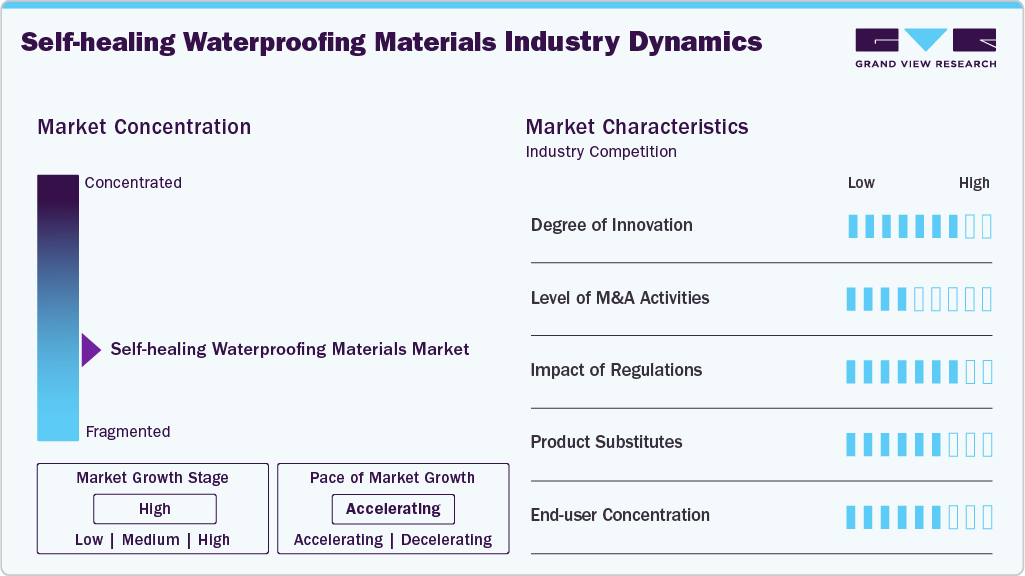
Product differentiation and performance-enhancement initiatives are shaping competitive positioning, with manufacturers focusing on optimized crystallization, moisture-triggered healing, pore sealing, and application-specific formulations. Commercial systems increasingly combine integral waterproofing with self-healing functionality, enabling crystalline structures to reactivate when water enters newly formed cracks. These developments improve resistance to water and chemical ingress while extending structural durability, strengthening product diversity, and supporting adoption across infrastructure, marine, water treatment, and building applications.
ANALYST PERSPECTIVE
The market is expected to transition over the next 5-10 years from conventional, performance-led waterproofing toward value-driven, durable, and sustainability-oriented solutions. Market leaders will differentiate through formulation expertise, self-healing technologies, application-specific product development, integrated manufacturing, contractor networks, technical support, intellectual property, and strategic partnerships. However, profitability may remain constrained by volatility in petrochemical-derived raw materials, construction-cycle fluctuations, pricing competition, substitution by conventional membranes and coatings, and fragmented regional supply chains. Long-term value creation will center on smart, durable, low-maintenance waterproofing systems and solutions tailored to demanding infrastructure and industrial environments.
Material Insights
The polyurethane (PU) segment dominated the market, accounting for 35.4% share in 2025, driven by increasing adoption of polyurethane (PU) systems across building waterproofing, infrastructure protection, foundations, roofs, terraces, and underground structures, supported by PU’s high elasticity, crack-bridging capability, adhesion, and water resistance. Advances in moisture-curing formulations, polymer network design, and functional additives are improving durability, flexibility, waterproofing performance, and self-healing behavior. These developments are expanding PU suitability across demanding construction and infrastructure applications.
The polymer-modified cementitious segment is expected to expand at a CAGR of 13.7% over the forecast period. The segment is driven by increasing adoption of polymer-modified cementitious systems across infrastructure, marine & water infrastructure, residential, commercial buildings, and industrial applications, supported by their ability to enhance waterproofing, crack resistance, adhesion, and durability. Polymer modifiers can refine cement pore structures and form protective films that improve resistance to water and chemical ingress. Advances in polymer formulation and cement-polymer interactions are enhancing self-healing performance and expanding suitability across demanding construction applications.
End Use Insights
The infrastructure segment led the market, accounting for 39.3% of revenue in 2025, and is projected to grow at an 12.9% CAGR from 2026 to 2033. The segment is driven by increasing adoption of self-healing waterproofing materials across bridges, tunnels, roads, dams, retaining structures, and other critical concrete assets. These materials help seal cracks, reduce water permeability, limit the ingress of aggressive substances, and improve structural durability. Growing investment in resilient infrastructure and long-service-life construction is further supporting demand, while advances in crystalline admixtures, microcapsules, and autonomous healing systems are expanding application potential.

The marine & water infrastructure segment is expected to grow at the fastest CAGR of 13.5% over the forecast period. The segment is driven by increasing adoption of self-healing waterproofing materials across dams, reservoirs, water-retaining structures, coastal facilities, tunnels, and marine concrete applications. These materials help seal cracks, reduce water permeability, and limit chloride and sulfate ingress, supporting structural durability under aggressive wet environments. Growing investment in resilient water infrastructure and coastal protection is further supporting demand, while advances in crystalline, microbial, and polymer-based healing systems expand application potential.
Regional Insights
The Asia Pacific self-healing waterproofing materials industry held the largest revenue share of 56.1% in 2025. The region is also expected to grow at the fastest CAGR of 12.9% over the forecast period. Rapid urbanization, expanding infrastructure development, and growing demand for durable construction solutions are supporting the growth of the self-healing waterproofing materials market across the Asia Pacific. Increasing investments in China, India, Japan, South Korea, and Southeast Asia are driving adoption across transportation infrastructure, water facilities, commercial buildings, and residential construction. Rising focus on structural durability, climate resilience, and lifecycle cost reduction is further accelerating regional demand for advanced self-healing waterproofing technologies.

India Self-healing Waterproofing Materials Market Trends
The India self-healing waterproofing materials market is expanding steadily, supported by rapid urbanization, infrastructure development, and growing demand for durable construction solutions. Increasing investments in highways, metro projects, water infrastructure, residential, and commercial buildings are encouraging the adoption of advanced waterproofing systems. Rising focus on structural durability, preventive maintenance, and lifecycle cost reduction is further supporting demand, while crystalline waterproofing technologies with self-healing capabilities are gaining relevance across critical concrete applications.
North America Self-healing Waterproofing Materials Market Trends
The self-healing waterproofing materials market in North America is supported by strong infrastructure investment, advanced construction technologies, and growing demand for durable, low-maintenance materials. The region accounted for 17.0% of the global market in 2025, reflecting early commercialization and substantial R&D activity. Increasing adoption across bridges, highways, tunnels, water infrastructure, and commercial buildings is further strengthening demand for self-healing waterproofing systems.
U.S. Self-healing Waterproofing Materials Market Trends
The self-healing waterproofing materials market in the U.S. is supported by extensive infrastructure investment and strong research capabilities in advanced construction materials. Growing use of self-healing systems in transportation infrastructure, water-retaining structures, bridges, and public buildings is accelerating demand. Government-supported infrastructure programs and increasing emphasis on sustainable, long-service-life construction are encouraging adoption, while innovations in crystalline, polymeric, and encapsulated healing technologies are expanding applications.
Europe Self-healing Waterproofing Materials Market Trends
The self-healing waterproofing materials market in Europe is expanding due to increasing adoption across infrastructure, commercial buildings, residential construction, marine structures, and water infrastructure. Aging bridges, tunnels, and other critical assets, along with sustainability initiatives, are supporting demand for durable, low-maintenance waterproofing solutions. Increasing investments in self-healing material research, pilot projects, and resilient construction are further strengthening regional market development, particularly across Germany, France, the UK, Italy, and Spain.
Central & South America Self-healing Waterproofing Materials Market Trends
The self-healing waterproofing materials market in Central & South America is expanding due to increasing infrastructure investment, urbanization, and demand for durable construction solutions. The growing development of transportation, residential, commercial, and water infrastructure is supporting the adoption of advanced waterproofing systems. Brazil, Argentina, Chile, and Colombia are emerging as key markets, while increasing focus on structural resilience, sustainability, and reduced maintenance requirements is further supporting regional adoption of self-healing materials across demanding construction applications.
Middle East and Africa Self-healing Waterproofing Materials Market Trends
The self-healing waterproofing materials market in the Middle East and Africa is expanding due to increasing infrastructure development, urbanization, and demand for durable construction solutions. Large-scale projects across Saudi Arabia, the UAE, and other regional markets are supporting the adoption of advanced waterproofing technologies. Harsh climatic conditions, water scarcity, and growing emphasis on sustainable, low-maintenance infrastructure are further strengthening demand, while advances in self-healing concrete, coatings, and polymer-based systems are expanding application potential.
Key Self-healing Waterproofing Materials Company Insights
Some of the key players operating in the market include Xypex Chemical Corporation and Kryton International.
-
Xypex Chemical Corporation participates through its portfolio of crystalline concrete waterproofing technologies, including admixtures, surface-applied coatings, and repair systems. The company emphasizes permanent waterproofing, chemical resistance, hydrostatic pressure resistance, and autonomous crack sealing. Its crystalline technology forms an insoluble structure within concrete pores and capillaries, enabling the material to reactivate when water is present and self-heal static hairline cracks, supporting applications across infrastructure, marine and water infrastructure, and industrial construction.
-
Kryton International participates through its Krystol technology portfolio, including Krystol Internal Membrane (KIM), Krystol T1, and related waterproofing and repair systems. The company emphasizes permanent waterproofing, self-sealing performance, hydrostatic pressure resistance, and concrete durability. Its crystalline technology reacts with moisture and unhydrated cement to form crystals that fill pores and micro-cracks, supporting applications across tunnels, marine infrastructure, wastewater facilities, reservoirs, foundations, and other water-exposed structures.
Supershield and Richlam Development Group are some of the emerging participants in the self-healing waterproofing materials market.
-
Supershield participates through its portfolio of crystalline waterproofing admixtures, coatings, and repair systems, including DPC ADMIXPLUS, ADMIX 100, ADMIX 200, ADMIX 300, and CRYSTALGUARD. The company emphasizes self-healing performance, permanent waterproofing, reduced permeability, and concrete durability, supported by moisture-activated crystalline formation within pores and capillaries. Its technologies are applied across water tanks, tunnels, sewage and water treatment plants, reservoirs, foundations, bridges, dams, and other infrastructure applications.
-
Richlam Development Group participates through its portfolio of crystalline waterproofing admixtures, sealers, coatings, and mortar systems, including Richlam100, Richlam200, Richlam300, Richlam400, and Richlam500. The company emphasizes autonomous crack healing, low permeability, hydrostatic pressure resistance, and long-term concrete durability. Its biomimetic crystalline technology activates in the presence of moisture to seal cracks and capillaries, supporting applications across tunnels, basements, water tanks, underground infrastructure, and other water-exposed structures.
Key Self-Healing Waterproofing Materials Companies
The following key companies have been profiled for this study on the self-healing waterproofing materials market.
-
Xypex Chemical Corporation
-
Kryton International
-
PENETRON
-
Sika AG
-
Master Builders Solutions
-
Basilisk Self-Healing Concrete
-
Supershield
-
Richlam Development Group
-
Pioneer Fibre
-
Drykos
-
Bronco Buildwell
Company Categorization
Operating Strategies
Competitive Edge
Weakness
Mature Players: Xypex Chemical Corporation, Kryton International, PENETRON, Sika AG, Master Builders Solutions.
- Strong focus on developing crystalline waterproofing admixtures, surface treatments, repair systems, and self-healing concrete technologies for foundations, tunnels, water-retaining structures, basements, parking structures, bridges, and other infrastructure applications.
- Continuous investment in reactive crystalline chemistry, concrete permeability reduction, crack-sealing performance, durability, chemical resistance, and compatibility with different concrete mix designs and construction methods.
- Expansion through established construction-material distribution networks, technical specification support, contractor relationships, project references, and broad concrete protection portfolios.
- Established brands, global distribution capabilities, technical expertise, and extensive project experience provide strong positioning in concrete waterproofing and durability applications.
- Strong product differentiation through integral waterproofing, moisture-activated self-healing, crack sealing, resistance to hydrostatic pressure, chemical protection, and extended concrete service life
- Broad application coverage across underground structures, water and wastewater infrastructure, tunnels, foundations, reservoirs, parking structures, swimming pools, and other demanding concrete environments strengthens market reach.
- Significant investment in proprietary chemical formulations, testing, technical validation, manufacturing, quality control, and application support can increase product-development and commercialization costs.
- Maintaining consistent crystallization, crack-sealing performance, permeability reduction, compatibility, and durability across different concrete formulations requires stringent formulation and application controls.
- Dependence on construction activity, infrastructure investment, project specifications, and contractor adoption can expose mature suppliers to cyclical demand and lengthy qualification processes.
Emerging Players: Basilisk Self-Healing Concrete, Supershield, Richlam Development Group, Pioneer Fibre, Drykos, Bronco Buildwell.
- Focus on specialized self-healing concrete, waterproofing additives, fibers, protective coatings, and construction solutions designed to reduce water ingress, crack formation, maintenance requirements, and lifecycle costs across building and infrastructure applications.
- Increasing emphasis on alternative self-healing mechanisms, including bacteria-based concrete technologies, fiber reinforcement, reactive additives, and specialized waterproofing formulations, allowing emerging suppliers to address specific crack-control and durability requirements.
- Expansion through customized solutions, project-specific technical support, regional construction networks, partnerships with contractors and concrete producers, and targeted applications where reduced maintenance and extended service life provide measurable value.
- Specialized technologies and flexible product development enable emerging suppliers to target niche requirements involving crack width, permeability, durability, waterproofing, reinforcement, and service-life extension.
- Alternative self-healing approaches provide differentiation from conventional surface-applied waterproofing systems and enable solutions to address cracks from within the concrete matrix.
- Smaller organizational structures can support faster customization, localized technical assistance, and adaptation to regional construction practices and project requirements.
- Comparatively narrower product portfolios, manufacturing capacity, geographic reach, brand recognition, and project references can limit competitiveness against established construction-chemical companies.
- Dependence on specialized projects and early-stage technology adoption can increase sensitivity to construction cycles, specification requirements, customer education, and technology acceptance.
- Demonstrating consistent long-term self-healing performance under different environmental conditions, concrete formulations, crack widths, and exposure levels can require substantial testing and validation resources.
Recent Developments
-
In July 2026, Saint-Gobain entered into a definitive agreement to acquire Xypex Chemical Corporation, a global supplier of crystalline waterproofing admixtures and coatings. The strategic initiative strengthened Saint-Gobain’s position in self-healing and crystalline waterproofing solutions, while expanding its capabilities across concrete protection, water resistance, and infrastructure applications. The acquisition also enhanced Saint-Gobain’s geographic reach and product portfolio, supporting broader adoption of durable and long-life waterproofing technologies across construction and infrastructure markets.
-
In December 2025, PENETRON began construction of a new production facility in Medzilaborce, Slovakia, scheduled for completion in 2026. The expansion strengthens PENETRON’s regional manufacturing capabilities for crystalline waterproofing products, supports localized supply, and enhances market penetration across Eastern Europe. The initiative also improves supply-chain responsiveness and positions the company to address growing demand for durable, self-healing waterproofing solutions across construction and infrastructure applications.
Self-Healing Waterproofing Materials Market Report Scope
Report Attribute
Details
Market size value in 2025
USD 1.1 billion
Estimated market size in 2026
USD 1.2 billion
Projected market size in 2033
USD 2.7 billion
Growth rate
CAGR of 12.4% from 2026 to 2033
Historical data
2021 - 2025
Forecast period
2026 - 2033
Quantitative units
Volume in kilotons; revenue in USD billion, and CAGR from 2026 to 2033
Report coverage
Volume & revenue forecast, competitive landscape, growth factors, and trends
Segments covered
Material, end use, region
Regional scope
North America; Europe; Asia Pacific; Central & South America; Middle East & Africa
Country scope
U.S.; Canada; Mexico; Germany; UK; France; Italy; Spain; China; India; Japan; South Korea; Australia; Brazil; Argentina; Saudi Arabia; UAE; South Africa
Key companies profiled
Xypex Chemical Corporation; Kryton International; PENETRON; Sika AG; Master Builders Solutions; Basilisk Self-Healing Concrete; Supershield; Richlam Development Group; Pioneer Fibre; Drykos; Bronco Buildwell.
Customization scope
Free report customization (equivalent to up to 8 analyst working days) with purchase. Addition or alteration to country, regional & segment scope
Pricing and purchase options
Avail customized purchase options to meet your exact research needs. Explore purchase options
Global Self-Healing Waterproofing Materials Market Report Segmentation
This report forecasts revenue growth at the global, regional, and country levels and provides an analysis of the latest industry trends across sub-segments from 2021 to 2033. For this study, Grand View Research has segmented the global global self-healing waterproofing materials market report based on material, end-use, and region:

-
Material Outlook (Volume, Kilotons; Revenue, USD Billion, 2021 - 2033)
-
Polyurethane (PU)
-
Polymer-Modified Cementitious
-
Epoxy
-
Acrylic
-
Silicone/Silane-Based
-
Other Polymer Systems
-
-
End Use Outlook (Volume, Kilotons; Revenue, USD Billion, 2021 - 2033)
-
Infrastructure
-
Marine & Water Infrastructure
-
Residential
-
Commercial Buildings
-
Industrial
-
Others
-
-
Regional Outlook (Volume, Kilotons; Revenue, USD Billion, 2021 - 2033)
-
North America
-
U.S.
-
Canada
-
Mexico
-
-
Europe
-
Germany
-
UK
-
France
-
Italy
-
Spain
-
-
Asia Pacific
-
China
-
India
-
Japan
-
South Korea
-
Australia
-
-
Central & South America
-
Brazil
-
Argentina
-
-
Middle East & Africa
-
Saudi Arabia
-
UAE
-
South Africa
-
-
Research Methodology
The self-healing waterproofing materials market figures in this report are based on a proven research process that combines executive interviews with secondary research from proprietary databases, company filings, and recognized regulatory and institutional sources. Market size is built through value-chain sizing—reconciling supply-side and demand-side estimates—and triangulated with bottom-up and top-down approaches. Every estimate passes multiple levels of expert validation before publication, with each self-healing waterproofing materials segment quantified using the revenue-capture definitions in the table below.
Segment Definition
Segment - Material
Revenue capture definition
Polyurethane (PU)
Revenue is captured through polyurethane-based self-healing waterproofing materials used in applications requiring high elasticity, crack-bridging capability, adhesion, chemical resistance, and moisture tolerance across foundations, roofs, basements, tunnels, bridges, and other concrete structures.
Polymer-Modified Cementitious
Revenue is generated through polymer-modified cementitious waterproofing materials used in applications requiring strong concrete adhesion, flexibility, crack resistance, water impermeability, and durability across foundations, water-retaining structures, basements, tunnels, and infrastructure applications.
Epoxy
Revenue is captured through epoxy-based self-healing waterproofing materials used in applications requiring high mechanical strength, chemical resistance, adhesion, abrasion resistance, and dimensional stability across industrial floors, concrete structures, tanks, processing facilities, and demanding construction environments.
Acrylic
Revenue is generated through acrylic-based self-healing waterproofing materials used in applications requiring flexibility, weather resistance, UV stability, adhesion, and crack-bridging performance across roofs, façades, balconies, terraces, concrete surfaces, and residential and commercial structures.
Silicone/Silane-Based
Revenue is captured through silicone- and silane-based self-healing waterproofing materials used in applications requiring water repellency, weather resistance, UV stability, vapor permeability, and durable surface protection across façades, masonry, concrete structures, roofs, bridges, and exposed building surfaces.
Other Polymer Systems
Revenue comes from other polymer-based self-healing waterproofing materials used in applications requiring specialized crack sealing, flexibility, adhesion, chemical resistance, water resistance, and durability across construction, infrastructure, industrial, and specialty waterproofing applications.
Segment - End-use
Revenue capture definition
Infrastructure
Revenue is generated through self-healing waterproofing materials used for bridges, tunnels, roads, foundations, retaining structures, dams, and other infrastructure assets requiring crack sealing, water impermeability, durability, and extended service life.
Marine & Water Infrastructure
Revenue is captured through self-healing waterproofing materials used in dams, reservoirs, water tanks, treatment facilities, marine structures, ports, seawalls, and other water-exposed assets requiring resistance to hydrostatic pressure, moisture ingress, chemical exposure, and long-term deterioration.
Residential
Revenue is generated through self-healing waterproofing materials used in basements, roofs, terraces, balconies, bathrooms, foundations, and other residential structures requiring crack protection, moisture resistance, water impermeability, and reduced maintenance requirements.
Commercial Buildings
Revenue is captured through self-healing waterproofing materials used in commercial roofs, façades, basements, parking structures, podiums, balconies, and foundations requiring durable water protection, crack bridging, weather resistance, and extended structural service life.
Industrial
Revenue is generated through self-healing waterproofing materials used in manufacturing facilities, warehouses, processing plants, chemical facilities, industrial floors, tanks, and foundations requiring high chemical resistance, mechanical durability, water resistance, and protection against aggressive operating environments.
Others
Revenue comes from self-healing waterproofing materials used across agricultural structures, institutional buildings, recreational facilities, specialty construction, and other applications requiring crack sealing, moisture protection, water resistance, and extended service life.
Estimation Model
Layer No.
Layer Name
Key Question
Description
1
Top-Down Self-Healing Waterproofing Materials Demand Assessment Layer
What defines overall market demand?
This layer establishes global demand for self-healing waterproofing materials across polyurethane (PU), polymer-modified cementitious, epoxy, acrylic, silicone/silane-based, and other polymer systems used in infrastructure, marine and water infrastructure, residential, commercial buildings, industrial, and other applications.
2
End-Use Demand Validation Layer
Where is demand concentrated?
This layer maps demand across infrastructure, marine and water infrastructure, residential, commercial buildings, industrial, and other applications based on requirements for crack sealing, water impermeability, elasticity, adhesion, chemical resistance, weather resistance, hydrostatic-pressure resistance, durability, and extended service life.
3
Consumption-to-Revenue Conversion Layer
How is demand monetized?
This layer converts waterproofing material consumption and treated surface area into revenue using material type, formulation, application method, coverage rate, crack-bridging capability, curing characteristics, product specifications, production costs, regional pricing, distribution margins, project requirements, order volumes, replacement cycles, and purchasing patterns across construction-material manufacturers, contractors, waterproofing specialists, infrastructure developers, building owners, and end users.
4
Regional Demand Verification Layer
Where is demand validated?
This layer validates demand across North America, Europe, Asia Pacific, Central & South America, and Middle East & Africa using infrastructure development, construction activity, marine and water infrastructure investment, residential and commercial building construction, industrial expansion, climate and moisture exposure, renovation and rehabilitation activity, building regulations, waterproofing standards, and adoption of durable and self-healing construction technologies.
Delivered Customizations
This report has been delivered with the following In-depth customizations
Client Request
Customization Delivered
Value Adds
Regional segmentation
Regional analysis across North America, Europe, Asia Pacific, Latin America, and Middle East & Africa, with country-level assessment of construction activity, infrastructure investment, waterproofing adoption, and demand for self-healing technologies.
Identifies high-growth geographies, regional demand patterns, and market-entry opportunities. Asia Pacific is identified as a particularly attractive growth region due to urbanization and infrastructure development.
Cross-segmentation
Cross-analysis of material/technology type, application, end-use industry, and region, including integral crystalline waterproofing, surface-applied systems, repair materials, infrastructure, residential, commercial, industrial, and marine & water infrastructure.
Highlights high-potential combinations of technologies, applications, and geographies and provides a more granular understanding of demand.
Competitive benchmarking
Benchmarking of major participants including Xypex Chemical Corporation, Kryton International, PENETRON, Sika AG, Master Builders Solutions, Fosroc, Saint-Gobain, Mapei, and other regional manufacturers, based on product portfolio, technology, application coverage, geographic presence, innovation, and competitive positioning.
Enables comparison of market leaders and emerging participants, identifies competitive strengths and portfolio gaps, and supports positioning strategies.
Frequently Asked Questions About This Report
The self-healing waterproofing materials market was estimated at around USD 1.1 billion in the year 2025 and is expected to reach around USD 1.2 billion in 2026.
The self-healing waterproofing materials market is expected to grow at a compound annual growth rate of 12.4% from 2026 to 2033 to reach around USD 2.7 billion by 2033.
The polyurethane (PU) in the self-healing waterproofing materials industry led the plastics in the self-healing waterproofing materials market in 2025 with a 35.4% share. Growing demand for flexible waterproofing, coupled with advances in crack-bridging and moisture-resistant formulations, is accelerating polyurethane adoption across infrastructure, residential, and industrial applications.
The key players in the self-healing waterproofing materials market are Xypex Chemical Corporation, Kryton International, PENETRON, Sika AG, Master Builders Solutions, Basilisk Self-Healing Concrete, Supershield, Richlam Development Group, Pioneer Fibre, Drykos, Bronco Buildwell.
The market is driven by demand for durable waterproofing across infrastructure and buildings, while advances in crystalline, encapsulated, and polymer-based systems improve crack sealing, resilience, sustainability, and reduce maintenance needs.
The Asia Pacific self-healing waterproofing materials market accounted for the largest share of 56.1% market size in 2025.
India was the leading player in the self-healing waterproofing materials market and is expected to grow at a compound annual growth rate of 15.3%.
Based on end-use, the infrastructure treatment segment accounted for the largest share of 39.3% market size in 2025. Aging infrastructure, rising resilience requirements, and expanding rehabilitation projects are accelerating self-healing waterproofing adoption across bridges, tunnels, foundations, dams, and other critical structure.
The polymer-modified cementitious segment, based on material type, is expected to grow at a CAGR of 13.7% for the forecast period.
About the Author(s)
Plastics Polymers & Resins Research Team
Industry · Plastics Polymers & ResinsThis report was authored by the plastics polymers & resins research team at Grand View Research - comprising two research analysts, one senior research analyst, and one industry expert - with specialized expertise in the plastics polymers & resins segment of the industry industry. All findings are based on proprietary industry databases, executive interviews, and regulatory analysis, subject to internal peer review prior to publication.
Last Updated:
Speak to Analyst


Customize this report to your needs — add regions, segments, or data points, with 20% free customization.
Or view our licence options:


ISO 9001:2015 & 27001:2022 Certified
We are GDPR and CCPA compliant! Your transaction & personal information is safe and secure. For more details, please read our privacy policy.


