
- Home
- »
- IT Services & Applications
- »
-
Self-service Analytics Market Size Report, 2025-2033GVR Report cover

Self-service Analytics Market (2025 - 2033) Size, Share & Trends Analysis Report By Component (Software, Services), By Application, By Deployment (Cloud, On-Premises), By Enterprise Size, By End Use (BFSI, Healthcare), By Region, And Segment Forecasts
Market Size, 2024
$4.8BMarket Estimate, 2026
$6.0BMarket Forecast, 2033
$17.5BCAGR, 2025–2033
15.9%Self-service Analytics Market Summary
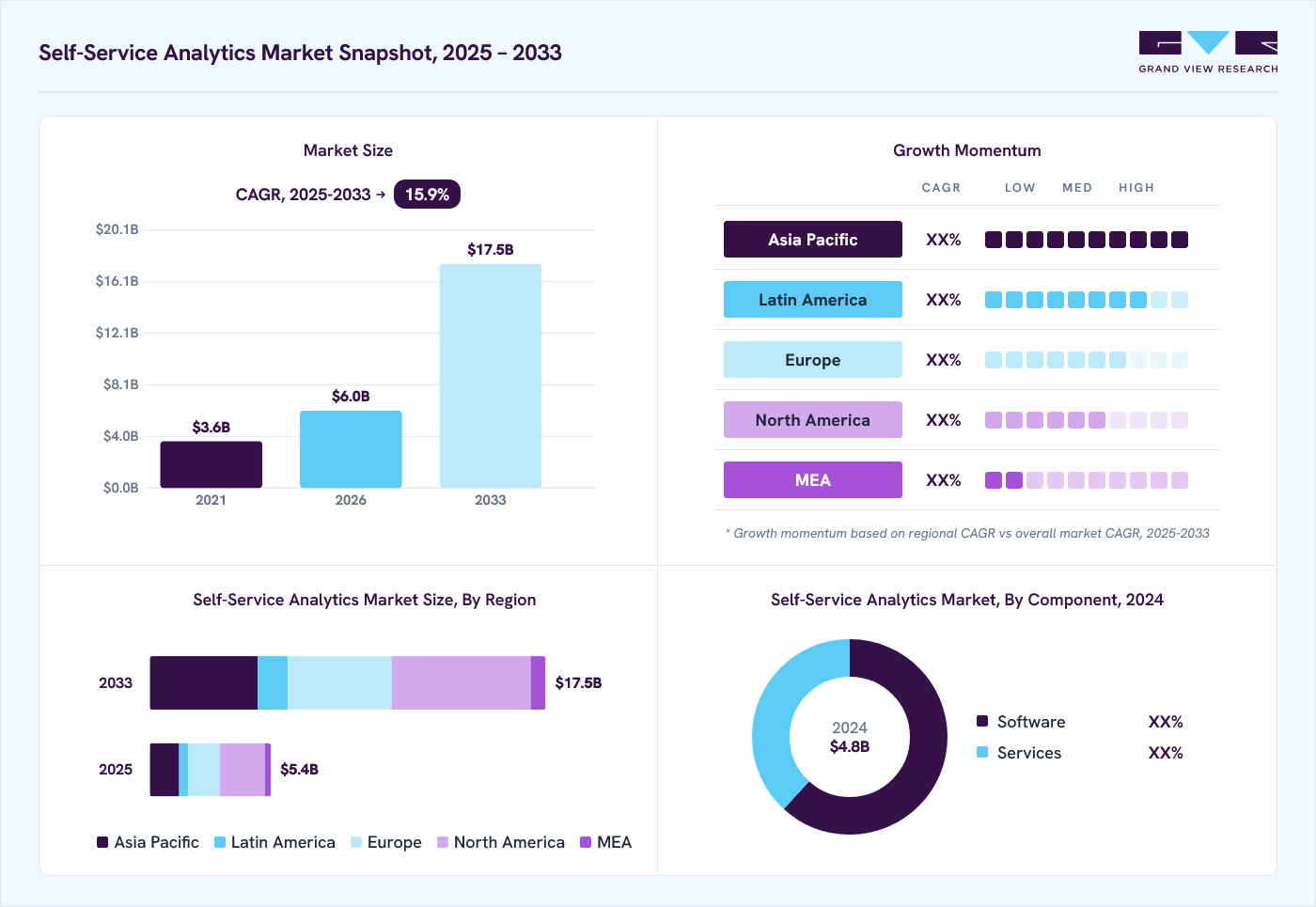
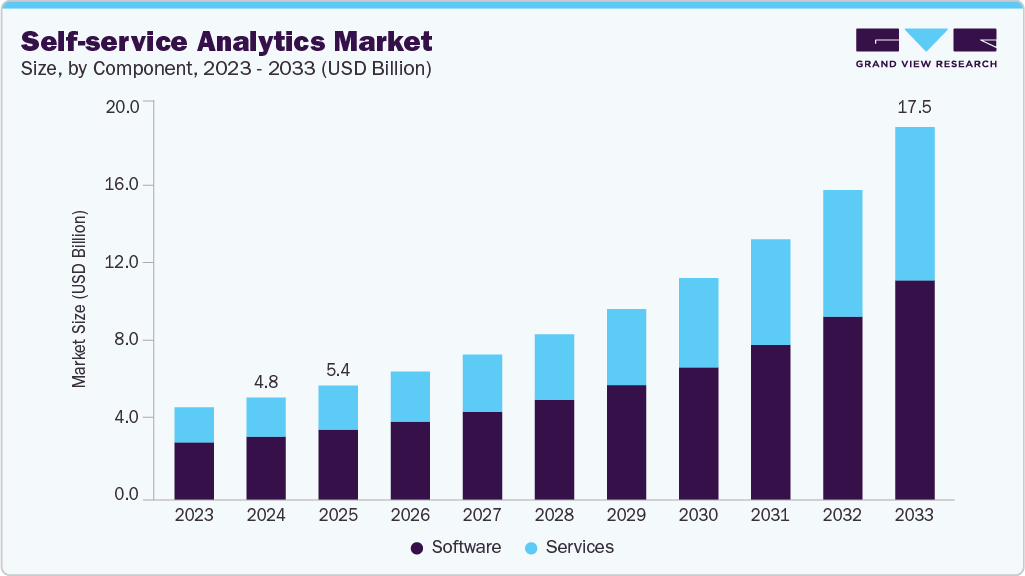
The global self-service analytics market size was valued at USD 4.8 billion in 2024 and is projected to grow from USD 6.0 billion in 2026 to USD 17.5 billion by 2033, at a CAGR of 15.9% from 2025 to 2033. North America dominated the market, accounting for a revenue share of 37.4% in 2024. The proliferation of cloud computing and scalable storage solutions is driving the the market growth.
 Source: Grand View Research, IR Documents, Primary Interviews, Paid DatabasesTo learn more about this report,
 Download Free Sample Report
 Key Market Trends & Insights
- North America held a 37.4% revenue share of the global self-service analytics market in 2024.
- In the U.S., the increasing complexity of supply chains and multi-channel business operations is accelerating the demand for self-service analytics systems.
- By component, the software segment held the largest revenue share of 61.7% in 2024.
- By application, the data visualization & reporting segment held the largest revenue share in 2024.
- By deployment, the cloud segment held the largest revenue share in 2024.
Market Size & Forecast
- 2024 Market Size: USD 4.8 Billion
- 2033 Projected Market Size: USD 17.5 Billion
- CAGR (2025-2033): 15.9%
- North America: Largest market in 2024
- Asia Pacific: Fastest growing market in 2024
Three ways to get this report
Buy it, customize it, or ask a question.Ask an Analyst
Analyst response in 1 business day
- AccessReport author, directly
- Reply timeWithin 1 working day
- No sales callDirect answer only
- FormatEmail reply
- CostFree, no cost
Get the Full Report
What the study covers
- FormatsPDF · Excel · Dashboard
- Timeline2025–2033 annual, 2024 base
- Coverage20+ countries, 5 regions
- Companies10+ key players profiled
Customize the Report
20% free customization
- IncludeCountries, segments, points
- TailorTo your product definition
- ExtendDeeper competitor detail
- OrA fully bespoke study
- Turnaround5–10 working days
The exponential growth of data across organizations and industries is driving the market growth. Companies are generating vast volumes of structured and unstructured data from multiple sources, including IoT devices, social media, enterprise applications, and customer interactions. Managing and extracting meaningful insights from this data is becoming increasingly complex. Self-service analytics platforms allow users to integrate diverse datasets, perform sophisticated analyses, and uncover patterns that would be difficult or time-consuming using traditional methods. This capability improves data utilization and reduces the dependency on data specialists, enabling organizations to act on insights in real time and maintain agility in a highly competitive business environment.The proliferation of cloud computing and scalable storage solutions is also driving the adoption of the market. Cloud-based platforms provide the infrastructure necessary to handle large-scale data processing, advanced analytics, and collaborative sharing across distributed teams. Organizations can deploy self-service analytics solutions without significant upfront investment in hardware or IT resources, allowing them to scale usage as required. The flexibility and accessibility offered by cloud environments make it easier for business users to interact with data from anywhere, supporting remote work, cross-functional collaboration, and real-time reporting. This trend has significantly lowered the barrier to entry for self-service analytics adoption across small, medium, and large enterprises.
 To learn more about this report, Download Free Sample Report
 The growing emphasis on real-time and operational analytics within organizations is a significant factor driving the market growth. Traditional reporting mechanisms, which often involve scheduled batch processing and delayed data delivery, are no longer sufficient. Self-service analytics platforms provide the ability to access live dashboards, perform real-time queries, and generate dynamic visualizations that reflect the current state of the business. This immediacy enables organizations to act on insights as events unfold, enhancing agility, reducing decision-making latency, and improving overall operational efficiency.
The growing need for personalized customer experiences and targeted marketing strategies is driving the market growth. Companies across industries are leveraging self-service analytics to understand customer preferences better, predict buying behavior, and tailor services or promotions to individual needs. By providing business users with direct access to customer data, self-service analytics platforms enable rapid segmentation, trend analysis, and scenario modeling. This capability allows organizations to respond quickly to changing consumer demands, optimize engagement strategies, and improve customer retention. As customer expectations for personalized experiences rise, the ability to derive actionable insights through self-service analytics becomes increasingly critical.
The integration of self-service analytics with collaborative and workflow tools is creating new value propositions that drive market growth. Organizations are looking to embed analytics into everyday business processes, enabling teams to make informed decisions in context and collaborate more effectively. Self-service analytics platforms are increasingly being designed with features that allow insights to be shared, annotated, and acted upon directly within business applications such as CRM, ERP, or project management systems. This convergence of analytics and operational tools enhances productivity, streamlines decision-making, and reinforces the role of data as a central pillar in strategic and tactical business planning.
Component Insights
The software segment dominated the market with a market share of 61.7% in 2024. The increasing need for embedded analytics capabilities within enterprise applications is driving segment growth. Modern software solutions, ranging from enterprise resource planning (ERP) and customer relationship management (CRM) systems to human capital management (HCM) platforms, are generating vast amounts of operational data. Organizations are seeking ways to provide their users with real-time insights directly within these applications, without the need to switch between multiple platforms or rely on IT teams. Self-service analytics embedded within software allows users to explore data, generate dashboards, and make data-driven decisions seamlessly within the context of their daily workflows. This integration improves productivity, reduces time to insight, and enhances the overall value of enterprise software investments.
The services segment is projected to be the fastest-growing segment from 2025 to 2033. The increasing adoption of cloud-based and digital services is further accelerating the demand for the market in the services segment. Professional services and IT service providers often manage projects and clients across multiple regions, requiring flexible and accessible analytics tools. Cloud-enabled self-service analytics solutions allow distributed teams to access centralized data from anywhere, enabling collaboration, consistent reporting, and unified decision-making. This accessibility is particularly valuable for organizations managing multiple client accounts or remote project teams, as it reduces dependency on internal IT departments and ensures that stakeholders can act on insights in real time.
Application Insights
The data visualization & reporting segment dominated the market in 2024. The proliferation of multi-source data environments is also fueling adoption in this segment. Modern organizations rely on a diverse mix of structured and unstructured data, including ERP systems, CRM platforms, social media, IoT devices, and cloud applications. Self-service analytics platforms designed for data visualization and reporting enable users to integrate and analyze data from multiple sources seamlessly. By consolidating disparate datasets into interactive visual formats, organizations can gain a holistic view of operations, uncover hidden relationships, and generate actionable insights without depending on IT or data specialists. This ability to unify complex data streams drives efficiency and enhances decision-making across departments.
The predictive & prescriptive analytics segment is projected to be the fastest-growing segment from 2025 to 2033. The growing adoption of hybrid and multi-cloud environments is further accelerating self-service analytics in the predictive and prescriptive segment. Organizations are managing distributed data across on-premises systems, private clouds, and public cloud platforms, creating challenges in data access, integration, and analysis. Self-service analytics tools that are compatible with hybrid architectures allow business users to analyze diverse datasets, run predictive models, and receive prescriptive recommendations without needing deep technical expertise or IT intervention. This flexibility enhances analytical agility and enables organizations to derive insights from a broader data landscape, improving decision-making quality across departments.
Deployment Insights
The cloud segment dominated the market in 2024. The integration of advanced technologies such as artificial intelligence, machine learning, and natural language processing within cloud-based self-service analytics platforms is driving adoption. These technologies enable users to uncover predictive insights, automate recommendations, and interact with data through conversational interfaces. Cloud platforms provide the necessary computing power and storage to handle these sophisticated algorithms at scale, allowing non-technical users to harness advanced analytics capabilities directly. By combining the accessibility of the cloud with AI-driven analytics, organizations can foster a data-driven culture, accelerate insights, and enable faster, more informed decision-making across all levels of the enterprise.
The on-premise segment is projected to grow at a significant CAGR from 2025 to 2033. The need for low-latency analytics and real-time operational monitoring is also fueling adoption in the on-premise segment. Certain industries, such as manufacturing, energy, and telecommunications, require rapid analysis of high-volume operational data to make immediate decisions, prevent downtime, and optimize processes. On-premise deployment ensures that data processing occurs locally, minimizing latency and ensuring that users can interact with real-time dashboards, perform ad-hoc queries, and make critical operational decisions without delays associated with cloud-based solutions. This immediacy is crucial for maintaining operational efficiency, safety, and competitiveness in fast-paced environments.
Enterprise Size Insights
The large enterprises segment dominated the market in 2024. The rising emphasis on scenario-based strategic planning and contingency management is driving self-service analytics adoption in large enterprises. Organizations are increasingly required to plan for multiple potential business scenarios, from supply chain disruptions to market volatility and technological shifts. Self-service analytics platforms enable executives and managers to simulate alternative strategies, forecast outcomes, and evaluate risks independently. By providing these capabilities directly to business users, enterprises can improve resilience, make more robust strategic decisions, and respond swiftly to unexpected events, ensuring continuity and long-term stability in a highly complex and uncertain global business environment.
The small & medium enterprises (SMEs) segment is projected to be the fastest-growing segment from 2025 to 2033. The growing focus on customer-centric strategies is fueling the adoption of self-service analytics in SMEs. Small and medium enterprises rely heavily on understanding customer behavior, preferences, and buying patterns to drive sales and retention. Self-service analytics platforms enable marketing, sales, and operations teams to analyze customer data directly, uncover patterns, and make data-driven decisions without waiting for centralized analytics support. By leveraging these insights, SMEs can optimize marketing campaigns, tailor product or service offerings, and enhance the overall customer experience, which is crucial for building loyalty and driving sustainable growth.
End Use Insights
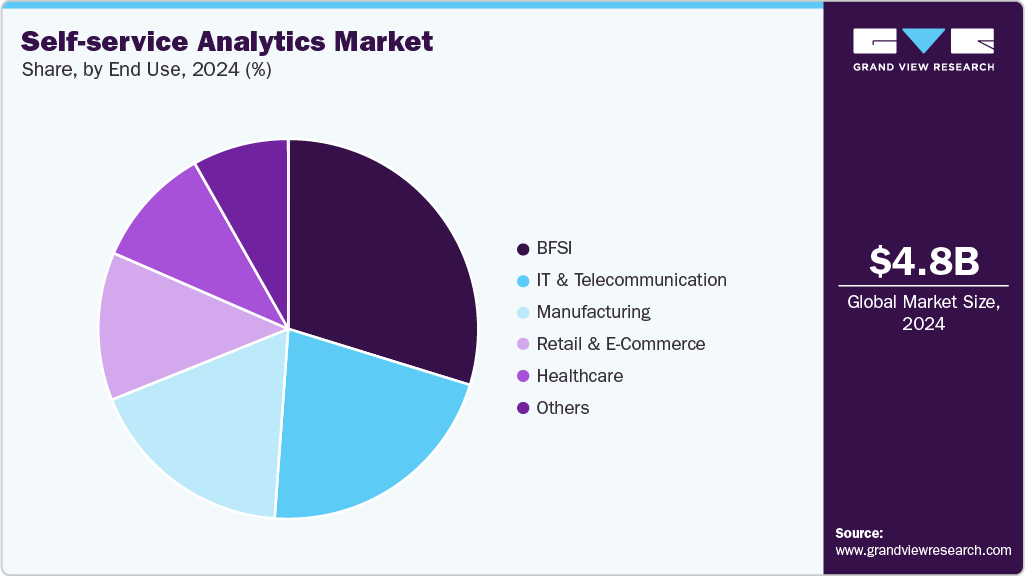
The BFSI segment dominated the market in 2024. The increasing adoption of digital and mobile banking solutions is accelerating the market in BFSI. As more transactions and interactions move online, institutions need tools that allow employees to analyze digital behavior, monitor online service performance, and detect emerging trends. Self-service analytics platforms enable front-line staff and managers to generate insights from these digital touchpoints independently, optimizing digital service delivery and identifying opportunities for revenue growth. The combination of real-time analytics and ease of access ensures that financial institutions remain agile and responsive to evolving customer expectations in an increasingly digital ecosystem.
 To learn more about this report, Download Free Sample Report
 The healthcare segment is projected to be the fastest-growing segment from 2025 to 2033. The rise of digital health technologies and telemedicine is driving the adoption of self-service analytics in healthcare. Remote monitoring devices, wearable health technology, and telehealth platforms generate continuous streams of patient data that require real-time analysis. Self-service analytics solutions allow healthcare professionals to monitor these data points directly, detect early warning signs, and make informed decisions about patient care remotely. This capability enhances the efficiency and reach of healthcare services, reduces the burden on centralized IT or analytics teams, and supports proactive and timely clinical interventions.
Regional Insights
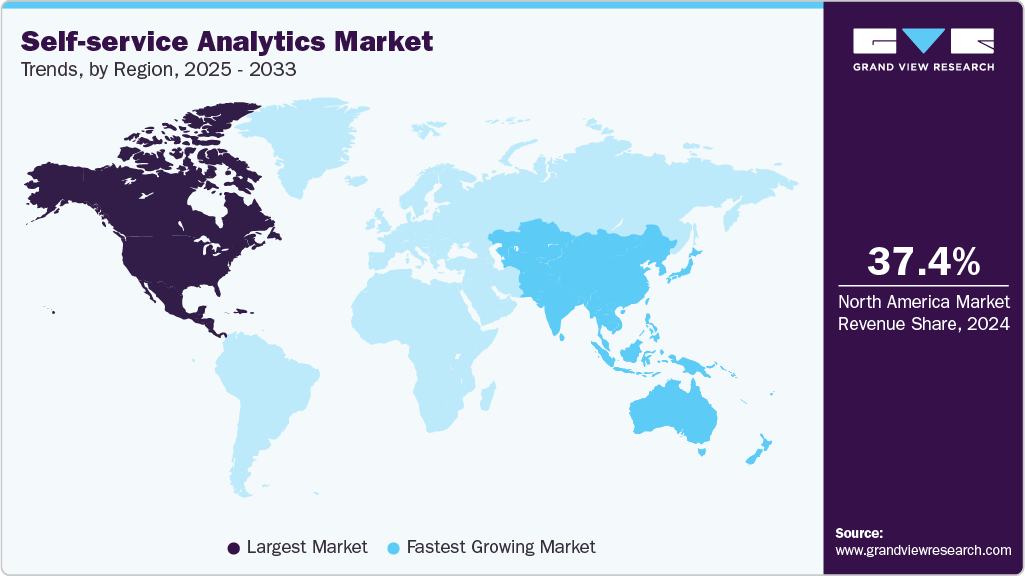
North America self-service analytics industry dominated globally in 2024, with a market share of 37.4%. The growing focus on advanced analytics, including predictive and prescriptive capabilities, is driving self-service analytics adoption in North America. Companies are leveraging these tools to forecast market trends, model customer behavior, and optimize operational strategies. Self-service platforms allow business users to interact with predictive models, run scenario analyses, and receive prescriptive recommendations without relying heavily on specialized data science teams. By embedding these advanced analytical capabilities into self-service tools, North American organizations can improve decision accuracy, enhance operational efficiency, and maintain a competitive edge in a data-intensive business environment.
 To learn more about this report, Download Free Sample Report
 U.S. Self-service Analytics Market Trends
The U.S. self-service analytics industry is projected to grow during the forecast period. The push toward innovation and rapid product development is fueling the market in the U.S. The U.S. organizations are under constant pressure to launch new products, services, and digital solutions quickly to maintain a competitive edge. Self-service analytics tools enable product managers, R&D teams, and business strategists to access real-time market insights, simulate different scenarios, and validate assumptions independently. By providing these capabilities directly to business users, organizations can accelerate innovation cycles, reduce time-to-market, and make more informed decisions during the product development process.
Asia Pacific Self-service Analytics Market Trends
The Asia Pacific self-service analytics industry is expected to be the fastest-growing segment, with a CAGR of 17.7% over the forecast period. The proliferation of digital ecosystems and e-commerce platforms is also driving adoption in the Asia Pacific market. With the rapid expansion of online marketplaces, mobile commerce, and digital payment solutions, organizations are generating massive volumes of transactional and behavioral data daily. Self-service analytics platforms allow business users to access this data directly, uncover patterns in customer behavior, and make decisions that optimize digital operations and sales strategies. This capability is particularly valuable in APAC markets where mobile-first consumer behavior and the adoption of digital services are accelerating faster than in other regions, providing a competitive advantage to data-savvy organizations.
The self-service analytics industry in China is projected to grow during the forecast period. The rise of cross-border trade and global expansion ambitions among Chinese enterprises is accelerating market adoption. Companies engaging in international markets need to analyze diverse datasets, including customer behavior in foreign regions, supply chain metrics, and regulatory compliance requirements across jurisdictions. Self-service analytics platforms allow business units to access and interpret these datasets directly, enabling faster decision-making for international strategy, market entry, and operational optimization. This capability is especially valuable for SMEs and export-oriented firms that require agility and real-time insights to remain competitive globally.
Europe Self-service Analytics Market Trends
The self-service analytics industry in Europe is expected to grow during the forecast period. The growing integration of operational technology (OT) with information technology (IT) in industries such as manufacturing, energy, and logistics drives the market growth. European enterprises are increasingly connecting machinery, production lines, and industrial processes to digital systems, generating large volumes of real-time operational data. Self-service analytics platforms empower engineers, plant managers, and operations teams to analyze this data independently, identify inefficiencies, predict equipment failures, and optimize production processes. By enabling frontline personnel to act on insights directly, organizations can reduce downtime, improve productivity, and lower operational costs, which is particularly crucial in highly competitive and technologically advanced European industrial sectors.
The self-service analytics industry in the UK is anticipated to grow during the forecast period. The trend toward organizational decentralization and cross-functional collaboration is driving self-service analytics adoption in the UK Enterprises that are increasingly being structured around autonomous teams and project-based workflows, which require access to timely data at the departmental level. Self-service analytics platforms allow individual teams to access relevant datasets, perform analyses, and make decisions independently while maintaining alignment with overall corporate objectives. By empowering employees at all levels to leverage data, organizations enhance agility, foster innovation, and improve responsiveness in a dynamic business environment where speed and flexibility are critical to success.
Key Self-service Analytics Company Insights:
Some of the key companies operating in the market include IBM Corporation, Zoho Corporation Pvt. Ltd., among others.
-
IBM Corporation is a multinational technology company. IBM’s self-service analytics portfolio includes IBM Cognos Analytics, a comprehensive business intelligence suite that blends enterprise reporting, AI-enhanced data exploration, and intuitive dashboarding in a single environment. This suite also offers an Analytics Content Hub, serving as a unified portal for accessing IBM analytics tools and third-party integrations.
-
Zoho Corporation Pvt. Ltd. is a privately owned Indian multinational technology company. Zoho's self-service analytics portfolio includes Zoho Analytics, a modern, cloud-based business intelligence and analytics platform designed to democratize data insights across organizations. Zoho Analytics spans the full analytics lifecycle. It provides seamless connectivity to hundreds of sources, including files, web feeds, local and cloud databases, and business applications. It allows users to import, blend, and prepare data using intuitive visual tools.
Actian Corporation and Sisense Ltd. are some of the emerging market participants in the self-service analytics industry.
-
Actian Corporation is a U.S.-based software firm rooted in database management and analytics. A partnership with Qlik equips self-service users with real-time analytical capabilities, marrying Qlik’s user-friendly BI tools with Actian’s high-performance Vector database for on-demand data discovery and ad hoc querying. More broadly, Actian promotes self-service through its Data Platform, which unifies transactional capabilities, data integration, and analytics in a simplified interface that allows data consumers to explore and act on analytic outputs across environments, be they cloud, hybrid, or on-premises.
-
Sisense Ltd. is a prominent company in intelligence and analytics. Sisense’s product portfolio includes its Fusion analytics platform, which integrates AI, embedded analytics, and composable architecture. Fusion enables seamless data modeling and connectivity, supporting live connections and in-warehouse preparation across cloud data warehouses. Its Compose SDK allows developers to embed dashboards, visual components, and insights directly into applications with white-label flexibility, while APIs and JS libraries give granular control over user experience.
Key Self-service Analytics Companies:
The following are the leading companies in the self-service analytics market. These companies collectively hold the largest market share and dictate industry trends.
- Actian Corporation
- Alteryx
- Athena Solutions
- Board International
- Cerexio
- Dremio
- IBM Corporation
- LANSA INC.
- Luzmo NV
- Metric Insights
- PYRAMID ANALYTICS
- QlikTech International AB
- Sisense Ltd.
- ThoughtSpot Inc.
- Zoho Corporation Pvt. Ltd.
Recent Developments
-
In June 2025, Actian, the data division of HCL Software, partnered with Databricks, a leader in data and AI, to integrate the Actian Data Intelligence Platform with Databricks’ Unity Catalog, its unified and open governance solution. Through Actian’s governed, self-service enterprise data marketplace, both technical and business users can easily explore datasets and request access, reducing time spent searching for information and allowing more focus on deriving meaningful insights. The joint integration supports several mission-critical use cases, including regulatory compliance, self-service analytics, and establishing an AI-ready data foundation.
-
In September 2024, Zoho Corporation Pvt. Ltd. announced the launch of a new version of Zoho Analytics, a self-service BI and analytics solution. The latest release brings over 100 enhancements, including advanced AI and ML capabilities that deliver diagnostic insights, predictive analytics, and automated report and dashboard creation. Key upgrades also feature a custom ML model-building studio, seamless OpenAI integration, and support for third-party BI platform extensions.
Self-service Analytics Market Report Scope
Report Attribute
Details
Market size in 2024
USD 4.8 billion
Estimated market size in 2026
USD 6.0 billion
Projected market size by 2033
USD 17.5 billion
Growth rate
CAGR of 15.9% from 2025 to 2033
Actual data
2021 - 2024
Forecast period
2025 - 2033
Quantitative units
Revenue in USD million/billion and CAGR from 2025 to 2033
Report coverage
Revenue forecast, company share, competitive landscape, growth factors, and trends
Segments covered
Component, application, deployment, enterprise size, end use, region
Regional scope
North America; Europe; Asia Pacific; Latin America; MEA
Country scope
U.S.; Canada; Mexico; UK; Germany; France; China; India; Japan; Australia; South Korea; Brazil; UAE; Saudi Arabia; South Africa
Key companies profiled
Actian Corporation; Alteryx; Athena Solutions; Board International; Cerexio; Dremio; IBM Corporation; LANSA INC.; Luzmo NV; Metric Insights; PYRAMID ANALYTICS; QlikTech International AB; Sisense Ltd.; ThoughtSpot Inc.; Zoho Corporation Pvt. Ltd.
Customization scope
Free report customization (equivalent to 8 analysts working days) with purchase. Addition or alteration to country, regional & segment scope.
Pricing and purchase options
Avail customized purchase options to meet your exact research needs. Explore purchase options
Global Self-service Analytics Market Report Segmentation
This report forecasts revenue growth at global, regional, and country levels and provides an analysis of the latest industry trends in each of the sub-segments from 2021 to 2033. For this study, Grand View Research has segmented the global self-service analytics market report based on component, application, deployment, enterprise size, end use, and region.
-
Component Outlook (Revenue, USD Billion, 2021 - 2033)
-
Software
-
Services
-
-
Application Outlook (Revenue, USD Billion, 2021 - 2033)
-
Data Visualization & Reporting
-
Data Preparation & Integration
-
Predictive & Prescriptive Analytics
-
Query & Search-Driven Analytics
-
Others
-
-
Deployment Outlook (Revenue, USD Billion, 2021 - 2033)
-
Cloud
-
On-Premise
-
-
Enterprise Size Outlook (Revenue, USD Billion, 2021 - 2033)
-
Small & Medium Enterprises
-
Large Enterprises
-
-
End Use Outlook (Revenue, USD Billion, 2021 - 2033)
-
BFSI
-
Retail & E-Commerce
-
Healthcare
-
IT & Telecommunication
-
Manufacturing
-
Others
-
-
Regional Outlook (Revenue, USD Billion, 2021 - 2033)
-
North America
-
U.S.
-
Canada
-
Mexico
-
-
Europe
-
Germany
-
UK
-
France
-
-
Asia Pacific
-
China
-
India
-
Japan
-
South Korea
-
Australia
-
-
Latin America
-
Brazil
-
-
Middle East & Africa
-
UAE
-
Saudi Arabia
-
South Africa
-
-
Frequently Asked Questions About This Report
The software segment dominated the self-service analytics market with a market share of 61.7% in 2024. The increasing need for embedded analytics capabilities within enterprise applications is driving segment growth.
Some key players operating in the market include Actian Corporation, Alteryx, Athena Solutions, Board International, Cerexio, Dremio, IBM Corporation, LANSA INC., Luzmo NV, Metric Insights, PYRAMID ANALYTICS, QlikTech International AB, Sisense Ltd., ThoughtSpot Inc., Zoho Corporation Pvt. Ltd.
Factors such as the proliferation of cloud computing and scalable storage solutions and the increasing complexity of supply chains and multi-channel business operations are the key factors driving the market growth.
North America dominated with a 37.4% revenue share in 2024.
The global self-service analytics market size was valued at USD 4.8 billion in 2024 and is estimated at USD 6.0 billion for 2026.
The global self-service analytics market is expected to grow at a CAGR of 15.9% from 2025 to 2033, reaching USD 17.5 billion by 2033.
About the Author(s)
IT Services & Applications Research Team
Technology · IT Services & ApplicationsThis report was authored by the it services & applications research team at Grand View Research - comprising two research analysts, one senior research analyst, and one industry expert - with specialized expertise in the it services & applications segment of the technology industry. All findings are based on proprietary technology databases, executive interviews, and regulatory analysis, subject to internal peer review prior to publication.
Last Updated:
Speak to Analyst

Customize this report to your needs - add regions, segments, or data points, with 20% free customization.
Or view our licence options:


ISO 9001:2015 & 27001:2022 Certified
We are GDPR and CCPA compliant! Your transaction & personal information is safe and secure. For more details, please read our privacy policy.


