
- Home
- »
- Medical Devices
- »
-
Sex Toys Market Size, Share & Trends Report, 2026-2033GVR Report cover

Sex Toys Market (2026 - 2033)
Size, Share & Trends Analysis Report By Product (Vibrators, Dildos, Penis Rings, Anal Toys, Masturbation Sleeves, Bondage, Sex Dolls), By Distribution Channel, By Region, And Segment Forecasts
Market Size, 2025
$41.1BMarket Estimate, 2026
$44.5BMarket Forecast, 2033
$82.8BCAGR, 2026–2033
9.3%Sex Toys Market Summary
The global sex toys market size was valued at USD 41.1 billion in 2025 and is projected to grow from USD 44.5 billion in 2026 to USD 82.8 billion by 2033, at a CAGR 9.3% from 2026 to 2033. North America dominated the market, accounting for a revenue share of 32.9% in 2025. Growing awareness of sexual health among younger adult generations and rising use of sex toys during intercourse for a better experience are the major factors driving the market growth. Additionally, the availability of sex toys across different platforms offering discreet purchasing is further encouraging the growth.
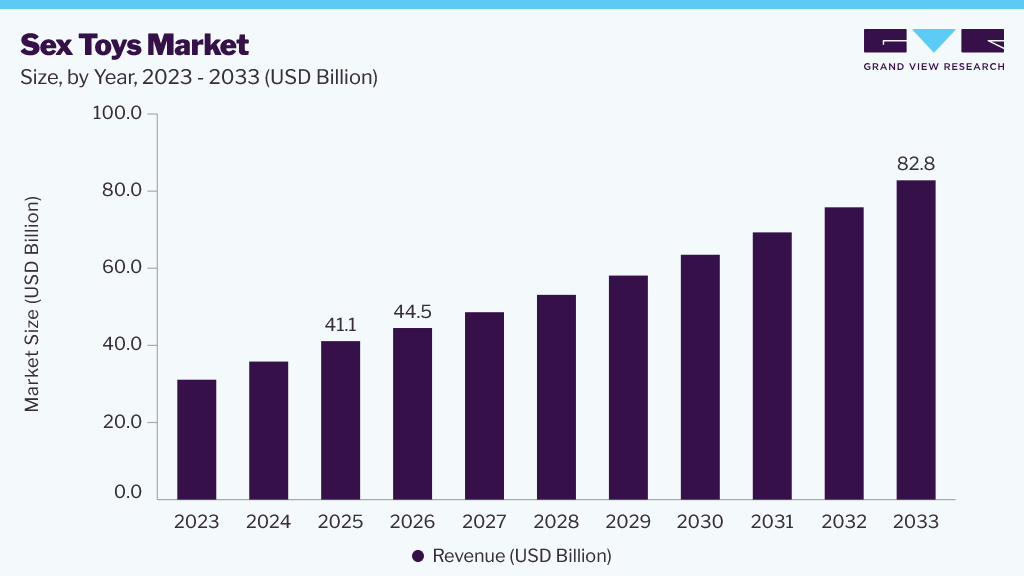 Source: Grand View Research, IR Documents, Primary Interviews, Paid DatabasesTo learn more about this report,
 Download Free Sample Report
Key Market Trends & Insights
- By product: Video walls segment held the largest market share of 22.6% in 2025.
- By distribution channel: E-commerce segment held the largest market share of 64.0% in 2025.
Regional Highlights
- Largest regional market: North America (32.9% revenue share, 2025)
- Fastest-growing regional market: Asia Pacific (highest CAGR, 2026-2033)
Market Size & Forecast
- Market size in 2025: USD 41.1 Billion
- Estimated market size in 2026: USD 44.5 Billion
- Projected market size by 2033: USD 82.8 Billion
- CAGR (2026–2033): 9.3%
Three ways to get this report
Buy it, customize it, or ask a question.Ask an Analyst
Analyst response in 1 business day
- AccessReport author, directly
- Reply timeWithin 1 working day
- No sales callDirect answer only
- FormatEmail reply
- CostFree, no cost
Get the Full Report
What the study covers
- FormatsPDF · Excel · Dashboard
- Timeline2026–2033 annual, 2025 base
- Coverage20+ countries, 5 regions
- Companies10+ key players profiled
Customize the Report
20% free customization
- IncludeCountries, segments, points
- TailorTo your product definition
- ExtendDeeper competitor detail
- OrA fully bespoke study
- Turnaround5–10 working days
Sex toys are gaining wider acceptance globally as women and couples increasingly explore products such as luxury adult toys, Bluetooth-enabled vibrators, romantic devices, and automated toys to enhance intimate and personal experiences. Beyond recreational use, these products are increasingly recognized for their potential therapeutic applications, including support for certain menopausal symptoms and sexual health issues. For men, sex toys may also be used to address challenges such as premature ejaculation, low libido, and erectile dysfunction. Growing awareness of the potential wellness and therapeutic benefits of these products is expected to support market growth during the forecast period.Technological advancements, particularly in artificial intelligence (AI), are transforming the industry and accelerating the transition from conventional sex toys toward SexTech products. AI-enabled and app-connected devices offer remote control, personalization, and interactive features that enhance the user experience. For instance, according to an article published in the South China Morning Post in February 2025, WMDoll, one of China’s biggest sex doll makers, witnessed a sales jump of 30% in a year after the company adopted open-source generative artificial intelligence (AI) to make the dolls more responsive and interactive. Continued advancements in AI and smart-device technologies are expected to drive demand for connected and AI-enabled sex toys.
Market Dynamics
The sex toys market is being shaped by changing consumer attitudes toward sexuality, rising awareness of sexual wellness, and the increasing availability of intimate products through e-commerce channels. Greater consumer acceptance and demand for personalized experiences are encouraging manufacturers to expand product portfolios and introduce innovative solutions. Technological advancements, including artificial intelligence, Bluetooth connectivity, smartphone applications, and remote-control capabilities, are further creating opportunities for smart and connected sex toys.
However, regulatory uncertainty, cultural sensitivities, and restrictions on advertising sexual wellness products remain important challenges. Variations in regulations related to product safety, marketing, distribution, and age verification across countries can increase compliance requirements and complicate international expansion. Advertising restrictions on major digital platforms can also limit brand visibility and customer acquisition. Despite these challenges, the continued convergence of sexual wellness and technology is expected to create opportunities for product differentiation, premiumization, and market expansion.
Increasing consumer acceptance of sexual wellness products is a key driver of the global sex toys market. Changing attitudes toward sexuality, greater awareness of sexual health, and the growing recognition of intimate wellness as part of overall personal well-being are encouraging consumers to explore sex toys. Reduced social stigma, particularly among younger consumers, is also contributing to greater openness toward purchasing and using these products. Increasing access to information through social media, digital platforms, and online sexual-health resources is further supporting consumer education and product awareness. Grand View Research identifies changing consumer attitudes and rising awareness of sexual health as important factors supporting demand for sex toys.
Technological advancements are further strengthening this driver by expanding the functionality and appeal of sex toys. Manufacturers are incorporating Bluetooth connectivity, smartphone applications, artificial intelligence, remote-control capabilities, and other smart features to provide personalized and interactive experiences. The expansion of SexTech is creating new product categories and encouraging premiumization, while e-commerce platforms provide consumers with greater product variety, convenience, and discreet purchasing options. These factors are collectively broadening the consumer base and supporting sustained demand for sex toys globally.
Regulatory uncertainty and restrictions on advertising sexual wellness products remain significant restraints for the sex toys market. Regulations governing the sale, marketing, distribution, product safety, and age verification of sex toys vary considerably across countries, creating compliance challenges for manufacturers, retailers, and online platforms. In some markets, legal ambiguity and cultural sensitivities limit the availability of sex toys through conventional retail channels, increasing manufacturers’ reliance on e-commerce and specialized distributors.
Advertising restrictions on major digital and social media platforms further constrain companies' ability to reach potential customers. Platforms may restrict or reject advertisements for sexual wellness products under policies covering adult products and services, limiting the use of mainstream digital marketing channels for customer acquisition. Industry research also identifies content moderation and regulatory requirements as challenges for SexTech companies, particularly as products become more technologically advanced and connected. Consequently, companies may need to rely more heavily on organic digital marketing, specialized platforms, influencer partnerships, and discreet retail channels, which can increase customer acquisition costs and limit brand visibility. Differences in regulations across regions can further increase compliance costs and complicate international expansion.
The increasing integration of artificial intelligence (AI), Bluetooth connectivity, smartphone applications, and remote-control technologies presents significant opportunities for the sex toys market. Consumers are increasingly seeking personalized, interactive, and convenient products, prompting manufacturers to develop smart devices that can be controlled via mobile applications and customized to individual preferences. The expansion of SexTech is further broadening the scope of conventional sex toys by incorporating connected technologies, AI-based personalization, and remote-use capabilities.
Manufacturers can capitalize on this opportunity by developing products with enhanced connectivity, personalized settings, and AI-enabled features while targeting emerging consumer segments. The opportunity is particularly relevant in Asia Pacific, where rising internet penetration, shifting consumer attitudes, and expanding online retail channels are driving demand for technologically advanced sexual wellness products. China and Japan are also emerging as important centers for innovation and manufacturing of AI-enabled devices. As technology becomes increasingly integrated into personal wellness, continued innovation in smart and connected products is expected to create new revenue opportunities for manufacturers and strengthen product differentiation.
Market Concentration & Characteristics
The sex toys market is experiencing continued innovation, supported by technological advancements, evolving attitudes toward sexuality, and growing awareness of sexual wellness. Although social stigma remains a challenge in several markets, increasing acceptance of sexual wellness products is supporting industry expansion. The integration of artificial intelligence (AI), virtual reality, augmented reality (AR), Bluetooth connectivity, smartphone applications, and remote-control capabilities is enabling more personalized, interactive, and connected user experiences. AI and smart technologies are also supporting the transition toward SexTech products, with manufacturers increasingly focusing on connected and intelligent devices.
Investment activity and strategic consolidation are also influencing the market, as established companies seek to expand product portfolios, strengthen technological capabilities, and enter new markets. Regulatory requirements related to product safety, marketing, distribution, privacy, and age verification continue to influence market development, with regulations varying significantly across countries. In India, legal and regulatory ambiguity surrounding adult products, combined with prevailing social attitudes, continues to limit their mainstream visibility.
Product innovation remains a key competitive strategy, with companies introducing technologically advanced devices to address diverse consumer preferences. For example, in January 2024, LELO introduced the Hugo 2 app and remote-controlled male sex toys, while OHDoki unveiled a technology-focused pleasure device at CES 2024. Regional expansion is similarly influenced by cultural attitudes, regulatory frameworks, disposable income, and consumer awareness. As sexual wellness gains greater acceptance and digital technologies become increasingly integrated into products, manufacturers are expected to expand their presence across emerging and established markets.
Analyst Perspective
The sex toys market is expected to maintain steady growth as changing attitudes toward sexual wellness, greater health awareness, and increasing product acceptance expand the consumer base. Online purchasing is improving accessibility while offering greater privacy and convenience. Technological innovation, including AI, Bluetooth connectivity, smartphone applications, and remote-control features, is enabling more personalized and interactive products. However, regulatory uncertainty, cultural sensitivities, and digital advertising restrictions can create compliance and customer-acquisition challenges across regions. The convergence of sexual wellness and consumer technology is supporting product differentiation and premium offerings. Future market development will depend on product innovation, discreet distribution, regulatory compliance, and targeted consumer engagement.
Type Insights
The vibrators segment dominated the sex toys industry, accounting for a revenue share of 22.6% in 2025, and is expected to grow at the fastest CAGR during the forecast period. The segment’s expansion is supported by continuous product innovation and the integration of advanced technologies that deliver more personalized, interactive user experiences. Manufacturers are increasingly introducing products with multiple functions, customizable settings, Bluetooth connectivity, and app-based controls to address diverse consumer preferences. Recent market analyses continue to identify vibrators as a leading product category, with technological innovation and increasing awareness of sexual wellness supporting demand.
The sex dolls segment is expected to grow at a significant CAGR of 8.7% during the forecast period. The product demand is driven by growing consumer interest in personalized, technologically advanced products, including smart and AI-enabled sex dolls. For instance, WMdoll in Zhongshan, China, introduced the MetaBox series of robotic dolls powered by open-source AI. These dolls offer enhanced features such as talking, identifying, and mimicking emotions. The increasing integration of connected technologies is expanding product functionality and creating new opportunities for manufacturers. Recent market analyses also indicate that sex dolls are evolving beyond conventional products, with manufacturers incorporating smart features and technology integration to cater to changing consumer preferences.
Distribution Channel Insights
The e-commerce segment accounted for the largest revenue share of 64.0% in 2025 and is expected to maintain its leading position during the forecast period. The segment benefits from increasing consumer preference for convenient, discreet, and private purchasing experiences. Online platforms offer a broad range of sexual wellness products, competitive pricing, customer reviews, and home delivery, making them an increasingly preferred channel for consumers. Growing internet penetration, expanding digital retail infrastructure, and increasing consumer familiarity with online shopping are further supporting the adoption of e-commerce channels for sex toys.
The mass merchandisers segment is expected to register significant growth during the forecast period, supported by the increasing availability and visibility of sexual wellness products across supermarkets, hypermarkets, and other large-format retail outlets. Retailers are expanding their sexual wellness product offerings, including vibrators, vibrating rings, and other personal wellness devices, as consumer acceptance increases. The integration of these products into broader wellness and personal-care categories is also helping improve their accessibility and mainstream visibility. As retailers expand shelf space and online assortments for sexual wellness products, mass merchandisers are expected to provide manufacturers with additional opportunities to reach a broader consumer base.
Regional Insights
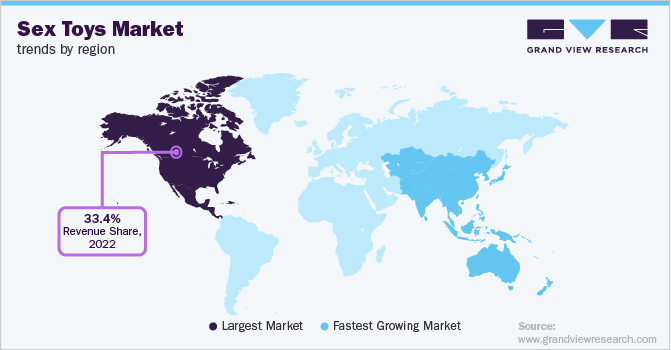
The North America sex toys market accounted for the largest global revenue share of 32.9% in 2025, supported by the presence of established manufacturers, retailers, and distributors that provide broad access to sexual wellness products. The U.S. is the largest market in the region, supported by growing consumer acceptance, extensive retail and e-commerce networks, and ongoing product innovation. The region also benefits from a well-established manufacturing base. For instance, Doc Johnson operates a large manufacturing facility in North Hollywood, California, and states that the majority of its products are designed and manufactured in the U.S. Continued innovation, expansion of distribution networks, and increased awareness of sexual wellness are expected to support the regional market during the forecast period.
 To learn more about this report, Download Free Sample Report
The Canada sex toys market is expected to register significant growth at a CAGR of 7.8% during the forecast period, supported by increasing consumer acceptance and rising demand for sexual wellness products. E-commerce is an important distribution channel, as online platforms provide consumers with convenient access, product variety, competitive pricing, and discreet delivery. The Canadian market is also benefiting from the growing adoption of technology-enabled sexual wellness products.
Europe Sex Toys Market Trends
The Europe sex toys industry is projected to witness considerable growth at a CAGR of 9.1% from 2026 to 2033. Germany, Italy, France, the UK, Denmark, and Spain are among the key contributors to the market growth, supported by increasing consumer awareness and the presence of established sexual wellness brands and retailers. Conventional products such as vibrators and dildos continue to account for a substantial share of consumer demand, while product innovation and growing acceptance of sexual wellness are expanding the market. The presence of prominent brands, including LELO, Lovehoney, Durex, and Fun Factory, has further strengthened the region’s product availability and contributed to Europe’s position as the second-largest regional market in 2025.
The UK sex toys market is expected to register significant growth during the forecast period, supported by broad product availability through online platforms, adult retailers, and specialty stores. Increasing awareness of sexual wellness and changing consumer attitudes toward intimate products are contributing to greater acceptance and adoption. In addition, the use of sex toys is increasingly viewed as part of personal and relationship wellness, supporting demand across different age groups. As consumers become more comfortable discussing and purchasing sexual wellness products, the UK market is expected to benefit from expanding product offerings, greater accessibility, and continued normalization of sexual wellness.
Asia Pacific Sex Toys Market Trends
The Asia Pacific sex toys industry is projected to grow at the fastest CAGR of 9.2% during the forecast period, supported by the region’s expanding manufacturing base and rising consumer demand across countries such as China, Australia, India, Japan, and New Zealand. China has more than 1,000 manufacturing facilities providing original equipment manufacturing (OEM) services to leading brands, strengthening its position as a major production hub for the global sex toys industry. The growing presence of online retailers, increasing consumer awareness of sexual wellness, and gradual changes in attitudes toward intimate products are further supporting regional market expansion. In addition, manufacturers across China and Japan are introducing technologically advanced products, including AI-enabled devices, creating new opportunities for market development.
The China sex toys market dominated Asia Pacific, with a revenue share of 32.4% in 2025, and is expected to maintain its leading position during the forecast period. China’s extensive OEM manufacturing ecosystem provides manufacturers with established production capabilities and supports product development for both domestic and international markets. Increasing investment in product innovation and the integration of technologies such as artificial intelligence and connectivity are enabling Chinese manufacturers to differentiate their offerings and address evolving consumer preferences. China’s established role in the global supply chain is expected to continue to support its importance in the Asia Pacific market.
Competitive Landscape
Companies in the sex toys market are increasingly pursuing strategic partnerships, acquisitions, and distribution agreements to expand their product portfolios and strengthen market reach. In September 2024, Lovehoney Group partnered with Just Eat Takeaway.com to expand access to sexual wellness products through on-demand delivery platforms, including products from brands such as Womanizer and Fifty Shades of Grey. In February 2024, Dame acquired sexual wellness brand Emojibator, marking its first acquisition and expanding its portfolio of pleasure products. Meanwhile, in May 2024, Satisfyer entered into a multi-year agreement with Adam & Eve to make its full product portfolio available through the retailer and its Australian subsidiary, Wild Secrets. The agreement also positioned Satisfyer as an OEM and private-label supplier for Adam & Eve's owned-brand products, strengthening its presence across branded and private-label segments.
Key Sex Toys Companies
The following key companies have been profiled for this study of the sex toys market.
-
Church & Dwight Co., Inc.
-
Reckitt Benckiser Group plc
-
LELO
-
LifeStyles Healthcare Pte Ltd
-
Doc Johnson Enterprises
-
Lovehoney Group Ltd
-
BMS Factory
-
PinkCherry
-
Tenga Co., Ltd.
-
Fun Factory
-
We-Vibe
Recent Developments
-
In January 2026, Lovense, a leading app-connected sex toys company, introduced its AI-powered companion doll at the CES 2026. This companion doll can combine physical intimacy with conversational intelligence.
-
In April 2025, Dame, a renowned sex toys company, announced the acquisition of Chakrubs, an intimacy wellness brand offering products made from 100% pure crystal. The acquisition was done to expand the existing product offerings by Dame.
-
In September 2024, Bellesa Boutique launched its WhisperTech Product Line for sexual wellness. One product in the line, WhisperBullet, is the world’s first-ever sub-audible vibrator.
Sex Toys Market Report Scope
Report Attribute
Details
Market size in 2025
USD 41.1 billion
Estimated market size in 2026
USD 44.5 billion
Projected market size by 2033
USD 82.8 billion
Growth rate
CAGR of 9.3% from 2026 to 2033
Base year for estimation
2025
Historical data
2021 - 2024
Forecast period
2026 - 2033
Quantitative units
Revenue in USD billion and CAGR from 2026 to 2033
Report coverage
Revenue forecast, company market position analysis, competitive landscape, growth factors, and trends
Segments covered
Product, distribution channel, region
Regional scope
North America; Europe; Asia Pacific; Latin America; Middle East & Africa
Country scope
U.S.; Canada; Germany; UK; France; Italy; Spain; Norway; Denmark; Sweden; China; Japan; India; South Korea; Australia; New Zealand; Brazil; Mexico; Argentina; South Africa
Key companies profiled
Church & Dwight Co., Inc.; Reckitt Benckiser Group plc; LELO; LifeStyles Healthcare Pte Ltd; Doc Johnson Enterprises; Lovehoney Group Ltd; BMS Factory; PinkCherry, Tenga Co., Ltd.; Fun Factory; We-Vibe
Customization scope
Free report customization (equivalent to up to 8 analysts working days) with purchase. Addition or alteration to country, regional & segment scope.
Pricing and purchase options
Avail of customized purchase options to meet your exact research needs. Explore purchase options
Global Sex Toys Market Report Segmentation
This report forecasts revenue growth at the global, regional, and country levels and provides an analysis of the latest industry trends in each of the sub-segments from 2021 to 2033. For this study, Grand View Research has segmented the global sex toys market report based on product, distribution channel, and region:
- Product Outlook (Revenue, USD Billion, 2021 - 2033)
- Vibrators
- Dildos
- Penis Rings
- Anal Toys
- Masturbation Sleeves
- Bondage
- Sex Dolls
- Others
- Distribution Channel Outlook (Revenue, USD Billion, 2021 - 2033)
- E-commerce
- Specialty Stores
- Mass Merchandisers
- Regional Outlook (Revenue, USD Billion, 2021 - 2033)
- North America
- U.S.
- Canada
- Europe
- UK
- Germany
- France
- Italy
- Spain
- Denmark
- Sweden
- Norway
- Asia Pacific
- China
- Japan
- India
- South Korea
- Australia
- New Zealand
- Latin America
- Brazil
- Mexico
- Argentina
- Middle East and Africa (MEA)
- South Africa
- North America
Frequently Asked Questions About This Report
The global sex toys market size was valued at USD 41.1 billion in 2025 and is estimated at USD 44.5 billion for 2026.
Key factors that are driving the sex toys market growth include growing demand from customers to enhance sexual experience, liberalization, penetration of social media, and the pop culture influence contributing to the increased awareness of sexual health.
The vibrators dominated the global sex toys market, accounting for the largest market share of over 22.6% in 2025.
The e-commerce segment led the global sex toys market and accounted for the largest revenue share of over 64.0% in 2025.
The global sex toys market is expected to grow at a CAGR of 9.3% from 2026 to 2033, reaching USD 82.8 billion by 2033.
Key players include Church & Dwight Co., Inc.; Reckitt Benckiser Group plc; LELO; LifeStyles Healthcare Pte Ltd; Doc Johnson Enterprises; Lovehoney Group Ltd; BMS Factory; Tenga Co., Ltd.; Fun Factory; and We-Vibe.
North America dominated with a 32.9% revenue share in 2025.
Sex Toys Market By Country
- U.S. Sex Toys Market
- Canada Sex Toys Market
- Germany Sex Toys Market
- France Sex Toys Market
- Italy Sex Toys Market
- Spain Sex Toys Market
- Russia Sex Toys Market
- Japan Sex Toys Market
- China Sex Toys Market
- India Sex Toys Market
- Australia Sex Toys Market
- Mexico - Latin America Sex Toys Market
- Brazil Sex Toys Market
- South Africa Sex Toys Market
- U.K. Sex Toys Market
About the Author(s)
Medical Devices Research Team
Healthcare · Medical DevicesThis report was authored by the medical devices research team at Grand View Research - comprising two research analysts, one senior research analyst, and one industry expert - with specialized expertise in the medical devices segment of the healthcare industry. All findings are based on proprietary healthcare databases, executive interviews, and regulatory analysis, subject to internal peer review prior to publication.
Last Updated:
Speak to Analyst

Customize this report to your needs - add regions, segments, or data points, with 20% free customization.
Or view our licence options:


ISO 9001:2015 & 27001:2022 Certified
We are GDPR and CCPA compliant! Your transaction & personal information is safe and secure. For more details, please read our privacy policy.


