
- Home
- »
- Clothing, Footwear & Accessories
- »
-
Shapewear Market Size, Share & Trends Report, 2026-2033GVR Report cover

Shapewear Market (2026 - 2033)
Size, Share & Trends Analysis Report By End-use (Female, Male), By Distribution Channel (Hypermarkets & Supermarkets, Specialty Stores, Online), By Region (North America, Europe, Asia Pacific, Latin America, MEA), And Segment Forecasts
Market Size, 2025
$2.9BMarket Estimate, 2026
$3.1BMarket Forecast, 2033
$5.4BCAGR, 2026–2033
8.1%Shapewear Market Summary
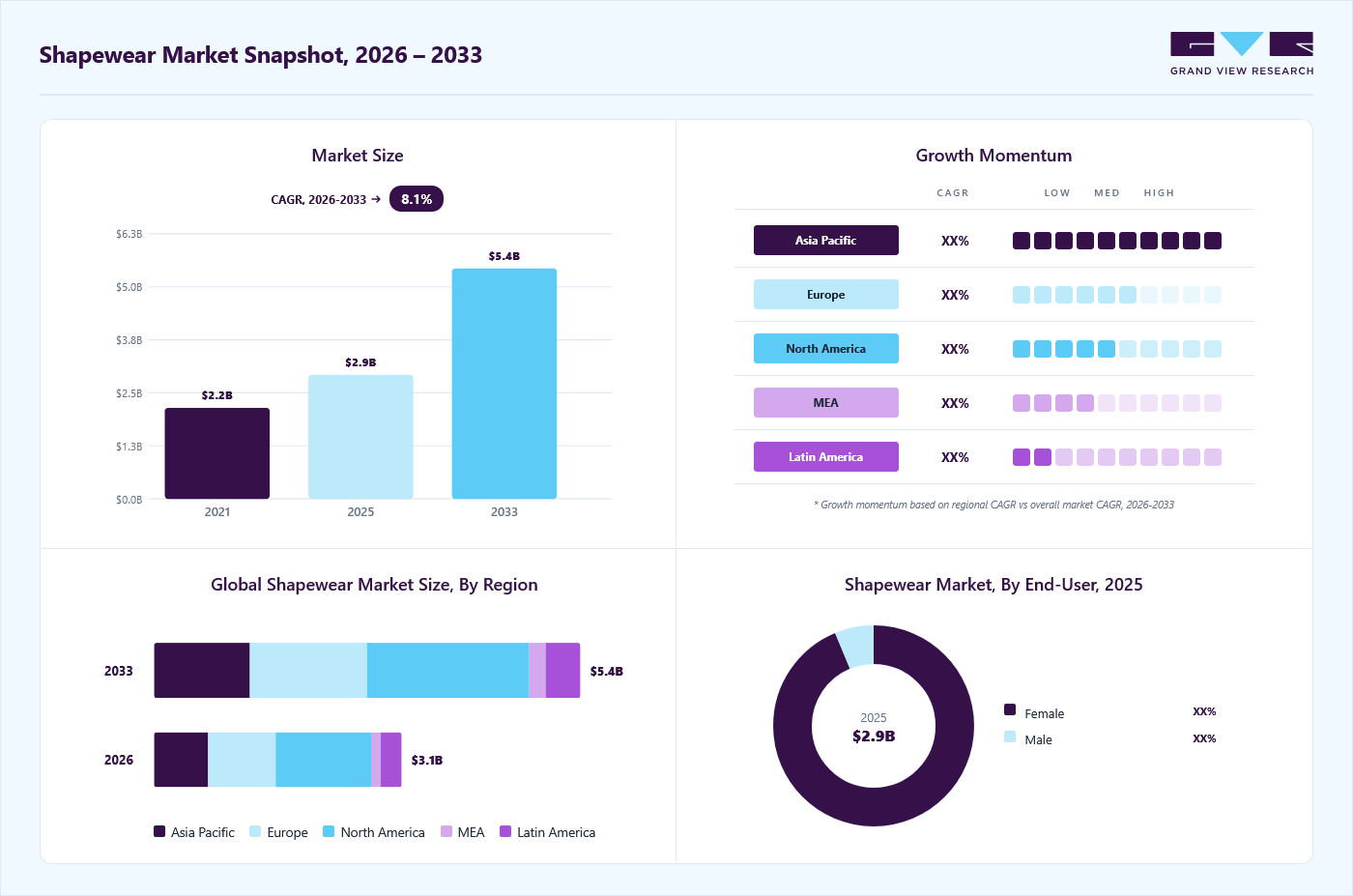
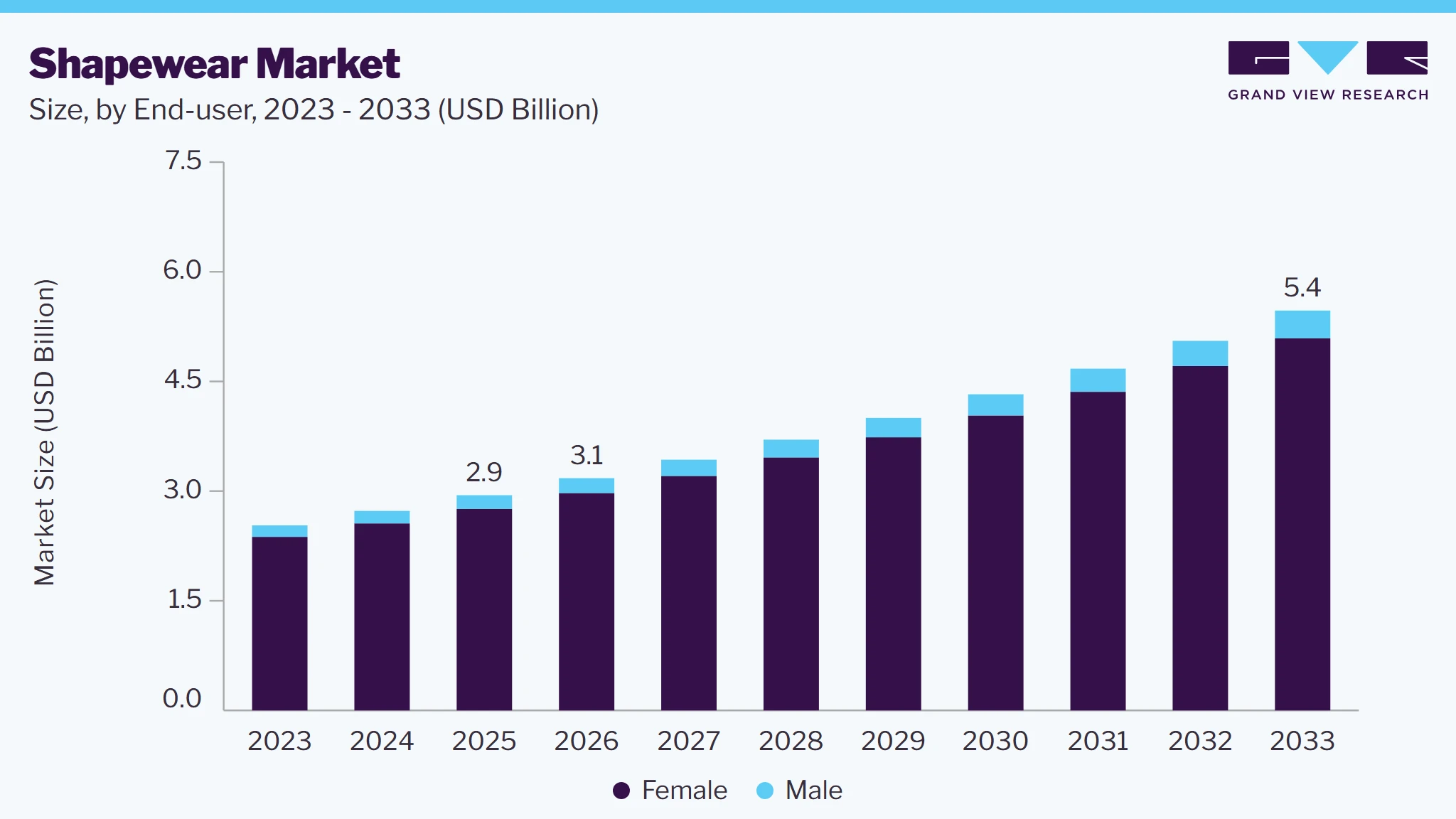
The global shapewear market was valued at USD 2.9 billion in 2025 and is projected to grow from USD 3.1 billion in 2026 to USD 5.4 billion by 2033, growing at a CAGR of 8.1% from 2026 to 2033. The market in North America dominated with a revenue share of 38.5% in 2025. This growth is attributed to changing consumer preferences, fabric technology advancements, and social media's increasing influence on fashion trends.
 Source: Grand View Research, IR Documents, Primary Interviews, Paid DatabasesTo learn more about this report,
 Download Free Sample Report
 Key Market Trends & Insights
- By end user: Female led the market with the largest revenue share of 93.7% in 2025.
- By distribution channel: The specialty stores led the market with the largest revenue share of 58.5% in 2025.
Regional Highlights
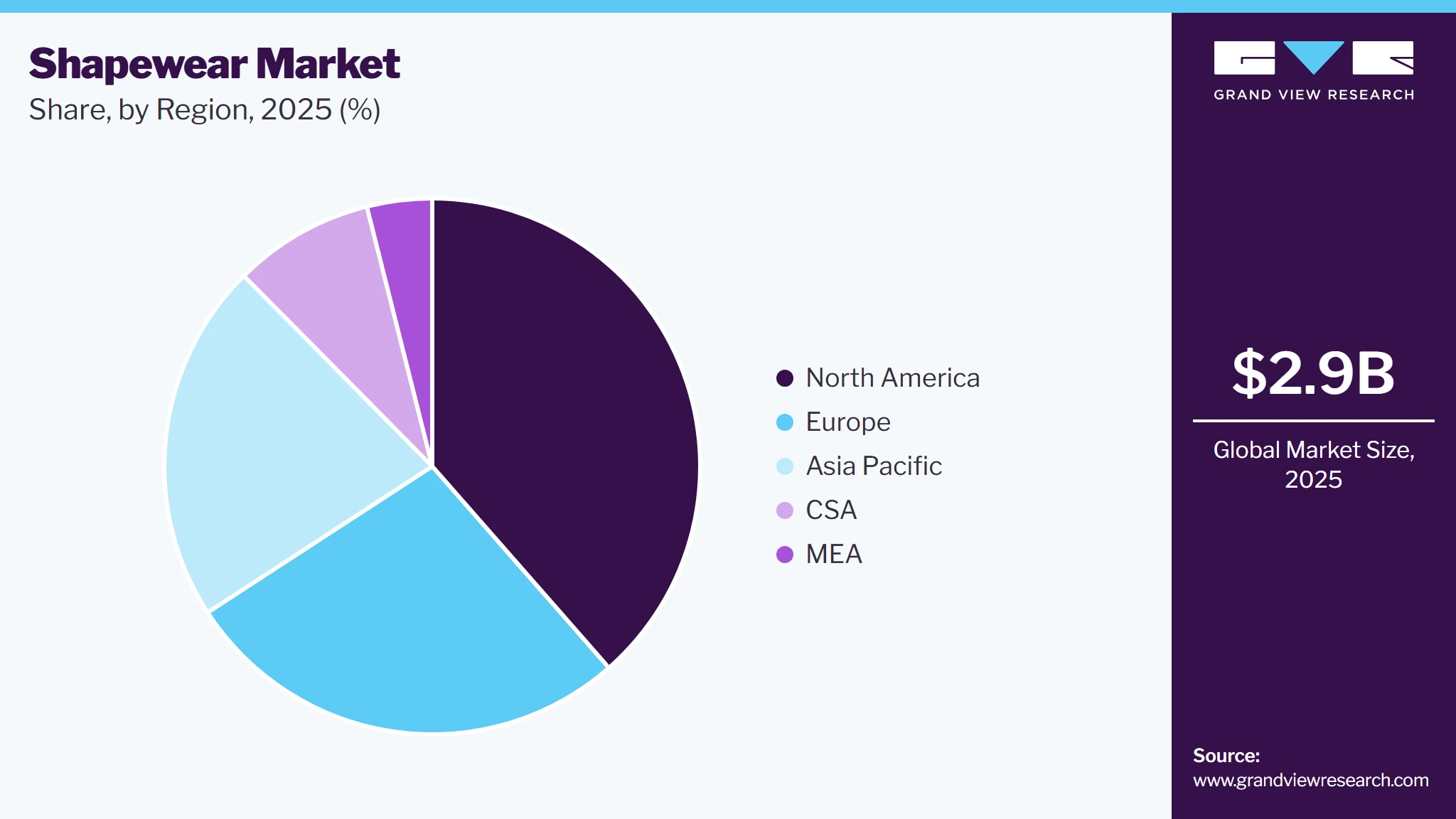
- Largest regional market: North America (38.5% revenue share, 2025)
- By country: The U.S. held the largest market share in 2025.
Market Size & Forecast
- Market size in 2025: USD 2.9 Billion
- Estimated market size in 2026: USD 3.1 Billion
- Projected market size by 2033: USD 5.4 Billion
- CAGR (2026-2033): 8.1%
Three ways to get this report
Buy it, customize it, or ask a question.Ask an Analyst
Analyst response in 1 business day
- AccessReport author, directly
- Reply timeWithin 1 working day
- No sales callDirect answer only
- FormatEmail reply
- CostFree, no cost
Get the Full Report
What the study covers
- FormatsPDF · Excel · Dashboard
- Timeline2026–2033 annual, 2025 base
- Coverage20+ countries, 5 regions
- Companies10+ key players profiled
Customize the Report
20% free customization
- IncludeCountries, segments, points
- TailorTo your product definition
- ExtendDeeper competitor detail
- OrA fully bespoke study
- Turnaround5–10 working days
The demand for shapewear products that enhance body shape and provide comfort is expected to surge as consumers become more conscious about their appearance and body image. The growing acceptance of shapewear among diverse demographics has further driven the shapewear industry. Originally popular only among women, shapewear is also gaining traction among men. This shift is reflected in the marketing of shapewear products designed specifically for men, such as shaping vests and compression shorts, responding to a broader cultural movement toward body positivity and self-expression. This diversification has played a key role in broadening the consumer base and encouraging manufacturers to innovate and improve their offerings.Technological advancements in fabric production have also played a crucial role in the growth of the shapewear industry. The introduction of high-performance materials that offer better elasticity, breathability, and moisture-wicking properties has enhanced the appeal of shapewear. Consumers are more inclined toward purchasing shapewear that offers comfort while shaping their bodies and also provides comfort during various activities, including exercise and daily routine. For instance, shapewear made from smart fabrics can adapt to body temperature and movement, providing a more comfortable experience for the wearer.
 To learn more about this report, Download Free Sample Report
 Moreover, the rise of e-commerce and social media marketing has significantly impacted how shapewear is marketed and sold. Online platforms allow brands to reach a wider consumer base while offering them the ease of shopping from home. Influencers and celebrities endorsing shapewear on social media have further fueled the interest of consumers and sales in this category. As a result of these interconnected factors that cater to evolving consumer needs and preferences, the shapewear industry is expected to continue its upward trajectory in the coming years.
Market Dynamics
Shapewear products are gaining widespread popularity as consumers increasingly seek garments that provide body contouring, posture support, comfort, and enhanced confidence for both everyday wear and special occasions. Modern shapewear incorporates advanced fabric technologies such as seamless construction, moisture-wicking materials, breathable textiles, and targeted compression zones to improve comfort and functionality. Additionally, growing demand for size-inclusive designs, multifunctional shapewear, and fashion-forward styles that can be worn as outerwear is expanding the consumer base across different age groups. The increasing influence of social media, celebrity endorsements, and body-positive marketing campaigns is further encouraging product adoption. Moreover, rising disposable incomes and the expansion of online retail platforms are improving product accessibility and consumer awareness. These factors, coupled with continuous product innovation and evolving fashion preferences, are expected to continue driving growth in the shapewear market.
Growing consumer interest in body contouring, enhanced appearance, and improved confidence is driving demand for shapewear products. Consumers are increasingly seeking garments that provide a better fit and all-day comfort for both everyday wear and special occasions. Additionally, advancements in seamless designs, breathable fabrics, and size-inclusive offerings have expanded shapewear adoption across diverse consumer groups. The influence of social media, celebrity endorsements, and rising fashion consciousness is further supporting market growth, while the expansion of online retail channels continues to improve product accessibility and consumer awareness.
Discomfort associated with prolonged wear and challenges related to achieving the right fit remain key restraints for the shapewear market. Many consumers perceive shapewear as restrictive, uncomfortable, or unsuitable for extended daily use, particularly products with high compression levels. Issues such as skin irritation, breathability limitations, rolling fabric, and sizing inconsistencies can negatively impact the user experience and discourage repeat purchases. Additionally, concerns regarding body image perceptions and the availability of well-fitting products across diverse body types may further limit adoption. These factors can reduce consumer acceptance and hinder market growth, especially among first-time users and comfort-focused consumers.
The increasing consumer preference for comfortable, versatile, and fashion-forward shapewear is creating significant growth opportunities in the shapewear market. Consumers are increasingly seeking products that combine body shaping benefits with features such as breathability, moisture management, and all-day comfort. This trend is encouraging manufacturers to develop innovative shapewear that can be worn both as innerwear and outerwear, expanding its appeal beyond traditional use cases. Additionally, growing demand for size-inclusive products, maternity shapewear, active shapewear, and men's shapewear is creating new revenue opportunities for brands. The rapid growth of e-commerce platforms and direct-to-consumer sales channels is further enabling companies to reach a broader consumer base and introduce personalized product offerings, supporting long-term market expansion.
Analyst Perspective
The shapewear market is positioned at the intersection of evolving fashion preferences, growing body-confidence awareness, and increasing demand for functional apparel. What was once viewed primarily as occasion-based undergarments has evolved into a broader lifestyle category driven by everyday wear, comfort, and versatility. Rising consumer preference for seamless construction, breathable fabrics, and size-inclusive designs is expanding the addressable market beyond traditional users and fostering higher product adoption across age groups and body types. The key competitive advantage will belong to brands that successfully combine shaping performance with comfort, inclusivity, and fashion appeal while building strong direct-to-consumer relationships. As shapewear increasingly overlaps with activewear, loungewear, and outerwear categories, companies that develop multifunctional products and leverage digital channels for personalized consumer engagement are likely to capture disproportionate market share. In the long term, innovation in fabric technology, sustainability, and fit customization will be critical differentiators, transforming shapewear from a niche apparel segment into a mainstream wardrobe essential.
End-use Insights
Based on end user, female led the market with the largest revenue share of 93.7% in 2025 and is expected to grow at the fastest CAGR over the forecast period, primarily due to the heightened focus on body image and fashion among women. This demographic has increasingly embraced shapewear as an essential component of their wardrobe, driven by a desire for enhanced body appearance. Many women are drawn to products such as high-waisted shaping shorts that provide support and a smooth finish under clothing, making them ideal for both casual and formal occasions. The growing acceptance and demand for shapewear among women reflect broader societal trends emphasizing self-expression and personal style, solidifying their dominant position in the market.
The male segment is expected to grow at the highest CAGR over the forecast period due to evolving fashion trends in men’s apparel, with increasing awareness about fitness and body image among them. There is a rising demand for shapewear that enhances their physique and provides support during physical activities. Market players engaged in designing and manufacturing shapewear are capitalizing on this trend by offering innovative products designed specifically for men, such as body-sculpting undershirts and supportive athletic tights that improve body contours while ensuring comfort. This shift in perception, combined with advancements in fabric technology that enhance breathability and flexibility, is driving rapid growth in the male shapewear industry.
Distribution Channel Insights
Based on distribution channel, the specialty stores led the market with the largest revenue share of 58.5% in 2025, largely due to the personalized shopping experience provided by these stores. Customers can try on products, receive tailored advice from knowledgeable staff, and access a curated selection of high-quality shapewear that may not be available in larger retail chains. Specialty stores feature exclusive brands and styles designed specifically for body-shaping needs, allowing customers to find the desired fit and style. The focus on customer service and product variety is a significant factor driving revenue growth in this segment, as shoppers increasingly seek specialized solutions that enhance their appearance, confidence, and comfort.
The online segment is expected to grow at the fastest CAGR over the forecast period due to the convenience and accessibility that it offers to consumers worldwide. With the proliferation of internet access and mobile devices, shoppers can easily browse a vast array of shapewear options from the comfort of their homes, allowing for greater comparison of styles, prices, and customer reviews. For instance, platforms such as Amazon and dedicated shapewear websites provide detailed product descriptions and user feedback, which help consumers make informed purchasing decisions. In addition, the influence of social media and celebrity endorsements has heightened interest in shapewear, driving traffic to online stores where consumers can quickly purchase trending items. The ability to shop anytime and anywhere, combined with exclusive deals and promotions, further enhances the appeal of online shopping, positioning it as a primary channel for shapewear purchases in the coming years.
Regional Insights
North America dominated the shapewear market with the largest revenue share of 38.5% in 2025, primarily due to strong consumer demand, innovative product offerings, and a well-established retail infrastructure. Increasing awareness about the benefits of maintaining health and fitness has led consumers to seek shapewear that enhances their appearance while providing comfort and support. The popularity of waist trainers in North America, which help create an hourglass figure through compression, exemplifies this trend.
 To learn more about this report, Download Free Sample Report
 Key players and brands in the region foster competition and encourage continuous product innovation, catering to diverse consumer preferences. Evolving fashion trends, including the integration of shapewear into everyday attire, are further expected to drive sales as more individuals view these products as essential wardrobe staples. The combination of these factors reflecting changing attitudes toward body image and fashion positions North America as a leader in the shapewear market.
U.S. Shapewear Market Trends
The shapewear market in the U.S. held the largest share in the North America region in 2025 with the largest revenue share, driven by cultural trends, consumer preferences, and a robust retail environment. The emphasis on body image and fitness in American culture has led to a significant demand for shapewear products that enhance physical appearance and provide comfort. Evolving fashion trends, including the integration of shapewear into everyday attire, have further driven sales as more individuals view these products as wardrobe essentials. The extensive availability of shapewear through various channels, including specialty stores and e-commerce platforms, has further amplified its accessibility and popularity in the country.
Asia Pacific Shapewear Market Trends
The Asia Pacific shapewear market is expected to grow at the highest CAGR over the forecast period, driven by rising fashion consciousness, urban lifestyle changes, and increasing disposable incomes across the region. As more consumers become aware of body image and personal aesthetics, there is a heightened demand for shapewear that enhances their appearance and fits the contemporary fashion trends. Furthermore, the growing popularity of body-positive movements has led to an increased acceptance of shapewear to boost confidence and comfort in everyday clothing.
China shapewear market dominated Asia Pacific in 2024 with the largest revenue share due to rising fashion consciousness, growing demand for shapewear that enhances body contours, and availability of shapewear styles that complement modern clothing. The popularity of high-waisted shaping leggings reflects this trend, as they provide both comfort and a flattering silhouette. Furthermore, expanding e-commerce platforms in China has made shapewear more accessible, allowing consumers to explore a wide range of products conveniently.
Europe Shapewear Market Trends
Europe shapewear market is expected to grow significantly over the forecast period with rising consumer awareness about body image, a strong fashion culture, and innovations in fabric technology. European consumers have become more health-conscious and fashion-savvy and are increasingly seeking shapewear that enhances their appearance while providing comfort and support. In addition, the growing emphasis on sustainable and eco-friendly materials in fashion is aligned with consumer preferences for high-quality products that are both stylish and eco-friendly. Germany and the UK are leading this trend, with consumers willing to invest in premium shapewear options that reflect their values and lifestyle choices.
Key Shapewear Company Insights
Some of the key players in the shapewear market are Nike, Inc., Adidas AG, Spanx, LLC, Triumph Intertrade AG., Leonisa, Wacoal., ANN CHERY, Jockey International, Inc., Shapermint, and Under Armour, Inc. These companies employ various strategies to maintain a competitive edge, including the development of innovative products that cater to diverse consumer needs and preferences. They focus on enhancing comfort and fit through advanced fabric technologies and design engineering, ensuring that their offerings meet the demands of modern consumers.
-
Spanx, LLC specializes in innovative shapewear solutions designed to enhance body confidence and comfort. The company caters to various body types and preferences by offering options such as shaping shorts, bodysuits, and bras. It focuses on high-quality materials and advanced compression technology, ensuring its products provide effective shaping without sacrificing comfort.
-
Nike, Inc. has expanded its athletic wear portfolio to include shapewear that combines performance and style. The company leverages its expertise in sports apparel to create shapewear for active individuals seeking functionality and aesthetic appeal. It incorporates advanced fabric technologies that offer breathability, moisture-wicking properties, and targeted compression, thereby addressing the needs of consumers looking for versatile shapewear suitable for workouts and daily wear.
Key Shapewear Companies:
The following key companies have been profiled for this study on the shapewear market.
-
Nike, Inc.
-
Adidas AG
-
Spanx, LLC
-
Triumph Intertrade AG.
-
Leonisa
-
ANN CHERY
-
Wacoal
-
Under Armour, Inc.
-
Jockey International, Inc.
-
Shapermint
Competitive Benchmarking
Category
Operating Strategies
Competitive Edge
Weakness
Established Players (Spanx, SKIMS, Wacoal, Triumph International, Jockey International)
- Expand product portfolios through innovation in seamless fabrics, size-inclusive offerings, premium collections, and omnichannel distribution. Invest in celebrity endorsements, brand collaborations, direct-to-consumer platforms, and global retail expansion.
- Strong brand recognition, extensive distribution networks, loyal customer base, economies of scale, and significant marketing resources. Ability to offer broad product ranges across multiple price points and consumer segments.
- Higher operating costs, dependence on mature markets, and slower product development cycles compared to agile digital-native brands. Challenges in rapidly adapting to changing consumer preferences and niche market trends.
Emerging Players (Shapermint, Honeylove, Yitty, Knix, Leonisa's DTC initiatives)
- Focus on digital-first business models, social media marketing, influencer partnerships, personalized fit solutions, and niche segments such as postpartum, active, and inclusive shapewear. Leverage consumer feedback for rapid product development.
- Faster innovation cycles, strong online engagement, direct customer relationships, and ability to address underserved consumer needs. Greater flexibility in responding to fashion trends and body-positivity movements.
- Limited financial resources, lower brand awareness in some regions, dependence on digital advertising channels, and challenges in scaling distribution and international expansion.
Recent Developments
-
In November 2024, Spanx launched its highly anticipated Black Friday sale, offering significant discounts across its entire range of products. It offered a sitewide discount of 30% on best-selling items, including shapewear, leggings, and loungewear, with up to 70% discount on select styles. The promotion aimed to attract new shoppers looking for stylish options in shapewear during the holiday season.
-
In July 2023, Wacoal unveiled its innovative Shape Revelation Collection of tailored bras and shapewear for specific breast and body shapes. This collection includes three styles of bras and five types of shapewear, addressing the needs of various body types.
Shapewear Market Report Scope
Report Attribute
Details
Market size value in 2025
USD 2.9 billion
Estimated market Size in 2026
USD 3.1 billion
Projected market size by 2033
USD 5.4 billion
Growth rate
CAGR of 8.1% from 2026 to 2033
Base year for estimation
2025
Historical data
2021 - 2024
Forecast period
2026 - 2033
Quantitative units
Revenue in USD million/billion and CAGR from 2026 to 2033
Report coverage
Revenue forecast, company ranking, competitive landscape, growth factors, and trends
Segments covered
End user, distribution channel, region
Regional scope
North America; Europe; Asia Pacific; MEA; CSA
Country scope
U.S.; Canada; Mexico; Germany; UK; France; Italy; Spain; Germany; China; Japan; India; South Korea; Brazil; South Africa
Key companies profiled
Nike, Inc., Adidas AG, Spanx, LLC, Triumph Intertrade AG., Leonisa, Wacoal., ANN CHERY, Jockey International, Inc., Shapermint, Under Armour, Inc.
Customization scope
Free report customization (equivalent up to 8 analysts' working days) with purchase. Addition or alteration to country, regional & segment scope.
Pricing and purchase options
Avail customized purchase options to meet your exact research needs. Explore purchase options
Global Shapewear Market Report Segmentation
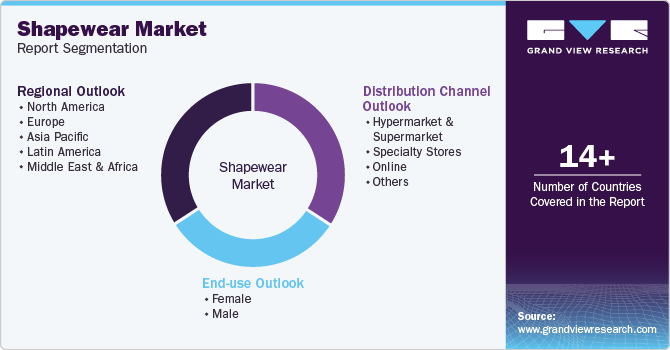
This report forecasts revenue growth at global, regional, and country levels and provides an analysis of the latest industry trends in each of the sub-segments from 2021 to 2033. For this study, Grand View Research has segmented the global shapewear market report based on end-use, distribution channel, and region:
 To learn more about this report, Download Free Sample Report
 -
End-use Outlook (Revenue, USD Million, 2021 - 2033)
-
Female
-
Male
-
-
Distribution Channel Outlook (Revenue, USD Million, 2021 - 2033)
-
Hypermarket & Supermarket
-
Specialty Stores
-
Online
-
Others
-
-
Regional Outlook (Revenue, USD Million, 2021 - 2033)
-
North America
-
U.S.
-
Canada
-
Mexico
-
-
Europe
-
Germany
-
UK
-
France
-
Italy
-
Spain
-
-
Asia Pacific
-
China
-
Japan
-
India
-
Australia
-
South Korea
-
-
Latin America
-
Brazil
-
-
Middle East and Africa (MEA)
-
Research Methodology
Segment Definition
Segment - Type
Revenue capture definition
Hypermarket & Supermarket
This segment covers the revenues generated through the sales of shapewear through hypermarkets, supermarkets, and large-format retail stores that offer a wide range of apparel, innerwear, and lifestyle products under one roof. Consumers purchase shapewear from these outlets due to the convenience of one-stop shopping, the ability to compare multiple brands in person, and frequent promotional offers. These stores typically stock shapewear products such as shaping briefs, bodysuits, waist cinchers, and shaping camisoles from both mass-market and premium brands.
Specialty Stores
This segment covers the revenues generated through the sales of shapewear through specialty stores that focus on lingerie, intimate apparel, hosiery, activewear, or women's fashion products. These retailers typically provide a curated assortment of shapewear styles, personalized fitting assistance, product recommendations, and access to premium or specialized brands. Consumers often prefer specialty stores when seeking specific compression levels, size-inclusive options, or professional fitting services.
Online
This segment covers the revenues generated through the sales of shapewear via e-commerce websites, brand-owned online stores, online marketplaces, mobile shopping applications, and social commerce platforms. Online channels enable consumers to browse extensive product assortments, compare prices, access customer reviews, benefit from home delivery services, and purchase products discreetly. The growing adoption of digital shopping and direct-to-consumer business models has significantly contributed to the expansion of this distribution channel.
Others
This segment covers the revenues generated through the sales of shapewear via department stores, discount stores, warehouse clubs, direct selling channels, independent apparel retailers, and other non-specialized retail formats not classified under hypermarkets & supermarkets, specialty stores, or online channels. These channels provide consumers with additional purchasing options and often cater to regional preferences, value-conscious shoppers, or customers seeking a broader apparel selection.
Estimation Model
Demographic Layer
Purchasing Power Layer
Adoption Layer
Revenue Layer
Who is likely to purchase shapewear??
Who can afford shapewear products?
Who actively purchases shapewear?
How much revenue is generated?
Identify the addressable consumer population based on demographics and lifestyle factors, including women and men within fashion-conscious age groups, working professionals, postpartum women, fitness enthusiasts, and consumers seeking body-contouring apparel. Apply population, income, and urbanization data to estimate the potential consumer base.
Apply region-specific disposable income levels, apparel expenditure patterns, and middle-class population data to the eligible consumer base. This layer filters consumers based on purchasing capacity and willingness to spend on premium apparel, intimate wear, and fashion-enhancing products.
Apply shapewear penetration rates, fashion awareness levels, e-commerce adoption, and frequency of apparel purchases to estimate active shapewear users. Consider factors such as body-shaping preferences, demand for seamless garments, social media influence, occasion wear usage, and growing acceptance of shapewear as everyday apparel.
Multiply active shapewear consumers by average annual spending on shapewear products, considering purchase frequency, product type (bodysuits, briefs, waist cinchers, leggings, camisoles, etc.), and pricing tiers. Incorporate revenue generated through specialty stores, hypermarkets & supermarkets, online channels, and other retail formats to derive total market revenue.
Delivered Customizations
This report has been delivered with the following In-depth customizations
Client Request
Customization Delivered
Value Adds
Shapewear Consumer Behavior & Purchase Drivers
Analyzed key factors influencing shapewear purchases, including body contouring needs, comfort preferences, fashion trends, and confidence-enhancing benefits across different consumer demographics.
Enables companies to refine product positioning, target high-value consumer groups, and improve marketing effectiveness.
Distribution Channel & Retail Landscape Analysis
Evaluated performance across specialty stores, hypermarkets & supermarkets, online platforms, and other retail channels, including channel-specific purchasing patterns and growth opportunities.
Assists stakeholders in optimizing distribution strategies and identifying the most lucrative sales channels.
Innovation, Premiumization & Growth Opportunities
Assessed emerging trends such as seamless shapewear, sustainable materials, inclusive sizing, athleisure-inspired shapewear, and premium product offerings across key regions.
Supports strategic planning by identifying future growth drivers, innovation priorities, and market expansion opportunities.
Frequently Asked Questions About This Report
North America dominated the shapewear market with a share of 38.5% in 2025. This is attributable to rising consumer spending on body-shaping products within the region.
Some key players operating in the shapewear market include Nike, Inc.; Spanx, Inc.; .Adidas AG; Triumph International Corp.; Leonisa SA; Wacoal America, Inc.; Ann Chery; 2XU Pty. Ltd.; Under Armour, Inc.; and Skins International Trading AG.
Key factors that are driving the market growth include rapidly evolving fashion trends and the increasing demand for superior fabrics worldwide.
The global shapewear market size was estimated at USD 2.9 billion in 2025 and is expected to reach USD 3.1 billion in 2026.
Asia Pacific is the fastest-growing region over the forecast period.
In North America U.S. accounted for the largest share with 85.9% in 2025.
The global shapewear market is expected to grow at a compound annual growth rate of 8.1% from 2026 to 2033 to reach USD 5.4 billion by 2033.
The female segment led with a 93.7% revenue share in 2025, while the male segment is the fastest-growing channel.
The specialty store segment led with a 58.5% revenue share in 2025, while the online channel is the fastest-growing channel.
About the Author(s)
Clothing, Footwear & Accessories Research Team
Consumer Goods · Clothing, Footwear & AccessoriesThis report was authored by the clothing, footwear & accessories research team at Grand View Research - comprising two research analysts, one senior research analyst, and one industry expert - with specialized expertise in the clothing, footwear & accessories segment of the consumer goods industry. All findings are based on proprietary consumer goods databases, executive interviews, and regulatory analysis, subject to internal peer review prior to publication.
Last Updated:
Speak to Analyst

Customize this report to your needs - add regions, segments, or data points, with 20% free customization.
Or view our licence options:


ISO 9001:2015 & 27001:2022 Certified
We are GDPR and CCPA compliant! Your transaction & personal information is safe and secure. For more details, please read our privacy policy.


