
- Home
- »
- Advanced Interior Materials
- »
-
Sludge Dewatering Equipment Market Size Report, 2033GVR Report cover

Sludge Dewatering Equipment Market (2026 - 2033)
Size, Share & Trends Analysis Report By Technology Type (Belt Filter Press, Centrifuges, Screw Press) By Application (Industrial, Municipal), By Region, And Segment Forecasts
Market Size, 2025
$5.5BMarket Estimate, 2026
$5.9BMarket Forecast, 2033
$10.4BCAGR, 2026–2033
8.6%Sludge Dewatering Equipment Market Summary
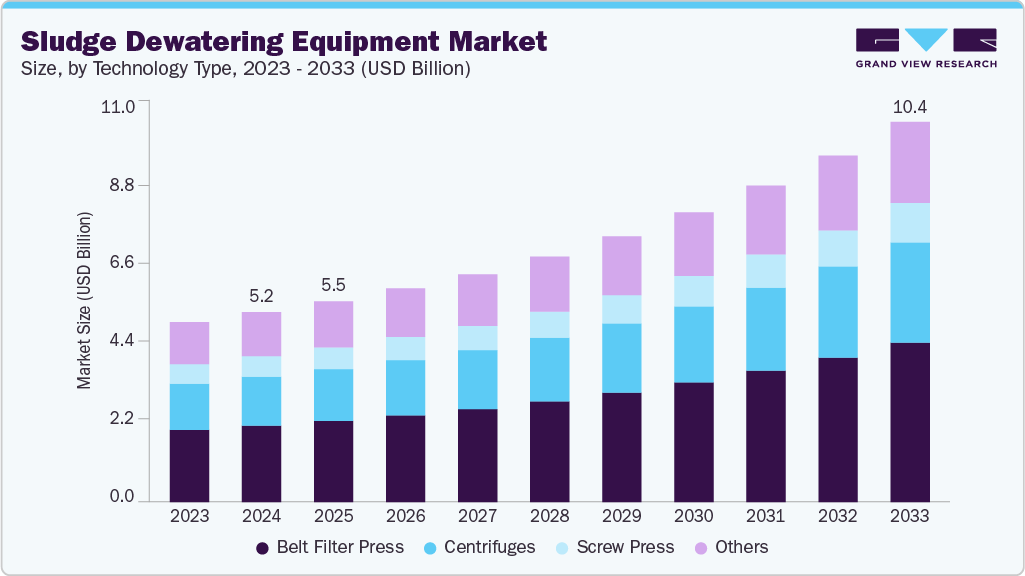
The global sludge dewatering equipment market size was valued at USD 5.5 billion in 2025 and is projected to grow from USD 5.9 billion in 2026 to USD 10.4 billion by 2033, at a CAGR of 8.6% from 2026 to 2033. Asia Pacific dominated the market, accounting for a revenue share of 34.4% in 2025. Growth is driven by increasing industrialization, stricter environmental regulations, and rising wastewater treatment demands.
 Source: Grand View Research, IR Documents, Primary Interviews, Paid DatabasesTo learn more about this report,
 Download Free Sample Report
Key Market Trends & Insights
- By technology type: Belt filter press segment led the market with the largest revenue share of 40.7% in 2025.
- By application: Municipal segment led the market with the largest revenue share of 73.6% in 2025.
Regional Highlights
- Largest regional market: Asia Pacific (34.4% revenue share, 2025)
- By country: China held the largest market share in 2025.
Market Size & Forecast
- Market size in 2025: USD 5.5 Billion
- Estimated market size in 2026: USD 5.9 Billion
- Projected market size by 2033: USD 10.4 Billion
- CAGR (2026-2033): 8.6%
Three ways to get this report
Buy it, customize it, or ask a question.Ask an Analyst
Analyst response in 1 business day
- AccessReport author, directly
- Reply timeWithin 1 working day
- No sales callDirect answer only
- FormatEmail reply
- CostFree, no cost
Get the Full Report
What the study covers
- FormatsPDF · Excel · Dashboard
- Timeline2026–2033 annual, 2025 base
- Coverage20+ countries, 5 regions
- Companies10+ key players profiled
Customize the Report
20% free customization
- IncludeCountries, segments, points
- TailorTo your product definition
- ExtendDeeper competitor detail
- OrA fully bespoke study
- Turnaround5–10 working days
Municipal and industrial sectors are investing in efficient dewatering technologies to reduce sludge volume, disposal costs, and environmental impact, driving consistent adoption across developing and developed regions alike. Technological advancements are significantly driving the market by enhancing efficiency, reducing operational costs, and improving environmental compliance. Innovations such as high-performance centrifuges, advanced screw press designs, and membrane filtration systems enable better solid-liquid separation and minimize sludge volume. Smart automation and IoT integration allow real-time monitoring, predictive maintenance, and optimized energy usage.
 To learn more about this report, Download Free Sample Report
Market Dynamics
The sludge dewatering equipment market is influenced by continuous technological advancements focused on improving dewatering efficiency, reducing operating costs, and enhancing process automation across municipal and industrial wastewater treatment facilities. Market participants are expanding their portfolios with energy-efficient centrifuges, screw presses, belt filter presses, and filter presses integrated with digital monitoring and automated control systems to optimize plant performance. The industry is also witnessing a shift toward complete sludge handling solutions that combine thickening, dewatering, conveying, and sludge management within a single process. Increasing emphasis on lifecycle cost optimization, reduced energy consumption, and lower maintenance requirements is influencing equipment selection, while manufacturers are strengthening aftermarket services, refurbishment, and technical support to enhance customer retention.
Increasing investments in municipal wastewater treatment infrastructure and industrial effluent management are strengthening the demand for sludge dewatering equipment. Stringent environmental regulations governing sludge handling and disposal, coupled with the need to improve treatment efficiency and reduce sludge transportation costs, are encouraging wastewater treatment facilities to adopt advanced dewatering technologies. The ongoing modernization of aging treatment plants and expansion of wastewater treatment capacity across developing and developed economies continue to support the deployment of centrifuges, belt filter presses, screw presses, and filter presses.
The adoption of sludge dewatering equipment is influenced by the substantial capital investment required for equipment procurement, installation, and system integration. In addition to initial expenditure, recurring costs associated with maintenance, energy consumption, polymer usage, and replacement of wear components increase the overall lifecycle cost of ownership. These factors can limit investment in advanced dewatering systems, particularly among small and medium-sized wastewater treatment facilities operating under budget constraints.
The transition toward automated and energy-efficient sludge management processes is creating new growth opportunities for equipment manufacturers. Wastewater treatment operators are increasingly prioritizing dewatering systems equipped with intelligent process controls, remote monitoring, and predictive maintenance capabilities to improve operational efficiency and reduce operating costs. Furthermore, investments in wastewater infrastructure modernization, resource recovery initiatives, and sustainable biosolids management are expanding the application of advanced sludge dewatering equipment across municipal and industrial treatment facilities.
Market Concentration & Characteristics
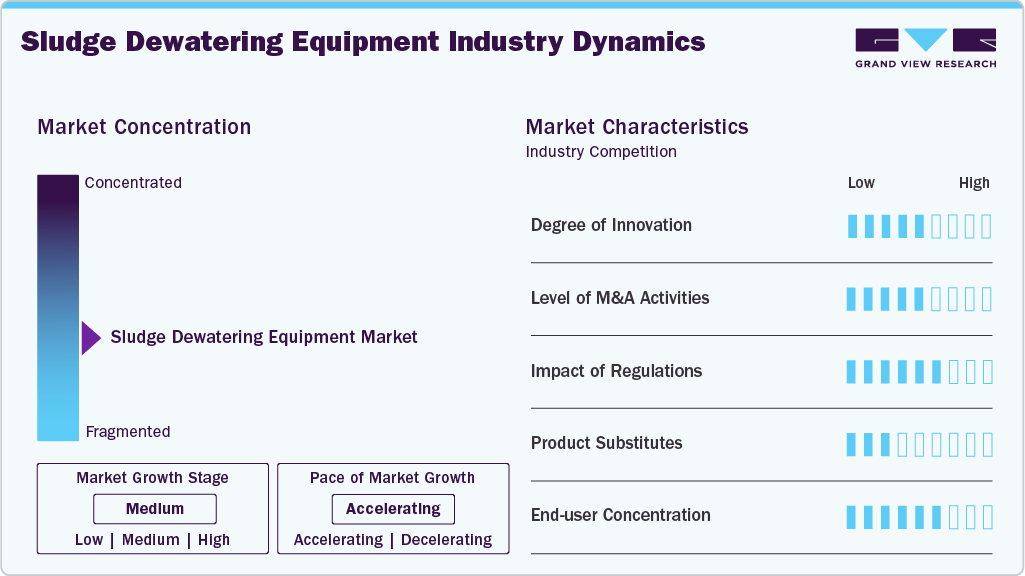
The global sludge dewatering equipment market is moderately fragmented, with a mix of established global players and regional manufacturers competing based on innovation, efficiency, and customization. Leading companies dominate in terms of technological expertise, production capacity, and global distribution networks, giving them a competitive edge in large-scale municipal and industrial projects. However, regional players thrive in local markets by offering cost-effective solutions tailored to specific customer needs. Strategic partnerships, acquisitions, and investment in R&D are common strategies to gain market share.
The sludge dewatering equipment market demonstrates a high degree of innovation, with advancements in automation, energy-efficient technologies, and smart monitoring systems. New designs focus on enhancing throughput, reducing environmental impact, and integrating IoT-based predictive maintenance, making operations more cost-effective and sustainable across municipal, industrial, and agricultural wastewater treatment facilities.
 To learn more about this report, Download Free Sample Report
Merger and acquisition activities in the sludge dewatering equipment market are driven by the need for technological expansion and market penetration. Leading players are acquiring niche companies to enhance their technology type portfolios and enter new geographies. For instance, in May 2025 Pelagia acquired aquaculture equipment supplier Fjord Solutions. Through its Blue Ocean Technology brand, Pelagia offers sludge and water treatment systems focused on dewatering, storage, and value creation, expanding its reach in sustainable aquaculture operations.
Regulations are significantly shaping the market by enforcing stricter environmental and wastewater management standards. These mandates compel municipalities and industries to adopt advanced, efficient dewatering technologies that minimize waste volumes, improve disposal practices, and ensure compliance, ultimately driving sustained investment and innovation in sludge treatment solutions.
Analyst Perspective
The sludge dewatering equipment market is growing steadily as municipalities and industries continue to invest in efficient wastewater treatment and sludge management solutions. Increasing wastewater generation from urbanization, industrial expansion, and stricter environmental regulations is driving the adoption of advanced dewatering technologies that reduce sludge volume, lower transportation and disposal costs, and improve operational efficiency. In addition, growing investments in wastewater treatment plant upgrades, water reuse initiatives, and resource recovery projects are encouraging the replacement of conventional systems with automated, energy-efficient, and high-capacity dewatering equipment. Technological advancements focused on improving solids capture, reducing energy consumption, and enabling real-time process monitoring are further strengthening market adoption. As governments and industries prioritize sustainable wastewater management and regulatory compliance, manufacturers offering reliable, high-performance, and application-specific sludge dewatering equipment are expected to benefit from sustained long-term market growth.
Technology Type Insights
Based on technology type, the belt filter press segment led the market with the largest revenue share of 40.7% in 2025 due to its cost-effectiveness, continuous operation capability, and suitability for large-scale municipal and industrial applications. Its ability to handle high volumes of sludge with low operating costs makes it a preferred choice across wastewater treatment facilities worldwide.
The centrifuges segment is witnessing strong growth in the market due to its high efficiency in separating solids from liquids, compact design, and adaptability to various sludge types. Industries prefer centrifuges for their rapid processing, reduced footprint, and ability to handle high-throughput operations with minimal manual intervention.
Application Insights
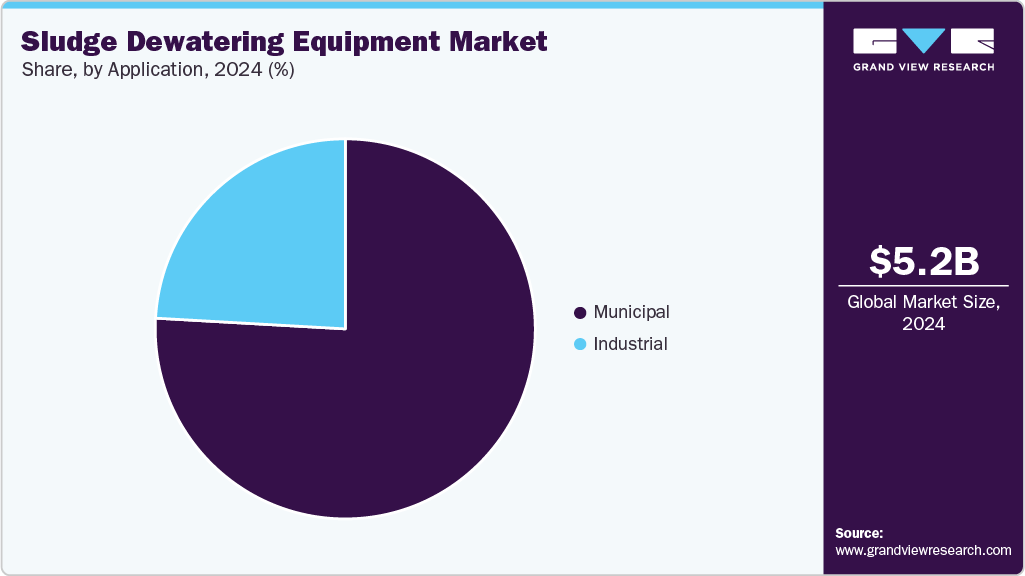
Based on application, the municipal segment led the market with the largest revenue share of 73.6% in 2025 and is witnessing significant expansion as urbanization and population growth strain wastewater treatment infrastructure. Governments and local bodies are investing in modern sludge dewatering solutions to improve sewage management, comply with environmental standards, and optimize operational efficiency, fueling growth in the market
 To learn more about this report, Download Free Sample Report
The industrial segment due to rising waste generation from sectors such as food processing, chemicals, and mining. Industries are adopting efficient dewatering systems to meet environmental regulations, reduce disposal costs, and enhance sustainability, driving increased demand for advanced, energy-efficient dewatering technologies
Regional Insights
North America sludge dewatering equipment marketis expected to grow at 6.5% CAGR during forecast period, driven by stringent environmental regulations, rising industrial waste generation, and growing investments in wastewater infrastructure. Technological advancements and sustainability goals further propel adoption across both municipal and industrial applications, strengthening the region's market position in coming years.
U.S. Sludge Dewatering Equipment Market Trends
The sludge dewatering equipment market in the U.S. is expected to grow at a CAGR of 5.8% from 2025 to 2033. U.S. is poised for strong growth in the market due to increasing regulatory compliance requirements, aging wastewater treatment facilities, and government investments in infrastructure upgrades. A focus on automation and energy-efficient equipment further supports adoption, particularly across municipal utilities and industrial facilities seeking cost-effective waste management solutions.
Mexico sludge dewatering equipment market is expected to witness notable growth, driven by expanding urban populations, increasing industrial activity, and growing awareness of sustainable waste management. Government initiatives to improve wastewater treatment infrastructure and rising demand from industries such as food processing and chemicals fuel the country’s market potential.
Europe Sludge Dewatering Equipment Market Trends
Europe is witnessing strong growth in the sludge dewatering equipment market due to strict environmental regulations such as Urban Wastewater Treatment Directive (91/271/EEC), and rising investments in sustainable infrastructure. The push for circular economy practices and advanced treatment technologies further fuels market demand across industrial and municipal applications.
Germany sludge dewatering equipment market is growing rapidly driven by robust environmental policies, advanced industrial base, and strong government focus on sustainable wastewater management. Ongoing technological innovations and the integration of energy-efficient systems in municipal and industrial sectors are expected to boost adoption of dewatering solutions.
UK sludge dewatering equipment market issupported by regulatory pressure from the Environment Agency, rising public infrastructure upgrades, and increasing industrial wastewater volumes. Growing demand for cost-effective, energy-efficient solutions in both public utilities and private sectors contributes to market expansion.
Asia Pacific Sludge Dewatering Equipment Market Trends
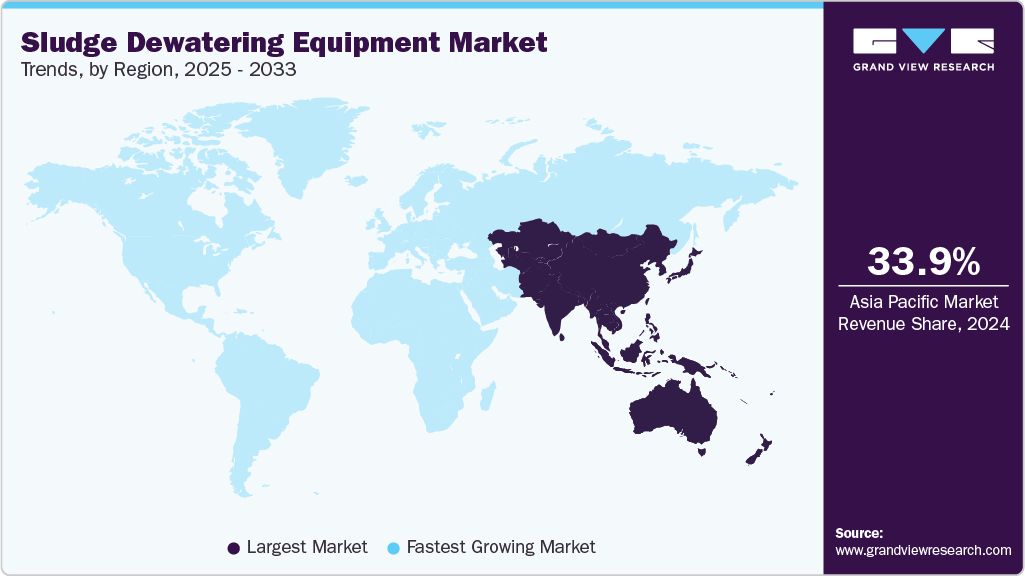
Asia Pacific dominated the sludge dewatering equipment market with the largest revenue share of 34.4% in 2025, due to rapid industrialization, urban expansion, and rising environmental awareness. Government initiatives for wastewater treatment and increasing investments in sustainable infrastructure are driving demand for advanced dewatering solutions across municipal and industrial sectors in countries such as China, India, and Japan.
 To learn more about this report, Download Free Sample Report
The sludge dewatering equipment market in China held the largest share in the Asia Pacific region in 2025 China sludge dewatering equipment market is growing rapidly, driven by strict government regulations on wastewater discharge, large-scale infrastructure projects, and smart city initiatives. Rising urbanization and industrial output are generating significant sludge volumes, prompting investments in efficient, automated dewatering technologies to ensure environmental compliance and resource recovery.
India sludge dewatering equipment market is growing rapidly in the market due to increasing focus on wastewater treatment under programs such as Swachh Bharat Mission and AMRUT. Growing urban population, industrial waste generation, and emphasis on improving sanitation infrastructure are boosting demand for cost-effective, energy-efficient dewatering solutions in both public and private sectors.
Middle East & Africa Sludge Dewatering Equipment Market Trends
Middle East & Africa is poised for steady growth in the sludge dewatering equipment market due to rising investments in water infrastructure, increasing industrialization, and growing awareness of water scarcity. Governments are emphasizing wastewater reuse and environmental compliance, creating demand for efficient dewatering technologies across municipal and industrial wastewater treatment facilities.
Saudi Arabia sludge dewatering equipment market is growing as the country prioritizes water reuse and environmental sustainability under Vision 2030. Expanding industrial zones, desalination plant upgrades, and smart city projects are driving the adoption of sludge dewatering technologies to manage wastewater and support a circular water economy.
Latin America Sludge Dewatering Equipment Market Trends
The sludge dewatering equipment market in Latin America is growing steadily, due to increasing urbanization, stricter environmental regulations, and the need for improved wastewater management infrastructure. Government efforts to enhance sanitation services and industrial sector expansion are driving demand for efficient sludge treatment technologies across the region.
Brazil sludge dewatering equipment market is expected to grow as the country invests in modernizing its wastewater treatment infrastructure. Rising awareness of water pollution, regulatory push for sustainable waste management, and growth in industrial activities are fueling the adoption of advanced sludge dewatering equipment to improve operational efficiency and environmental compliance.
Key Sludge Dewatering Equipment Company Insights
Some of the key players operating in the market include Alfa Laval, ANDRITZ, Veolia Water Technologies, HUBER SE.
-
Alfa Laval is a global provider of specialized products and engineering solutions based on its key technologies of heat transfer, separation, and fluid handling. In the sludge dewatering equipment market, the company holds a prominent position due to its extensive range of decanter centrifuges and belt filter presses that serve both municipal and industrial wastewater treatment applications. Alfa Laval’s dewatering solutions are designed to optimize dry solids content while minimizing energy consumption and operational costs.
-
ANDRITZ is a globally recognized engineering group headquartered in Austria, offering innovative and sustainable technology solutions across multiple sectors, including water and wastewater management. In the sludge dewatering equipment market, ANDRITZ stands out for its robust portfolio of mechanical dewatering technologies such as belt presses, screw presses, and decanter centrifuges. The company’s innovative solutions such as the ANDRITZ C-Press screw press and D-Series decanter centrifuges are designed for maximum performance, reliability, and cost-efficiency.
Key Sludge Dewatering Equipment Companies
The following key companies have been profiled for this study on the sludge dewatering equipment market.
-
ALFA LAVAL
-
ANDRITZ
-
HUBER SE
-
Evoqua Water Technologies LLC
-
Komline
-
Phoenix Process Equipment
-
Kontek Ecology Systems Inc.
-
Flottweg SE
-
AMCON Europe s.r.o.
-
Groupe Industries Fournier Inc.
-
Hitachi Zosen Corporation
-
Benenv Co. Ltd.
-
Kurita Water Industries Ltd.
-
MSE Filterpressen GmbH
-
Veolia Water Technologies
Competitive Benchmarking
Category
Operating Strategies
Competitive Edge
Weakness
Established Players (e.g., ANDRITZ, Alfa Laval, HUBER SE, Flottweg SE, Veolia Water Technologies)
Expand portfolios of centrifuges, belt filter presses, screw presses, and filter presses while investing in automation and energy-efficient dewatering technologies.
Secure long-term municipal and industrial wastewater treatment contracts and strengthen global service and aftermarket capabilities.
Comprehensive sludge dewatering equipment portfolios with strong engineering expertise and global manufacturing capabilities.
Well-established customer relationships, extensive service networks, and proven performance in municipal and industrial wastewater treatment applications.
High investment requirements for product development, manufacturing facilities, and service infrastructure.
Long procurement cycles and dependence on public infrastructure spending and industrial capital investment.
Emerging & Regional Players (e.g., Komline-Sanderson, MSE Filterpressen GmbH, AMCON Inc., Phoenix Process Equipment, Fournier Industries Inc)
Focus on specialized sludge dewatering equipment and customized solutions for municipal and industrial wastewater treatment plants.
Expand through application-specific innovation, regional partnerships, and customer-focused engineering and technical support.
Strong capability to provide customized dewatering solutions and respond quickly to customer-specific process requirements.
Expertise in niche technologies with competitive pricing and responsive technical support.
Limited global manufacturing footprint and financial resources compared with multinational competitors.
Lower international market presence and greater reliance on regional wastewater infrastructure projects and distributor networks.
Recent Developments
-
In October 2024, the Los Angeles Department of Water and Power announced an investment exceeding USD 6 billion in an advanced water infrastructure initiative, previously known as Operation Next (OpNEXT). This initiative focuses on enhancing local water supply resilience against risks such as aging infrastructure, droughts, earthquakes, and dependence on imported water. The project also includes the integration of sludge dewatering equipment throughout the city, which is expected to support market growth.
-
In September 2024, Andritz secured a significant procurement contract from MVA Bielefeld-Herford GmbH, a waste management firm in Germany. The contract involves supplying an EcoFluid bubbling fluidized bed (BFB) boiler system for a new mono-incineration plant designed to treat concentrated sewage waste. This solution will support efficient waste management and facilitate phosphorus recovery from sewage sludge.
Sludge Dewatering Equipment Market Report Scope
Report Attribute
Details
Market size in 2025
USD 5.5 billion
Estimated market size in 2026
USD 5.9 billion
Projected market size by 2033
USD 10.4 billion
Growth rate
CAGR of 8.6% from 2026 to 2033
Base year for estimation
2025
Historical data
2021 - 2024
Forecast period
2026 - 2033
Quantitative units
Revenue in USD billion and CAGR from 2026 to 2033
Report coverage
Revenue forecast, company ranking, competitive landscape, growth factors, and trends
Segments covered
Technology type, application, region
Regional scope
North America; Europe; Asia Pacific; Latin America; Middle East & Africa
Country scope
U.S.; Canada; Mexico; UK; Germany; France; Spain; Italy; China; Japan; India; Australia; South Korea; Brazil; Argentina; Saudi Arabia; South Africa; UAE
Key companies profiled
ANDRITZ; Alfa Laval; HUBER SE; Flottweg SE; Komline-Sanderson; MSE Filterpressen GmbH; AMCON Inc.; Phoenix Process Equipment; Veolia Water Technologies; Fournier Industries Inc.
Customization scope
Free report customization (equivalent up to 8 analysts' working days) with purchase. Addition or alteration to country, regional & segment scope.
Pricing and purchase options
Avail customized purchase options to meet your exact research needs. Explore purchase options
Global Sludge Dewatering Equipment Market Report Segmentation
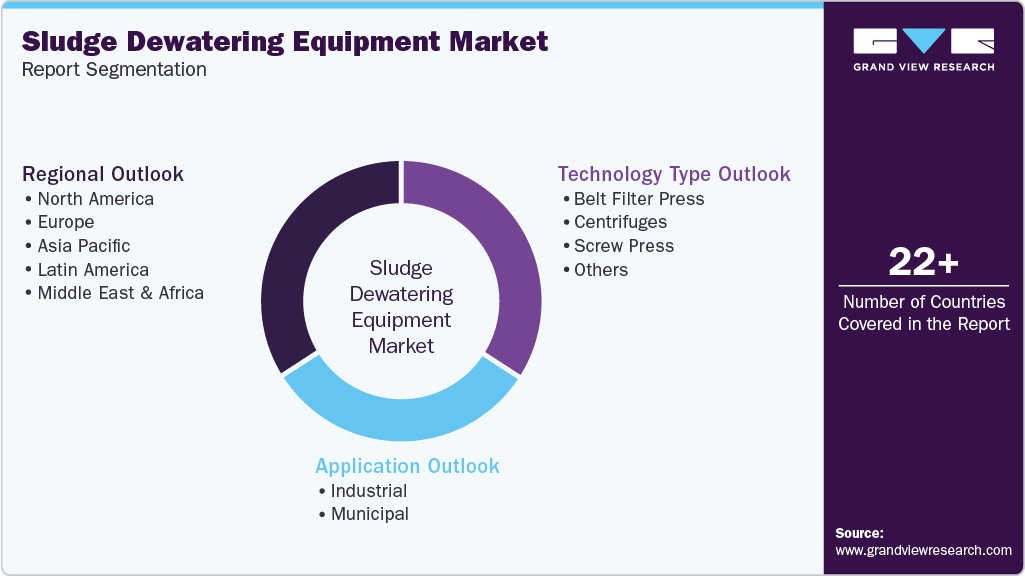
This report forecasts revenue growth at global, regional, and country levels and provides an analysis of the latest industry trends in each of the sub-segments from 2021 to 2033. For this study, Grand View Research has segmented the global sludge dewatering equipment market report based on technology type, application, and region.
 To learn more about this report, Download Free Sample Report
-
Technology Type Outlook (Revenue, USD Million, 2021 - 2033)
-
Belt Filter Press
-
Centrifuges
-
Screw Press
-
Others
-
-
Application Outlook (Revenue, USD Million, 2021 - 2033)
-
Industrial
-
Pulp & Paper
-
Textile
-
Food & Beverage
-
Chemical
-
Others
-
-
Municipal
-
-
Regional Outlook (Revenue, USD Million, 2021 - 2033)
-
North America
-
U.S.
-
Canada
-
Mexico
-
-
Europe
-
Germany
-
France
-
Italy
-
Spain
-
UK
-
-
Asia Pacific
-
China
-
India
-
Japan
-
South Korea
-
Australia
-
-
Latin America
-
Brazil
-
Argentina
-
-
Middle East and Africa
-
Saudi Arabia
-
UAE
-
South Africa
-
-
Research Methodology
The sludge dewatering equipment Market figures in this report are based on a proven research process that combines executive interviews with secondary research from proprietary databases, company filings, and recognized regulatory and institutional sources. Market size is built through value-chain sizing - reconciling supply-side and demand-side estimates - and triangulated with bottom-up and top-down approaches. Every estimate passes multiple levels of expert validation before publication, with each sludge dewatering equipment Market segment quantified using the revenue-capture definitions in the table below.
Segment Definition
Segment - Technology
Revenue Capture Definition
Belt Filter Press
Revenue is generated through the sales of belt filter press systems, including standard and customized configurations offered to wastewater treatment operators and industrial customers.
Centrifuges
Revenue is generated from the sales decanter centrifuge systems, including integrated dewatering solutions, equipment upgrades, and replacement units.
Screw Press
Revenue is generated through the sales of screw press dewatering systems, including customized equipment configurations and complete mechanical dewatering packages.
Others
Revenue is generated from the sales of alternative sludge dewatering technologies, including filter presses, rotary presses, and other specialized mechanical dewatering systems.
Segment - Application
Revenue Capture Definition
Industrial
Revenue is generated through the sale of sludge dewatering equipment to industrial customers, supported by customized system integration, project-based equipment deliveries, and replacement demand across multiple process industries.
Municipal
Revenue is generated from sales equipment in municipal wastewater treatment facilities for sludge dewatering.
Estimation Model
Layer Name
Key Question
Description
Sludge Generation & Treatment Demand Layer
Where is sludge dewatering equipment required?
Analyze demand across municipal wastewater treatment plants, industrial wastewater treatment facilities, food & beverage, pulp & paper, chemicals, mining, pharmaceuticals, and other process industries. Assess sludge generation volumes, treatment capacity, wastewater discharge requirements, and solids handling needs to establish the addressable demand for sludge dewatering equipment.
Water & Wastewater Infrastructure Investment Layer
Where is new equipment demand being created?
Evaluate investments in municipal wastewater treatment infrastructure, industrial effluent treatment plants, water recycling facilities, and environmental compliance projects. Assess greenfield installations, plant capacity expansions, equipment replacement, and modernization initiatives that drive procurement of new sludge dewatering equipment.
Product Adoption Layer
Which sludge dewatering technologies are being deployed?
Segment demand by technology and end-use industry. Apply adoption rates based on sludge characteristics, treatment capacity, solids recovery efficiency, energy consumption, automation requirements, and regulatory compliance. Assess the increasing adoption of energy-efficient, automated, and high-throughput dewatering systems to reduce sludge disposal costs and improve operational performance.
Revenue Generation Layer
How much market revenue is generated?
Estimate annual shipments of sludge dewatering equipment by equipment type, end-use industry, and region. Quantify revenues generated exclusively from the sale of new sludge dewatering equipment supplied to municipal utilities, industrial facilities, EPC contractors, and wastewater treatment operators. The scope excludes installation, commissioning, maintenance, spare parts, consumables, rental equipment, and aftermarket services.
Delivered Customizations
This report has been delivered with the following In-depth customizations
Client Request
Customization Delivered
Value Adds
Competitive Benchmarking
A competitive benchmarking analysis was conducted by evaluating manufacturers based on product portfolio, dewatering technologies, manufacturing footprint, technological innovation, strategic initiatives, financial strength, and competitive positioning within the sludge dewatering equipment market.
This benchmarking enabled stakeholders to assess competitor capabilities, identify technology and product differentiation opportunities, understand evolving market strategies, and develop informed positioning and growth plans.
Regional Segmentation
A comprehensive regional analysis was conducted across North America, Europe, Asia Pacific, Latin America, and the Middle East & Africa, assessing wastewater treatment investments, municipal infrastructure development, industrial wastewater generation, environmental regulations, technology adoption, and the contribution of major countries to regional market performance.
The regional insights helped stakeholders identify high-growth markets, optimize expansion strategies, allocate investments effectively, and tailor product offerings to regional wastewater treatment requirements and regulatory standards.
Opportunity Assessment
A detailed opportunity assessment was conducted by evaluating municipal and industrial wastewater treatment projects, tightening environmental regulations, advancements in energy-efficient and automated dewatering systems, sludge volume reduction initiatives, and investments in water reuse and resource recovery. The analysis identified growth opportunities across municipal wastewater, food & beverage, mining, pulp & paper, chemicals, and other industries.
This assessment enabled stakeholders to prioritize high-growth investment areas, align product development with evolving customer and regulatory requirements, and capitalize on expanding demand for efficient sludge management and sustainable wastewater treatment solutions.
Frequently Asked Questions About This Report
The belt filter press segment led the market with the largest revenue share of 40.7% in 2025.
The municipal segment accounted for the largest revenue share of 73.6% in 2025.
China held the largest share of the Asia Pacific sludge dewatering equipment market in 2025.
The global sludge dewatering equipment market size was estimated at USD 5.5 billion in 2025 and is expected to be USD 5.9 billion in 2026.
The global sludge dewatering equipment market, in terms of revenue, is expected to grow at a compound annual growth rate of 8.6% from 2026 to 2033 to reach USD 10.4 billion by 2033.
Key factors include increasing investments in wastewater treatment infrastructure, stringent environmental regulations governing sludge disposal, growing municipal wastewater generation, rising industrial effluent treatment requirements, and increasing adoption of energy-efficient sludge management technologies.
Asia Pacific dominated the sludge dewatering equipment market with the largest revenue share of 34.4% in 2025.
Some of the key players operating in the global sludge dewatering equipment market include Some of the key players operating in the global sludge dewatering equipment market include ANDRITZ; Alfa Laval; HUBER SE; Flottweg SE; Komline-Sanderson; MSE Filterpressen GmbH; AMCON Inc.; Phoenix Process Equipment; Veolia Water Technologies; Fournier Industries Inc.
About the Author(s)
Advanced Interior Materials Research Team
Advanced Materials · Advanced Interior MaterialsThis report was authored by the advanced interior materials research team at Grand View Research - comprising two research analysts, one senior research analyst, and one industry expert - with specialized expertise in the advanced interior materials segment of the advanced materials industry. All findings are based on proprietary advanced materials databases, executive interviews, and regulatory analysis, subject to internal peer review prior to publication.
Last Updated:
Speak to Analyst

Customize this report to your needs - add regions, segments, or data points, with 20% free customization.
Or view our licence options:


ISO 9001:2015 & 27001:2022 Certified
We are GDPR and CCPA compliant! Your transaction & personal information is safe and secure. For more details, please read our privacy policy.


