
- Home
- »
- Renewable Energy
- »
-
Small Hydropower Market Size & Share Report, 2026-2033GVR Report cover

Small Hydropower Market (2026 - 2033)
Size, Share & Trends Analysis Report By Capacity (Up to 1 MW, 1- 10 MW), By Type (Micro Hydropower, Mini Hydropower), By Component, By Region, And Segment Forecasts
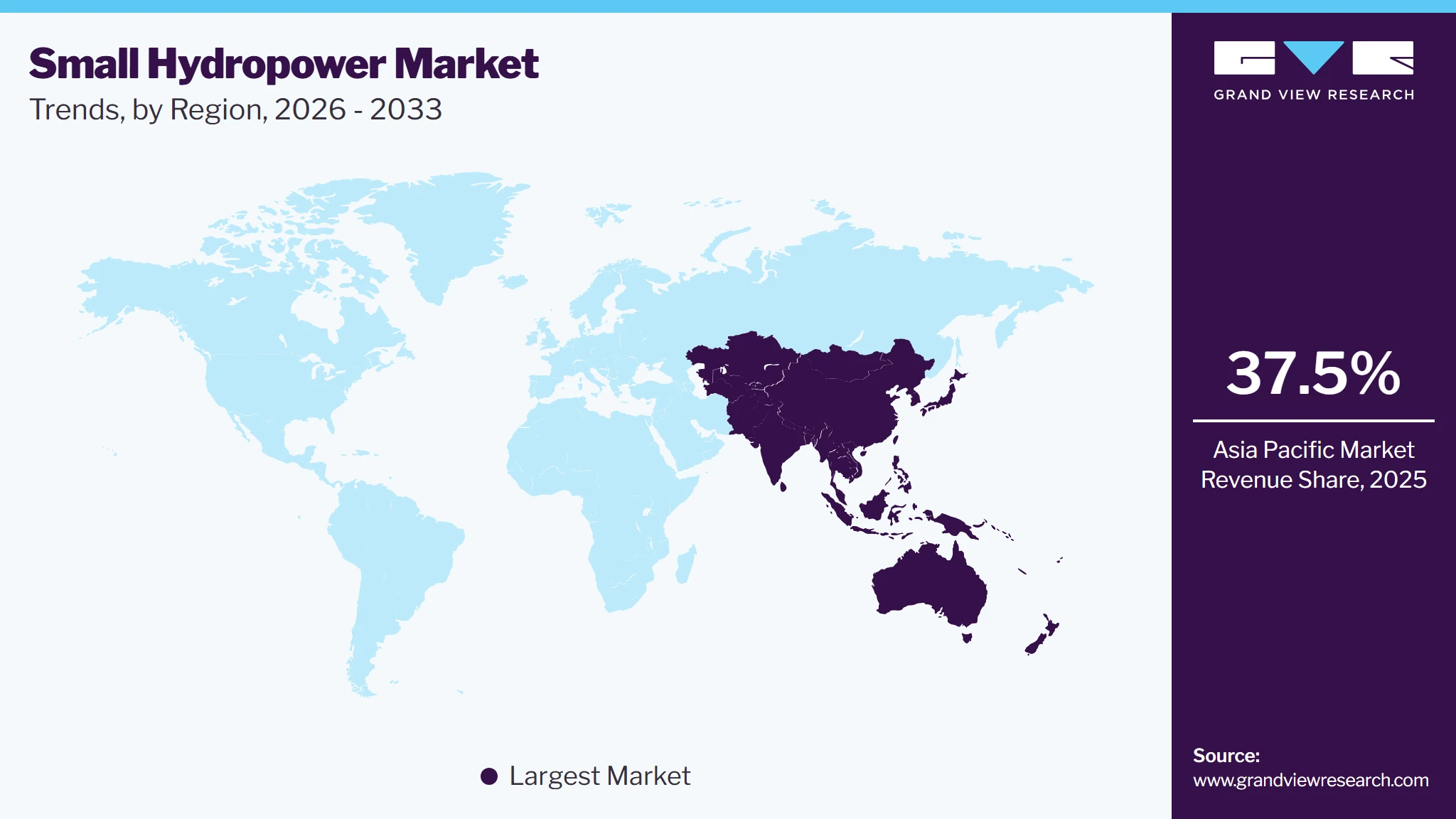
Market Size, 2025
$2.2BMarket Estimate, 2026
$2.3BMarket Forecast, 2033
$2.9BCAGR, 2026–2033
3.6%Small Hydropower Market Summary
The global small hydropower market size was valued at USD 2.2 billion in 2025 and is projected to grow from USD 2.3 billion in 2026 to USD 2.9 billion by 2033, at a CAGR of 3.6% from 2026 to 2033. Asia Pacific dominated the market, accounting for a revenue share of 37.5% in 2025. The industry is primarily driven by the increasing global demand for renewable energy and rural electrification initiatives.
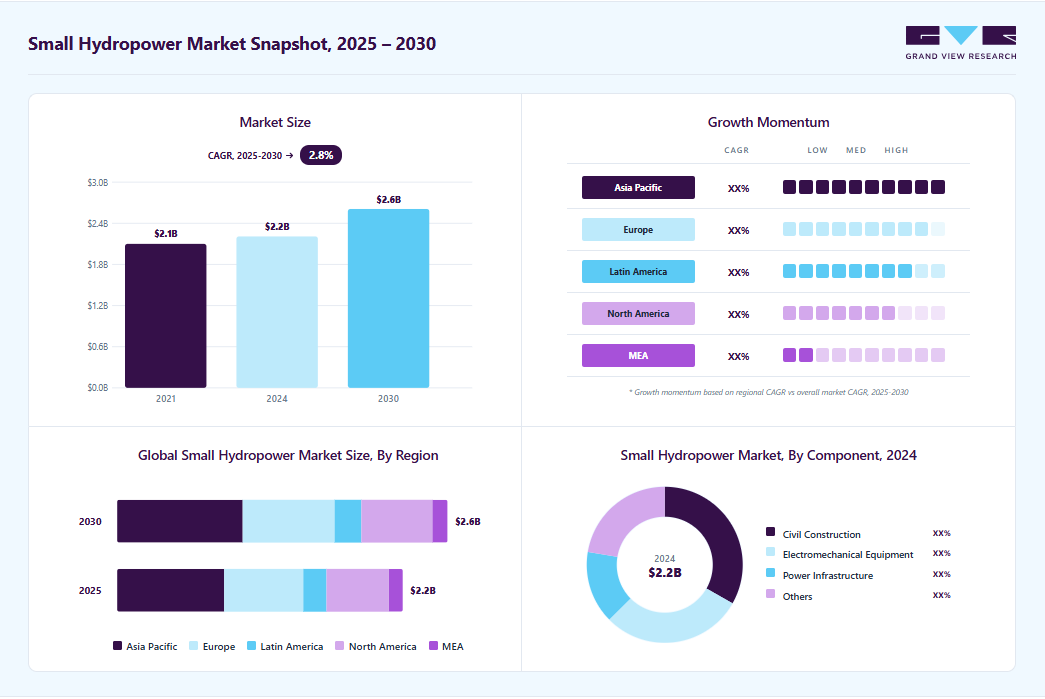 Source: Grand View Research, IR Documents, Primary Interviews, Paid DatabasesTo learn more about this report,
 Download Free Sample Report
 Key Market Trends & Insights
- By type: Micro hydropower segment led the market with the largest revenue share of 55.2% in 2025.
- By capacity: Up to 1 MW segment led the market with the largest revenue share of 55.2% in 2025.
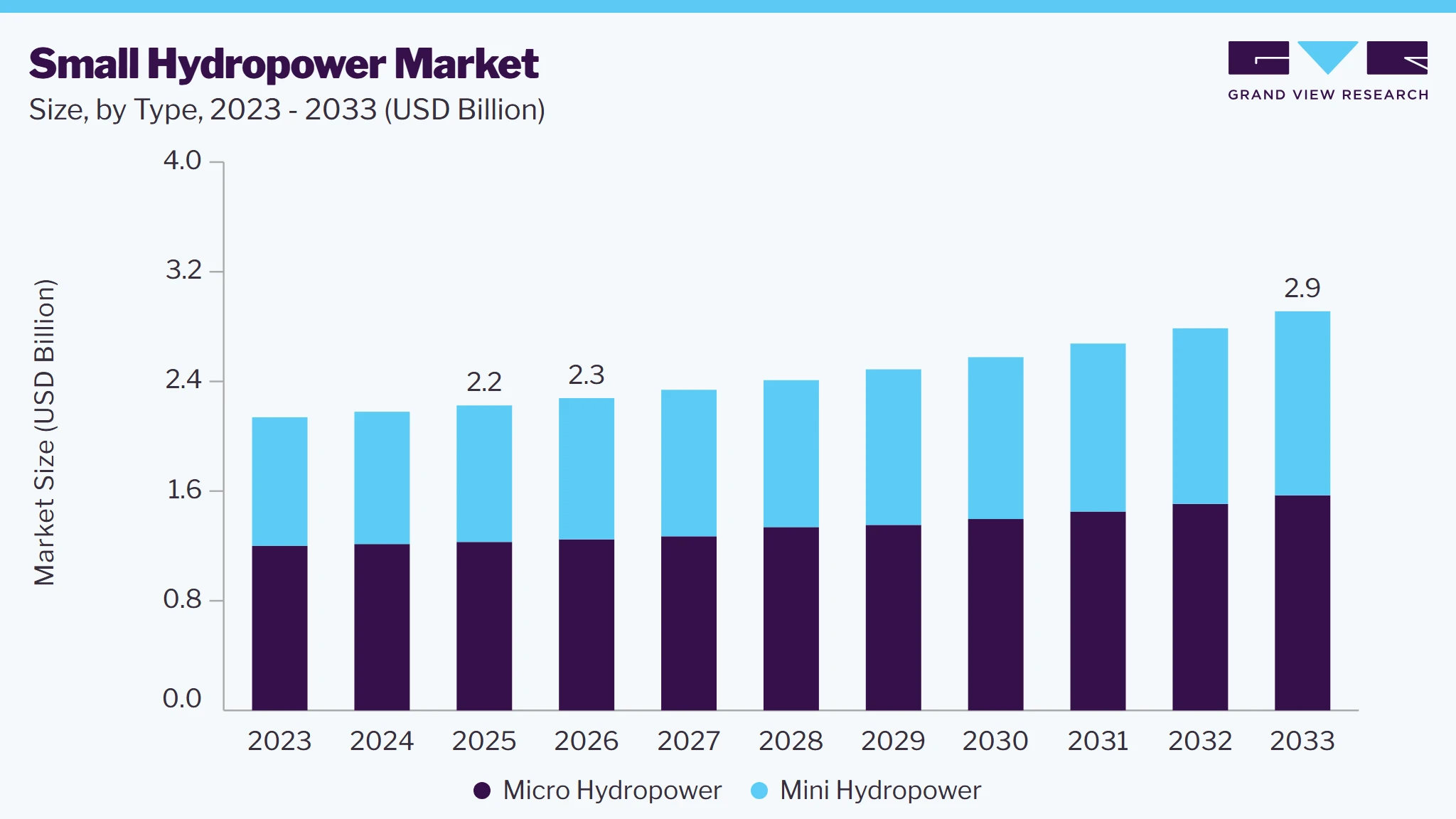
- By component: Civil construction segment led the market with the largest revenue share of 33.4% in 2025.
Regional Highlights
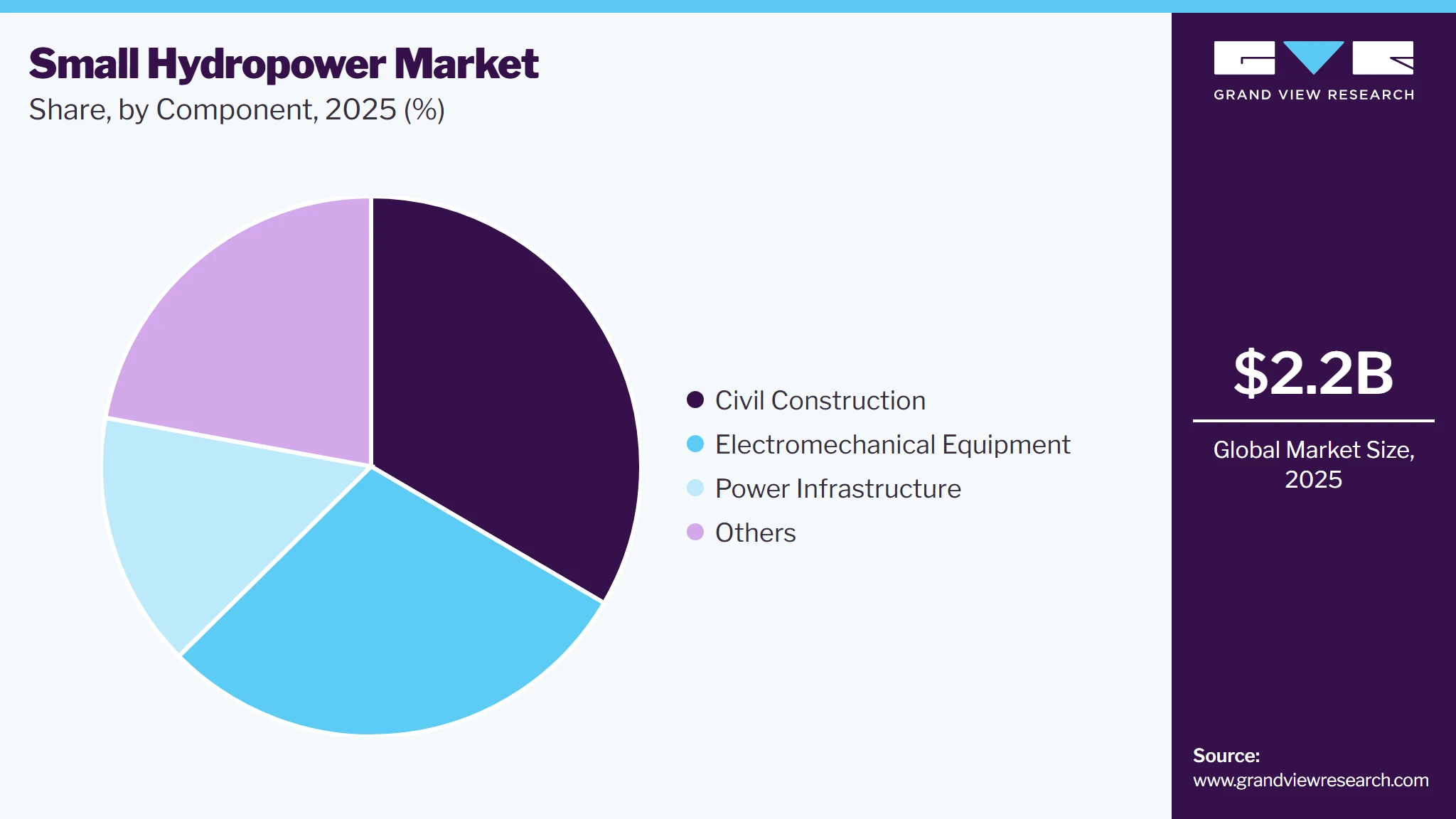
- Largest regional market: Asia Pacific (37.5% revenue share, 2025)
- By country: China held the largest market share in 2025.
Market Size & Forecast
- Market size in 2025: USD 2.2 Billion
- Estimated market size in 2026: USD 2.3 Billion
- Projected market size by 2033: USD 2.9 Billion
- CAGR (2026-2033): 3.6%
Three ways to get this report
Buy it, customize it, or ask a question.Ask an Analyst
Analyst response in 1 business day
- AccessReport author, directly
- Reply timeWithin 1 working day
- No sales callDirect answer only
- FormatEmail reply
- CostFree, no cost
Get the Full Report
What the study covers
- FormatsPDF · Excel · Dashboard
- Timeline2026–2033 annual, 2025 base
- Coverage20+ countries, 5 regions
- Companies10+ key players profiled
Customize the Report
20% free customization
- IncludeCountries, segments, points
- TailorTo your product definition
- ExtendDeeper competitor detail
- OrA fully bespoke study
- Turnaround5–10 working days
Many governments are promoting small hydropower projects due to their low environmental impact, cost-effectiveness, and ability to provide a stable energy supply in remote areas. Additionally, supportive policies, tax incentives, and financial aid from organizations such as the World Bank and the International Renewable Energy Agency (IRENA) are encouraging investments in small-scale hydropower solutions. Technological advancements, including more efficient turbines and digital monitoring systems, are also enhancing the feasibility and attractiveness of small hydropower projects.
 To learn more about this report, Download Free Sample Report
 Governments worldwide are implementing supportive policies, including feed-in tariffs, subsidies, and tax incentives, to encourage investment in SHP projects. The rising need for rural electrification, particularly in developing regions, has further accelerated market growth. Small hydropower systems offer a reliable and cost-effective alternative to fossil fuel-based power generation, aligning with international sustainability goals and carbon reduction commitments.
Technological advancements have also played a crucial role in the expansion of the SHP market. Innovations in turbine efficiency, automation, and grid integration have improved the viability of small-scale hydropower projects. Additionally, modern SHP installations require lower capital investments and have shorter payback periods compared to large hydropower plants, making them attractive to investors and utilities. The ability of SHP projects to operate with minimal environmental impact further enhances their appeal in an era of heightened environmental consciousness and stricter regulatory frameworks.
Market Dynamics
The small hydropower market is growing steadily due to increasing demand for clean and reliable electricity, especially in rural and remote areas. Government support for renewable energy projects, favorable financing programs, and investments in decentralized power generation are encouraging new installations. The market also benefits from the modernization and refurbishment of aging small hydropower plants to improve efficiency and extend operational life. However, lengthy permitting processes and environmental regulations can slow project development. A key trend is the integration of digital monitoring and smart control systems to enhance plant performance and reduce operating costs.
The primary driver of the small hydropower market is the increasing global investment in renewable energy to reduce carbon emissions and strengthen energy security. Governments and utilities are expanding small hydropower capacity as it provides reliable, low-carbon electricity with lower environmental impacts than large hydroelectric projects. Small hydropower also makes effective use of existing rivers, canals, and dams, reducing infrastructure costs while supporting the transition toward cleaner power generation. Its ability to deliver consistent electricity further complements the growing share of variable renewable sources in the energy mix.
A notable example is the World Bank's approval of the USD 1.5 billion Accelerating Sustainable and Clean Energy Access Transformation (ASCENT) Program in 2025 for Eastern and Southern Africa. The program supports investments in renewable energy infrastructure, including small hydropower where suitable, to expand electricity access and strengthen clean energy systems across multiple countries. This initiative demonstrates how rising global investments in renewable energy are creating new opportunities for small hydropower development.
High initial capital costs remain a major restraint for the small hydropower market. Although these projects are smaller than conventional hydropower plants, they still require significant investment in civil infrastructure, including weirs, canals, tunnels, and powerhouses, along with turbines, generators, and grid connection equipment. Long project development periods and high upfront expenditures can make financing difficult, particularly for small developers and projects in remote locations. These cost challenges often delay project approvals and reduce the pace of new installations.
A significant emerging opportunity in the small hydropower market lies in the modernization and rehabilitation of aging hydropower facilities. Many existing small hydropower plants were commissioned decades ago and require upgrades to improve efficiency, reliability, and operational flexibility. Replacing older turbines, generators, and control systems with advanced digital technologies can increase power output without constructing new dams, while also extending plant life and reducing maintenance costs. This creates a cost-effective growth avenue for utilities and plant operators seeking to expand renewable electricity generation.
Type Insights
Based on type, the micro hydropower segment led the market with the largest revenue share of 55.2% in 2025 and is expected to grow at the fastest CAGR of 3.8% during the forecast period. Governments and private entities are investing in micro hydropower projects to enhance rural electrification, particularly in remote areas where grid connectivity is limited. Advancements in turbine technology, coupled with favorable regulatory policies and financial incentives, are further accelerating market growth. Additionally, micro hydropower systems offer a cost-effective and sustainable alternative to fossil fuels, aligning with global decarbonization goals.
The mini hydropower segment is driven by increasing demand for decentralized renewable energy solutions and rural electrification initiatives. Governments and private investors are prioritizing mini hydropower projects due to their cost-effectiveness, lower environmental impact, and ability to provide stable, off-grid electricity in remote areas. Advancements in turbine technology and regulatory incentives further enhance the segment's growth, making mini hydropower a viable alternative to fossil fuel-based power generation. Additionally, the rising emphasis on energy security and sustainability goals continues to propel investment in this segment, strengthening its role in the global renewable energy landscape.
Capacity Insights
Based on capacity, the up to 1 MW segment led the market with the largest revenue share of 55.2% in 2025. This segment benefits from lower capital investment requirements, streamlined regulatory approvals, and shorter project development timelines compared to larger installations. Additionally, advancements in turbine efficiency and modular hydropower technologies enhance feasibility, while government incentives and policies supporting renewable energy adoption further accelerate growth. As industries and communities seek reliable, sustainable power sources, the sub-1 MW segment remains a key enabler of energy access and rural electrification initiatives.
The 1 MW to 10 MW capacity segment is driven by the increasing demand for decentralized renewable energy solutions, particularly in remote and off-grid areas. Governments and private investors are prioritizing this segment due to its ability to provide stable and sustainable electricity with minimal environmental impact.
Component Insights
Based on component, the civil construction segment led the market with the largest revenue share of 33.4% in 2025. This segment encompasses critical components such as dams, weirs, intake structures, penstocks, and powerhouses, all of which are essential for the efficient harnessing of hydropower potential. Advancements in engineering design, material innovation, and sustainable construction practices have significantly enhanced the durability and cost-effectiveness of these structures.
 To learn more about this report, Download Free Sample Report
 The electromechanical equipment segment is expected to expand at a CAGR of 3.9% over the forecast period. Major small hydropower plants have a trash rack cleaning machine, which removes material from water in order to avoid it entering plant waterways and damaging the electromechanical equipment or reducing hydraulic performance. In small hydropower, the electromechanical equipment costs vary from country to country depending upon the requirements affecting the investment costs that differ not only from country to country but also from region to region. In addition, the cost of various components of electro-mechanical equipment has been worked out as per prevailing rates based on runner diameter and capacity of the plant for different types of turbines and generators.
Regional Insights
North America small hydropower market is experiencing a resurgence as a clean, renewable energy source, particularly in regions with abundant water resources. Trends include an increased focus on environmental sustainability, with efforts to minimize ecological impacts through fish-friendly turbines and improved water management practices. There is also a push for the modernization of aging infrastructure, with many small hydropower projects being retrofitted or upgraded to enhance efficiency and performance. Additionally, government incentives and policies promoting clean energy are boosting the growth of small hydropower, especially in remote and off-grid areas, as part of broader efforts to transition to renewable energy sources.
U.S. Small Hydropower Market Trends
The small hydropower market in the U.S. is experiencing a resurgence as part of the broader push for renewable energy. Trends indicate an increased focus on modernizing existing infrastructure, such as retrofitting old dams with new technology to enhance efficiency and minimize environmental impact. Advances in turbine design, energy storage integration, and improved regulatory frameworks are enabling more small-scale projects to emerge, particularly in underserved rural and remote areas. Despite challenges related to permitting, environmental concerns, and fluctuating energy prices, the sector is poised for growth as part of the nation's transition to a cleaner energy grid.
Asia Pacific Small Hydropower Market Trends
Asia Pacific dominated the small hydropower market with the largest revenue share of 37.5% in 2025. The region benefits from increasing demand for renewable energy, rural electrification initiatives, and government support. Countries like China, India, and Vietnam are leading in SHP installations due to favorable policies, abundant water resources, and investment in sustainable infrastructure. Technological advancements, declining costs, and the need for energy security further propel market growth. However, challenges such as environmental concerns, regulatory hurdles, and high initial costs persist. The region continues to witness significant developments, with emerging markets contributing to the expansion of decentralized and off-grid small hydropower solutions.
 To learn more about this report, Download Free Sample Report
 The small hydropower market in China held the largest share in the Asia Pacific region in 2025. China small hydropower market has been steadily expanding its small hydropower capacity as part of its strategy to diversify renewable energy sources and meet sustainability goals. In recent years, China has focused on improving the efficiency and environmental impact of these plants, while also addressing the challenges posed by the aging infrastructure of existing projects. The government's support for these technologies is evident in policy incentives, including subsidies and green bonds, and small hydropower plays a crucial role in the country's efforts to transition to a low-carbon energy system. However, concerns about the ecological impact and the displacement of local communities continue to be areas of focus
Europe Small Hydropower Market Trends
The small hydropower market in Europe is experiencing notable growth, particularly in the 1-10 MW capacity segment, which is projected to dominate the market due to increasing investments in decentralized energy projects. Countries like Norway, France, and Italy are leading this trend, driven by rural electrification initiatives and governmental support. For instance, the European Investment Bank has funded multiple small hydropower projects, including a significant investment for the construction of run-of-river plants in Italy.
Germany small hydropower market is expected to grow over the forecast period. In 2023, hydropower accounted for 4% of the country's total installed power generation capacity and 3% of total power generation. The sector is expected to see gradual growth, with projections indicating that by 2035, hydropower will account for 2% of total installed generation capacity. This trend is expected to continue to play a pivotal role in Germany's renewable energy landscape.
Central & South America Small Hydropower Market Trends
The small hydropower market in Central and South America is driven by increasing energy demands and supportive government policies. Brazil, as the largest hydropower producer in the region, leads the market with significant installed capacity and a reported 20% increase in small hydropower installations in 2024. The country's extensive water resources and favorable regulatory frameworks are key factors propelling this growth. Additionally, Chile is making strides with small and micro hydropower projects, which added 228 MW to its capacity recently, alongside larger initiatives like the Espejo de Tarapacá pumped storage facility that integrates solar energy.
Middle East & Africa Small Hydropower Market Trends
The small hydropower market in the Middle East & Africa is growing as the region has significant untapped hydropower potential, particularly in sub-Saharan Africa, where many countries are beginning to recognize the benefits of small-scale hydropower for rural electrification and energy security. For instance, projects initiated in countries like Kenya and Nigeria are aimed at enhancing local energy supply through small hydropower installations, contributing to both economic development and sustainability goals.
Challenges such as inadequate infrastructure and financing constraints have historically hindered the growth of small hydropower in the MEA region. However, recent initiatives by governments and international organizations are focusing on addressing these barriers. Investments are increasingly directed towards off-grid small hydropower solutions that cater to remote communities lacking access to centralized electricity networks. This trend is expected to drive the adoption of innovative technologies that enhance efficiency and reduce costs, making small hydropower a viable option for meeting local energy needs while supporting broader renewable energy targets.
Key Small Hydropower Company Insights
The global small hydropower market is characterized by intense competition. Key players such as ANDRITZ, Bharat Heavy Electricals Limited, FLOVEL Energy Private Limited, General Electric, Gilkes, Natel Energy, and Siemens Energy, among others, dominate the market with advanced components and robust supply chain networks. The competitive environment is further intensified by the entry of new players, partnerships, and collaborations. Regional players are leveraging government incentives to gain market share, while established companies focus on R&D, vertical integration, and scaling production to maintain their competitive edge.
-
In March 2024, the United Nations Industrial Organization (UNIDO) executed two small hydropower projects in Nigeria as part of over USD 10 million over a contract of over three years. The project aims to enhance energy accessibility and promote circular economy practices to address pollution and climate change in Nigeria.
Key Small Hydropower Companies
The following key companies have been profiled for this study on the small hydropower market.
-
ANDRITZ
-
Bharat Heavy Electricals Limited
-
FLOVEL Energy Private Limited
-
General Electric
-
Gilkes
-
Natel Energy
-
Siemens Energy
-
SNC Lavalin Group
-
TOSHIBA CORPORATION
-
Voith GmbH & Co.
Competitive Benchmarking
Category
Operating Strategies
Competitive Edge
Weakness
Established Players (Siemens Energy, General Electric Company, Voith GmbH & Co. KGaA, TOSHIBA CORPORATION, ANDRITZ, Gilbert Gilkes & Gordon Ltd., Bharat Heavy Electricals Limited, AtkinsRéalis)
- Focus on delivering turnkey small hydropower projects by integrating design, equipment manufacturing, installation, and long-term maintenance services.
- Expand global presence by partnering with governments, utilities, and EPC contractors for grid-connected and rural electrification projects.
- Invest in advanced turbine technologies, digital monitoring systems, and automation to improve plant efficiency and operational reliability.
- Strong global brand recognition and decades of expertise in hydropower engineering and project execution.
- Extensive manufacturing capabilities and established supply chains enable timely delivery of large and complex projects.
- Comprehensive after-sales support, maintenance networks, and financing capabilities strengthen long-term customer relationships.
- Higher project and operating costs compared to regional manufacturers.
- Longer decision-making and project execution timelines due to organizational complexity.
- Lower flexibility in addressing highly customized, small-volume projects.
Emerging Players (FLOVEL Energy Private Limited, Natel Energy)
- Focus on niche applications such as modular, low-head, and environmentally sustainable small hydropower systems.
- Expand through regional partnerships with local developers, engineering firms, and government rural electrification programs.
- Invest in innovative turbine designs and modular equipment to reduce installation costs and simplify deployment.
- Greater flexibility to customize solutions for site-specific project requirements.
- Faster innovation cycles driven by specialized technologies and lean organizational structures.
- Competitive pricing and lower overheads make them attractive for small and medium-sized projects.
- Limited global presence and lower brand recognition compared to established competitors.
- Smaller manufacturing capacity and constrained financial resources may restrict participation in large projects.
- Limited after-sales service networks and international project experience.
Small Hydropower Market Report Scope
Report Attribute
Details
Market Definition
The small hydropower market measures revenue generated from the sales of micro and mini hydropower systems, including civil construction, power infrastructure, electromechanical equipment, and other project components for plants with capacities up to 10 MW.
Market size in 2025
USD 2.2 billion
Estimated market size in 2026
USD 2.3 billion
Projected market size by 2033
USD 2.9 billion
Growth rate
CAGR of 3.6% from 2026 to 2033
Base year for estimation
2025
Historical data
2021 - 2024
Forecast period
2026 - 2033
Quantitative units
Revenue in USD Million and CAGR from 2026 to 2033
Report coverage
Revenue forecast, company ranking, competitive landscape, growth factors, and trends
Segments covered
Type, Capacity, Component, Region
Regional scope
North America, Europe, Asia Pacific, Latin America, Middle East & Africa
Country scope
U.S., Canada, Mexico, Germany, UK, France, Italy, Spain, Russia, China, India, Japan, South Korea, Australia, Brazil, Colombia, Paraguay, Saudi Arabia, UAE, South Africa, Egypt
Key companies profiled
Siemens Energy, General Electric Company, Voith GmbH & Co. KGaA, TOSHIBA CORPORATION, FLOVEL Energy Private Limited, ANDRITZ, Natel Energy, Gilbert Gilkes & Gordon Ltd., Bharat Heavy Electricals Limited, AtkinsRéalis
Customization scope
Free report customization (equivalent up to 8 analysts' working days) with purchase. Addition or alteration to country, regional & segment scope.
Pricing and purchase options
Avail customized purchase options to meet your exact research needs. Explore purchase options
Global Small Hydropower Market Report Segmentation
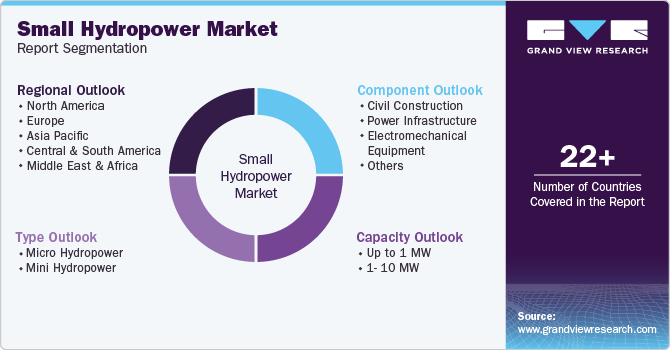
This report forecasts revenue growth at global, regional, and country levels and provides an analysis of the latest industry trends in each of the sub-segments from 2021 to 2033. For this study, Grand View Research has segmented the global small hydropower market report on the basis of type, capacity, component, and region:
 To learn more about this report, Download Free Sample Report
 -
Type Outlook (Revenue, USD Million, 2021 - 2033)
-
Micro hydropower
-
Mini hydropower
-
-
Capacity Outlook (Revenue, USD Million, 2021 - 2033)
-
Up to 1 MW
-
1- 10 MW
-
-
Component Outlook (Revenue, USD Million, 2021 - 2033)
-
Civil Construction
-
Power Infrastructure
-
Electromechanical Equipment
-
Others
-
-
Regional Outlook (Revenue, USD Million, 2021 - 2033)
-
North America
-
U.S.
-
Canada
-
Mexico
-
-
Europe
-
Germany
-
UK
-
France
-
Italy
-
Spain
-
Russia
-
-
Asia Pacific
-
China
-
India
-
Japan
-
Australia
-
South Korea
-
-
Central & South America
-
Brazil
-
Colombia
-
Paraguay
-
-
Middle East & Africa
-
Saudi Arabia
-
UAE
-
South Africa
-
Egypt
-
-
Research Methodology
The small hydropower Market figures in this report are based on a proven research process that combines executive interviews with secondary research from proprietary databases, company filings, and recognized regulatory and institutional sources. Market size is built through value-chain sizing - reconciling supply-side and demand-side estimates - and triangulated with bottom-up and top-down approaches. Every estimate passes multiple levels of expert validation before publication, with each small hydropower Market segment quantified using the revenue-capture definitions in the table below.
Segment Definition
Segment - Type
Revenue capture definition
Micro hydropower
Includes revenue from the sale of micro hydropower systems, typically with installed capacities of up to 100 kW, used for rural electrification, off-grid power generation, and small community energy supply.
Mini hydropower
Represents revenue generated from the sale of mini hydropower systems, generally ranging from 100 kW to 1 MW, deployed for localized grid-connected and captive power generation applications.
Segment - Capacity
Revenue capture definition
Up to 1 MW
Includes revenue from the sale of small hydropower plants with installed capacities of up to 1 MW, serving off-grid, rural, commercial, and small utility-scale electricity generation needs.
1- 10 MW
Represents revenue from the sale of small hydropower plants with installed capacities between 1 MW and 10 MW, primarily developed for grid-connected electricity generation and regional power supply.
Segment - Component
Revenue capture definition
Civil Construction
Covers revenue from civil engineering works such as dams, weirs, canals, intake structures, penstocks, powerhouses, and associated site infrastructure required for small hydropower projects.
Power Infrastructure
Represents revenue generated from electrical infrastructure, including transformers, switchgear, substations, transmission lines, protection systems, and grid interconnection equipment.
Electromechanical equipment
Includes revenue from the sale of turbines, generators, governors, control systems, valves, and other electromechanical equipment essential for power generation.
Others
Captures revenue from auxiliary products and services, including monitoring systems, instrumentation, communication equipment, installation accessories, and other supporting components used in small hydropower plants.
Estimation Model
Layer Name
Key Question
Description
Small Hydropower Demand Layer
What drives the demand for small hydropower systems?
Identify the key demand drivers for small hydropower, including rising renewable energy deployment, rural electrification initiatives, increasing demand for decentralized power generation, supportive government policies, and investments in clean energy infrastructure. Assess the impact of grid expansion, energy security goals, and the modernization of aging hydropower assets on market growth.
Small Hydropower Type & Capacity Layer
Which system types and capacities are widely adopted?
Analyze market adoption based on system type (micro and mini hydropower) and installed capacity (up to 1 MW and 1-10 MW). Assess demand according to project scale, grid connectivity, site conditions, power generation requirements, and application-specific deployment trends.
Small Hydropower Component Layer
Which components contribute the most to project value?
Evaluate demand across civil construction, electromechanical equipment, power infrastructure, and other supporting components. Assess component adoption based on project complexity, equipment requirements, installation costs, operational efficiency, and long-term maintenance needs.
Revenue Layer
How is market revenue generated?
Market revenue is quantified through the sales of small hydropower systems and associated project components, including civil construction, electromechanical equipment, and power infrastructure. The overall market value is determined by revenue generated from micro and mini hydropower installations across different capacity ranges for grid-connected and off-grid renewable power generation applications.
Delivered Customizations
This report has been delivered with the following In-depth customizations
Client Request
Customization Delivered
Value Adds
Capacity-wise Market Analysis
A detailed analysis was conducted across different small hydropower capacity ranges by evaluating installed capacity trends, project pipeline, investment patterns, and demand across utility, rural electrification, and captive power applications.
Identified the fastest-growing capacity segments, investment priorities, and application areas, enabling clients to target high-growth market opportunities.
Competitive Landscape & Market Share Analysis
Major small hydropower companies were benchmarked based on product portfolio, turbine technologies, project portfolio, geographic presence, manufacturing capabilities, service network, strategic partnerships, and recent developments. Market share analysis was also conducted to assess competitive positioning.
Provided a clear understanding of market leadership, competitive strengths, technology differentiation, and strategic positioning to support partnership, investment, and market entry decisions.
Country-Level Regulatory Assessment
A comprehensive review of country-specific policies, renewable energy targets, hydropower regulations, licensing frameworks, financial incentives, and rural electrification initiatives was conducted across key markets.
Identified favorable regulatory environments, policy-driven growth opportunities, and potential market entry barriers, helping clients prioritize countries with the strongest long-term growth potential.
Frequently Asked Questions About This Report
The key factors driving the small hydropower market include rising investments in renewable energy, expanding rural electrification initiatives, modernization of aging hydropower infrastructure, and increasing demand for decentralized clean power generation.
The Asia Pacific region dominated the small hydropower market with a revenue share of 37.5% in 2025.
China dominated the Asia Pacific region market with a revenue share of 42.5% in 2025.
Europe is anticipated to register the second fastest CAGR of 3.7% over the forecast period.
Based on type, the micro hydropower segment accounted for the largest revenue share of 55.2% in 2025.
Based on component, the civil construction segment accounted for the largest revenue share of 33.4% in 2025.
The key players operating in the small hydropower market are Siemens Energy, General Electric Company, Voith GmbH & Co. KGaA, TOSHIBA CORPORATION, ANDRITZ, Gilbert Gilkes & Gordon Ltd., Bharat Heavy Electricals Limited, AtkinsRéalis, FLOVEL Energy Private Limited, Natel Energy, and others.
The small hydropower market size was estimated at USD 2.2 billion in 2025 and is expected to reach USD 2.3 billion in 2026.
The small hydropower market is expected to grow at a CAGR of 3.6% from 2026 to 2033 to reach USD 2.9 billion by 2033.
About the Author(s)
Renewable Energy Research Team
Energy & Power · Renewable EnergyThis report was authored by the renewable energy research team at Grand View Research - comprising two research analysts, one senior research analyst, and one industry expert - with specialized expertise in the renewable energy segment of the energy & power industry. All findings are based on proprietary energy & power databases, executive interviews, and regulatory analysis, subject to internal peer review prior to publication.
Last Updated:
Speak to Analyst

Customize this report to your needs - add regions, segments, or data points, with 20% free customization.
Or view our licence options:


ISO 9001:2015 & 27001:2022 Certified
We are GDPR and CCPA compliant! Your transaction & personal information is safe and secure. For more details, please read our privacy policy.


