
- Home
- »
- Biotechnology
- »
-
Small-Scale Perfusion Bioreactors Market Report, 2033GVR Report cover

Small-Scale Perfusion Bioreactors Market (2026 - 2033)
Size, Share & Trends Analysis Report By Product Type (Single-use Perfusion Bioreactors, Reusable Perfusion Bioreactors), By Capacity, By Application (Biopharmaceutical Production), By End Use, By Region, And Segment Forecasts
Market Size, 2025
$267.9MMarket Estimate, 2026
$286.8MMarket Forecast, 2033
$485.3MCAGR, 2026–2033
7.8%Small-Scale Perfusion Bioreactors Market Summary
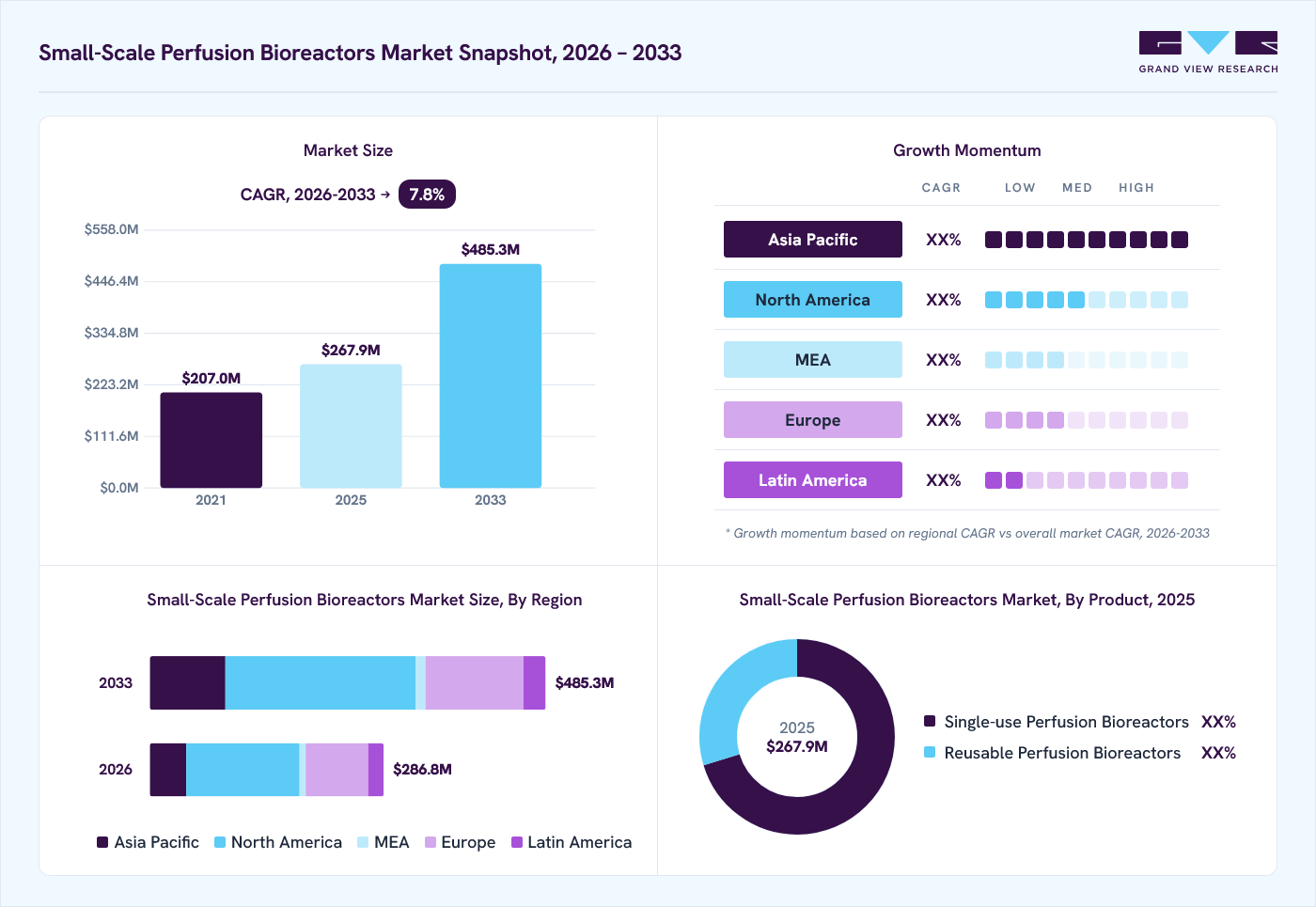
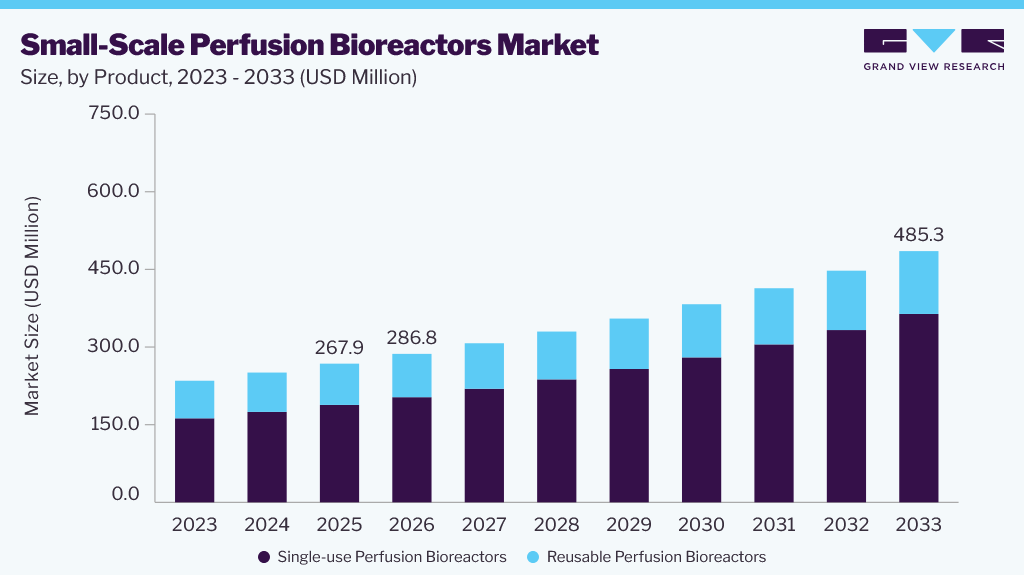
The global small-scale perfusion bioreactors market size was valued at USD 267.9 million in 2025 and is projected to grow from USD 286.8 million in 2026 to USD 485.3 million by 2033, at a CAGR of 7.8% from 2026 to 2033. North America dominated the market, accounting for the largest revenue share of 48.3% in 2025. Market growth is driven by the increasing adoption of continuous and perfusion-based bioprocessing for efficient cell cultivation, particularly in biologics and cell and gene therapy manufacturing, as well as advancements in bioreactor automation, process monitoring, single-use technologies, and scalable process development.
 Source: Grand View Research, IR Documents, Primary Interviews, Paid DatabasesTo learn more about this report,
 Download Free Sample Report
 Key Market Trends & Insights
- By product type: Single-use perfusion bioreactors segment held the highest market share of 70.2% in 2025.
- By capacity: 5 mL-100 mL segment held the highest market share in 2025.
- By application: Process & cell-line development segment held the highest market share in 2025.
Regional Highlights
- Largest regional market: North America (48.3% revenue share, 2025)
- Fastest-growing regional market: Asia Pacific (highest CAGR, 2026-2033)
- By country: The U.S. held the largest market share in 2025.
Market Size & Forecast
- Market size in 2025: USD 267.9 Million
- Estimated market size in 2026: USD 286.8 Million
- Projected market size by 2033: USD 485.3 Million
- CAGR (2026-2033): 7.8%
Three ways to get this report
Buy it, customize it, or ask a question.Ask an Analyst
Analyst response in 1 business day
- AccessReport author, directly
- Reply timeWithin 1 working day
- No sales callDirect answer only
- FormatEmail reply
- CostFree, no cost
Get the Full Report
What the study covers
- FormatsPDF · Excel · Dashboard
- Timeline2026–2033 annual, 2025 base
- Coverage20+ countries, 5 regions
- Companies10+ key players profiled
Customize the Report
20% free customization
- IncludeCountries, segments, points
- TailorTo your product definition
- ExtendDeeper competitor detail
- OrA fully bespoke study
- Turnaround5–10 working days
 To learn more about this report, Download Free Sample Report
 Market Dynamics
The small-scale perfusion bioreactors market is experiencing steady growth, driven by the increasing adoption of continuous and intensified bioprocessing, rising demand for high-density cell culture, and the growing use of small-scale systems for process development and optimization. Advancements in automation, real-time monitoring, and process control are improving productivity and reproducibility, while biologics, cell, and gene therapy development and CDMO activities are increasing demand for flexible perfusion platforms.
The increasing adoption of single-use bioreactor technologies is driving the small-scale perfusion bioreactors market by reducing cleaning and sterilization requirements, lowering cross-contamination risks, shortening commissioning timelines, and reducing initial capital investment compared with stainless-steel systems. These benefits provide greater flexibility and operational efficiency for small-scale process development, where rapid deployment and frequent process changes are important. The key operational and economic advantages of single-use perfusion bioreactors compared with stainless-steel systems are summarized in the table below:
Comparison of Single-use and Stainless-steel Perfusion Bioreactors
Parameter
Single-use Perfusion Bioreactor
Stainless-steel Perfusion Bioreactor
Maximum commercial scale
Up to approximately 2,000 L
Up to 10,000 L and beyond
Cleaning and sterilization
Not required; disposable bioreactor bag
Required; cleaning-in-place (CIP) and sterilization-in-place (SIP)
Commissioning timeline
Shorter; modular and disposable systems
Longer; requires facility qualification and system commissioning
Leachables and extractables
Requires extended-contact testing
Not applicable
Cross-contamination risk
Minimal due to disposable product-contact surfaces
Requires validated cleaning between products
Capital expenditure
Lower initial capital expenditure; higher consumable operating costs
Higher initial capital expenditure; lower consumable operating costs
Impeller customization
Limited to the specifications of the disposable bag
Customizable based on vessel and process requirements
Source: Drug Discovery News, Secondary Research, Primary Research Analysis, Grand View Research Analysis
Moreover, in September 2025, Distek expanded its BIOne Single-Use Bioreactor portfolio with models designed for integration with perfusion technologies, including Repligen XCell alternating tangential flow and KrosFlo tangential flow depth filtration. Available in 2 L, 5 L, and 10 L working volumes, the systems were intended to support process development, scale-up, and small-scale production, demonstrating the increasing integration of single-use bioreactor platforms with perfusion technologies.
The complexity of developing and optimizing perfusion processes can constrain growth in the small-scale perfusion bioreactors market. Unlike conventional batch or fed-batch systems, perfusion processes require precise control of parameters such as perfusion rate, cell density, media exchange, oxygen transfer, and metabolite removal. Optimizing these parameters across different cell lines and process conditions can increase development time and operational complexity.
Moreover, achieving consistent process performance at a small scale can require extensive experimentation and process monitoring to establish suitable operating conditions. Variations in cell growth, nutrient consumption, and waste accumulation can affect process stability and product quality, increasing the technical expertise and resources required for optimization. These challenges may limit adoption among smaller research organizations and facilities with limited bioprocess development capabilities.
The increasing demand for high-density cell culture systems presents a significant opportunity for the small-scale perfusion bioreactors market, as perfusion enables continuous nutrient replenishment and removal of metabolic waste, allowing cells to be maintained at higher viable densities for extended periods. This approach improves volumetric productivity while reducing the required culture volume, supporting process intensification and efficient bioprocess development.
According to an article published by Springer Nature in June 2026, researchers developed a 500 mL single-use perfusion bioreactor integrated with impulse tangential-flow filtration for high-density animal cell culture. The system achieved cell densities of 8.32 × 10⁷ cells/mL for CHO cells and 1.17 × 10⁸ cells/mL for HEK293 cells, demonstrating its potential for intensified biopharmaceutical production and supporting demand for small-scale perfusion platforms.
Market Concentration & Characteristics
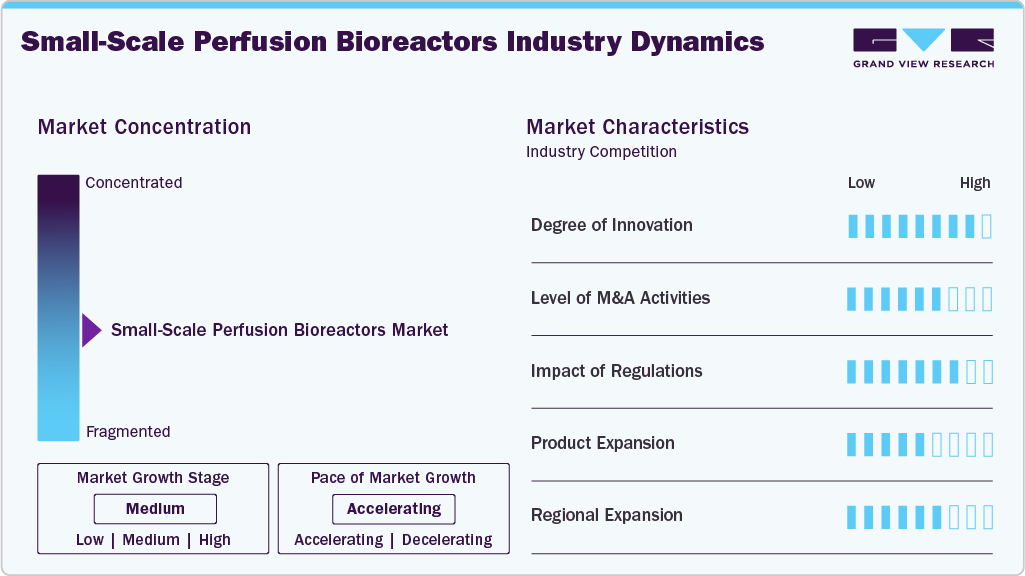
The small-scale perfusion bioreactors industry is characterized by a high degree of innovation, driven by automation, parallel processing, real-time monitoring, and integrated perfusion control. Manufacturers are developing compact platforms that enable high-throughput process development and reproducible high-density cultures. For instance, in December 2025, PBS Biotech launched MiniPRO, a multi-parallel platform supporting up to 24 independent small-scale cultures with automated control and perfusion media exchange.
"Companies have been looking for a reliable, automated small-scale system that mirrors the performance of their clinical manufacturing equipment. MiniPRO fills that gap by offering precise control and real-time monitoring in a closed system that supports faster, more consistent process development."
- Brian Lee, CTO and Founder of PBS Biotech
The small-scale perfusion bioreactors market has witnessed strategic M&A activity aimed at strengthening capabilities in perfusion-based bioprocessing and expanding technology portfolios. For instance, in June 2025, UltraGreen.ai acquired Perfusion Tech, strengthening its capabilities in real-time perfusion quantification and expanding its technology portfolio. The acquisition supported the company’s efforts to enhance perfusion assessment technologies and broaden its capabilities in advanced bioprocessing applications.
 To learn more about this report, Download Free Sample Report
 The small-scale perfusion bioreactors industry is influenced by regulatory requirements governing biopharmaceutical manufacturing, particularly process consistency, contamination control, data integrity, and validation. These requirements increase the importance of automated, controlled small-scale platforms capable of generating reproducible process development data to support scale-up and technology transfer.
The small-scale perfusion bioreactor industry is experiencing moderate expansion, with manufacturers developing platforms that integrate compact working volumes with automated process control, perfusion management, real-time monitoring, and scalable process development capabilities. These advancements are enhancing process flexibility, reproducibility, and efficiency across laboratory-scale and early-stage bioprocessing workflows.
The small-scale perfusion bioreactor industry is experiencing moderate regional expansion, supported by increasing investments in biopharmaceutical manufacturing and process development infrastructure across major biotechnology hubs. Manufacturers are expanding their commercial presence, technical support, and production capabilities across regions to address growing demand for perfusion-based process development and intensified cell culture.
Analyst Perspective
The small-scale perfusion bioreactors market is expected to witness steady growth, driven by the increasing adoption of continuous bioprocessing and the growing need for efficient process development and optimization. Rising demand for flexible, scalable, and automated systems for cell culture and biologics development is accelerating the adoption of small-volume perfusion platforms. Advancements in real-time monitoring, process control, and single-use technologies are further enhancing workflow efficiency and reproducibility. Increasing investments in biopharmaceutical research and development are expected to support market expansion, encouraging manufacturers to focus on automation, digital integration, and scalable perfusion solutions.
Product Type Insights
The single-use perfusion bioreactors segment accounted for the largest revenue share, over 70.2% in 2025, and is expected to grow at the fastest CAGR during the forecast period, driven by their operational flexibility, reduced turnaround requirements, and suitability for rapid process development. Increasing adoption for high-density cell culture, process optimization, and scale-down studies is further supporting segment growth across biologics and advanced therapy development.
The reusable perfusion bioreactors segment is expected to register a significant CAGR over the forecast period, driven by their suitability for repeated process development studies, greater operational control, and compatibility with established bioprocessing workflows. According to a May 2026 article in Cytotherapy, researchers demonstrated carrier-free human iPSC expansion using a 3 L bioreactor equipped with a reusable perfusion kit, supporting the use of reusable platforms in scalable cell manufacturing.
Capacity Insights
The 5 mL-100 mL segment dominated the market with a 27.6% share in 2025, driven by increasing adoption in early-stage process and cell-line development, where small working volumes enable efficient screening and optimization of critical perfusion parameters. Their lower media consumption, reduced material requirements, and suitability for parallel experimentation further support their use in bioprocess development and scale-up studies.
The >1 L-3 L segment is expected to register the fastest CAGR over the forecast period, driven by growing demand for larger-volume systems in process development, scale-up, and intensified cell culture studies. These bioreactors enable more representative assessment of process parameters, cell growth, and product productivity while providing a practical transition between laboratory-scale experimentation and larger manufacturing platforms.
Application Insights
The process & cell-line development segment dominated the market with a 29.2% share in 2025, driven by the extensive use of small-scale perfusion bioreactors for screening cell lines, optimizing culture conditions, evaluating media performance, and establishing critical process parameters. Their ability to generate controlled, reproducible data while minimizing material and resource requirements further supports adoption during early-stage bioprocess development.
The cell & gene therapy manufacturing segment is expected to register the fastest CAGR over the forecast period, driven by the increasing adoption of perfusion-based culture strategies for high-density cell expansion, improved control of nutrient and metabolite levels, and the need for efficient manufacturing of personalized therapies. According to an article published by the NIH in April 2026, researchers developed a closed-perfusion microbioreactor integrating viral transduction and cell expansion for CAR-Treg manufacturing, achieving a 92% higher CAR-Treg yield than conventional culture methods and highlighting the potential of small-scale perfusion platforms for advanced cell therapy manufacturing.
End Use Insights
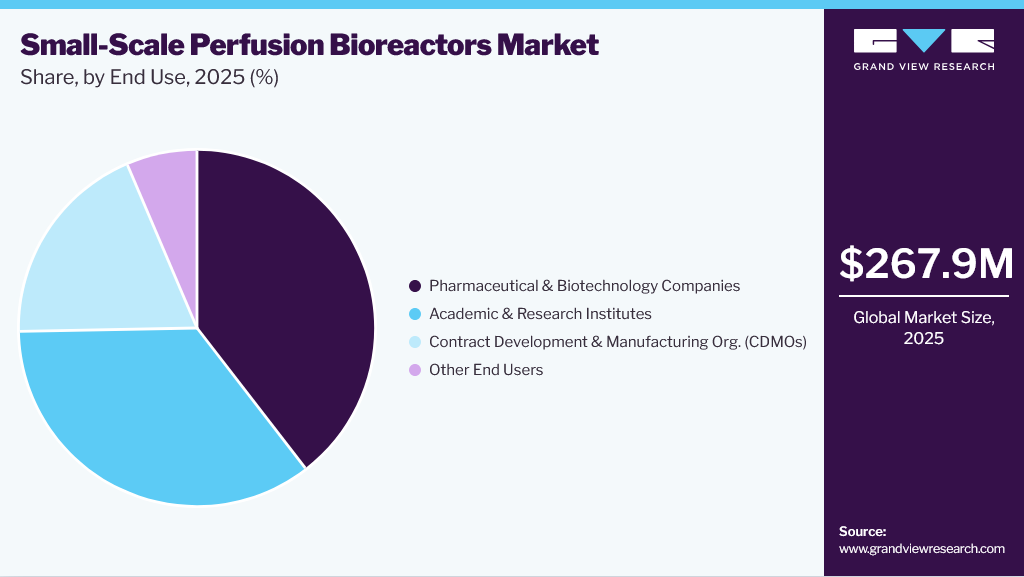
The pharmaceutical & biotechnology companies segment dominated the market with a 39.5% share in 2025, driven by the extensive use of small-scale perfusion bioreactors for process development, cell-line evaluation, media optimization, and scale-down studies. Increasing investments in biologics and advanced therapy development, coupled with the need for controlled, reproducible process conditions, are further driving adoption among pharmaceutical and biotechnology companies.
 To learn more about this report, Download Free Sample Report
 The contract development & manufacturing organizations (CDMOs) segment is projected to witness the fastest CAGR, driven by increasing outsourcing of bioprocess development activities, rising demand for flexible and scalable process development capabilities, and growing adoption of perfusion-based approaches for high-density cell culture. The need to provide clients with efficient process optimization and technology transfer capabilities is further supporting investment in small-scale perfusion platforms among CDMOs.
Regional Insights
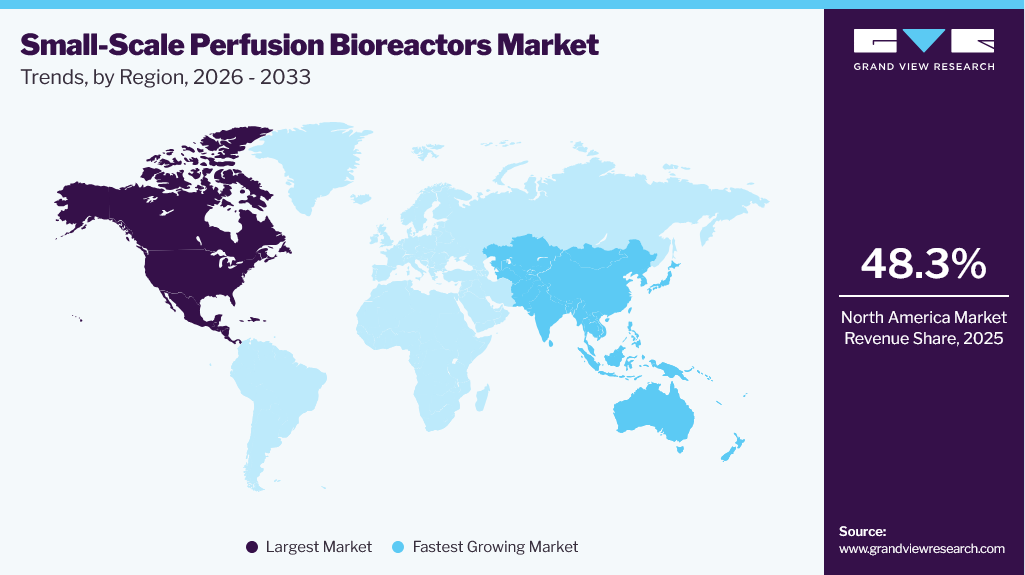
North America dominated the small-scale perfusion bioreactors industry, accounting for the largest revenue share of 48.3% in 2025, supported by advanced bioprocessing infrastructure, strong cell therapy development, and increasing adoption of intensified culture technologies. For instance, in May 2025, Sunflower Therapeutics delivered and installed its Daisy Petal Perfusion Bioreactor System at BioBuilder’s Learning Lab in Massachusetts, marking the system’s first U.S. installation and expanding access to compact perfusion technology.
 To learn more about this report, Download Free Sample Report
 U.S. Small-Scale Perfusion Bioreactors Market Trends
The small-scale perfusion bioreactors industry in the U.S. is expected to grow over the forecast period, supported by expanding bioprocess development infrastructure and increasing demand for process optimization and scale-up capabilities. For instance, in April 2026, Thermo Fisher Scientific opened a Bioprocess Design Center in Massachusetts, providing customers with facilities and technical expertise for process testing, optimization, troubleshooting, and scale-up of bioprocessing workflows.
Europe Small-Scale Perfusion Bioreactors Market Trends
The small-scale perfusion bioreactors market in Europe was identified as a lucrative region in this industry, supported by established biopharmaceutical research capabilities and increasing adoption of intensified cell-culture technologies. For instance, in July 2025, Sunflower Therapeutics entered the European market through an exclusive distribution agreement with Alflow Scandinavia for its Daisy Petal Perfusion Bioreactor System in Denmark, Norway, Sweden, and Iceland, marking its first commercial partnership in Europe.
The UK small-scale perfusion bioreactors market is supported by strong academic and industry collaboration in perfusion-based cell therapy manufacturing. According to an article published by NIH in June 2025, researchers from University College London and Sartorius evaluated perfusion feeding strategies for CAR-T cell expansion in stirred-tank bioreactors, demonstrating the potential of intensified perfusion to increase cell yields and shorten manufacturing timelines.
The small-scale perfusion bioreactors market in Germany is anticipated to grow significantly over the forecast period, supported by its established biopharmaceutical research base, advanced bioprocessing capabilities, and strong expertise in cell-culture technologies. Increasing adoption of intensified bioprocessing and demand for efficient process-development platforms are expected to support market growth.
Asia Pacific Small-Scale Perfusion Bioreactors Market Trends
Asia-Pacific is expected to grow at the fastest CAGR of 11.0% during the forecast period, supported by expanding bioprocessing capabilities and increasing availability of compact perfusion technologies. For instance, in February 2025, Sunflower Therapeutics partnered with PharmNXT Biotech to launch the Daisy Petal Perfusion Bioreactor System commercially in India, Singapore, Thailand, Indonesia, Malaysia, and South Korea, expanding access to perfusion technology across the region.
The small-scale perfusion bioreactors market in China is supported by the country’s expanding biopharmaceutical R&D ecosystem, increasing investment in advanced cell-culture technologies, and growing adoption of intensified bioprocessing approaches. Rising biologics and cell therapy development activities are expected to increase demand for flexible small-scale platforms for process optimization, characterization, and scale-up studies.
The small-scale perfusion bioreactors market in Japan is witnessing growth. The country’s strong foundation in biopharmaceutical research and cell-culture technologies is creating opportunities for small-scale perfusion bioreactors. Increasing emphasis on process intensification, efficient resource utilization, and reproducible bioprocess development is driving the adoption of compact perfusion platforms for early-stage research, process optimization, and scale-up.
Latin America Small-Scale Perfusion Bioreactors Market Trends
The Latin America small-scale perfusion bioreactors market is expected to grow gradually, supported by expanding cell and gene therapy activities and pharmaceutical research infrastructure. For instance, in August 2025, Mexico and Brazil signed cooperation agreements covering health, pharmaceutical research, regulatory coordination, and scientific collaboration, strengthening the regional ecosystem for advanced biomanufacturing technologies.
MEA Small-Scale Perfusion Bioreactors Market Trends
MEA small-scale perfusion bioreactors market is expected to grow steadily, supported by increasing biopharmaceutical research activities, expanding cell and gene therapy development, and growing emphasis on advanced bioprocessing technologies. Rising demand for efficient cell-culture platforms and process optimization is expected to support the adoption of small-scale perfusion bioreactors across research and development applications.
Key Small-Scale Perfusion Bioreactors Company Insights
Several established companies operate in the small-scale perfusion bioreactor market, supported by their portfolios of perfusion bioreactor systems, cell culture platforms, and technologies for process development and scale-up. Key players such as Sartorius AG, Merck / MilliporeSigma, PerfuseCell-Cronus A/S (Stobbe Group), PBS Biotech, Inc., Cell Culture Company, LLC, Synthecon, Incorporated, 3D Biotek LLC, FiberCell Systems, CELLEC BIOTEK, and Sunflower Therapeutics maintain market presence through product development, perfusion technology advancements, process automation, and strategic initiatives focused on improving cell-culture performance, process control, scalability, and bioprocess development.
Key Small-Scale Perfusion Bioreactors Companies
The following key companies have been profiled for this study on the small-scale perfusion bioreactors market.
-
Sartorius AG
-
Merck / MilliporeSigma
-
PerfuseCell-Cronus A/S (Stobbe Group)
-
PBS Biotech, Inc.
-
Cell Culture Company, LLC
-
Synthecon, Incorporated
-
3D Biotek LLC
-
FiberCell Systems
-
CELLEC BIOTEK
-
Sunflower Therapeutics
Recent Developments
-
In February 2026, Sunflower Therapeutics expanded distribution into Japan through MATSUBO Corporation, enabling domestic customers to access its Daisy Petal perfusion bioreactor system for automated, continuous protein manufacturing applications.
-
In April 2025, Culture Biosciences launched the Stratyx 250 in the U.S., a 250-mL bench-scale bioreactor integrating automation, cloud-based monitoring, and single-use technology to support scalable process development and perfusion applications.
Small-Scale Perfusion Bioreactors Market Report Scope
Report Attribute
Details
Market size in 2025
USD 267.9 million
Estimated market size in 2026
USD 286.8 million
Projected market size by 2033
USD 485.3 million
Growth rate
CAGR of 7.8% from 2026 to 2033
Historical data
2021 - 2025
Forecast period
2026 - 2033
Quantitative units
Revenue in USD million, and CAGR from 2026 to 2033
Report coverage
Revenue forecast, company ranking, competitive landscape, growth factors, and trends
Segments covered
Product type, capacity, application, end-use, and region
Regional scope
North America; Europe; Asia Pacific; Latin America; MEA
Country scope
U.S.; Canada; Mexico; UK; Germany; France; Italy; Spain; Norway; Denmark; Sweden; China; Japan; India; South Korea; Australia; Thailand; Brazil; Argentina; Saudi Arabia; South Africa; UAE; Kuwait
Key companies profiled
Sartorius AG; Merck / MilliporeSigma; PerfuseCell-Cronus A/S (Stobbe Group); PBS Biotech, Inc.; Cell Culture Company, LLC; Synthecon, Incorporated; 3D Biotek LLC; FiberCell Systems; CELLEC BIOTEK; Sunflower Therapeutics
Customization scope
Free report customization (equivalent up to 8 analysts' working days) with purchase. Addition or alteration to country, regional & segment scope.
Pricing and purchase options
Avail customized purchase options to meet your exact research needs. Explore purchase options
Global Small-Scale Perfusion Bioreactors Market Report Segmentation
This report forecasts revenue growth and provides an analysis on the latest trends in each of the sub-segments from 2021 to 2033. For the purpose of this report, Grand View Research has segmented the global small-scale perfusion bioreactors market on the basis of product type, capacity, application, end-use, and region
-
Product Type Outlook (Revenue, USD Million, 2021 - 2033)
-
Single-use Perfusion Bioreactors
-
Reusable Perfusion Bioreactors
-
-
Capacity Outlook (Revenue, USD Million, 2021 - 2033)
-
5 mL-100 mL
-
>100 mL-250 mL
-
>250 mL-500 mL
-
>500 mL-1 L
-
>1 L-3 L
-
>3 L-5 L
-
-
Application Outlook (Revenue, USD Million, 2021 - 2033)
-
Biopharmaceutical Production
-
Cell & Gene Therapy Manufacturing
-
Process & Cell-line Development
-
Research & Other Applications
-
-
End Use Outlook (Revenue, USD Million, 2021 - 2033)
-
Pharmaceutical & Biotechnology Companies
-
Contract Development & Manufacturing Organizations (CDMOs)
-
Academic & Research Institutes
-
Other End Users
-
-
Regional Outlook (Revenue, USD Million, 2021 - 2033)
-
North America
-
U.S.
-
Canada
-
Mexico
-
-
Europe
-
UK
-
Germany
-
France
-
Italy
-
Spain
-
Denmark
-
Sweden
-
Norway
-
-
Asia Pacific
-
Japan
-
China
-
India
-
Australia
-
Thailand
-
South Korea
-
-
Latin America
-
Brazil
-
Argentina
-
-
Middle East and Africa (MEA)
-
South Africa
-
Saudi Arabia
-
UAE
-
Kuwait
-
-
Research Methodology
The small-scale perfusion bioreactors market figures in this report are based on a proven research process that combines executive interviews with secondary research from proprietary databases, company filings, and recognized regulatory and institutional sources. Market size is built through value-chain sizing-reconciling supply-side and demand-side estimates-and triangulated with bottom-up and top-down approaches. Every estimate passes multiple levels of expert validation before publication, with each small-scale perfusion bioreactors segment quantified using the revenue-capture definitions in the table below.
Segment Definition
Segment- Product Type
Revenue Capture Definition
Single-use Perfusion Bioreactors
Revenue generated from perfusion bioreactor systems designed with disposable, single-use components that enable continuous media exchange and cell retention without requiring extensive cleaning and sterilization between batches. These systems are used for process development, cell culture optimization, biologics production, and advanced therapy manufacturing while reducing cross-contamination and turnaround requirements.
Reusable Perfusion Bioreactors
This segment captures income from durable perfusion bioreactor systems intended for repeated operation across multiple production or development cycles. These platforms typically incorporate reusable vessels and process components and are utilized where repeated operation, equipment longevity, and established cleaning and sterilization procedures are required.
Segment- Capacity
Revenue Capture Definition
5 mL-100 mL
Market value in this category stems from small-volume perfusion bioreactors designed for early-stage experimentation, media optimization, cell culture studies, and initial process development, where limited working volumes are required.
>100 mL-250 mL
Revenue within this capacity range is associated with perfusion bioreactors used for laboratory-scale process development, optimization of culture conditions, and evaluation of cell growth and productivity under continuous perfusion.
>250 mL-500 mL
This segment represents income from intermediate-volume perfusion systems that support intensified cell culture studies, process characterization, and scale-up activities, bridging laboratory experimentation and larger development platforms.
>500 mL-1 L
Revenue derived from perfusion bioreactors with working capacities suited to advanced process development, cell-line evaluation, and larger-scale experimentation requiring greater culture volumes and more representative process conditions.
>1 L-3 L
This category reflects demand for small-scale perfusion systems used for process scale-up, optimization, and manufacturing development, where higher culture volumes are required while maintaining controlled perfusion conditions.
>3 L-5 L
This segment captures revenue from higher-capacity small-scale perfusion bioreactors used for process validation, intensified cell culture development, and scale-up studies requiring working volumes approaching pilot-scale volumes.
Segment- Application
Revenue Capture Definition
Biopharmaceutical Production
Revenue generated from small-scale perfusion bioreactors used to produce biologics such as monoclonal antibodies, recombinant proteins, vaccines, and other biopharmaceutical products. These systems support continuous cell culture, process intensification, productivity enhancement, and development of scalable manufacturing processes.
Cell & Gene Therapy Manufacturing
This segment reflects income from perfusion bioreactor platforms used in the development and manufacturing of cell and gene therapies, supporting cell expansion, culture optimization, and controlled production of therapeutic cell populations and related biological materials.
Process & Cell-line Development
Market value in this category arises from the use of small-scale perfusion systems for cell-line screening, media optimization, process parameter evaluation, culture condition development, and scale-up studies prior to larger-scale manufacturing.
Research & Other Applications
Includes revenue from small-scale perfusion bioreactors utilized in academic research, cellular and molecular biology studies, experimental bioprocessing, and other specialized applications outside production and formal process development activities.
Segment- End-use
Revenue Capture Definition
Pharmaceutical & Biotechnology Companies
Revenue originates from the adoption of small-scale perfusion bioreactors by pharmaceutical and biotechnology companies for biologics development, cell-line optimization, process intensification, therapeutic research, and manufacturing process development.
Contract Development & Manufacturing Organizations (CDMOs)
This segment captures income generated by CDMOs through the use of small-scale perfusion bioreactors, providing process development, scale-up, manufacturing, and technology transfer services to pharmaceutical and biotechnology clients.
Academic & Research Institutes
Demand in this category is driven by universities, research institutions, and other scientific organizations that use small-scale perfusion systems for bioprocess research, cell culture studies, technology development, and academic experimentation.
Other End Users
Revenue in this segment is driven by the adoption of small-scale perfusion bioreactors by hospitals, government research organizations, clinical research facilities, and other specialized users engaged in cell culture and bioprocessing.
Estimation Model
Top-Down
Parent Market
Segmentation
Validation
Forecasting
Commodity Flow Analysis
Parent Market Analysis
Market Segmentation
Data Validation
Market Forecasting
Analyze overall market size through production, imports, exports, shipments, and distribution flows.
Estimate the relevant market by assessing the size and growth of the broader parent market and applying the relevant share.
Segment the market by product type, application, end user, geography, and other relevant market categories.
Validate estimates through secondary research, company data, industry sources, expert interviews, and cross-checking of market assumptions.
Forecast market growth using historical trends, market drivers, adoption rates, penetration levels, and expected changes in demand.
Delivered Customizations
This report has been delivered with the following In-depth customizations
Client Request
Customization Delivered
Value Adds
Small-Scale Perfusion Process Development Assessment
Evaluation of small-scale perfusion bioreactor requirements across process development, cell-line screening, media optimization, and scale-down studies, including viable cell density, perfusion rate, cell retention, media consumption, oxygen transfer, and culture duration.
Helps clients optimize experimental workflows, identify critical process parameters, improve process reproducibility, and accelerate translation from laboratory studies to larger-scale perfusion processes.
High-Density Cell Culture & Process Intensification Analysis
Assessment of high-density culture capabilities across small-scale perfusion systems, including nutrient delivery, metabolite removal, oxygen transfer, cell retention, volumetric productivity, and media utilization for biologics and advanced therapy applications.
Helps clients evaluate process-intensification potential, identify productivity bottlenecks, optimize culture conditions, and assess opportunities to reduce process footprint and resource consumption.
Perfusion Scale-Up & Scale-Down Strategy Assessment
Evaluation of scale-up and scale-down requirements from small-scale perfusion systems to pilot- and commercial-scale platforms, including process parameter equivalency, mass transfer, cell retention, perfusion rates, and process control requirements.
Supports clients in reducing scale-up risks, establishing representative small-scale models, improving technology transfer, and accelerating commercial process development.
Frequently Asked Questions About This Report
The global small-scale perfusion bioreactors market size was valued at USD 267.9 million in 2025 and is estimated at USD 286.8 million for 2026.
The global small-scale perfusion bioreactors market is expected to grow at a CAGR of 7.8% from 2026 to 2033, reaching USD 485.3 million by 2033.
Which product type segment accounted for the largest small-scale perfusion bioreactors market share?The single-use perfusion bioreactors segment led with a 70.2% revenue share in 2025.
North America dominated with a 48.3% revenue share in 2025.
Market growth is driven by the increasing adoption of continuous and perfusion-based bioprocessing for efficient cell cultivation, particularly in biologics and cell and gene therapy manufacturing, as well as advancements in bioreactor automation, process monitoring, single-use technologies, and scalable process development.
Key players include Sartorius AG, Merck / MilliporeSigma, PerfuseCell-Cronus A/S (Stobbe Group), PBS Biotech, Inc., Cell Culture Company, LLC, Synthecon, Incorporated, 3D Biotek LLC, FiberCell Systems, CELLEC BIOTEK, and Sunflower Therapeutics
The 5 mL–100 mL segment led with a 27.6% revenue share in 2025.
The process & cell-line development segment led with a 29.2% revenue share in 2025.
The pharmaceutical & biotechnology companies segment led with a 39.5% revenue share in 2025.
About the Author(s)
Biotechnology Research Team
Healthcare · BiotechnologyThis report was authored by the biotechnology research team at Grand View Research - comprising two research analysts, one senior research analyst, and one industry expert - with specialized expertise in the biotechnology segment of the healthcare industry. All findings are based on proprietary healthcare databases, executive interviews, and regulatory analysis, subject to internal peer review prior to publication.
Last Updated:
Speak to Analyst

Customize this report to your needs - add regions, segments, or data points, with 20% free customization.
Or view our licence options:


ISO 9001:2015 & 27001:2022 Certified
We are GDPR and CCPA compliant! Your transaction & personal information is safe and secure. For more details, please read our privacy policy.


