
- Home
- »
- Electronic & Electrical
- »
-
Smart Ceiling Fans Market Size, Share, Global Industry Report, 2025GVR Report cover
![Smart Ceiling Fans Market Size, Share & Trends Report]()
Smart Ceiling Fans Market (2019 - 2025) Size, Share & Trends Analysis Report By Application (Residential, Commercial), By Distribution Channel (Offline, Online), By Region, And Segment Forecasts
Report Overview
The global smart ceiling fans market size was valued at USD 698.4 million in 2018. Rising consumer preference for convenient products along with the rapid adoption of advanced technology is expected to drive the market. Furthermore, high demand for technologically advanced products, especially from millennial consumers coupled with easy access to a wide range of products is expected to positively affect market growth.
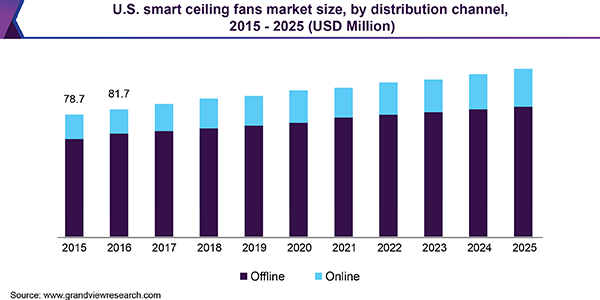
Changing consumer lifestyle and rising inclination for convenience and the latest technology are some of the major factors driving the demand for smart ceiling fans. Rising adoption of smart household appliances including smart ceiling fans that can be controlled through internet and smartphones, is anticipated to drive the growth.
Smart fans have a wireless connection, advanced cooling functions, and automatic temperature control among other features. Consumers can effortlessly operate these products by downloading the compatible app including Google Assistant and Alexa on their mobile phones and connecting them through Bluetooth or Wi-Fi. The consumers can maintain appropriate humidity, ventilation, and keep the air free from dust and aerial microorganisms with the help of these fans. The advanced features such as climate control and energy-efficiency have been encouraging consumers to opt for these products.
Rising adoption of smart ceiling fans with LED lights in innovative styles and designs is anticipated to drive innovation in the market. The manufactures have been emphasizing on technological advancements and innovative styles to cater to consumer demand. For instance, the introduction of bladeless ceiling fan has been gaining significant popularity in modern homes. However, the relatively high price of smart fans compared to their conventional counterparts is expected to hamper the smart ceiling fans market growth.
Market Dynamics
The growing trend of home renovations and interior modernization is emerging as a significant driver of the smart ceiling fans market. Consumers are increasingly investing in aesthetically appealing and technologically advanced home appliances that complement modern interior designs and enhance overall living comfort. Smart ceiling fans with sleek finishes, integrated LED lighting, minimalist designs, and customizable controls are gaining strong popularity in newly renovated homes, premium apartments, and luxury residential projects. In addition, the growing influence of social media, home décor platforms, and smart lifestyle trends is encouraging consumers to upgrade conventional appliances with stylish, connected alternatives. For instance, companies such as Fanimation, Modern Forms, and Havells India are increasingly introducing designer smart ceiling fans featuring premium finishes, silent operation, and app-based customization options. Moreover, increasing expenditure on residential luxury housing projects across urban areas is further supporting product demand. Consumers are prioritizing appliances that combine functionality with aesthetics, thereby accelerating the adoption of smart ceiling fans in modern residential and commercial spaces.
Limited consumer awareness of the benefits and functionality of smart ceiling fans, coupled with their perceived high cost, remains a key challenge restraining market growth. Many consumers, particularly in developing and price-sensitive regions, remain unfamiliar with smart home technologies and continue to prefer conventional ceiling fans for their affordability and simpler operation. In addition, several buyers are unaware of the long-term energy-saving benefits offered by smart ceiling fans equipped with BLDC motors, IoT connectivity, and automation features. For instance, consumers often hesitate to invest in smart ceiling fans due to concerns regarding complex installation, app connectivity issues, and compatibility with existing smart home ecosystems. Moreover, the significantly higher upfront cost of smart fans compared to traditional models discourages adoption among middle-income households. Instances of consumers facing difficulties configuring Wi-Fi-enabled appliances and keeping software up to date further highlight the impact of limited technical awareness and usability concerns. As a result, these factors continue to restrict the widespread adoption of smart ceiling fans, particularly across emerging economies and rural markets.
Distribution Channel Insights
Offline distribution channel accounted for the largest market share of more than 80% in 2018. Consumer preference for brick and mortar distribution channels, especially the specialty stores, due to the provision of detail instructions about installation and after-sale services by the professionals, is anticipated to fuel the segment growth. Furthermore, the easy availability of compatible product accessories has been attracting buyers to purchase from these channels.
Online distribution channel segment is anticipated to expand at a CAGR of more than 6% from 2019 to 2025. Rising spending on e-commerce for purchasing home appliances among the middle-income population due to the rising use of smartphones and the internet is anticipated to drive the segment growth. In addition, growth of online retailers, especially company-owned shopping portals, such as Ottomate International, Orient Electric Limited, and LG Electronics among others is expected to speed up online sales in the upcoming years.
Application Insights
Residential application held the largest share of the smart ceiling fans market, accounting for more than 80% of revenue share. Rising adoption of smart devices has been boosting the product demand from the residential sector. Furthermore, rising demand for silent and energy-saving fans is driving the segment growth. Consumers opt for these products as they complement the modern and smart homes. These products offer room-specific climate. In March 2019, Ottomate International, launched Ottomate Smart Fan, which enables Bluetooth mesh connectivity. The Otto mode of the product allows it to adjust the airflow automatically by sensing the climate conditions of a particular room.
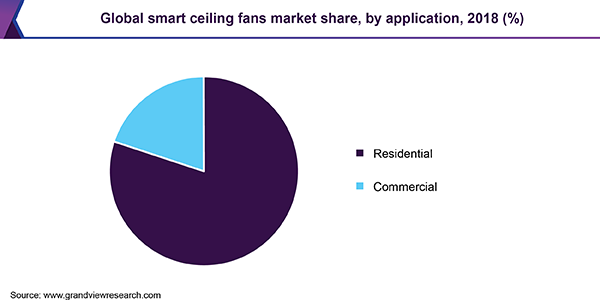
Commercial segment is expected to witness the fastest CAGR of 5.5% from 2019 to 2025, due to rising demand for products with energy-efficiency and automatic temperature control features. The advanced technology makes it easy to control multiple fans at the same time. Therefore, the application of the product is expected to witness a significant rise in commercial buildings including manufacturing facilities, offices, and malls. Over the past few years, manufacturers have been launching products to expand their reach to this sector. For instance, in May 2019, Delta T, LLC’s Big Ass Fans introduced Powerfoil D suitable for harsh industrial environments.
Regional Insights
In 2018, Asia Pacific led the market, contributed to more than 60% of the global revenue share. Rise in middle-class population in the developing countries, including China, Bangladesh, India, and Indonesia is driving the regional demand for premium home appliances. Additionally, hot climate South Asian countries is expected to promote the use of smart cooling devices, including smart ceiling fans.
Over the past few years, the key market participants have been expanding their business in this region to cater to the rising product demand. For instance, in May 2019, LG Electronics entered the smart fan industry in India by launching its The Fan. It is compatible with Amazon Alexa and LG SmartThinQ and is also equipped with the mosquito away feature.
Key Companies & Market Share Insights
Key market participants include Hunter Fan Company; Orient Electric; Delta T, LLC; Ottomate International; Minka Lighting Inc.; Modern Form; Fanimation; OCECO; Havells India Ltd.; and CG Power and Industrial Solutions Limited. Over the past few years, the companies have been investing in product innovation o gain a competitive advantage. For instance, in October 2018, Orient Electric, a CK Birla group company, collaborated with Tata Elxsi to improve product performance and design. In another development, Orient Electric launched an energy-efficient Orient Ecogale ceiling fan under its Eco-series range, which consumes 32-watt power compared to the 70-watt power consumed by the fans operating on an induction motor.
Competitive Benchmarking
Operating Strategies
Competitive Edge
Weaknesses
Mature Players: Havells India Ltd.
- Mature players focus on expanding their smart home ecosystem offerings through IoT-enabled ceiling fans integrated with voice assistants, mobile applications, and energy-efficient BLDC motors. They emphasize premium product innovation, smart connectivity features, silent operation, and aesthetically advanced designs to strengthen brand positioning. Companies are also investing in partnerships with smart home technology providers and expanding online distribution networks to improve consumer reach and after-sales services.
- Established players maintain a competitive edge through strong brand recognition, distribution networks, technological expertise, and diversified smart appliance portfolios. Their ability to invest in R&D, launch advanced smart cooling solutions, and integrate their products with ecosystems such as Alexa and the Google Assistant strengthens their long-term market positioning. In addition, premium product quality and large-scale manufacturing capabilities help mature companies maintain pricing power and operational efficiency.
- High investment requirements in product innovation, IoT integration, and regulatory compliance increase operational costs for mature companies. In addition, dependence on semiconductor components, smart connectivity modules, and global supply chains exposes established players to pricing volatility and supply disruptions.
Emerging Players: Modern Form
- Emerging players adopt innovation-driven strategies to capture niche consumer segments. These companies primarily focus on affordable smart fans with app-based controls, compact designs, and energy-saving features targeted toward urban middle-income consumers. Many startups leverage e-commerce platforms, direct-to-consumer sales, and digital marketing campaigns to rapidly expand visibility and compete with established brands.
- Emerging players benefit from faster adaptability to changing consumer preferences and smart home trends. Their competitive advantage lies in offering cost-effective products with modern features and customizable designs. Lower operational complexity and strong digital-first marketing also enable these companies to attract tech-savvy, younger consumers seeking affordable smart home solutions.
- Emerging players often face limitations in manufacturing scale, brand trust, and long-term service infrastructure. Many smaller companies struggle with maintaining product quality consistency and after-sales support. Limited financial resources and weaker distribution networks further limit their ability to compete aggressively with global, well-established smart appliance manufacturers.
Smart Ceiling Fans Market Report Scope
Report Attribute
Details
Market size value in 2020
USD 770.2 million
Revenue forecast in 2025
USD 993.6 million
Growth Rate
CAGR of 5.2% from 2019 to 2025
Base year for estimation
2018
Historical data
2015 - 2017
Forecast period
2019 - 2025
Quantitative units
Revenue in USD million/billion and CAGR from 2019 to 2025
Report coverage
Revenue forecast, company ranking, competitive landscape, growth factors, and trends
Segments covered
Application, distribution channel, region
Regional scope
North America; Europe; Asia Pacific; Central & South America; Middle East & Africa
Country scope
U.S.; U.K.; Germany; China; India; Brazil; South Africa
Key companies profiled
Hunter Fan Company; Orient Electric; Delta T, LLC; Ottomate International; Minka Lighting Inc.; Modern Form; Fanimation; OCECO; Havells India Ltd.; CG Power and Industrial Solutions Limited
Customization scope
Free report customization (equivalent up to 8 analysts working days) with purchase. Addition or alteration to country, regional & segment scope.
Pricing and purchase options
Avail customized purchase options to meet your exact research needs. Explore purchase options
Segments Covered in the Report
This report forecasts revenue growth at global, regional, and country levels, and provides an analysis of the latest industry trends in each of the sub-segments from 2015 to 2025. For the purpose of this study, Grand View Research has segmented the global smart ceiling fans market based on application, distribution channel, and region:
-
Application Outlook (Revenue, USD Million, 2015 - 2025)
-
Residential
-
Commercial
-
-
Distribution Channel Outlook (Revenue, USD Million, 2015 - 2025)
-
Offline
-
Online
-
-
Region Outlook (Revenue, USD Million, 2015 - 2025)
-
North America
-
The U.S.
-
-
Europe
-
Germany
-
The U.K.
-
-
Asia Pacific
-
China
-
India
-
-
Central & South America
-
Brazil
-
-
Middle East & Africa
-
South Africa
-
-
Delivered Customizations
This report has been delivered with the following In-depth customizations
Client Request
Customization Delivered
Value Adds
Smart Home Adoption & Consumer Preference Analysis
- Developed a tailored assessment of consumer adoption trends for smart ceiling fans across residential and commercial sectors. The study evaluated rising smart home penetration, consumer preference for connected appliances, demand for voice-enabled and app-controlled fans, and the influence of energy-efficient lifestyles on purchasing behavior. It also analyzed adoption trends across emerging economies such as India and China, where demand for smart household appliances is rapidly increasing.
- Enables stakeholders to understand evolving consumer expectations around convenience, automation, and energy efficiency, helping companies align product development and marketing strategies with smart home ecosystem trends and premium appliance demand.
Product Innovation & Technology Benchmarking
- Delivered a comprehensive evaluation of technological advancements in the smart ceiling fans market, including IoT integration, Bluetooth and Wi-Fi connectivity, climate sensing technology, BLDC motors, voice assistant compatibility, automated airflow control, and energy-saving features. The analysis also assessed innovation trends such as bladeless fan designs, integrated LED lighting, silent operation, and remote/mobile-based fan management systems.
- Provides actionable insights into emerging technology trends, product differentiation opportunities, and innovation-driven competitive advantages, enabling manufacturers to strengthen product portfolios and accelerate next-generation smart fan development.
Distribution Channel & Regional Growth Opportunity Assessment
- Conducted a focused analysis of distribution channel dynamics and regional demand patterns within the smart ceiling fans market. The study examined the rapid growth of online appliance sales, consumer preference for offline specialty stores, and regional demand drivers across Asia Pacific, North America, and emerging economies. It also assessed the impact of rising urbanization, infrastructure development, middle-class expansion, and e-commerce penetration on market growth.
- Supports strategic expansion planning by identifying high-growth regions, emerging online sales opportunities, and evolving retail preferences. The insights help stakeholders optimize channel strategies, improve market penetration, and target high-potential customer segments more effectively.
Frequently Asked Questions About This Report
The global smart ceiling fans market size was estimated at USD 733.2 million in 2019 and is expected to reach USD 770.2 million in 2020.
The global smart ceiling fans market is expected to grow at a compound annual growth rate of 5.17% from 2019 to 2025 to reach USD 993.6 million by 2025.
Asia Pacific dominated the smart ceiling fans market with a share of 61.4% in 2019. This is attributable to rise in middle-class population in the developing countries and hot climate South Asian countries is expected to promote the use of smart cooling devices, including smart ceiling fans.
Some key players operating in the smart ceiling fans market include Hunter Fan Company; Orient Electric; Delta T, LLC; Ottomate International; Minka Lighting Inc.; Modern Form; Fanimation; OCECO; Havells India Ltd.; and CG Power and Industrial Solutions Limited.
Key factors that are driving the market growth include rising consumer preference for convenient products along with the rapid adoption of advanced technology and smart household appliances.
About the Author(s)
Electronic & Electrical Research Team
Consumer Goods · Electronic & ElectricalThis report was authored by the electronic & electrical research team at Grand View Research - comprising two research analysts, one senior research analyst, and one industry expert - with specialized expertise in the electronic & electrical segment of the consumer goods industry. All findings are based on proprietary consumer goods databases, executive interviews, and regulatory analysis, subject to internal peer review prior to publication.
Last Updated:
Speak to Analyst


Customize this report to your needs - add regions, segments, or data points, with 20% free customization.
Or view our licence options:


ISO 9001:2015 & 27001:2022 Certified
We are GDPR and CCPA compliant! Your transaction & personal information is safe and secure. For more details, please read our privacy policy.


