
- Home
- »
- Next Generation Technologies
- »
-
Smart Energy Market Size And Share Report, 2026-2033GVR Report cover

Smart Energy Market (2026 - 2033)
Size, Share & Trends Analysis Report By Product (Smart Grid, Digital Oilfield, Smart Solar, Home Energy Management System), By End User (Industrial, Commercial, Residential), By Component (Solution, Services), By Region, And Segment Forecasts
Market Size, 2025
$199.9BMarket Estimate, 2026
$219.1BMarket Forecast, 2033
$416.2BCAGR, 2026–2033
9.6%Smart Energy Market Summary
The global smart energy market size was valued at USD 199.9 billion in 2025 and is projected to grow from USD 219.1 billion in 2026 to USD 416.2 billion by 2033, growing at a CAGR of 9.6% from 2026 to 2033. North America dominated the market, accounting for a revenue share of 38.0% in 2025. Smart energy is a sustainable, economically viable, and secure energy infrastructure that prioritizes advancing renewable energy sources while keeping production costs low.
Key Market Trends & Insights
- By product: The smart grid segment led the market in 2025, accounting for more than 41.0% of global revenue.
- By component: The solution segment accounted for the largest revenue share, exceeding 74.0% in 2025.
Regional Highlights
- Largest regional market: North America (38.0% revenue share, 2025)
- Fastest-growing regional market: Asia Pacific (highest CAGR, 2026-2033)
Market Size & Forecast
- Market size in 2025: USD 199.9 Billion
- Estimated market size in 2026: USD 219.1 Billion
- Projected market size by 2033: USD 416.2 Billion
- CAGR (2026-2033): 9.6%
Three ways to get this report
Buy it, customize it, or ask a question.Ask an Analyst
Analyst response in 1 business day
- AccessReport author, directly
- Reply timeWithin 1 working day
- No sales callDirect answer only
- FormatEmail reply
- CostFree, no cost
Get the Full Report
What the study covers
- FormatsPDF · Excel · Dashboard
- Timeline2026–2033 annual, 2025 base
- Coverage20+ countries, 5 regions
- Companies10+ key players profiled
Customize the Report
20% free customization
- IncludeCountries, segments, points
- TailorTo your product definition
- ExtendDeeper competitor detail
- OrA fully bespoke study
- Turnaround5–10 working days
This intelligent energy system encompasses smart electricity, gas, and heat grids. In addition, the adoption of intelligent energy systems has the potential to reduce the reliance on traditional fossil fuels. Substantial investments in smart grid technology significantly drive market growth. The installation of smart energy systems requires various hardware and software components, including instrumentation, network infrastructure, and network management software. Source: Grand View Research, IR Documents, Primary Interviews, Paid DatabasesTo learn more about this report,
 Download Free Sample Report
 Furthermore, governments' rising global concern about the challenges posed by climate change is expected to drive increased demand for solar energy. Governments in various countries are addressing this concern by introducing new rebates and incentive programs designed to encourage the adoption of smart energy technologies, with a focus on solar solutions. These initiatives by governments aim to encourage both the residential and industrial sectors to invest in and install smart energy technologies.
Market Dynamics
Perpetual adoption of smart grid infrastructure and smart metering systems for residential, commercial, and industrial applications is expected to encourage market growth. Smart grids are equipped with various technological advancements, including digital communication platforms, real-time sensors, system automation, and data analytics. This helps manage the generation, transmission & distribution, and consumption of energy in real time. Such smart grids are capable of highly efficient energy operation with minimum outages. Moreover, smart grids readily incorporate renewable energy sources, such as solar and wind. Consequently, factors such as energy efficiency, the incorporation of nonconventional energy sources, and infrastructure automation are driving demand for smart grids worldwide.
Similarly, smart meters are electronic meters used to record consumption of various energy sources, including electricity and gas. The smart meters are equipped with a communication platform that can share consumption patterns and actual readings in real time with consumers and service providers. These meters provide precise hourly consumption data, helping consumers manage their usage and save money on utility bills. Several governments are also encouraging the use of smart meters to facilitate better energy efficiency. According to the Ministry of Power in India, more than twenty million smart meters had been installed as of mid-2025 through the RDSS program. Besides, a 2025 CII study found overwhelming industry support for smart meters, driven by improved billing, reduced energy theft, and grid management. Such developments are expected to drive the demand for the market over the coming years.
One of the major constraints in the smart energy sector is data privacy and security, as well as consumers' willingness to use smart meters and other technologies. Such issues in the industry are linked to the massive amounts of real-time energy consumption data that must be handled appropriately. In addition to the issues associated with the existing infrastructure and connectivity problems, the lack of trust among consumers also hinders market growth. According to a 2025 study by the Confederation of Indian Industry (CII), misconceptions about billing and data privacy, and consumer ignorance about smart meters were major hindrances to their adoption in India. Recent research on smart grids has shown that cyber-attacks and other security breaches pose additional constraints on smart energy systems.
The rising use of Virtual Power Plants (VPPs) is offering tremendous growth opportunities for the smart energy sector. The term refers to technologies capable of aggregating and controlling distributed energy resources, including rooftop photovoltaic systems, battery energy storage, electric vehicles, and smart home devices as a generation system. Through VPPs, utilities can manage electricity generation and consumption, integrating renewable energy sources into the power grid. Several case studies suggest that the rise of VPPs is an opportunity within the smart energy sector. For instance, in January 2025, a study by the U.S. Department of Energy's Lawrence Berkeley National Laboratory found that the popularity of VPP programs has increased due to their ability to meet growing electricity demand. In addition, according to the American Public Power Association, the capacity of virtual power plants in North America reached 37.5 GW in 2025. Such data clearly demonstrate the utility of VPP within the smart energy system and thus promote market growth.
Analyst Perspective
The adoption of smart grids worldwide to achieve high energy efficiency, reduce energy losses, and enable transparent transmission and distribution is one of the most important drivers of market growth. Integration of smart grids with AI, smart sensors, communication platforms, and automation is helping energy management companies and governments regulate energy use and prevent power outages. In addition, the use of smart meters across all residential, industrial, and commercial sectors is driving market growth. Integration of nonconventional energy sources is also gaining popularity among consumers, reducing the overall environmental impact and saving on energy expenditure.
Product Insights
The smart grid segment led the market in 2025, accounting for more than 41.0% share of the global revenue. The smart grid is a digital technology that facilitates bidirectional communication between utility providers and consumers and supports transmission line sensing. The intelligent grid is a comprehensive system comprising controllers, computers, automation, state-of-the-art instrumentation operations, and innovative technologies. It enhances problem detection and enables network self-healing by applying technologies such as state estimation. In addition, the smart grid incorporates the next-generation transmission and distribution infrastructure designed to handle bidirectional energy flows seamlessly. Governments worldwide are deploying smart grid infrastructure on a significant scale, recognizing its utility and energy conservation capabilities. For instance, in 2025, India continued to accelerate smart grid deployment through large-scale smart meter installations. According to the Ministry of Power, more than 3.46 crore smart meters had been installed across the country by June 2025 under various government programs.
The smart solar segment is estimated to grow significantly over the forecast period. The growing awareness and concern for environmental sustainability have driven a surge in demand for renewable energy sources, with solar power a prominent and accessible alternative. According to data published by the IEA, total solar power generation reached 2677 TWh in 2025, up from 2052 TWh in 2024. Furthermore, advancements in smart solar technologies, including improved efficiency, grid integration, and monitoring capabilities, have contributed to its widespread adoption. Moreover, governments worldwide have been introducing supportive policies and incentives to encourage the installation of smart solar systems, further boosting the market share.
Component Insights
The solution segment led the market in 2025, accounting for more than 74.0% share of the global revenue. The increasing complexity of energy management and the need for integrated, comprehensive solutions have driven demand for smart energy solutions. These solutions often encompass a range of technologies, software platforms, and analytics that collectively optimize energy usage, enhance efficiency, and enable effective monitoring and control. Furthermore, the growing focus on sustainability and regulatory standards to reduce carbon footprints has driven the adoption of smart energy solutions as an effective means to achieve energy efficiency and environmental goals.
The services segment is estimated to grow considerably over the forecast period. Companies and utilities need expert assistance in integrating smart energy solutions into their existing infrastructure. The services covered in the market study include consulting, system integration, maintenance, and support. These services play a crucial role in ensuring the seamless operation and continuous improvement of smart energy solutions. Consulting services help clients strategize and plan their smart energy initiatives, while system integration services ensure the smooth incorporation of new technologies into existing systems. For Instance, in Feb 2025, Schneider Electric announced the launch of EcoConsult in India. The initiative was undertaken to provide consulting services for electrical and automation systems, enabling them to prevent downtime, maximize safety and resilience, and contribute towards their sustainability goals.
End User Insights
The industrial segment accounted for the largest revenue share, exceeding 66.0% in 2025, driven by substantial demand for smart energy solutions across energy-intensive industrial sectors, particularly in intensive manufacturing processes and operations. As a result, there is a significant demand for these solutions to optimize energy usage, reduce costs, and enhance overall operational efficiency. Smart energy technologies enhance overall operational efficiency by delivering insights into energy consumption patterns and enabling predictive maintenance. For Instance, in July 2025, Schneider Electric announced the development of a new manufacturing facility in Hosur, India, incorporating advanced energy management and automation technologies to improve operational efficiency and support sustainable manufacturing.
The commercial segment is predicted to experience significant growth in the forecast period. The commercial sector comprises all enterprises other than those involved in manufacturing and transportation. Smart energy technologies are widely used in commercial buildings, including offices, schools, hospitals, warehouses, police stations, shopping malls, hotels, information technology enterprises, and banks. The versatility of these solutions in addressing diverse energy needs within the commercial sector contributes significantly to their widespread adoption.
Regional Insights
North America dominated the market in 2025, accounting for more than 38.0% of global revenue, driven by substantial increases in government incentives and support for smart energy initiatives. The rapid growth of smart grids in North America has significantly driven the market's expansion. These intelligent grid systems, coupled with a broader trend towards energy transition, have enhanced the efficiency and sustainability of energy distribution networks. In addition, the region's focus on improving energy quality aligns with growing expectations for reliable, advanced energy services. This emphasis on quality further strengthens North America's position in the global market. One recent development that illustrates North America’s prominence in the smart energy arena is the ongoing investment in smart grids across the U.S. The U.S. Department of Energy announced a USD 2 billion investment for the Grid Resilience and Innovation Partnerships program in October 2024.
 To learn more about this report, Download Free Sample Report
 Asia Pacific Smart Energy Market Trends
The smart energy market in the Asia Pacific is anticipated to register the fastest CAGR over the forecast period. The Asia Pacific region is marked by rapid economic growth and industrial development. The rising energy demands associated with economic expansion have driven the adoption of smart energy solutions to ensure efficient, sustainable energy use. Furthermore, ongoing urbanization and infrastructure development in many countries in the region have spurred the demand for smart energy solutions.
Key Smart Energy Company Insights
Prominent firms have used product launches and developments, followed by expansions, mergers and acquisitions, contracts, agreements, partnerships, and collaborations as their primary business strategy to increase their market share. The companies have used various techniques to enhance market penetration and boost their position in the competitive industry.
Key Smart Energy Companies
The following key companies have been profiled for this study on the smart energy market.
-
ABB
-
General Electric Company
-
Holley Technology Ltd.
-
Honeywell International Inc.
-
Iskraemeco Group
-
Itron Inc.
-
Landis+Gyr.
-
Schneider Electric
-
Sensus
-
Siemens
Recent Development
-
In December 2025, approximately 47.6 million smart meters were installed nationwide under the RDSS scheme. The objective of installing such smart meters is to improve billing accuracy, minimize power losses, and facilitate real-time energy recording.
-
In November 2025, Rhythm Energy announced the launch of a new U.S. Virtual Power Plant to facilitate battery integration for both residential and grid applications. The company partnered with Kinergy’s load flexibility software to expand access to home batteries and strengthen grid reliability
Smart Energy Market Report Scope
Report Attribute
Details
Market size in 2025
USD 199.9 billion
Estimated market size in 2026
USD 219.1 billion
Projected market size by 2033
USD 416.2 billion
Growth rate
CAGR of 9.6% from 2026 to 2033
Historical data
2021 - 2025
Forecast period
2026 - 2033
Quantitative units
Revenue in USD billion, and CAGR from 2026 to 2033
Report coverage
Revenue forecast, company ranking, competitive landscape, growth factors, and trends
Segments covered
Product, component, end user, region
Regional Scope
North America; Europe; Asia Pacific; Latin America; MEA
Country Scope
U.S.; Canada; Germany; UK; France; China; Japan; India; South Korea; Australia; Brazil; Mexico; Saudi Arabia; UAE; South Africa
Key companies profiled
ABB; General Electric Company; Holley Technology Ltd.; Honeywell International Inc.; Iskraemeco Group; Itron Inc.; Landis+Gyr.; Schneider Electric; Sensus; Siemens
Customization scope
Free report customization (equivalent up to 8 analysts working days) with purchase. Addition or alteration to country, regional & segment scope.
Pricing and purchase options
Avail of customized purchase options to meet your exact research needs. Explore purchase options
Global Smart Energy Market Report Segmentation
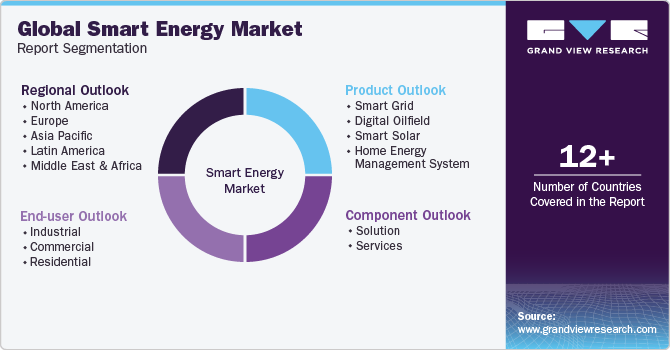
The report forecasts revenue growth at global, regional, and country levels and provides an analysis of the latest industry trends in each of the sub-segments from 2021 to 2033. For this study, Grand View Research has segmented the global smart energy market report based on product, component, end-user, and region:
 To learn more about this report, Download Free Sample Report
 -
Product Outlook (Revenue, USD Billion, 2021 - 2033)
-
Smart Grid
-
Digital Oilfield
-
Smart Solar
-
Home Energy Management System
-
-
Component Outlook (Revenue, USD Billion, 2021 - 2033)
-
Solution
-
Smart Meters
-
Data And Device Management
-
PV Monitoring
-
Smart Energy Storage
-
Others
-
-
Services
-
-
End-user Outlook (Revenue, USD Billion, 2021 - 2033)
-
Industrial
-
Commercial
-
Residential
-
-
Regional Outlook (Revenue, USD Billion, 2021 - 2033)
-
North America
-
U.S.
-
Canada
-
-
Europe
-
Germany
-
U.K.
-
France
-
-
Asia Pacific
-
China
-
Japan
-
India
-
South Korea
-
Australia
-
-
Latin America
-
Brazil
-
Mexico
-
-
Middle East and Africa (MEA)
-
Kingdom of Saudi Arabia
-
UAE
-
South Africa
-
-
Frequently Asked Questions About This Report
The global smart energy market size was valued at USD 199.9 billion in 2025 and is estimated at USD 219.1 billion for 2026.
The global smart energy market is expected to grow at a CAGR of 9.6% from 2026 to 2033, reaching USD 416.2 billion.
North America dominated with a 38.0% revenue share in 2025.
Key players include ABB; General Electric Company; Holley Technology Ltd.; Honeywell International Inc.; Iskraemeco Group; Itron Inc.; Landis+Gyr.; Schneider Electric; Sensus; Siemens
Solution dominated the smart energy market with a share of 74.0% in 2025.
About the Author(s)
Next Generation Technologies Research Team
Technology · Next Generation TechnologiesThis report was authored by the next generation technologies research team at Grand View Research - comprising two research analysts, one senior research analyst, and one industry expert - with specialized expertise in the next generation technologies segment of the technology industry. All findings are based on proprietary technology databases, executive interviews, and regulatory analysis, subject to internal peer review prior to publication.
Last Updated:
Speak to Analyst

Customize this report to your needs - add regions, segments, or data points, with 20% free customization.
Or view our licence options:


ISO 9001:2015 & 27001:2022 Certified
We are GDPR and CCPA compliant! Your transaction & personal information is safe and secure. For more details, please read our privacy policy.


