
- Home
- »
- Electronic Devices
- »
-
Smart Speakers Market Size And Share Report, 2026-2033GVR Report cover

Smart Speaker Market (2026 - 2033)
Size, Share & Trends Analysis Report By Component, By Connectivity, By Virtual Personal Assistant, By Distribution Channel, By Application, By End Use, By Region, And Segment Forecasts
Market Size, 2025
$15.8BMarket Estimate, 2026
$18.1BMarket Forecast, 2033
$48.6BCAGR, 2026–2033
15.1%Smart Speaker Market Summary
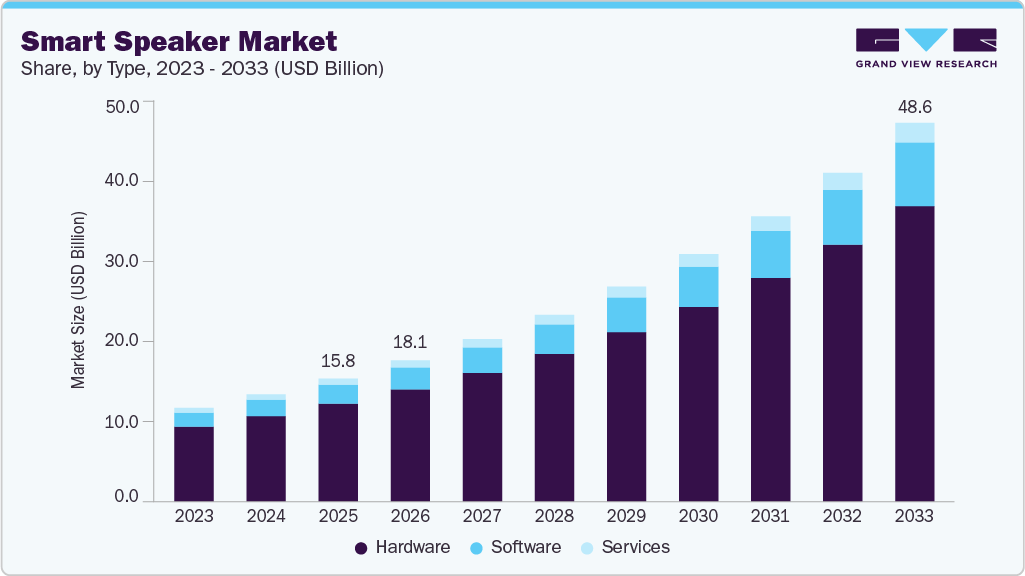
The global smart speaker market size was estimated at USD 15.8 billion in 2025 and is projected to grow from USD 18.1 billion in 2026 to USD 48.6 billion by 2033, at a CAGR of 15.1% from 2026 to 2033. North America held the largest revenue share of 38.2% of the global market in 2025. The smart speaker industry is experiencing strong global expansion, driven by the rapid adoption of voice-enabled technologies and connected home ecosystems.
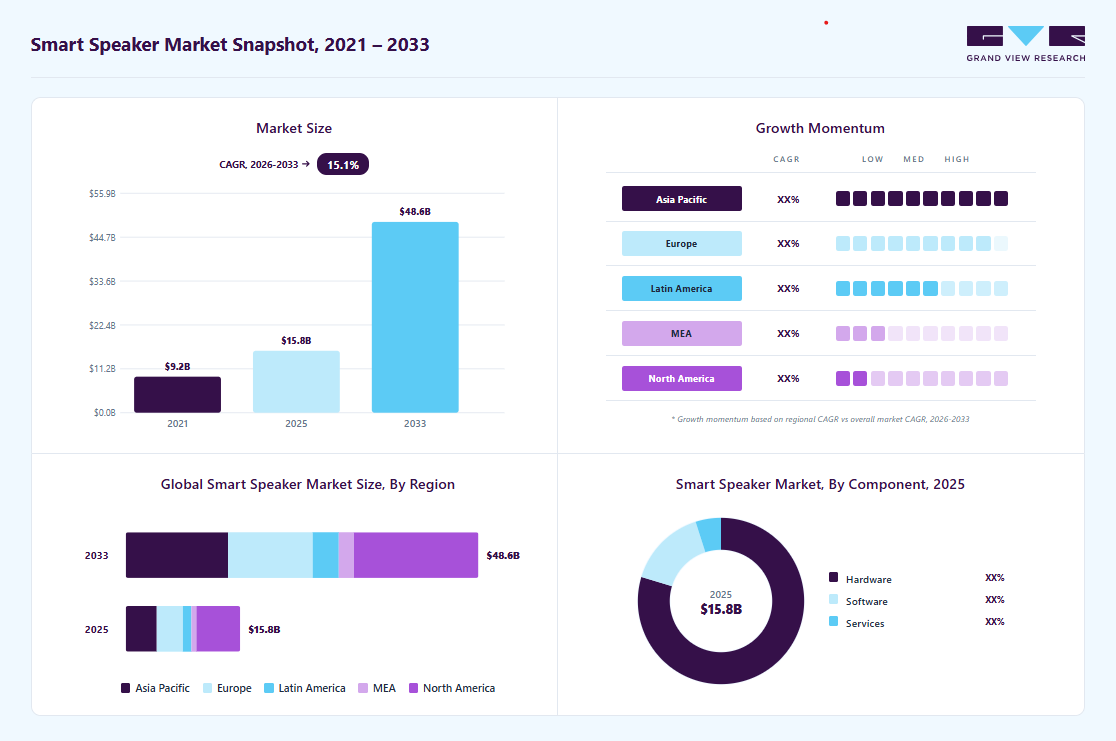 Source: Grand View Research, IR Documents, Primary Interviews, Paid DatabasesTo learn more about this report,
 Download Free Sample Report
 Key Market Trends & Insights
- By component: Hardware segment held the largest share of 79.6% in 2025.
- By connectivity: Wi-Fi segment held the largest share in 2025.
- By virtual personal assistant: Amazon Alexa held the largest share in 2025.
- By distribution channel: Online segment held the largest share in 2025.
- By application: Music & entertainment segment held the largest share in 2025.
Regional Highlights
- Largest regional market: North America (38.2% market share, 2025)
- Fastest-growing regional market: Asia Pacific (highest CAGR from 2026-2033)
- By Country: The U.S. held the largest market share in 2025.
Market Size & Forecast
- Market size in 2025: USD 15.8 Billion
- Market size in 2026: USD 18.1 Billion
- Projected market size by 2033: USD 48.6 Billion
- CAGR (2026-2033): 15.1%
Three ways to get this report
Buy it, customize it, or ask a question.Ask an Analyst
Analyst response in 1 business day
- AccessReport author, directly
- Reply timeWithin 1 working day
- No sales callDirect answer only
- FormatEmail reply
- CostFree, no cost
Get the Full Report
What the study covers
- FormatsPDF · Excel · Dashboard
- Timeline2026–2033 annual, 2025 base
- Coverage20+ countries, 5 regions
- Companies10+ key players profiled
Customize the Report
20% free customization
- IncludeCountries, segments, points
- TailorTo your product definition
- ExtendDeeper competitor detail
- OrA fully bespoke study
- Turnaround5–10 working days
Smart speakers, equipped with voice-enabled virtual assistants, allow users to perform a wide range of tasks such as playing music, controlling home appliances, accessing information, and managing daily routines through simple voice commands.
The smart speaker market has seen strong global penetration, particularly in North America, Europe, and Asia-Pacific, driven by rising internet connectivity and the proliferation of Internet of Things (IoT) devices. In particular, the smart home speaker industry has emerged as a major growth segment, driven by rising consumer demand for connected, automated living environments.
 To learn more about this report, Download Free Sample Report
 A key factor shaping the global industry is the deep integration of these devices within smart home ecosystems. Smart speakers serve as centralized hubs for connected devices such as lighting systems, thermostats, security cameras, and entertainment platforms, enabling seamless automation and greater user convenience. The global adoption of smart homes has significantly accelerated demand, with residential applications accounting for a dominant share of the global market. In markets such as the U.S. market, high household penetration and early technology adoption continue to reinforce strong demand, making it one of the most mature and influential regional markets.
In addition, advancements in connectivity technologies such as Wi-Fi, Bluetooth, and 5G have enhanced device performance, while improvements in natural language processing (NLP) and machine learning have made voice assistants more accurate, contextual, and user-friendly. This evolution is further expanding use cases beyond households into commercial environments such as hotels, healthcare facilities, and offices.
At the same time, manufacturers are increasingly focusing on enterprise-grade audio solutions to tap into commercial demand. This shift is encouraging innovation in networked, scalable, and energy-efficient smart speaker technologies. For instance, at ISE 2026 in February 2026 in Barcelona, Genelec showcased its Smart IP PoE loudspeaker portfolio, highlighting high-quality networked audio delivered via single-cable connectivity for commercial applications. The company also demonstrated immersive audio setups and advanced configuration software, reinforcing innovation, sustainability, and strong global partnerships within the global market. This development is expected to accelerate the adoption of networked audio solutions in the global industry. It will also strengthen demand for scalable, energy-efficient, and integrated smart speaker systems across commercial environments.
In conclusion, the smart speakers market is poised for sustained growth as it continues to evolve alongside advancements in AI, IoT, and voice technologies. While challenges such as data privacy concerns and intense competition among major technology providers persist, ongoing innovation and ecosystem expansion are expected to address them. The industry is gradually shifting from hardware-driven sales to software and service-based value creation, with increasing emphasis on personalization, automation, and cross-device integration. As adoption expands across both residential and commercial sectors, including the rapidly evolving smart home speaker market and the highly developed U.S. market, the industry is expected to play a central role in shaping the future of human-device interaction and the broader connected living environment.
Market Dynamics
The increasing adoption of smart home technologies and AI-powered voice assistants is significantly driving the growth of the smart speaker market. Consumers are using smart speakers for home automation, streaming entertainment, voice-based search, online shopping, and controlling connected devices, driving strong demand for intelligent, voice-enabled devices. The rapid expansion of IoT ecosystems, rising internet penetration, and growing consumer preference for hands-free and personalized digital experiences are further accelerating market growth.
For instance, in May 2026, Amazon expanded its AI-powered Alexa+ ecosystem by integrating with Bose smart speakers and soundbars, enabling users to access advanced conversational AI, music discovery, smart home management, and service booking directly through Bose devices. Amazon reported that customers were engaging with Alexa+ “twice as much” since launch, highlighting the increasing consumer adoption of AI-enabled voice assistants across connected home ecosystems. Moreover, the growing integration of generative AI, contextual voice recognition, and cross-device smart home connectivity is enhancing the role of smart speakers as centralized digital assistants within connected households. Therefore, the increasing demand for AI-driven smart home experiences and seamless voice interaction is significantly contributing to the growth of the smart speaker market.
Data privacy and cybersecurity concerns are among the major factors restraining the growth of the smart speaker market. Since smart speakers continuously process voice commands and collect user interaction data, consumers are increasingly concerned about unauthorized access to data, voice recording storage, third-party data sharing, and potential surveillance risks. These concerns have become more significant as AI-powered voice assistants gain deeper access to personal information, connected devices, and home automation systems.
For instance, several consumer advocacy groups and regulators across North America and Europe have raised concerns about the collection and processing of voice data by smart speaker providers, particularly regarding user consent, targeted advertising, and the cloud-based storage of sensitive conversations. Growing scrutiny under regulations such as GDPR and consumer privacy laws has also increased compliance pressure on device manufacturers and technology companies.
Additionally, risks associated with device hacking, unauthorized activation, and integration vulnerabilities within connected home ecosystems may discourage some consumers from adopting smart speaker devices. As a result, concerns regarding data privacy, cybersecurity, and consumer trust continue to hinder the broader adoption of smart speakers globally.
Market Concentration & Characteristics
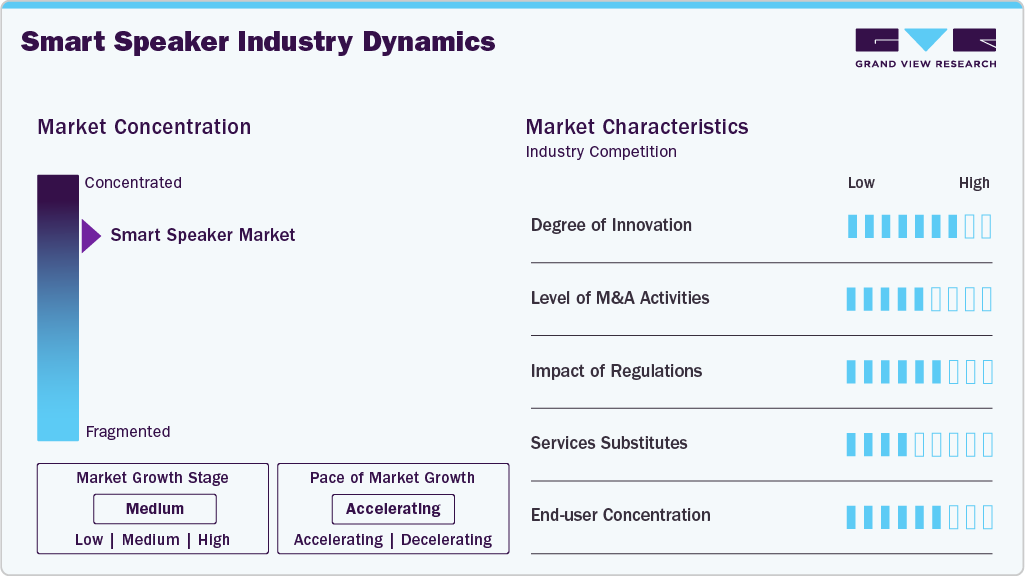
The smart speaker market is moderately concentrated, with a few major technology companies such as Amazon, Google, Apple, Alibaba, and Baidu accounting for a significant share of global revenues due to their strong ecosystem integration, AI assistant capabilities, and extensive distribution networks. However, the market also includes several regional consumer electronics brands and smart home device manufacturers offering affordable and localized smart speaker solutions, particularly in the Asia Pacific and emerging markets. Competition is largely driven by ecosystem compatibility, voice assistant performance, sound quality, pricing strategies, and smart home integration capabilities.
 To learn more about this report, Download Free Sample Report
 The market demonstrates a high degree of innovation, fueled by advancements in artificial intelligence (AI), natural language processing (NLP), generative AI, voice recognition, and IoT-enabled smart home ecosystems. Vendors are enhancing multilingual support, contextual voice interactions, home automation integration, and personalized AI assistant capabilities to improve user experience. The market is witnessing moderate merger, partnership, and ecosystem expansion activities, with technology companies collaborating with smart appliance manufacturers, streaming platforms, automotive companies, and IoT providers to strengthen connected device ecosystems. Regulatory impact is moderate, primarily affecting data privacy, voice data collection, cybersecurity, and consumer protection regulations, particularly in North America and Europe. Service substitutes include smartphones, smart displays, wearable assistants, and AI-enabled home automation hubs; however, smart speakers continue to maintain strong demand due to their convenience, hands-free operation, and central role in connected smart home environments. Additionally, the market exhibits moderate-to-high end-user concentration among urban households, tech-savvy consumers, and smart home adopters, particularly in developed economies with high internet penetration and high adoption of connected devices.
Component Insights
The hardware segment led the market with the largest revenue share of 79.6% in 2025, driven by continuous advancements in audio technology and far-field voice recognition, which enhance sound quality and allow devices to accurately capture commands even in noisy environments. In addition, the increasing consumer demand for compact, aesthetically designed, and energy-efficient devices has encouraged manufacturers in the global market to invest in innovative hardware configurations and premium materials. The integration of advanced chipsets supporting AI-based voice assistants and multi-device connectivity has further strengthened the value proposition of hardware components. As a result, the hardware segment remains a dominant and essential contributor to the overall market, supporting performance improvements, product differentiation, and sustained market expansion.
The software segment is anticipated to grow at the fastest CAGR during the forecast period. This segment primarily includes voice assistant platforms, operating systems, AI-driven analytics, and application integration frameworks that enhance the functionality and personalization capabilities of smart speakers. A key driver for this segment is the continuous advancement of artificial intelligence and natural language processing technologies, which have significantly improved voice accuracy, multilingual support, and contextual understanding—making smart speakers more intuitive and user-friendly. As competition intensifies among key players to deliver differentiated user experiences, ongoing innovation in software capabilities is expected to remain a central driver of growth, reinforcing the importance of this segment within the overall market.
Connectivity Insights
The Wi-Fi segment accounted for the largest market revenue share in 2025, as it enables seamless internet access, cloud-based processing, and integration with a wide range of smart home ecosystems. Wi-Fi connectivity enables smart speakers to deliver real-time voice recognition, stream high-quality audio, and support advanced features such as multi-room synchronization and over-the-air updates, making it essential for an enhanced user experience in the global landscape.
Therefore, the Wi-Fi segment continues to dominate the connectivity landscape, supporting sustained growth and innovation in the global market, especially the mature markets such as the U.S., as well as rapidly developing markets like the Japan and Mexico.
The hybrid (Wi-Fi + Bluetooth) segment is expected to grow at the fastest CAGR over the forecast period, driven by its ability to combine the strengths of both technologies to deliver enhanced user flexibility and seamless performance. Wi-Fi enables stable internet connectivity for cloud-based voice assistants, music streaming, and smart home integration, while Bluetooth provides quick, direct pairing with nearby devices without requiring network access. This dual functionality is particularly appealing in emerging markets and multi-device households, where users seek uninterrupted usage across different environments and connectivity conditions.
In sectors such as the smart home speaker industry and expanding ecosystems in the U.S., Japan, and Mexico, hybrid connectivity is gaining traction for its adaptability across varying levels of infrastructure maturity. As the industry continues to expand amid increasing adoption of connected devices and voice-enabled ecosystems, the hybrid connectivity segment is expected to witness sustained demand, driven by its ability to enhance convenience, reliability, and the overall user experience.
Virtual Personal Assistant Insights
The Amazon Alexa segment accounted for the largest market revenue share in 2025, driven by its strong ecosystem integration and widespread device compatibility. As the core voice assistant powering Amazon Echo devices, Alexa enables seamless control over smart home appliances, entertainment systems, and third-party applications, making it a preferred choice among consumers in the global market. In addition, the increasing demand for hands-free automation and connected living environments further supports the growth of this segment. In conclusion, the Amazon Alexa segment continues to play a pivotal role in shaping the global industry, supported by its robust ecosystem, continuous innovation, and expanding global user base within the industry.
The Google Assistant segment is expected to grow at the fastest CAGR over the forecast period, driven by strong integration with the broader Google ecosystem and widespread adoption across Android-based devices. Within the industry, the Google Assistant benefits from advanced natural language processing, multilingual support, and seamless connectivity with smart home devices, enabling users to control lighting, security systems, and entertainment platforms via voice commands. In conclusion, the Google Assistant segment is expected to maintain a strong position in the global market, supported by technological advancements, ecosystem expansion, and growing consumer preference for integrated, intelligent voice-enabled solutions.
Distribution Channel Insights
The online segment accounted for the largest market revenue share in 2025 and is projected to grow at the fastest CAGR during the forecast period, driven by the increasing consumer preference for convenient, contactless, and time-efficient purchasing options. E-commerce platforms enable customers to compare features, prices, and user reviews across multiple brands, significantly influencing buying decisions in the global market. In addition, the availability of exclusive online discounts, bundled offers, and easy return policies has further strengthened adoption in this segment, particularly among the younger generation and urban consumers. In the broader smart home speaker market, online channels play a crucial role in accelerating product penetration across developed and emerging economies, including the U.S., Japan, and Mexico, where digital retail ecosystems are highly influential. As a result, the online segment continues to gain traction and is expected to remain a dominant distribution channel, supporting the sustained expansion of the market globally.
The offline segment is expected to grow at a significant CAGR during the forecast period. Physical retail outlets such as electronics stores, supermarkets, and brand-exclusive showrooms allow customers to interact with devices, assess sound quality, and understand features through live demonstrations, thereby building trust and supporting purchase decisions. A key driving factor for this segment is the increasing emphasis by manufacturers on experiential retail strategies, including dedicated display zones and trained sales personnel who educate buyers about smart home integration and voice assistant capabilities. In regions such as the smart home speaker industry in the U.S., Japan, and Mexico, offline retail continues to play an important role in educating first-time users and driving adoption of premium products. Although online channels are expanding rapidly, the offline segment remains a steady contributor to the global market, driven by its ability to deliver personalized customer engagement and enhance consumer confidence in adopting smart technologies.
Application Insights
The music & entertainment segment accounted for the largest market revenue share in 2025, driven by the growing consumer preference for seamless, voice-controlled audio experiences. Smart speakers are widely used to stream music, podcasts, radio, and audiobooks via integrated platforms such as Spotify, Apple Music, and Amazon Music, enabling users to access personalized content with minimal effort. In addition, the increasing adoption of multi-room audio systems and high-quality sound technologies has further strengthened the role of smart speakers as central entertainment devices in modern households. In the broader smart home speaker market, this segment remains highly influential across developed and emerging regions, including the U.S., Japan, and Mexico markets, where audio streaming continues to be a primary use case driving adoption. As a result, the music and entertainment segment continues to significantly contribute to the market growth, with sustained innovation and content integration expected to drive long-term expansion in the global landscape.
 To learn more about this report, Download Free Sample Report
 The smart home control segment is projected to register at the fastest CAGR during the forecast period. Smart speakers are increasingly used as control hubs for a wide range of smart home devices, including lighting systems, thermostats, security cameras, and entertainment units, allowing users to manage multiple functions seamlessly through voice commands. A key driver of this segment is the rising consumer preference for convenience, automation, and energy efficiency, supported by advancements in AI-powered voice assistants and improved device interoperability. As smart home penetration continues to expand globally, particularly in urban households, the demand for integrated control solutions through smart speakers is accelerating. Consequently, the smart home control segment is expected to maintain its dominant position in the global market, reinforcing its role as a critical growth driver across the industry.
End Use Insights
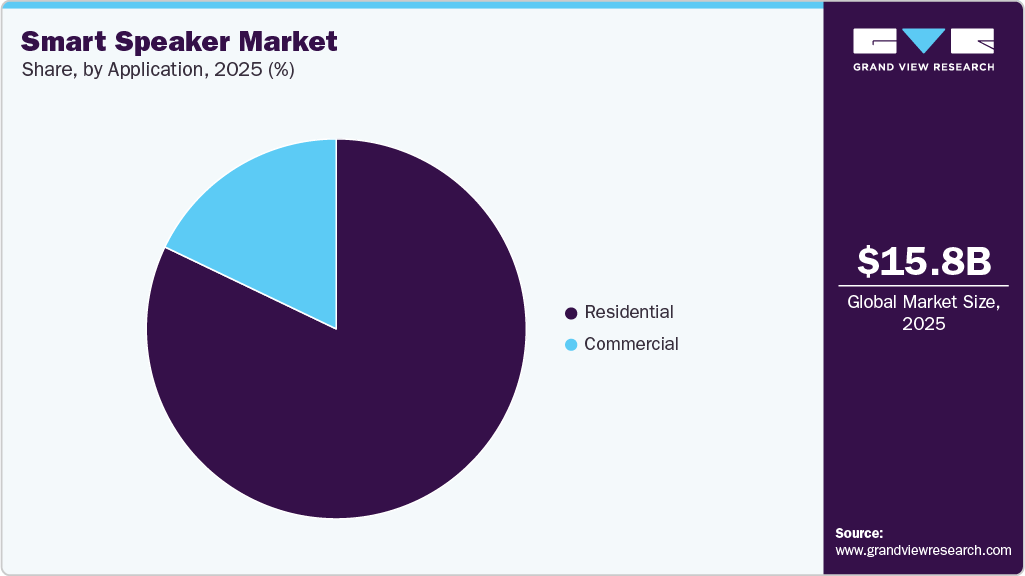
The residential segment accounted for the largest market revenue share in 2025, driven by the increasing adoption of smart home technologies and the growing preference for voice-enabled convenience among consumers. Smart speakers are widely used in households for tasks such as controlling lighting, managing home security systems, streaming music, setting reminders, and accessing real-time information, making them an integral part of daily routines. In conclusion, the residential segment is expected to continue leading the global market, supported by ongoing advancements in artificial intelligence, improved connectivity, and the growing shift toward fully automated, connected homes.
The commercial segment is projected to grow at the fastest CAGR from 2026 to 2033, driven by the increasing adoption of voice-enabled technologies across sectors such as hospitality, retail, healthcare, and corporate offices. Businesses are leveraging smart speakers to enhance customer engagement, streamline operations, and deliver personalized services. For instance, hotels are integrating voice assistants in guest rooms to control lighting, temperature, and service requests, thereby improving customer experience while reducing operational workload. As organizations continue to focus on efficiency, customer satisfaction, and smart infrastructure development, the commercial segment is expected to play an increasingly important role in shaping the industry as a whole.
Regional Insights
North America dominated the global smart speaker market with the largest revenue share of 38.2% in 2025, driven by strong consumer adoption of connected home technologies and the high penetration of digital ecosystems across the United States and Canada. The region benefits from early adoption of technology, widespread internet connectivity, and the presence of major technology providers that continually enhance voice assistant capabilities and device integration. The increasing demand for convenience-driven lifestyles, coupled with the growing adoption of smart home automation systems, has significantly accelerated the deployment of smart speakers across residential and commercial applications.
 To learn more about this report, Download Free Sample Report
 U.S. Smart Speaker Market Trends
The smart speaker market in the U.S. accounted for the largest revenue share in North America in 2025, driven by high consumer adoption of voice-assisted technologies, strong penetration of smart home ecosystems, and the presence of leading technology providers that are continuously innovating in artificial intelligence and natural language processing. The region benefits from a digitally mature consumer base with widespread use of connected devices, with smart speakers increasingly central control hubs for home automation, entertainment, and information access.
Europe Smart Speaker Market Trends
The smart speaker industry in Europe is anticipated to register a considerable CAGR from 2026 to 2033, driven by increasing consumer adoption of connected home ecosystems and rising demand for voice-enabled convenience across households and commercial spaces. Strong penetration of broadband infrastructure, coupled with high smartphone usage and growing familiarity with AI-based virtual assistants, is significantly accelerating the adoption of smart speakers across key countries such as the UK, Germany, France, and the Nordics. Overall, the European market is expected to continue its growth trajectory, supported by evolving consumer lifestyles, digital transformation trends, and expanding smart home ecosystems, thereby strengthening the broader smart speakers industry in the region.
The UK smart speaker market is expected to grow significantly during the forecast period, driven by high consumer adoption of smart home ecosystems, strong digital connectivity, and increasing preference for voice-enabled convenience in daily activities. The widespread penetration of broadband and smartphones across the country has significantly accelerated the integration of smart speakers into households, with applications extending from entertainment and information access to home automation and energy management. In particular, the growing trend of connected living, supported by rising demand for hands-free control of appliances and services, is strengthening the position of the smart speaker industry in the UK.
The smart speaker market in Germany accounted for a substantial share of the European market in 2025, supported by growing consumer adoption of connected home technologies and rising demand for voice-enabled digital assistance in households and commercial spaces. The region’s strong digital infrastructure, high internet penetration, and growing preference for smart home ecosystems are key factors driving the expansion of the smart speakers industry in Germany. In addition, the integration of advanced AI-based voice assistants and compatibility with multiple IoT-enabled devices are further enhancing product utility and user experience. Overall, the German market is expected to continue its upward trajectory, driven by technological innovation, expanding smart home penetration, and strong consumer inclination toward seamless digital connectivity, thereby reinforcing the long-term growth prospects of the smart speaker industry in the region.
Asia Pacific Smart Speaker Market Trends
The smart speaker market in the Asia Pacific is anticipated to grow at the fastest CAGR during the forecast period, driven by rapid digital transformation, rising disposable incomes, and increasing adoption of connected home technologies across both developed and emerging economies in the region. Countries such as China, India, Japan, and South Korea are playing a pivotal role in shaping demand, supported by strong internet penetration, growing smartphone usage, and the proliferation of affordable IoT-enabled devices. In particular, the integration of voice assistants in regional languages and the localization of content have significantly enhanced user engagement, making smart speakers more accessible to a broader consumer base.
The Japan smart speaker market is expected to grow significantly during the forecast period, driven by increasing adoption of connected home ecosystems and rising consumer preference for voice-enabled convenience across daily activities. In the regional context, Japan’s rapidly aging population is a key driver of demand, as smart speakers offer hands-free assistance with tasks such as communication, reminders, entertainment, and smart home control, thereby improving the quality of life for elderly users.
The smart speaker market in China accounted for a substantial share of Asia Pacific revenue in 2025, driven by rapid digitalization, high smartphone penetration, and the strong integration of artificial intelligence across consumer electronics. The presence of leading domestic technology companies such as Alibaba Group, Baidu, and Xiaomi has significantly strengthened the ecosystem, enabling smart speakers to serve as central hubs for smart home control, entertainment, and voice-assisted services in Mandarin and regional dialects.
Key Smart Speaker Company Insights
Key players operating in the smart speaker industry are Amazon.com, Inc., Google LLC, Apple, Inc., Xiaomi Corporation, Samsung Electronics, Baidu, Inc., Alibaba Group, HARMAN International, Bose Corporation, and Sony Corporation. The companies are focusing on various strategic initiatives, including new product development, partnerships & collaborations, and agreements to gain a competitive advantage over their rivals.
Key Smart Speaker Companies:
The following key companies have been profiled for this study on the smart speaker market.
- Alibaba Group
- Amazon.com, Inc.
- Apple, Inc.
- Baidu, Inc
- Bose Corporation
- Google LLC
- HARMAN International
- Lenovo Group Limited
- LG Electronics
- Panasonic Holdings Corporation
- Samsung Electronics
- Sonos, Inc.
- Sony Corporation
- Ultimate Ears
- Xiaomi
Competitive Benchmarking
Operating Strategies
Competitive Edge
Weakness
Mature Players: Amazon.com, Inc.; Google LLC; Apple, Inc.; Alibaba Group; Baidu, Inc.; Xiaomi; Samsung Electronics; Sony Corporation; LG Electronics; Panasonic Holdings Corporation
- Moving from free voice assistants to advanced, paid generative AI-driven assistant models to monetize the ambient home computing space.
- Flooding the entry-level market with subsidized, low-cost puck speakers to capture massive household footprints and drive downstream e-commerce or cloud subscription sales.
- Direct ownership over the underlying Virtual Personal Assistants and LLM infrastructures, ensuring the fastest, lowest-latency context processing.
- Deep interoperability protocols anchored to their platforms, making their speakers the necessary central control hubs for thousands of smart lightbulbs, plugs, and security systems.
- Standard entry-level models frequently sacrifice premium audio hardware quality to keep retail prices low and focus on voice processing.
- Continuous data collection practices spark persistent user anxiety over microphones "always listening" and potential intrusive advertising monetization models.
Emerging Players: Sonos, Inc.; Bose Corporation; HARMAN International (JBL); Lenovo Group Limited; Ultimate Ears
- Building hardware that supports multiple competing voice assistants rather than locking users into a single closed ecosystem.
- Shifting focus from basic desktop speakers to integrated smart audio, such as high-end in-ceiling speaker collaborations, smart soundbars, and high-resolution spatial audio arrays.
- Decades of specialized engineering authority in sound staging, active room tuning, and high-fidelity component manufacturing that generic technology platforms cannot easily replicate.
- Deeply rooted consumer loyalty among audiophiles and premium buyers who are willing to pay significant price premiums exclusively for superior acoustic performance.
- Lacking proprietary state-of-the-art AI brains means they must constantly rely on third-party APIs from Google or Amazon, leaving their core smart features vulnerable to competitor platform updates or licensing shifts.
- Premium-only pricing strategies effectively lock them out of the high-volume, mass-market adoption cycles enjoyed by subsidized lower-tier competitors.
Recent Development
-
In December 2025, LG Electronics expanded its xboom by will.i.am smart speaker lineup with AI-powered personalization, adaptive sound tuning, and lifestyle-focused portable designs. The range includes models for parties, outdoor use, and everyday listening, featuring enhanced connectivity, battery life, and immersive audio experiences for diverse user environments. This development will strengthen demand for AI-enabled portable smart speakers and drive greater product differentiation in the global market.
-
In October 2025, Amazon introduced next-generation Echo devices powered by Alexa+ with advanced AI processing, Omnisense sensors, and custom silicon chips. The lineup enhances voice interaction, ambient intelligence, and premium audio performance across smart speakers and displays, improving personalization and smart home integration in the global market. This launch is expected to intensify competition and accelerate innovation in AI-enabled smart speakers globally.
-
In October 2025, Google introduced Gemini-powered Google Home devices, including a new smart speaker and Nest Cams with advanced AI capabilities. The lineup features improved voice assistance, 2K video monitoring, intelligent alerts, and contextual search, enhancing smart home integration and user experience across connected devices. This launch is expected to significantly advance AI-driven smart speaker ecosystems and strengthen demand for integrated smart home solutions in the global market.
Smart Speaker Market Report Scope
Report Attribute
Details
Market size value in 2025
USD 15.8 billion
Estimated Market size in 2026
USD 18.1 billion
Projected Market size by 2033
USD 48.6 billion
Growth rate
CAGR of 15.1% from 2026 to 2033
Base year for estimation
2025
Historical data
2021 - 2024
Forecast period
2026 - 2033
Quantitative units
Revenue in USD million/billion, and CAGR from 2026 to 2033
Report distribution channel
Revenue forecast, company share, competitive landscape, growth factors, and trends
Segments covered
Component, connectivity, virtual personal assistant, distribution channel, application, end use, region
Regional scope
North America; Europe; Asia Pacific; Latin America; MEA
Country scope
U.S.; Canada; Mexico; UK; Germany; France; China; India; Japan; Australia; South Korea; Brazil; UAE; Saudi Arabia; South Africa
Key companies profiled
Apple, Inc.; Alibaba Group; Amazon.com, Inc.; Baidu, Inc.; Bose Corporation; Google LLC; HARMAN International; Sonos, Inc.; Lenovo Group Limited; LG Electronics; Panasonic Holdings Corporation; Samsung Electronics; Sony Corporation; Ultimate Ears; Xiaomi
Customization scope
Free report customization (equivalent to 8 analysts working days) with purchase. Addition or alteration to country, regional & segment scope.
Pricing and purchase options
Avail customized purchase options to meet your exact research needs. Explore purchase options
Global Smart Speaker Market Report Segmentation
This report forecasts revenue growth at the global, regional, and country levels and provides an analysis of the latest industry trends across sub-segments from 2021 to 2033. For this study, Grand View Research has segmented the global smart speaker market report based on component, connectivity, virtual personal assistant, distribution channel, application, end use, and region:
-
Component Outlook (Revenue, USD Billion, 2021 - 2033)
-
Hardware
-
Software
-
Services
-
-
Connectivity Outlook (Revenue, USD Billion, 2021 - 2033)
-
Wi-Fi
-
Bluetooth
-
Hybrid (Wi-Fi + Bluetooth)
-
Others
-
-
Virtual Personal Assistant Outlook (Revenue, USD Billion, 2021 - 2033)
-
Amazon Alexa
-
Google Assistant
-
Apple Siri
-
Others
-
-
Distribution Channel Outlook (Revenue, USD Billion, 2021 - 2033)
-
Online
-
Offline
-
-
Application Outlook (Revenue, USD Billion, 2021 - 2033)
-
Smart Home Control
-
Music & Entertainment
-
Information Retrieval
-
Communication (Calls & Messaging)
-
Others
-
-
End Use Outlook (Revenue, USD Billion, 2021 - 2033)
-
Residential
-
Commercial
-
-
Regional Outlook (Revenue, USD Billion, 2021 - 2033)
-
North America
-
U.S.
-
Canada
-
Mexico
-
-
Europe
-
UK
-
Germany
-
France
-
-
Asia Pacific
-
China
-
India
-
Japan
-
South Korea
-
Australia
-
-
Latin America
-
Brazil
-
-
Middle East & Africa
-
UAE
-
Saudi Arabia
-
South Africa
-
-
Delivered Customizations
This report has been delivered with the following In-depth customizations
Client Request
Customization Delivered
Value Adds
Consumer voice interaction behavior analysis for a smart speaker manufacturer
- Analysis of user engagement trends for music streaming, home automation, shopping, and AI-based conversational interactions
- Evaluation of multilingual voice assistant adoption patterns across age groups and households
- Identified high-engagement consumer use cases driving device usage
- Supported AI assistant feature prioritization and user experience enhancement
Smart speaker ecosystem partnership assessment for a consumer electronics company
- Evaluation of strategic partnerships between smart speaker vendors, streaming platforms, and smart appliance manufacturers
- Analysis of interoperability trends across connected home ecosystems
- Highlighted ecosystem expansion and collaboration opportunities
- Supported partnership and ecosystem integration strategy
Premium vs budget smart speaker positioning analysis across the Asia Pacific
- Comparative analysis of pricing, audio quality, AI capabilities, and brand positioning across premium and entry-level devices
- Assessment of consumer preferences in India, China, Japan, and Southeast Asia
- Identified pricing gaps and regional positioning opportunities
- Supported product portfolio and localization strategy
Frequently Asked Questions About This Report
The key players operating in the smart speakers market include Apple, Inc., Amazon.com, Inc., Bose Corporation, Baidu, Inc., Google LLC, HARMAN International, Sonos, Inc., ULTIMATE EARS, SONY Corporation, Panasonic Holdings Corporation, and Xiaomi.
Increasing the adoption of smart home technology and the presence of smart home devices enables people to shift their preferences toward smart speakers. The capability of these products to operate using voice commands is driving their adoption.
Asia Pacific is the fastest-growing region over the forecast period.
Hardware segment led with 79.6% share in 2025, while software segment is expected to grow fastest.
Wi-Fi segment dominated in 2025, while hybrid (Wi-Fi + Bluetooth) segment is expected to grow fastest.
The global smart speaker market size was estimated at USD 15.8 billion in 2025 and is expected to reach USD 18.1 billion in 2026.
The global smart speaker market is expected to grow at a compound annual growth rate of 15.1% from 2026 to 2033 to reach USD 48.6 billion by 2033.
North America dominated the smart speaker market with a share of 38.2% in 2025. This is attributable to the growing demand for Internet-of-Things (IoT)-enabled services and wireless devices. The increasing consumer inclination toward convenience goods in North America has fueled the region’s growth.
Amazon Alexa held the largest share in 2025, while Google Assistant segment is expected to grow fastest.
About the Author(s)
Electronic Devices Research Team
Semiconductors & Electronics · Electronic DevicesThis report was authored by the electronic devices research team at Grand View Research - comprising two research analysts, one senior research analyst, and one industry expert - with specialized expertise in the electronic devices segment of the semiconductors & electronics industry. All findings are based on proprietary semiconductors & electronics databases, executive interviews, and regulatory analysis, subject to internal peer review prior to publication.
Last Updated:
Speak to Analyst

Customize this report to your needs - add regions, segments, or data points, with 20% free customization.
Or view our licence options:


ISO 9001:2015 & 27001:2022 Certified
We are GDPR and CCPA compliant! Your transaction & personal information is safe and secure. For more details, please read our privacy policy.


