
- Home
- »
- Electronic & Electrical
- »
-
Smart Sports Equipment Market Size Report, 2026-2033GVR Report cover

Smart Sports Equipment Market (2026 - 2033)
Size, Share & Trends Analysis Report By Product (Balls, Golf Stick, Hockey Stick, Rackets & Bats, Others), By Distribution Channel (Franchise Stores, Specialty Stores, Online), By Region, And Segment Forecasts
Market Size, 2025
$3.4BMarket Estimate, 2026
$3.8BMarket Forecast, 2033
$8.0BCAGR, 2026–2033
11.4%Smart Sports Equipment Market Summary
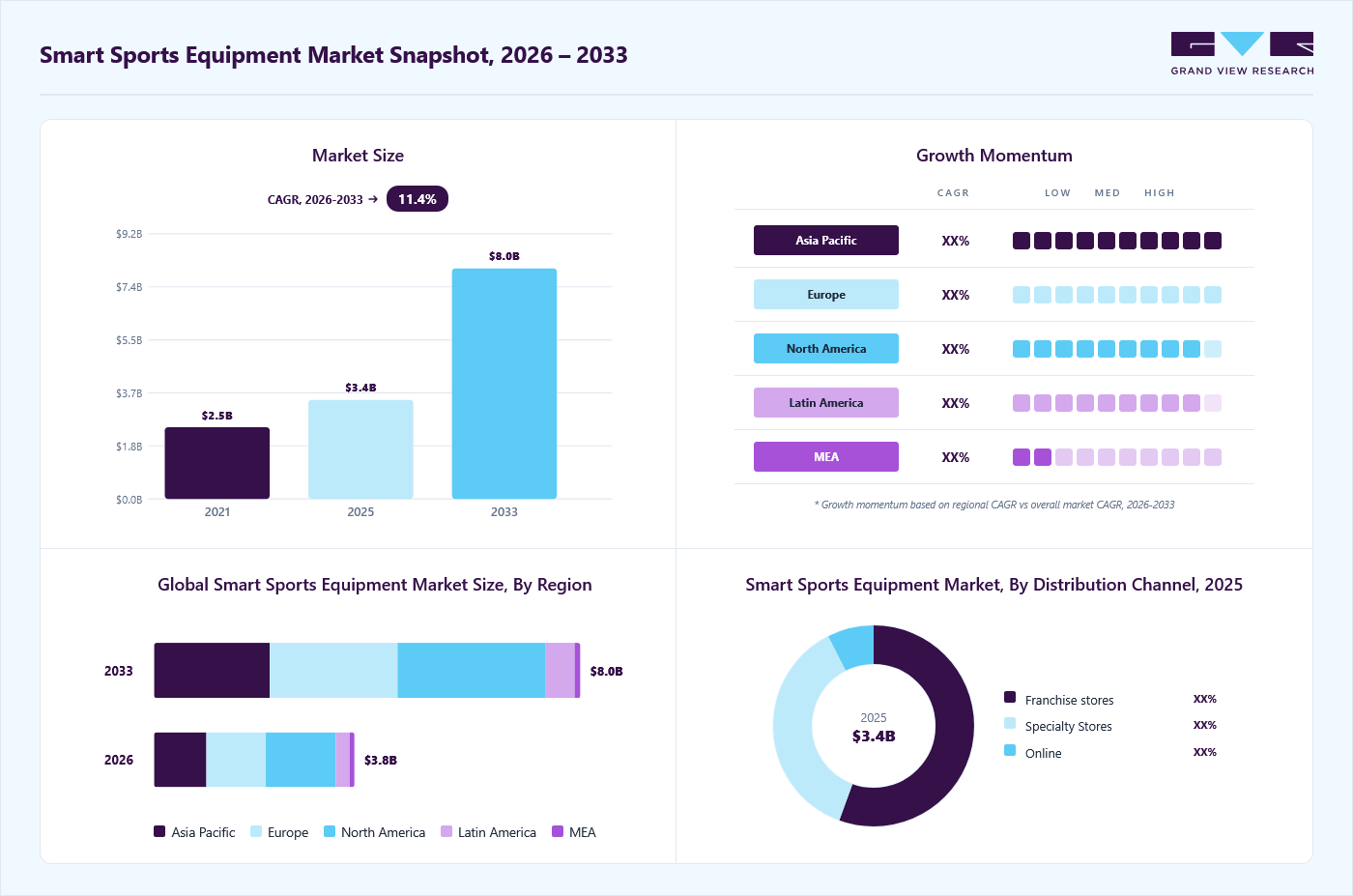
The global smart sports equipment market size was valued at USD 3.4 billion in 2025 and is projected to grow from USD 3.8 billion in 2026 to USD 8.0 billion by 2033, at a CAGR of 11.4% from 2026 to 2033. North America dominated the global market with the largest revenue share of 34.9% in 2025. The increasing adoption of Internet of Things (IoT) technology in sports is a major driver.
 Source: Grand View Research, IR Documents, Primary Interviews, Paid DatabasesTo learn more about this report,
 Download Free Sample Report
Key Market Trends & Insights
- By product: Golf stick segment led the market with the largest revenue share of 29.8% in 2025.
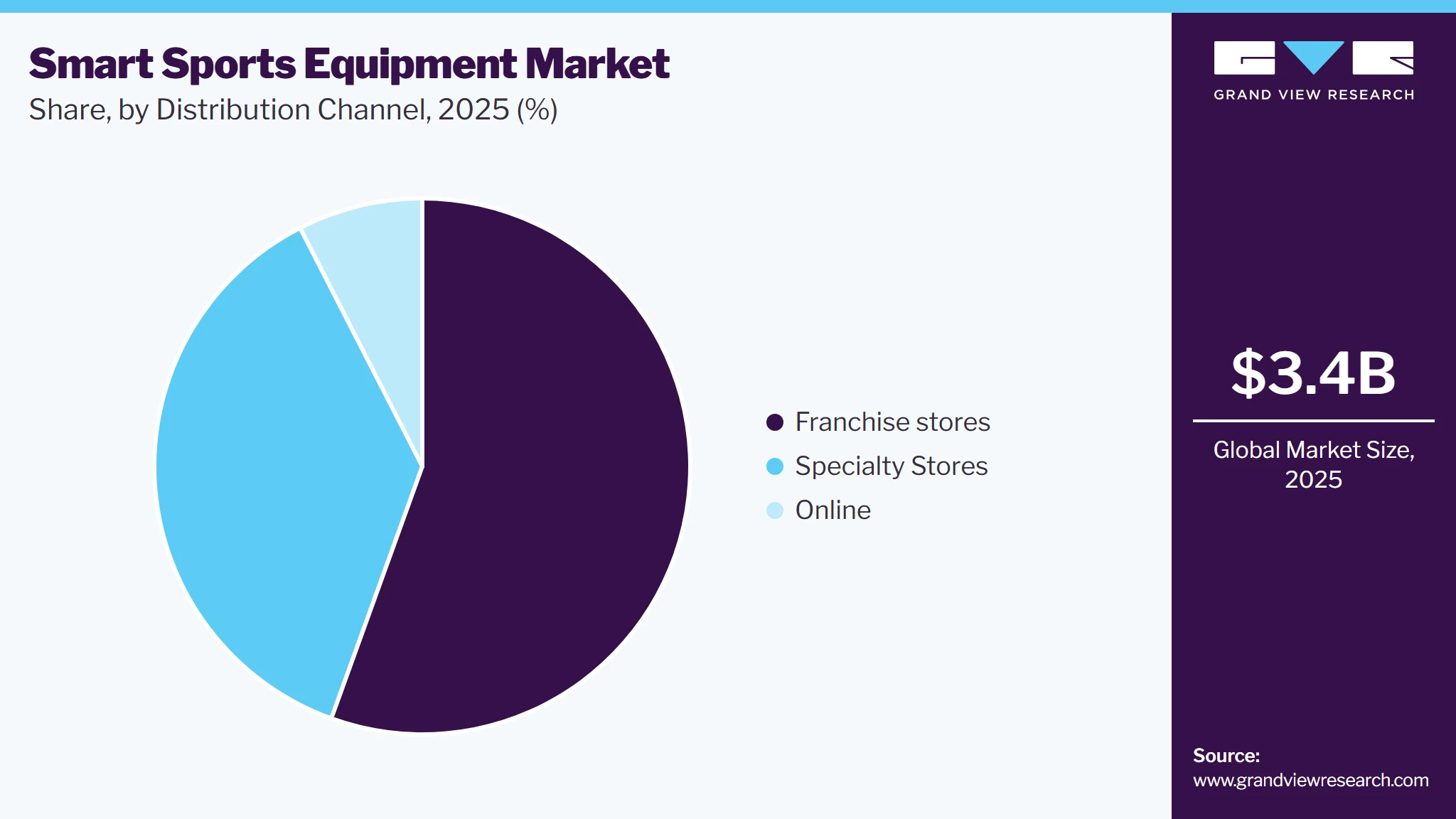
- By distribution channel: Franchise stores segment led the market with the largest revenue share of 55.5% in 2025.
Regional Highlights
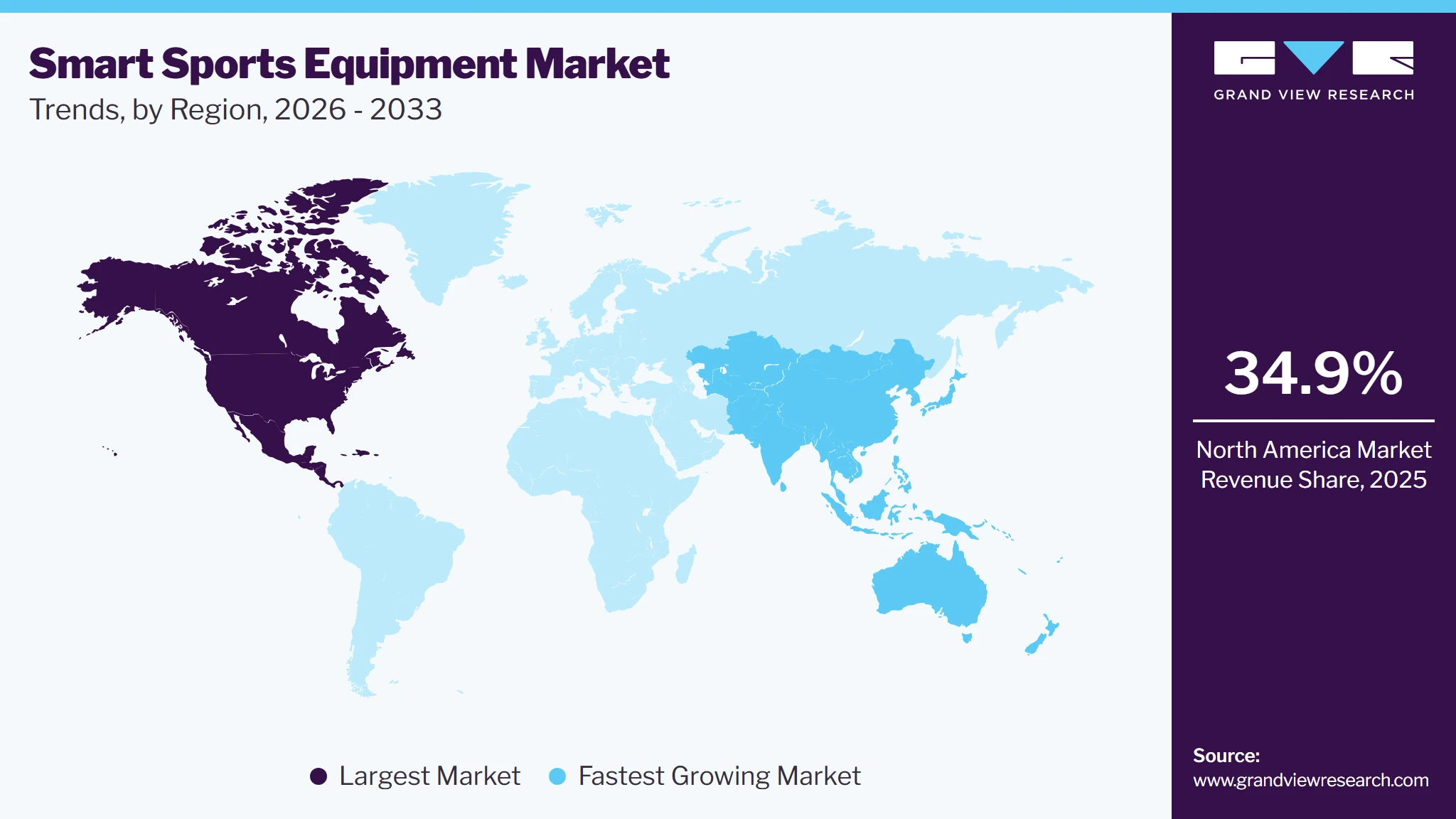
- Largest regional market: North America (34.9% revenue share, 2025)
- Fastest-growing regional market: Asia Pacific (highest CAGR, 2026-2033)
- By country: The smart sports equipment market in the U.S. held the largest share in the North America region in 2025.
Market Size & Forecast
- Market size in 2025: USD 3.4 Billion
- Estimated market size in 2026: USD 3.8 Billion
- Projected market size by 2033: USD 8.0 Billion
- CAGR (2026-2033): 11.4%
Three ways to get this report
Buy it, customize it, or ask a question.Ask an Analyst
Analyst response in 1 business day
- AccessReport author, directly
- Reply timeWithin 1 working day
- No sales callDirect answer only
- FormatEmail reply
- CostFree, no cost
Get the Full Report
What the study covers
- FormatsPDF · Excel · Dashboard
- Timeline2026–2033 annual, 2025 base
- Coverage20+ countries, 5 regions
- Companies10+ key players profiled
Customize the Report
20% free customization
- IncludeCountries, segments, points
- TailorTo your product definition
- ExtendDeeper competitor detail
- OrA fully bespoke study
- Turnaround5–10 working days
For instance, smart sports equipment such as sensor-embedded balls and helmets allow athletes to monitor their performance in real time, providing valuable data on metrics such as heart rate and movement patterns. This helps in enhancing both safety and performance.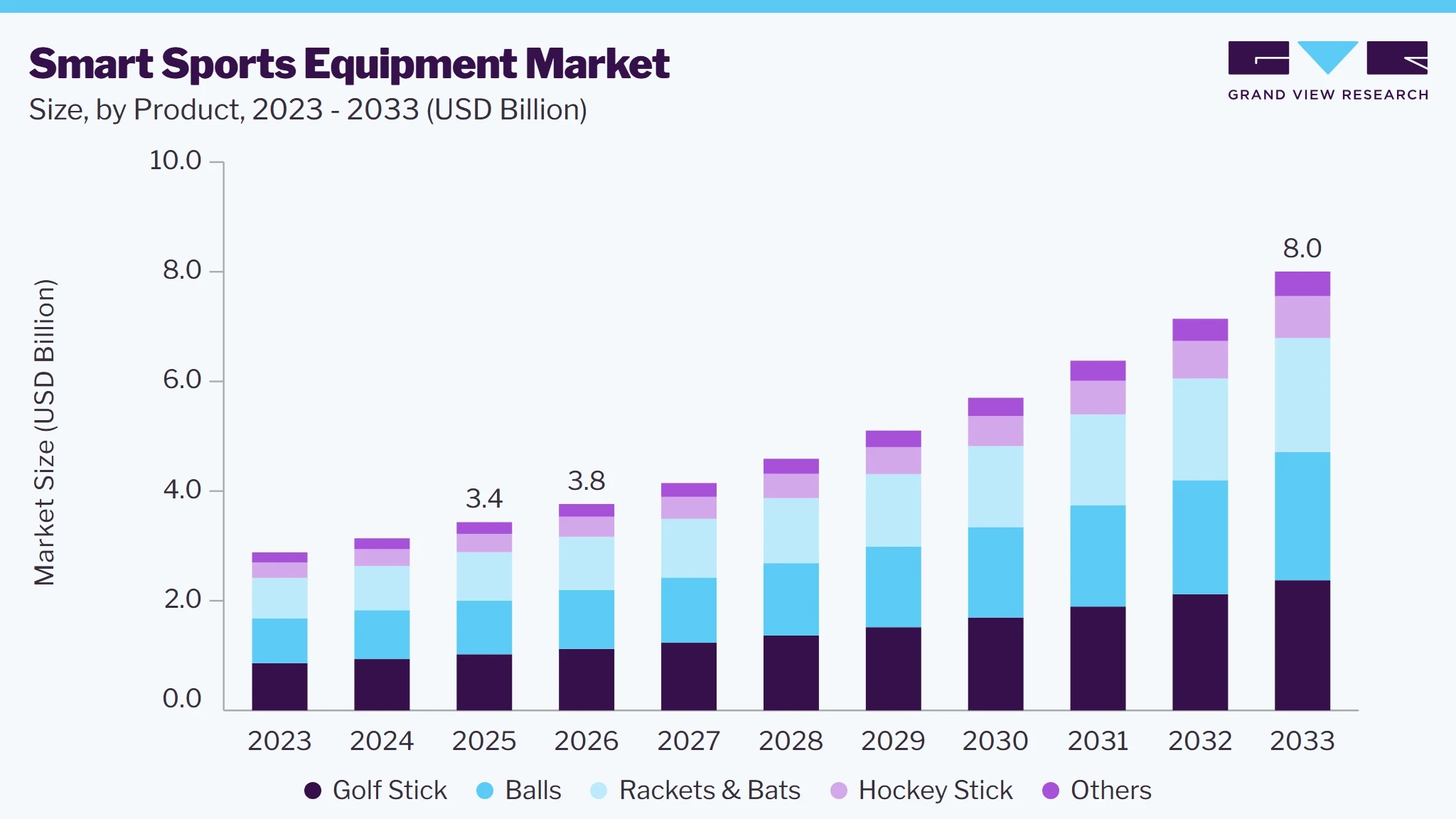 To learn more about this report, Download Free Sample Report
The rising demand for fitness and athletic performance monitoring devices is boosting market growth. With more people becoming health-conscious, there is a growing interest in devices that can track and analyze fitness metrics. For example, smart fitness trackers and wearable devices are becoming increasingly popular among consumers who want to monitor their exercise routines and health metrics more effectively. In January 2025, in celebration of the 10th anniversary of the PlayStation brand's launch in China, Sony introduced a limited edition PlayStation-themed fitness tracker, customized from the Xiaomi Smart Band 9 Pro. This special edition device features PlayStation colors and includes a blue strap adorned with the iconic PlayStation symbols-cross, triangle, square, and circle-alongside the PS logo. The package contains the fitness tracker, a charging cable, and a commemorative card.
Market Dynamics
The smart sports equipment market is gaining traction as athletes, fitness enthusiasts, and recreational players increasingly adopt connected sports technologies to enhance performance, training efficiency, and gameplay experiences. Smart sports equipment, such as balls, golf sticks, hockey sticks, rackets, and bats, incorporates advanced sensors, connectivity features, and real-time performance-tracking capabilities, enabling users to monitor accuracy, speed, swing mechanics, impact force, and overall skill development. The growing emphasis on data-driven training, rising participation in sports and fitness activities, and increasing demand for personalized coaching solutions across amateur and professional sports segments are expected to continue driving growth in the smart sports equipment market.
The increasing adoption of data-driven coaching methodologies across sports academies, training centers, and professional sports organizations is driving demand for smart sports equipment. Products such as smart balls, golf sticks, hockey sticks, rackets, and bats provide detailed performance metrics that help coaches assess player techniques, identify areas for improvement, and create personalized training programs. The growing focus on enhancing athletic performance, improving training efficiency, and reducing performance inconsistencies is encouraging educational institutions and sports organizations to invest in technologically advanced equipment, thereby supporting market growth.
The relatively high cost of smart sports equipment compared to traditional sporting goods is a key factor restraining market growth. The incorporation of sensors, wireless connectivity, embedded electronics, and analytics software increases manufacturing costs and retail prices, making these products less accessible to casual players and cost-sensitive consumers. Additionally, expenses associated with software subscriptions, maintenance, and device compatibility can further discourage adoption. As a result, price-sensitive customers and sports institutions with limited budgets often continue to rely on conventional equipment, limiting market penetration.
The growing emphasis on youth sports development and grassroots participation presents significant opportunities for the smart sports equipment market. Governments, schools, and sports associations are increasingly promoting organized sports activities to encourage physical fitness and identify emerging talent at an early stage. Smart sports equipment can enhance training experiences by providing real-time feedback, performance insights, and interactive learning capabilities for young athletes. As sports development initiatives expand globally and digital technologies become increasingly integrated into training programs, manufacturers have substantial opportunities to introduce affordable, youth-focused smart sporting solutions.
Analyst Perspective
The smart sports equipment market is benefiting from a structural shift in sports training and athlete development, as data-driven performance optimization increasingly becomes a core component of both professional and recreational sports. Demand is being reinforced by the growing adoption of connected training ecosystems, sports analytics platforms, virtual coaching solutions, and technology-enabled sports academies, while advances in sensors, artificial intelligence, and real-time tracking technologies are enhancing product functionality and user engagement. The defining competitive advantage will belong to manufacturers that seamlessly integrate hardware, software, and performance analytics into comprehensive training solutions, transforming sports equipment from standalone products into connected performance ecosystems that capture a larger share of athlete training and development spending.
Product Insights
Based on product, the golf stick segment led the market with the largest revenue share of 29.8% in 2025. The segment's growth is attributed to the integration of advanced technology in golf sticks, which enhances player performance and provides an improved user experience. For instance, smart golf sticks equipped with sensors can track swing speed, angle, and distance, offering players real-time feedback and data analysis to refine their techniques. Another important factor is the rising popularity of golf as a leisure and professional sport. For instance, Mid-2024 witnessed U.S. recreational golf rounds 2% above 2023 levels, maintaining historically high demand. According to the National Golf Foundation (NGF), the industry is experiencing a 'new normal' in terms of play. In addition, as more people take up golf, there is a growing demand for innovative equipment to improve their game. The appeal of smart golf sticks lies in their ability to provide a more immersive and data-driven golfing experience, attracting both amateur and professional players.
The balls segment is expected to grow at the highest CAGR over the forecast period. The integration of smart technology into sports balls, such as basketballs, soccer balls, and tennis balls, is enhancing the user experience. These smart balls have sensors that can track various metrics, including speed, spin, trajectory, and impact force. For example, smart soccer balls can provide real-time feedback on a player's kicks, helping them improve their techniques and overall performance. Furthermore, several key players are adopting strategies to remain competitive. For instance, in October 2024, Russell Brands, LLC ("Spalding") announced a new partnership with SportIQ (SIQ) Basketball, the creator of the world's first official size and weight smart basketball. This collaboration integrates SIQ's patented technology and mobile application with Spalding's existing and upcoming basketballs, providing a data-driven, gamified experience. Athletes will gain real-time access to shooting metrics through the application, which tracks key performance indicators such as shooting percentage and release speed.
Distribution Channel Insights
Based on distribution channel, the franchise stores segment led the market with the largest revenue share of 55.5% in 2025. Franchise stores usually provide comprehensive customer support, including product demonstrations, after-sales service, and guarantee management. This high level of customer care enhances the overall buying experience and builds long-term customer loyalty. Franchise stores often have extensive networks, ensuring that smart sports equipment is readily available in various locations. This widespread presence makes it convenient for customers to find and purchase the latest smart sports equipment. For instance, in October 2024, Form's award-winning Smart Swim 2 augmented reality goggles available at 20 Apple Store locations and online at Apple.com in the U.S., Canada, and the U.K. The goggles feature integrated heart rate monitoring and a digital compass, enhancing the swimming experience for users.
 To learn more about this report, Download Free Sample Report
The specialty stores segment is expected to grow at the highest CAGR over the forecast period owing to increasing focus on niche, high-tech products that cater to specific athletic needs. These stores provide expert advice and support, enhancing the shopping experience for consumers seeking personalized fitness solutions. The growing demand for advanced sports gear, particularly among younger consumers, further boosts the popularity of specialty stores. This segment is poised for rapid growth due to its adaptability to new technologies and consumer preferences.
Regional Insights
North America dominated the smart sports equipment market with the largest revenue share of 34.9% in 2025. North America has a highly developed sports culture that strongly focuses on fitness and health. This has led to a higher adoption rate of smart sports equipment among both amateur and professional athletes. Additionally, the region benefits from advanced technological infrastructure, facilitating the integration of smart technologies into sports equipment. The presence of major market players and the continuous innovation in product offerings further strengthen North America's position in the market. For instance, in December 2024, Spalding and the Pro Volleyball Federation extended their partnership, with Spalding continuing as the Official Volleyball Net Equipment Supplier through 2027. The collaboration, established in 2024, has been pivotal in enhancing player and fan experiences with Spalding's innovative Freestanding Volleyball Systems. Spalding's commitment to fostering innovation and supporting the sport's growth remains strong. CEO Jen Spicher and Sr. Product Marketing Manager Lisa M Ebersole express enthusiasm for continued collaboration as the league anticipates another successful season starting January 2025.
 To learn more about this report, Download Free Sample Report
U.S. Smart Sports Equipment Market Trends
The smart sports equipment market in the U.S. held the largest share in the North America region in 2025. This dominance is attributed to factors such as advanced technological infrastructure, high consumer awareness and demand for innovative fitness solutions, and the presence of leading market players who continually drive product innovation. The country's strong sports culture and emphasis on health and wellness further support the industry's growth, making the U.S. a key player in the global smart sports equipment market. In 2023, an impressive 242 million individuals in the U.S.-almost 80% of the population aged six and older-engaged in at least one sports or fitness activity. This marks a notable 2.2% increase compared to 2022, establishing a new record for participation in a single year. Furthermore, the trend indicates that the number of Americans involved in fitness activities has consistently risen annually for the last decade, highlighting a growth of 5 million participants in just the past year.
Europe Smart Sports Equipment Market Trends
Europe smart sports equipment industry held a considerable share in 2024. The region's strong technological infrastructure supports the integration of smart technologies into sports equipment. Europe is home to many leading manufacturers and innovative startups, fostering a competitive market that drives continuous product development. For instance, in August 2024, Xiaomi officially announced the European release of the Smart Band 9, following its debut in China. The device retail for USD 41.93, with an introductory discount reducing the price to USD 36.68. Consumers can secure a purchase by placing a USD 1.05 deposit, completed by August 19. Notably, the Smart Band 9 may include NFC connectivity, a feature absent since the Smart Band 7. Furthermore, favorable government initiatives promoting physical activity and wellness have boosted the adoption of smart sports equipment. The increasing popularity of various sports and fitness activities, along with high disposable incomes, further contributes to the market's robust growth in this region.
Asia Pacific Smart Sports Equipment Market Trends
Asia Pacificsmart sports equipment industry is expected to grow at the fastest CAGR over the forecast period. The increasing disposable income and rising health consciousness among the population in this region are driving the demand for advanced fitness and sports equipment. Furthermore, the growing popularity of sports and fitness activities, especially among the younger generation, is fueling the market's expansion. Additionally, the region's strong technological advancements and the presence of a large number of manufacturers are contributing to the development and adoption of smart sports equipment. Moreover, government initiatives promoting health and fitness are also playing a crucial role in boosting the market growth in Asia Pacific.
India smart sports market dominated the Asia Pacific market in 2024, owing to the growing popularity of sports and fitness activities and the increasing adoption of digital technologies, such as apps, devices, and sensors, which have significantly enhanced athlete performance and fan engagement. Furthermore, the expansion of distribution channels and the support from healthcare professionals recommending smart sports equipment have further fueled the market's growth.
Key Smart Sports Equipment Company Insights
Some key companies in smart sports equipment marketinclude InfoMotion Sports Technologies Inc., DribbleUp, Inc., Adidas AG, Wilson Sporting Goods, Babolat, and others.
-
DribbleUp, Inc. specializes in smart sports equipment like smart basketballs, soccer balls, baseball gloves, and tennis rackets, all integrated with their app offering live and on-demand classes from elite trainers.
-
Adidas AG, a global leader in sportswear, offers smart football boots, running shoes, and fitness gear that provide real-time performance data.
Key Smart Sports Equipment Companies:
The following key companies have been profiled for this study on the smart sports equipment market.
-
InfoMotion Sports Technologies Inc.
-
DribbleUp, Inc.
-
Adidas AG
-
Wilson Sporting Goods
-
Babolat
-
HockeyShot
-
Zepp INC.
-
Gridiron Technologies
-
Riddell
Competitive Benchmarking
Category
Operating Strategies
Competitive Edge
Weakness
Established Players (Adidas AG; Wilson Sporting Goods; Babolat; Riddell)
- Expand product portfolios through connected sports equipment, sensor-enabled training solutions, and performance analytics platforms. Strengthen partnerships with professional sports organizations, training academies, and retailers while investing in artificial intelligence, data analytics, and product innovation to enhance athlete performance, training efficiency, and user engagement.
- Strong brand recognition, extensive distribution networks, and established relationships with athletes, teams, and sporting organizations. Ability to leverage advanced research and development capabilities, large customer bases, and global market presence across professional, amateur, and recreational sports segments.
- Higher research, development, and technology integration costs are associated with advanced smart equipment offerings. Slower innovation cycles and reduced agility in addressing emerging niche sports categories, evolving consumer preferences, and rapidly changing digital technology trends.
Emerging Players (Agio International Company, LTD.; Aura Global Furniture; and Barbeques Galore)
- Focus on specialized categories such as sport-specific training solutions, interactive coaching platforms, connected equipment, and mobile application integration. Utilize direct-to-consumer sales channels, subscription-based analytics services, and digital marketing strategies to target athletes, coaches, and sports enthusiasts seeking personalized training experiences.
- Agility in product development, a strong focus on innovation, and the ability to address specific sports training requirements. Their specialized expertise in connected sports technologies enables rapid deployment of new features, enhanced user engagement, and tailored performance improvement solutions for targeted customer segments.
- Limited financial resources, lower brand visibility, and smaller distribution networks compared to established competitors. Dependence on technology adoption rates, customer acquisition efforts, and continued investment in product development may restrict scalability and broader market penetration.
Recent Developments
-
In December 2024, TRNR, listed on NASDAQ, announced a non-binding letter of intent and exclusivity agreement to acquire a connected fitness equipment company. The deal is expected to close in Q1 2025 and positively influence financial results. Interactive Strength Inc., operating under the CLMBR and FORME brands, offers specialty fitness equipment and digital services. CLMBR provides efficient, full-body workouts with compact, low-impact designs suitable for various settings. FORME integrates smart gyms with virtual training through products like the FORME Studio Lift and FORME Studio, offering diverse training formats and health coaching.
Smart Sports Equipment Market Report Scope
Report Attribute
Details
Market size value in 2025
USD 3.4 billion
Estimated market size in 2026
USD 3.8 billion
Projected market size by 2033
USD 8.0 billion
Growth rate
CAGR of 11.4% from 2026 to 2033
Base year for estimation
2025
Historical data
2021 - 2024
Forecast period
2026 - 2033
Quantitative units
Revenue in USD million/billion and CAGR from 2026 to 2033
Report coverage
Revenue forecast, company ranking, competitive landscape, growth factors, and trends
Segments covered
Product, distribution channel, region
Regional scope
North America; Europe; Asia Pacific; Latin America; MEA
Country scope
U.S.; Canada; Mexico; Germany; UK; France; Italy; Spain; China; Japan; India; South Korea; Australia; Brazil; South Africa; UAE
Key companies profiled
InfoMotion Sports Technologies Inc.; DribbleUp, Inc.; Adidas AG; Wilson Sporting Goods; Babolat; HockeyShot; Zepp INC.; Gridiron Technologies; Riddell
Customization scope
Free report customization (equivalent to up to 8 analysts' working days) with purchase. Addition or alteration to country, regional & segment scope.
Pricing and purchase options
Avail customized purchase options to meet your exact research needs. Explore purchase options
Global Smart Sports Equipment Market Report Segmentation
This report forecasts revenue growth at global, regional, and country levels and provides an analysis of the latest industry trends in each of the sub-segments from 2021 to 2033. For this study, Grand View Research has segmented the global smart sports equipment industry report based on product, distribution channel, and region:
 To learn more about this report, Download Free Sample Report
-
Product Outlook (Revenue, USD Million, 2021 - 2033)
-
Balls
-
Golf Stick
-
Hockey Stick
-
Rackets & Bats
-
Others
-
-
Distribution Channel Outlook (Revenue, USD Million, 2021 - 2033)
-
Franchise Stores
-
Specialty Stores
-
Online
-
-
Regional Outlook (Revenue, USD Million, 2021 - 2033)
-
North America
-
U.S.
-
Canada
-
Mexico
-
-
Europe
-
UK
-
Germany
-
France
-
Italy
-
Spain
-
-
Asia Pacific
-
Japan
-
China
-
India
-
South Korea
-
Australia
-
-
Latin America
-
Brazil
-
-
Middle East and Africa (MEA)
-
South Africa
-
-
Research Methodology
Segment Definition
Segment - Distribution Channel
Revenue capture definition
Specialty Stores
Revenue is generated from the sale of smart sports equipment through dedicated sporting goods and specialty retail stores focused on sports, fitness, and athletic products. These outlets offer a wide range of smart balls, golf sticks, hockey sticks, rackets, and bats, supported by expert product guidance, equipment customization services, and performance-focused recommendations. Specialty stores generate revenue by attracting professional athletes, sports enthusiasts, and recreational players seeking advanced sporting solutions, while premium product offerings and accessory sales provide additional revenue streams.
Franchise stores
As the largest distribution channel segment, revenue is generated through the sale of smart sports equipment via authorized franchise outlets operating under established sports brands. These stores offer products such as smart balls, golf sticks, hockey sticks, rackets, and bats, along with brand-specific customer support, product demonstrations, and after-sales services. Franchise stores contribute to revenue growth by expanding brand presence, enhancing consumer trust, and providing standardized shopping experiences across multiple locations.
Online
Revenue is generated through the sale of smart sports equipment via e-commerce platforms, brand-owned websites, and online sporting goods retailers. Products such as smart balls, golf sticks, hockey sticks, rackets, and bats are available with detailed product information, customer reviews, virtual demonstrations, and convenient home delivery. The online channel contributes to revenue growth by expanding market reach, enabling direct-to-consumer sales, and providing access to a broader customer base across geographic regions.
Estimation Model
Framework Phase
Strategic Question
Operational Logic & Market Segment
Sports Participation Layer
Who actively participates in sports?
Focus on high-participation sports, youth development programs, amateur athletes, and growing sports demographics to increase the addressable customer base and adoption rates.
Purchasing Power Layer
Who can afford smart sports equipment?
Apply income-based segmentation across developed and emerging markets, target premium users and institutions, and introduce financing options and affordable product tiers to expand accessibility.
Technology Adoption Layer
Who is willing to use connected sports technologies?
Target digitally engaged consumers, integrate AI-driven coaching features, enhance wearable compatibility, and promote performance analytics to accelerate technology acceptance and usage.
Distribution & Accessibility Layer
How easily can consumers access products?
Expand e-commerce presence, strengthen specialty retail partnerships, leverage sports academies as sales channels, and improve regional distribution networks to maximize market penetration.
Delivered Customizations
This report has been delivered with the following In-depth customizations
Client Request
Customization Delivered
Value Adds
Smart Sports Equipment Technology & Sensor Innovation Analysis
Comprehensive assessment of sensor technologies embedded in smart balls, golf sticks, hockey sticks, rackets, and bats, including motion tracking, impact measurement, swing analytics, connectivity protocols, and AI-driven performance feedback systems. Evaluation of technology evolution, patent activity, integration capabilities with mobile applications, and future innovation roadmaps across key sports categories.
Identify emerging technology white spaces and innovation opportunities. Support product development strategies and R&D prioritization. Benchmark technology sophistication and feature differentiation across leading smart sports equipment manufacturers.
Sports Academy, Professional Team & Institutional Adoption Analysis
Detailed evaluation of smart sports equipment adoption across professional sports teams, sports academies, training centers, schools, universities, and youth development programs. Analysis of procurement trends, training technology investments, performance analytics utilization, and adoption barriers across different end-user segments and regions.
Identify high-growth institutional customer segments and revenue opportunities. Support B2B sales strategy development and partnership targeting. Benchmark adoption rates and spending patterns across sports organizations and training institutions.
Connected Sports Ecosystem & Digital Platform Integration Analysis
In-depth analysis of software ecosystems supporting smart sports equipment, including mobile applications, cloud-based analytics platforms, virtual coaching solutions, subscription-based training services, and integration with wearables and fitness platforms. Assessment of user engagement models, data monetization strategies, and ecosystem expansion trends.
Identify recurring revenue opportunities beyond hardware sales. Support digital transformation and platform development strategies. Benchmark ecosystem maturity and customer retention approaches among market participants.
Frequently Asked Questions About This Report
The global smart sports equipment market size was valued at USD 3.4 billion in 2025 and is estimated to reach USD 3.8 billion in 2026.
The global smart sports equipment market is expected to grow at a CAGR of 11.4% from 2026 to 2033, reaching USD 8.0 billion by 2033.
Key factors include the rising prominence of sports as a principal vertical market for connected objects and the Internet of Things, which is popularizing the concept of smart sports equipment.
North America dominated with a 34.9% revenue share in 2025.
Asia Pacific is the fastest-growing region over the forecast period.
Franchise stores segment led the market with the largest revenue share of 55.5% in 2025.
Some key players operating in the smart sports equipment market include InfoMotion Sports Technologies, Golfsmith International Holdings, Inc., DribbleUp, Inc., Adidas AG, Wilson Sporting Goods, BABOLAT VS S.A., HockeyShot Inc., Riddell, Zepp Labs, Inc. and Gridiron Technologies.
Golf stick segment led the market with the largest revenue share of 29.8% in 2025.
About the Author(s)
Electronic & Electrical Research Team
Consumer Goods · Electronic & ElectricalThis report was authored by the electronic & electrical research team at Grand View Research - comprising two research analysts, one senior research analyst, and one industry expert - with specialized expertise in the electronic & electrical segment of the consumer goods industry. All findings are based on proprietary consumer goods databases, executive interviews, and regulatory analysis, subject to internal peer review prior to publication.
Last Updated:
Speak to Analyst

Customize this report to your needs - add regions, segments, or data points, with 20% free customization.
Or view our licence options:


ISO 9001:2015 & 27001:2022 Certified
We are GDPR and CCPA compliant! Your transaction & personal information is safe and secure. For more details, please read our privacy policy.


