
- Home
- »
- Homecare & Decor
- »
-
Smart Toilet Market Size, Share & Growth Report, 2026-2033GVR Report cover

Smart Toilet Market (2026 - 2033)
Size, Share & Trends Analysis Report By Application (Residential, Commercial), By Distribution Channel (Offline, Online), By Region (North America, Europe, Asia Pacific, Central & South America), And Segment Forecasts
Market Size, 2025
$11.8BMarket Estimate, 2026
$13.2BMarket Forecast, 2033
$28.8BCAGR, 2026–2033
11.8%Smart Toilet Market Summary
The global smart toilet market size was valued at USD 11.8 billion in 2025 and is projected to grow from USD 13.2 billion in 2026 to USD 28.8 billion by 2033, growing at a CAGR of 11.8% from 2026 to 2033. Europe dominated the market, accounting for the largest revenue share of 34.4% in 2025. The market is experiencing steady growth, driven by increasing consumer awareness of personal hygiene, rising adoption of smart home technologies, and growing demand for premium bathroom solutions.
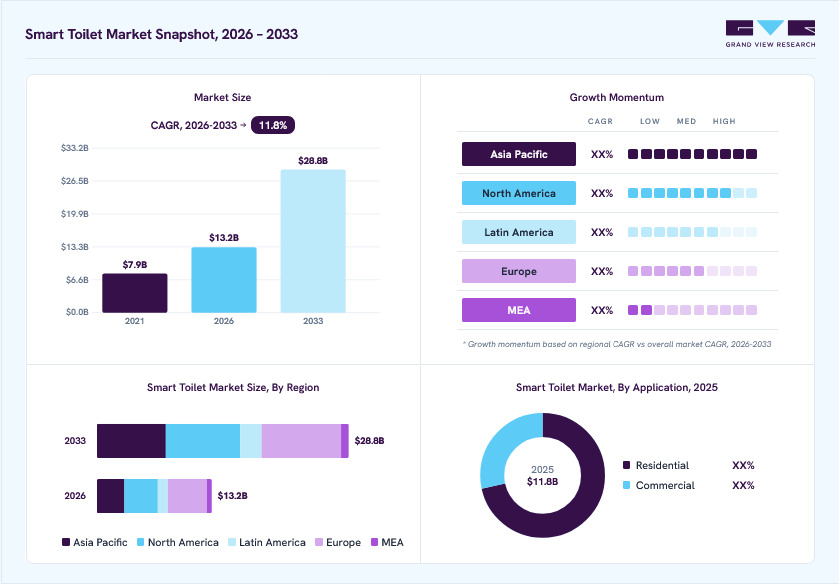 Source: Grand View Research, IR Documents, Primary Interviews, Paid DatabasesTo learn more about this report,
 Download Free Sample Report
Key Market Trends & Insights
- By application: Residential accounted for 71.5% of the market share in 2025.
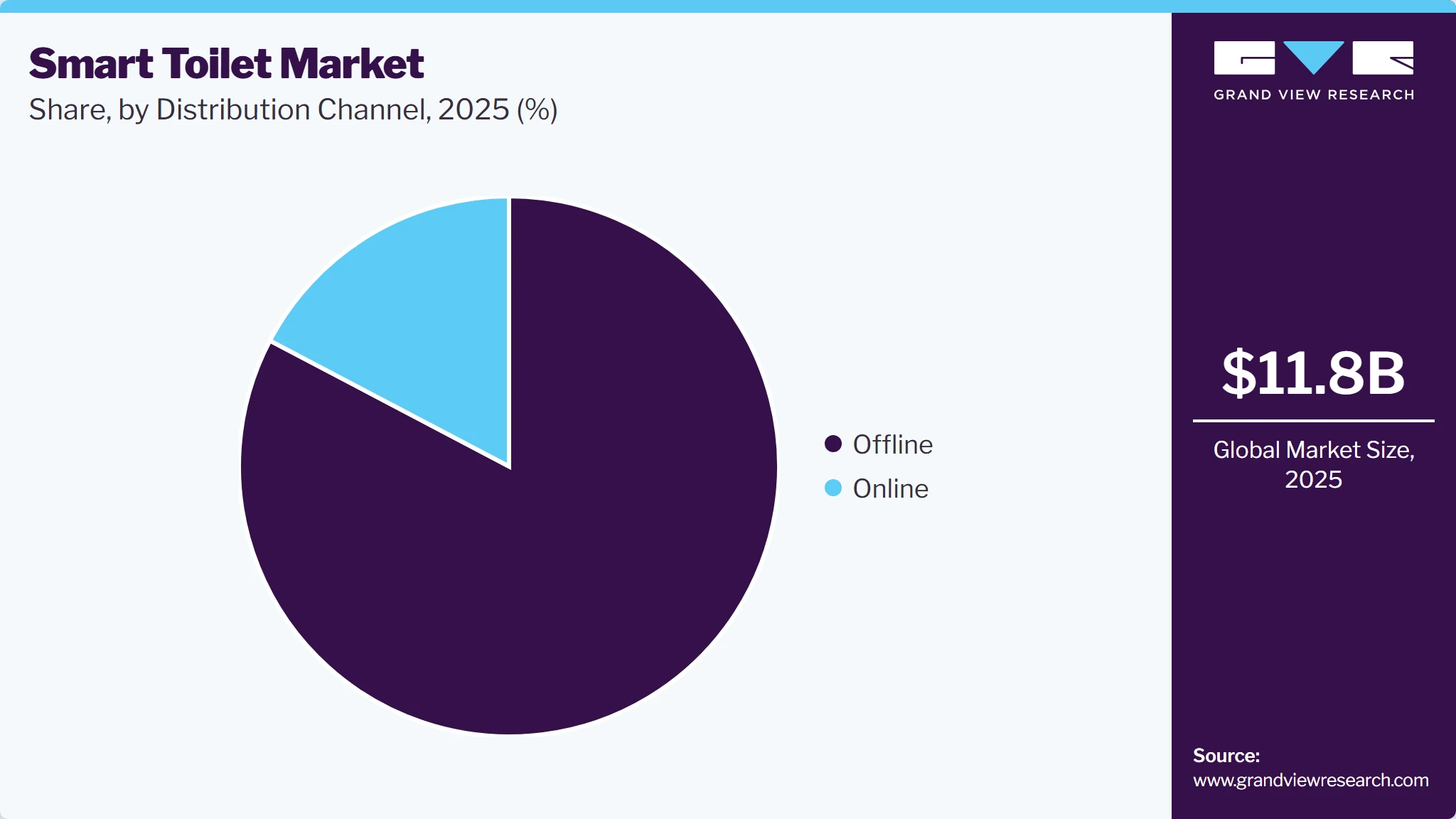
- By distribution channel: Offline sales accounted for 82.7% of the market in 2025.
Regional Highlights
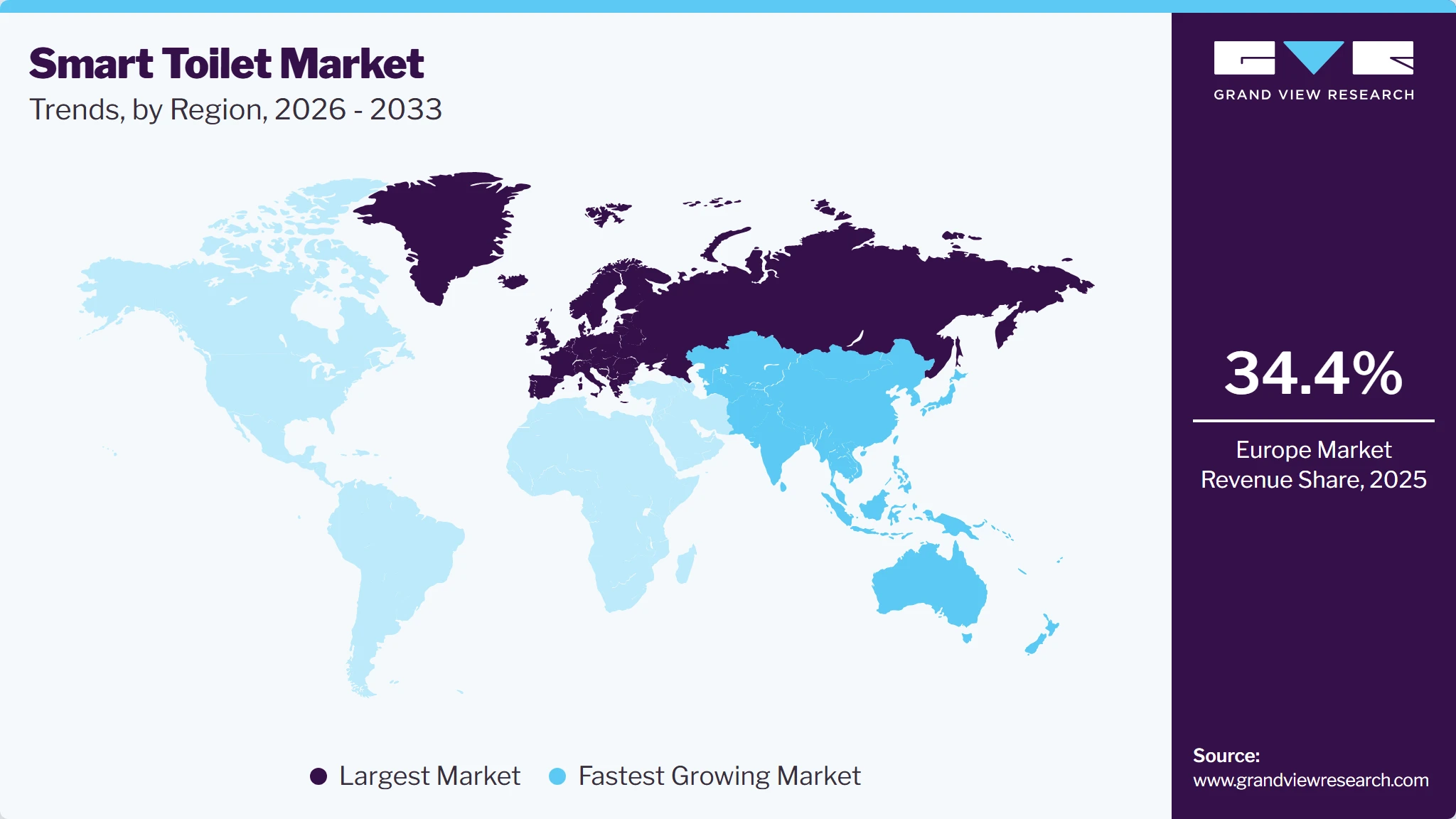
- Largest regional market: Europe (34.4% revenue share, 2025)
- Fastest-growing regional market: Asia Pacific (highest CAGR, 2026-2033)
- By country: Italy held the largest market share in 2025
Market Size & Forecast
- Market size in 2025: USD 11.8 Billion
- Estimated market size in 2026: USD 13.2 Billion
- Projected market size by 2033: USD 28.8 Billion
- CAGR (2026-2033): 11.8%
Three ways to get this report
Buy it, customize it, or ask a question.Ask an Analyst
Analyst response in 1 business day
- AccessReport author, directly
- Reply timeWithin 1 working day
- No sales callDirect answer only
- FormatEmail reply
- CostFree, no cost
Get the Full Report
What the study covers
- FormatsPDF · Excel · Dashboard
- Timeline2026–2033 annual, 2025 base
- Coverage20+ countries, 5 regions
- Companies10+ key players profiled
Customize the Report
20% free customization
- IncludeCountries, segments, points
- TailorTo your product definition
- ExtendDeeper competitor detail
- OrA fully bespoke study
- Turnaround5–10 working days
Consumers are increasingly investing in products that enhance comfort, convenience, and sanitation, supporting demand for smart toilets equipped with features such as automatic flushing, bidet washing, heated seats, warm-air drying, deodorization, and touchless operation. In addition, aging populations and the need for accessible bathroom solutions are further accelerating market adoption across residential and commercial sectors. The market is also witnessing a strong shift toward AI-enabled, connected, and health-focused smart toilet solutions. Manufacturers are integrating IoT connectivity, water-saving technologies, self-cleaning systems, UV sterilization, and health-monitoring capabilities to improve the user experience and enhance sustainability. For instance, in January 2025, Kohler introduced the PureWash E930 Bidet Seat, featuring UV-C self-sanitization, customizable cleansing functions, warm-air drying, and voice assistant compatibility, reflecting the industry's focus on intelligent, hygienic, and personalized bathroom technologies. This highlights the broader transition toward digitally connected sanitation products, where automation, resource efficiency, and wellness-oriented innovations are increasingly influencing consumer purchasing decisions.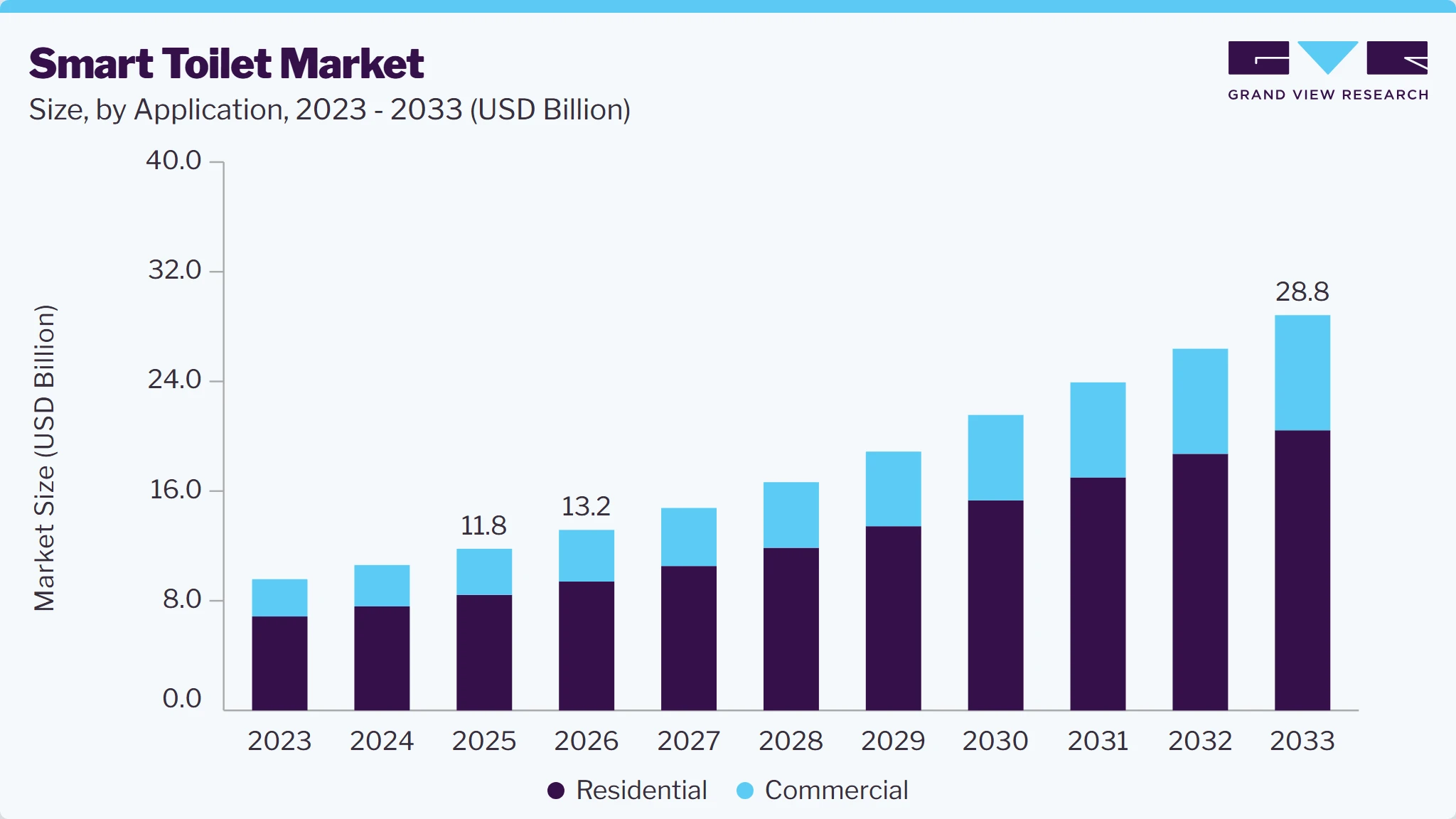 To learn more about this report, Download Free Sample Report
Growing consumer awareness of hygiene, wellness, and smart home technologies is significantly driving market demand. Consumers increasingly view smart toilets as a combination of comfort, convenience, health, and sustainability, driving higher adoption across residential, hospitality, healthcare, and commercial applications. This trend is influencing purchasing decisions for integrated smart toilets and smart bidet seats equipped with automatic flushing, heated seats, warm-water cleansing, warm-air drying, deodorization, and touchless operation. Consumers are also showing a strong preference for products that improve hygiene while reducing water consumption and minimizing physical contact, supporting the adoption of advanced bathroom solutions in both new construction and renovation projects.
The market is also witnessing a strong shift toward AI-enabled, IoT-connected, and health-monitoring technologies as consumers increasingly prioritize personalized experiences and preventive healthcare. Smart toilets are being equipped with features such as self-cleaning nozzles, UV sterilization, automatic lid opening and closing, voice control, mobile app connectivity, leak detection, and real-time health monitoring capabilities, including urine and stool analysis. Demand for water-efficient flushing systems, energy-saving technologies, and customizable user profiles is also increasing as consumers seek greater convenience, sustainability, and long-term cost savings. At the same time, manufacturers are focusing on intuitive interfaces, improved accessibility, and seamless smart-home integration to align with evolving consumer expectations for comfort, automation, and digital connectivity.
Furthermore, changing consumer demographics and evolving lifestyle preferences are expanding the customer base within the global market. Aging populations, individuals with mobility limitations, and health-conscious consumers are increasingly adopting smart toilets for their accessibility, hygiene, and wellness benefits. Rising urbanization, increasing disposable incomes, and growing investment in premium residential developments and luxury hospitality projects are further supporting market growth. Consumers are also increasingly influenced by modern bathroom aesthetics, wellness-focused home designs, and environmentally sustainable living, encouraging manufacturers to develop products that combine sophisticated design, advanced functionality, and resource-efficient performance.
In addition, the rapid expansion of e-commerce platforms, direct-to-consumer sales channels, and digital retail ecosystems is significantly reshaping consumer purchasing behavior in the global market. Consumers increasingly rely on online platforms to compare product features, evaluate customer reviews, access virtual product demonstrations, and purchase smart bathroom solutions with professional installation services. Digital marketing campaigns, social media engagement, smart-home influencers, and online brand experiences are accelerating product awareness and influencing purchase decisions. As a result, manufacturers are strengthening their digital presence, expanding online-exclusive product portfolios, and investing in personalized customer support and after-sales services to improve consumer engagement and broaden market reach.
Market Dynamics
The increasing demand for hygiene-focused, touchless, and smart bathroom solutions is emerging as a major market driver. Consumers are becoming more conscious of personal hygiene, sanitation, and wellness, leading to rising adoption of smart toilets equipped with automatic flushing, bidet washing, heated seats, warm-air drying, deodorization, and self-cleaning nozzles. The growing preference for contactless bathroom experiences in residential, commercial, hospitality, and healthcare settings is further supporting market expansion, particularly as consumers seek products that enhance comfort while minimizing direct surface contact.
In addition, advancements in IoT connectivity, sensor technology, AI-enabled features, and water-efficient flushing systems are improving product functionality and user experience. Consumers are increasingly investing in premium bathroom solutions that offer personalized settings, voice control, mobile app integration, energy-saving performance, and improved accessibility for elderly and mobility-limited users. Rising urbanization, increasing disposable incomes, luxury housing developments, and the growing adoption of smart home ecosystems are also encouraging the installation of connected bathroom fixtures. This increasing focus on hygiene, convenience, sustainability, and digital integration is significantly contributing to market growth.
High installation and product ownership costs remain a major factor constraining market growth. Smart toilets generally entail higher upfront costs than conventional toilets due to integrated electronic components, advanced sensors, automated functions, heating systems, connectivity features, and premium design specifications. Additional costs related to professional installation, electrical and plumbing modifications, maintenance, and replacement of specialized components can further increase the total cost of ownership, limiting adoption among price-sensitive consumers.
In addition, consumers in developing and emerging markets may have limited awareness regarding the benefits, functionality, and long-term value of smart toilets. Concerns about maintenance complexity, electricity dependence, product durability, compatibility with existing bathroom infrastructure, and the availability of after-sales service may also lead to hesitation when purchasing high-value smart bathroom products. The combination of elevated upfront investment, installation requirements, and affordability constraints among mass-market consumers continues to limit broader adoption and poses a key challenge to the global market's expansion.
The expanding elderly population and rising emphasis on accessible bathroom infrastructure are creating significant opportunities for smart toilet manufacturers. Features such as automated flushing, bidet washing, heated seats, touchless lids, adjustable water pressure, and remote-control operation can improve hygiene, comfort, and independence for elderly users and individuals with limited mobility. Demand is expected to increase across hospitals, assisted-living facilities, rehabilitation centers, and age-friendly residential developments.
Manufacturers can further capitalize on this opportunity by integrating health-monitoring capabilities, including urine analysis, hydration tracking, body-temperature measurement, and abnormality detection. Partnerships with healthcare providers, senior-living operators, real estate developers, and sanitaryware distributors can support wider product deployment. The development of affordable, easy-to-install models tailored to institutional and residential applications is expected to broaden adoption and create new revenue opportunities across developed and emerging markets.
Analyst Perspective
The smart toilet market is transitioning from a niche premium category to a mainstream smart home and wellness segment. Growth is driven by demand for hygiene, automation, water efficiency, personalized comfort, and IoT-enabled features. Manufacturers are integrating touchless operation, health monitoring, voice control, self-cleaning, and customizable settings to differentiate products. Developed markets lead adoption, while urbanization, rising incomes, infrastructure investment, and digital retail expansion are creating strong growth opportunities across emerging economies.
Consumer Insights
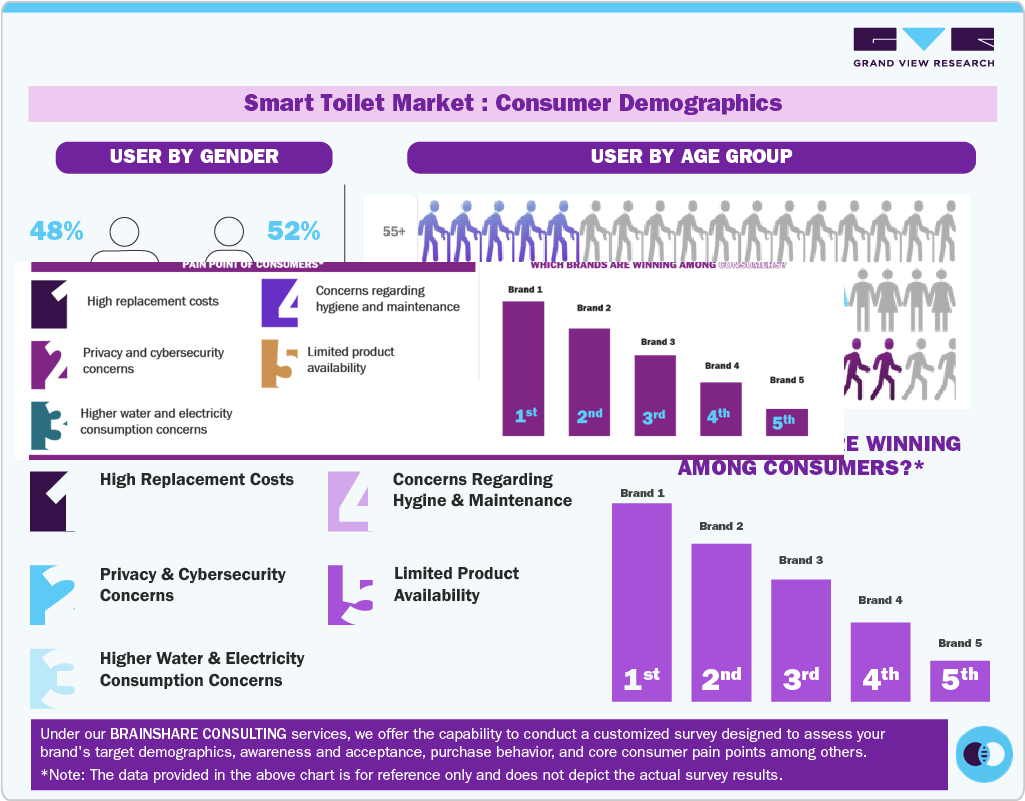
Consumer behavior in the global market is increasingly centered on hygiene, convenience, and wellness, with buyers prioritizing products that deliver enhanced sanitation, comfort, and water efficiency over conventional bathroom fixtures. Consumers are actively seeking smart toilets equipped with automatic flushing, bidet cleansing, heated seats, warm-air drying, self-cleaning nozzles, deodorization, and touchless operation to improve everyday bathroom experiences. This trend is reinforcing smart toilets as a value-added home improvement product, with advanced functionality, ease of use, and long-term resource savings directly influencing purchasing decisions.
 To learn more about this report, Download Free Sample Report
At the same time, purchasing behavior in the global market is strongly influenced by smart home adoption and demand for personalized user experiences. Consumers are increasingly preferring products with IoT connectivity, voice assistant compatibility, mobile application controls, customizable user profiles, and water- and energy-efficient technologies that seamlessly integrate into connected home ecosystems. Demand is also rising among elderly individuals, health-conscious consumers, and premium residential buyers who value accessibility, comfort, and preventive wellness features. This evolving purchasing behavior is encouraging consumers to invest in premium bathroom upgrades during new home construction and renovation projects, supporting higher product value and sustained demand across residential and commercial applications.
Application Insights
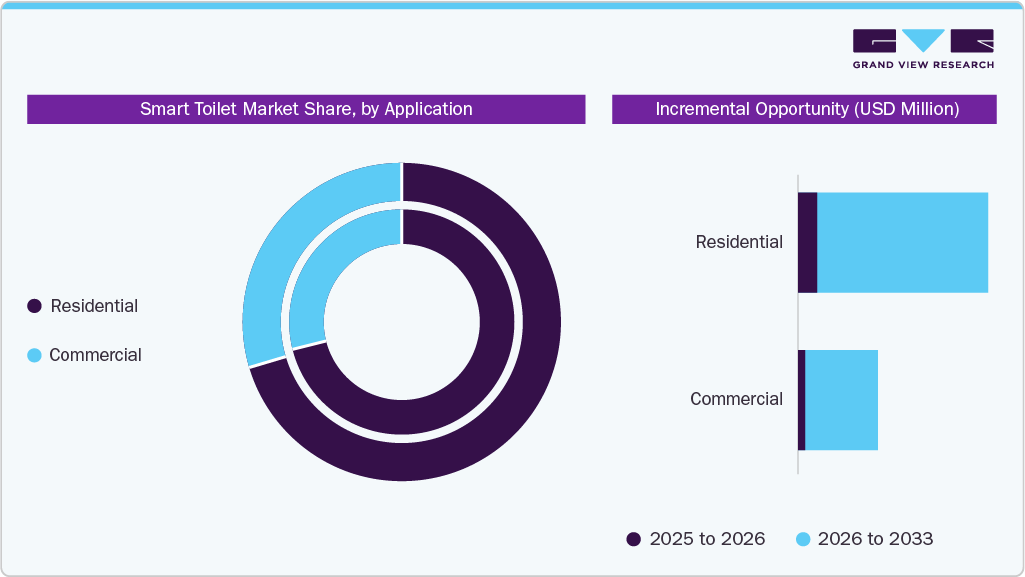
Residential accounted for the largest revenue share of 71.5% in 2025, driven by increasing adoption of smart home technologies, rising consumer awareness of personal hygiene, and growing investment in premium bathroom renovations. Homeowners are increasingly replacing conventional toilets with smart toilets featuring automatic flushing, bidet washing, heated seats, warm-air drying, deodorization, and touchless operation to enhance comfort, convenience, and sanitation. Rising disposable incomes, luxury housing developments, and growing demand for water-efficient and energy-saving bathroom fixtures are further supporting the segment's dominance. In addition, the integration of smart toilets with connected home ecosystems and voice assistants is encouraging wider residential adoption.
 To learn more about this report, Download Free Sample Report
Commercial is anticipated to grow at a CAGR of 12.1% from 2026 to 2033, driven by increasing investments in premium sanitation infrastructure across hotels, airports, hospitals, corporate offices, shopping malls, restaurants, and other public facilities. Businesses are increasingly adopting smart toilets to improve user experience, maintain high hygiene standards, reduce water consumption, and enhance operational efficiency. The growing emphasis on touchless restroom technologies, sustainability initiatives, and premium customer amenities is accelerating product deployment across commercial establishments. Furthermore, the expansion of tourism, healthcare infrastructure, and smart building developments is expected to support sustained growth in the commercial segment throughout the forecast period.
Distribution Channel Insights
Offline accounted for the largest revenue share of 82.7% in 2025, driven by consumer preference for in-person product evaluation, professional consultation, and installation support when purchasing high-value bathroom fixtures. Specialty sanitaryware stores, home improvement retailers, authorized brand showrooms, and building material distributors enable consumers to compare product features, assess build quality, and receive expert recommendations before making a purchase. In addition, offline channels offer installation services, after-sales support, warranty assistance, and customized bathroom solutions, making them the preferred choice for residential renovation projects as well as commercial and institutional developments.
 To learn more about this report, Download Free Sample Report
Online is expected to grow at a CAGR of 12.3% from 2026 to 2033, supported by the rapid expansion of e-commerce platforms and increasing consumer adoption of digital purchasing channels. Online platforms provide access to a wider range of smart toilet models, detailed product specifications, customer reviews, virtual demonstrations, and competitive pricing, enabling more informed purchasing decisions. The availability of doorstep delivery, installation scheduling, financing options, and exclusive online promotions is further encouraging adoption. Moreover, manufacturers are strengthening their direct-to-consumer channels and digital marketing strategies to improve customer engagement, expand market reach, and capitalize on the growing demand for smart home products.
Regional Insights
The North American smart toilet industry accounted for market share of 29.0% in 2025. The North America market is driven by increasing adoption of smart home technologies, growing consumer awareness of hygiene and wellness, and rising investments in premium residential construction and bathroom remodeling across the U.S. and Canada. Consumers are increasingly seeking intelligent bathroom solutions that enhance comfort, convenience, and sanitation through features such as automatic flushing, bidet washing, heated seats, warm-air drying, self-cleaning nozzles, deodorization, and touchless operation. Demand is particularly strong for integrated smart toilets and advanced bidet systems as homeowners prioritize luxury living, water conservation, and energy-efficient home upgrades. The presence of leading manufacturers and a well-established home improvement industry further supports market growth.
The market is also witnessing increasing adoption of AI-enabled and IoT-connected bathroom technologies, including voice assistant compatibility, mobile application controls, personalized user profiles, and health-monitoring capabilities. Growing demand from the hospitality, healthcare, and commercial sectors is accelerating the installation of smart toilets to improve user experience, accessibility, and hygiene standards. In addition, expanding e-commerce platforms, specialty bathroom retailers, and strong after-sales service networks are improving product accessibility, while continued investments in sustainable buildings and smart infrastructure are supporting long-term market growth.
U.S. Smart Toilet Market Trends
The smart toilet market in the U.S. accounted for around 77.0% of the North American market in 2025. The U.S. is supported by the country's high adoption of smart home technologies, increasing investment in residential remodeling, and growing consumer awareness of hygiene, wellness, and water conservation. Consumers are increasingly prioritizing convenience, comfort, and sanitation, driving strong demand for integrated smart toilets and bidet seats equipped with automatic flushing, heated seats, warm-water cleansing, warm-air drying, self-cleaning nozzles, deodorization, and touchless operation. The market also benefits from rising consumer spending on premium bathroom fixtures and growing demand for accessible bathroom solutions among aging populations and individuals with mobility limitations.
In addition, evolving consumer preferences for connected home ecosystems and personalized living experiences are driving demand for smart toilets with voice-assistant compatibility, mobile-app controls, customizable user profiles, and water- and energy-efficient technologies. Consumers are also showing growing interest in health-focused innovations, including hygiene-enhancing features and wellness-monitoring capabilities, as part of broader smart home adoption trends. Furthermore, the strong presence of leading manufacturers, established home improvement retailers, specialty bathroom showrooms, and rapidly expanding e-commerce platforms is improving product accessibility and accelerating the adoption of technologically advanced smart toilet solutions across residential and commercial applications.
Canada smart toilet marketis expected to grow at a CAGR of 12.1% from 2026 to 2033. Canada is driven by increasing adoption of smart home technologies, growing consumer awareness of hygiene and water conservation, and rising investments in residential renovation and premium bathroom upgrades. Canadian consumers are increasingly preferring intelligent bathroom solutions that enhance comfort, convenience, and sanitation through features such as automatic flushing, heated seats, bidet washing, warm-air drying, self-cleaning nozzles, and touchless operation. Demand is particularly strong for water-efficient and energy-saving smart toilets that align with the country's sustainability initiatives and environmentally conscious purchasing behavior.
Consumers in Canada are also showing growing interest in connected bathroom technologies that feature mobile app controls, voice assistant compatibility, and personalized user settings, reflecting the broader adoption of smart home ecosystems. In addition, the country's aging population is supporting demand for accessible bathroom fixtures that improve independence and ease of use for elderly and mobility-limited individuals. Sustainability trends are further influencing purchasing decisions, with consumers increasingly favoring smart toilets that incorporate efficient flushing systems, reduced water consumption, and eco-friendly technologies, encouraging manufacturers to expand their portfolios of environmentally responsible bathroom solutions.
Europe Smart Toilet Market Trends
The smart toilet market in Europe dominated the region, accounting for 34.4% in 2025. Europe is driven by increasing adoption of smart home technologies, growing emphasis on water conservation, and rising consumer demand for premium bathroom solutions across countries such as Germany, the UK, France, Italy, and Spain. Consumers in the region increasingly prefer technologically advanced smart toilets that enhance hygiene, comfort, and energy efficiency through features such as automatic flushing, bidet washing, heated seats, warm-air drying, self-cleaning nozzles, and touchless operation. Demand remains strong for integrated smart toilets and intelligent bidet systems that combine modern design with sustainable performance.
 To learn more about this report, Download Free Sample Report
The market is also witnessing a growing preference for environmentally sustainable and resource-efficient bathroom technologies, with consumers increasingly favoring products featuring low-water-flushing systems, energy-saving functions, and durable components with longer service lives. In addition, the growing adoption of connected home ecosystems is supporting demand for smart toilets with IoT connectivity, mobile application controls, voice assistant compatibility, and personalized user settings. The presence of established sanitaryware manufacturers, stringent environmental regulations, premium residential developments, and expanding e-commerce penetration is further improving product accessibility and supporting growth across both residential and commercial applications.
The UK smart toilet market is expected to grow at a CAGR of 11.0% from 2026 to 2033. The UK smart toilet market is driven by increasing consumer adoption of smart home technologies, growing investment in residential renovation projects, and rising awareness of hygiene, accessibility, and water-efficient bathroom solutions. Consumers in the UK are increasingly preferring smart toilets that offer convenience, comfort, and enhanced sanitation through features such as automatic flushing, bidet washing, heated seats, warm-air drying, self-cleaning nozzles, and touchless operation. Demand is particularly increasing for compact, energy-efficient, and aesthetically designed smart toilets that complement modern bathroom interiors while reducing water consumption.
In addition, consumers are showing growing preference for digitally connected and intelligent bathroom technologies, including smart toilets with mobile application controls, voice assistant compatibility, personalized user settings, and automated maintenance functions. Sustainability trends are also influencing purchasing behavior, with increasing interest in products featuring water-saving flushing systems, energy-efficient operation, and environmentally responsible designs. Rising adoption of premium home improvement solutions and the expansion of smart home ecosystems are further supporting demand for advanced smart toilet products across residential and commercial applications in the UK market.
The smart toilet industry in France accounted for a revenue share of around 15.0% of Europe in 2025. France is driven by growing consumer demand for premium home improvement products, increasing awareness of hygiene and water conservation, and rising adoption of smart home technologies. French consumers increasingly prefer smart toilets that combine advanced functionality, comfort, and elegant design, reflecting a strong preference for high-quality sanitaryware and modern bathroom aesthetics. Demand is particularly strong for integrated smart toilets featuring automatic flushing, bidet washing, heated seats, warm-air drying, self-cleaning nozzles, and touchless operation, offering enhanced convenience and everyday hygiene.
The market is also supported by rising preference for technologically advanced and environmentally sustainable bathroom solutions that improve user comfort while reducing water and energy consumption. Consumers in France are increasingly adopting smart toilets equipped with IoT connectivity, voice assistant compatibility, mobile application controls, and personalized user settings as part of connected home ecosystems. In addition, growing investment in premium residential renovations, luxury hospitality projects, and sustainable building developments is encouraging higher spending on intelligent bathroom fixtures and accelerating the adoption of smart toilet solutions across the French market.
Asia Pacific Smart Toilet Market Trends
The smart toilet market in the Asia Pacific is expected to grow at a CAGR of 14.0% from 2026 to 2033. Asia Pacific is driven by rapid urbanization, increasing adoption of smart home technologies, rising disposable incomes, and growing consumer awareness of hygiene and water-efficient bathroom solutions across countries such as Japan, China, South Korea, Australia, and India. Consumers in the region increasingly prefer technologically advanced, space-efficient, and multifunctional smart toilets that enhance comfort, convenience, and sanitation through features such as automatic flushing, bidet washing, heated seats, warm-air drying, self-cleaning nozzles, and touchless operation. Demand is particularly strong for compact integrated smart toilets and intelligent bidet systems designed for modern urban residences with limited bathroom space.
The market is also benefiting from the rapid expansion of smart city initiatives, premium residential developments, and connected home ecosystems, particularly in technologically advanced economies such as Japan and South Korea. In addition, consumers across the region are showing growing preference for AI-enabled, IoT-connected bathroom solutions featuring mobile application controls, voice assistant compatibility, personalized user settings, and water- and energy-efficient technologies. Rising investment in hospitality, healthcare, and commercial infrastructure, along with the growing influence of premium lifestyle trends and digital retail platforms, is further accelerating the adoption of smart toilet solutions across the Asia Pacific market.
China smart toilet marketaccounted for a revenue share of around 37.9% of the Asia Pacific market in 2025. China is driven by rapid urbanization, increasing adoption of smart home technologies, rising consumer spending on premium home improvement products, and growing awareness of hygiene and wellness. Chinese consumers are increasingly viewing smart toilets as an essential component of modern, connected homes, driving demand for integrated smart toilets and bidet systems with automatic flushing, heated seats, bidet washing, warm-air drying, self-cleaning nozzles, and touchless operation. Consumers also show a strong preference for intelligent bathroom products that combine advanced technology, convenience, and water-efficient performance.
The market is further supported by growing demand for AI-enabled and IoT-connected bathroom solutions, including products with mobile application controls, voice assistant compatibility, personalized user settings, and health-monitoring capabilities. In addition, younger consumers in China are increasingly influenced by smart home trends, digital lifestyles, and premium interior design preferences, driving greater adoption of technologically advanced bathroom fixtures in both residential and commercial developments. The rapid expansion of e-commerce platforms, smart city initiatives, and domestic manufacturers is further accelerating the adoption of smart toilet solutions across the Chinese market.
The smart toilet market in Indiais expected to grow at a CAGR of 14.0% from 2026 to 2033. India is increasingly being shaped by rapid urbanization, rising disposable incomes, growing adoption of smart home technologies, and increasing consumer awareness of hygiene and sanitation. Consumers are showing rising preference for smart bathroom solutions that combine affordability with advanced functionality, particularly in premium residential projects, luxury apartments, hotels, and commercial developments. Demand is steadily increasing for integrated smart toilets and smart bidet seats featuring automatic flushing, bidet washing, heated seats, self-cleaning nozzles, warm-air drying, and touchless operation, offering enhanced convenience and improved hygiene.
The market is also seeing strong traction in connected and water-efficient bathroom technologies, driven by growing interest in smart homes and sustainable living. Younger consumers are increasingly influenced by modern home design trends, digital lifestyles, and premium interior aesthetics, driving greater adoption of smart toilets with mobile app controls, voice assistant compatibility, and personalized user settings. In addition, the rapid expansion of e-commerce platforms, organized sanitaryware retail, and smart residential infrastructure is reshaping consumer purchasing behavior and accelerating the adoption of technologically advanced smart toilet solutions across the Indian market.
Central & South America Smart Toilet Market Trends
The smart toilet market in CSA is expected to grow at a CAGR of 11.5% from 2026 to 2033. CSA is primarily driven by increasing urbanization, improving living standards, and growing consumer awareness of hygiene, sanitation, and water-efficient bathroom solutions across countries such as Brazil, Argentina, Chile, and Colombia. Consumers in the region are increasingly opting for cost-effective, technologically advanced smart toilets that enhance comfort, convenience, and cleanliness, particularly in urban centers where smart home adoption and premium residential developments are expanding. Demand is rising for integrated smart toilets and smart bidet seats featuring automatic flushing, bidet washing, self-cleaning nozzles, heated seats, and touchless operation across residential and commercial applications.
The market is also witnessing growing adoption of modern bathroom technologies in hotels, hospitals, corporate offices, and luxury residential projects, encouraging demand for premium sanitation solutions with enhanced user comfort and water-saving capabilities. In addition, the increasing availability of smart toilets through home improvement retailers, sanitaryware showrooms, local distributors, and expanding e-commerce platforms is improving product accessibility across both urban and developing regions. Rising disposable incomes, greater exposure to global smart home trends, and increasing investments in sustainable building infrastructure are further supporting the gradual expansion of the CSA market.
Middle East & Africa Smart Toilet Market Trends
The smart toilet market in MEA is expected to grow at a CAGR of 6.8% from 2026 to 2033. MEA is driven by increasing investment in premium residential and commercial infrastructure, rising adoption of smart home technologies, and growing demand for luxury bathroom solutions in countries such as the UAE, Saudi Arabia, South Africa, and Qatar. Consumers in the region are increasingly preferring high-quality, technologically advanced smart toilets that enhance hygiene, comfort, and convenience through features such as automatic flushing, bidet washing, heated seats, warm-air drying, self-cleaning nozzles, and touchless operation. Demand is particularly strong for premium smart bathroom fixtures in luxury residences, hotels, healthcare facilities, and commercial developments.
The market is also witnessing growing demand for connected and sustainable bathroom technologies, including smart toilets with IoT connectivity, voice assistant compatibility, personalized user settings, and water-efficient flushing systems that support regional sustainability initiatives. In addition, affluent consumers are increasingly influenced by luxury lifestyle trends and modern interior design, which is encouraging greater adoption of premium sanitaryware and intelligent bathroom solutions. Expanding retail networks, increasing hospitality and tourism investments, smart city developments, and the growing presence of international sanitaryware manufacturers are further supporting market penetration and long-term market growth in the Middle East & Africa.
Key Smart Toilet Company Insights
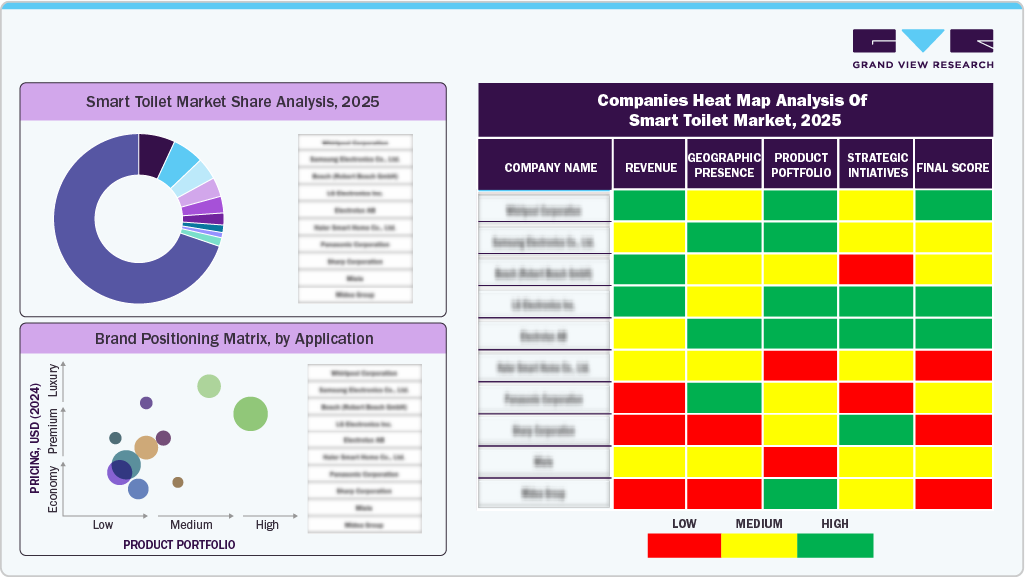
The global market is highly competitive, with leading manufacturers focusing on technological innovation, premium product design, and water-efficient sanitation solutions to strengthen their market positions. Companies such as Kohler Co., TOTO Ltd., Xiaomi Corporation, Roca Sanitario S.A., LIXIL Group Corporation, Duravit AG, Wellis, Masco Corporation, Villeroy & Boch AG, and JOMOO Group compete through the continuous launch of integrated smart toilets and intelligent bidet systems featuring automatic flushing, heated seats, self-cleaning nozzles, touchless operation, UV sterilization, and energy- and water-saving technologies. Competition is increasingly centered on smart home integration, user comfort, hygiene performance, and sustainability, enabling manufacturers to differentiate their offerings across both premium and mid-range product categories.
 To learn more about this report, Download Free Sample Report
The market is also witnessing increasing investment in connected bathroom ecosystems and health-focused innovations. Companies are incorporating AI-enabled features, IoT connectivity, voice assistant compatibility, mobile application controls, personalized user profiles, and wellness monitoring capabilities to enhance the overall consumer experience. In addition, manufacturers are expanding their presence through strategic partnerships, diversification of product portfolios, digital sales channels, and investments in residential, hospitality, healthcare, and commercial infrastructure projects to strengthen brand visibility and capture the growing demand for intelligent bathroom solutions.
Key Smart Toilet Companies:
The following key companies have been profiled for this study on the smart toilet market.
-
Kohler Co.
-
Toto Ltd.
-
Xiaomi Corporation
-
Roca Sanitario SA
-
LIXIL Group Corporation
-
Duravit AG
-
Wellis
-
Masco Corporation
-
Villeroy & Boch AG
-
Jomoo Group
Competitive Benchmarking
Category
Operating Strategies
Competitive Edge
Weakness
Established Players (Kohler Co.; TOTO Ltd.; LIXIL Group Corporation; Roca Sanitario S.A.; Duravit AG; Masco Corporation; Villeroy & Boch AG.)
Expand smart bathroom portfolios through continuous product innovation, integrate IoT-enabled and touchless technologies, strengthen global distribution and dealer networks, invest in premium residential and commercial projects, and collaborate with smart home ecosystem providers.
Strong global brand recognition, advanced R&D capabilities, extensive distribution networks, premium product quality, broad product portfolios, and strong expertise in automated hygiene, water-saving, and intelligent bathroom solutions.
High product prices, significant R&D and manufacturing costs, slower adoption in price-sensitive markets, longer replacement cycles, and dependence on premium construction and renovation demand.
Emerging Players (Xiaomi Corporation; Jomoo Group; Wellis.)
Focus on affordable smart toilet solutions, leverage digital and direct-to-consumer (DTC) sales channels, expand through e-commerce platforms, integrate smart connectivity features, and strengthen presence in rapidly growing residential markets.
Competitive pricing, rapid product innovation, strong presence in Asian markets, growing smart home ecosystem integration, and agility in responding to evolving consumer preferences.
Limited brand recognition in premium global bathroom fixture markets, smaller international distribution networks, lower penetration in commercial projects, and comparatively limited premium product portfolios.
Recent Developments
-
In February 2026, Kohler Co. expanded its smart bathroom portfolio with the launch of the Leap™ Smart Toilet and PureWash® E860 Dual-Wand Bidet Seat at KBIS 2026. The new products incorporate dual-wand bidet technology, automatic flushing, heated seating, warm-air drying, customizable cleansing functions, and enhanced hygiene features to improve user comfort and sanitation. This launch reflects the growing industry focus on intelligent, touchless, and personalized bathroom solutions that integrate advanced technology with premium user experiences.
-
In February 2026, TOTO Ltd. expanded its premium smart toilet portfolio by introducing new matte finish options for its NEOREST® LS Smart Bidet Toilet collection at KBIS 2026. The product combines EWATER+ self-cleaning technology, automatic flushing, heated seating, warm-water cleansing, and an integrated design to enhance hygiene, comfort, and sustainability. This launch highlights the industry's increasing emphasis on technologically advanced, aesthetically refined, and wellness-oriented smart bathroom solutions that cater to evolving consumer preferences.
Smart Toilet Market Report Scope
Report Attribute
Details
Market size in 2025
USD 11.8 billion
Estimated market size in 2026
USD 13.2 billion
Projected market size by 2033
USD 28.8 billion
Growth rate
CAGR of 11.8% from 2026 to 2033
Historical data
2021 - 2025
Forecast period
2026 - 2033
Quantitative units
Revenue in USD billion and CAGR from 2026 to 2033
Report coverage
Revenue forecast, company ranking, competitive landscape, growth factors, and trends
Segments covered
Application, distribution channel, region
Regional scope
North America; Europe; Asia Pacific; CSA; MEA
Country scope
U.S.; Canada; Mexico; UK; Germany; France; Italy; Spain; China; India; Japan; South Korea; Australia & New Zealand; Brazil; South Africa
Key companies profiled
Kohler Co.; Toto Ltd.; Xiaomi Corporation; Roca Sanitario SA; LIXIL Group Corporation; Duravit AG; Wellis; Masco Corporation; Villeroy & Boch AG; omoo Group
Customization scope
Free report customization (equivalent up to 8 analysts working days) with purchase. Addition or alteration to country, regional & segment scope.
Pricing and purchase options
Avail customized purchase options to meet your exact research needs. Explore purchase options
Global Smart Toilet Market Report Segmentation
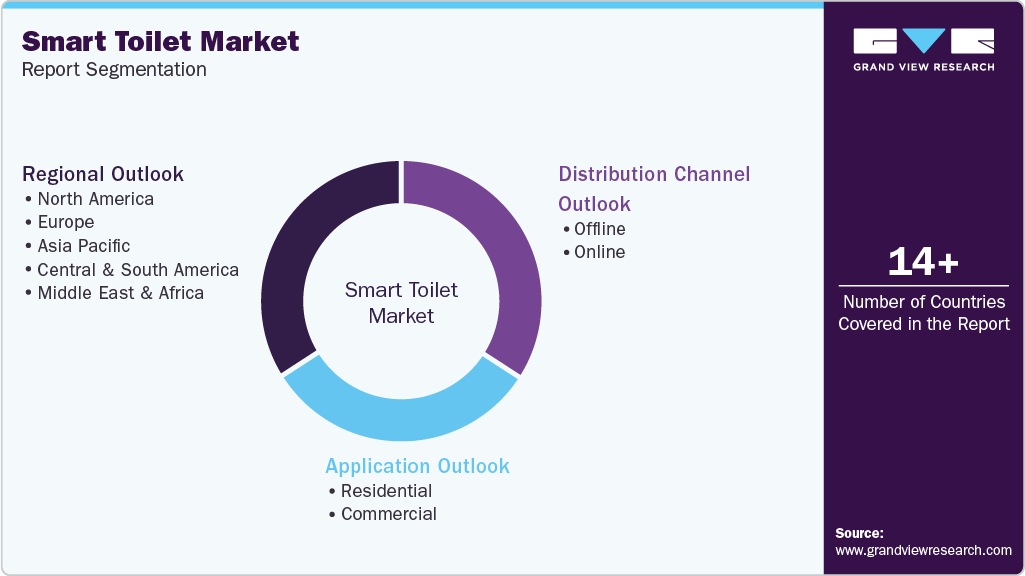
This report forecasts revenue growth at global, regional & country levels and provides an analysis of the latest trends and opportunities in each of the sub-segments from 2021 to 2033. For this study, Grand View Research has segmented the global smart toilet market based on application, distribution channel, and region.
 To learn more about this report, Download Free Sample Report
-
Application Outlook (Revenue, USD Billion; 2021 - 2033)
-
Residential
-
Commercial
-
-
Distribution Channel Outlook (Revenue, USD Billion; 2021 - 2033)
-
Offline
-
Online
-
-
Regional Outlook (Revenue, USD Billion; 2021 - 2033)
-
North America
-
U.S.
-
Canada
-
Mexico
-
-
Europe
-
UK
-
Germany
-
France
-
Italy
-
Spain
-
-
Asia Pacific
-
China
-
India
-
Japan
-
South Korea
-
Australia & New Zealand
-
-
Central & South America
-
Brazil
-
-
Middle East & Africa
-
South Africa
-
-
Research Methodology
The smart toilet market figures in this report are based on a proven research process that combines executive interviews with secondary research from proprietary databases, company filings, and recognized regulatory and institutional sources. Market size is built through value-chain sizing-reconciling supply-side and demand-side estimates-and triangulated with bottom-up and top-down approaches. Every estimate passes multiple levels of expert validation before publication, with each smart toilet segment quantified using the revenue-capture definitions in the table below.
Segment Definition
Segment - Application
Revenue capture definition
Residential
This segment covers revenue from sales of smart toilets for residential applications, where homeowners install these products to enhance bathroom hygiene, comfort, convenience, and accessibility. Demand is driven by increasing adoption of smart home technologies, luxury home renovations, and growing consumer preference for touchless and water-efficient bathroom fixtures. Real-life examples include smart toilets installed in apartments, independent homes, villas, condominiums, and luxury residential developments.
Commercial
This segment covers revenue generated from the sale of smart toilets for commercial applications, where businesses and institutions deploy these products to improve user experience, hygiene standards, operational efficiency, and sustainability. Adoption is increasing across high-traffic facilities seeking premium restroom solutions with automated and water-saving features. Real-life examples include hotels and resorts, corporate offices, shopping malls, airports, hospitals, restaurants, educational institutions, stadiums, and public restrooms in commercial buildings.
Estimation Model
Each layer progressively narrows the population pool and applies a conversion rate to arrive at addressable revenue.
Layer Name
Key Question
Description / Methodology
Epidemiology Layer
Who needs smart toilets?
Identify residential and commercial users seeking advanced hygiene, comfort, and water-efficient bathroom solutions.
Digital Access Layer
Who can install smart toilets?
Filter users based on plumbing infrastructure, electricity access, purchasing power, and product availability.
Behavioural Layer
Who actively purchases smart toilets?
Apply adoption rates based on smart home trends, hygiene awareness, premium bathroom upgrades, and commercial modernization.
Monetisation Layer
How much revenue is generated?
Estimate revenue by multiplying smart toilet unit sales by average selling price (ASP), including installation and replacement demand.
Delivered Customizations
This report has been delivered with the following In-depth customizations
Client Request
Customization Delivered
Value Adds
Smart Bathroom Automation & Consumer Adoption Trends
Conducted a detailed assessment of smart toilet adoption across residential, commercial, and hospitality sectors, covering touchless flushing, bidet functionality, heated seats, self-cleaning systems, IoT connectivity, water-saving technologies, and smart home integration trends.
Helps stakeholders identify high-growth application areas, understand consumer preferences for premium and hygienic bathroom solutions, and evaluate opportunities in connected bathroom technologies and smart home ecosystems.
Hygiene, Sustainability & Wellness Technology Trends
Evaluated demand for advanced hygiene solutions, water-efficient smart toilets, AI-enabled health monitoring features, antimicrobial technologies, accessibility solutions for aging populations, and sustainable bathroom innovations across developed and emerging markets.
Provides insights into evolving consumer expectations, sustainability-driven purchasing behavior, and emerging wellness technologies, supporting product innovation, premium positioning, and long-term market expansion strategies.
Smart Sanitation Infrastructure & Market Opportunity Assessment
Assessed growth opportunities across luxury residential developments, healthcare facilities, hotels, airports, and smart city projects, while analyzing regulatory standards, installation challenges, digital connectivity, and infrastructure requirements influencing smart toilet adoption.
Supports investment, product development, and regional expansion strategies by identifying underserved markets, infrastructure gaps, technology adoption barriers, and commercialization opportunities across residential and commercial sanitation ecosystems.
Frequently Asked Questions About This Report
The global smart toilet market size was valued at USD 11.8 billion in 2025 and is estimated at USD 13.2 billion for 2026.
The global smart toilet market is expected to grow at a CAGR of 11.8% from 2025 to 2033, reaching USD 28.8 billion by 2033.
Europe dominated with a 34.4% revenue share in 2025.
Some key players operating in the global smart toilet market include Kohler Co., Toto Ltd., Roca Sanitario SA, LIXIL Group Corporation, Duravit AG, Wellis, Masco Corporation, Bradley Corporation, Fortune Brands, and Villeroy & Boch AG.
Key factors that are driving the market growth include rising need for convenient sanitary hygiene products, and emergence of this product as a style statement in developed nations.
The application for residential accounted for a market share of 71.5% in 2025.
The distribution channel sales through offline accounted for a market share of 82.7% in 2025.
The Smart Toilet Market is witnessing growing demand for AI-enabled and IoT-connected toilets with features such as automatic flushing, health monitoring, voice control, and app-based customization. Additionally, increasing consumer preference for water-efficient, hygienic, and touchless bathroom solutions is driving innovation and adoption in both residential and commercial sectors.
The Smart Toilet Market in Italy held the largest share in the Europe region in 2025.
About the Author(s)
Homecare & Decor Research Team
Consumer Goods · Homecare & DecorThis report was authored by the homecare & decor research team at Grand View Research - comprising two research analysts, one senior research analyst, and one industry expert - with specialized expertise in the homecare & decor segment of the consumer goods industry. All findings are based on proprietary consumer goods databases, executive interviews, and regulatory analysis, subject to internal peer review prior to publication.
Last Updated:
Speak to Analyst

Customize this report to your needs - add regions, segments, or data points, with 20% free customization.
Or view our licence options:


ISO 9001:2015 & 27001:2022 Certified
We are GDPR and CCPA compliant! Your transaction & personal information is safe and secure. For more details, please read our privacy policy.


