
- Home
- »
- Consumer F&B
- »
-
Snacks Market Size, Share & Growth Report, 2026-2033GVR Report cover

Snacks Market (2026 - 2033)
Size, Share & Trends Analysis Report By Product (Frozen & Refrigerated, Fruit, Bakery, Savory, Confectionery, Dairy), By Packaging (Bag & Pouches, Boxes, Cans, Jars), By Distribution Channel, By Region, And Segment Forecasts
Market Size, 2025
$747.6BMarket Estimate, 2026
$778.1BMarket Forecast, 2033
$1,062.0BCAGR, 2026–2033
4.5%Snacks Market Summary
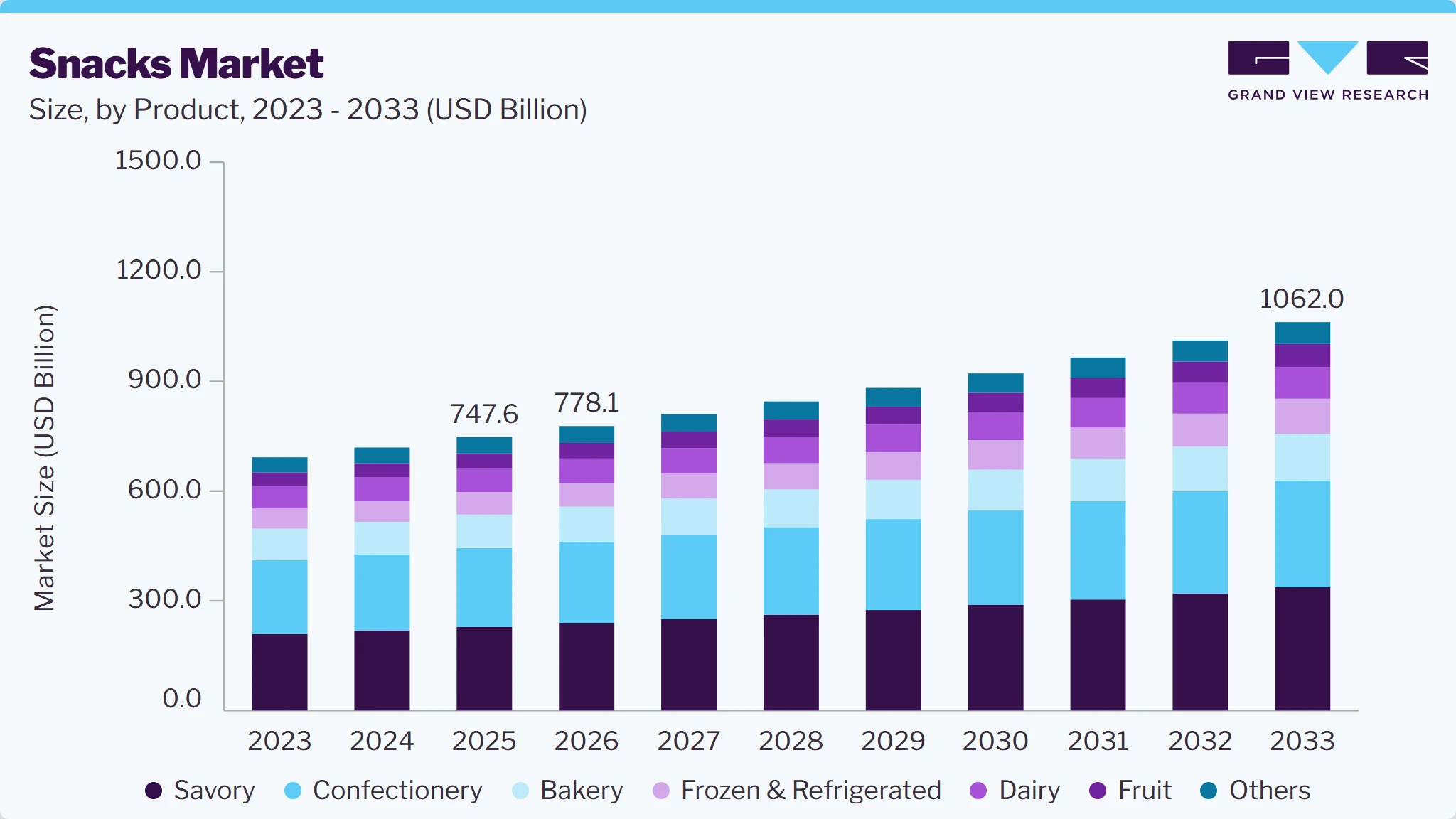
The global snacks market size was valued at USD 747.6 billion in 2025 and is projected to grow from USD 778.1 billion in 2026 to USD 1,062.0 billion by 2033, growing at a CAGR of 4.5% from 2026 to 2033. Asia Pacific dominated the snacks market with the largest revenue share of 40.1% in 2025. The increasing prevalence of on-the-go consumption, particularly among the urban and younger demographics, has significantly contributed to its market growth.
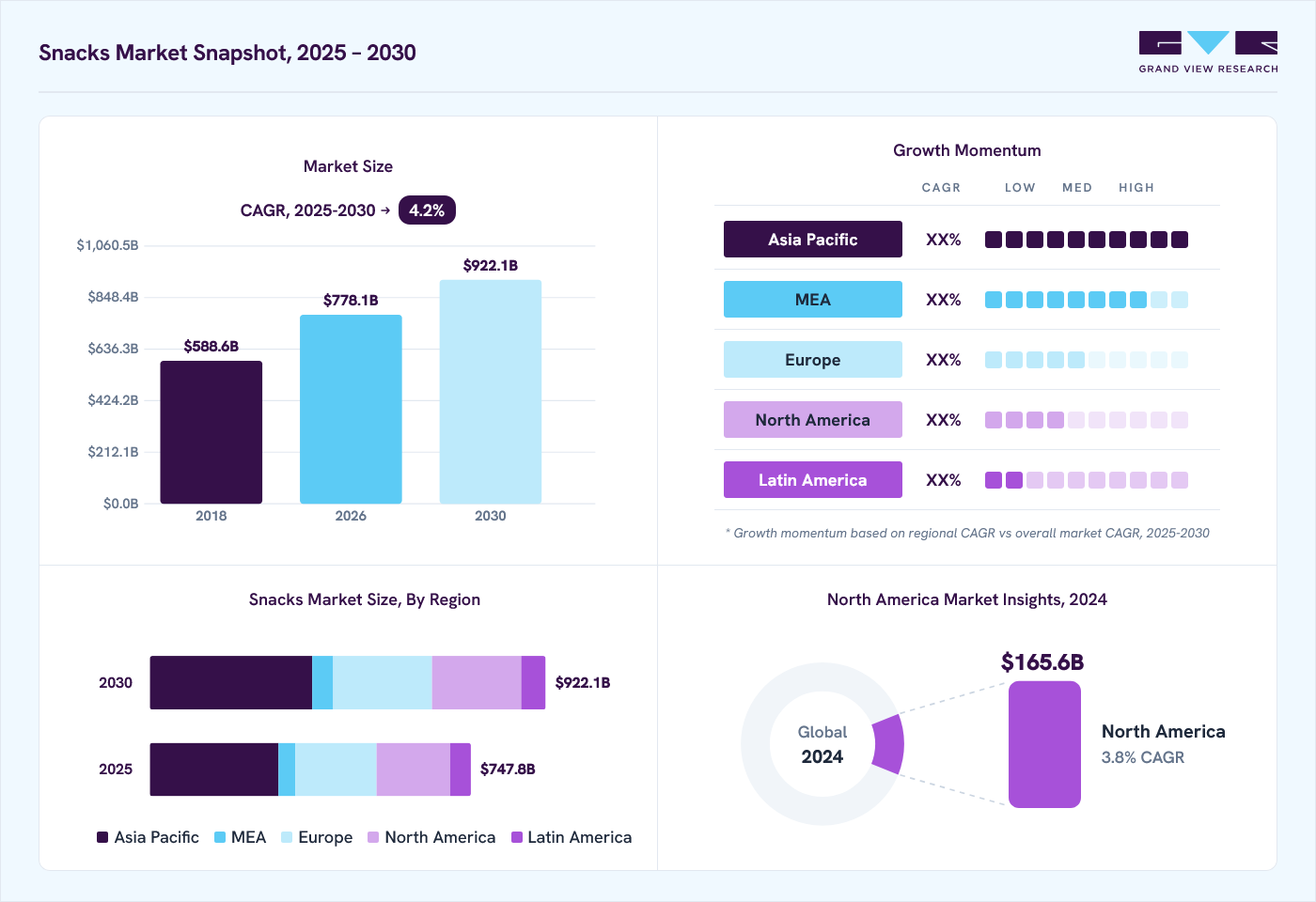 Source: Grand View Research, IR Documents, Primary Interviews, Paid DatabasesTo learn more about this report,
 Download Free Sample Report
 Key Market Trends & Insights
- By Product: Savory segment led the market with the largest revenue share of 30.5% in 2025.
- By packaging: Bag & pouches segment led the market with the largest revenue share of 33.6% in 2025.
- By channel: Supermarket/Hypermarket segment led the market with the largest revenue share of 62.2% in 2025.
Regional Highlights
- Largest regional market: Asia Pacific (40.1% revenue share, 2025)
- By country: China held the largest market share in 2025.
Market Size & Forecast
- Market size in 2025: USD 747.6 Billion
- Estimated market size in 2026: USD 778.1 Billion
- Projected market size by 2033: USD 1,062.0 Billion
- CAGR (2026-2033): 4.5%
Three ways to get this report
Buy it, customize it, or ask a question.Ask an Analyst
Analyst response in 1 business day
- AccessReport author, directly
- Reply timeWithin 1 working day
- No sales callDirect answer only
- FormatEmail reply
- CostFree, no cost
Get the Full Report
What the study covers
- FormatsPDF · Excel · Dashboard
- Timeline2026–2033 annual, 2025 base
- Coverage20+ countries, 5 regions
- Companies10+ key players profiled
Customize the Report
20% free customization
- IncludeCountries, segments, points
- TailorTo your product definition
- ExtendDeeper competitor detail
- OrA fully bespoke study
- Turnaround5–10 working days
Consumers are attracted to the wide array of flavors and varieties available in snacks, catering to their diverse preferences. Moreover, the shift toward healthier and more convenient snack options has been a key driver in market growth. Consumer preferences have undergone a notable transformation in recent years, with a growing inclination towards the convenience and portability of snacks. Consumers who are often pressed for time seek snacks that can be easily consumed while on the move or during short breaks.This trend has increased the demand for snacks that offer convenience without compromising taste or nutritional value. In June 2022, Kellogg’s Special K introduced a new line of protein snack bars to provide a delicious and convenient option for individuals with busy lifestyles. These are available in two delicious flavors: Berry Vanilla and Brownie Sundae. These new bars are designed to offer a portable and satisfying snack option rich in protein, making them ideal for busy lifestyles where quick and nutritious choices are essential. Consumers often prefer a wide range of flavors to cater to diverse tastes. Offering unique and innovative flavor options can attract consumers looking for exciting taste experiences.
 To learn more about this report, Download Free Sample Report
 In May 2024, Pringles, a popular brand of potato crisps known for its unique packaging and flavors, introduced three new snacks to its lineup. These new additions aim to excite consumers with fresh taste experiences and limited-edition offerings. The first of the two new flavors introduced by Pringles is Carnitas Taco. This flavor offers pork carnitas with a mix of spices, such as onion, cumin, garlic, and oregano. The second new flavor is All Dressed, which offers a blend of sweet, savory, and tangy flavors. In addition to the two flavors, Pringles has also unveiled The Limited Edition Minecraft Spicy TNT. With a growing focus on health-conscious choices, consumers are increasingly seeking snacks that are perceived as healthier options. This includes snacks with low sugar content, natural ingredients, organic certifications, or specific health benefits.
According to the Mondelez International State Of Snacking 2021 Global Consumer Snacking Trends Study, a majority of consumers claim that making better snacking choices would be possible if the snacks were gluten-free (23%), natural/organic (40%), low in sugar, carbs, or fat, (43%), support gut health (44%), high in protein(44%), boost immunity (46%), and vitamin-rich (48%). Busy lifestyles have made convenience a key factor in snack selection. Consumers look for snacks that are easy to grab on the go, require minimal preparation, and fit into their fast-paced routines. Moreover, the packaging of snacks plays a significant role in consumer preferences. Portable and resealable packaging options are favored by consumers for convenience and freshness, especially for snacking occasions outside the home.
Market Dynamics
The snacks market is witnessing steady growth, supported by changing consumer lifestyles, increasing demand for convenient food options, and rising preference for healthier snacking choices. Consumers are increasingly seeking products that combine taste, nutrition, and convenience, driving innovation across savory, sweet, and functional snack categories. Product diversification, premiumization, and expanding retail and e-commerce distribution channels are expected to sustain market growth globally.
Busy lifestyles and increasing health awareness are encouraging consumers to choose snacks that offer convenience without compromising nutritional value. Rising demand for protein-rich, low-sugar, clean-label, and functional snack products is contributing significantly to market expansion.
Fluctuations in the prices of key ingredients such as grains, nuts, dairy products, and cocoa can impact production costs and profit margins. Additionally, supply chain disruptions and evolving regulatory requirements may create operational and pricing challenges for manufacturers.
Growing consumer interest in wellness-focused and premium food products is creating opportunities for innovative snack formulations. Manufacturers are increasingly introducing products with added protein, fiber, plant-based ingredients, and clean-label claims, enabling brand differentiation and supporting long-term market growth.
Market Concentration & Characteristics
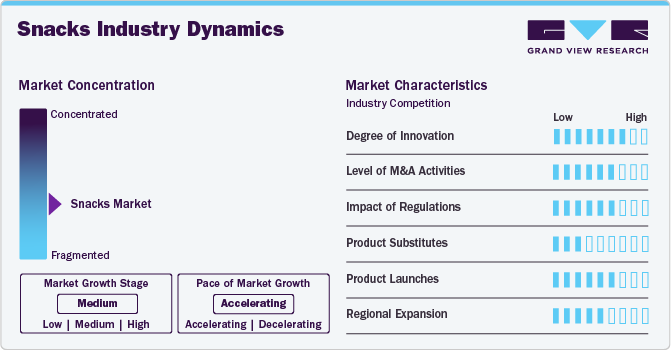
Manufacturers in the snacks industry are actively engaged in various initiatives to meet evolving consumer demands and market trends. The degree of innovation is high in the snacks industry. There's a growing demand for healthier snack options. Innovations include the usage of natural ingredients, reduced sugar, high protein, gluten-free, and plant-based snacks. Companies are focusing on sustainable practices, such as using eco-friendly packaging, reducing waste, and sourcing ingredients responsibly.
The snacks industry has witnessed a significant level of merger and acquisition (M&A) activities in recent years. This trend is driven by several factors, including the desire for companies to expand their product portfolios, enter new markets, achieve economies of scale, and innovate by integrating new brands and technologies.
 To learn more about this report, Download Free Sample Report
 Regulations in the snacks market significantly impact various aspects of the industry, including product formulation, labeling, marketing, and overall business operations. Manufacturers must comply with stringent food safety and quality standards set by regulatory bodies, such as the U.S. Food & Drug Administration (FDA) and the European Food Safety Authority (EFSA). These regulations ensure that snacks are safe for consumption and free from contaminants.
In the snacks industry, several product substitutes are available that consumers may consider based on their nutritional needs, dietary preferences, and lifestyle choices. Consumers increasingly seek these substitutes to align their snack choices with their health goals, dietary restrictions, and lifestyle preferences, leading to a more diverse and dynamic snack market. Snack packs (nuts, cheese, fruits), protein shakes, and meal replacement bars are typical substitutes in the market.
In recent years, the snacks market has seen a variety of product launches, reflecting consumer demand for healthier, more diverse, and more convenient snack options. These launches often focus on incorporating trending ingredients, addressing specific dietary needs, and offering innovative flavors and textures. Regional expansion in the snacks industry involves companies strategically entering new geographic markets to capitalize on growth opportunities, expand their customer base, and diversify their revenue streams.
Analyst Perspective
The snacks market is demonstrating sustained growth, supported by evolving consumer lifestyles, increasing demand for convenient on-the-go food options, and rising preference for healthier and premium snack offerings. Consumers are increasingly seeking products that combine taste, nutrition, and convenience, encouraging manufacturers to invest in product innovation, clean-label ingredients, and functional formulations. The growing influence of e-commerce, expanding retail distribution networks, and demand for diverse flavor profiles continue to strengthen market expansion. However, volatility in raw material prices, regulatory compliance requirements, and intense competition from both established brands and private-label products may pose challenges to market growth during the forecast period.
Product Type Insights
Based on Product, the savory segment led the market with the largest revenue share of 30.5% in 2025. The rising trend of snacking occasions replacing or supplementing traditional meals is another crucial factor propelling the market. As cultural norms and work patterns shift, consumers are embracing a more flexible approach to eating, leading to an increased frequency of snacking throughout the day. With their versatility and diverse flavor profiles, savory snacks align perfectly with this trend, offering consumers various options to satisfy their cravings between meals. A survey conducted by Whisps, renowned for its high-protein snacks made from 100% real cheese, unveiled shifting trends in American snacking habits. The survey, encompassing over 2,000 American adults in April 2023, revealed a significant trend of people substituting an average of 4 meals per week with snacks.
The frozen & refrigerated snacks segment is expected to grow at a CAGR of 5.5% from 2024 to 2030. There is a growing demand for convenient food options that require minimal preparation time as consumer lifestyles are becoming busier and more fast-paced. Furthermore, frozen and refrigerated snack manufacturers are constantly innovating to meet consumer demands for new flavors, ingredients, and formats. This focus on product innovation drives consumer interest and encourages the trial of new snack offerings, contributing to market growth. In November 2023, Golden West Food Group partnered with The Hershey Company to introduce a new line of Hershey's Frozen Fruit treats. The snacks, featuring real fruit coated in chocolate, include Hershey's Cookies 'N' Creme fruit strawberries, Reese's frozen fruit banana slices, and Hershey's White Creme & Milk Chocolate frozen fruit blueberries and raspberries.
Packaging Insights
Based on packaging, the bag & pouches segment led the market with the largest revenue share of 33.6% in 2025. With increasing awareness about environmental issues, including plastic pollution and waste management, there is a growing demand for sustainable packaging solutions. Brands are transitioning toward eco-friendly materials for snack packaging, such as recyclable plastics, compostable films, or biodegradable pouches. Consumers are more likely to choose snacks that come in environmentally friendly packaging options as part of their commitment to sustainability. In April 2024, PepsiCo introduced new paper outer bags for all Snack A Jacks multipacks. These eco-friendly bags are widely recyclable in home recycling bins and can be collected at kerbside. The implementation of paper packaging is projected to reduce the greenhouse gas (GHG) emissions of each pack by approximately 52%.
The cans segment is expected to grow at a CAGR of 4.5% from 2024 to 2030. Packing snacks in cans is becoming increasingly popular due to many benefits catering to manufacturers' needs and consumer preferences. For manufacturers, cans offer the advantage of extending the shelf life of snacks due to their airtight and lightproof nature, which preserves freshness and nutritional value without the need for added preservatives. The durability and protection afforded by cans also minimize spoilage and damage during transportation, ensuring the product's integrity upon reaching consumers.
Distribution Channel Insights
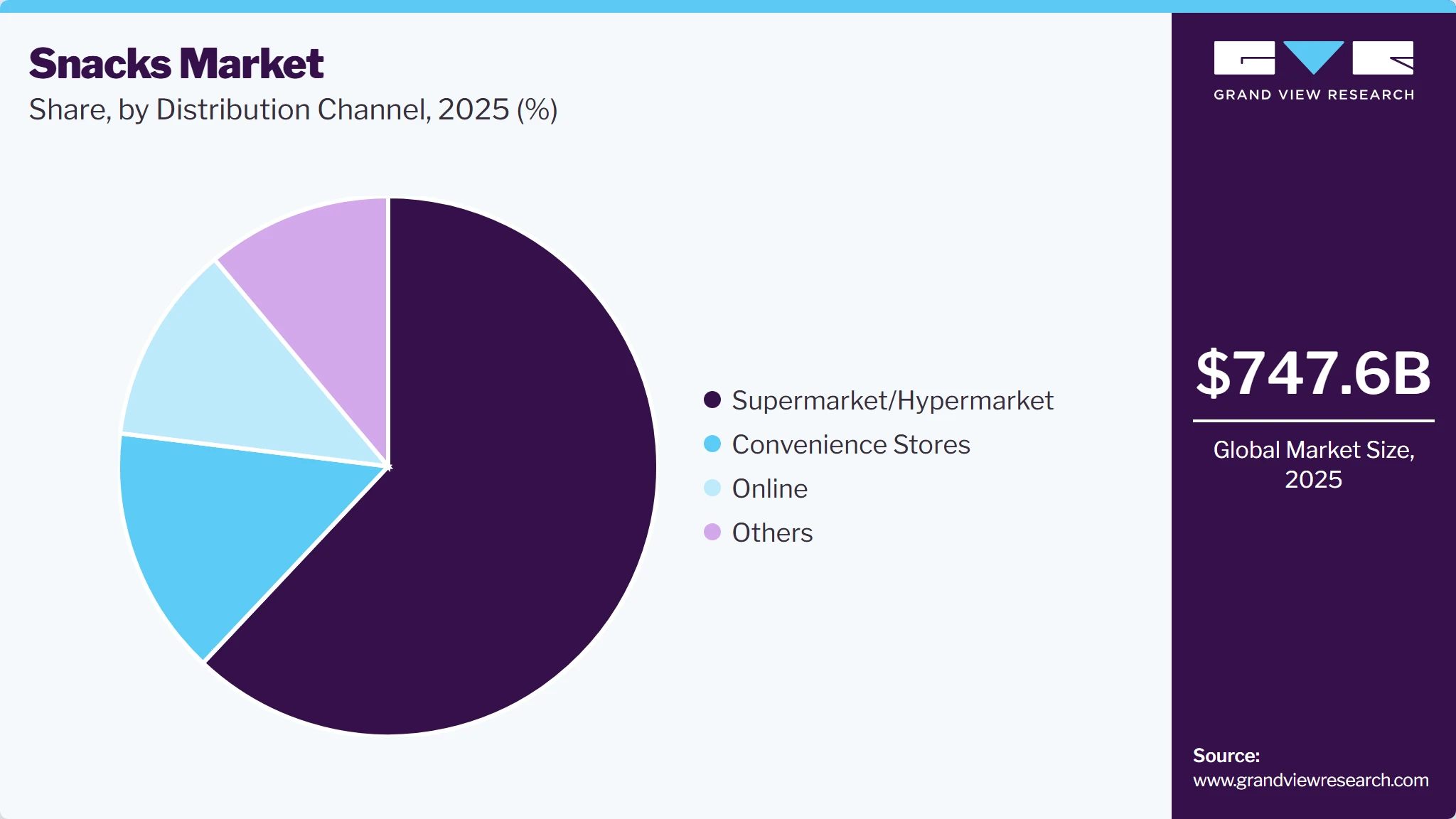
Based on distribution channel, the Supermarket/Hypermarket segment led the market with the largest revenue share of 62.2% in 2025. Consumers exhibit a preference for supermarkets and hypermarkets when it comes to selecting snacks, and this inclination is attributed to several factors. These retail establishments present a diverse range of nutritious snack options, including roasted nuts, seeds, and fruits, effectively meeting the growing consumer demand for snack variety. Moreover, the sheer volume of supermarkets and hypermarkets globally allows them to dominate the market in terms of the distribution channel. For instance, 7-Eleven-one of the largest supermarket chains in the world-has more than 71,100 stores in more than 17 countries. The rapid progress of retail infrastructure across developing economies will likely accentuate the segment growth further.
 To learn more about this report, Download Free Sample Report
 The online channels segment is expected to register a CAGR of 6.3% from 2024 to 2030. The convenience and accessibility provided by online platforms significantly contribute to their popularity for purchasing snacks. Consumers can easily browse and buy a wide array of products from the comfort of their homes, eliminating the need to visit physical stores. This convenience factor is especially appealing to those with busy lifestyles, limited time for grocery shopping, or those residing in areas with limited access to specialty health food stores. According to a survey commissioned by mobile app developer Bryj and conducted by Dynata, in 2024, 39% of shoppers prefer buying groceries through an app. Similarly, a Bank of America survey noted that 61% of respondents plan to shop for groceries online in 2024. These findings suggest that many consumers prefer buying snacks and groceries online.
Regional Insights
Asia Pacific dominated the snacks market with the largest revenue share of 40.1% in 2025. A key factor driving the regional market growth is the continuous innovation and new product development by key players to meet the changing demands of consumers. This includes introducing healthier ingredients, innovative flavors, and convenient packaging options that appeal to a wide range of consumers. For instance, in April 2024, Pop-Tarts, a popular brand known for its toaster pastries, expanded its product line by introducing a new snack product called “Crunchy Poppers.” These Crunchy Poppers come in two delicious flavors: strawberry and brownie. This launch marks an exciting addition to the Pop-Tarts family and offers consumers a convenient and tasty snacking option.
 To learn more about this report, Download Free Sample Report
 U.S. Snacks Market Trends
The snacks market in the China held the largest share in the Asia Pacific region in 2025. The snacking culture in the U.S. has evolved, with snacking becoming more than just a means of satisfying hunger between meals. Snacks are now seen as indulgent treats, mood boosters, comfort foods, or meal replacements, driving innovation and diversity in the snack segment.
Europe Snacks Market Trends
The Europe snacks market accounted for a revenue share of 25.4% in 2023. There’s a rising demand for natural, organic, and clean-label snacks as consumers become more health-conscious. Products free from artificial additives & preservatives and high in natural ingredients are preferred. Moreover, there is a rising trend of premiumization in the regional market. Gourmet, artisanal, and high-quality ingredients are sought for a more indulgent snacking experience. The rise of plant-based diets is reshaping the snack landscape. As veganism and flexitarianism grow in popularity, snacks derived from legumes, fruits, and vegetables are being embraced. Innovations in plant-based chips and bars have made it possible for consumers to enjoy savory and sweet snacks without compromising their dietary choices.
The snacks market in Germany is expected to grow at a CAGR of 4.3% from 2024 to 2030. Most consumers are willing to try new snack products, driven by factors, such as attractive offers, caloric content, natural ingredients, and the desire for variety. This openness to experimentation encourages manufacturers to innovate and introduce new products, driving market growth. According to Mondelēz International’s annual State of Snacking report, in 2023, approximately 59% of global consumers surveyed identified as “snack adventurers,” expressing a preference for trying new and innovative snack options.
The UK snacks market is expected to grow at a CAGR of 4.4% from 2024 to 2030. Companies in the snacks industry are investing heavily in marketing strategies to promote their products to consumers in the region. These strategies include targeted advertising campaigns, social media promotions, influencer partnerships, and engaging packaging designs. Companies can increase brand awareness and drive sales by effectively reaching out to their target audience through various channels.
Asia Pacific Snacks Market Trends
The snacks market in Asia Pacific is expected to grow with a CAGR of 4.7% from 2024 to 2030. Consumer preferences play a significant role in driving the regional market growth. There has been a notable increase in the consumption of savory snacks, with potato-based snacks, nuts, seeds, and popcorn among the most popular subcategories. Consumers increasingly seek intense flavors and single-flavor packages, indicating a preference for variety and taste innovation.
The China snacks market is expected to grow at a CAGR of 3.9% from 2024 to 2030. The trend of healthy snacking has been on the rise, with more and more people opting for nutritious and wholesome options instead of traditional high-calorie, sugar-laden snacks. This shift toward healthier snacking is not just a transient fad but a conscious effort by the Chinese population to lead a healthier lifestyle.
The snacks market in India is expected to grow at a CAGR of 6.6% from 2024 to 2030. Supermarkets and hypermarkets are also actively promoting and highlighting snacks. They partner with popular snack brands and offer discounts and promotions to attract more consumers. This has increased the sales of snacks and created a space for smaller and local snack brands to reach a wider audience.
Central & South America Snacks Market Trends
The Central & South America snacks market growth is driven by the introduction of innovative product offerings. Companies constantly develop new flavors, textures, and formats to cater to changing consumer preferences. By staying ahead of trends and offering unique snack options, companies can attract new customers and retain existing ones.
Key Snacks Company Insights
The global snacks market is characterized by the presence of numerous well-established players, such as General Mills, Inc.; PepsiCo; the Kraft Heinz Company; Nestlé; the Kellogg Company; Unilever; Conagra Brands, Inc.; Grupo Bimbo; Danone; and Mars, Inc. The market players face intense competition from each other as some of them are among the top snack manufacturers with diverse product portfolios for snacks. These companies have a large customer base due to the presence of established and vast distribution networks to reach out to both regional and international consumers.
Key Snacks Companies
The following key companies have been profiled for this study on the snacks market.
-
General Mills, Inc.
-
PepsiCo
-
The Kraft Heinz Company
-
Nestlé
-
The Kellogg Company
-
Unilever
-
Conagra Brands, Inc.
-
Grupo Bimbo
-
Danone
-
Mars, Inc.
Competitive Benchmarking
Category
Operating Strategies
Competitive Edge
Weakness
Established Players (Nestlé, PepsiCo, The Kraft Heinz Company, Mars, Inc., General Mills, Inc.)
- Expanding snack portfolios through continuous product innovation, premium offerings, and healthier snack formulations.
- Leveraging extensive global distribution networks, acquisitions, and brand investments to strengthen market presence.
- Strong brand equity, broad product portfolios, and significant market penetration across multiple regions.
- Advanced R&D capabilities, large-scale manufacturing infrastructure, and established retailer relationships.
- Exposure to fluctuating raw material and packaging costs affecting profitability.
- Regulatory scrutiny related to nutrition, labeling, and sustainability requirements across markets
Emerging Players (The Kellogg Company, Unilever, Conagra Brands, Inc., Grupo Bimbo, Danone)
- Strengthening presence in convenience and on-the-go snack categories through product diversification and strategic partnerships.
- Investing in health-focused, functional, and clean-label snack innovations to address evolving consumer preferences.
- Diverse food portfolios, strong regional presence, and well-established distribution channels.
- Ability to leverage consumer insights, marketing expertise, and operational scale for market expansion.
- Intense competition from private-label and emerging niche brands.
- Dependence on changing consumer preferences and economic conditions that may impact category growth.
Recent Developments
-
In April 2024, Danone North America introduced a new range of yogurt and dairy snacks named Remix, which consists of three brands: Oikos Remix, Too Good & Co. Remix, and Light + Fit Remix. These products offer a yogurt or dairy base with assorted mix-in toppings in different flavors to meet the growing snack demand
-
In April 2024, Magnum, Unilever’s ice cream brand, launched Magnum Pleasure Express, mood-inspired flavored ice creams. Magnum also put up 3D action billboards to promote these ice creams. It collaborated with Mindshare, LOLA MullenLowe, DOOH.com, and Kinetic to deliver the innovative live-action billboard in London, UK. The Pleasure Express 3D OOH creative shows off the brand’s summer campaign to support the launch of NPD Magnum Euphoria Pink Lemonade and Magnum Chill Blueberry Cookie flavored ice creams
-
In March 2024, Nestlé Maggi entered the frozen food category with frozen pops, kebabs, and pockets in India. Maggi would be competing with brands, such as McCain, ITC Master Chef, and Gadre, within the frozen snacks category in the country. The bars are available in five distinct flavors: Chocolate Chip, Peanut Butter Chocolate Chip, Strawberry, Cinnamon Roll, and Oats & Honey
Snacks Market Report Scope
Report Attribute
Details
Market size in 2025
USD 747.6 billion
Estimated market size in 2026
USD 778.1 billion
Projected market size by 2033
USD 1,062.1 billion
Growth rate
CAGR of 4.5% from 2026 to 2033
Base year for estimation
2025
Historical data
2021 - 2024
Forecast period
2026 - 2033
Quantitative units
Revenue in USD million/billion and CAGR from 2026 to 2033
Report coverage
Revenue forecast, company ranking, competitive landscape, growth factors, and trends
Segments covered
Product, packaging, distribution channel and region
Regional scope
North America; Europe; Asia Pacific; Central & South America and Middle East & Africa.
Country scope
U.S.; Canada; Mexico; UK; Germany; France; Italy; Spain; China; India; Japan; Australia & New Zealand; South Korea; Brazil; UAE; South Africa
Key companies profiled
General Mills, Inc.; PepsiCo; the Kraft Heinz Company; Nestlé; the Kellogg Company; Unilever; Conagra Brands, Inc.; Grupo Bimbo; Danone; Mars, Inc.
Customization scope
Free report customization (equivalent up to 8 analysts' working days) with purchase. Addition or alteration to country, regional & segment scope.
Pricing and purchase options
Avail customized purchase options to meet your exact research needs. Explore purchase options
Global Snacks Market Report Segmentation
This report forecasts revenue growth at the global, regional, and country levels and provides an analysis of the latest trends in each of the sub-segments from 2021 to 2033. For this study, Grand View Research has segmented the snacks market report on the basis of product, packaging, distribution channel, and region:
 To learn more about this report, Download Free Sample Report
 -
Product Outlook (Revenue, USD Million, 2021 - 2033)
-
Frozen & Refrigerated
-
Fruit
-
Bakery
-
Savory
-
Confectionery
-
Dairy
-
Others
-
-
Packaging Outlook (Revenue, USD Million, 2021 - 2033)
-
Bag & Pouches
-
Boxes
-
Cans
-
Jars
-
Others
-
-
Distribution Channel Outlook (Revenue, USD Million, 2021 - 2033)
-
Supermarket/Hypermarket
-
Convenience Stores
-
Online
-
Others
-
-
Regional Outlook (Revenue, USD Million, 2021 - 2033)
-
North America
-
U.S.
-
Canada
-
Mexico
-
-
Europe
-
UK
-
Germany
-
France
-
Italy
-
Spain
-
-
Asia Pacific
-
China
-
India
-
Japan
-
Australia & New Zealand
-
South Korea
-
-
Central & South America
-
Brazil
-
-
Middle East & Africa
-
UAE
-
South Africa
-
-
Research Methodology
The snacks market figures in this report are based on a proven research process that combines executive interviews with secondary research from proprietary databases, company filings, and recognized regulatory and institutional sources. Market size is built through value-chain sizing - reconciling supply-side and demand-side estimates - and triangulated with bottom-up and top-down approaches. Every estimate passes multiple levels of expert validation before publication, with each snacks segment quantified using the revenue-capture definitions in the table below.
Segment Definition
Segment - Products
Revenue capture definition
Frozen & refrigerated
This segment includes sales of snack products sold in frozen and refrigerated formats, including ready-to-eat, ready-to-cook, and chilled snacks.
Fruit
This segment includes sales of fruit-based snack products, including dried fruits, fruit bars, fruit bites, and another fruit-derived snacks.
Bakery
This segment includes sales of bakery-based snack products such as biscuits, cookies, crackers, pastries, cakes, and another baked snacks.
Savory
This segment includes sales of savory snack products, including chips, popcorn, pretzels, extruded snacks, nuts, and other salted or seasoned snacks.
Confectionery
This segment includes sales of confectionery snack products, including chocolates, candies, gummies, chewing gums, and other sweet snacks.
Dairy
This segment includes sales of dairy-based snack products, including yogurt snacks, cheese snacks, dairy desserts, and another dairy-derived snacks.
Others
This segment includes sales of protein snacks, cereal-based snacks, plant-based snacks, and other emerging snacks formats.
Estimation Model
Consumer Base Layer
Accessibility Layer
Adoption Layer
Monetisation Layer
Who drives demand for snacks?
Where are snack products available?
Which consumers support snack consumption?
How much revenue is generated?
Identify the consumer base through demographic, lifestyle, and consumption patterns. Assess demand from individuals seeking convenient, on-the-go, indulgent, and better-for-you snack options across various age groups and income segments.
Evaluate product availability across supermarkets, convenience stores, online retail platforms, specialty stores, vending channels, and foodservice outlets to determine market reach and accessibility.
Analyze adoption across key consumption occasions, including between-meal snacking, workplace consumption, travel, entertainment, and health-focused eating habits. Assess penetration across product categories such as savory snacks, bakery snacks, confectionery, and functional snacks.
Estimate market revenue by evaluating consumption volumes, average selling prices, product mix, premiumization trends, and value-added offerings across multiple snack categories and distribution channels.
Delivered Customizations
This report has been delivered with the following In-depth customizations
Client Request
Customization Delivered
Value Adds
Cross-Segmentation Analysis for Snack Types Across Distribution Channels
Detailed cross-segmentation analysis of snack categories including frozen & refrigerated, fruit, bakery, savory, confectionery, dairy, and others across supermarket/hypermarket, convenience stores, online, and other retail channels. Analysis covers consumption patterns, channel preferences, pricing trends, and purchasing behavior.
Identify high-growth product-channel combinations, optimize distribution strategies, and support portfolio expansion across key consumer segments.
Regulatory Compliance Analysis
Comprehensive assessment of food safety regulations, labeling requirements, ingredient standards, and product compliance frameworks governing snack products across major markets.
Support risk mitigation, regulatory alignment, and informed market expansion strategies while ensuring compliance with evolving industry standards.
Company Share Analysis
Detailed evaluation of company-wise market share, competitive positioning, product portfolio strength, pricing strategies, brand presence, and distribution capabilities within the snacks market.
Benchmark competitive landscape, identify leading market participants, and support strategic growth, partnership evaluation, and market positioning decisions.
Frequently Asked Questions About This Report
Some of the key market players in the snacks market are General Mills, Inc.; PepsiCo; The Kraft Heinz Company; Nestlé; The Kellogg Company; Unilever; Calbee; Intersnack Group GmbH & Co. KG; Conagra Brands, Inc.; ITC Limited; Grupo Bimbo; Danone; Mars, Incorporated
the bag & pouches segments led with a 33.6% revenue share in the 2025, and significantly growing market over the forecast period.
the supermarkets / hypermarket segments led with a 62.0% revenue share in the 2025, while online is the fastest growing segment over the forecast period.
Asia Pacific dominated with 40.1% revenue share in the 2025.and significantly growing market over the forecast period.
The global snacks market size was estimated at USD 747.6 billion in 2025 and is expected to reach USD 778.1 billion in 2026.
The global snacks market is expected to grow at a compound annual growth rate of 4.5% from 2026 to 2033 to reaching USD 1,062.0 billion.
by product the savory segments led with a 30.5% revenue share in the 2025, and significantly growing market over the forecast period.
The increasing demand for convenient and portable food options, driven by changing lifestyles and busy schedules, has been a significant driver. The growing emphasis on healthier snacking choices and the rising awareness of nutrition have propelled the development of a diverse range of healthier snack alternatives. Furthermore, the influence of cultural diversity and globalization has expanded the array of snack options available worldwide. Additionally, technological advancements and the widespread accessibility of snacks through various retail channels, including online platforms, have contributed to market growth
About the Author(s)
Consumer F&B Research Team
Consumer Goods · Consumer F&BThis report was authored by the consumer f&b research team at Grand View Research - comprising two research analysts, one senior research analyst, and one industry expert - with specialized expertise in the consumer f&b segment of the consumer goods industry. All findings are based on proprietary consumer goods databases, executive interviews, and regulatory analysis, subject to internal peer review prior to publication.
Last Updated:
Speak to Analyst

Customize this report to your needs - add regions, segments, or data points, with 20% free customization.
Or view our licence options:


ISO 9001:2015 & 27001:2022 Certified
We are GDPR and CCPA compliant! Your transaction & personal information is safe and secure. For more details, please read our privacy policy.


