
- Home
- »
- Electronic & Electrical
- »
-
Soda Water Dispenser Market Size & Share Report, 2033GVR Report cover

Soda Water Dispenser Market (2026 - 2033)
Size, Share & Trends Analysis Report By Product (Countertop, Drop-In), By Dispenser Style (Push Button Dispenser, Lever Dispenser), By Region (North America, Europe, Asia Pacific, Latin America, MEA), And Segment Forecasts
Market Size, 2025
$1.5BMarket Estimate, 2026
$1.6BMarket Forecast, 2033
$2.1BCAGR, 2026–2033
4.4%Soda Water Dispenser Market Summary
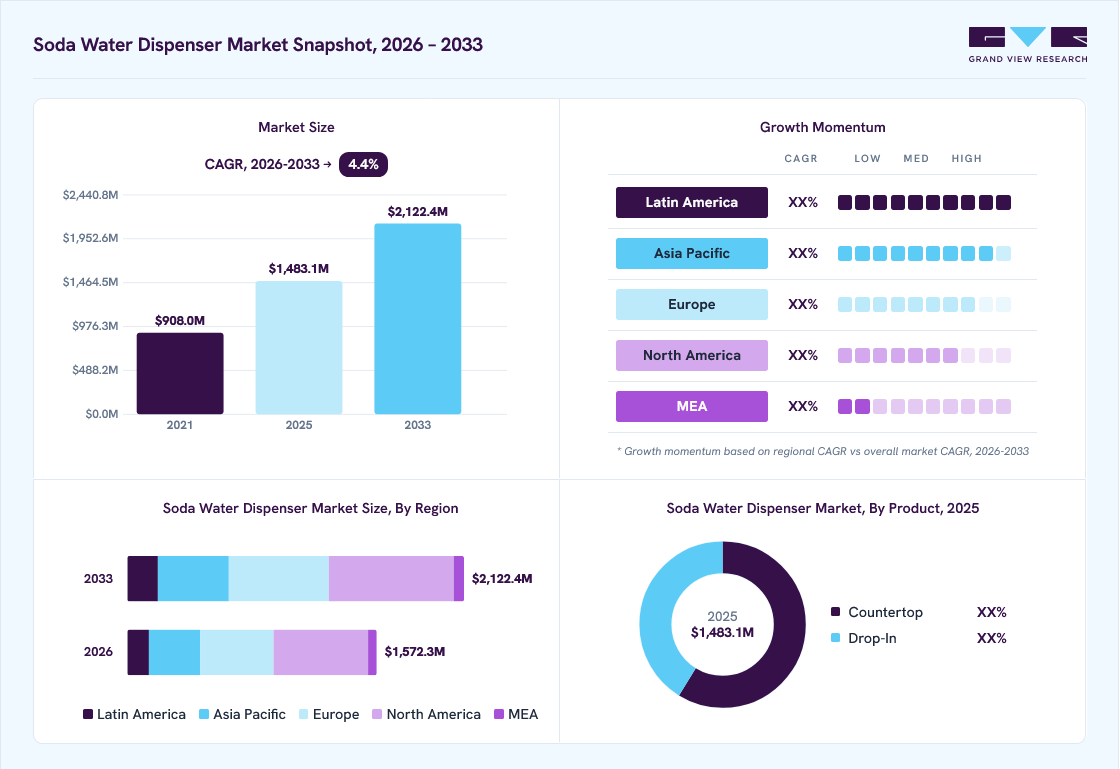
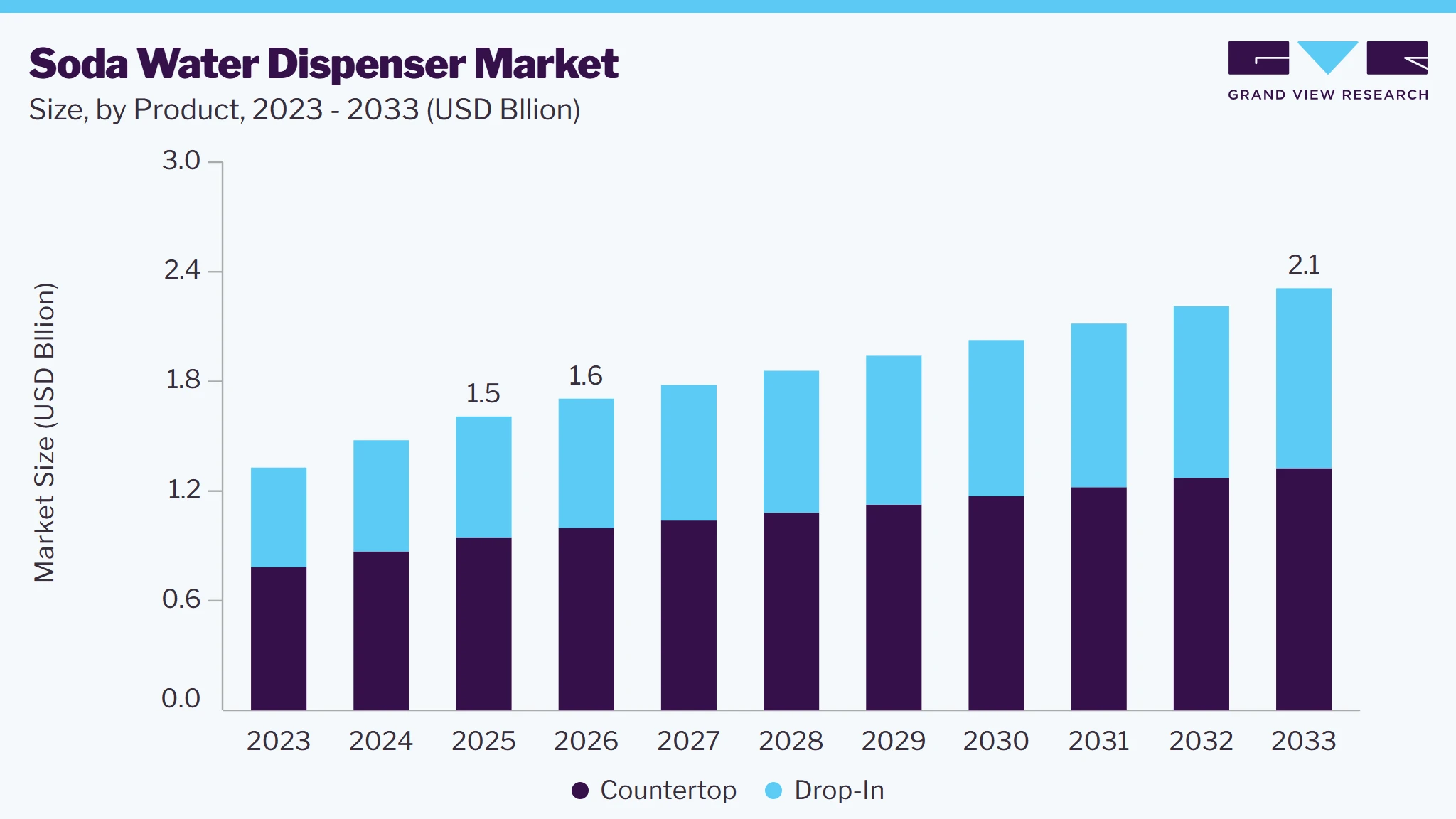
The global soda water dispenser market size was valued at USD 1.5 billion in 2025 and is projected to grow from USD 1.6 billion in 2026 to USD 2.1 billion by 2033, at a CAGR of 4.4% from 2026 to 2033. The market in North America dominated with a revenue share of 38.0% in 2025. This is due to growing demand for convenient options for beverages in various settings such as restaurants, convenience stores and cafes.
 Source: Grand View Research, IR Documents, Primary Interviews, Paid DatabasesTo learn more about this report,
 Download Free Sample Report
Key Market Trends & Insights
- By product: Countertop segment held the largest market share of 58.7% in 2025.
- By dispenser style: Lever dispenser segment held the largest market share of 62.8% in 2025.
Regional Highlights
- Largest regional market: North America (38.0% revenue share, 2025)
- By country: The U.S. held the largest market share in 2025.
Market Size & Forecast
- Market size in 2025: USD 1.5 Billion
- Estimated market size in 2026: USD 1.6 Billion
- Projected market size by 2033: USD 2.1 Billion
- CAGR (2026-2033): 4.4%
Prism AI by Grand View Research Free to tryAsk a question about the soda water dispenser market✓Every figure cited from GVR research Prefer the report? Download free sample →As consumers are shifting towards healthier beverage choices, soda water dispensers offering fruit-infused and sugar free alternatives are gaining popularity, which is driving the market growth. Beverages made with sparkling water are in demand leading to higher demand and thus increasing sales of such machines.
High penetration of soda dispensers in high-end restaurants, bars, and small-town diners is a key driving factor. The soda dispenser reduces the cost of packaging and bottling and gives higher profit margins to its owners, thereby resulting in boosting the sales in the market over the forecast period. Moreover, consumers consider it to be a fresh drink option as compared to those soda cans and bottles in the market, thereby increasing its market share in the industry.
 To learn more about this report, Download Free Sample Report
The soda fountains also help to minimize the use of soda bottles and cans, thereby reducing the hectic work to keep a bulk of beverage containers in-store. However, awareness regarding the disposal of plastic bottles and aluminum cans has increased the sales of beverage dispensers in the industry. The use of regular tap waters for the making of soda beverages in dispensers has lowered the use of water containers.
This reduces the manufacturing of plastic containers, thereby creating a less plastic environment in the industry. Also, the transportation cost for the delivery of bottle containers gets reduced by the incorporation of soda machines in the industry. Moreover, customizations such as mixing various flavors in a single drink increase its penetration in the market.
The product helps to keep the favorite drinks of consumers loaded in a dispenser, thereby saving time by providing instant flavors of drinks ready to be served at parties and restaurants. Also, the use of such machines at events and parties reduces the cost of hiring a bartender for serving and handling the drinks to the members. Moreover, keeping the soda machines at commercial spaces and institutes helps to keep the employees refreshed and active throughout the working hours of the day.
Market Dynamics
The soda water dispenser market is witnessing steady growth, driven by increasing consumer preference for sparkling water as a healthier alternative to sugary carbonated beverages. Rising health consciousness, growing demand for customizable beverage solutions, and the expansion of home carbonation systems and commercial beverage dispensing equipment are supporting market growth. Technological advancements, including smart dispensing systems, CO₂-efficient carbonation technology, touchless operation, and sustainable refillable cylinders, are enhancing user convenience while reducing environmental impact. Furthermore, increasing adoption across households, restaurants, hotels, cafés, offices, and hospitality establishments is expected to continue driving demand for soda water dispensers globally.
The rising shift toward healthier beverage consumption is a key factor driving the soda water dispenser market. Consumers are increasingly replacing sugar-sweetened soft drinks with sparkling water due to growing awareness of obesity, diabetes, and other lifestyle-related diseases. Soda water dispensers provide users with flexibility to prepare fresh carbonated water while reducing dependence on single-use plastic bottles and canned beverages. In addition, the expanding hospitality, foodservice, and corporate sectors are increasingly adopting soda water dispensing systems to offer customizable beverages while minimizing packaging waste and operational costs. Growing environmental awareness and government initiatives promoting plastic waste reduction are further encouraging consumers and businesses to invest in refillable carbonation systems and sustainable beverage dispensing solutions.
The relatively high upfront cost of soda water dispensers, particularly commercial-grade and premium home systems, remains a major challenge for market growth. In addition to equipment costs, users incur recurring expenses related to CO₂ cylinder refills, replacement parts, maintenance, and periodic servicing. Commercial establishments must also ensure compliance with food safety regulations and proper handling of pressurized gas cylinders, increasing operational complexity. Furthermore, limited availability of CO₂ refill infrastructure and after-sales service networks in developing regions may discourage adoption, particularly among price-sensitive consumers and small businesses.
The increasing adoption of smart kitchen appliances and connected beverage dispensing technologies presents significant growth opportunities for the soda water dispenser market. Manufacturers are introducing dispensers equipped with IoT connectivity, digital controls, adjustable carbonation levels, touchless dispensing, and mobile app integration to improve user convenience and operational efficiency. At the same time, growing consumer demand for eco-friendly products is accelerating innovation in reusable CO₂ cylinders, energy-efficient dispensing systems, and sustainable packaging solutions. Expansion of premium residential kitchens, workplace hydration programs, quick-service restaurants, cafés, hotels, and self-service beverage stations is further creating opportunities for manufacturers to introduce advanced soda water dispensing solutions tailored to both residential and commercial applications.
Analyst Perspective
The soda water dispenser market sits at the intersection of shifting beverage consumption patterns, rising health consciousness, and accelerating demand for at-home and on-premises carbonated drink solutions. As consumers increasingly move away from sugary carbonated soft drinks toward customizable, low-calorie, and functional hydration options, soda water dispensers are gaining traction across both residential and commercial segments, including households, cafés, quick-service restaurants, and hospitality environments. The structural tailwinds are further reinforced by sustainability concerns, as reusable dispensing systems reduce dependence on single-use plastic bottles and canned beverages, aligning with broader environmental goals. The central competitive moat, however, will belong to players that successfully integrate compact design innovation, carbonation customization, and smart dispensing technologies with scalable CO₂ supply ecosystems and strong service networks transforming soda dispensers from a niche appliance into a mainstream hydration platform that blends health, convenience, and sustainability in a single consumption system.
Product Insights
Based on product, the countertop segment led the market with the largest revenue share of 58.7% in 2025. Countertop soda water dispensers offer convenience as they can be easily placed on kitchen counters or tabletops, allowing users to quickly access and enjoy carbonated water without requiring large appliances. Many countertop soda water dispensers come with features that allow users to adjust their carbonation levels, flavors, and even add fruits to create personalized beverages.
The drop-in segment is projected to witness fastest CAGR of 4.8% over the forecast period. The drop-in type has a wide space at the bottom for filling the soda and ice in the machine. This large space is utilized for operation and other small works, thereby boosting its growth in the market. Bars and restaurants make extensive usage of the machine due to its feature of extra space. The machine is very easy to operate as it is a simple mechanical device as compared to countertop types, thereby fueling the growth of the product over the forecast period. This also makes the dispenser less costly to the buyers. Moreover, its reliability due to a safe flush provided in the machine increases its demand in the market.
Dispenser Style Insights
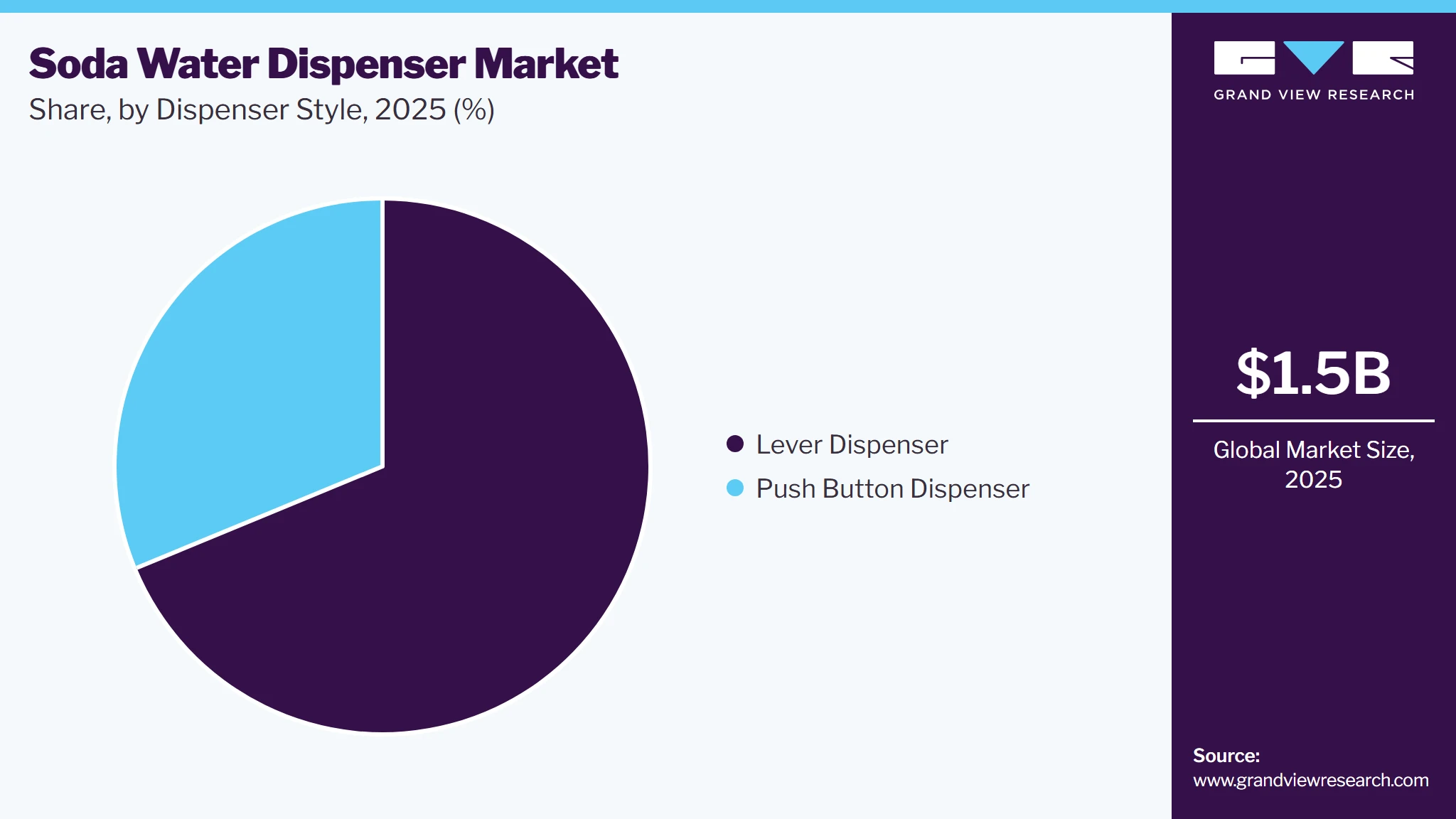
Based on dispenser style, the lever dispenser segment led the market with the largest revenue share of 62.8% in 2025. Lever dispensers offer a convenient way for users to easily control the amount of soda water they dispense, resulting in higher user satisfaction and ease of use. Level dispensers help maintain hygiene as they reduce the need for direct contact with the dispenser, especially in public spaces and areas with heavy foot traffic.
 To learn more about this report, Download Free Sample Report
The push button dispenser segment is projected to grow at the fastest CAGR of 5.3% over the forecast period. Push button dispensers are easy to use, requiring minimal effort to operate, which makes them popular among consumers looking for a hassle-free experience. Push button dispensers provide fast and efficient dispensing of soda water, perfect for busy environments where quick service is essential.
Regional Insights
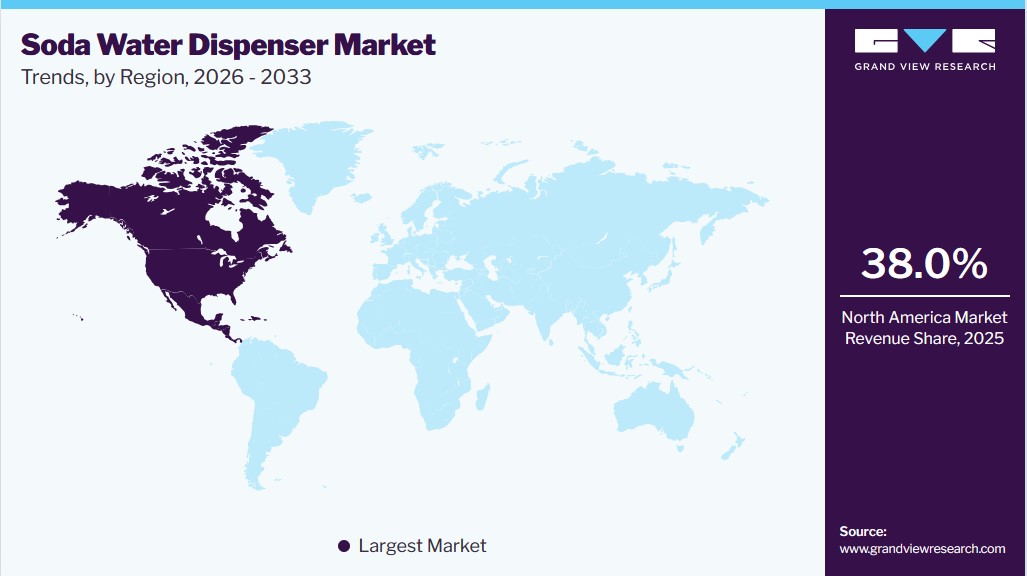
North America dominated the soda water dispenser market with the largest revenue share of 38.0% in 2025. The market is driven by the growing penetration of leading quick-service restaurants such as Subway, McDonald's, KFC, Burger King, Pizza Hut, and Dominoes. These restaurants are incorporating soda machines for the fast delivery of drinks for the consumers. Moreover, the penetration of leading manufacturers in the region such as The Coca-Cola Company, PepsiCo Inc., and Dr. Pepper has driven the sales of soda dispensers. The soda water dispenser market growth is attributed to rising demand among the people for a fresh delivery of soda drinks in the industry.
 To learn more about this report, Download Free Sample Report
U.S. Soda Water Dispenser Market Trends
The soda water dispenser market in the U.S. held the largest share in the North America region in 2025. The U.S. market is experiencing a change towards healthier lifestyle, as consumers are choosing low calorie and sugar free drinks such as soda water.
Europe Soda Water Dispenser Market Trends
Europe soda water dispenser market was identified as a lucrative region in 2025 due tothe increasing awareness about the harmful effects of sugary drinks that has led to a shift towards alternatives like soda water. With the rising concerns about plastic pollution and environmental sustainability, there is a growing trend towards decreasing the use of single-use plastic bottles and soda water dispensers offer eco-friendlier option by eliminating need for such bottles.
The Germany soda water dispenser market held a substantial market share in 2025. Germany is known for its strong emphasis on sustainability and environmental responsibility. The availability of advanced soda water dispenser models with features such as accurate carbonation control, smart connectivity, and sleek designs attracts to tech-savvy consumers, fueling the market growth.
Asia Pacific Soda Water Dispenser Market Trends
Asia Pacific market is anticipated to witness significant growth in the coming years on account of rising demand for the soda machines in the fast-food restaurant industry in countries such as China and India. The demand is anticipated to grow due to the rise in the purchasing power of the consumers, inclination towards the use of cost-effective products, and rising government initiatives. The soda water dispenser is an environmentally friendly machine due to its delivery through paper cups. This, in turn, has reduced the sales of plastic bottles, thereby boosting the market growth in Asia Pacific.
Key Soda Water Dispenser Company Insights
Some of the key companies in the soda water dispenser market include PepsiCo, The Coca-Cola Company, Zikool Refrigeration Pvt. Ltd., and others. Vendors in the market are focusing on increasing customer base to gain a competitive edge in the industry. Therefore, key players are taking several strategic initiatives, such as mergers and acquisitions and partnerships with other major companies.In May 2021, The Coca-Cola Company launched a next-generation soda dispenser with a touch screen design for an easy and fast experience for the users. The growth in the market is attributed to the rise in the number of manufacturers due to growing demand among consumers for fresh and quick dispensing options for soda drinks in the industry.
- Zikool Refrigeration Pvt. Ltd operates as both a manufacturer and exporter, specializing in products such as soda machines, soda fountain machines, and soda mobile van machines.
Key Soda Water Dispenser Companies
The following key companies have been profiled for this study on the soda water dispenser market.
-
PepsiCo
-
The Coca-Cola Company
-
Hoshizaki America, Inc.
-
Marmon Foodservice Technologies, Inc.
-
Keurig Dr Pepper Inc.
-
WELBILT INC
-
Cool Star Equipment
-
Zikool Refrigeration Pvt. Ltd.
-
Planet Soda
-
Himalay Soda Fountain
Competitive Benchmarking
Category
Operating Strategies
Competitive Edge
Weakness
Established Players (The Coca-Cola Company, PepsiCo, BRITA, Cornelius, Hoshizaki, Waterlogic International)
Focus on smart carbonation systems, expansion in commercial foodservice channels (QSRs, cafés, hotels), integration of IoT-enabled dispensing technologies, and partnerships with appliance manufacturers to strengthen home and office beverage ecosystems.
Strong global distribution networks, high brand trust in beverage and equipment segments, established contracts with restaurants and QSR chains, and advanced product innovation capabilities in automated and connected dispensers.
High capital intensity, dependence on commercial hospitality demand cycles, regulatory compliance burden in different regions, and slower adaptation in low-cost emerging markets due to premium positioning.
Emerging Players (SodaStream, DrinkMate, Aarke, Primo Water Corporation, Smart Soda Holdings, Zikool Refrigeration Pvt. Ltd.)
Target residential and small commercial segments with compact countertop dispensers, emphasize sustainability (reduced plastic usage), introduce customizable carbonation and flavor infusion systems, and leverage direct-to-consumer e-commerce channels and subscription-based CO₂ refill models.
Faster innovation cycles, strong alignment with health-conscious and eco-friendly consumer trends, flexible pricing strategies, and strong traction in at-home sparkling water consumption markets.
Limited large-scale commercial penetration, weaker global service networks, dependency on CO₂ supply ecosystems, and comparatively lower brand authority in institutional foodservice procurement.
Recent Developments
-
In February 2023, Smart Soda Holdings launched IoT JuLi Connect, a new countertop beverage solution. It is developed for commercial use and enables users to customize tea, soda, still-flavoured alkaline and sparkling water by setting carbonation levels, functional nutrition boosts and flavor combinations.
-
In July 2020, Pepsico launched Soda Stream Professional. It is a connected sparkling water system for the offices.
Soda Water Dispenser Market Report Scope
Report Attribute
Details
Market size in 2025
USD 1.5 billion
Estimated market size in 2026
USD 1.6 billion
Projected market size by 2033
USD 2.1 billion
Growth rate
CAGR of 4.4% from 2026 to 2033
Base year for estimation
2025
Historical data
2021 - 2024
Forecast period
2026 - 2033
Quantitative units
Revenue in USD million/billion and CAGR from 2026 to 2033
Report coverage
Revenue forecast, company ranking, competitive landscape, growth factors, and trends
Segments covered
Product, Dispenser Style, Region
Regional scope
North America; Europe; Asia Pacific; Latin America; MEA
Country scope
U.S.; Canada; Mexico; Germany; UK; France; Italy; Spain; China; Japan; India; South Korea; Australia; Brazil; South Africa;
Key companies profiled
PepsiCo; The Coca-Cola Company; Hoshizaki America, Inc.; Marmon Foodservice Technologies, Inc.; Keurig Dr Pepper Inc.; WELBILT INC; Cool Star Equipment; Zikool Refrigeration Pvt. Ltd.; Planet Soda; Himalay Soda Fountain
Customization scope
Free report customization (equivalent up to 8 analysts' working days) with purchase. Addition or alteration to country, regional & segment scope.
Pricing and purchase options
Avail customized purchase options to meet your exact research needs. Explore purchase options
Global Soda Water Dispenser Market Report Segmentation
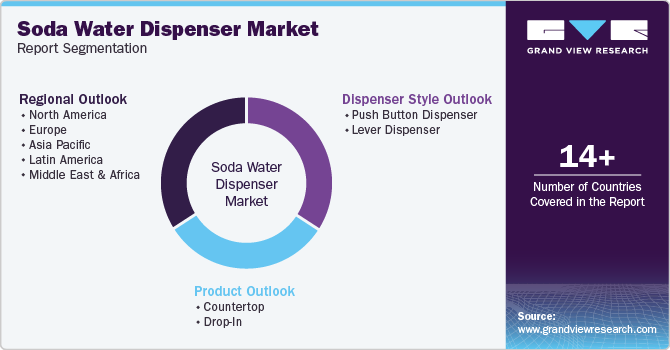
This report forecasts revenue growth at global, regional, and country levels and provides an analysis of the latest industry trends in each of the sub-segments from 2021 to 2033. For this study, Grand View Research has segmented the global soda water dispenser market report based on product, dispenser style, and region.
 To learn more about this report, Download Free Sample Report
-
Product Outlook (Revenue, USD Million, 2021 - 2033)
-
Countertop
-
Drop-In
-
-
Dispenser Style Outlook (Revenue, USD Million, 2021 - 2033)
-
Push Button Dispenser
-
Lever Dispenser
-
-
Regional Outlook (Revenue, USD Million, 2021 - 2033)
-
North America
-
U.S.
-
Canada
-
Mexico
-
-
Europe
-
UK
-
Germany
-
France
-
Italy
-
Spain
-
-
Asia Pacific
-
Japan
-
China
-
India
-
Australia & New Zealand
-
South Korea
-
-
Latin America
-
Brazil
-
-
MEA
-
South Africa
-
-
Research Methodology
The soda water dispenser market figures in this report are based on a proven research process that combines executive interviews with secondary research from proprietary databases, company filings, and recognized regulatory and institutional sources. Market size is built through value-chain sizing - reconciling supply-side and demand-side estimates - and triangulated with bottom-up and top-down approaches. Every estimate passes multiple levels of expert validation before publication, with each soda water dispenser segment quantified using the revenue-capture definitions in the table below.
Segment Definition
Segment - Product
Revenue capture definition
Countertop
This segment covers the revenues generated through the sales of countertop soda water dispensers, which are designed to be placed on kitchen counters, office pantries, cafés, restaurants, and self-service beverage stations without requiring built-in installation. These dispensers offer convenient access to chilled and carbonated water while occupying minimal space, making them suitable for both residential and commercial applications. Real-life examples include countertop soda water dispensers used in homes, office breakrooms, cafés, convenience stores, and hotel breakfast areas.
Drop-In
This segment covers the revenues generated through the sales of drop-in soda water dispensers, which are installed directly into countertops or beverage stations to provide a built-in, space-efficient dispensing solution. These systems are commonly integrated into commercial foodservice environments where high-volume dispensing, aesthetics, and ease of operation are important. Real-life examples include drop-in soda water dispensers installed at restaurant beverage counters, hotel buffets, corporate cafeterias, airport lounges, and quick-service restaurant self-serve stations.
Segment - Dispenser Style
Revenue capture definition
Push Button Dispenser
This segment covers the revenues generated through the sales of push button soda water dispensers, where users dispense carbonated water by pressing an electronic or mechanical button. These dispensers provide controlled dispensing, ease of use, and hygienic operation, making them suitable for both commercial and residential settings. Real-life examples include push button dispensers installed in office hydration stations, cafés, hotels, hospitals, restaurants, and modern home carbonation systems.
Lever Dispenser
This segment covers the revenues generated through the sales of lever soda water dispensers, which dispense carbonated water when users manually pull or press a dispensing lever. These dispensers are valued for their simple mechanical operation, durability, and reliability, particularly in high-traffic commercial environments. Real-life examples include lever-operated soda water dispensers used in bars, restaurants, fast-food outlets, convenience stores, cafeterias, and beverage self-service counters.
Estimation Model
Layer Name
Key Question
Description
Epidemiology Layer
Who needs soda water dispensers?
Identify demand across households, restaurants, hotels, offices, bars, cafés, and commercial beverage service establishments to define the addressable customer base.
Digital Access Layer
Who can be reached through sales channels?
Assess customers accessible through retail stores, e-commerce platforms, distributors, and direct B2B sales across key regions.
Behavioural Layer
Who actively purchases and uses the product?
Apply adoption rates based on consumer preference for sparkling water, sustainability trends, and commercial beverage dispensing needs to estimate active users.
Monetisation Layer
How much revenue is generated?
Estimate market revenue by multiplying unit sales across residential and commercial segments by the average selling price (ASP) of soda water dispensers.
Delivered Customizations
This report has been delivered with the following In-depth customizations
Client Request
Customization Delivered
Value Adds
Product Innovation & Smart Dispensing Trends
Conducted a focused analysis of soda water dispensers covering countertop, drop-in, and integrated systems, emphasizing smart dispensing technologies, touchless operation, carbonation customization, energy-efficient designs, and premium beverage dispensing trends across residential and commercial applications.
Helps stakeholders identify high-growth product categories, assess technology adoption trends, and uncover commercialization opportunities in connected, energy-efficient, and premium soda water dispensing solutions.
Commercial Adoption & End-use Demand Analysis
Evaluated adoption trends across restaurants, hotels, cafés, offices, convenience stores, and residential consumers, including demand for sustainable beverage solutions, refillable carbonation systems, and increasing preference for on-demand sparkling water.
Provides insights into evolving consumer preferences, end-user purchasing behavior, and high-potential application segments to support product development, market expansion, and go-to-market strategies.
Distribution Channel & Market Opportunity Assessment
Assessed market opportunities across direct sales, distributors, specialty retail, e-commerce platforms, and foodservice equipment suppliers, along with competitive benchmarking, regional demand patterns, regulatory considerations, and sustainability initiatives influencing market growth.
Supports investment and expansion strategies by identifying emerging distribution opportunities, competitive positioning, sustainability-driven innovations, and long-term growth prospects across residential and commercial beverage dispensing markets.
Frequently Asked Questions About This Report
Key players include PepsiCo; The Coca-Cola Company; Hoshizaki America, Inc.; Marmon Foodservice Technologies, Inc.; Keurig Dr Pepper Inc.; WELBILT INC; Cool Star Equipment; Zikool Refrigeration Pvt. Ltd.; Planet Soda; Himalay Soda Fountain
Key factors that are driving the soda water dispenser market growth include increasing demand for soda dispensers in quick-service restaurants and beverages made with sparkling water is in great demand, thus leading to higher demand for this product in the market.
The global soda water dispenser market size was valued at USD 1.5 billion in 2025 and is estimated at USD 1.6 billion for 2026.
CSA is expected to be the fastest-growing regional market for the soda water dispenser.
The soda water dispenser market is witnessing growing demand for smart, touchless, and energy-efficient dispensers, alongside increasing adoption in homes driven by the premium at-home beverage trend. Manufacturers are also focusing on sustainable solutions, including reusable CO₂ cylinders, eco-friendly designs, and customizable carbonation features.
North America dominated the soda water dispenser market with a share of 38.0% in 2025. This is attributable to the rising number of leading quick-service restaurants such as Subway, McDonald's, KFC, Burger King, Pizza Hut, and Domino’s which are incorporating soda machines for the fast delivery of drinks for the consumers.
The global soda water dispenser market is expected to grow at a CAGR of 4.4% from 2026 to 2033, reaching USD 2.1 billion by 2033.
Based on product, the countertop segment led the market with the largest revenue share of 58.7% in 2025, while the drop-in segment is the fastest-growing.
Based on dispenser style, the lever dispenser segment led the market with the largest revenue share of 62.8% in 2025.
About the Author(s)
Electronic & Electrical Research Team
Consumer Goods · Electronic & ElectricalThis report was authored by the electronic & electrical research team at Grand View Research - comprising two research analysts, one senior research analyst, and one industry expert - with specialized expertise in the electronic & electrical segment of the consumer goods industry. All findings are based on proprietary consumer goods databases, executive interviews, and regulatory analysis, subject to internal peer review prior to publication.
Last Updated:
Speak to Analyst

Customize this report to your needs - add regions, segments, or data points, with 20% free customization.
Or view our licence options:


ISO 9001:2015 & 27001:2022 Certified
We are GDPR and CCPA compliant! Your transaction & personal information is safe and secure. For more details, please read our privacy policy.


