
- Home
- »
- Personal Care & Cosmetics
- »
-
Sodium Benzoate Market Size & Share Report, 2026-2033GVR Report cover

Sodium Benzoate Market (2026 - 2033)
Size, Share & Trends Analysis Report By Form (Powder, Granule), By Application (Beverage & Food, Cosmetics, Pharmaceuticals), By Region (North America, Europe, Asia Pacific, Central & South America, Middle East & Africa), And Segment Forecasts
Market Size, 2025
$477.0MMarket Estimate, 2026
$502.9MMarket Forecast, 2033
$769.3MCAGR, 2026–2033
6.3%Sodium Benzoate Market Summary
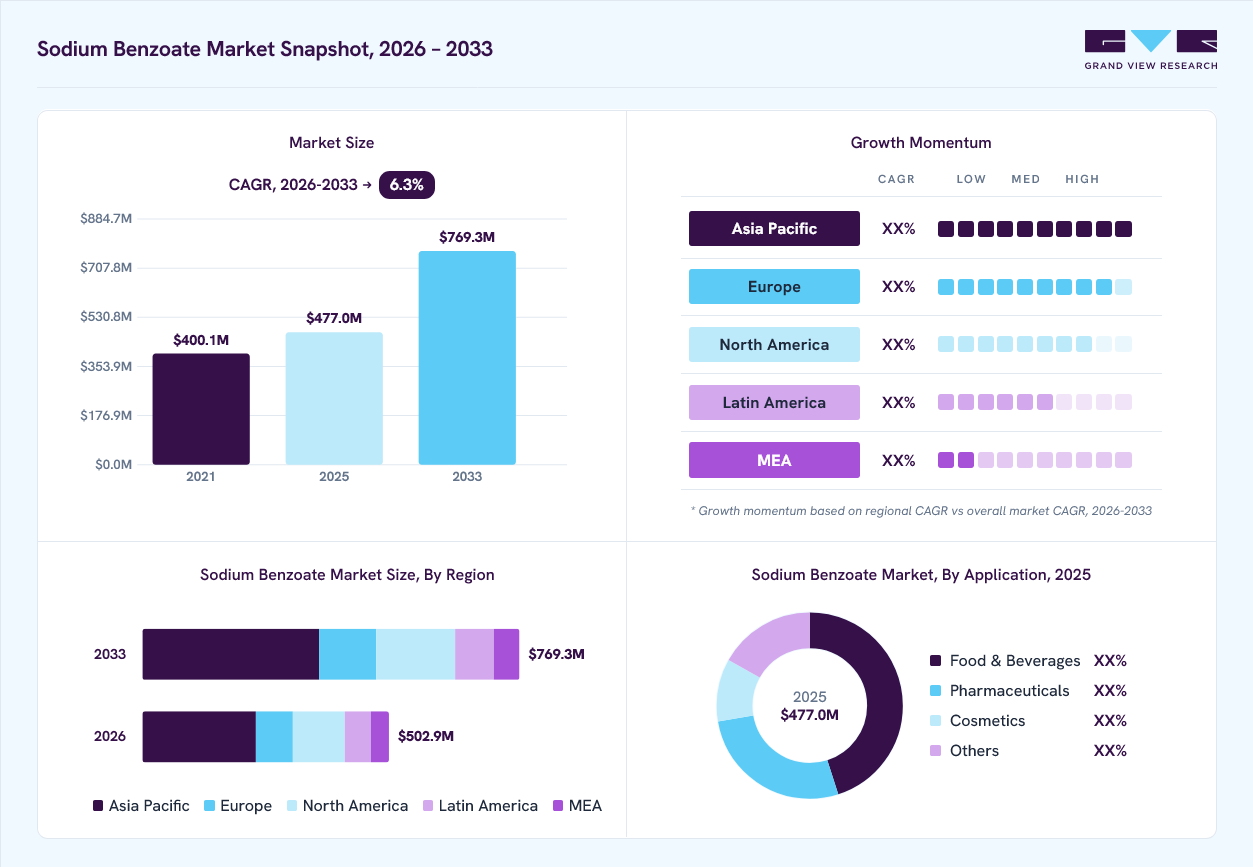
The global sodium benzoate market size was valued at USD 477.0 million in 2025 and is projected to grow from USD 502.9 million in 2026 to USD 769.3 million by 2033, at a CAGR of 6.3% from 2026 to 2033. Asia Pacific dominated the market, accounting for a revenue share of 45.9% in 2025. Consumers' are moving toward processed food and beverage goods such as fruit drinks, snacks, processed meat, and others to fulfill their daily meal requirements.
 Source: Grand View Research, IR Documents, Primary Interviews, Paid DatabasesTo learn more about this report,
 Download Free Sample Report
Key Market Trends & Insights
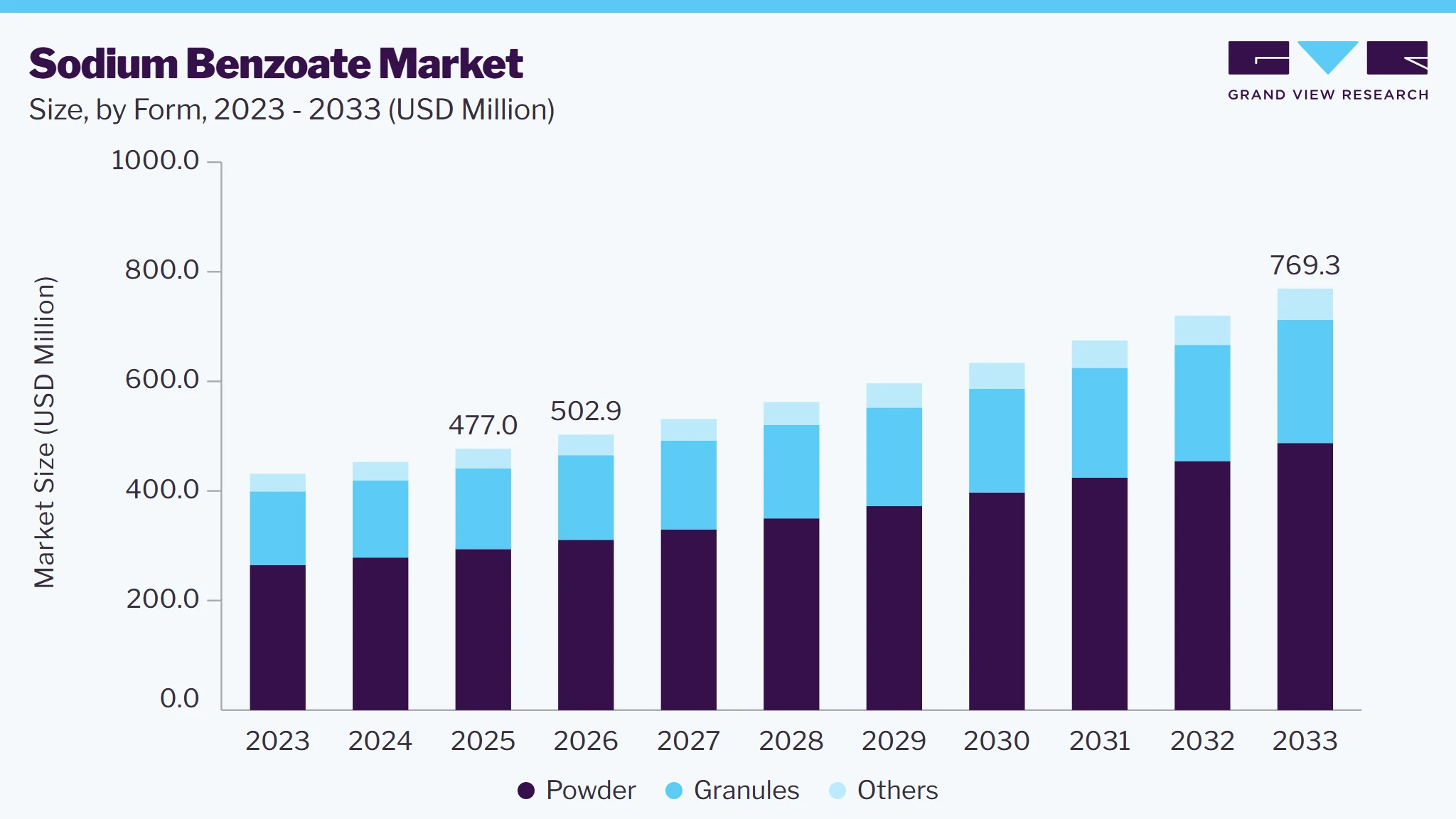
- By form: Powder segment dominated the product segment with a market share of 61.6% in 2025.
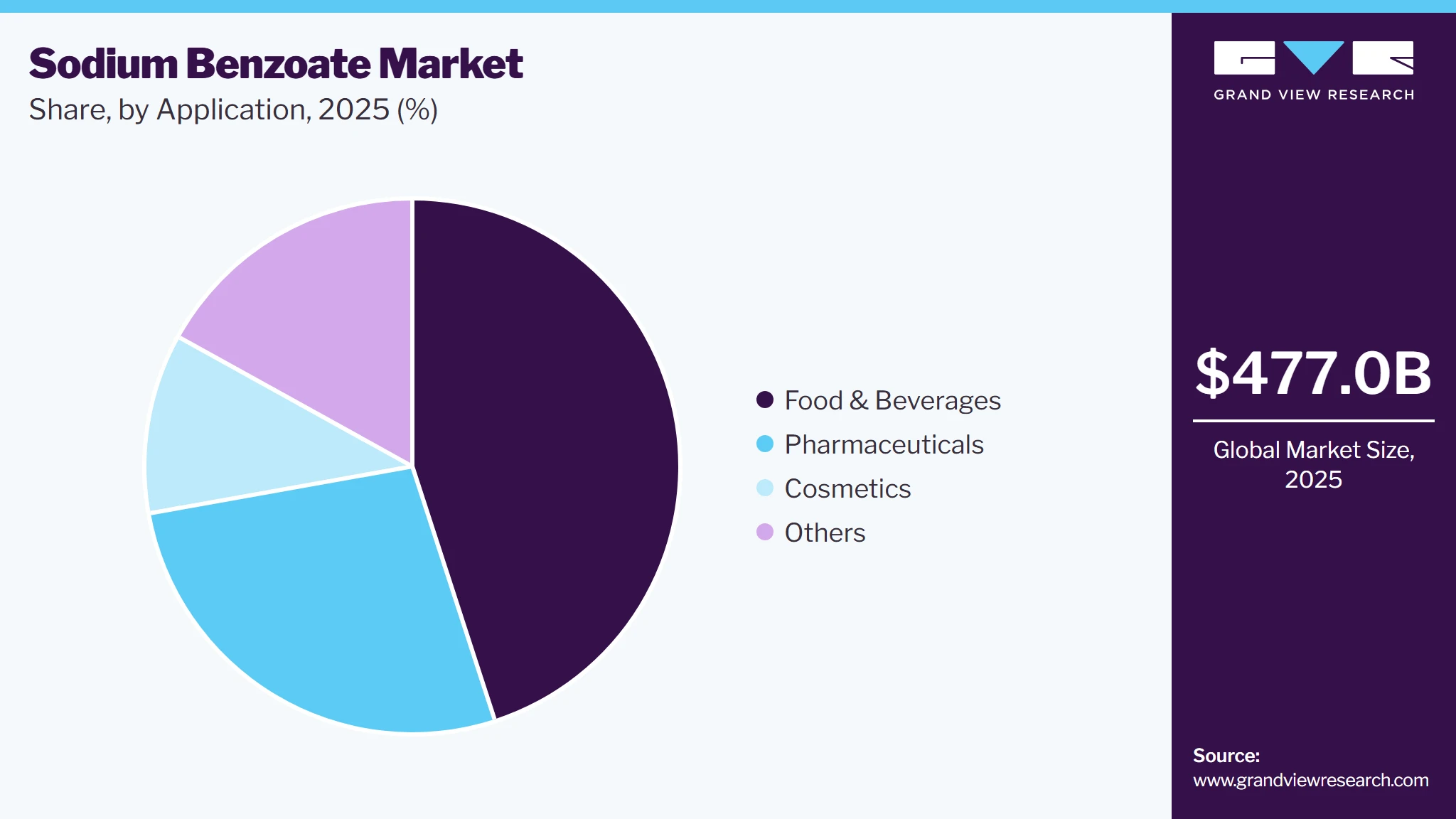
- By application: Food & Beverages segment projected the largest share of 45.8% in 2025.
Regional Highlights
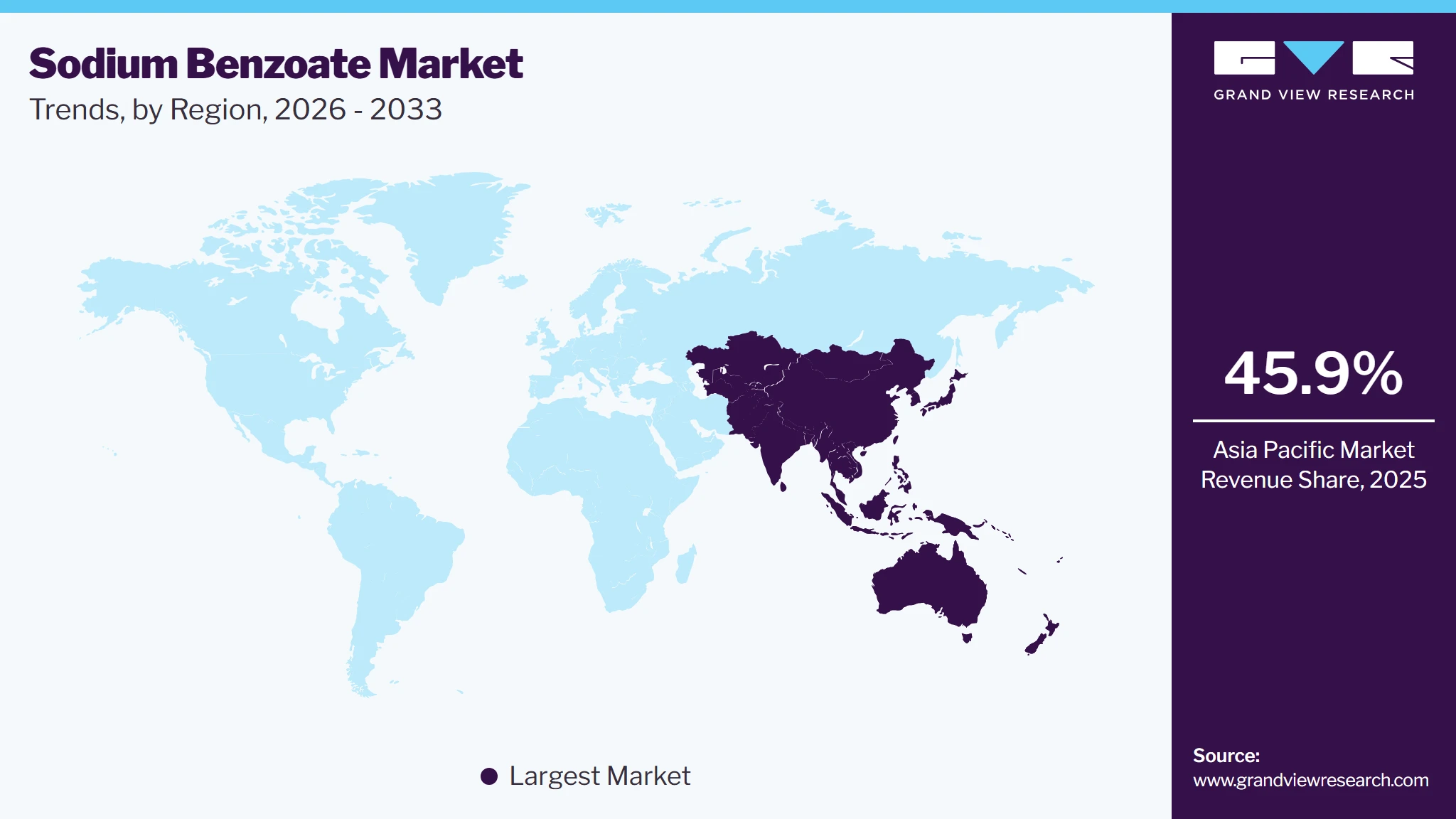
- Largest regional market: Asia Pacific (45.9% revenue share, 2025)
- By country: China held the highest market revenue share in Asia Pacific in 2025.
Market Size & Forecast
- Market size in 2025: USD 477.0 Million
- Estimated market size in 2026: USD 502.9 Million
- Projected market size by 2033: USD 769.3 Million
- CAGR (2026-2033): 6.3%
Three ways to get this report
Buy it, customize it, or ask a question.Ask an Analyst
Analyst response in 1 business day
- AccessReport author, directly
- Reply timeWithin 1 working day
- No sales callDirect answer only
- FormatEmail reply
- CostFree, no cost
Get the Full Report
What the study covers
- FormatsPDF · Excel · Dashboard
- Timeline2026–2033 annual, 2025 base
- Coverage20+ countries, 5 regions
- Companies10+ key players profiled
Customize the Report
20% free customization
- IncludeCountries, segments, points
- TailorTo your product definition
- ExtendDeeper competitor detail
- OrA fully bespoke study
- Turnaround5–10 working days
In many European countries, the popularity of missing meals such as breakfast has increased customer preference for processed and packaged food and beverage goods. Preservatives, including sodium benzoate, is an essential ingredient in processed food and beverage and has driven the market.Due to the shutdown, channel partners witnessed a significant drop in demand. This resulted in higher inventory levels with most trade partners, as well as an inability to clear pending stock with them. During the first two quarters of 2020, sodium benzoate manufacturers experienced a substantial disruption in their raw material supply chain owing to the COVID-19 pandemic. The usage of sodium benzoate as a synthetic preservative in the food industry is a significant growth driver for the market. It is primarily utilized as an anti-microbial in lower pH products such as jams, salad dressings, carbonated drinks, pickles, etc. It is a popular food preservative due to its ease of manufacturing, colorlessness, and low cost. It is also employed as a preservative in liquid pharmaceutical formulations in the pharmaceutical sector.
 To learn more about this report, Download Free Sample Report
Due to the rising worldwide population, the food industry and pharmaceuticals are expanding industries that will drive the market. Factors such as increased consumer awareness, increased urbanization, increased demand for medicinal supplies, and the growth of the packaged food business have driven the expansion of the market. Increasing public awareness about the dangers of synthetic preservatives, particularly in North America and Europe, is projected to limit market growth in the future years.
The use of dangerous chemicals in cosmetics, food, and pharmaceuticals is restricted and tightly monitored by government authorities in North America and Europe, which might have an impact on the rate of expansion of the market. Although sodium benzoate is a common additive in the industry, there are many replacements available in the market for both food and pharmaceuticals, limiting the market share of sodium benzoate.
Market Dynamics
The sodium benzoate market is witnessing stable growth, driven by increasing demand for food preservation solutions across the food & beverage, pharmaceutical, personal care, and industrial sectors. Sodium benzoate is widely used as an effective antimicrobial preservative that extends product shelf life by preventing the growth of bacteria, yeast, and mold in acidic formulations. The expanding consumption of processed foods, ready-to-drink beverages, liquid pharmaceuticals, and cosmetic products, coupled with stringent food safety standards, continues to support market expansion. Advancements in preservative formulations and the growing production of packaged consumer goods are further contributing to market growth.
The increasing consumption of processed foods, packaged beverages, and convenience products is one of the primary drivers of the sodium benzoate market. As urbanization, busy lifestyles, and changing dietary habits continue to reshape consumer preferences, demand for products with extended shelf life has increased significantly. Sodium benzoate is widely used as a preservative in carbonated soft drinks, fruit juices, jams, sauces, pickles, dressings, and bakery products because it effectively inhibits microbial growth in acidic environments while maintaining product quality and safety.
Food manufacturers are also focusing on reducing product spoilage, minimizing food waste, and ensuring compliance with stringent food safety regulations. The rapid expansion of organized retail, modern distribution networks, and e-commerce has increased the need for packaged foods capable of maintaining quality throughout longer transportation and storage periods. As global food processing activities continue to expand, the demand for reliable and cost-effective preservatives such as sodium benzoate is expected to remain strong.
Stringent regulations governing the use of food preservatives remain a significant restraint for the sodium benzoate market. Regulatory agencies across major economies have established maximum permissible usage levels to ensure consumer safety, particularly in food and beverage applications. Manufacturers are required to conduct extensive product testing, quality assurance, and compliance monitoring, increasing production costs and creating additional challenges for market participants operating across multiple regulatory jurisdictions.
Growing consumer awareness regarding food ingredients and health-conscious purchasing behavior is accelerating demand for clean-label and preservative-free products. Many food and beverage manufacturers are reformulating products using natural preservation alternatives to meet evolving consumer expectations. This gradual shift toward natural ingredients may reduce the adoption of synthetic preservatives such as sodium benzoate in premium and organic product segments, limiting market growth in certain applications, and compliance management, increasing overall development and manufacturing costs.
The expanding pharmaceutical and personal care industries present significant growth opportunities for the sodium benzoate market. Sodium benzoate is widely utilized as an antimicrobial preservative in cough syrups, liquid medicines, topical formulations, oral care products, creams, lotions, shampoos, and cosmetic products. Increasing healthcare expenditure, growing pharmaceutical manufacturing capacity, and rising demand for personal hygiene products are supporting greater consumption of high-quality preservatives across these industries.
Rapid industrialization and improving healthcare infrastructure in emerging economies are further creating new avenues for market expansion. Manufacturers are investing in high-purity sodium benzoate production, advanced quality control systems, and customized formulations to meet the specific requirements of pharmaceutical and cosmetic applications. The continued growth of these end-use industries, along with increasing demand for safe, stable, and longer-lasting formulations, is expected to generate substantial opportunities for sodium benzoate producers over the coming years.
Analyst Perspective
The global sodium benzoate market is positioned for steady growth, driven by increasing demand from the food & beverage, pharmaceutical, personal care, and industrial sectors. Sodium benzoate is a widely used preservative that inhibits the growth of bacteria, yeast, and mold, thereby extending the shelf life of products while maintaining their safety and quality. The food & beverages segment remains the largest application area, supported by its extensive use in carbonated soft drinks, fruit juices, sauces, jams, pickles, and other processed foods. Rising consumption of packaged and convenience foods, expanding pharmaceutical production, growing demand for personal care products, and increasingly stringent food safety and quality regulations continue to support the long-term growth of the sodium benzoate market.
Form Insights
Powder segment dominated the product segment with a market share of 61.6% in 2025. Sodium benzoate E211 powder is a white powder with the strongest impact at slightly acidic pH levels. It dissolves readily in water but less in organic solvents. Sodium benzoate helps to preserve fruit and vegetable, salads, and fish marinades. It's also used to keep beer, olives fresh, and fruit yogurt. It is environmentally friendly and accumulates in water and soil.
The granules segment is expected to witness a CAGR of 5.4 % over the forecast period. Sodium benzoate granules are whitein color. This is the sodium salt of benzoic acid, which is water-soluble. It is utilized as preservatives in food. Such as fruit juices, pickles, salad dressings, carbonated drinks, jams, etc. As an antifungal, sodium benzoate is used to balance the pH inside individual cells, boosting the overall acidity of the product and making it more difficult for fungi to proliferate. These fungi can infect food and cause it to degrade, reducing its shelf life substantially.
Application Insights
Food & Beverages segment projected the largest share of 45.8% in 2025. As per the International Program on Health and safety, sodium benzoate is widely used in the beverage sector. Sodium benzoate raises the acidity of soft drinks, which also boosts the flavor intensity of high-fructose corn syrup. Sodium benzoate is listed as E211 in the ingredients list on the back of a soda can, which is the number assigned to it as a food additive. E211 is a common ingredient in diet soft drinks.
 To learn more about this report, Download Free Sample Report
The cosmetic segment is expected to witness the fastest CAGR of 7.2% over the forecast period in terms of revenue. It has been determined that sodium benzoate can be used safely at percentages up to 5%, however, no immunologic phenomena should be considered when applying this chemical in cosmetic formulations for infants and children. Sodium benzoate is an antifungal preservative found in cosmetics and food. As a result, it is highly effective against fungus, yeasts, and bacteria.
Regional Insights
Europe dominated the sodium benzoate market and accounted for the largest revenue share of 39.3% in 2021. Total demand for sodium benzoate in Europe remained low in the last quarter of 2020 due to the pandemic-induced slowdown. The rise of animal diseases like "African swine fever" in Germany caused a reduction in EU compound feed production across the region.
Asia Pacific Sodium Benzoate Market Trends
Asia Pacific accounted for 45.9% of the sodium benzoate market revenue in 2025, making it the largest regional market. Sodium Benzoate prices increased in Asia Pacific in the first month of 2022, owing to increased demand from end-user industries and lower feedstock prices. Demand for sodium benzoate in the food and cosmetics industries increased due to the increasing disposable income and growing population. This resulted in a price increase for sodium benzoate in the domestic market.
 To learn more about this report, Download Free Sample Report
China Sodium Benzoate Market Trends
China held the highest market revenue share in Asia Pacific in 2025.
Middle East and Africa Sodium Benzoate Market Trends
The Middle East and Africa region's demand for food and beverages is fast expanding, and this trend is expected to continue during the forecasted period. This need, combined with various planned investments by various governments in the food and beverage industry, is expected to raise sodium benzoate demand during the projection period.
Key Companies & Market Share Insights
The market is fragmented in nature as it features various global and regional market players. Leading industry players are incorporating strategies such as partnerships, collaborations, acquisitions and mergers, and agreements to expand their business footprints. In March 2022 Ganesh Benzoplast Ltd, in collaboration with Golden Agri International Enterprises Pte. Limited., KN Agri Resources Ltd., and other investors, entered the ethanol production and Extra Neutral Alcohol (ENA) by acquiring a 100 percent shareholding in Sagar Industries, a distillery in the Nasik, Maharashtra, India
DuPont de Nemours ("DuPont") and ("IFF") International Flavors and Fragrances Inc. signed a definitive agreement in December 2019, to merge DuPont's Nutrition and Biosciences ("N&B") division with IFF. In February 2021, the merger was completed. IFF received different legal entities affiliated with the N&B company as part of the merger.
Key Sodium Benzoate Companies:
The following key companies have been profiled for this study on the sodium menzoate market.
-
Foodchem International Corporation
-
Avantor Inc.
-
Merck KGaA
-
Ganesh Benzoplast Ltd.
-
Spectrum Chemicals
-
Wuhan Youji Industries Co. Ltd.
-
FBC Industries, Inc.
-
Tengzhou Tenglong Chemical Co., Ltd.
-
CellMark AB
-
A.M. Food Chemical Co. Limited
-
Hugestone enterprise co. Ltd.
-
PENTA CHEMICALS
-
DuPont de Nemours, Inc.
-
Tulstar Products, Inc.
-
Lanxess AG
Competitive Benchmarking
Category
Operating Strategies
Competitive Edge
Weakness
Established Players (Avantor Inc.; Merck KGaA; DuPont de Nemours, Inc.; Lanxess AG; CellMark AB)
- Expand high-purity sodium benzoate portfolio for pharmaceutical, laboratory, and food-grade applications.
- Strengthen global distribution through strategic partnerships and regional warehousing.
- Invest in quality certifications, regulatory compliance, and sustainable manufacturing processes.
- Enhance value-added offerings through customized formulations and technical support.
- Strong global distribution networks and established customer relationships.
- Comprehensive regulatory expertise and internationally recognized quality standards.
- Broad product portfolios serving multiple end-use industries.
- Robust financial capabilities supporting R&D and capacity expansion.
- Higher operating and compliance costs than regional competitors.
- Dependence on raw material price fluctuations affecting margins.
- Premium pricing may reduce competitiveness in price-sensitive markets.
- Stringent regulatory requirements increase operational complexity.
Emerging & Regional Players (Foodchem International Corporation; Ganesh Benzoplast Ltd.; Spectrum Chemicals; Wuhan Youji Industries Co. Ltd.; FBC Industries, Inc.; Tengzhou Tenglong Chemical Co., Ltd.; A.M. Food Chemical Co. Limited; Hugestone Enterprise Co. Ltd.; PENTA CHEMICALS; Tulstar Products, Inc.)
- Focus on cost-effective production and regional market expansion.
- Strengthen partnerships with food, pharmaceutical, and personal care manufacturers.
- Expand exports through distributors and private-label supply agreements.
- Invest in manufacturing efficiency and product quality improvements to meet international standards.
- Competitive pricing is supported by localized manufacturing and sourcing.
- Flexible production capabilities for customized customer requirements.
- Faster response to regional demand and shorter supply chains.
- Strong presence in domestic and export markets across Asia and other emerging regions.
- Limited production capacity compared to multinational competitors.
- Lower brand recognition in developed markets.
- Limited investment capacity for large-scale R&D and global expansion.
- Greater exposure to regional demand fluctuations and raw material supply risks.
Sodium Benzoate Market Report Scope
Report Attribute
Details
Market size in 2025
USD 477.0 Million
Estimated market size in 2026
USD 502.9 Million
Projected market size by 2033
USD 769.3 Million
Growth rate
CAGR of 6.3% from 2026 to 2033
Base year for estimation
2025
Historical data
2021 - 2024
Forecast period
2026 - 2033
Quantitative units
Volume in Kilotons, Revenue in USD Billion, and CAGR from 2026 to 2033
Report coverage
Revenue & volume forecast, company ranking, competitive landscape, growth factors, and trends
Segments covered
Form, application, region
Regional scope
North America; Europe; Asia Pacific; Latin America; MEA
Country scope
U.S.; Canada; Mexico; Germany; France; U.K.; Italy; China; Japan; India; South Korea; Australia; Brazil
Key companies profiled
Foodchem International Corporation; Avantor Inc.; Merck KGaA; Ganesh Benzoplast Ltd.; Spectrum Chemicals; Wuhan Youji Industries Co. Ltd.; FBC Industries, Inc.; Tengzhou Tenglong Chemical Co., Ltd.; CellMark AB; A.M. Food Chemical Co. Limited; Hugestone enterprise co. Ltd.; PENTA CHEMICALS; DuPont de Nemours, Inc.; Tulstar Products, Inc.; Lanxess AG
Customization scope
Free report customization (equivalent up to 8 analysts' working days) with purchase. Addition or alteration to country, regional & segment scope.
Pricing and purchase options
Avail customized purchase options to meet your exact research needs. Explore purchase options
Global Sodium Benzoate Market Report Segmentation
This report forecasts revenue growth at global, regional, and country levels and provides an analysis of the latest industry trends in each of the sub-segments from 2021 to 2033. For the purpose of this study, Grand View Research has segmented the global sodium benzoate market report based on form, application, and region:
-
Form Outlook (Volume, Kilotons, Revenue, USD Million, 2021 - 2033)
-
Powder
-
Granule
-
Others
-
-
Application Outlook (Volume, Kilotons, Revenue, USD Million, 2021 - 2033)
-
Beverages & Food
-
Cosmetic
-
Pharmaceuticals
-
Others
-
-
Regional Outlook (Volume, Kilotons, Revenue, USD Million, 2021 - 2033)
-
North America
-
U.S.
-
Canada
-
Mexico
-
-
Europe
-
Germany
-
France
-
U.K.
-
Italy
-
-
Asia Pacific
-
China
-
Japan
-
India
-
Australia
-
South Korea
-
-
Central & South America
-
Brazil
-
-
Middle East & Africa
-
Research Methodology
The sodium benzoate market figures in this report are based on a proven research process that combines executive interviews with secondary research from proprietary databases, company filings, and recognized regulatory and institutional sources. Market size is built through value-chain sizing - reconciling supply-side and demand-side estimates - and triangulated with bottom-up and top-down approaches. Every estimate passes multiple levels of expert validation before publication, with each sodium benzoate segment quantified using the revenue-capture definitions in the table below.
Segment Definition
Segment - Form
Revenue capture definition
Powder
Captures revenue generated from sodium benzoate sold in powder form, widely used as a preservative in food & beverages, pharmaceuticals, personal care products, and industrial formulations due to its ease of blending and high stability.
Granules
Represents revenue from sodium benzoate supplied in granular form, preferred in automated manufacturing processes for improved handling, reduced dust generation, and uniform dispersion across food processing, chemical, and pharmaceutical applications.
Other Form
Accounts for revenue associated with sodium benzoate marketed in alternative forms, including flakes, pellets, and customized formulations, designed to meet specific processing requirements across specialized industrial and commercial applications.
Segment - Application
Revenue capture definition
Food & Beverages
Accounts for revenue generated from sodium benzoate used as a preservative in acidic food and beverage products, including soft drinks, fruit juices, sauces, pickles, jams, dressings, and processed foods to extend shelf life and maintain product safety.
Pharmaceuticals
Reflects revenue from sodium benzoate utilized as a preservative and stabilizing agent in pharmaceutical formulations such as syrups, oral liquids, injectable solutions, and topical medicines to ensure microbial stability and product integrity.
Cosmetics
Measures revenue derived from sodium benzoate used in cosmetics and personal care products, including shampoos, conditioners, creams, lotions, facial cleansers, and oral care formulations, where it helps prevent microbial contamination and extends product shelf life.
Other Application
Captures revenue from sodium benzoate used in industrial applications such as chemical intermediates, tobacco products, animal feed, textile processing, and corrosion inhibition, along with other niche end-use sectors requiring antimicrobial preservation.
Estimation Model
Layer Name
Key Question
Description
Sodium Benzoate Production Layer
What forms is the supply base?
Identify the global production capacity of sodium benzoate by evaluating benzoic acid availability, sodium hydroxide supply, manufacturing technologies, production capacities, plant locations, purity grades, and key manufacturing facilities. This layer establishes the global supply base serving the food & beverage, pharmaceutical, personal care, and industrial sectors.
Application Adoption Layer
Where is sodium benzoate utilized?
Estimate the distribution of sodium benzoate consumption across major applications, including food & beverages, pharmaceuticals, cosmetics & personal care, animal feed, and industrial applications, by analyzing end-use demand, formulation trends, and regional consumption patterns.
Consumption Intensity Layer
How much sodium benzoate is consumed?
Assess sodium benzoate consumption across end-use industries by evaluating production volumes of processed foods, carbonated beverages, fruit-based products, pharmaceutical formulations, cosmetics, personal care products, and industrial chemicals to estimate annual sodium benzoate demand across major regional markets.
Revenue Layer
How is market revenue generated?
Market revenue is generated through the sale of sodium benzoate in various purity grades and forms to manufacturers of food & beverages, pharmaceuticals, cosmetics, personal care products, animal feed, and industrial formulations through direct supply agreements, distributors, and integrated chemical distribution networks.
Delivered Customizations
This report has been delivered with the following In-depth customizations
Client Request
Customization Delivered
Value Adds
Cross-Segmentation Analysis
Detailed cross-segmentation assessment evaluating the relationship between application (Food & Beverages, Pharmaceuticals, Cosmetics, and Other Applications) and form (Powder, Granules, and Other Forms). The analysis identifies application-wise form adoption, consumption patterns, product preferences, and revenue contribution across each form–application combination.
Supports product portfolio optimization and production planning by identifying the most profitable form–application combinations, enabling better capacity allocation, inventory management, and targeted marketing strategies.
Competitive Benchmarking
Comparative evaluation of leading sodium benzoate manufacturers based on production capacity, product portfolio, purity grades, manufacturing capabilities, regulatory certifications, geographic presence, distribution network, sustainability initiatives, and recent strategic developments across major regional markets.
Assists competitive intelligence and strategic decision-making by providing insights into market positioning, operational strengths, product differentiation, regulatory compliance, and competitive advantages.
Opportunity Assessment
Comprehensive assessment of emerging opportunities across high-growth applications including processed foods, beverages, pharmaceuticals, cosmetics, and personal care products, along with expanding demand in emerging economies, clean manufacturing technologies, and high-purity sodium benzoate production.
Helps identify high-growth application segments, regional investment opportunities, and product innovation areas, supporting capacity expansion, market entry strategies, customer acquisition, and long-term revenue growth.
Frequently Asked Questions About This Report
The global sodium benzoate market size was estimated at USD 477.0 million in 2025 and is expected to reach USD 502.9 million in 2026.
Some of the key players operating in the sodium benzoate market Avantor Inc., A.M Food Chemical Co., Limited, Cellmark AB, DuPont De Nemours, Inc., Wuhan Youji Industries Co. Ltd, FBC Industries, Inc., Tengzhou Tenglong Chemical Co., Ltd, Ganesh Benzoplast Limited, Hugestone enterprise co. Ltd., Ing. Petr Svec - PENTA s.r.o., TULSTAR PRODUCTS, INC, and LANXESS, among others.
The key factors driving the sodium benzoate market include increase in the use of sodium benzoate in the food and pharmaceutical industry, rise in cosmetics products usage, increasing demand for processed food items & beverages, increasing demand in the Middle East & Africa region.
Powder dominated the market, accounting for 61.6% of global revenue in 2025,driven by its excellent solubility, ease of handling, and widespread use in food, pharmaceutical, and personal care formulations.
Food & Beverages held the largest market share, accounting for 45.8% of global revenue in 2025, driven by rising demand for processed foods and beverages requiring effective preservation and extended shelf life.
Cosmetics is projected to register the fastest CAGR of 7.2% during the forecast period, driven by increasing demand for preservative systems in skincare, haircare, and personal hygiene products.
Sustainability is encouraging manufacturers to adopt energy-efficient production processes, reduce emissions, optimize resource utilization, and implement environmentally responsible manufacturing practices while complying with evolving regulatory standards.
The sodium benzoate market is expected to grow at a compound annual growth rate of 6.3% from 2026 to 2033 to reach USD 769.3 million in 2033.
Asia Pacific dominated the sodium benzoate market with a revenue share of 45.9% in 2025. This is attributable to the rise in demand for sodium benzoate in the food and beverage, pharmaceutical, cosmetics, and personal care industries, where it is used as a preservative.
About the Author(s)
Personal Care & Cosmetics Research Team
Bulk Chemicals · Personal Care & CosmeticsThis report was authored by the personal care & cosmetics research team at Grand View Research - comprising two research analysts, one senior research analyst, and one industry expert - with specialized expertise in the personal care & cosmetics segment of the bulk chemicals industry. All findings are based on proprietary bulk chemicals databases, executive interviews, and regulatory analysis, subject to internal peer review prior to publication.
Last Updated:
Speak to Analyst

Customize this report to your needs - add regions, segments, or data points, with 20% free customization.
Or view our licence options:


ISO 9001:2015 & 27001:2022 Certified
We are GDPR and CCPA compliant! Your transaction & personal information is safe and secure. For more details, please read our privacy policy.


